Показаны сообщения с ярлыком Israel. Показать все сообщения

четверг, 19 сентября 2024 г.

UN General Assembly demands Israel end ‘unlawful presence’ in Occupied Palestinian Territory


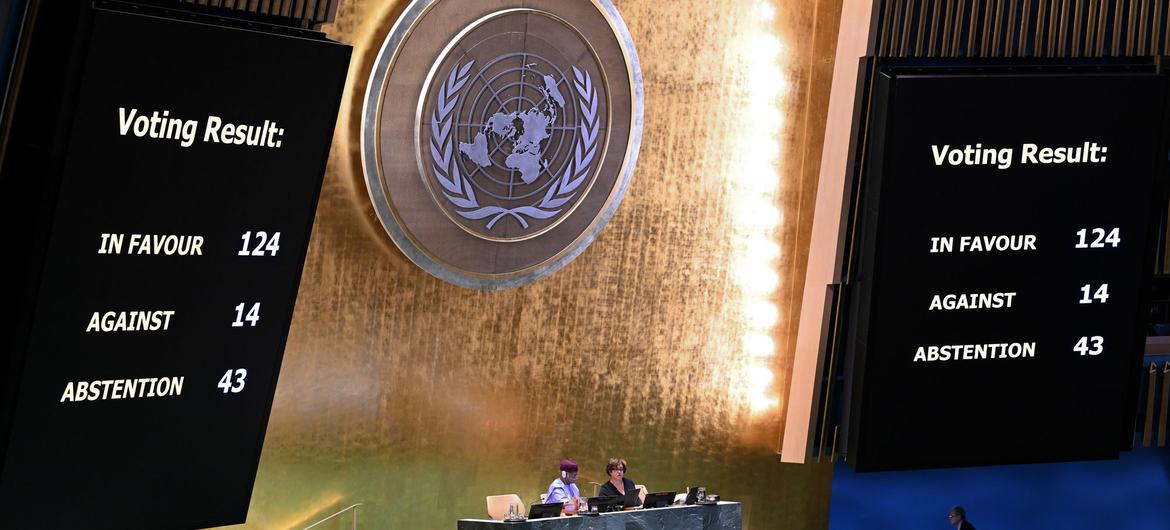
Result of the General Assembly vote on a draft resolution on the ICJ advisory opinion on the legal consequences arising from Israel’s policies and practices in the Occupied Palestinian Territory
UN Photo/Evan Schneider
 
Result of the General Assembly vote on a draft resolution on the ICJ advisory opinion on the legal consequences arising from Israel’s policies and practices in the Occupied Palestinian Territory


18 September 2024 

Peace and Security

The United Nations General Assembly on Wednesday voted overwhelmingly to adopt a resolution that demands that Israel “brings to an end without delay its unlawful presence” in the Occupied Palestinian Territory.

With a recorded vote of 124 nations in favour, 14 against, and 43 abstentions, the resolution calls for Israel to comply with international law and withdraw its military forces, immediately cease all new settlement activity, evacuate all settlers from occupied land, and dismantle parts of the separation wall it constructed inside the occupied West Bank.

The General Assembly further demanded that Israel return land and other “immovable property”, as well as all assets seized since the occupation began in 1967, and all cultural property and assets taken from Palestinians and Palestinian institutions.

The resolution also demands Israel allow all Palestinians displaced during the occupation to return to their place of origin and make reparation for the damage caused by its occupation.

The resolution stems from the advisory opinion issued by the International Court of Justice (ICJ) in July, in which the Court declared that Israel’s continued presence in the Territory “is unlawful”, and that “all States are under an obligation not to recognize” the decades-long occupation.

Click here for the full text of the resolution and here for our live coverage of the meeting.

Tweet URL

Threat to peace and security

The Assembly “strongly deplored the continued and total disregard and breaches” by the Government of Israel of its obligations under the UN Charter, international law and UN resolutions, stressing that such breaches “seriously threaten” regional and international peace and security.

It also recognized that Israel “must be held to account for any violations” of international law in the Occupied Palestinian Territory, including of international humanitarian and human rights laws.

The text says Israel “must bear the legal consequences of all its internationally wrongful acts, including by making reparation for the injury, including any damage, caused by such acts.”

The General Assembly highlighted the need for the establishment of an international mechanism for reparations to address damage, loss, or injury caused by Israel’s actions.

It also called for creating an international register of damage caused, to document evidence and related claims.

International conference

The resolution also includes a decision to convene an international conference during the Assembly’s current session to implement UN resolutions pertaining to the question of Palestine and the two-State solution for the achievement of a just, lasting and comprehensive peace in the Middle East.

Additionally, the Assembly requested the UN Secretary-General to present proposals for a mechanism to follow up on Israel’s violations of article 3 of the International Convention on the Elimination of All Forms of Racial Discrimination, as identified by the ICJ.

Article 3 refers to racial segregation and apartheid and the undertaking by International Convention’s States Parties to prevent, prohibit and eradicate all practices of this nature in territories under their jurisdiction.
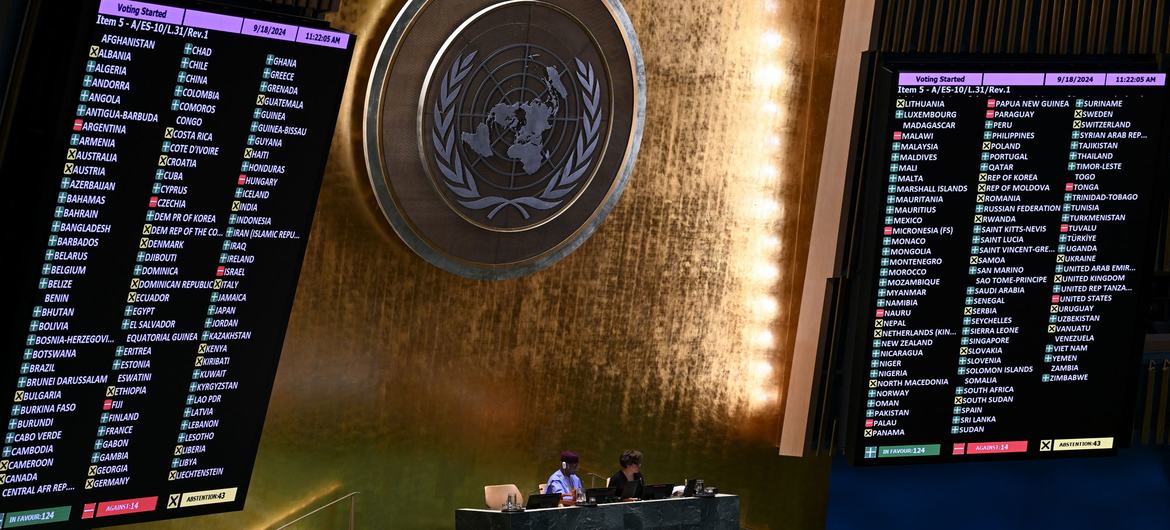
General Assembly votes on a draft resolution on the ICJ advisory opinion.
UN Photo/Evan Schneider
 
General Assembly votes on a draft resolution on the ICJ advisory opinion.

Call on States

In its resolution, the General Assembly called upon all UN Member States to comply with their obligations under international law and take concrete steps to address Israel’s ongoing presence in the Occupied Palestinian Territory.

The Assembly urged States to refrain from recognizing Israel’s presence in the Territory as lawful and to ensure that they do not provide aid or assistance in maintaining the situation created by the occupation. This includes taking measures to prevent their nationals, companies, and entities under their jurisdiction from engaging in activities that support or sustain Israel’s occupation.

Additionally, the Assembly called on States to cease importing products originating from Israeli settlements and to halt the transfer of arms, munitions, and related equipment to Israel in cases where there are reasonable grounds to suspect they may be used in the Occupied Palestinian Territory.

Moreover, the resolution urged States to implement sanctions, such as travel bans and asset freezes, against individuals and entities involved in maintaining Israel’s unlawful presence in the Territory. This includes addressing issues related to settler violence and ensuring that those engaged in these activities face legal and financial consequences.

Adjournment

Finally, the Assembly temporarily adjourned its tenth emergency special session and authorized the President of the General Assembly to reconvene the session upon request from Member States.

The special session is a continuation of the tenth emergency special session of the General Assembly that last met in May amid the ongoing crisis in Gaza, during which it adopted a resolution, laying out additional rights for the State of Palestine’s participation in Assembly meetings.

That resolution did not grant Palestine the right to vote or put forward its candidature to UN Main Organs such as the Security Council or the Economic and Social Council (ECOSOC).

It also did not confer membership to the State of Palestine, which requires a specific recommendation from the Security Council.


https://news.un.org/en/story/2024/09/1154496


https://creativecommons.org/licenses/by/4.0/legalcode

понедельник, 22 июля 2024 г.

UN chief expresses deep concern over Israel strikes on Yemen, and risk of regional escalation

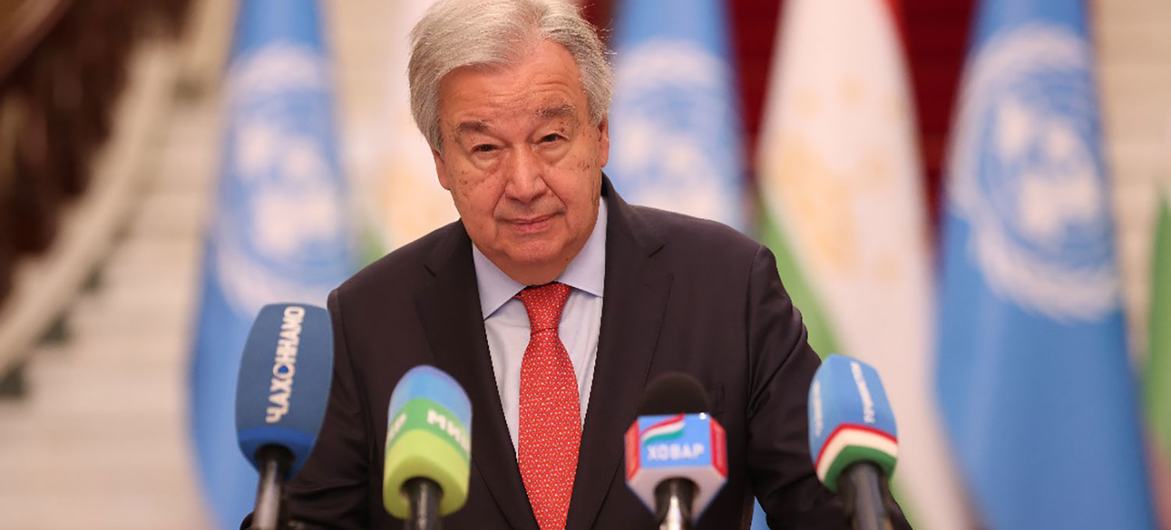
UN Secretary-General António Guterres (file)
UN Tajikistan/Didor Sadulloev
 
UN Secretary-General António Guterres (file)


21 July 2024 

Peace and Security

UN Secretary-General António Guterres has responded to Israel’s airstrikes on the Yemeni port city of Hudaydah, which reportedly killed at least six people and injured more than 80, by calling for all parties involved in the conflict to “exercise utmost restraint”.

In statement, Mr. Guterres noted that Israel had claimed responsibility for the strikes, which took place on Saturday, as a response to previous attacks on Israel by the Houthis – formally known as Ansar Allah – a group which controls swathes of territory in Yemen, including Hudaydah.

The strikes came after a drone attack on the Israeli city of Tel Aviv on Friday killed one person and wounded 10 more. The attack was claimed by the Houthis and led to a senior Israeli Government minister vowing to “settle the score”. The Israelis strikes on Saturday hit electricity infrastructure and a refinery, creating a large fire.

Efforts to mediate between the Houthis and Yemeni government have stalled in recent months and, following the onset of the war in Gaza in October, the Houthis pledged to attack what they deemed to be pro-Israeli shipping interests along the Red Sea coast, as a demonstration of solidarity with the Palestinians in Gaza.

In turn, a United States (US)-led coalition defending shipping in the Red Sea has continued to strike areas controlled by Houthis in Hudaydah, the capital Sana’a and Ta’iz.

The Houthis reportedly warned that the group’s response to the Israeli airstrikes “will be huge” and that the group would continue to attack Israel and that there would be no “red lines”.

The Yemeni conflict, which began in 2015, has been disastrous for the civilian population. The UN says the war has destroyed most sectors in Yemen, including healthcare, and caused one of the worst humanitarian crises in the world. Around half of the population, some 18.2 million people, are in need of some form of assistance.


https://news.un.org/en/story/2024/07/1152346


https://creativecommons.org/licenses/by/4.0/legalcode

четверг, 16 мая 2024 г.

A. Guterres repeats call to Israel to halt Rafah assault as aid stocks dwindle


A. Guterres repeats call to Israel to halt Rafah assault as aid stocks dwindle

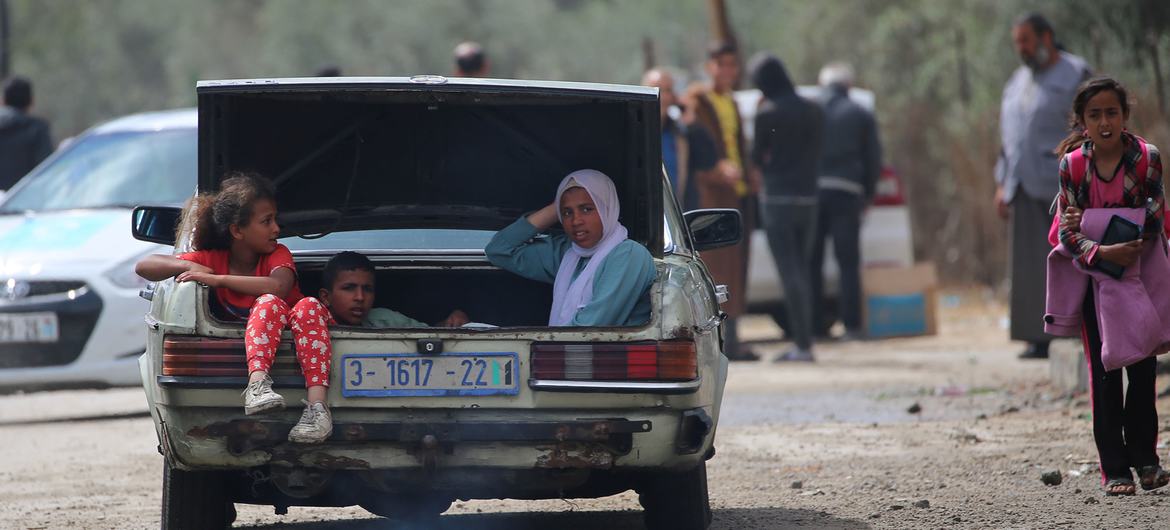
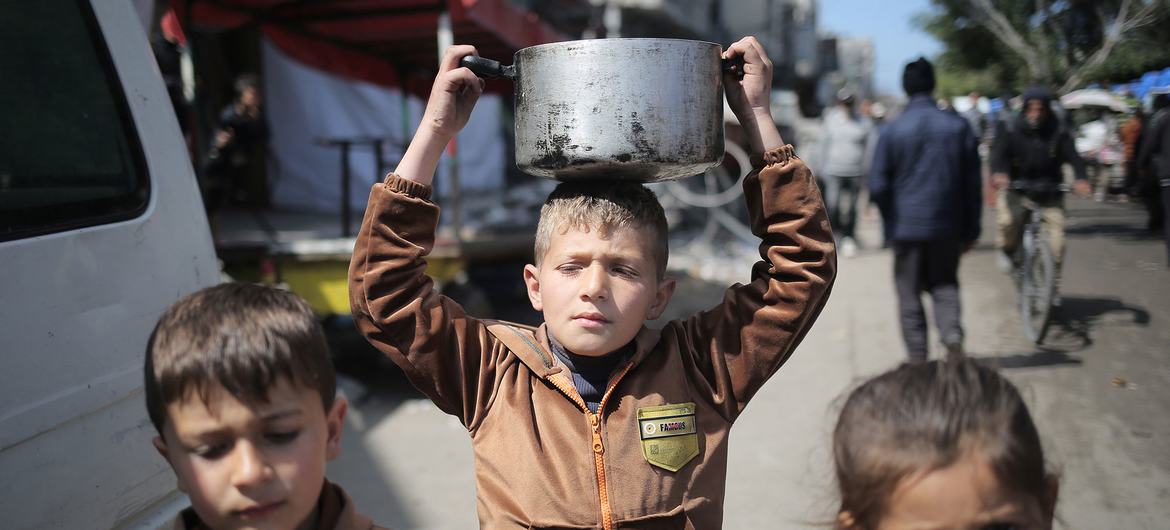
Children travel in the trunk of a car as they leave Rafah in southern Gaza.
© UNICEF/Eyad El Baba
 
Children travel in the trunk of a car as they leave Rafah in southern Gaza.


16 May 202
Peace and Security

UN chief António Guterres reiterated his warning on Thursday against a full-scale assault on Rafah, just as aid teams issued increasingly urgent appeals for safe passage throughout Gaza, to replenish dangerously low stocks of lifesaving supplies.

In a related development, the UN’s top court prepared to hear a new request from South Africa to issue more constraints on Israeli military action in the enclave.

In a call for the “immediate and unconditional release of all hostages” still held in Gaza, the Secretary-General told Arab League leaders at a Summit in Bahrain that nothing justified the “collective punishment” of Palestinians. 

“Any assault on Rafah is unacceptable; it would inflict another surge of pain and misery when we need a surge in life-saving aid,” he added.

Flanked by Philippe Lazzarini, head of the UN agency for Palestinian refugees, UNRWA, Mr. Guterres also renewed his strong backing for the UN agency. It  “remains the backbone of our operations in Gaza and a lifeline for Palestine refugees across the region. It needs full support and funding,” he insisted, as the UN World Food Programme (WFP) issued a new warning about looming famine in Gaza.

Crossing barriers

“Food and fuel stocks will run out in a matter of days,” WFP warned in a social media post on X. “Since 6 May, we have not been able to access and receive aid from the Kerem Shalom crossing. The situation is becoming unsustainable.”

Tweet URL
WFP_MENA

The UN agency highlighted the very real threat that any further escalation of hostilities in Gaza could bring aid operations “to a complete standstill” and lead to a humanitarian catastrophe. 

Although WFP has provided special nutritional foods to pregnant and breastfeeding women along with children under five across Gaza, the UN agency said that as of 11 May distributions were suspended in Rafah “and are only ongoing in Khan Younis and Deir El Balah in a limited capacity”.

In northern Gaza, WFP also warned that rates of acute malnutrition among under two-year-olds “doubled from 15 per cent in January to 30 per cent in March”. 

Humanitarians warn that acute malnutrition is the most deadly form of malnutrition, leaving affected children between three to 12 times more likely to die than a well-nourished child.

The dire assessment comes as the UN agency for Palestinian refugees (UNRWA) reported late Wednesday that 600,000 people – one quarter of Gaza’s population - have now been forcibly displaced from Rafah in the last week, amid ongoing Israeli military activity and evacuation orders.

Another 100,000 people have been uprooted from the north to comply with evacuation orders by the Israeli military, while heavy gun battles have reportedly raged.

Evacuation orders at scale

According to the UN aid coordination office, OCHA, “285 square kilometres, or approximately 78 per cent of the Gaza Strip” are now subject to evacuation orders by the Israeli military.

In its latest update, OCHA reported continuing bombardment “from the air, land and sea…across much of the Gaza Strip, resulting in further civilian casualties, displacement, and destruction of houses and other civilian infrastructure”.

The UN office confirmed reports of ground incursions and heavy fighting in Jabalia in northern Gaza, as well as in Deir al Balah in central Gaza and eastern Rafah in the south

“As of 15 May, Rafah crossing remains closed. Kerem Shalom crossing is operational, but the prevailing security and logistical conditions are hampering humanitarian aid deliveries at scale,” OCHA noted.

Echoing those concerns, the WFP insisted that “multiple entry points” for aid are required “to reverse six months of near starvation conditions and avert a famine, steady flows of food supplies, every day and every week…The threat of famine in Gaza never loomed larger.”

South Africa v. Israel

In an effort to halt the military operation in and around the enclave’s southern-most city, South Africa filed a new request to the UN’s top court which it was due to hear on Thursday.

“Urgent provisional measures are required to ensure the survival of Palestinians in Gaza,” the South Africa application said, in its latest claim filed on 10 May.

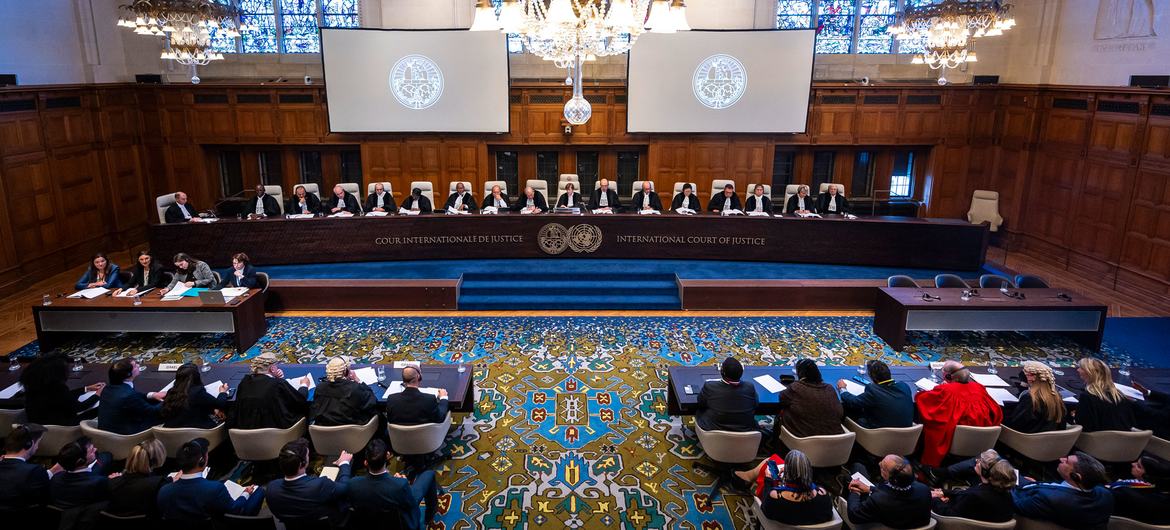
The International Court of Justice delivers its ruling in the case of South Africa v. Israel in The Hague.
© ICJ-CIJ/ Frank van Beek
 
The International Court of Justice delivers its ruling in the case of South Africa v. Israel in The Hague.

“The situation brought about by the Israeli assault on Rafah, and the extreme risk it poses to humanitarian supplies and basic services into Gaza, to the survival of the Palestinian medical system, and to the very survival of Palestinians in Gaza as a group, is not only an escalation of the prevailing situation, but gives rise to new facts that are causing irreparable harm to the rights of the Palestinian people in Gaza.” 

Rafah the last refuge

Rafah is “the last refuge” for Gazans, the South Africa petition continued, adding that the city is also the “last viable centre” for shelter and basic services including medical care. The Israeli military’s seizure of Rafah crossing and the brief closure and ongoing access problems to nearby Kerem Shalom crossing have blocked the main entry points for lifesaving humanitarian aid to Gaza, South Africa also insisted. 

“The remaining population and medical facilities are at extreme risk, given the recent evidence of evacuation zones being treated as extermination zones, the mass destruction and mass graves at Gaza’s other hospitals and the use by Israel of Artificial Intelligence (‘AI’) to identify ‘kill lists’,” ICJ court documents show.

The International Court of Justice previously issued special orders to Israel in late January – known as “provisional measures” – to prevent harm to Gazans, following South Africa’s allegation that Israel was in violation of its obligations as a signatory of the Genocide Convention. There was no explicit call for an immediate halt to Israel’s full-scale military operation in the Strip.

Israel strongly denied the allegations and is scheduled to respond to the latest South Africa request on Friday.


https://news.un.org/en/story/2024/05/1149811


https://creativecommons.org/licenses/by/3.0/legalcode

вторник, 7 мая 2024 г.

Guterres urges Israel, Hamas ‘to show political courage’ and secure ceasefire

Guterres urges Israel, Hamas ‘to show political courage’ and secure ceasefire

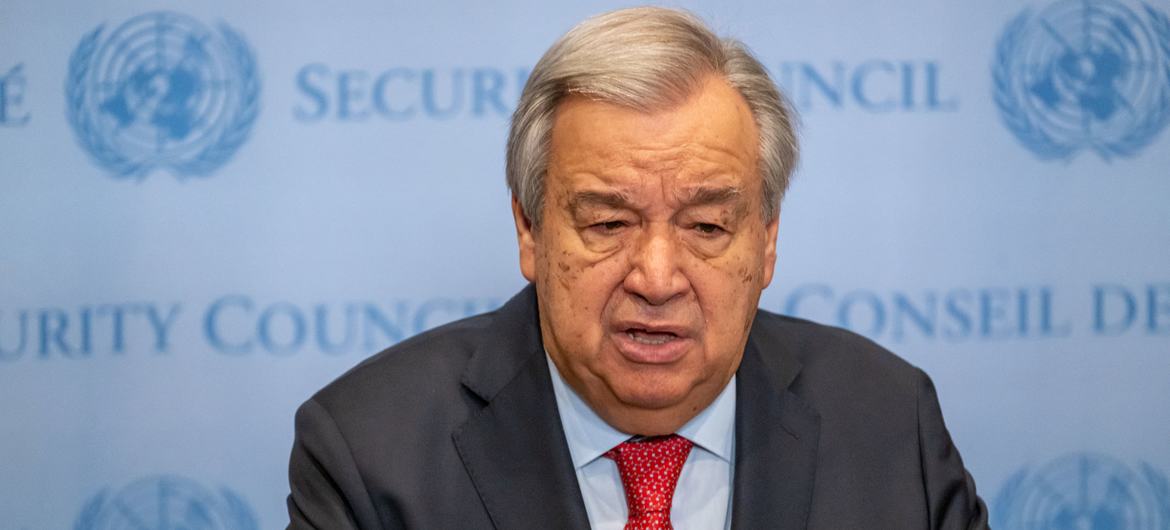
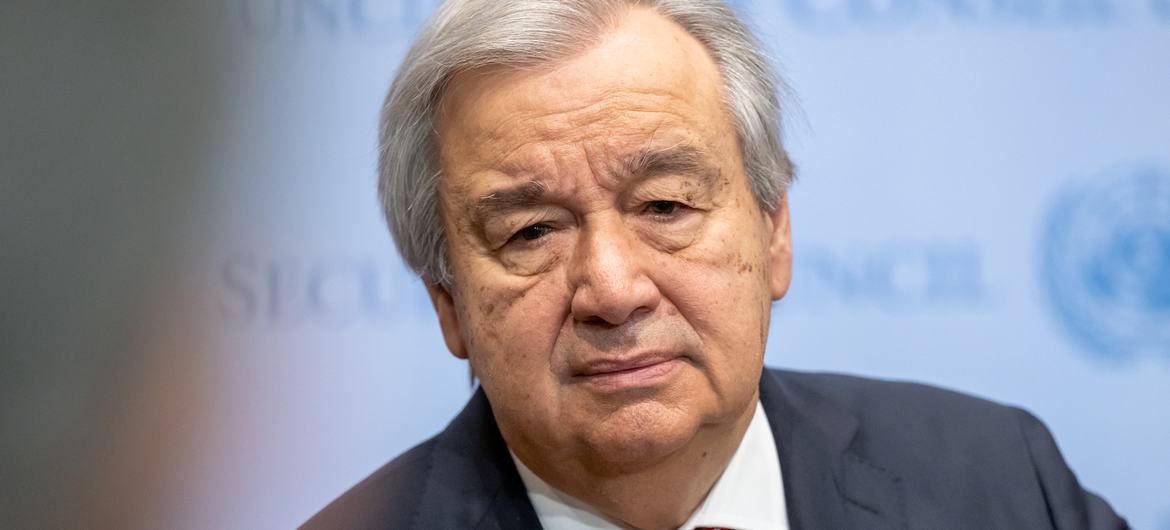
UN Secretary-General António Guterres speaking to the press at the UN Headquarters, in New York.
UN Photo/Mark Garten
 
UN Secretary-General António Guterres speaking to the press at the UN Headquarters, in New York.


7 May 2024

Peace and Security

The UN Secretary-General on Tuesday reiterated his appeal to Israel to stop any escalation in Gaza, amid reports that its forces have taken over key border crossings in Rafah.

In the far south of the Gaza Strip, bordering Egypt, the town of Rafah has been hosting hundreds of thousands of Palestinians driven from elsewhere in the enclave due to the ongoing Israeli military operation.

There are also grave concerns that humanitarian aid stocks are fast running out across the war-torn Strip, and fuel reserves will run out by the end of the day.

“The closure of both the Rafah and Karem Shalom crossings is especially damaging to an already dire humanitarian situation. They must be re-opened immediately,” Secretary-General António Guterres said at a press stakeout at UN Headquarters in New York.

He called on the Israeli Government to stop any escalation and engage constructively in the ongoing diplomatic talks.

Tweet URL
UN_News_Centre

“After more than 1,100 Israelis killed in the Hamas terror attacks of 7 October, after more than 34,000 Palestinians killed in Gaza, haven’t we seen enough?”

Agreement essential

Mr. Guterres underscored the need for an agreement between the Government of Israel and the leadership of Hamas to stop the “unbearable suffering” of both Palestinians in Gaza and the Israeli hostages and their families.

“It would be tragic if weeks of intense diplomatic activity for peace in Gaza, yield no ceasefire. No release of hostages. And a devastating offensive in Rafah,” he said, stressing:

“I reiterate my appeal for both parties to show the political courage and spare no effort to secure an agreement now.”

Human catastrophe

The UN chief further emphasized that a full-scale assault on Rafah will be a “human catastrophe”.

“Countless more civilian casualties. Countless more families forced to flee yet again – with nowhere safe to go. Because there is no safe place in Gaza,” Mr. Guterres said.

“Attacking Rafah will further upend our efforts to support people in dire humanitarian straits as famine looms.”

Call on ‘those with influence’

Mr. Guterres also warned that the repercussions of an attack on Rafah will be felt far beyond the war-ravaged Gaza Strip, the occupied West Bank and the wider Middle East region.

“Even the best friends of Israel are clear: An assault on Rafah would be a strategic mistake, a political calamity, and a humanitarian nightmare,” he said.

“I appeal to all those with influence over Israel to do everything in their power to help avert even more tragedy.”


https://creativecommons.org/licenses/by/3.0/legalcode


https://news.un.org/en/story/2024/05/1149411

воскресенье, 14 апреля 2024 г.

Guterres condemns Iran’s attack on Israel, calls for immediate end to hostilities


Secretary-General briefs press at UN Headquarters. (file)
UN Photo/Mark Garten
 
Secretary-General briefs press at UN Headquarters. (file)

13 April 2024
Peace and Security

Strongly condemning the “large-scale attack” launched on Israel by Iran, UN Secretary-General António Guterres has urged maximum restraint by all parties and warned that “neither the region nor the world can afford another war.”

“I call for an immediate cessation of these hostilities,” said the Secretary-General in a statement issued in New York early Saturday evening, shortly after what media reports suggest had been hundreds of drones and missiles launched by Iran at Israel.

The UN chief said that he is deeply alarmed about the very real danger of a devastating region-wide escalation.  

“I urge all parties to exercise maximum restraint to avoid any action that could lead to major military confrontations on multiple fronts in the Middle East,” said the Secretary-General, and added: “I have repeatedly stressed that neither the region nor the world can afford another war.”  

Tensions have been ratcheting up in the region since Hamas’ deadly 7 October terror attack and mass hostage taking and Israel’s subsequent full-scale assault on the Gaza Strip, which has left thousands dead and pushed the population to the brink of starvation.

The UN Security Council has scheduled an emergency meeting for 4pm Sunday to discuss this latest flare-up in the region.

Tit-for-tat violence will only lead to ‘more misery’  

For his part, the President of the UN General Assembly, Dennis Francis, also expressed deep concern about the unfolding situation in the Middle East, “involving the launch by Iran of drones and missiles against Israel.”  

In a separate statement, Mr. Francis noted that Iran had explained its action “in the context of article 51 of the UN Charter, following the recent Israeli attack on the Iranian Embassy in Damascus.”

“The Iranian response compounds the already tense and delicate peace and security situation in the Middle East,” said the Assembly President and strongly called upon all parties to exercise the utmost restraint to avoid further escalation of tension in the region.  

“This is a moment that calls for wise and prudent judgement, in which the risks and extended risks are very carefully considered. I expect that the Iranian authorities will honour their word that by their action today, the matter can be deemed concluded.”

Stressing that dialogue and diplomacy are the only way to resolve differences, Mr. Francis warned: “A vicious cycle of attack and counterattack will lead to nowhere, but inevitably, to more death, suffering and misery.” 


https://news.un.org/en/story/2024/04/1148546


https://creativecommons.org/licenses/by/3.0/legalcode

суббота, 6 апреля 2024 г.

Israel must allow ‘quantum leap’ in aid delivery UN chief urges, calling for change in military tactics

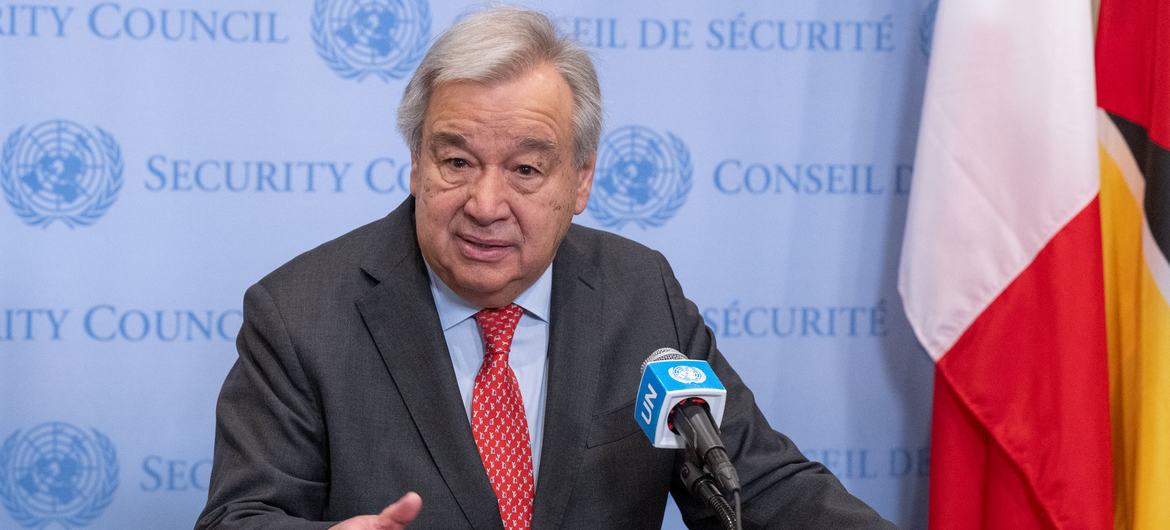
UN Secretary-General António Guterres briefs the media outside the Security Council on the situation in Gaza.
UN Photo/Eskinder Debebe
 
UN Secretary-General António Guterres briefs the media outside the Security Council on the situation in Gaza.


5 April 2024

Peace and Security

Israel must make meaningful changes in the way it is fighting in Gaza to avoid civilian casualties while also undergoing “a true paradigm shift” in lifesaving aid delivery, the UN chief said on Friday. 

Marking six months of war since the “abhorrent” Hamas-led terror attacks of 7 October, António Guterres told journalists at UN Headquarters in New York that nothing could justify the horror unleashed by Palestinian militants that day. 

“I once again utterly condemn the use of sexual violence, torture injuring and kidnapping of civilians, the firing of rockets towards civilian targets and the use of human shields”, he said, calling again for the unconditional release of all hostages still being held in the Gaza Strip. 

Tweet URL
UN_News_Centre

Having met many of the family members of those held captive “I carry their anguish, uncertainty and deep pain with me every day”, added Mr. Guterres. 

‘Relentless death’ 

But the past six months of Israel’s military campaign has also brought “relentless death and destruction to Palestinians”, with over 32,000 reported killed, the vast majority women and children. 

“Lives are shattered. Respect for international law is in tatters”, he said. 

The resulting humanitarian disaster is unprecedented, with more than a million “facing catastrophic hunger.” 

Children are dying due to lack of food and water: “This is incomprehensible and entirely avoidable”, the UN chief declared, repeating that nothing can justify such collective punishment. 

Weaponized AI 

Mr. Guterres said he was deeply troubled by reports that the Israeli military has been using AI to help identify targets during its relentless bombing of densely populated areas of Gaza. 

No part of life and death decisions which impact entire families should be delegated to the cold calculation of algorithms”, he said. 

AI should only be used as a force for good, not to wage war “on an industrial level, blurring accountability.” 

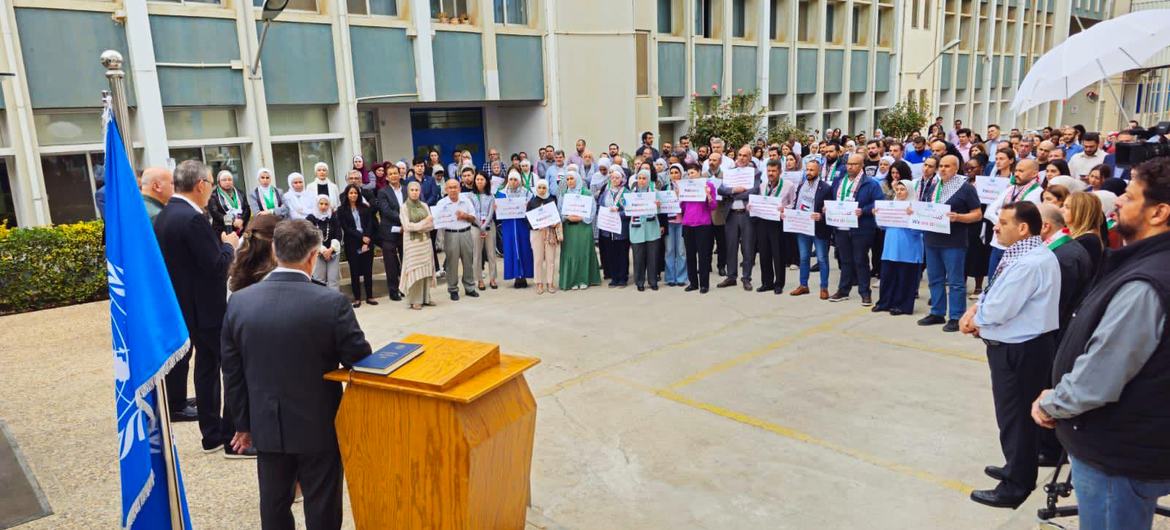
UNRWA staff in Amman, Jordan, attend a ceremony to remember colleagues who have lost their lives in Gaza.
UNRWA/Shafiq Fahed
 
UNRWA staff in Amman, Jordan, attend a ceremony to remember colleagues who have lost their lives in Gaza.

Humanitarian deaths 

Branding the war “the deadliest of conflicts”, he highlighted that 196 humanitarians including over 175 UN staffers have been killed, the vast majority serving with Palestine relief agency UNRWA

“An information war has added to the trauma – obscuring facts and shifting blame”, said the UN chief, compounded by Israel denying journalists entry into Gaza, consequently allowing disinformation to spread. 

Tactics must change 

And following the appalling killing of the seven staffers with World Central Kitchen, the main problem is not who made the mistakes but “the military strategy and procedures in place that allow for those mistakes to multiply time and time again”, the Secretary-General said. 

Fixing those failures requires independent investigations and meaningful and measurable changes on the ground.” 

He said the UN had been told by the Israeli Government that it was now planning to allow a “meaningful increase” in the flow of aid to Gaza. The UN chief said he sincerely hoped the increase in aid would materialize quickly. 

‘Failure would be unforgivable’ 

“Dramatic humanitarian conditions require a quantum leap in the delivery of life-saving aid – a true paradigm shift.” 

He noted last week’s Security Council resolution calling for hostages releases, civilian protection and unimpeded aid delivery.  

“All those demands must be implemented. Failure would unforgivable”, he said. 

Six months on, the world stands on the brink of mass starvation in Gaza, a regional conflagration and a “total loss of faith in global standards and norms.”

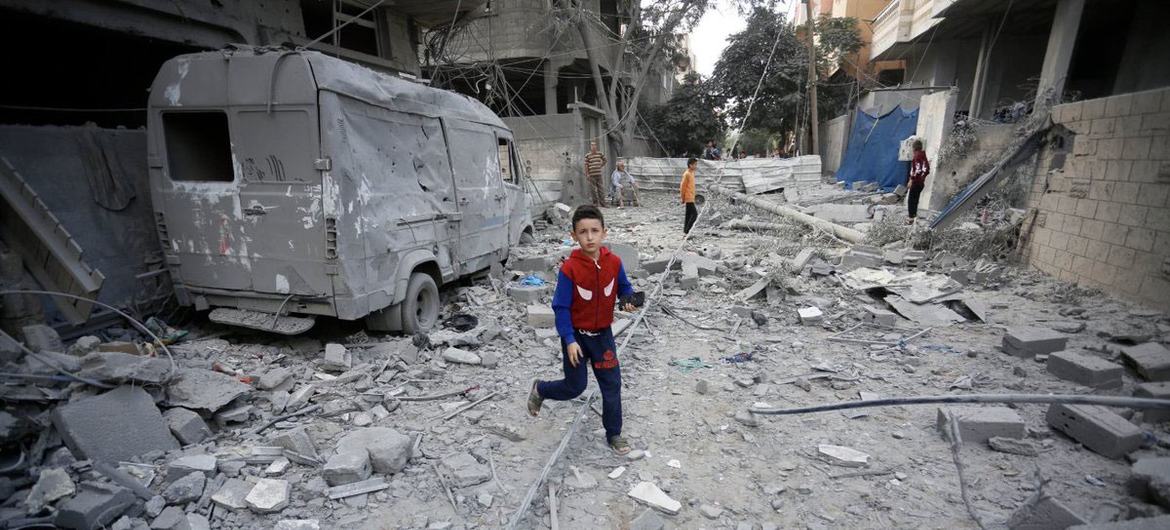
A boy runs through the destroyed streets of Gaza.
© UNRWA/Ashraf Amra
 
A boy runs through the destroyed streets of Gaza.

Unprecedented violations: UN rights office 

The violations committed since 7 October in Israel and Gaza, as well as the destruction and suffering of civilians in the enclave are unprecedented, the UN human rights office, OHCHRsaid on Friday, warning that the risk of further atrocity crimes is high. 

OHCHR upheld the need to ensure aid delivery and the protection of humanitarian workers, noting that attacks against them may amount to war crimes. 

The Israeli airstrikes that killed the World Central Kitchen personnel underline the horrific conditions under which humanitarians are operating in Gaza, said Spokesperson Jeremy Laurence told journalists in Geneva. 

Israel has also killed law enforcement officials and others involved in securing humanitarian aid delivery, directly contributing to the breakdown of civil order and putting humanitarian workers and those in need of aid in further danger,” he added. 

Following the attacks, World Central Kitchen and other NGOs suspended aid delivery and distributions in Gaza, “increasing the already real risk of more deaths from famine and disease at larger scale.” 

War crimes warning 

Mr. Laurence recalled that international law requires all warring parties to respect and protect humanitarian personnel and ensure their safety, security, and freedom of movement. 

As the occupying power, Israel has the additional obligation to ensure, to the fullest extent possible, that the basic needs of Gaza’s population are met. This means the authorities must either ensure that people can access food and medical care or facilitate the work of humanitarians delivering this assistance.  

“Attacking people or objects involved in humanitarian assistance may amount to a war crime,” he said. 

He pointed out that UN Human Rights High Commissioner Volker Türk has repeatedly stated that impunity must end. 


https://news.un.org/en/story/2024/04/1148266


https://creativecommons.org/licenses/by/3.0/legalcode

вторник, 2 апреля 2024 г.

Israel continues to block aid into northern Gaza; UN sending team to shattered Al-Shifa Hospital

Children walk through the streets of Rafah in southern Gaza.
© UNICEF/Eyad El Baba
 
Children walk through the streets of Rafah in southern Gaza.


1 April 2024
Humanitarian Aid

Israeli forces are blocking aid deliveries into famine-stricken northern Gaza as the five-month-long war grinds on despite recent strong demands from the top UN court and the Security Council for open aid access into the enclave and for a temporary ceasefire and the return of all hostages taken in October, as the UN plans a assessment mission into Al-Shifa Hospital, which had been occupied by Israel for two weeks.

More than a dozen Palestinians have been killed related to airdrops by multiple nations who are trying to deliver desperately needed aid in the face of Israel’s slow walking food shipments at border crossings into Gaza, according to news reports. 

The victims reportedly either died by drowning while trying to retrieve food packages from the sea or were fatally struck by falling boxes of aid.

At the same time, reports from UN agencies on the ground in Gaza indicate a continuation of airstrikes and attacks.

This comes alongside ever louder calls for an immediate humanitarian ceasefire and for Israel to comply with both a Security Council resolution for a cessation of hostilities during Ramadan, which ends on 10 April, and the International Court of Justice (ICJ) orders last Friday, asking the country to respect its obligations as a signatory of the Genocide Convention and open border crossings to allow sufficient aid into the enclave.

Battlefields across the Strip

In its latest situation report, the specialist UN Palestine relief agency UNRWA said Israeli Security Forces (ISF) continued military operations across the Gaza Strip, resulting in further civilian casualties, displacement and destruction of houses and other civilian infrastructure.

Israeli attacks have killed more than 32,000 people in Gaza since the war began in October, according to the health ministry there, following a Hamas-led incursion into Israel that left almost 1,200 dead and more than 240 taken hostage.

Airstrikes and bombardment continued in north Gaza, Khan Younis and Rafah, where UNRWA estimates a total of 1.2 million people are now living, the vast majority in formal and informal shelters, the UN agency reported.

Over 100 UNRWA schools have been directly or indirectly hit, with some being severely damaged. Many have been used as shelters for displaced families since the war began.

“No place is safe in #GazaStrip. This is a war on children. On their childhood and their future. Ceasefire now,” UNRWA posted on social media.

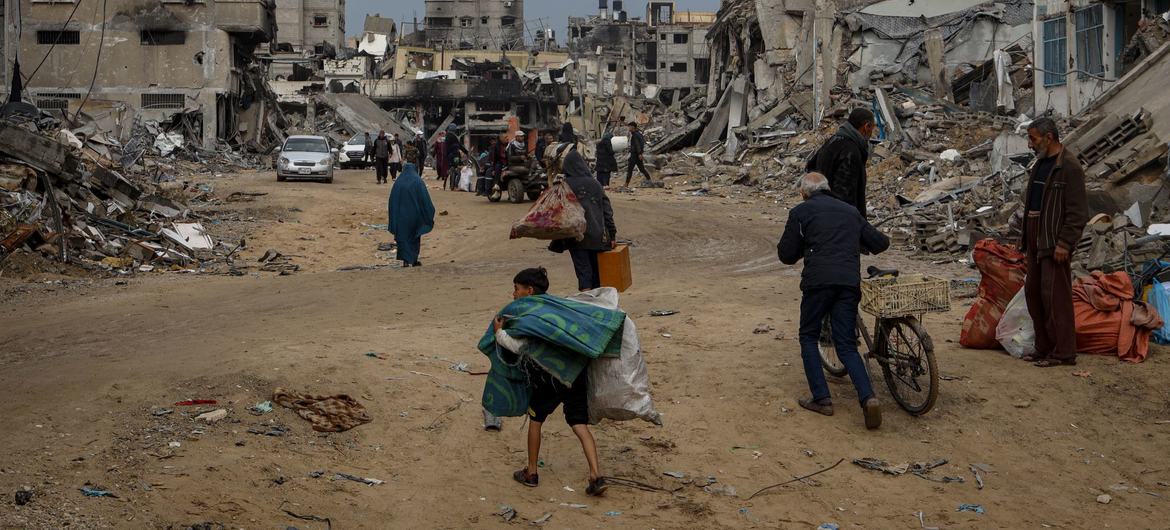
People carry their possessions through Khan Younis in the southern Gaza Strip.
© UNICEF/Eyad El Baba
 
People carry their possessions through Khan Younis in the southern Gaza Strip.

Aid access impeded

Access impediments continue to severely compromise the ability of humanitarians to reach people in Gaza, UNRWA said.

According to the UN humanitarian coordination office, OCHA, since 1 March, 30 per cent of humanitarian aid missions to northern Gaza have been denied by Israeli authorities.

UNRWA is disproportionately impacted, with Israeli authorities continuing to deny the agency access to northern Gaza to deliver emergency food assistance since announcing last week that it would no longer approve these shipments.

There has been no significant change in the volume of humanitarian supplies entering Gaza or improved access to the north, UNRWA reported, noting that from 1 to 20 March.

In terms of aid shipments, there have only been 159 aid trucks entering Gaza on average per day, well below the operational target of 500 trucks needed daily, the UN Spokesperson Stéphane Dujarric told reporters at Headquarters on Monday.

UNRWA continues to provide storage and distribution capacity for other agency food and commodities, and reported that since the war broke out, 1.8 million Gazans have received flour, and nearly 600,000 people have received emergency food parcels, he said.

The UN World Food Programme (WFP) is providing desperately needed food to 1.45 million people in Gaza, but says “it’s not enough.”

“Without a ceasefire and full access, lives are at risk,” the UN agency said.

‘Attempts to sideline UNWRA must stop’

Responding to media reports that Israel had sent the UN Secretary-General a formal plan to dismantle UNRWA, the UN Spokesperson said on Monday that no senior UN official in the region has received any plan from Israel and neither has the UN chief.

“Our position on UNRWA remains unchanged, that it is a line of hope for millions of Palestinians in the region, including in Gaza,” he said. “Currently, it’s the backbone, the spine, the arms and the legs of our humanitarian operation there.”

UN Emergency Humanitarian Relief Coordinator Martin Griffiths slammed any efforts to limit UNRWA’s lifesaving work, which is mandated by the UN General Assembly.

“Attempts to sideline UNRWA must stop,” he said.

UNRWA is the backbone of the humanitarian operation in Gaza. Any effort to distribute aid without them is simply doomed to fail.”

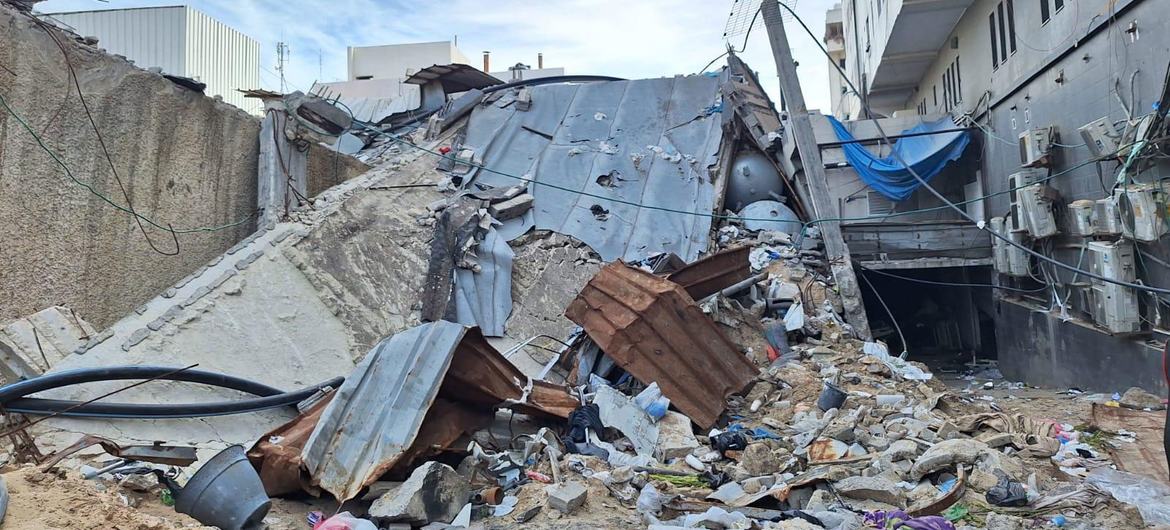
Al-Shifa Hospital in the north of Gaza lies in ruins.
© UNICEF/Sonia Silva
 
Al-Shifa Hospital in the north of Gaza lies in ruins.

Hospitals must be protected: Tedros

The World Health Organization (WHO) chief reported at the weekend that at least four people were killed and 17 injured after an Israeli airstrike hit Al-Aqsa Hospital in middle area of the Gaza Strip.

The “WHO team was on a humanitarian mission at Al-Aqsa Hospital in Gaza, when a tent camp inside the hospital compound was hit by an Israeli airstrike on Sunday,” said Tedros Adhanom Ghebreyesus in a social media post.

Tweet URL
un_news_centre

“WHO staff are all accounted for,” he explained, adding that the team was at the hospital assessing the needs and collecting incubators to be sent to the north of Gaza.

We again call for protection of patients, health personnel and humanitarian missions,” he urged. “The ongoing attacks and militarisation of hospitals must stop. International humanitarian law must be respected.”

He called for an immediate end to the hostilities.

“We urge parties to comply with the UN Security Council resolution and ceasefire!”

The WHO chief spoke out against the Israeli siege of Al-Shifa Hospital in northern Gaza. The two-week-long military operation left many dead and injured, according to media reports.

"Hospitals must be respected and protected; they must not be used as battlefields," he said.

UN plans mission to Al-Shifa Hospital

The UN is looking into the two-week siege of Al-Shifa Hospital, the UN Spokesperson Stéphane Dujarric said on Monday.

“We’re planning a mission to the hospital as soon as we can get there,” he said.

The mission will help people get medical assistance and assess the state of the hospital, he explained, adding that WHO had reported that 21 patients had died during the siege.

Security Council ‘needs to do more’: France to table new draft resolution

The Security Council needs to do more to help ease the “catastrophic” humanitarian situation in Gaza said France’s Ambassador to the UN Nicolas de Rivière, speaking outside the Council Chamber on Monday, following a closed door meeting.

He said the Council had to live up to its responsibilities, following last week’s resolution tabled by the E-10 elected members, demanding an “immediate ceasefire”, which passed when the United States abstained as opposed to vetoing the draft.

He said a “comprehensive” new draft resolution was being presented by France on Monday, calling for an immediate ceasefire without any time limitation and the unconditional release of all hostages. He said it would also condemn the terror attacks by Hamas on 7 October, and full humanitarian access.

Watch his full remarks here:


https://news.un.org/en/story/2024/04/1148141


https://creativecommons.org/licenses/by/3.0/legalcode