Показаны сообщения с ярлыком UN General Assembly. Показать все сообщения

четверг, 19 сентября 2024 г.

UN General Assembly demands Israel end ‘unlawful presence’ in Occupied Palestinian Territory


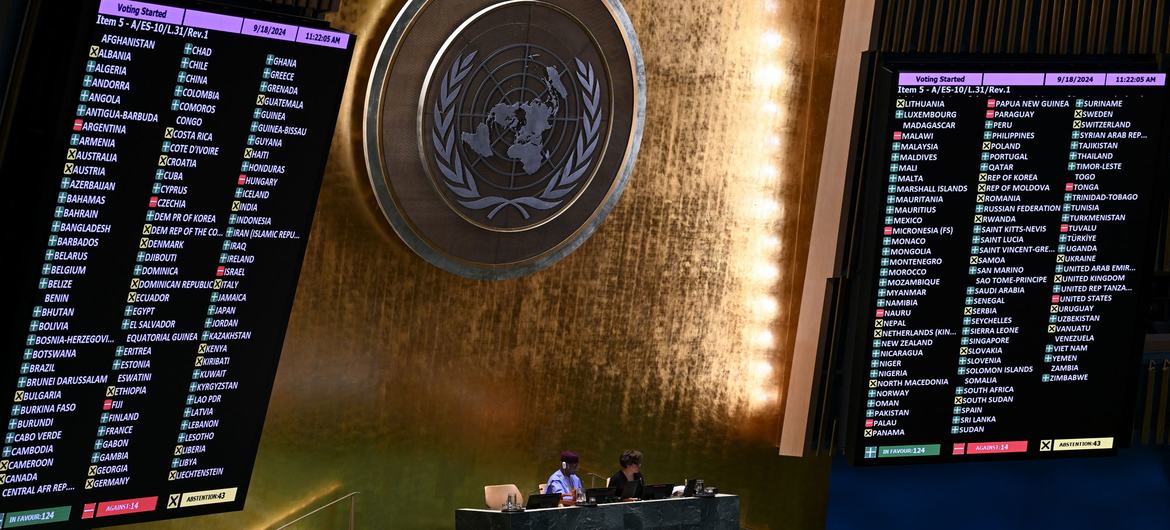
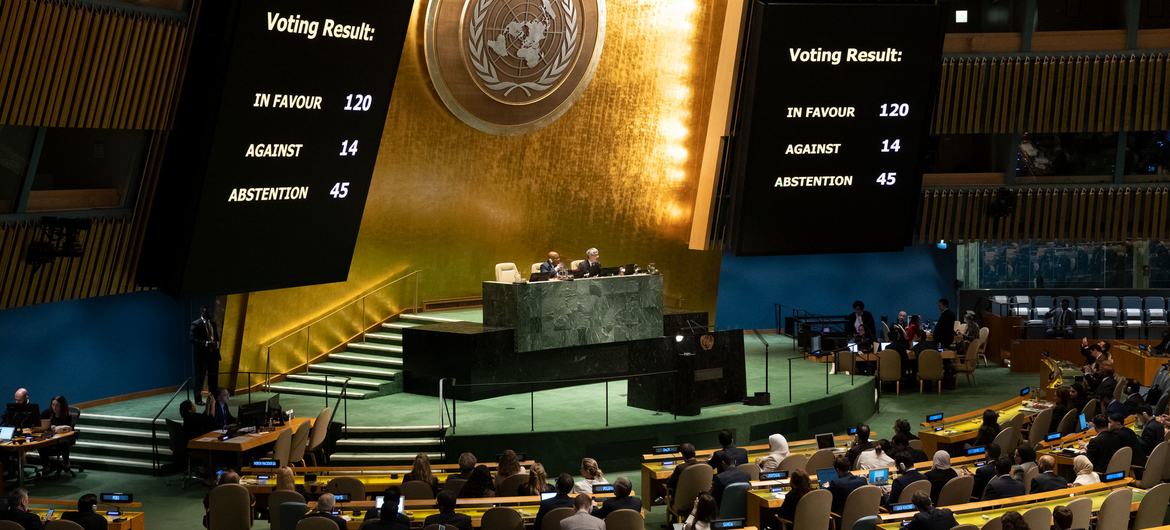
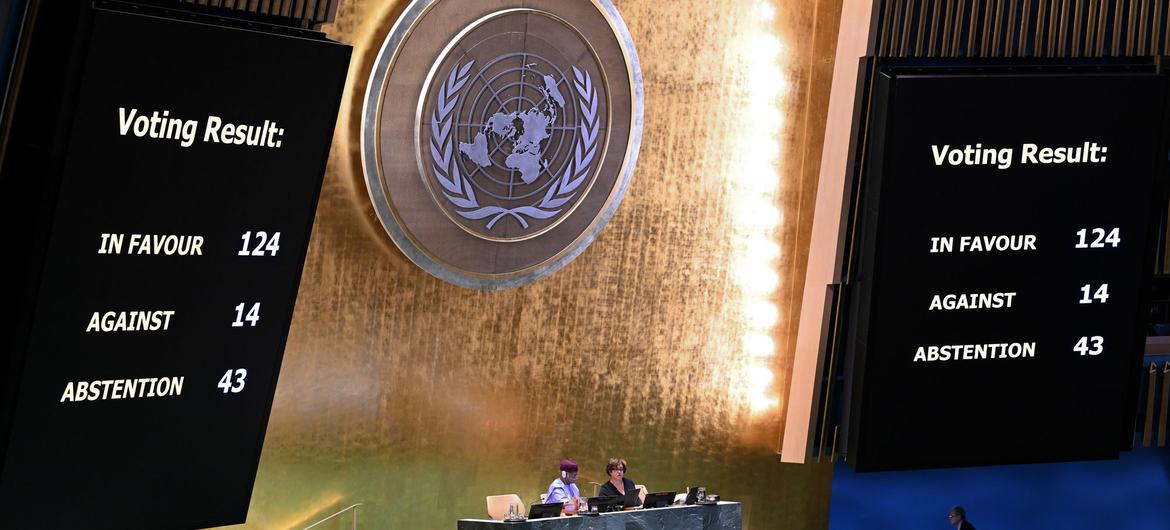
Result of the General Assembly vote on a draft resolution on the ICJ advisory opinion on the legal consequences arising from Israel’s policies and practices in the Occupied Palestinian Territory
UN Photo/Evan Schneider
 
Result of the General Assembly vote on a draft resolution on the ICJ advisory opinion on the legal consequences arising from Israel’s policies and practices in the Occupied Palestinian Territory


18 September 2024 

Peace and Security

The United Nations General Assembly on Wednesday voted overwhelmingly to adopt a resolution that demands that Israel “brings to an end without delay its unlawful presence” in the Occupied Palestinian Territory.

With a recorded vote of 124 nations in favour, 14 against, and 43 abstentions, the resolution calls for Israel to comply with international law and withdraw its military forces, immediately cease all new settlement activity, evacuate all settlers from occupied land, and dismantle parts of the separation wall it constructed inside the occupied West Bank.

The General Assembly further demanded that Israel return land and other “immovable property”, as well as all assets seized since the occupation began in 1967, and all cultural property and assets taken from Palestinians and Palestinian institutions.

The resolution also demands Israel allow all Palestinians displaced during the occupation to return to their place of origin and make reparation for the damage caused by its occupation.

The resolution stems from the advisory opinion issued by the International Court of Justice (ICJ) in July, in which the Court declared that Israel’s continued presence in the Territory “is unlawful”, and that “all States are under an obligation not to recognize” the decades-long occupation.

Click here for the full text of the resolution and here for our live coverage of the meeting.

Tweet URL

Threat to peace and security

The Assembly “strongly deplored the continued and total disregard and breaches” by the Government of Israel of its obligations under the UN Charter, international law and UN resolutions, stressing that such breaches “seriously threaten” regional and international peace and security.

It also recognized that Israel “must be held to account for any violations” of international law in the Occupied Palestinian Territory, including of international humanitarian and human rights laws.

The text says Israel “must bear the legal consequences of all its internationally wrongful acts, including by making reparation for the injury, including any damage, caused by such acts.”

The General Assembly highlighted the need for the establishment of an international mechanism for reparations to address damage, loss, or injury caused by Israel’s actions.

It also called for creating an international register of damage caused, to document evidence and related claims.

International conference

The resolution also includes a decision to convene an international conference during the Assembly’s current session to implement UN resolutions pertaining to the question of Palestine and the two-State solution for the achievement of a just, lasting and comprehensive peace in the Middle East.

Additionally, the Assembly requested the UN Secretary-General to present proposals for a mechanism to follow up on Israel’s violations of article 3 of the International Convention on the Elimination of All Forms of Racial Discrimination, as identified by the ICJ.

Article 3 refers to racial segregation and apartheid and the undertaking by International Convention’s States Parties to prevent, prohibit and eradicate all practices of this nature in territories under their jurisdiction.

General Assembly votes on a draft resolution on the ICJ advisory opinion.
UN Photo/Evan Schneider
 
General Assembly votes on a draft resolution on the ICJ advisory opinion.

Call on States

In its resolution, the General Assembly called upon all UN Member States to comply with their obligations under international law and take concrete steps to address Israel’s ongoing presence in the Occupied Palestinian Territory.

The Assembly urged States to refrain from recognizing Israel’s presence in the Territory as lawful and to ensure that they do not provide aid or assistance in maintaining the situation created by the occupation. This includes taking measures to prevent their nationals, companies, and entities under their jurisdiction from engaging in activities that support or sustain Israel’s occupation.

Additionally, the Assembly called on States to cease importing products originating from Israeli settlements and to halt the transfer of arms, munitions, and related equipment to Israel in cases where there are reasonable grounds to suspect they may be used in the Occupied Palestinian Territory.

Moreover, the resolution urged States to implement sanctions, such as travel bans and asset freezes, against individuals and entities involved in maintaining Israel’s unlawful presence in the Territory. This includes addressing issues related to settler violence and ensuring that those engaged in these activities face legal and financial consequences.

Adjournment

Finally, the Assembly temporarily adjourned its tenth emergency special session and authorized the President of the General Assembly to reconvene the session upon request from Member States.

The special session is a continuation of the tenth emergency special session of the General Assembly that last met in May amid the ongoing crisis in Gaza, during which it adopted a resolution, laying out additional rights for the State of Palestine’s participation in Assembly meetings.

That resolution did not grant Palestine the right to vote or put forward its candidature to UN Main Organs such as the Security Council or the Economic and Social Council (ECOSOC).

It also did not confer membership to the State of Palestine, which requires a specific recommendation from the Security Council.


https://news.un.org/en/story/2024/09/1154496


https://creativecommons.org/licenses/by/4.0/legalcode

суббота, 11 мая 2024 г.

UN General Assembly presses Security Council to give ‘favourable consideration’ to full Palestinian membership


UN General Assembly presses Security Council to give ‘favourable consideration’ to full Palestinian membership

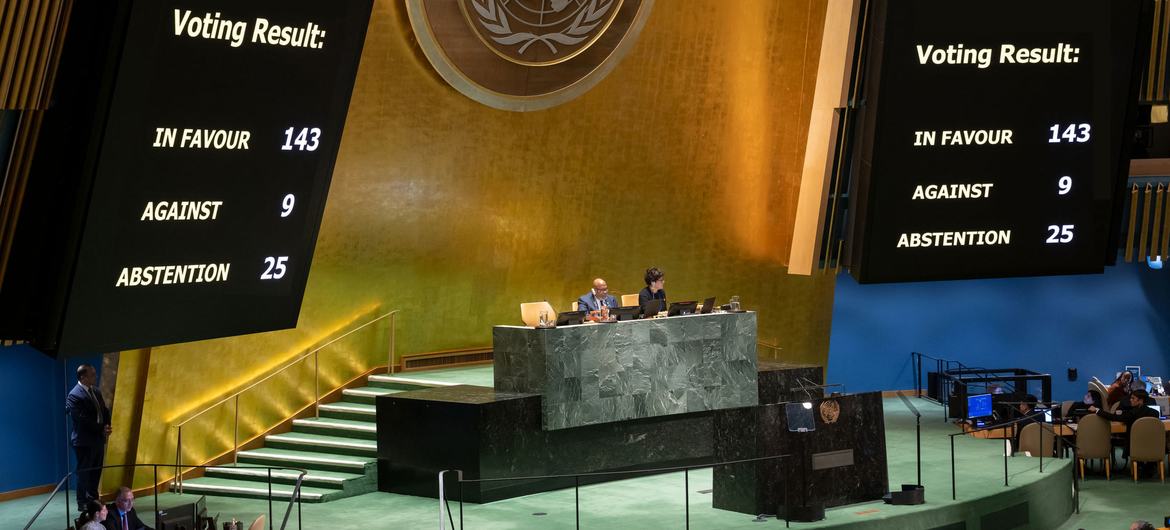
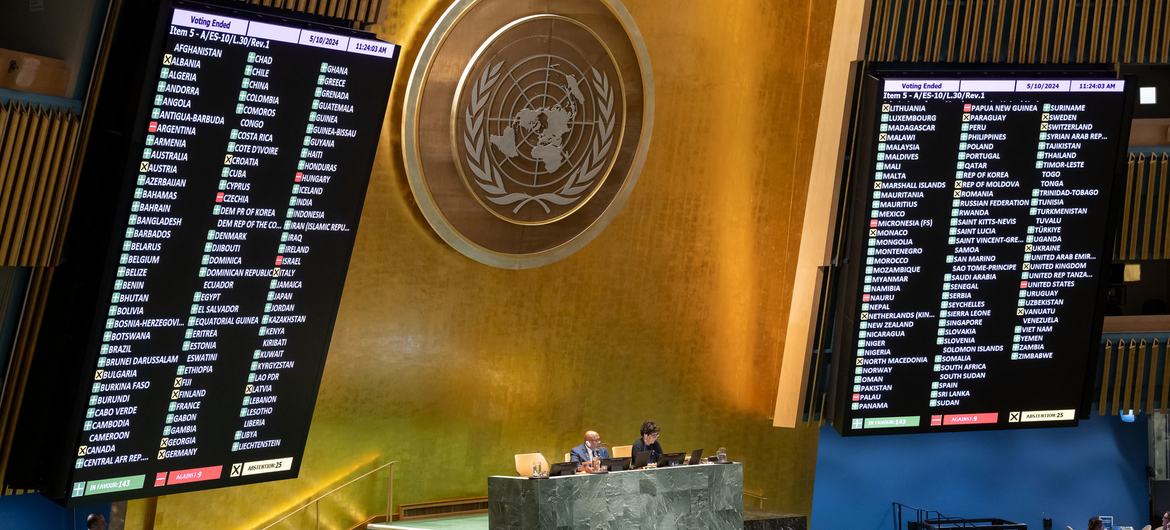
Results of the General Assembly's vote on the resolution on the status of the Observer State of Palestine.
UN Photo/Manuel Elías
 
Results of the General Assembly's vote on the resolution on the status of the Observer State of Palestine.


10 May 2024
Peace and Security

The UN General Assembly convened again in New York on Friday for an emergency special session on the Gaza crisis and overwhelmingly passed a resolution which upgrades Palestine’s rights at the world body as an Observer State, without offering full membership. It urged the Security Council to give “favourable consideration” to Palestine’s request.

What does the resolution mean?

Tweet URL
UN_News_Centre

Here’s a quick recap of what this means: by adopting this resolution the General Assembly will upgrade the rights of the State of Palestine within the world body, but not the right to vote or put forward its candidature to such organs as the Security Council or the Economic and Social Council (ECOSOC).

Granting Palestinian membership requires a recommendation from the Security Council. At the same time, the Assembly determines that the State of Palestine is qualified for such status and recommends that the Security Council “reconsider the matter favourably”.

None of the upgrades in status will take effect until the new session of the Assembly opens on 10 September.

Here are some of the changes in status that Palestine will have a right to later this year:

  1. To be seated among Member States in alphabetical order
  2. Make statements on behalf of a group
  3. Submit proposals and amendments and introduce them
  4. Co-sponsor proposals and amendments, including on behalf of a group
  5. Propose items to be included in the provisional agenda of the regular or special sessions and the right to request the inclusion of supplementary or additional items in the agenda of regular or special sessions
  6. The right of members of the delegation of the State of Palestine to be elected as officers in the plenary and the Main Committees of the General Assembly
  7. Full and effective participation in UN conferences and international conferences and meetings convened under the auspices of the General Assembly or, as appropriate, of other UN organs

6:04 PM

The meeting has adjourned for the day. Vice President Jörundur Valtýsson announced that the session will reconvene on Monday, 13 May, at 10 AM New York time.

For a full summary of this and other major UN meetings, visit UN Meetings Coverage in English and French.

4:59 PM

Saudi Arabia: Re-establish the truth

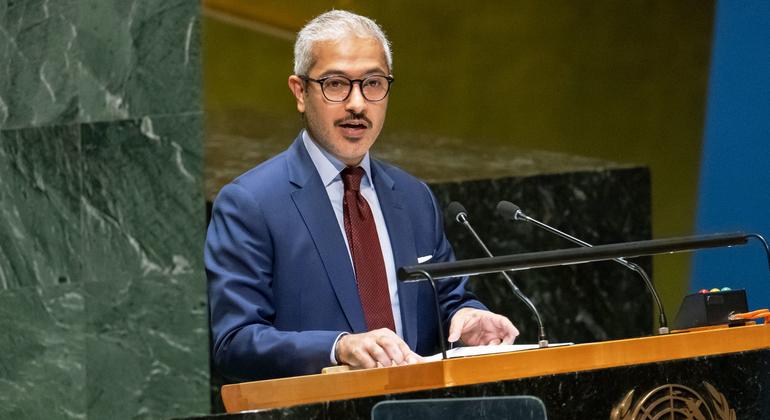
Saudi Arabian Ambassador Abdulaziz Alwasil recalled General Assembly resolutions adopted over the years that reaffirmed the rights of the Palestinian people, including their right to self-determination.

Ambassador Abdulaziz M. Alwasil of Saudi Arabia addresses the resumed 10th Emergency Special Session meeting on the situation in the Occupied Palestinian Territory.
UN Photo

“The resolution presented today is fully in line with those resolutions. It seeks to implement the will of the international community and contribute to building true peace in the Middle East based on the two-State solution,” he said.

“It is high time for the international community to re-establish the truth because the world can no longer ignore the suffering of the Palestinian people that has lasted for decades,” he added.

Ambassador Alwasil further noted Israel, the occupying power, has perpetrated “all sorts of crimes” against Palestinian people, scorning international law.

“Israel is convinced that they are above these resolutions and that they enjoy a certain level of immunity…which explains their ongoing hostile and brutal policies,” he said.

He highlighted the dire situation in Rafah, the last refuge for the Palestinian people which was also densely populated by those displaced from elsewhere and called he for a strong international position to put an end to the Israeli practices in Gaza.

Concluding his statement, the Ambassador expressed Saudi Arabia’s commitment to supporting the right of Palestinian people to self-determination and to build their own independent State within the 1967 borders with East Jerusalem as its capital, in line with relevant resolutions. 

4:43 PM

China: Resolution reflects the will of the international community

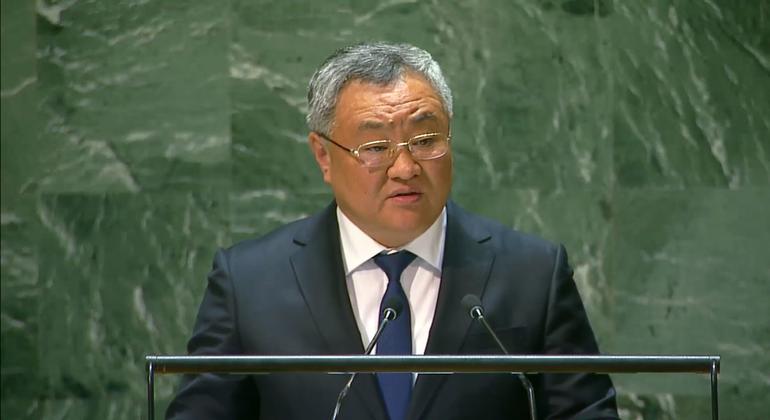
Ambassador FU Cong of China said that Palestine should have the same status as Israel and that Palestinian people should enjoy the same rights as Israeli people.

Ambassador Fu Cong of China addresses addresses the resumed 10th Emergency Special Session meeting on the situation in the Occupied Palestinian Territory.
UN Photo

“It is the common responsibility of the international community to support and advance the process of Palestinian independent Statehood, and provide strong support for the implementation of the two-State solution and a lasting peace in the Middle East,” he said.

He further noted that on the Palestinian-Israeli issue, the United States repeatedly used its veto “in an unjustified attempt” to obstruct the international community’s efforts to correct the “historical injustice long visited on Palestine”.

“It is not commensurate with the role of a responsible major country,” he said.

He also recalled the overwhelming support for the General Assembly resolution, adopted earlier in the day, reaffirming the right of Palestinian people to self-determination and recommending that the Security Council reconsider favourably its application to join the United Nations.

“China welcomes this historic resolution, which reflects the will of the international community,” Ambassador Fu said.

“We believe that the special modalities adopted within the limits permitted by the UN Charter will enable the international community to listen more adequately to the voice of Palestine and help it to talk and negotiate with Israel on a more equal footing.”

3:04 PM

Assembly President Francis resumed the meeting, with about 72 speakers left to take the floor. The spokesperson for the General Assembly announced earlier in the day that due to the number of remaining speakers, the meeting will likely continue on Monday.

1:07 PM

With the last speaker for the morning having delivered their statement, the President of the General Assembly adjourned the meeting. It will reconvene at 3 PM New York time.

1:00 PM

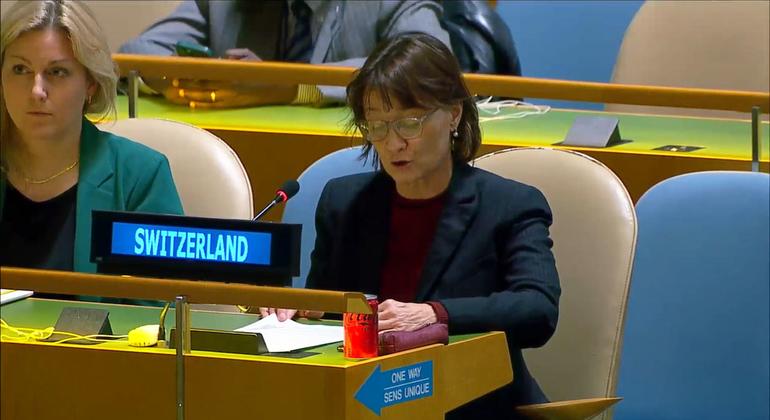
Switzerland: Ceasefire urgently needed

Swiss Ambassador Pascale Christine Baeriswyl explained that her country’s abstention from the vote was in line with its position at the Security Council last month.

Ambassador Pascale Christine Baeriswyl of Switzerland addresses the resumed 10th Emergency Special Session meeting on the situation in the Occupied Palestinian Territory.
UN Photo

“We felt that in view of the great instability prevailing in the region, this stage was not conducive to improving the situation,” she said.

“Without opposing it, we believe it would be preferable to consider admitting Palestine as a full member of the United Nations at time when such a step would insert itself in the logic of emerging peace,” she added, noting that such admission would have to follow the procedures enshrined in the UN Charter.

She also voiced Switzerland’s firm support to the two-State solution, stating that only a negotiated solution in which two States – Israel and Palestine – live side by side in peace and security can lead to lasting peace.

Ambassador Baeriswyl also voiced deep concern over the catastrophic situation of civilians in the ongoing conflict in Gaza, stating that it could worsen further in the event of a major Israeli military offensive in Rafah.

“Such a prospect is unacceptable, and Switzerland reaffirms its opposition to such an operation,” she said, emphasising the need to ensure protection of humanitarians and respect for international humanitarian and human rights laws.

In conclusion, she called for an immediate ceasefire.

“Safety of civilians must be ensured. All hostages must be released immediately and unconditionally, and safe, rapid and unhindered access for humanitarian aid must be allowed via all crossing points.”

12:10 PM

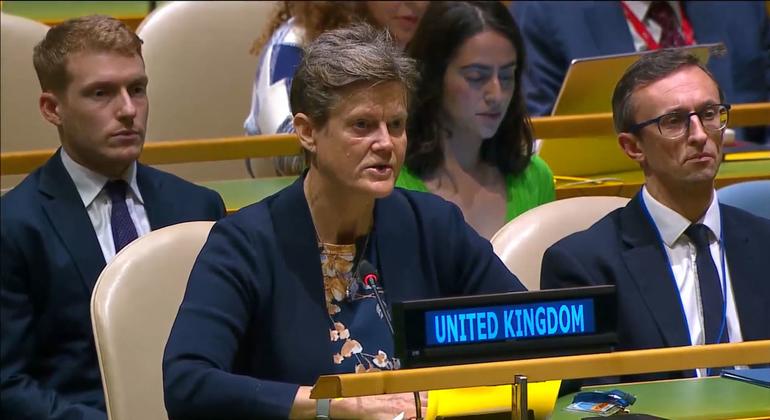
Firmly committed to two-State solution: UK

Barbara Woodward, Ambassador of the United Kingdom, said that her country remains “firmly committed” to the two-State solution that guarantees security and stability for both the Israeli and the Palestinian people.

Ambassador Barbara Woodward of the United Kingdom addresses the resumed 10th Emergency Special Session meeting on the situation in the Occupied Palestinian Territory.
UN Photo

“We are abstaining from this resolution because we believe the first step towards achieving this goal is resolving the immediate crisis in Gaza,” she said, emphasising that the fastest way to end the conflict is “to secure a deal which gets the hostages out and allows for a pause in the fighting”.

“We must then work together to turn that pause into a sustainable, permanent ceasefire.”

She added that “setting out the horizon” for a Palestinian State should be one of the vital conditions from moving from a pause in fighting to a sustainable ceasefire.

“Recognising a Palestinian State, including at the UN, should be part of that process,” she said.

Ambassador Woodward also noted that the UK remains deeply concerned about the prospect of a major operation in Rafah and that it will not support such an act, unless there is a “very clear plan” on protecting civilians as well as their access to aid and medical care.

“We have not seen that plan, so in these circumstances, we will not support a major operation in Rafah,” she said.

11:58 AM

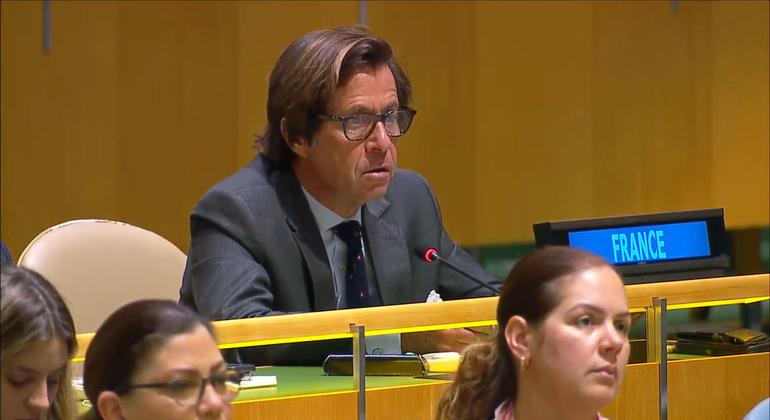
France: High time for political solution

French Ambassador Nicolas de Rivière said his country voted in favour of the resolution, noting also the clarifications provided in the text on the right to vote and the right to be elected, which are the prerogatives of Member States alone.

Ambassador Nicolas de Rivière of France addresses the resumed 10th Emergency Special Session meeting on the situation in the Occupied Palestinian Territory.
UN Photo

“France recalls that the procedure for admitting a new Member State is defined by the UN Charter, and it must not be circumvented,” he said.

He also noted that France is in favour of the admission of Palestine as a full member of the Organization, which is why it voted in favour at the Security Council last month.

Reiterating his country’s condemnation of the terrorist attacks by Hamas and other groups on 7 October, Ambassador de Rivière stated France’s demand for a ceasefire and release of all hostages.

“The offensive that has started in Rafah risks causing numerous victims and displacing people at a time where nowhere can be deemed safe today in Gaza. There is further risk of disrupting delivery of aid,” he said, expressing his country’s opposition to the military operation.

“All parties must do everything they can to protect civilians and guarantee access for humanitarian aid. It is high time to mobilise for a political solution,” he added.

11:46 AM

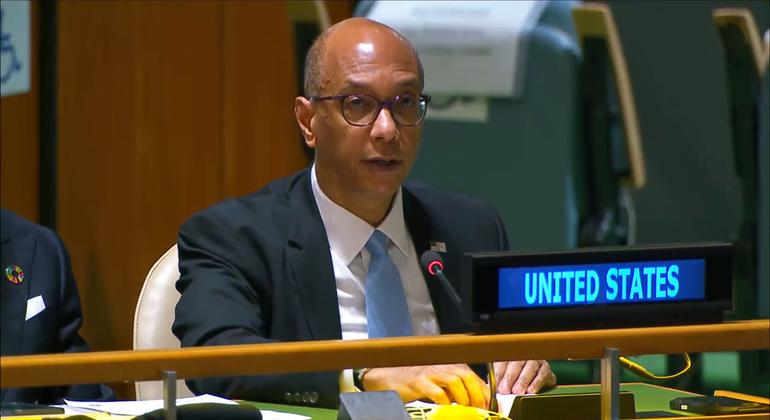
Statehood must be negotiated: US

Explaining the US’s negative vote, Ambassador Robert Wood said that it did not reflect opposition to Palestinian statehood.

Deputy Permanent Representative Robert A. Wood of the United States, addresses the resumed 10th Emergency Special Session meeting on the situation in the Occupied Palestinian Territory.
UN Photo

“We have been very clear that we support it and seek to advance it meaningfully. Instead, it is an acknowledgement that statehood will come from a process that involves direct negotiations between the parties,” he said.

“There is no other path that guarantees Israel’s security and future as a democratic Jewish State. There is no other path that guarantees Palestinians can live in peace and dignity in a State of their own,” he added.

He further expressed the US commitment to intensifying its engagement with Palestinians and the rest of the Middle East region to advance a political settlement that will create a path to Palestinian statehood and subsequent membership in the UN.

“This resolution does not resolve the concerns about the Palestinian membership application raised in April in the Security Council…and should the  Security Council take up the Palestinian membership application as a result of this resolution, there will be a similar outcome,” he said.

Results of the General Assembly's vote on the resolution on the status of the Observer State of Palestine.
UN Photo/Manuel Elías
 
Results of the General Assembly's vote on the resolution on the status of the Observer State of Palestine.

11:24 AM

Tweet URL
UN_News_Centre

Draft resolution passed overwhelmingly

The vote is in. It has passed overwhelmingly with 143 countries in favour, nine against and 25 abstaining.

11:22 AM

The Assembly just voted to pass the draft resolution as long as two thirds agree.

11:18 AM

Pakistan: Resolution vote will determine strong support

Ambassador Munir Akram of Pakistan said there will come a day when Israel will be held accountable for the crimes committed against Palestinians, especially in Gaza.

The insults hurled today are “the arrogance of the aggressor” reflecting the impunity of the occupier, he said, explaining his delegation's position ahead of the vote on the draft resolution.

He also expressed hope that the international community will appropriately respond in that regard.

The Ambassador underscored that the resolution’s adoption will determine the widespread support for Palestine to be accorded full UN membership.

11:05 AM

Russia: A moral duty

The Assembly is now preparing to vote on the draft resolution.

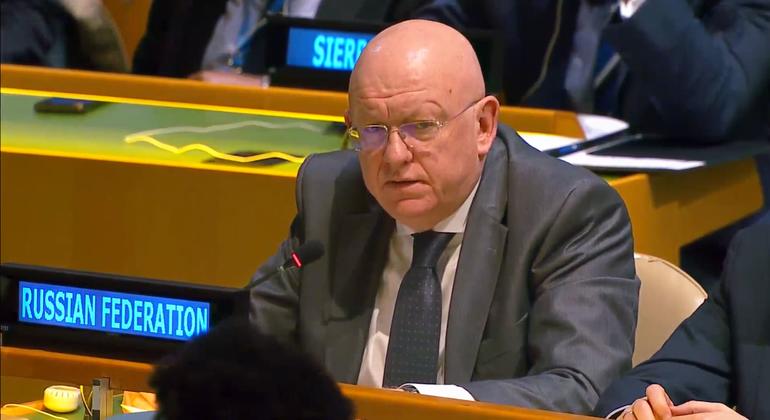
Before that, some countries are exercising their right to make statements before the vote, starting with Russia's Ambassador Vassily Nebenzia.

Ambassador Vassily Nebenzia of the Russian Federation addresses the resumed 10th Emergency Special Session meeting on the situation in the Occupied Palestinian Territory.
UN Photo

He is criticising the US, saying that the resolution is complicated because it is attempting to advance Palestinian membership as far as possible without provoking another veto from Washington on full membership.

He said Palestine deserves nothing less than full membership at the UN. 

“It is the moral duty of everyone," he said.

“Only full-fledged membership will allow Palestine to stand alongside other members of the Organization and enjoy the rights that this status implies.”

10:55 AM

Israel: Extra benefits for Palestine would appease terrorists

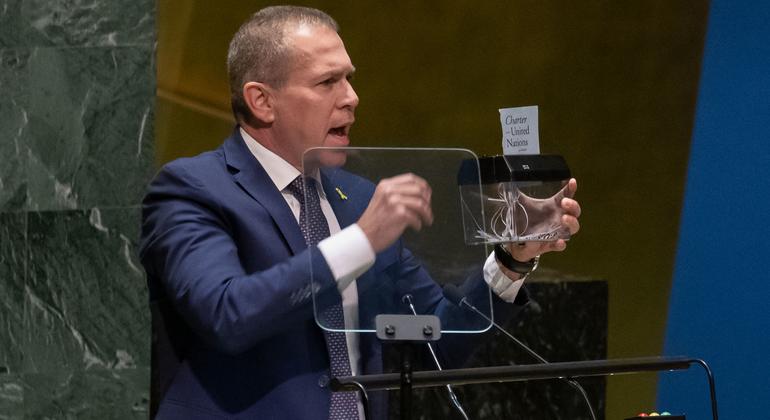
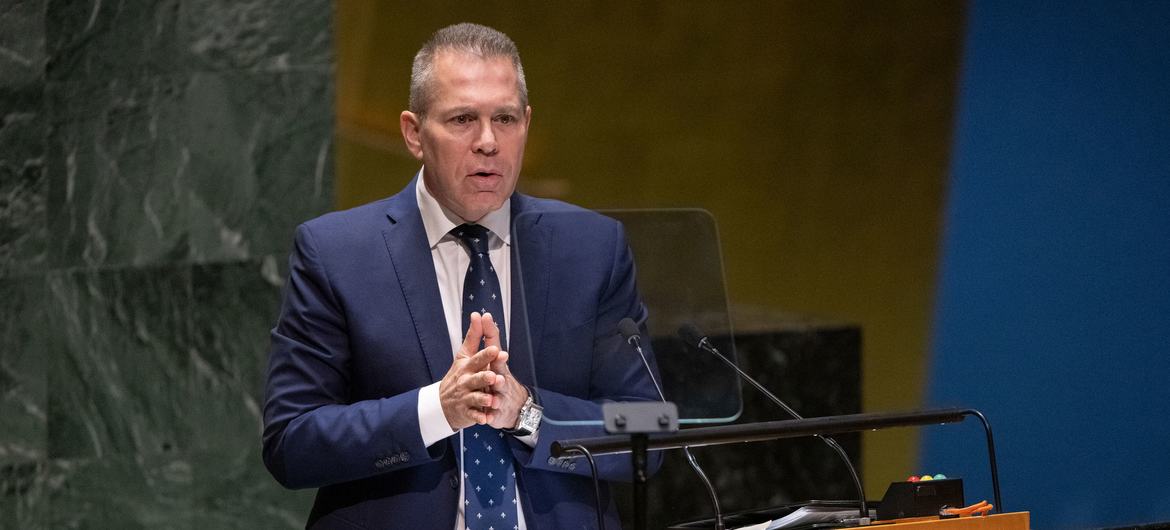
Israel’s Ambassador Gilad Erdan said that after Hitler’s rise to power, the Nazis had sought to annihilate the Jewish people and all those they deemed sub-human, but the forces of good fought to return peace to the world, and the UN was founded to ensure that such tyranny never raised its head again.

Ambassador Gilad Erdan of Israel shreds the UN Charter at the podium of the General Assembly.
UN Photo/Manuel Elías

“Today, you are doing the opposite…welcoming a terror State into its ranks,” he said. 

“You have opened up the United Nations to modern-day Naziism. It makes me sick.”

The terrorist group Hamas controls Gaza and has taken over areas of the West Bank, he said, holding up a poster showing Hamas’s leader, who he described as “a terrorist diplomat whose stated goal is Jewish genocide”.

“Today, you have a choice between weakness and fighting terror,” he said, adding that the UN is appeasing “murderous dictators” and destroying the UN Charter. “This day will go down in infamy.”

In closing, he held up a mini portable electric document shredder and inserted the cover of the UN Charter.

10:48 AM

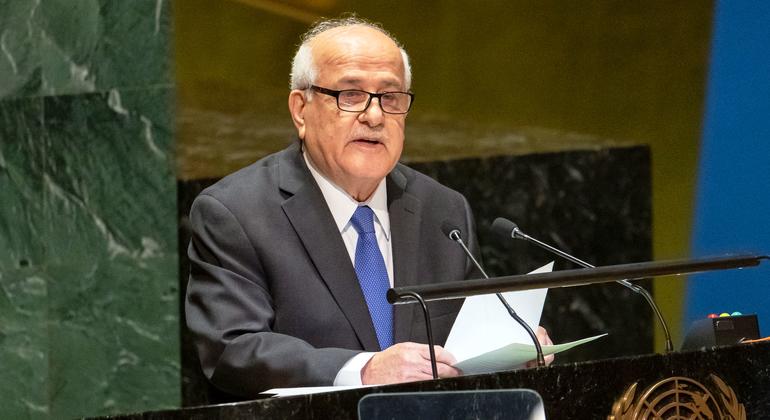
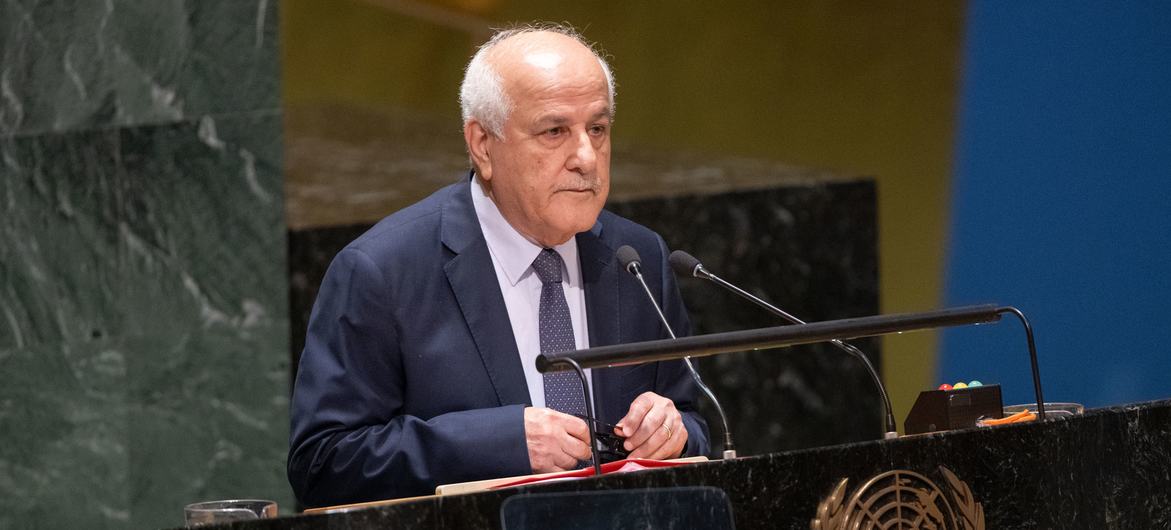
Palestinian flag ‘flies high and proud’

Riyad Mansour, Permanent Observer of the observer State of Palestine, recounted the devastating impacts of the ongoing war in Gaza, with over 35,000 Palestinians killed, a further 80,000 injured and over two million displaced.

“No words can capture what such loss and trauma signify for Palestinians, their families, their communities and for our nation as whole,” he said.

He added that the Palestinians in Gaza have been pushed to the “very edge” of the Strip “to the very brink of life” with “bombs and bullets haunting them”.

Mr. Mansour highlighted that despite the attacks and destruction, the flag of Palestine “flies high and proud” in Palestine and across the globe, becoming a “symbol raised by all those who believe in freedom and its just rule”.

Riyad Mansour, Permanent Observer of the State of Palestine to the United Nations, addresses the resumed 10th Emergency Special Session meeting on the situation in the Occupied Palestinian Territory.
UN Photo/Manuel Elías

‘Lives cannot be restored’

“It is true that we will not disappear, but the lives lost cannot be restored,” he stated.

The Permanent Observer said people have to make a decision: stand by the right of a nation to live in freedom and dignity on its ancestral land, standing with peace and recognising the rights of Palestinians or they can stand on the sidelines of history.

Mr. Mansour said after holding observer status for 50 years, “we wish from all those who invoke the UN Charter to abide by the right of the Palestinian people to self-determination guaranteed by the Charter.”

“A ‘yes’ vote is a vote for Palestinian existence; it is not against any State, but it is against attempts to deprive us of our State,” he added, stating that it would be an investment in peace and empowering the forces of peace.

10:29 AM

Security Council must heed global call for Palestinian statehood: UAE

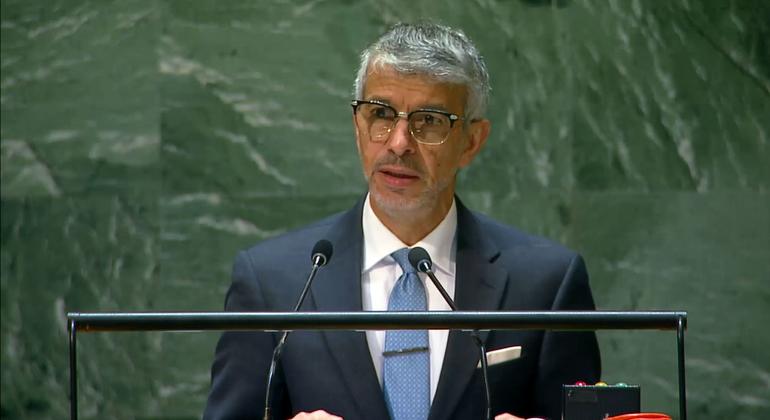
On behalf of the Arab Group, Mohamed Issa Hamad Mohamed Abushahab, Permanent Representative of the United Arab Emirates to the UN, introduced the draft resolution, saying it recommends that the Security Council reconsider Palestine’s full UN membership application.

“Today marks a defining moment,” he said.

Ambassador Mohamed Issa Abushahab of the United Arab Emirates addresses the resumed 10th Emergency Special Session meeting on the situation in the Occupied Palestinian Territory.
UN Photo/Manuel Elías

The State of Palestine has demonstrated that it deserves full membership in the international community by acceding to international treaties, adhering to the UN Charter and meeting requirements of statehood. In addition, more than 140 countries now recognise Palestine as a State, he said.

Voting for the resolution amid the ongoing conflict would support the two-State solution to the crisis, he said, adding that the Security Council must respond to the will of the international community.

Vote to take place at 11:00 AM

After delivering his statement, the UAE Ambassador called on the Assembly to vote on the draft at 11:00 AM New York time.

Members agreed to do so and would afterwards resume the debate.

10:17 AM

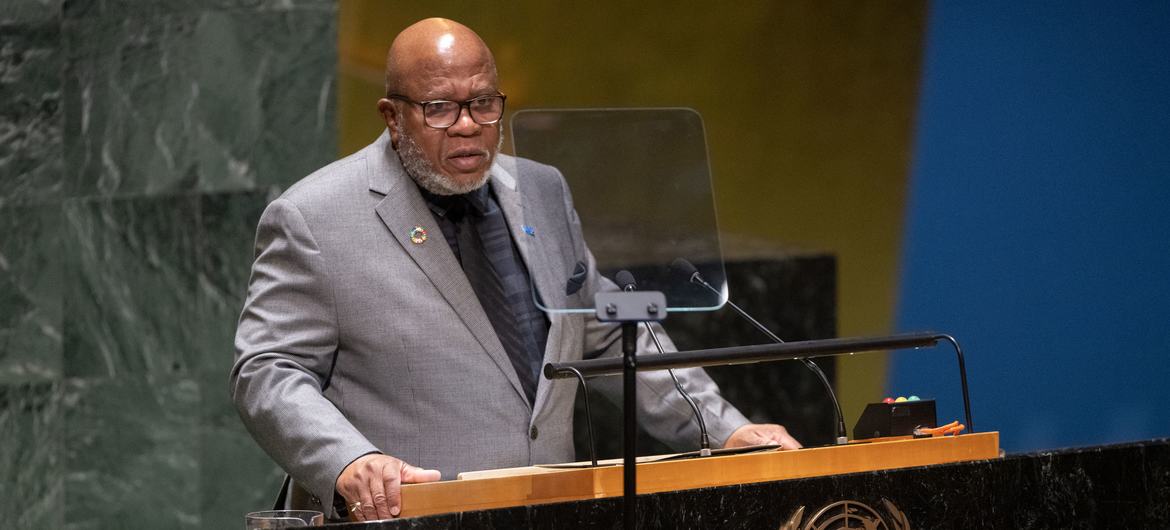
Middle East on course for ‘full-scale catastrophe’, warns Francis

Mr. Francis said from the podium of the Assembly Hall that the Israel-Palestine crisis was the original crisis before the world body when it was founded in 1946.

Peace has remained elusive, and today has become an untenable situation that is deteriorating "at an alarming speed", he told delegates.

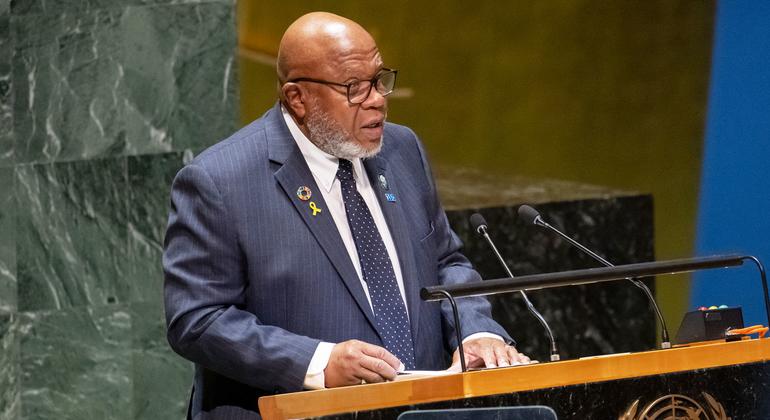
General Assembly President Dennis Francis addresses the resumed 10th Emergency Special Session meeting on the situation in the Occupied Palestinian Territory.
UN Photo/Manuel Elías

This is “bringing countless innocent victims into its deadly fold and pushing the region further to the brink of full-scale catastrophe”.

He urged the international community to not look away from the dire situation that has unfolded since the  7 October terror attacks and the ensuing Israeli devastation of Gaza.

End the scourge of war

“Today, let us remember the legacy from which we hail. We stand proudly upon the shoulders of those who, many decades ago, recognised their ultimate responsibility to forge a peace that will banish the scourge and terror of war,” he urged.

“I therefore call upon the membership to purposely assess the situation before us, with nothing else in mind but a commitment to peace as our utmost ambition,” he said.

He called upon the parties to the conflict, supported by nations with leverage, to urgently come to an agreement on a ceasefire to bring to an end to the suffering of countless people and secure the release of all hostages.

“We must believe in the essential goodness of others," he said, and “in the understanding that no problem of human relations is insoluble”, calling on them to help bring lasting peace, save lives and end the violence.

10:14 AM

He’s inviting the Assembly to recognise the fact that some members are in arrears with their mandatory contributions. If you don't pay up, you lose your vote. Those are the rules. But, there are exceptions that have been made, including today. 

10:12 AM

The President of the General Assembly Dennis Francis has just gavelled in the resumed session on the Gaza crisis.

09:55 AM

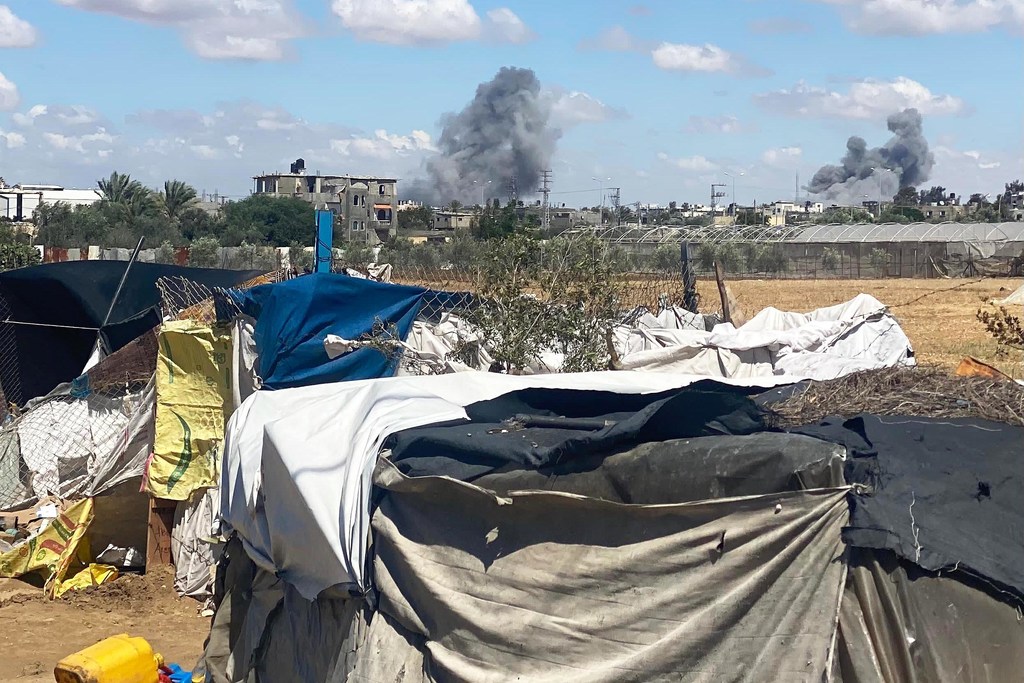
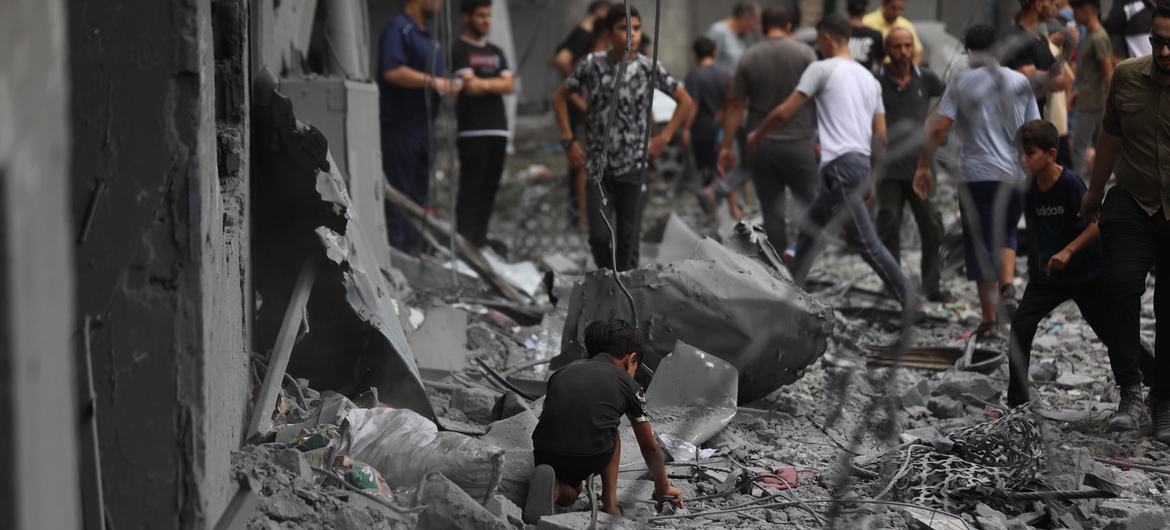
Aid operations have come to a standstill since the start of the military’s ground operation in Rafah this week, with an estimated 100,000 Palestinians displaced once again in a highly fluid situation, according to humanitarians.

UNRWA
Smoke rises above Rafah as bombardments continue.
 
UNRWA

The Assembly is also expected to vote on a draft resolution, co-sponsored by a group of countries, concerning the status of the observer State of Palestine at the United Nations.

Read our explainer on Palestine’s status at the UN here.

The draft resolution follows the veto cast by United States at the Security Council on 18 April, which blocked Palestine’s admission as a full UN Member State. That draft resolution, submitted by non-permanent Council member Algeria, had received 12 votes in favour, with Switzerland and the United Kingdom abstaining.

Draft resolution on Palestine

The draft resolution expected to be put to a vote at the 193-member General Assembly, where no nations have veto power, would have the world body “recommend” that the Security Council reconsider the matter of Palestine’s membership favourably in line with Article 4 of the UN Charter concerning membership and the advisory opinion issued by the International Court of Justice (ICJ) in 1948.

revised version of the draft resolution, as of Thursday evening in New York, also included an annex, which on an exceptional basis and without setting a precedent, lists significant changes to the State of Palestine’s status at General Assembly meetings and conferences, including its order in the list of speakers and seating arrangements.

These would not just be of symbolic importance, but signal a shift in Palestine’s diplomatic heft within the entire UN system. That said, General Assembly will not grant Palestinian membership in the UN, since this requires a recommendation from the Security Council.

No voting rights

The draft resolution also notes that as an observer State, Palestine does not have the right to vote in the General Assembly or to put forward its candidature to UN organs such as the Security Council or the Economic and Social Council.

If adopted, the resolution’s provisions would only apply from the start of the 79th session of the General Assembly, which gets underway in mid-September 2024.

Draft resolutions do not represent the official position of the General Assembly until they are formally adopted.

Once the resolution is voted on, the whole issue of Palestine’s status will return to the 15-member Security Council for further consideration, where any effort to attain full membership is likely to be blocked again by the United States, which holds veto power alongside the organ’s other permanent members – China, France, Russia and the United Kingdom.

The majority of the General Assembly will have had their say, however, amid the continuing crisis.

10th Emergency Special Session

The meeting is the continuation of the 10th Emergency Special Session (ESS), which last convened on 12 December 2023, against the backdrop of a worsening crisis in Gaza.  

At that meeting in a resolution passed overwhelmingly, the Assembly demanded an immediate humanitarian ceasefire as well as the immediate and unconditional release of all hostages.

The Assembly also decided to adjourn the session temporarily and authorised the President of the General Assembly to resume its meeting upon request from Member States.

The 10th ESS convened for the first time in April 1997 following a request from Qatar. It followed a series of Security Council and General Assembly meetings regarding the Israeli decision to build a large housing project in an area of East Jerusalem.

Learn more about these emergency special sessions from our explainer here


https://news.un.org/en/story/2024/05/1149596

https://creativecommons.org/licenses/by/3.0/legalcode

суббота, 28 октября 2023 г.

UN General Assembly adopts Gaza resolution calling for immediate and sustained ‘humanitarian truce’

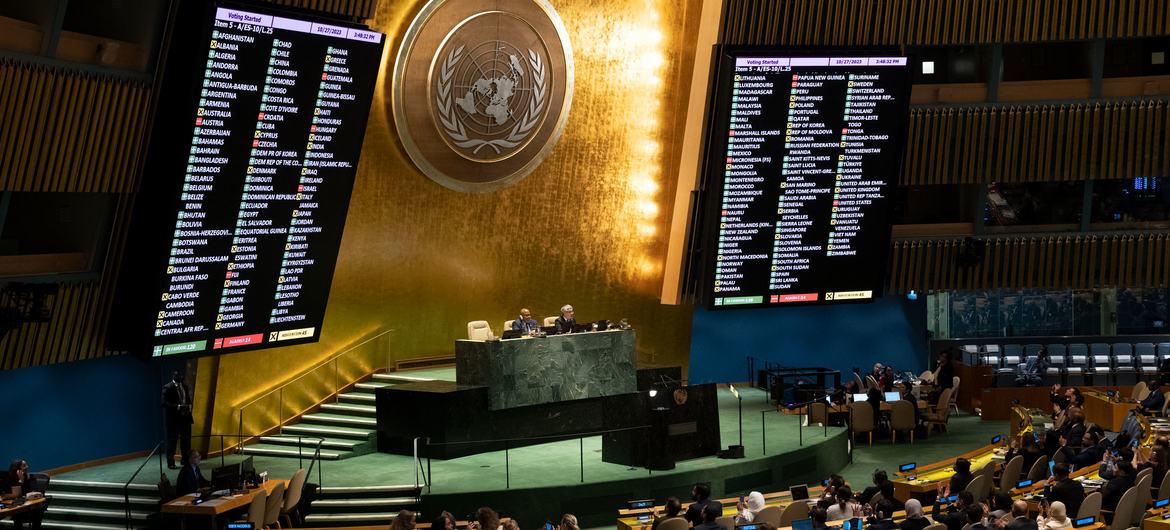
Members of the United Nations General Assembly vote on a resolution at the resumed 10th Emergency Special Session meeting on the situation in the Occupied Palestinian Territory.

UN Photo/Evan Schneider
 
Members of the United Nations General Assembly vote on a resolution at the resumed 10th Emergency Special Session meeting on the situation in the Occupied Palestinian Territory.
26 October 2023
Peace and Security

The United Nations General Assembly on Friday adopted a resolution calling for an “immediate, durable and sustained humanitarian truce” between Israeli forces and Hamas militants in Gaza. It also demands “continuous, sufficient and unhindered” provision of lifesaving supplies and services for civilians trapped inside the enclave, as news reports suggest Israel has expanded ground operations and intensified bombing campaign.

5: 30 PM

We'll be ending our live coverage of this emergency session shortly, which saw the adoption of a non-binding Jordanian resolution on Friday afternoon in New York by a large majority of Member States, with 120 votes in favour, 14 against and 45 abstentions.

It marks the first formal response of the United Nations to the escalation of violence in Israel and Palestine since the Hamas terror attacks of 7 October, after the Security Council failed on four occasions to reach consensus on any action.

Friday’s key things you need to know:

DAY 2 HIGHLIGHTS

  • Assembly adopted a major resolution, calling for an “immediate, durable and sustained humanitarian truce leading to a cessation of hostilities”; it was proposed by Jordan and backed by over 45 Member States
  • An amendment, proposed by Canada and backed by over 35 Member States, including the US, seeking an explicit condemnation of Hamas, did not pass, failing to get two-thirds support
  • Countries put forward arguments for and against the amendment, and explained their positions on the adopted resolution
  • Earlier in the day, several countries took the floor, reiterating the impact of the crisis on civilians and underscoring the imperative to ensure aid finally flows into the enclave as supplies of food, water and fuel reach critically low levels
  • The US declared that after the current crisis is over, “there is no going back to the status quo, as it stood on 6 October”, noting the importance of a two-State solution
  • The Emergency Special Session will continue on Tuesday, with countries continuing their debate 

4:50 PM

Ghana: World must find 'fierce agency' for peace

Ghana’s Ambassador and Deputy Permanent Representative Carolyn Oppong-Ntir, said her delegation voted in favour of the resolution because, among other reasons, the humanitarian crisis could not be ignored.

“We have a responsibility as an international community to help end the heart-breaking tragedies” in Israel and Palestine, she said. “Out of this tragedy, we must find the fierce agency to support the two parties to resume and conclude a peace agreement” and advance the two-State solution. 

She said her country - a current Security Council member - voted in favour of the resolution because, among other reasons, the humanitarian crisis could not be ignored.

“We have a responsibility as an international community to help end the heart-breaking tragedies” in Israel and Palestine, she said. “Out of this tragedy, we must find the fierce agency to support the two parties to resume and conclude a peace agreement” and advance the two-State solution.

4:38 PM

India calls for de-escalation

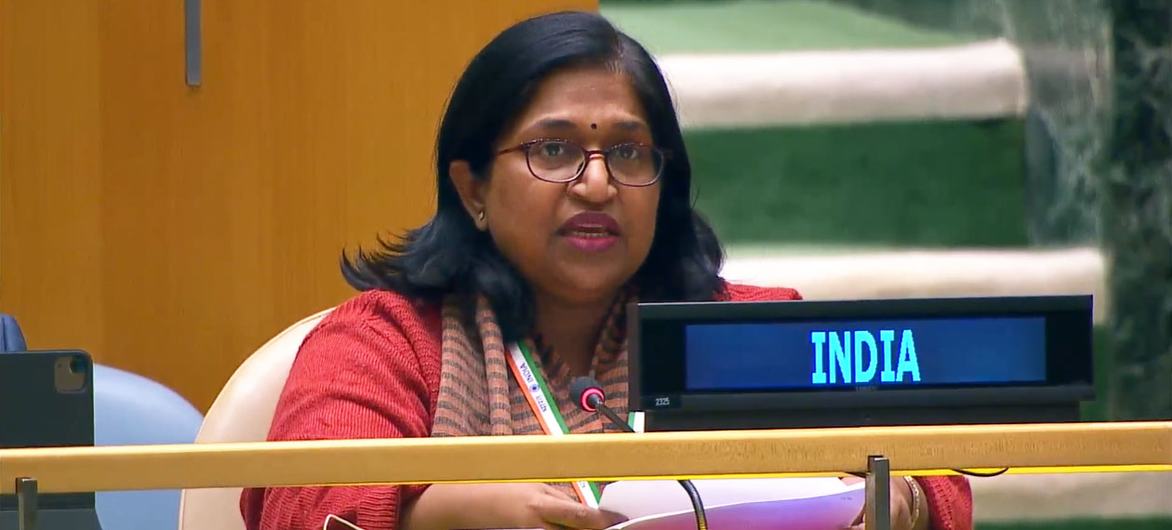
Ambassador Yojna Patel of India speaks in response to the resolution being adopted at the resumed 10th Emergency Special Session meeting on the situation in the Occupied Palestinian Territory.
United Nations
 
Ambassador Yojna Patel of India speaks in response to the resolution being adopted at the resumed 10th Emergency Special Session meeting on the situation in the Occupied Palestinian Territory.

India’s Deputy Permanent Representative Ambassador Yojna Patel said the 7 October terror attacks are shocking, calling for the immediate release of the hostages. Casualties in Gaza are a continuing concern and the crisis needs to be addressed, she said.

India abstained in the resolution vote. 

Welcoming ongoing efforts and reiterating support for the two-State solution, she urged the parties to de-escalate the violence and work towards resuming substantial peace negotiations.

4:23 PM

Israel: Day of 'infamy'

Gilad Erdan, Ambassador of Israel to the UN, said in response to the resolution passing that “today is a day that will go down in infamy”.

“We have all witnessed that the UN holds not even one ounce of legitimacy,” he said. “The UN is committed to ensuring further atrocity. According to the family of nations, Israel has no right to defend itself.”

There are no talks or discussions to be held with Hamas, he said, adding that Israel will not sit idly by to let them commit atrocities again. The resolution does not mention Hamas once, as if the war started on its own.

“What is going on here?” he asked, questioning whether the goal was to tie Israel’s hands. “The only way to destroy Hamas is to root them out. Why are you not holding Hamas accountable?”

“We know there is no humanitarian crisis in accordance with international humanitarian law,” he said, noting that every statistic comes from Hamas about information about Gaza.

Anyone interested in preventing violence should call on Hamas to lay down their arms, turn themselves in and return all hostages, he said.

“If this were to happen, the war would end immediately,” he said. “This is a dark day for the UN and mankind. Israel will defend itself and will do what must be done to eradicate Hamas’ capabilities and bring the hostages home.”

4:18 PM

France: Security Council must act

France’s Ambassador Nicolas de Rivière speaking after the resolution passed, said his delegation voted in favour, as “nothing justifies the killing of civilians”.

“We have to work collectively to set up a humanitarian truce because the situation in Gaza is catastrophic,” he said, noting that France has already sent an aid vessel. “The Assembly must call for the release of hostages.”

However, the adoption of this resolution cannot replace the Security Council’s efforts nor the decisions that the organ must now adopt, he said, expressing hope that the Council can reach a decision.

“We have a duty to prevent a worsening of the situation,” he said. “The only viable solution is a two-State solution.”

3:48 PM

Resolution adopted

The Jordanian resolution has been adopted by the General Assembly, with 120 votes in favour, 14 against and 45 abstentions.

Another reminder of the key provisions of the resolution now adopted, which is a non-binding expression of the majority view of UN Member States.

It marks the first formal response of the United Nations to the hostilities since the Hamas terror attacks of 7 October, after the Security Council failed on four occasions to reach consensus on any action.

Check out our explainer here, on how emergency special sessions of the Assembly work, and WHY they matter.

General Assembly adopts resolution on Protection of Civilians and Upholding Legal and Humanitarian Obligations in Gaza.
UN Photo/Evan Schneider
 
General Assembly adopts resolution on Protection of Civilians and Upholding Legal and Humanitarian Obligations in Gaza.

The resolution does not make specific mention of the militant group which controls Gaza, Hamas, one of the key issues which led to a Canadian amendment being proposed.

The resolution calls for an “immediate, durable and sustained humanitarian truce”, and demands all parties comply with international humanitarian law and “continuous, sufficient and unhindered” provision of essential supplies and services into the Gaza Strip.

It also calls for the “immediate and unconditional release” of all civilians held captive as well as demanding their safety, well-being and humane treatment in compliance with international law.

3:45 PM

Canadian amendment fails to get enough support

The votes on the amendment were 85 for, 55 against, with 23 abstentions, so it failed to get the required two-thirds majority.

3:45 PM

Israel must be named too: Pakistan

In a powerful speech rebutting Canada's explanation, Pakistan’s ambassador Munir Akram said that if Canada was being fair in its amendment it would agree to name Israel as well as Hamas.

Not naming either side was the best choice he said, as the Jordanian resolution does.

“Israel needs to be named too, if you are to be fair and equitable and just”, he said.

We all know who started this. It is 50 years of Israeli occupation and the killing of Palestinians with impunity, he said.

Israel can’t face the truth or face justice. The Israeli occupation is the original sin, not what happened on 7 October.

3: 28 PM

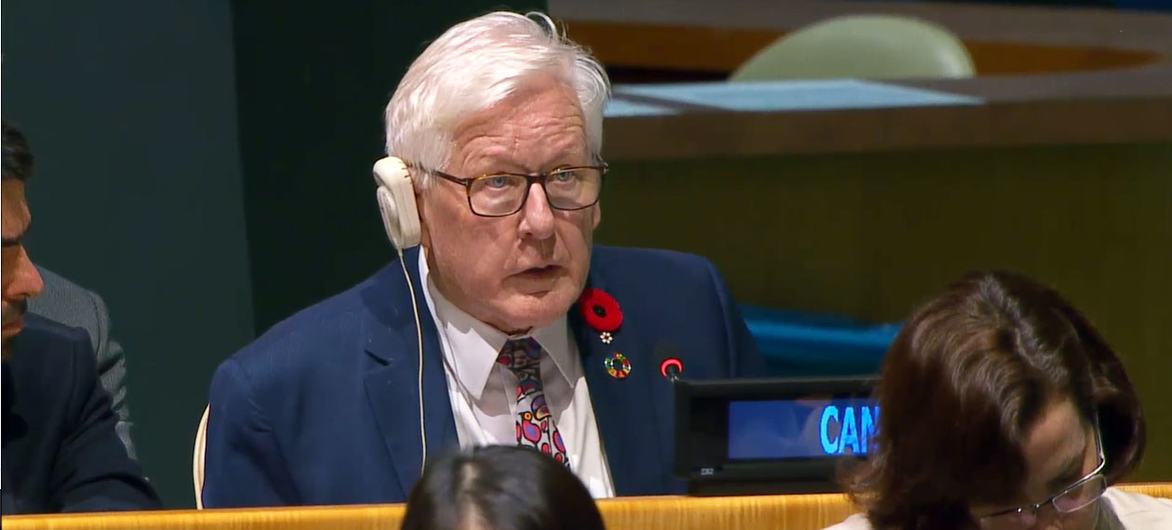
Canada: Terror attacks must be recognized

Canada’s Ambassador Bob Rae said the Assembly is meeting to show Israelis and Palestinians that any life lost is a tragedy. Yet, the critical reason for being here has been forgotten. On 7 October, Hamas wreaked terror on Israel. Since then, more that 7,000 Palestinians have been killed.

“We can see the need for a rapid response,” he said.

Unfortunately, Canada cannot support the current text, he said, adding that the Assembly cannot act without recognizing the 7 October terrorist attacks and the hostage taking.

If the proposed amendment is not adopted, the Assembly will not have recognized one of the world’s worst terrorist attacks and “we will all have to live with that failure as the tragedy continues to unfold,” he said.

Ambassador Bob Rae of Canada speaks ahead of the vote at the resumed 10th Emergency Special Session meeting on the situation in the Occupied Palestinian Territory.
United Nations
 
Ambassador Bob Rae of Canada speaks ahead of the vote at the resumed 10th Emergency Special Session meeting on the situation in the Occupied Palestinian Territory.

If the proposed amendment is not adopted, the Assembly will not have recognized one of the world’s worst terrorist attacks and “we will all have to live with that failure as the tragedy continues to unfold,” he said.

This amendment “names what has to be named”, he said. Emphasizing that the crisis must not spread through the region, he reiterated that Canada supports the two-State solution and continues to provide humanitarian aid for Gaza.

3:24 PM

'Simple yet vital goal'

Jordan’s ambassador Mahmoud Daifallah Hmoud spoke ahead of the voting, saying that the "urgent need for an immediate ceasefire cannot be overstated."

He said that the immeasurable suffering of the Palestinian people was destined to leave a lasting mark on generations to come.

He said that delegates were "witnessing a ground invasion by Israel as we speak" and failure four times by the Security Council to reach any consensus for action.

He said the was a "simple yet vital goal" of their resolution "that aligns with the very purpose for which the UN was established, peace and compliance with international law."

3:14 PM

With a palpable buzz among delegates inside the UN General Assembly Hall, the afternoon session is underway. 

Seven more countries have become co-sponsors of the Jordanian resolution in the past few hours and 36 more countries have become co-sponsors of the Canadian amendment.

2:45 PM

What does the resolution say?

Just a reminder as the voting looms at 3 PM of what the resolution and the Canadian amendment - which will be considered first - actually calls for...

The Jordanian resolution has the backing of more than 40 Member States, including Egypt, Oman and UAE.

It calls for an “immediate, durable and sustained humanitarian truce”, and demands all parties comply with international humanitarian law and “continuous, sufficient and unhindered” provision of essential supplies and services into the Gaza Strip.

It also calls for the “immediate and unconditional release” of all civilians held captive as well as demanding their safety, well-being and humane treatment in compliance with international law.

The resolution makes no specific mention of the Hamas terror attacks of 7 October.

Canada's amendment condemns Hamas

An amendment has been proposed by Canada that “unequivocally rejects and condemns the terrorist attacks by Hamas” in Israel starting 7 October and the taking of hostages.

Several countries including the US, have spoken out forcefully in favour of the amendment this morning. 

Draft resolutions do not represent the official position of the General Assembly until adopted.

13:08 PM

The morning session has ended and the General Assembly will reconvene at 3 PM to consider the draft resolution and any related amendments.

After voting, the debate will resume with dozens more countries due to take the podium.

12:51 PM

UK: Take all steps possible to protect civilian life

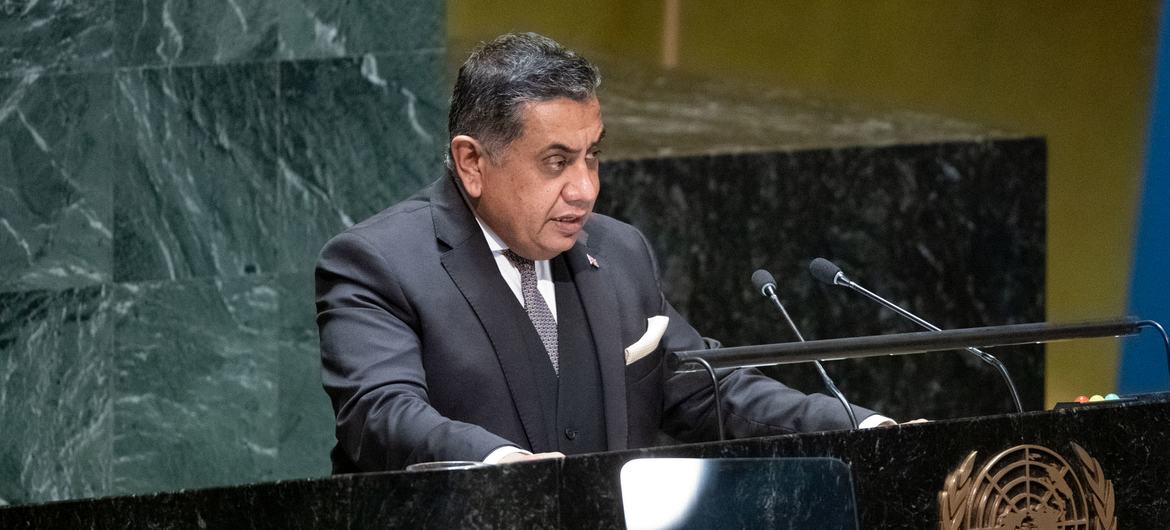
The United Kingdom’s Minister for the Middle East, Lord Tariq Ahmad, began by offering condolences to UN staff and medics who have lost their lives under bombardment in Gaza, together with the victims of the 7 October attacks in Israel and the families of innocent Palestinians killed.

“Every life that is lost is a tragedy. Not just for a family in Israel, Gaza or the West Bank but for all of humanity.”

He called on all parties to respect international humanitarian law, calling for the unconditional release of hostages and unhindered humanitarian access.

Lord Ahmad said it was urgent to scale up aid through the Rafah crossing, and praised the UN Secretary-General and all staff who are working tirelessly to ensure aid reaches those in need.

He said humanitarian pauses were essential to allow aid through.

United Kingdom’s Minister for the Middle East, Lord Tariq Ahmad, addresses the resumed 10th Emergency Special Session meeting on the situation in the Occupied Palestinian Territory.
UN Photo/Evan Schneider
 
United Kingdom’s Minister for the Middle East, Lord Tariq Ahmad, addresses the resumed 10th Emergency Special Session meeting on the situation in the Occupied Palestinian Territory.

Standing against terror

The UK stands with Israel in the face of Hamas terror and Israel’s right to self defence, he underlined, but stressed this must be within international law. 

Stating a "personal view", as a Muslim, the British peer said “terrorism is evil” and every act of terrorism is against humanity “and we must condemn it unequivocally”. 

On this basis, the resolution before the Assembly “should be clearer on this point.”

However, the UK has been equally clear that all steps must be taken to minimize harm and ensure civilian movements are voluntary and safe.

“In this moment of darkness” he said, let’s come together and not lose sight of the promise of a two-State solution to the conflict.

“We in the UK will continue to work closely with all partners in the region and beyond in these efforts because peace must prevail.”

12:39 PM

Brazil: Condemnation for all attacks on civilians

Sérgio França Danese, Ambassador and Permanent Representative of Brazil to the UN, expressed “unequivocal condemnation” of the heinous terrorist attacks by Hamas, including the taking of hostages.

He also “clearly condemned” the attacks that are indiscriminately killing and wounding civilians and destroying homes in the Gaza Strip, depriving them of basic tools for survival.

Mr. França Danese said Brazil, the President of the Security Council for October, welcomed the emergency session after the Security Council failed to adopt any of four draft resolutions on the crisis, including one proposed by his delegation, which drew 12 votes in favour.

The robust support given by Council members to the resolution “indicates that it was a balanced text,” he said, describing the resolution as “solidly rooted” in international humanitarian and human rights law, and “fundamentally committed to the humanitarian imperative.”

12:30 PM

Turkiye: Peace not possible if Palestine aspirations are denied 

Permanent Representative of Türkiye to the United Nations, Sedat Önal said that with a paralyzed Security Council, it is up to the General Assembly to rise to the occasion. Based on principle, Türkiye co-authored the resolution introduced today, which contains the minimum of what we need to put an end to the carnage and ease tensions on the ground.

Targeting civilians and civilian infrastructure will not bring security . Peace will not be possible as long as Palestinians aspirations for freedom, dignity and statehood continue to be denied.  .

11:52 AM

Saudi Arabia: International failures

Abdulaziz M. Alwasil, Ambassador and Permanent Representative of Saudi Arabia to the UN, said that the killing and destruction in the Gaza Strip is not only creating a humanitarian catastrophe but is also having dire consequences and repercussions on the security of the region and the world.

“We have clearly condemned the targeting of civilians by any party, called for a ceasefire, stop to the bloodshed, immediate lifting of the siege, release of hostages, and providing humanitarian assistance and support to those affected,” he said.

Ambassador Abdulaziz M. Alwasil of Saudi Arabia addresses the resumed 10th Emergency Special Session meeting on the situation in the Occupied Palestinian Territory.
UN Photo/Evan Schneider
 
Ambassador Abdulaziz M. Alwasil of Saudi Arabia addresses the resumed 10th Emergency Special Session meeting on the situation in the Occupied Palestinian Territory.

“We also condemned the attempts at forcible displacement and policies of collective punishment against the population in Gaza, including starvation of civilians as a weapon of war,” he added.

Reaffirming the priority should be to work for peace, Ambassador Alwasil called for compliance with international conventions and laws.

He stressed the current crisis was due to the failure on the part of the international community to end Israeli occupation and implement a two-State solution.

“Silence in the face of illegitimate Israeli practices, whether over the past 70 years, or even  recently is what led the region to the current crisis,” he said, warning of a possible spillover of the conflict that would threaten global peace and security. 

11:47 AM

European Union: Humanitarian access essential

The European Union's UN Representative, Olof Skoog, said the EU deeply regretted the use of veto in the Security Council because the crisis requires a strong, timely, united message by the Security Council.

The urgency is to provide safe, rapid, unhindered humanitarian access to populations in need, by all possible means, whether a “corridor” or a “humanitarian pause” - but this must not be exploited by terrorists.

He said the EU is ready to contribute to the resumption of the political process on the basis of a two-State solution and supports the holding of an international peace conference as soon as possible.

He understood the need to reach a consensus in the General Assembly in the absence of a Security Council’s resolution adding that the EU had worked constructively and formulated amendments, to overcome divisions.

11:24 AM

US: 'Omissions of evil' to avoid reference to Hamas or hostages

Linda Thomas-Greenfield, Ambassador and Permanent Representative of US to the UN, emphasized that the death, destruction and desperation “playing out before our eyes is enough for anyone to lose faith in humanity.”

Citing “barbaric acts of terror by Hamas”, Ms. Thomas-Greenfield stressed “there is no justification for terror – none whatsoever. You all know that and we must condemn Hamas’ acts of terror.”  

Ms. Thomas-Greenfield said that to the terrorists of Hamas, civilians “are expendable.”

She said Israel was exercising its right and responsibility to defend its people from Hamas, but “it must do so in line with rules of war” and with respect for international humanitarian law.  

Recalling her country’s work to help protect civilian lives and ensure humanitarian assistance into Gaza, she called on all Member States to also alleviate the humanitarian suffering there.

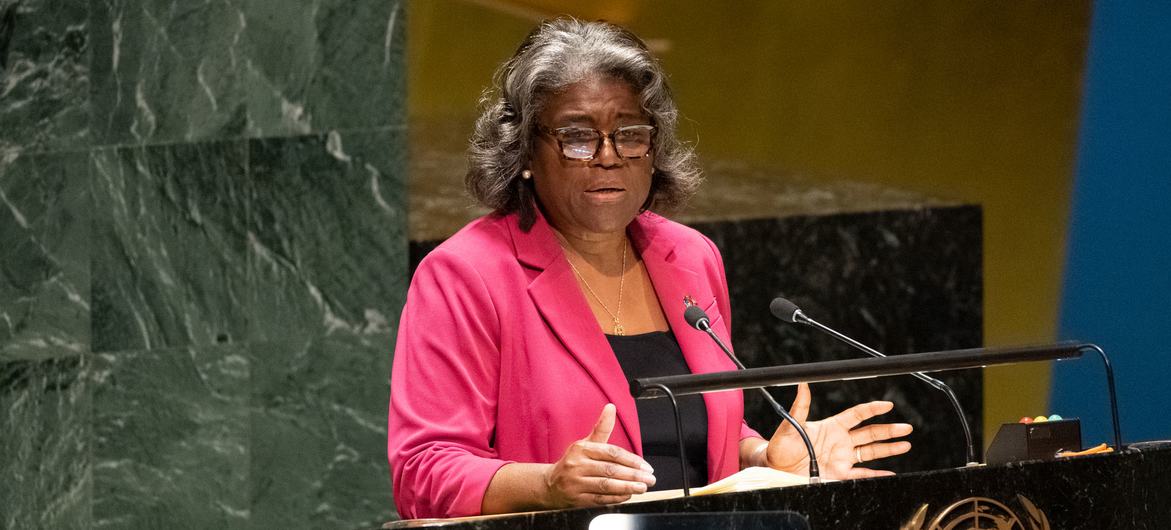
Ambassador Linda Thomas-Greenfield of the United States addresses the resumed 10th Emergency Special Session meeting on the situation in the Occupied Palestinian Territory.
UN Photo/Evan Schneider
 
Ambassador Linda Thomas-Greenfield of the United States addresses the resumed 10th Emergency Special Session meeting on the situation in the Occupied Palestinian Territory.

'Lives hang in the balance'

“Time is of the essence and lives hang in the balance,” she said.

Turning to the resolution, the US Ambassador emphasized that two key words were missing in the draft.

“First is Hamas, it is outrageous that the resolution fails to name the perpetrators of the 7 October terrorist attack,” she said, adding that the other “key word missing is hostage; this resolution makes no mention of the innocent people, including citizens of many of you in this room, who have citizens that are held hostage by Hamas and other terrorist groups.”

“These are omissions of evil, they give cover to and empower Hamas’ brutality, and no Member State should allow that to happen,” she stressed.

Ms. Thomas-Greenfield noted that the US has co-sponsored an amendment by Canada that corrects these omissions, condemning Hamas’ terrorist attacks and calling for immediate and unconditional release of hostages.

“This is the bare minimum we would hope to see on this resolution,” she said, urging all Member States to support the amendment.

“The General Assembly must send a clear message to the world that we stand against all acts of terror and that we stand with all those who are being held hostage,” she added.

Status quo must shift

The Ambassador recalled a statement by President Joe Biden that “there is no going back to the status quo, as it stood on 6 October.”

“We must not go back to a status quo, where Hamas terrorizes Israel and uses Palestinian civilians as human shields, and we must not go back to a status quo where extremist settlers can attack and terrorize Palestinians in the West Bank.”

This means that when this crisis is over, there has to be a vision of what comes next, in our view that vision must be centred around a two-State solution. Getting there will require concerted effort by all of us, she said.

10:58 AM

Egypt: ‘Enough is enough’

Silence over the basic rights of Palestinians under fire in Gaza “is no longer an option” said Egypt’s ambassador Osama Mahmoud Abdelkhalek.

He said there had to one standard applied to all, including Palestinians, as opposed to double standards.

“No to targeting civilians, no to terrorism, no to violating international humanitarian law, no to bombarding hospitals and medical centres, no to killing children, no to the siege and no to cutting off all basic necessities of life.”

He said no to forcible displacement and liquidating human rights: “No to genocide – all people are equal.”

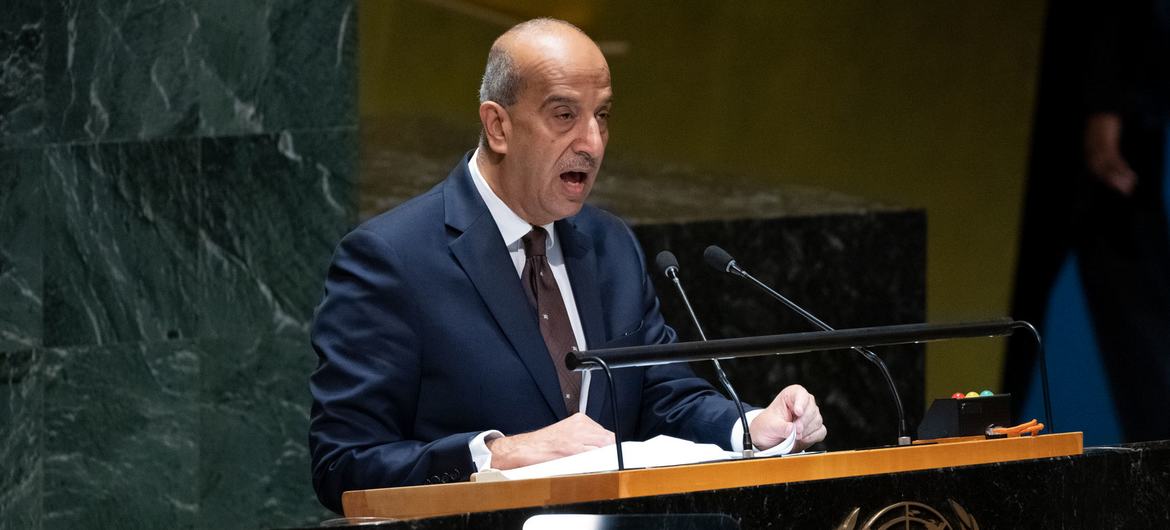
Ambassador Osama Mahmoud Abdelkhalek of Egypt addresses the resumed 10th Emergency Special Session meeting on the situation in the Occupied Palestinian Territory.
UN Photo/Evan Schneider
 
Ambassador Osama Mahmoud Abdelkhalek of Egypt addresses the resumed 10th Emergency Special Session meeting on the situation in the Occupied Palestinian Territory.

He said it was key to speak out to not be – quoting an Arab proverb – a “mute devil that does not speak out for the truth.”

“Enough is enough” he said. “We can no longer bear what is happening to the Palestinians.”

Defending the work of the UN in Gaza and its calls for a humanitarian ceasefire, Ambassador Abdelkhalek said that that had nothing to do with supporting terrorist aggression, but was an important first step “to stop the bloodshed.”

He denounced the policy of besieging and starving civilians of the Gaza Strip, saying that denying them water had “no place in the 21st century. They are reminiscent of practices of the Middle Ages.”

He called on the Assembly to demand aid is delivered to Gaza, “without any conditions”, adding that otherwise it would mean “a death sentence for the people of Gaza.”

Displacing Gazans for the third time in history from their land must be “rejected categorically”, he added.

10:50 AM

Qatar condemns targetting of civilians

Alya Ahmed Saif Al-Thani, Ambassador and Permanent Representative of Qatar to UN, said the crisis threatens the security of the region and the world, and voiced regret over the failure of the Security Council to act.

She called on all parties to deescalate and move towards a full ceasefire; immediate release of all prisoners, particularly civilians; delivery of humanitarian aid into the Gaza Strip; and opening of safe humanitarian corridors.

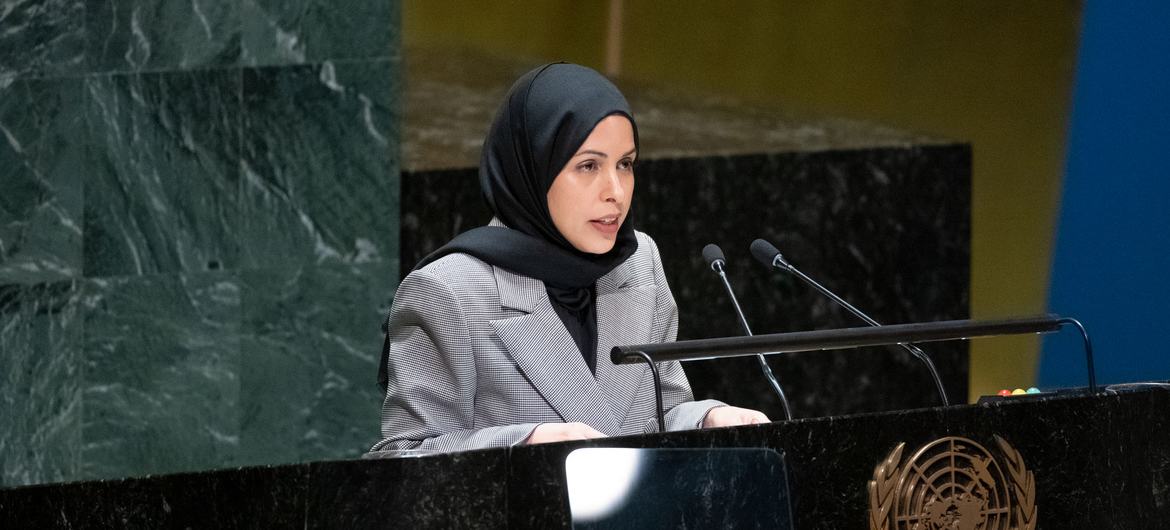
Ambassador Alya Ahmed Saif Al-Thani of Qatar addresses the resumed 10th Emergency Special Session meeting on the situation in the Occupied Palestinian Territory.
UN Photo/Evan Schneider
 
Ambassador Alya Ahmed Saif Al-Thani of Qatar addresses the resumed 10th Emergency Special Session meeting on the situation in the Occupied Palestinian Territory.

Ms. Al-Thani reaffirmed her country’s condemnation of targeting civilians, particularly women and children, as well as “our unequivocal rejection of the siege imposed by Israel, the occupying power”, depriving 2.3 million people - half of them children - of their basic needs.

She urged all Member States to support the Jordanian-led draft resolution and to send a “message of hope".

In conclusion, she said “Qatar continues to contribute to the ongoing diplomatic efforts to find a way out, that will stop the bloodshed of our Palestinian brothers and ensure a sustainable political solution in accordance to the well known terms of reference and steer the region away from spiralling into chaos and violence.”

Ambassador Brian Wallace of Jamaica addresses the resumed 10th Emergency Special Session meeting on the situation in the Occupied Palestinian Territory.
UN Photo/Evan Schneider
 
Ambassador Brian Wallace of Jamaica addresses the resumed 10th Emergency Special Session meeting on the situation in the Occupied Palestinian Territory.

Jamaica: Devasting consequences of escalation

Brian Wallace, Jamaica's Permanent Representative who spoke for Caribbean Community CARICOM, said that If we do not immediately put an end to conflict, it could escalate into a wider regional war.

He expressed concerns about the implications for international stability, with devastating consequences, particularly for small vulnerable island states such as those in CARICOM, which are "already struggling to overcome multi-faceted challenges.” 

“Let us recognize once and for all the utter futility of war, violence and terror,” he said, reaffirming CARICOM's continued support for UN Security Council resolution 242, calling for accelerated efforts for a peaceful and lasting resolution to the conflict. 

10:30 AM

Venezuela: End 'inflammatory rhetoric'

Taking the floor first on Friday, Joaquín Alberto Pérez Ayestarán, Ambassador and Deputy Permanent Representative of Venezuela, also spoke on behalf of the Group of Friends in Defense of the Charter of the United Nations.

He called for an immediate ceasefire and end to all hostilities directed towards civilians and civilian infrastructure, including hospitals, refugee centres and food warehouses.

“We also call for restraint and urge an end to all inflammatory rhetoric and dehumanizing language, which in no way serves ongoing political and diplomatic efforts to deescalate...and on the contrary only further stokes tension and violence endangering thousands of innocent lives,” he said.

On behalf of the Group, he called on the Security Council to urge Israel to heed the latest calls by the UN Secretary-General including sticking to the principles of the UN Charter, the Geneva Conventions, and relevant international law.

10:25 AM

There's no objection to holding a vote at 3 PM. Venezuela is now taking its turn to speak at the podium.

The Assembly also decided by general consent that for the adoption of any draft resolution, and any amendments to it, a two-thirds majority will be required.

10:20 AM:

The President of the General Assembly Dennis Francis has taken his seat and gavelled the special session to order. The Jordanian ambassador is making a point of order. 

He's calling for the suspension of the debate at 3 PM today, to initiate “immediate action” on their resolution.

10:06 AM

Delegates are gathering in the gilded General Assembly Hall for a long day ahead.

A dozen of the 110 speakers due to take the floor spoke on Thursday and we’ll continue coverage here on Friday for day two from 10 AM New York time.

The emergency session is expected to vote on a Jordanian-backed draft resolution on the crisis, which among others calls for an “immediate, durable and sustained humanitarian truce”, all parties comply with international law, and continuous and unhindered aid into the Gaza Strip.

Venezuela is expected to take the floor first first on Friday, followed by Jamaica. Qatar, Egypt and the United States are also expected to be among the early speakers. 

DAY 2

09:00 AM

The draft resolution

The Jordanian-led draft resolution on the crisis is expected to be put to a vote at the end of the emergency session which may extend beyond Friday. It has the backing of over 40 Member States, including Egypt, Oman and UAE.

Key issues in the draft include calls for an “immediate, durable and sustained humanitarian truce”, as well as “demands” that all parties comply with international humanitarian law and for “continuous, sufficient and unhindered” provision of essential supplies and services into the Gaza Strip.

It also calls for the “immediate and unconditional release” of all civilians held captive as well as demanding their safety, well-being and humane treatment in compliance with international law.

An amendment has been proposed by Canada that “unequivocally rejects and condemns the terrorist attacks by Hamas” in Israel starting 7 October and the taking of hostages.

Draft resolutions do not represent the official position of the General Assembly until adopted.

Voting at the UN General Assembly

At the General Assembly, the 193 Member States each have one vote, and in contrast with the Security Council, there are no vetoes.

Decisions of the Assembly on important questions are made by a two-thirds majority of the members present and voting. These questions include: recommendations with respect to the maintenance of international peace and security, or other subjects defined under rule 83 of the General Assembly Rules of Procedures

Decisions on questions other than those provided for in rule 83, including the determination of additional categories of questions to be decided by a two-thirds majority, are made by a majority of the members present and voting.

The phrase “members present and voting” means members casting an affirmative or negative vote. Members which abstain from voting are considered as not voting.

Permanent Observers of the UN, the Holy See and the State of Palestine do not have a say in decisions of the General Assembly. 

DAY 1 HIGHLIGHTS

  • The session convened under the “Uniting for Peace” mandate, empowering the Assembly to act when the Security Council is deadlocked over a critical matter of international peace and security
  • Assembly President Dennis Francis called for an immediate and unconditional humanitarian ceasefire and the opening of aid corridors to save lives
  • The State of Palestine spoke first, making a powerful appeal to stop the killing for the sake of “all those who can be saved”
  • Israel spoke next in another powerful address, describing the brutality of Hamas attacks on Israeli civilians and others, stressing that its siege of Gaza and war against the militant group is to ensure that such “depravity and atrocity never occurs again”
  • Jordan, on behalf of the Arab Group, said it will table a resolution to “make a stand for peace”, after Security Council’s repeated failure to reach any consensus

1:03 PM

The President of the General Assembly Dennis Francis brought Thursday's emergency session to a close saying it would reconvene at 10 am on Friday.

For a full story tying together all the highlights of the first day of the session, visit our Meetings Coverage page here.

Many key countries with a stake in the region have yet to take the iconic podium in the Assembly Hall, and tomorrow's speakers' list will likely see the session last through the entire day. 

For an explainer on how the Security Council and General Assembly work in times of acute international crisis and what happens when no agreement on action can be reached, check out our piece here.

12:47 PM

Mauritania bemoans lack of consensus

Ambassador Sidi Mohamed Laghdaf of Mauritania addresses the resumed 10th Emergency Special Session meeting on the situation in the Occupied Palestinian Territory.
UN Photo/Manuel Elías
 
Ambassador Sidi Mohamed Laghdaf of Mauritania addresses the resumed 10th Emergency Special Session meeting on the situation in the Occupied Palestinian Territory.

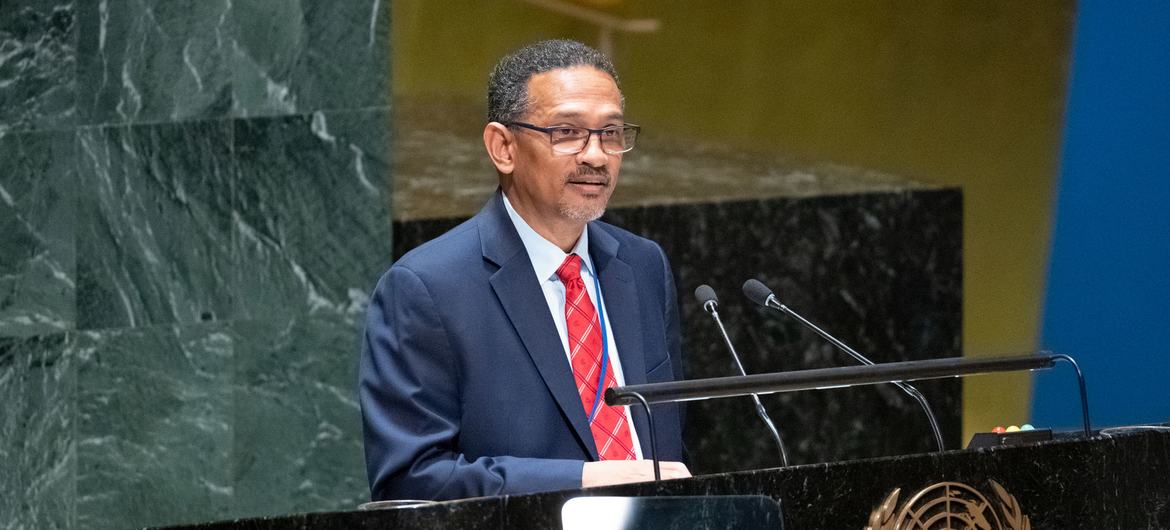
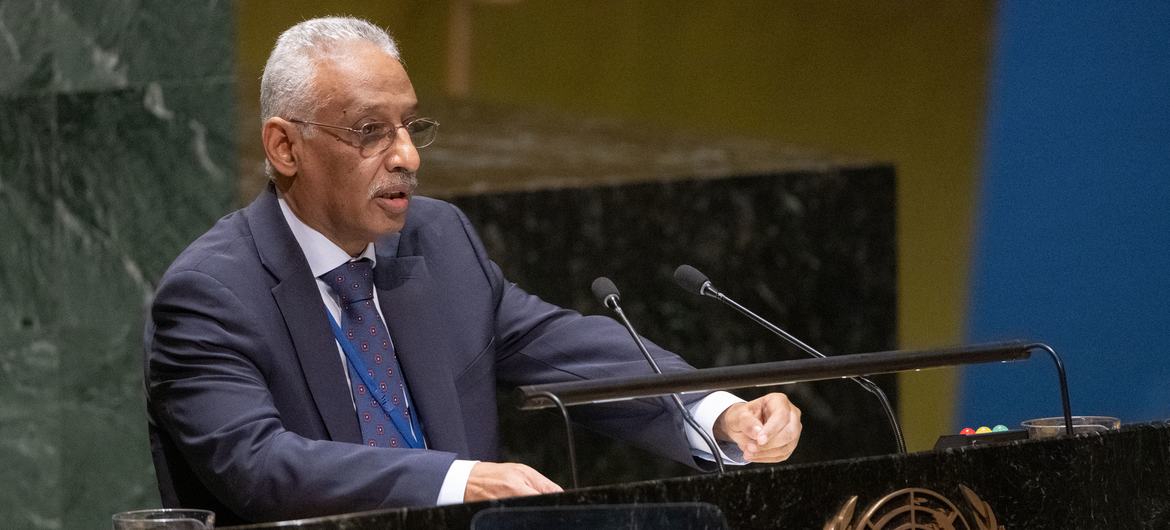
Sidi Mohamed Laghdaf, Ambassador of Mauritania to UN, spoke on behalf of the Organization of Islamic Cooperation saying the absence of any moral, legal, or political consensus has only emboldened the occupying power to carry on with impunity its illegal policy of colonial settlement and annexation.

He pointed to Israel's years-long blockade, forced displacement of Palestinian civilians, systematic ethnic cleansing, organized acts of terrorism, and desecration of holy places, including Jerusalem's Al-Aqsa Mosque.

He added that Israel was persisting with its denial of the violation of the inalienable right of people to self-determination and independence. This unacceptable situation must be brought to an end, he said.

11:51 AM

Iran slams 'genocide'

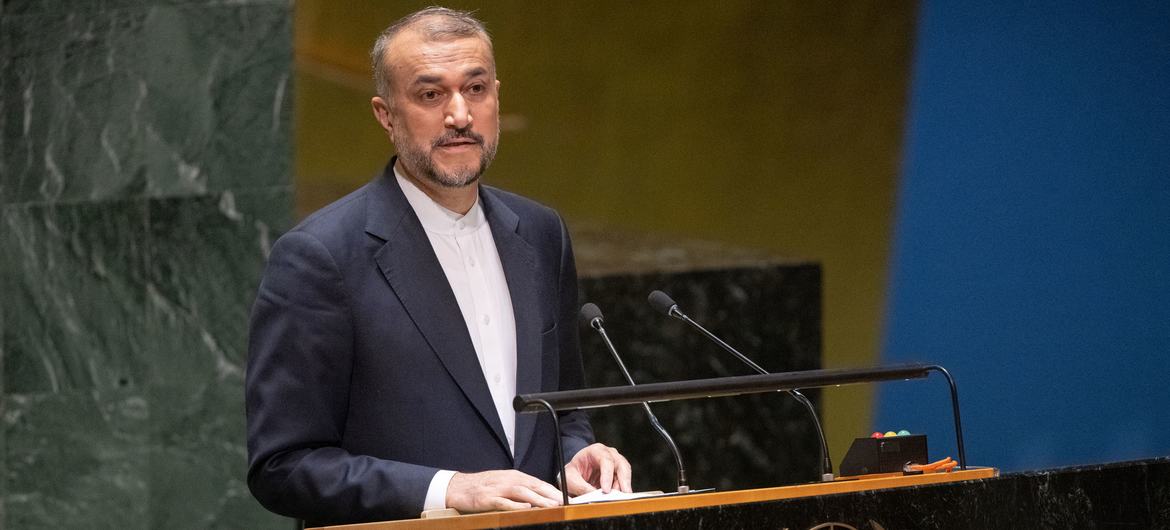
Hossein Amir-Abdollahian, Minister of Foreign Affairs of Iran, said that it has been three weeks that the international community has been a witness to the “war crime and genocide of the occupying Israeli regime in Gaza and the West Bank of Palestine.”

Foreign Minister Hossein Amir-Abdollahian of Iran addresses the resumed 10th Emergency Special Session meeting on the situation in the Occupied Palestinian Territory.
UN Photo/Manuel Elías
 
Foreign Minister Hossein Amir-Abdollahian of Iran addresses the resumed 10th Emergency Special Session meeting on the situation in the Occupied Palestinian Territory.

He said that the US and several European countries sided with Israel and they refer to the Palestinian liberation movement as "terrorists”.

“Unfortunately this is the state of our world today. This is the situation of the Security Council, which was supposed to try to establish world peace and security,” he said.

Mr. Amir-Abdollahian called on the US to work for peace and security and not war against people, women and children, stating “instead of sending rockets, tanks and bombs, to be used against Gaza, the United States should stop supporting genocide in Gaza and Palestine.”

Hamas ready to release civilian hostages

“I say frankly to the American statesmen who are now managing the genocide in Palestine, that we do not welcome the expansion of war in the region, but I warn if the genocide in Gaza continues, they will not be spared from this fire,” he stressed.

“It is our home and West Asia is our region, we do not compromise with any party and any side, and we have no reservation when it comes to our homes’ security.”

He also noted that according to Iranian negotiations, Hamas is ready to release civilian prisoners, on the other hand the international community should support the release of 6,000 Palestinians held in Israeli prisons.

11:28 AM

We must stand for peace: Jordan

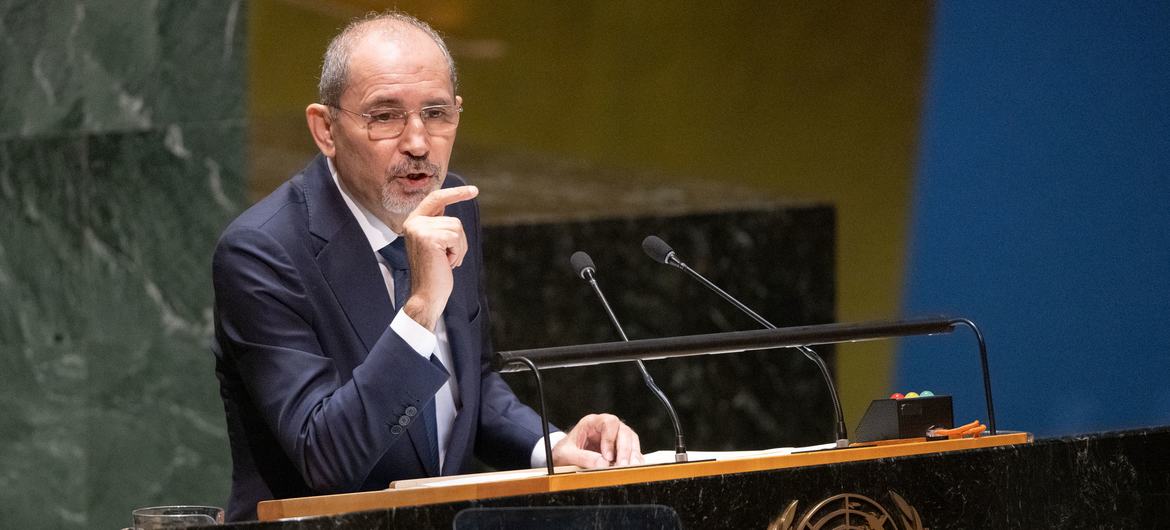
On behalf of the Arab Group, Jordan’s Deputy Prime Minister Ayman Safadi said “there is no room for grey areas”.

Foreign Minister Ayman Safadi of Jordan addresses the resumed 10th Emergency Special Session meeting on the situation in the Occupied Palestinian Territory.
UN Photo/Manuel Elías
 
Foreign Minister Ayman Safadi of Jordan addresses the resumed 10th Emergency Special Session meeting on the situation in the Occupied Palestinian Territory.

“We must stand for peace, our human values and the UN Charter,” he said. “History will judge us. Say no to war. Say no to the killing. Call out war crimes.”

As the killing continues, he said the Israeli Government have cabinet members that call for “wiping out Palestinians from the face of this Earth”.

“Israel is making Gaza a hell on Earth,” he said. “The trauma will haunt generations to come.”

Israel must uphold values, he said. “The right to self-defence is not a right to impunity; Israel cannot remain above the law,” he said. “Let the guns go silent and let the will to live and let live prevail. Let’s restore faith in the peace process as the only path to ending this conflict once and for all.”

Mr. Safadi said Jordan, on behalf of the Arab Group, will table a draft resolution after the UN Security Council failed to do so again on Wednesday.

“Vote for it; make a stand,” he said.

“Let’s make a collective cry, a cry out against more bloodletting,” he said. “Let’s unite for peace.”

“Make a stand for peace, make a stand for life, make it clear, make it firm,” he said, calling for a moment of silence for all the civilians and innocents who have perished during this war. 

10:58 AM

At war with Hamas: Israel

Gilad Erdan, Ambassador and Permanent Representative of Israel to UN, said that the 7 October massacre and what ensued “has nothing” to do with the Palestinians, the Arab-Israeli conflict or the Palestinian question.

Ambassador Gilad Erdan of Israel addresses the resumed 10th Emergency Special Session meeting on the situation in the Occupied Palestinian Territory.
UN Photo/Manuel Elías
 
Ambassador Gilad Erdan of Israel addresses the resumed 10th Emergency Special Session meeting on the situation in the Occupied Palestinian Territory.

“This is not a war with the Palestinians, he said. “Israel is at war with the genocidal jihadist Hamas terror organization. It is the law abiding democracy of Israel against modern day Nazis.”

He went on to note that Hamas does not care about Palestinian people, peace or dialogue. Its only goal is to “annihilate Israel and murder every single Jew on the face of the Earth.”

Mr. Erdan spoke of the brutal killings of innocent Israeli civilians and intentional targeting of Israeli medical teams that were trying to help the injured during the terror attack. He questioned the “hypocrisy” that there is not a single condemnation of the barbarity against Israelis.

“The hypocrisy is beyond belief,” he stressed.

Emergency workers in Israel respond to missile attacks.
© Magen David Adom Israel
 
Emergency workers in Israel respond to missile attacks.

From the podium of the General Assembly Hall, Ambassador UN Erdan presented a video on a tablet, turning the screen towards the delegates, that he said depicted a brutal decapitation with a garden tool against a helpless agricultural worker from Thailand.

'No words' for evil of Hamas

“There are no words in any language to describe the evil we just witnessed,” at the hands of a Hamas militant, he said, adding that it is not describable because it has no place in humankind.

“ISIS was the Islamic State of Iraq and Syria and Hamas is the Islamic State of Gaza. Just as was done with ISIS, Hamas must be no more,” he declared, stating that the goal of Israel is to “completely eradicate Hamas’ capabilities and we will use every means at our disposal to accomplish this.”

“Not for revenge, not for retaliation. But to ensure such depravity and atrocity never occurs again,” said the Israeli ambassador.

10:32 AM

Meeting amidst death in Gaza: Palestine

“We are meeting here while Palestinians in Gaza are under the bombs,” Riyad Mansour, Permanent Observer of the State of Palestine, said, speaking first. 

Riyad Mansour, Permanent Observer of the State of Palestine to the United Nations, addresses the resumed 10th Emergency Special Session meeting on the situation in the Occupied Palestinian Territory.
UN Photo/Manuel Elías
 
Riyad Mansour, Permanent Observer of the State of Palestine to the United Nations, addresses the resumed 10th Emergency Special Session meeting on the situation in the Occupied Palestinian Territory.

“You are speaking while families are being killed, while hospitals are coming to a halt, while neighbourhoods are being destroyed, while people are fleeing from one place to another with no safe place to go.”

“There is no time to mourn,” he said tearfully, pointing to the rising death toll. “If you do not stop it for all those who have been killed, stop it for all those who can be saved.”

Citing personal accounts of life on the ground, he said humanitarian aid is badly needed. Hospitals are operating without anaesthetics, with doctors and patients alike wondering if help is on the way.

“This time, it’s just too much,” he said.

Mr. Mansour, recalling Israel’s recent comments in the UN Security Council about how its people are suffering, said Palestinians are suffering too. Israel’s representative had called to “release the hostages, then takes two million Palestinians hostage”, he added.

There are 1,000 Palestinians killed every day, he said, adding that nothing can justify war crimes and crimes against humanity.

“Why not feel a sense of urgency to ending the killing,” he said. “You are setting us back 80 years by trying to justify what Israel is doing now.”

The Al Shati refugee camp in Gaza has been hit by air strikes.
© UNICEF/Mohammad Ajjour
 
The Al Shati refugee camp in Gaza has been hit by air strikes.

Decades of occupation

Palestinians have survived decades of occupation, 16 years of a blockade and five wars in Gaza, he said.

The answer to the killing of Israelis and Palestinians is not more killing, he said, asking the UN membership to uphold UN principles and keep future generations from the scourge of war.

“The only path forward is justice for the Palestinian people,” he said.

“Vote to stop the killing, vote to stop this madness,” he said. “Choose justice, not vengeance. Choose peace, not more wars. Vote to put an end to almost three weeks of the worst double standards we have seen in decades. Do not miss this chance. Lives are hanging in the balance. Please, save lives, save lives, save lives.”

10:17 AM 

Protect and save lives: Assembly President

Mr. Francis said he was “deeply disturbed and distraught” at the events unfolding in Israel and Palestine.

“Yet again, we gather amidst the gravest escalation of violence and hostility in the Middle East in decades.”

The violence “must end now”, he declared, calling for an immediate and unconditional humanitarian ceasefire and the opening of aid corridors.

He voiced his condemnation of the attack on Israel by Hamas on 7 October, stating “the brutality of the Hamas assault is shocking and unacceptable and has no place in our world.”

He also condemned the indiscriminate targeting of innocent civilians in Gaza and the destruction of critical infrastructure by Israel, he said, adding that “the ceaseless bombardment of the Gaza Strip by Israel and its consequences are deeply alarming.”

Assembly President Francis underscored that the preeminent priority of the collective UN membership “must be to protect and to save civilian lives.”

“All parties to this conflict must abide by international humanitarian law, and immediately create the necessary conditions to allow for an opening of humanitarian corridor to the Gaza Strip,” he said, emphasizing that urgently needed lifesaving assistance must reach those in need.

He also praised the work of UN personnel in Gaza, offering condolences to the families of the 35 UNRWA staff members who were killed since the start of the crisis.

General Assembly President Dennis Francis addresses the resumed 10th Emergency Special Session meeting on the situation in the Occupied Palestinian Territory.
UN Photo/Manuel Elías
 
General Assembly President Dennis Francis addresses the resumed 10th Emergency Special Session meeting on the situation in the Occupied Palestinian Territory.

10:10 AM

Session starts

The President of the General Assembly Dennis Francis gavelled the session open shortly after 10 but he will make the first address in the ornate General Assembly Hall.

He reminded delegates that the emergency session is reconvening following a request by Member States and letters signed by Jordan, Mauritania, Nicaragua and Russia, together with Syria.

Members who have not paid their dues aren't allowed to vote in General Assembly meetings like this, but Mr. Francis agreed by general consent to allow those in arrears a waiver so they can take part. 

09:00 AM (New York)

The tenth Emergency Special Session of the Assembly is expected to start at 10 AM, New York time, and as of now, 110 speakers are inscribed on the list.

The State of Palestine is expected to address Member States first, with Israel expected to go second.

Tweet URL

Emergency Special Session

Under the “Uniting for Peace” landmark resolution, adopted by the General Assembly in 1950, the body can convene an “emergency special session” within 24 hours, should the Security Council “fail to exercise its primary responsibility” for the maintenance of international peace and security.

This tenth Emergency Special Session was convened for the first time in April 1997, following a request from Qatar. It followed a series of Security Council and General Assembly meetings regarding the Israeli decision to build a large housing project in an area of East Jerusalem.

The Session last came together on 13 June 2018 to consider a draft resolution entitled “Protection of the Palestinian civilian population”.

At the end of that session, the Assembly decided to adjourn “temporarily and to authorize the President of the General Assembly at its most recent session to resume its meeting upon request from Member States.”

Ongoing crisis

According to several UN agencies on the ground, critical lifesaving supplies, fuels to keep hospitals running and drinking water is running out.

Meanwhile on Wednesday, the Security Council failed to adopt two resolutions on addressing the humanitarian crisis. China and Russia vetoed a United States-led draft resolution and a second Russian-backed resolution failed to secure sufficient votes in favour.

This followed failures for unity at the Council, last week. A Russian-led draft resolution calling for an “immediate humanitarian ceasefire” was voted down last Monday and the following Wednesday, the US vetoed a Brazilian-led text that urged “humanitarian pauses” to deliver aid to millions in the Gaza Strip.


https://news.un.org/en/story/2023/10/1142847


https://creativecommons.org/licenses/by/3.0/legalcode