суббота, 6 июня 2026 г.

Kyrgyzstan wins seat on UN Security Council for first time ever


By Vibhu Mishra
3 June 2026 
UN Affairs

A closely watched Security Council election delivered a mix of continuity and change on Wednesday, as Austria, Portugal, Trinidad and Tobago, Zimbabwe – and first-time member Kyrgyzstan, secured seats around the iconic horseshoe table.

A dramatic morning which saw multiple rounds of voting for the competitive seats, came amid widening geopolitical divisions and repeated deadlock within the UN body dedicated to resolving conflicts and preventing wars from erupting in the first place.

The five countries were elected by the 193-member General Assembly to serve as non-permanent members of the Security Council for two-year terms beginning on 1 January 2027.

Austria and Portugal won the two seats allocated to the Western European and other States (WEOG) Group, while Trinidad and Tobago and Zimbabwe were elected from the Latin American and Caribbean Group and the African Group respectively.

Kyrgyzstan secured the Asia-Pacific seat after defeating the Philippines in four rounds of voting.

Vote tally

Portugal and Austria prevailed in the first round, receiving 134 and 131 votes respectively – comfortably above the required two-thirds majority. Germany received 104 votes and was eliminated.

In the Latin American and Caribbean Group, Trinidad and Tobago secured 181 votes, while Guyana received one vote despite not being a candidate.

Zimbabwe, the sole candidate for the African Group seat, received 182 votes.

Kyrgyzstan makes history

The most competitive contest unfolded in the Asia-Pacific Group. Kyrgyzstan led the first ballot with 105 votes to the Philippines’ 85, before steadily increasing its support through three head-to-head rounds of voting, ultimately prevailing by 142 to 49 in the fourth round.

The election marks a historic milestone for Kyrgyzstan, which will serve on the Security Council for the first time since joining the United Nations in 1992.

Delegates from the Kyrgyz mission applauded and celebrated with other diplomatic well-wishers for several minutes following the result inside the gilded General Assembly Hall.

The other four newly elected members all have previous Council experience: Austria and Portugal have served three times each, Zimbabwe twice and Trinidad and Tobago once.
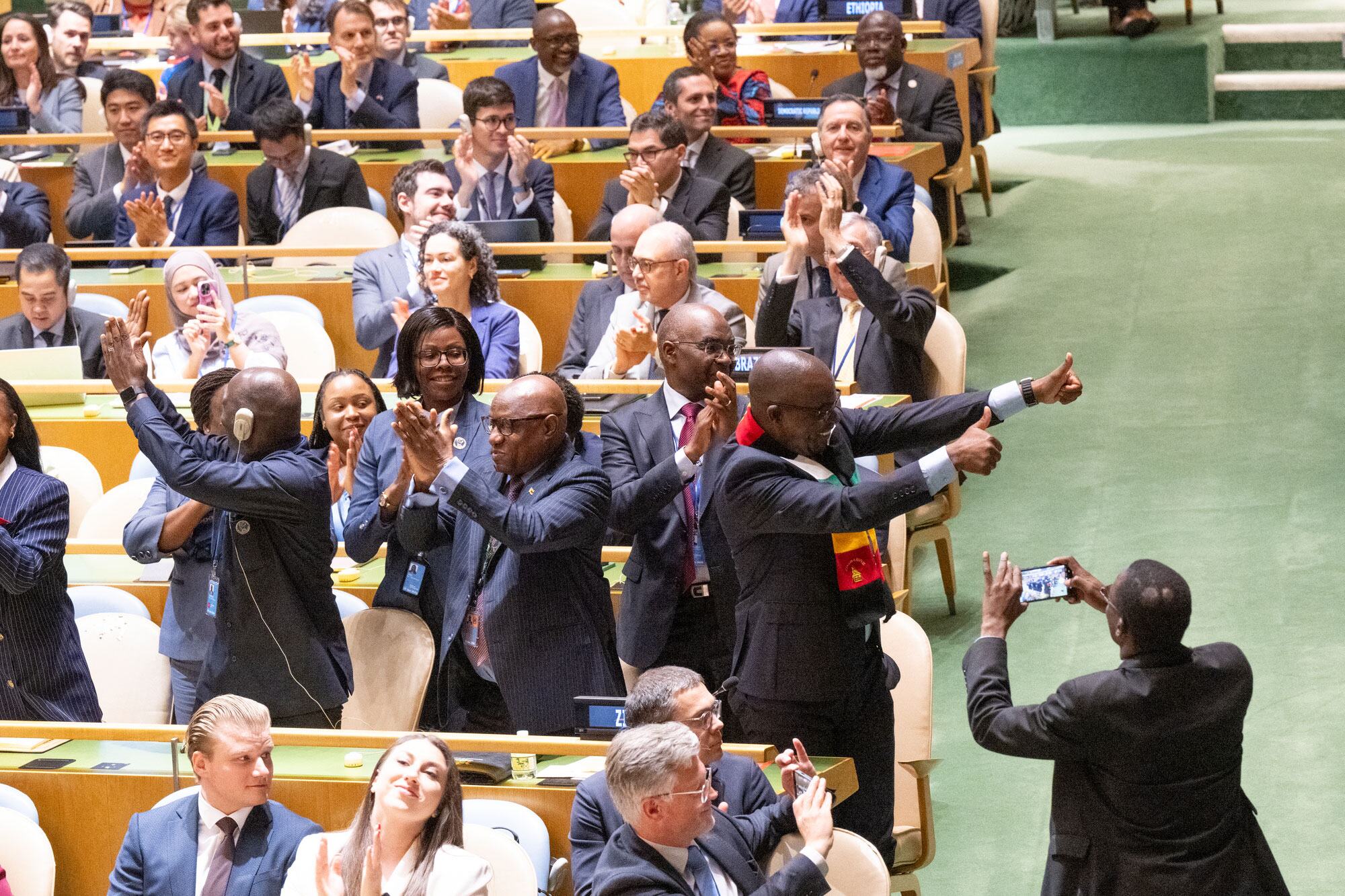
 

Делегаты от Зимбабве празднуют свое избрание непостоянным членом Совета Безопасности ООН.
UN Photo/Eskinder Debebe The delegation of Zimbabwe celebrate after being elected.
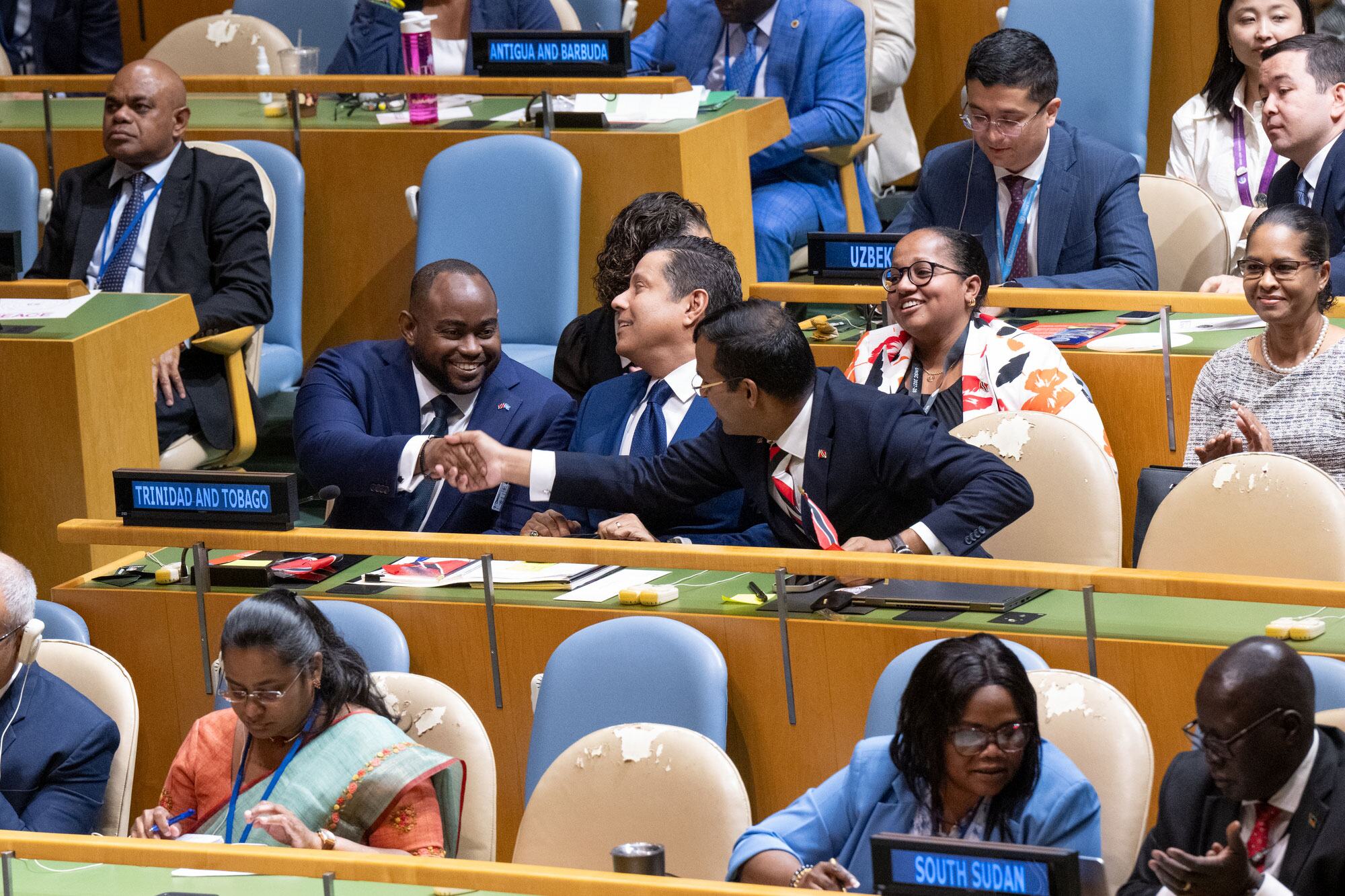
Делегаты из Тринидада и Тобаго празднуют победу на заседании Совета Безопасности ООН, пожимая друг другу руки в зале заседаний.
UN Photo/Eskinder Debebe The delegation of Trinidad and Tobago celebrate after being elected.

Fifteen seats

The Council comprises 15 members: five permanent members – China, France, Russia, the United Kingdom and the United States – with veto power and 10 non-permanent members elected for staggered two-year terms.

Seats are distributed among regional groups to ensure geographical representation.

The five countries elected on Wednesday will replace Denmark, Greece, Pakistan, Panama and Somalia when their terms conclude at the end of 2026.

Bahrain, Colombia, the Democratic Republic of the Congo, Latvia and Liberia will remain on the Council through the end of 2027, providing continuity in its work.
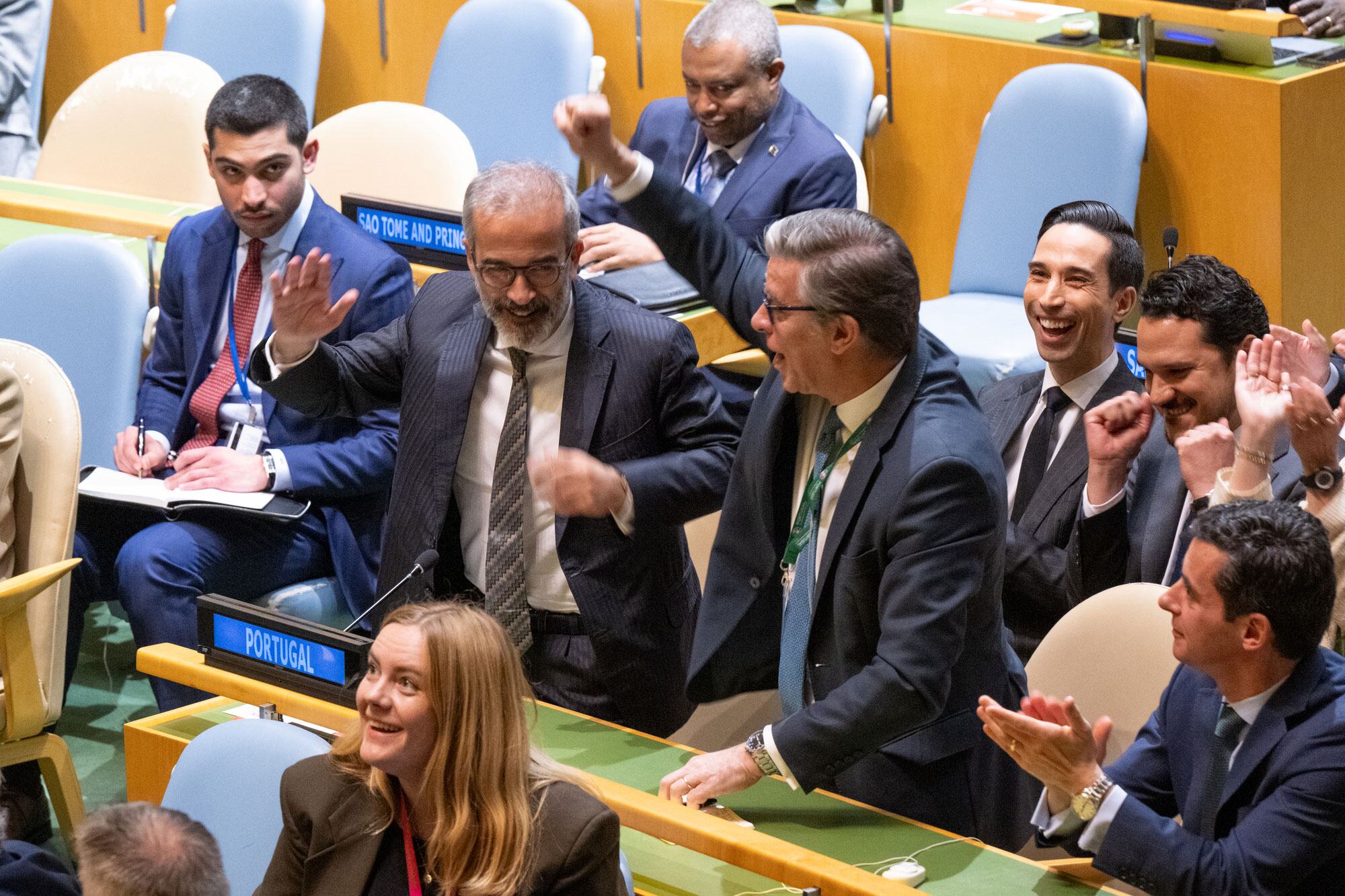
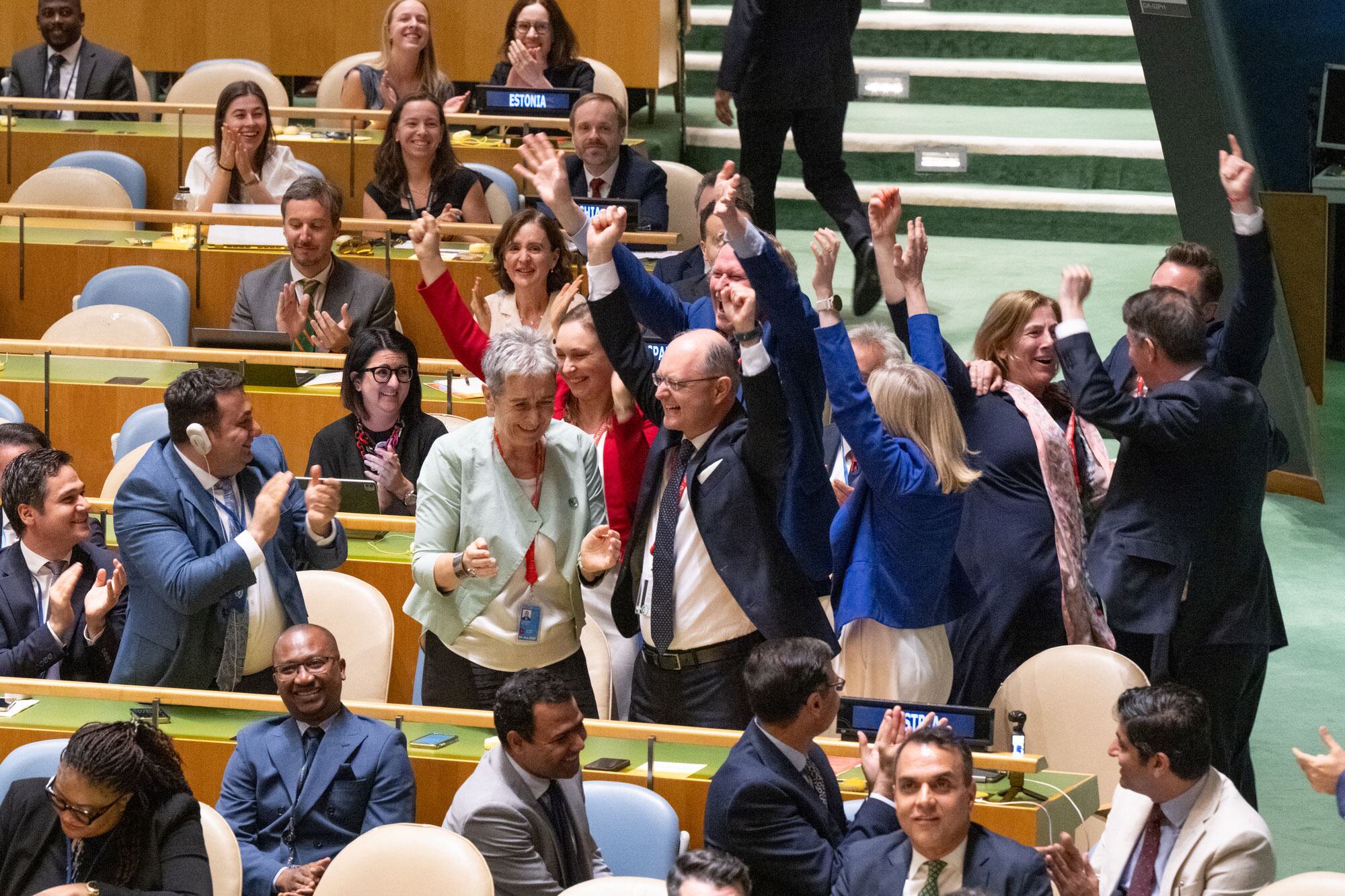
Португальская делегация празднует избрание непостоянным членом Совета Безопасности ООН.
UN Photo/Eskinder Debebe The delegation of Portugal celebrate after being elected.
Анналена Бербок и другие делегаты празднуют избрание новых членов Совета Безопасности на пленарном заседании Генеральной Ассамблеи Организации Объединенных Наций.
UN Photo/Eskinder Debebe The delegation of Austria celebrate after being elected.

Peace under pressure

The incoming members will take their seats at a moment when the Council faces some of its most difficult tests in years.

Its work has increasingly been shaped by geopolitical rivalries among major powers, particularly the five permanent members.

Deep divisions over conflicts including Ukraine and Gaza have led to stalemate, frustrating action, while the use of vetoes has at times prevented agreement on resolutions addressing major crises.

Growing calls for reform

The Council has also faced mounting calls for reform, with UN and world leaders arguing that its composition no longer reflects contemporary geopolitical realities.

Secretary-General António Guterres has repeatedly warned that international institutions remain “stuck in the world as it was in 1945, not the world of today,” including the Security Council itself.

African countries have been among the strongest advocates for change, arguing that a continent of 54 Member States remains underrepresented in the Council's permanent decision-making structures. Calls for expanded representation from developing countries overall have also grown louder.


https://news.un.org/en/story/2026/06/1167636

https://creativecommons.org/licenses/by/4.0/legalcode

суббота, 3 января 2026 г.

Security Council: New faces, old tensions as five nations take their seats


Security Council: New faces, old tensions as five nations take their seats

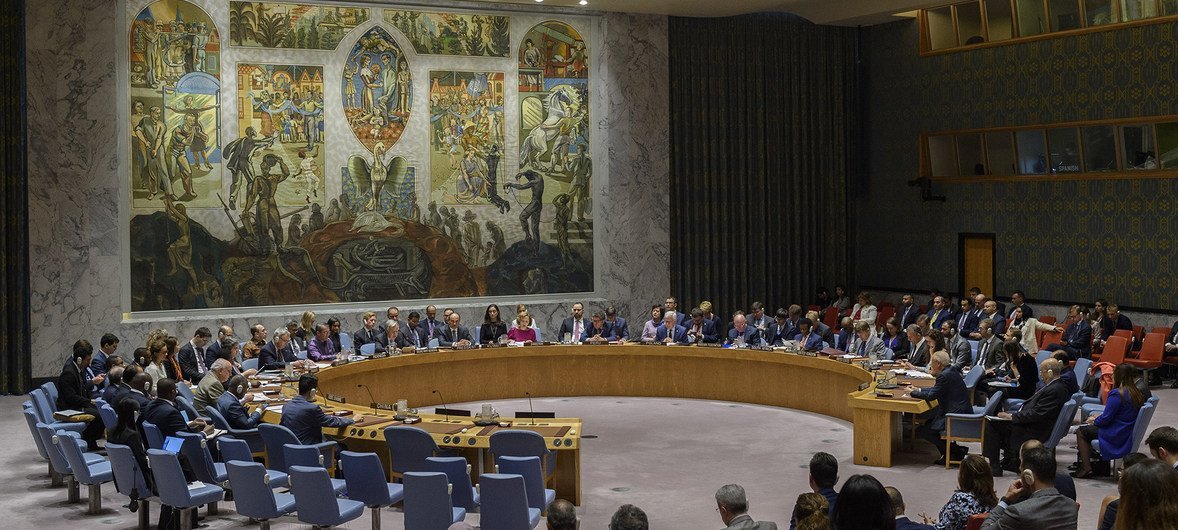
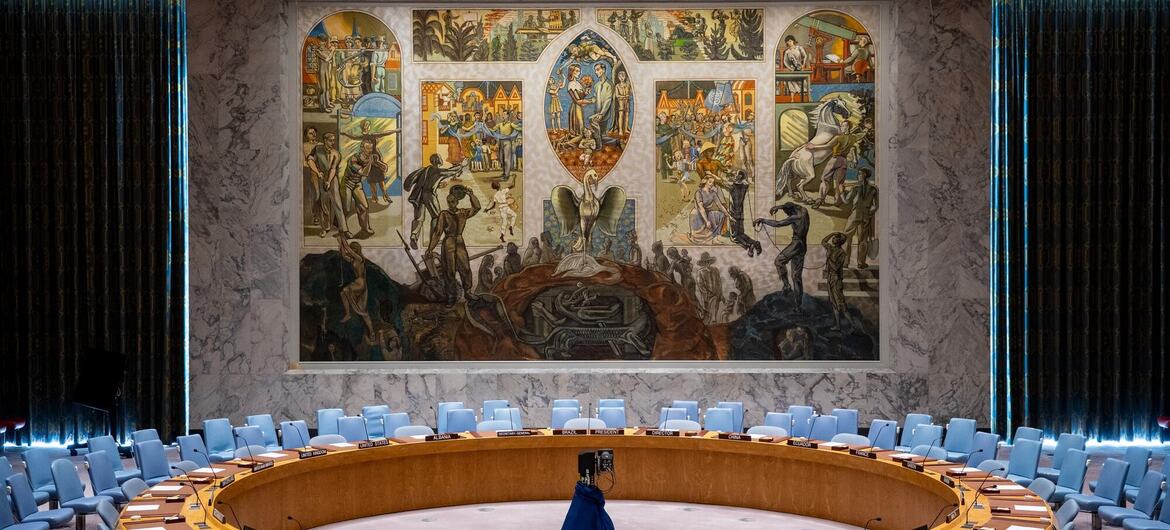
The Security Council Chamber of the United Nations, featuring a large mural by Norwegian artist Per Krohg depicting a phoenix rising from ashes of war and slavery into a peaceful world, donated in 1952.
UN Photo/Paulo Filgueiras
 
A wide view of the Security Council Chamber. (file photo)


By Vibhu Mishra
2 January 2026 
Peace and Security

From deploying peacekeepers to conducting quiet – but at times heated – diplomacy, the UN Security Council sits at the heart of global decision-making on war and peace. As of January, five new countries will have a seat around the iconic horseshoe table.

Bahrain, Colombia, the Democratic Republic of the Congo, Latvia and Liberia have begun two-year terms as non-permanent members, replacing Algeria, Guyana, the Republic of Korea, Sierra Leone and Slovenia, whose terms ended last month.

They join the other five non-permanent members – Denmark, Greece, Pakistan, Panama and Somalia – who will serve through the end of 2026, alongside the five nations who are a constant presence – China, France, Russia, the United Kingdom and the United States.

The P5, as permanent members are called, hold veto power, allowing any one of them to block the adoption of a substantive resolution, regardless of majority support.

What the Security Council does

Under the UN Charter, the Security Council has primary responsibility for maintaining international peace and security. It is the only UN body whose decisions are legally binding on all Member States.

It can investigate disputes, urge parties to resolve conflicts, impose sanctions, authorise peacekeeping operations and – in exceptional circumstances – approve the use of force. Its resolutions shape international responses to armed conflicts, terrorism and nuclear proliferation.

The Council’s work unfolds both in public and behind closed doors: open meetings allow Member States, the media and the public, access to debates and briefings, while closed consultations give diplomats space to negotiate sensitive issues privately.

The Council has a calendar of meetings but can also convene emergency sessions at short notice.

Members of the UN Security Council meet in the Security Council Chamber at UN headquarters in New York.
UN Photo/Loey Felipe
 
An open meeting of the Security Council. Its 15 members and the Secretary-General seated at the iconic horseshoe table, along with an invited participant (far right).

Inside the Security Council Chamber

  • The mural: A vast painting dominates the chamber, depicting a phoenix rising from the ashes as a symbol of renewal – humanity’s struggle from conflict toward peace.
  • The doors: The heavy wooden doors, inlaid with images of torches and swords – symbols of war – emphasise the Council’s responsibility to preserve peace.
  • The horseshoe table: The curved table ensures there is no head position, symbolic of formal equality, even as diplomatic power dynamics play out in practice. 

Read more about the Chamber here.

Prestige and responsibility

Non-permanent members are elected annually by the 193-member General Assembly through a secret ballot. Seats are allocated by regional group, and candidates must secure a two-thirds majority to win election.

Membership involves considerable costs, covering meetings, travel, logistics and staff. More than 50 UN Member States have never served, underscoring the significance and capital involved in occupying a seat – Latvia makes history this January, joining for the first time.

Countries that are not Council members may take part in discussions without a vote when their interests are affected or when they are party to a dispute under consideration.

Growing deadlock, vetoes

The new members take their seats amid growing geopolitical divisions, with deep disagreements over conflicts such as Ukraine and the Middle East increasingly limiting unified action.

This deadlock is reflected in the growing use of the veto.

In the years following the end of the Cold War, vetoes were rare, often numbering one or two per year - and sometimes none at all. Since the mid-2010s, hands have been raised inside the chamber more often: seven times in 2023 and eight in 2024.

Diplomats often point to this trend as evidence of widening geopolitical rifts, which have made consensus harder to achieve and limited the Council’s ability to respond decisively.

Many of the UN's mandates are agreed at the Security Council at UN Headquarters in New York.
UN Photo/Rick Bajornas
 
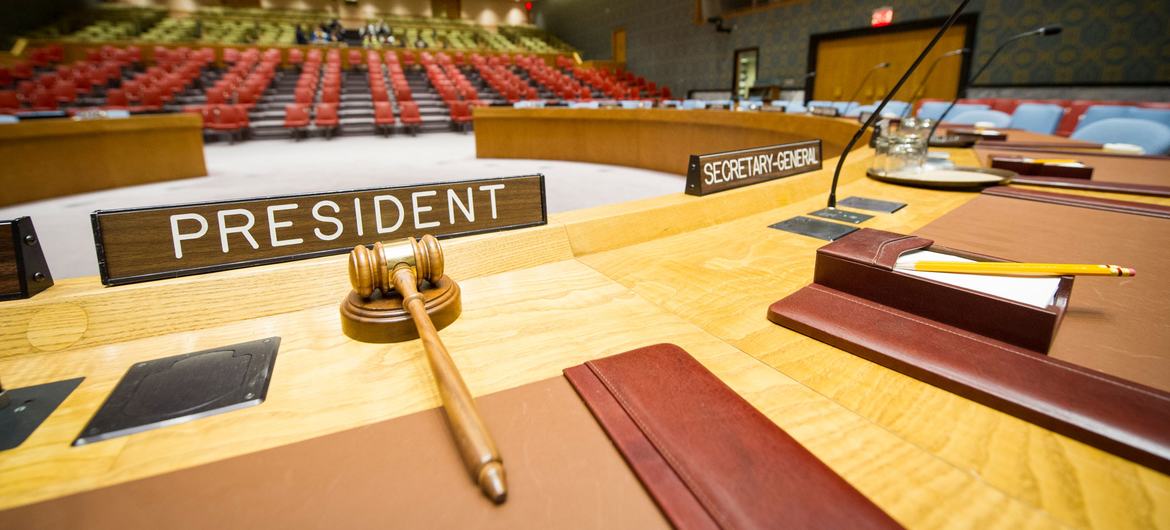
The seat of the President of the Security Council and the gavel used to conduct its meetings.

Somalia at the helm

Each month, one Council member serves as President, a role that rotates in English alphabetical order among the 15 members. For January, it is Somalia.

The Presidency sets the programme of work, chairs meetings and issues statements on behalf of the Council. It is a role described as “wearing two hats”: acting both as a neutral facilitator for the Council as a whole and as a representative of their own national government.

After a turbulent 2025 that saw escalating warfare and shrinking resources, 2026 will test whether members can help build momentum and open space for decisive action, in a body increasingly shaped by entrenched positions.

https://news.un.org/en/story/2026/01/1166697

https://creativecommons.org/licenses/by/4.0/legalcode
четверг, 1 января 2026 г.

Results expected 5 January after landmark elections in Central African Republic


Results expected 5 January after landmark elections in Central African Republic

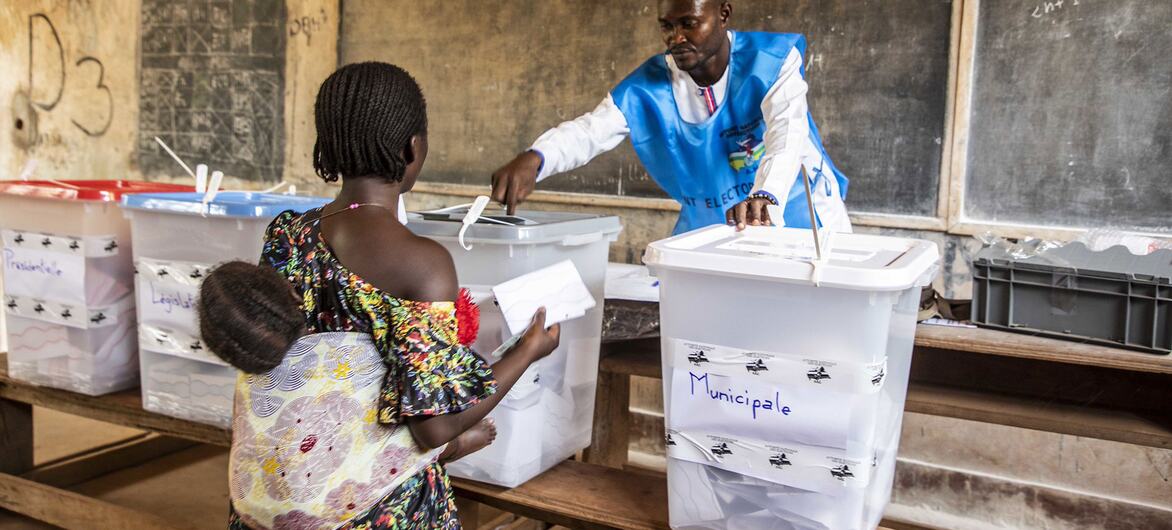
A woman carrying a child places a ballot into a transparent ballot box labeled 'Municipale' while an election official observes in a classroom setting.
MINUSCA
 
A woman, carrying a baby, casting her votes during the elections.


By Vibhu Mishra
31 December 2025 
Peace and Security

Voting proceeded largely as planned in the Central African Republic’s first-ever combined presidential, legislative, regional and municipal elections, and ballot counting is now complete, the UN peacekeeping mission (MINUSCA) said on Wednesday, with results expected to be announced on 5 January.

According to MINUSCApreliminary reports from observers indicate that more than 99 per cent of polling stations across the country opened as scheduled on election day.

The transfer of envelopes containing the results from 19 prefectural capitals to the national capital, Bangui, is now underway, with logistical and security support from the mission.

The 28 December vote marked an unprecedented moment in the country’s political history, bringing together four ballots in a single electoral exercise. Municipal elections, in particular, had not been held in the Central African Republic (CAR) since 1988 and were a key provision of the 2019 Political Agreement for Peace and Reconciliation.

Vast, sparsely populated and landlocked, CAR is crisscrossed by dense forests, rivers and long, often impassable roads. Outside Bangui, many communities are reachable only by air or days-long journeys.

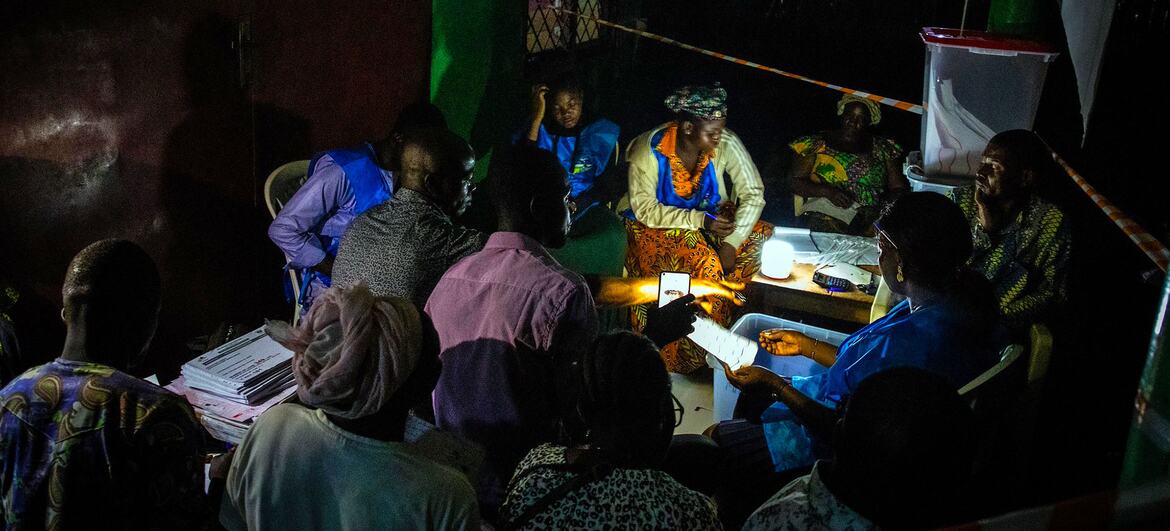
A group of people gathered around a table at night, counting ballots during an election under the light of a small lamp, with a ballot box in the background.
MINUSCA
 
Ballots are counted under flashlights after the elections in Central African Republic.

Extensive UN support for complex operation

MINUSCA said it worked closely with national authorities and UN agencies to support the electoral process, delivering all voting materials on time despite difficult terrain and security constraints.

In total, the mission carried out 84 flights and eight road convoys to transport more than 230 tonnes of election materials, including ballot papers, indelible ink, voter cards, voting booths and ballot boxes.

Electoral materials were delivered to 6,679 of the country’s 6,700 polling stations, allowing them to function normally across 20 prefectures.

On the technical and operational front, some 34,500 people – including electoral agents, supervisors and polling station staff – were trained with UN support.

Security measures

Security for the polls was reinforced through the deployment of additional national troops and police, supported logistically by MINUSCA, alongside strengthened patrols by UN peacekeepers and police personnel.

The mission also provided Central African armed forces and internal security personnel with vehicles and motorcycles to reach remote and isolated areas.

Speaking at a press conference in Bangui on Wednesday, the Special Representative of the Secretary-General for CAR, Valentine Rugwabiza, said the mission had successfully fulfilled its mandate despite operating in a challenging environment.

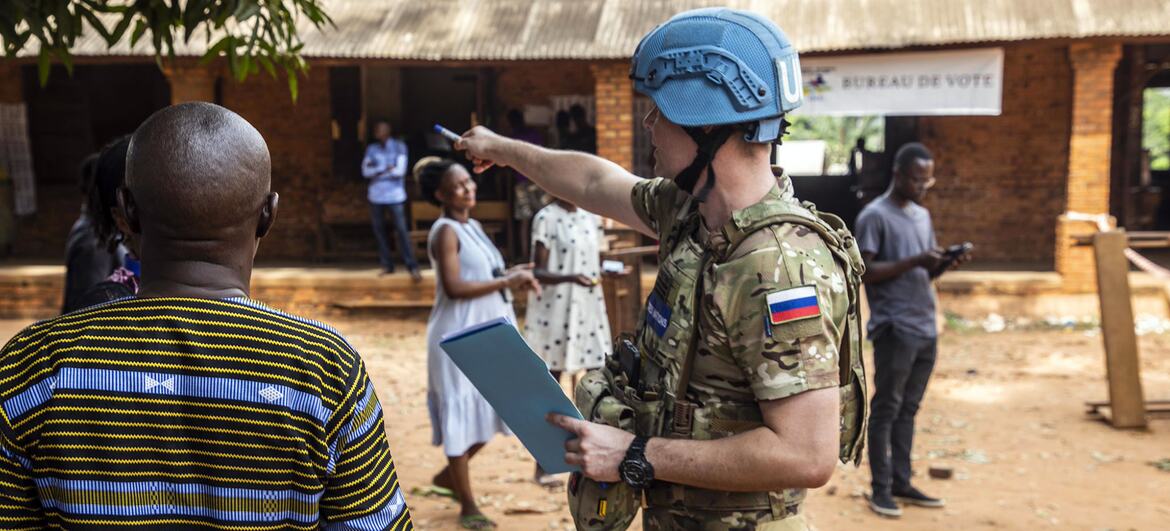
A UN peacekeeper in a blue helmet and military uniform points at a ballot box while overseeing an election at a 'Bureau de Vote' in Africa.
MINUSCA
 
UN peacekeepers on patrol at a polling centre in the capital Bangui during the elections.

Incident in Haut-Mbomou

Ms. Rugwabiza strongly condemned an attack in Bambouti, in the south-eastern Haut-Mbomou prefecture near the border with South Sudan, which prevented voting from taking place in that locality due to insecurity.

The attack, carried out by the Azandé Ani Kpi Gbe (AAKG) armed group, also involved hostage-taking, including the sub-prefect.

She said MINUSCA has been working around the clock since Sunday to facilitate the release of those taken hostage.

Results expected next week

The National Elections Authority (NEA) is expected to announce the preliminary results of the presidential election on 5 January 2026.


https://news.un.org/en/story/2025/12/1166688


https://creativecommons.org/licenses/by/4.0/legalcode