Показаны сообщения с ярлыком Peace and Security. Показать все сообщения

суббота, 3 января 2026 г.

Security Council: New faces, old tensions as five nations take their seats

Security Council: New faces, old tensions as five nations take their seats

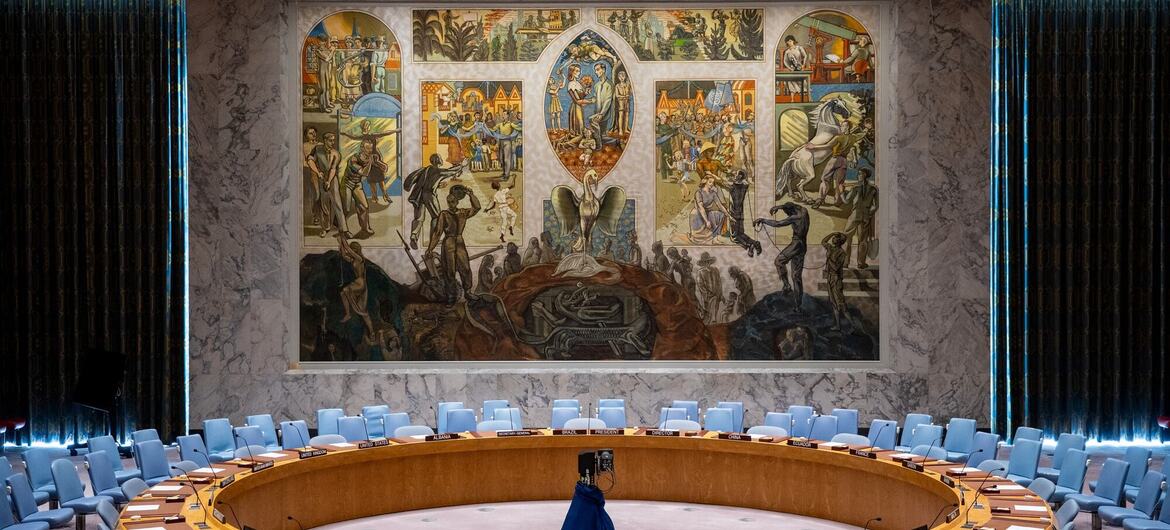
The Security Council Chamber of the United Nations, featuring a large mural by Norwegian artist Per Krohg depicting a phoenix rising from ashes of war and slavery into a peaceful world, donated in 1952.
UN Photo/Paulo Filgueiras
 
A wide view of the Security Council Chamber. (file photo)


By Vibhu Mishra
2 January 2026 
Peace and Security

From deploying peacekeepers to conducting quiet – but at times heated – diplomacy, the UN Security Council sits at the heart of global decision-making on war and peace. As of January, five new countries will have a seat around the iconic horseshoe table.

Bahrain, Colombia, the Democratic Republic of the Congo, Latvia and Liberia have begun two-year terms as non-permanent members, replacing Algeria, Guyana, the Republic of Korea, Sierra Leone and Slovenia, whose terms ended last month.

They join the other five non-permanent members – Denmark, Greece, Pakistan, Panama and Somalia – who will serve through the end of 2026, alongside the five nations who are a constant presence – China, France, Russia, the United Kingdom and the United States.

The P5, as permanent members are called, hold veto power, allowing any one of them to block the adoption of a substantive resolution, regardless of majority support.

What the Security Council does

Under the UN Charter, the Security Council has primary responsibility for maintaining international peace and security. It is the only UN body whose decisions are legally binding on all Member States.

It can investigate disputes, urge parties to resolve conflicts, impose sanctions, authorise peacekeeping operations and – in exceptional circumstances – approve the use of force. Its resolutions shape international responses to armed conflicts, terrorism and nuclear proliferation.

The Council’s work unfolds both in public and behind closed doors: open meetings allow Member States, the media and the public, access to debates and briefings, while closed consultations give diplomats space to negotiate sensitive issues privately.

The Council has a calendar of meetings but can also convene emergency sessions at short notice.
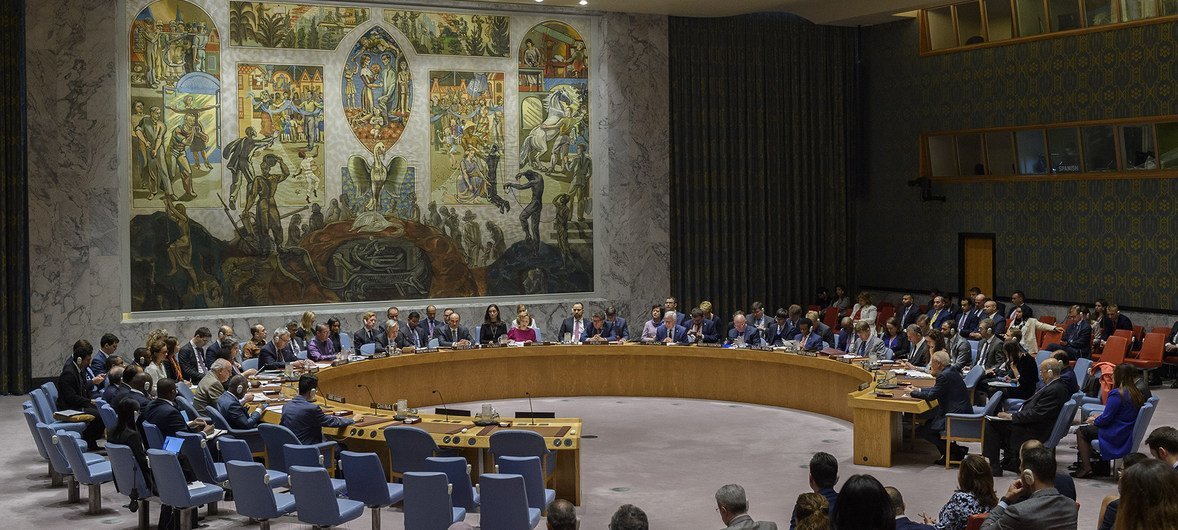
Members of the UN Security Council meet in the Security Council Chamber at UN headquarters in New York.
UN Photo/Loey Felipe
 
An open meeting of the Security Council. Its 15 members and the Secretary-General seated at the iconic horseshoe table, along with an invited participant (far right).

Inside the Security Council Chamber

  • The mural: A vast painting dominates the chamber, depicting a phoenix rising from the ashes as a symbol of renewal – humanity’s struggle from conflict toward peace.
  • The doors: The heavy wooden doors, inlaid with images of torches and swords – symbols of war – emphasise the Council’s responsibility to preserve peace.
  • The horseshoe table: The curved table ensures there is no head position, symbolic of formal equality, even as diplomatic power dynamics play out in practice. 

Read more about the Chamber here.

Prestige and responsibility

Non-permanent members are elected annually by the 193-member General Assembly through a secret ballot. Seats are allocated by regional group, and candidates must secure a two-thirds majority to win election.

Membership involves considerable costs, covering meetings, travel, logistics and staff. More than 50 UN Member States have never served, underscoring the significance and capital involved in occupying a seat – Latvia makes history this January, joining for the first time.

Countries that are not Council members may take part in discussions without a vote when their interests are affected or when they are party to a dispute under consideration.

Growing deadlock, vetoes

The new members take their seats amid growing geopolitical divisions, with deep disagreements over conflicts such as Ukraine and the Middle East increasingly limiting unified action.

This deadlock is reflected in the growing use of the veto.

In the years following the end of the Cold War, vetoes were rare, often numbering one or two per year - and sometimes none at all. Since the mid-2010s, hands have been raised inside the chamber more often: seven times in 2023 and eight in 2024.

Diplomats often point to this trend as evidence of widening geopolitical rifts, which have made consensus harder to achieve and limited the Council’s ability to respond decisively.
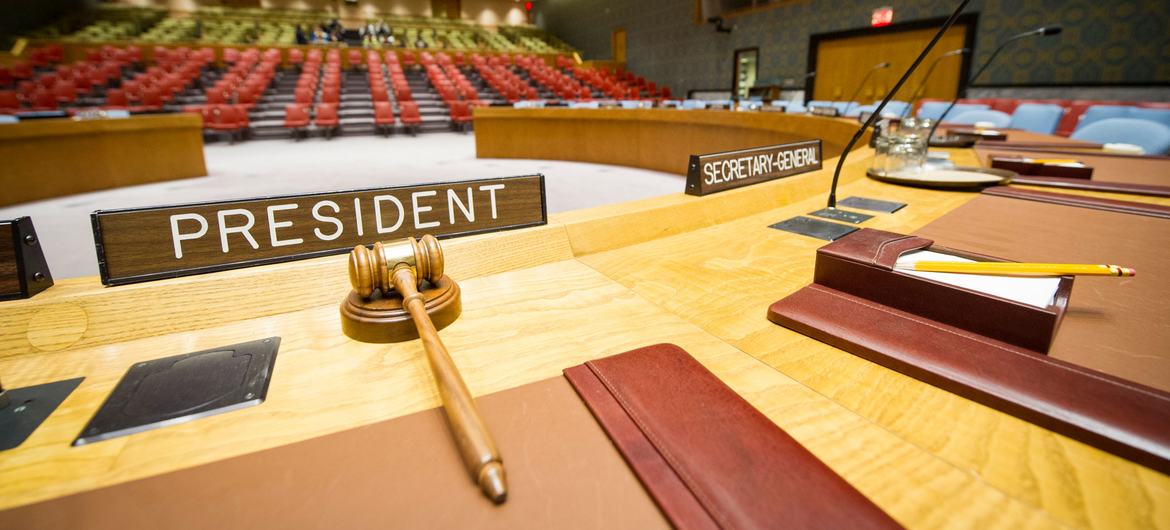
Many of the UN's mandates are agreed at the Security Council at UN Headquarters in New York.
UN Photo/Rick Bajornas
 
The seat of the President of the Security Council and the gavel used to conduct its meetings.

Somalia at the helm

Each month, one Council member serves as President, a role that rotates in English alphabetical order among the 15 members. For January, it is Somalia.

The Presidency sets the programme of work, chairs meetings and issues statements on behalf of the Council. It is a role described as “wearing two hats”: acting both as a neutral facilitator for the Council as a whole and as a representative of their own national government.

After a turbulent 2025 that saw escalating warfare and shrinking resources, 2026 will test whether members can help build momentum and open space for decisive action, in a body increasingly shaped by entrenched positions.

https://news.un.org/en/story/2026/01/1166697

https://creativecommons.org/licenses/by/4.0/legalcode

вторник, 16 декабря 2025 г.

Ex-UN chief Ban warns Security Council risks irrelevance without reform


A wide view of the UN Security Council open debate on "Leadership for Peace".


By Vibhu Mishra
15 December 2025 
Peace and Security

Gathered around the Security Council’s iconic horseshoe table, ambassadors were challenged on Monday to look backwards – when, despite deep rivalry and distrust, the body chose leaders capable of steering the world away from catastrophe towards active cooperation.

That call came during an open debate on “Leadership for Peace,” where former Secretary-General Ban Ki-moon and academic Anjali Dayal pressed members to confront both the external crises facing the UN and internal constraints that have weakened its ability to act.

Mr. Ban, now an emeritus member of The Elders group, warned that global conditions have worsened since he left office at the end of 2016, marked by deepening confrontation among major powers, eroding multilateralism and conflicts in which civilians continue to pay the highest price.

“This deeply disappointing situation is characterized by confrontation rather than cooperation among major powers,” he told the Council, mass civilian casualties in Gaza and weakening international cooperation – even as the global climate crisis accelerates.

Lurching towards irrelevance

The former UN chief said the overall crisis cannot be separated from the Security Council’s own failures.

“The Security Council’s ongoing failure to properly function constitutes the most egregious cause,” he said, highlighting the repeated use of veto by permanent members “to shield themselves, their allies and their proxies from accountability.”

Without meaningful reform, Mr. Ban warned, civilians will remain unprotected and impunity will persist. “Without it, the UN risks lurching towards either collapse or irrelevance,” he said.

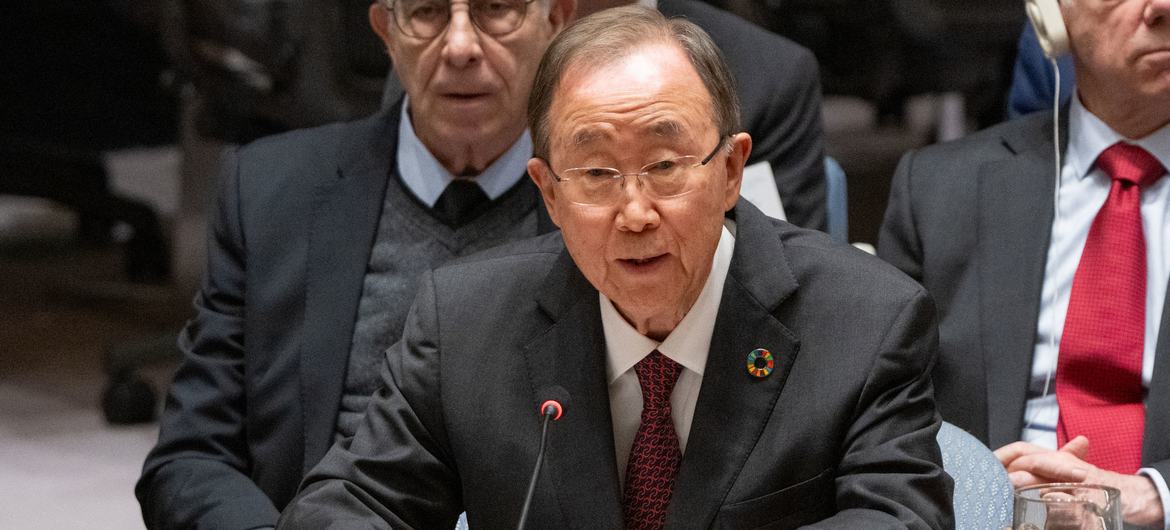
Former UN Secretary-General Ban Ki-moon speaking at a Security Council meeting on international peace and security.
UN Photo/Eskinder Debebe
 
Former Secretary-General Ban Ki-moon, addresses the Security Council.

Reduce political pressures

Turning to the selection of the next Secretary-General, Ban called for a single, non-renewable seven-year term to strengthen the independence of the office.

The current practice of two five-year terms, he said, leaves Secretaries-General “overly dependent on this Council’s Permanent Members for an extension,” even though the arrangement is a convention rather than a requirement of the UN Charter.

“The General Assembly holds the power to set the terms of the appointment itself,” Mr. Ban noted, urging member states to use that authority to empower the next UN leader more fully.

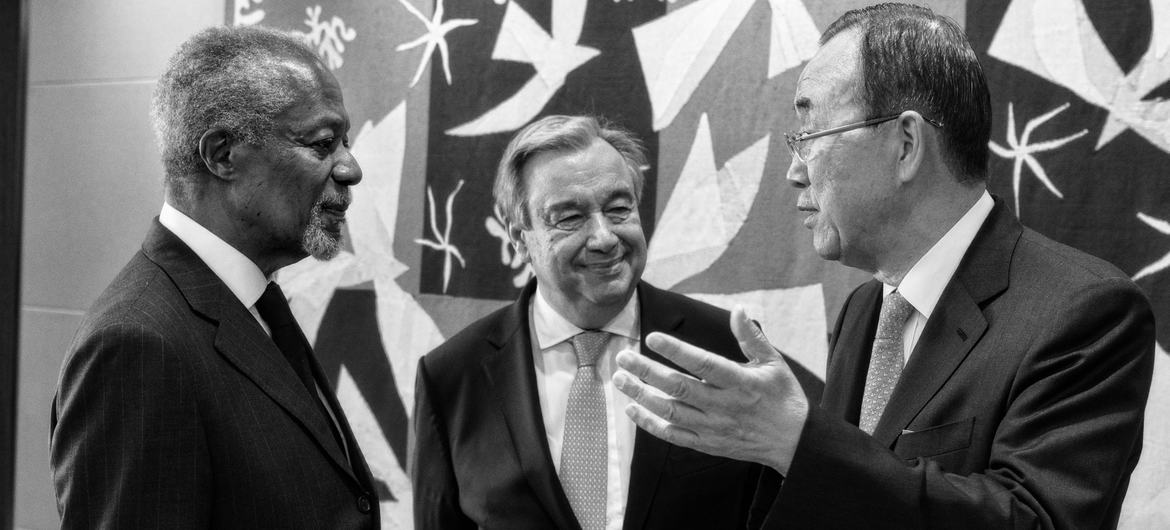
Former Secretaries-General Kofi Annan (left) and Ban Ki-moon (right) pay a courtesy call on Secretary-General António Guterres.
UN Photo/Mark Garten
 
Former Secretaries-General Kofi Annan (left) and Ban Ki-moon (right) with Secretary-General António Guterres at the UN Headquarters, in New York.

The selection process

Secretary-General António Guterres’ second term expires at the end of next year, and the formal selection process is already under way.

In November, the Presidents of the General Assembly and the Security Council launched the process together, in line with General Assembly resolution 79/327, which emphasises transparency and inclusivity.

Under the established procedure, candidates are nominated by Member States or groups and are required to submit a vision statement, curriculum vitae and campaign financing disclosures. The President of the General Assembly convenes publicly broadcast interactive dialogues with all candidates, while engaging closely with Member States throughout the process.

As of mid-December, only Rafael Mariano Grossi – the Director-General of the UN nuclear watchdog International Atomic Energy Agency (IAEA) – has been nominated by Argentina.

You can find the list of candidates on the UN website here.

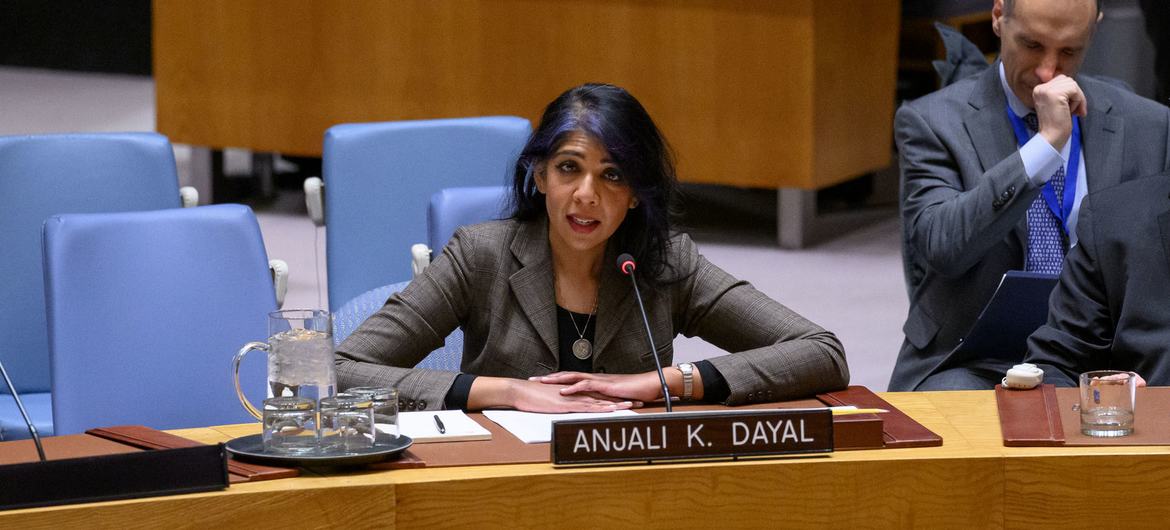
Professor Anjali Dayal of international relations at Fordham University’s Lincoln Center campus, addresses the  Security Council meeting on maintenance of international peace and security.
UN Photo/Loey Felipe
 
Anjali Dayal, Associate Professor for International Politics at Fordham University, addresses the Security Council.

Unprecedented strain

Anjali Dayal, Associate Professor for International Politics at Fordham University, told the Council that the next Secretary-General will assume office at a time of unprecedented strain, including a deepening funding crisis that is already shrinking the UN’s capacity to deliver essential services.

“That will result not just in shrinking this Organization, but also in less of the work that only the UN can do at scale,” she said, pointing to fewer vaccinations, reduced humanitarian aid and diminished mine-clearance efforts, even as global needs grow.

Ms. Dayal said history shows that even in periods of intense division, the Council has been capable of choosing leaders who advanced peace and cooperation.

She recalled the protracted deadlock that preceded the selection of Javier Pérez de Cuéllar in 1981 and the critique of U Thant, yet they deftly maneuvered an end to the Iran-Iraq war, resolve conflicts in Cambodia and Nicaragua, and help end the Cuban Missile Crisis.

Jaw-jaw better than war-war

Those examples, she said, underscore that the Secretary-General’s influence lies less in material power than in the ability to shape ideas, narratives and long-term cooperation – “to make conference rooms always more attractive than the battlefield.”

For Mr. Ban, that responsibility ultimately rests with the Council itself. Reforming veto use and renewing support for UN leadership, he said, are essential if the Organization is to remain relevant in the twenty-first century.

“The path of each for themselves is no different from the path of mutual destruction,” he warned.

https://news.un.org/en/story/2025/12/1166598


https://creativecommons.org/licenses/by/4.0/legalcode
воскресенье, 26 октября 2025 г.

Guterres calls for urgent reform of the Security Council


24 October 2025 
Peace and Security

Secretary-General António Guterres on Friday warned that the “fragile” legitimacy of the Security Council could endanger global peace if it remains gridlocked and fails to fulfil its primary purpose.

Mr. Guterres was addressing ambassadors in the iconic chamber in New York on United Nations Day, marking 80 years since its founding. He spoke via video link from the capital of Viet Nam, Hanoi, during a robust open debate on how the UN navigates an uncertain future.

Tweet URL

As the UN’s primary body for maintaining international peace and security, the council wields significant power, including the authority to impose sanctions and authorize military action.

Five of its 15 members have a permanent seat and were granted veto power under the UN Charter.

While the Council has played a central role in peacekeeping, conflict resolution and upholding international law, its veto system has often stalled action and sparked criticism.

The body’s structure is viewed by many countries and top officials as unrepresentative, leaving regions like Africa and Latin America without a permanent voice.

Invoking those who have looked to the council over 80 years to end wars, Mr. Guterres said that “the privilege to sit at this table carries a duty – above all – to honour the faith of those people,” he said. “Without a Security Council fit for purpose, the world is in grave danger.”

Debate over fundamentals

Presiding over the council for October, Russia praised the UN’s achievements but criticised the actions of Western governments, while elected (non-permanent) member Guyana, said the body was unrepresentative, advocating for greater and meaningful global representation.

The United States focused on operational reform, accountability, and called for a merit-based selection of the next Secretary-General – who takes the helm in January 2027 – emphasising the primacy of national sovereignty and transparency in the selection process.

The US representative called for an end to a selection process based on regions taking it in turns, arguing it was time to choose from a global roster of candidates.

For a full readout of the meeting click here.

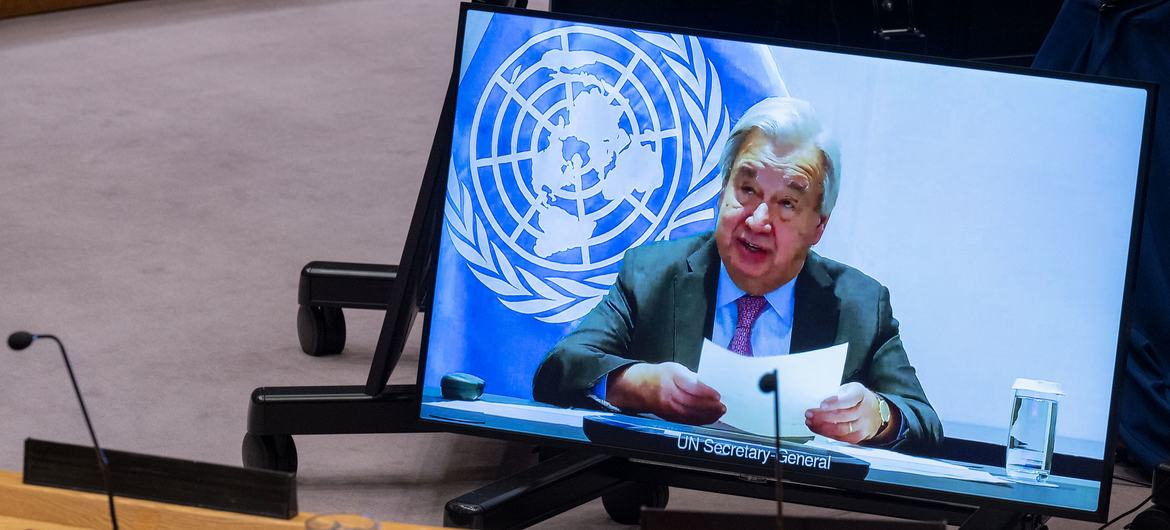
Secretary-General António Guterres (on screen) addresses Security Council members.
UN Photo/Manuel Elías
 
Secretary-General António Guterres (on screen) addresses Security Council members.

A UN for the weak, not the powerful

The UN chief painted a vivid picture of how Council decisions can impact citizens worldwide:

“The Security Council is not about hegemons and empires. It is about parents who have lost their children, refugees flung far from their homes, soldiers who have sacrificed their limbs.

“In every shadow of this Chamber, you are surrounded by the ghosts of the dead. But beside them stands something else – the hopes of the living.”

He urged Council members to listen to those hopes.

“Listen closely and you will hear the cries of your citizens who rally for peace; the whispers of families who long for safety...The United Nations emblem does not bear the laurel wreath of a victor, but the olive crown of a peacemaker.”

But its legitimacy is fragile

Mr. Guterres highlighted the Council’s successes over eight decades, from helping Cambodia emerge from genocide to supporting South Africa’s transition from apartheid and deploying missions in Sierra Leone, Timor-Leste, and Liberia.

Yet its legitimacy remains fragile, he stressed, noting that violations of the UN Charter by some Member States erode trust and risk global stability.

He called for and expanded membership to better reflect the world’s demographics, including permanent representation for Africa, Latin America and the Caribbean.

Mr. Guterres also encouraged discussions on proposals to limit the use of the veto.

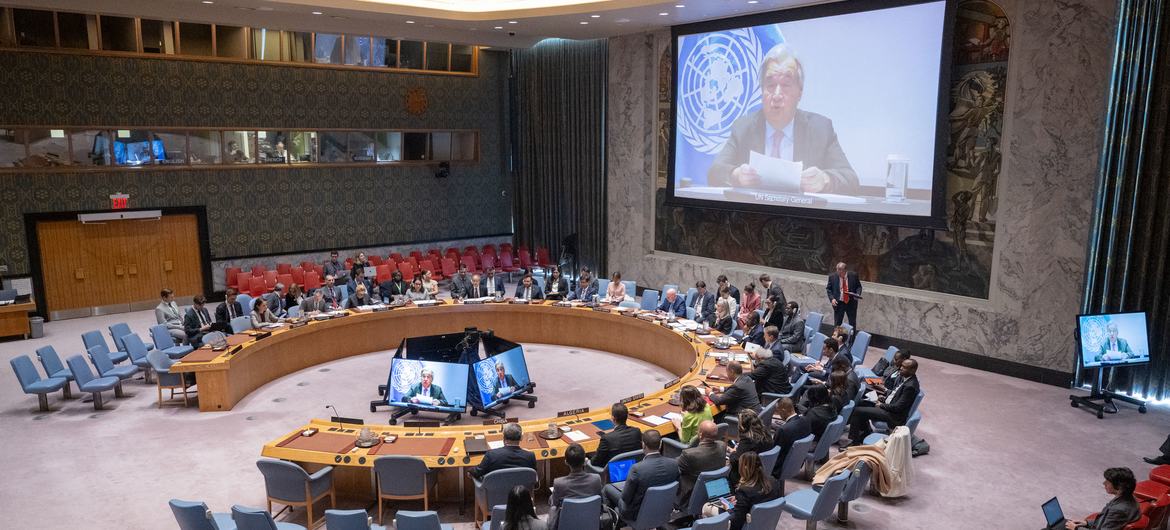
A wide view of the Security Council as Secretary-General António Guterres (on screen) addresses members.
UN Photo/Manuel Elías
 
A wide view of the Security Council as Secretary-General António Guterres (on screen) addresses members.

Russia: Divisive Western powers

Russia’s Ambassador Vassily Nebenzia praised the UN’s achievements but cautioned against the actions of Western powers.

“In an effort to maintain its waning influence, the West divided the world into ‘us’ and ‘them’ – ‘democracies’ and ‘autocracies’ – a group of those who are chosen, and those who are violating their imposed order,” he said.

As a result, many of the UN Charter’s principles remain concepts, not a reality. “Adventures” – from the Iraq invasion and Colour Revolutions to the recent invasion of Iran – have only led to tragedy, he said.

Guyana: Reform now

Guyana’s Ambassador Carolyn Rodrigues-Birkett echoed calls for reform, describing the current configuration of the Council as unrepresentative.

“The Security Council must be reformed. Notwithstanding the expansive breadth of the work of the UN, the reality is that this success or failure of the United Nations as a whole is judged in large measure through the action, or lack thereof, of the Security Council,” she said.

She called for permanent seats for Africa and Latin America and a rotating seat for small island developing States, emphasising that national interest and international cooperation are complementary.

US: UN ‘has lost its way’

The United States, represented by Ambassador Dorothy Shea, focused on accountability. She said the UN had become a “bloated bureaucracy” that has lost its way, calling for mandates with clear political objectives and measurable benchmarks.

“The UN should serve Member States rather than have Member States beholden to an unaccountable bureaucracy,” she said.

On the next Secretary-General, Ambassador Shea said the US seeks a leader who will restore the UN to its founding purpose, respecting state sovereignty and prioritising accountability and transparency.

She added that the selection process should be merit-based, drawing candidates from all regional groupings, and that the next Secretary-General should “bring the UN back to basics and by so doing, help achieve the bold vision of peace and prosperity to which we all committed.”

A humble ballot box

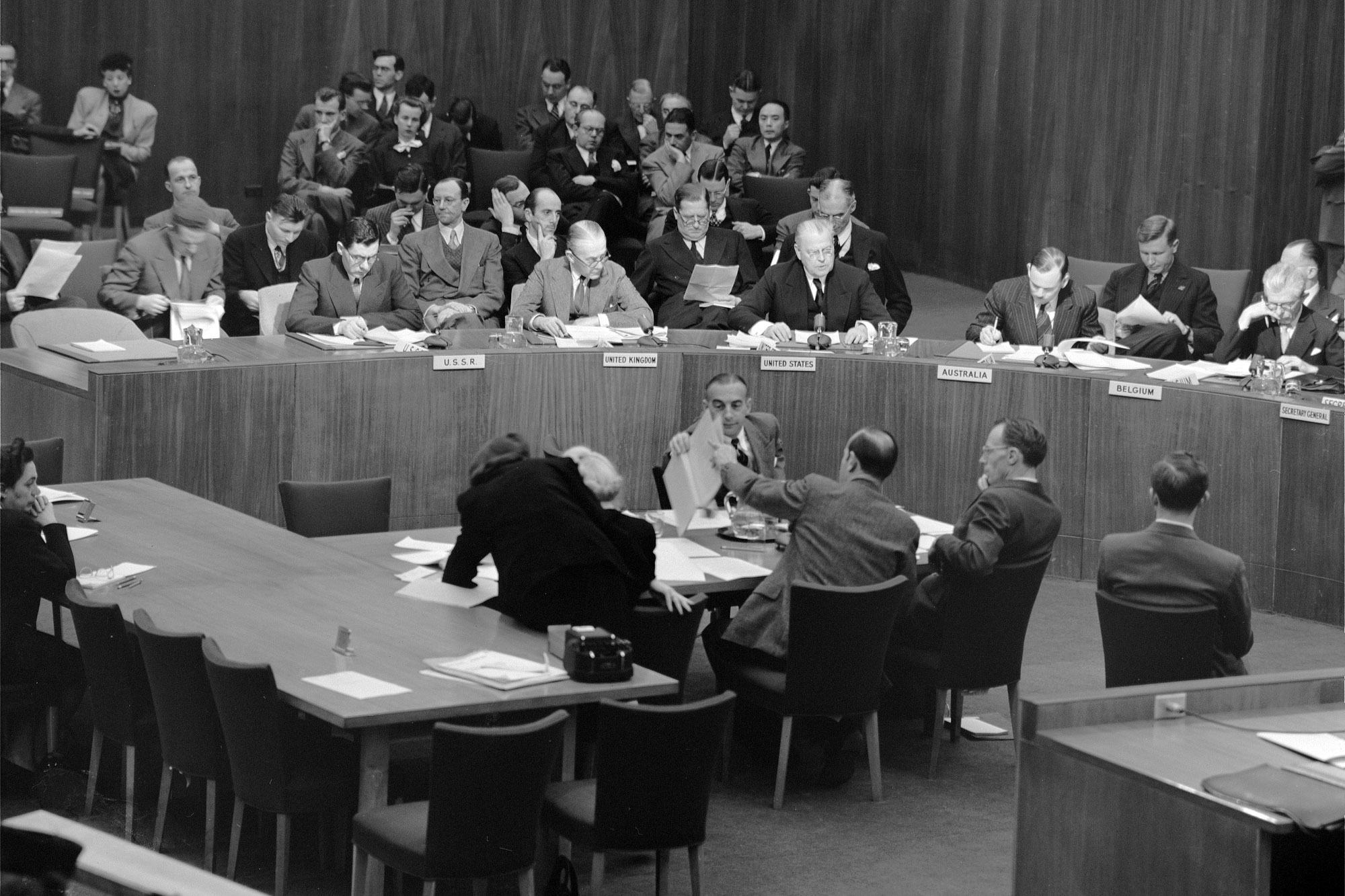
A photograph of a UN Security Council meeting on atomic energy in 1947.
UN Photo
 
A photograph of a UN Security Council meeting on atomic energy in 1947.

At the start of the meeting, the UN chief recalled a remarkable moment from the UN’s early days: the first Security Council ballot box in 1946. To everyone’s surprise, a slip of paper was already inside – a note from Paul Antonio, a local New York mechanic who had made the box.

“May I, who have had the privilege of fabricating this ballot box, cast the first vote? May God be with every member of the United Nations Organization, and through your noble efforts bring lasting peace to us all – all over the world,” Mr. Antonio wrote.

“Paul Antonio – the mechanic never sat at this table He never gave a speech or signed a treaty,” Mr. Guterres told ambassadors.

“But he believed in everyone here. He believed in you. I urge you: honour that trust. Make this chamber worthy of the hopes of every man, woman and child.”


https://creativecommons.org/licenses/by/4.0/legalcode

https://creativecommons.org/licenses/by/4.0/legalcode
воскресенье, 21 сентября 2025 г.

Iran’s uranium stockpile grows following three years of denied access


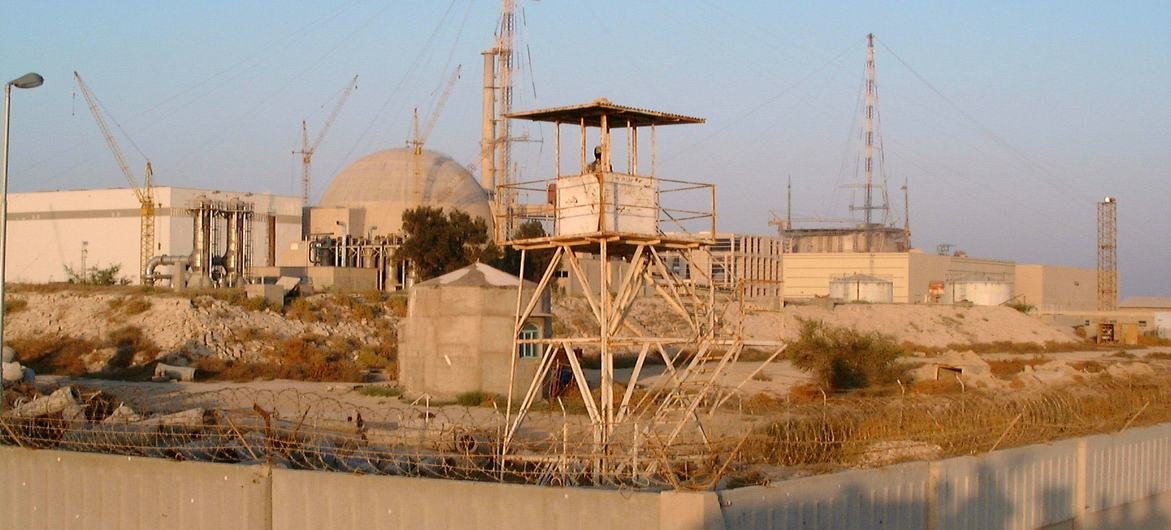
The Busher nuclear power plant in Iran. (file photo)
IAEA/Paolo Contri
 
The Busher nuclear power plant in Iran. (file photo)

3 June 2024
Peace and Security

Iran’s stockpile of enriched uranium continues to increase, the head of the UN atomic watchdog agency said on Monday, adding that it has been three years since the agency was able to access the country.

Addressing the Board of Governors of the International Atomic Energy Agency (IAEA), Director General Rafael Grossi indicated no progress had been made in resolving outstanding issues.

He mentioned that Iran is still not implementing provisions of the nuclear safeguards agreement, and that withdrawal of designations for several IAEA inspectors are yet to be reversed.

“These outstanding safeguards issues…need to be resolved for [IAEA] to be in a position to provide assurance that Iran’s nuclear programme is exclusively peaceful,” Mr. Grossi emphasized.

He also voiced concerns about public statements made in Iran regarding its technical capabilities to produce nuclear weapons and potential changes to its nuclear doctrine, which only deepen apprehensions about the “correctness and completeness” of the country’s safeguards declarations.

Ukraine’s power plants

Nuclear Safety, Security and Safeguards in Ukraine.
© IAEA
 
Nuclear Safety, Security and Safeguards in Ukraine.

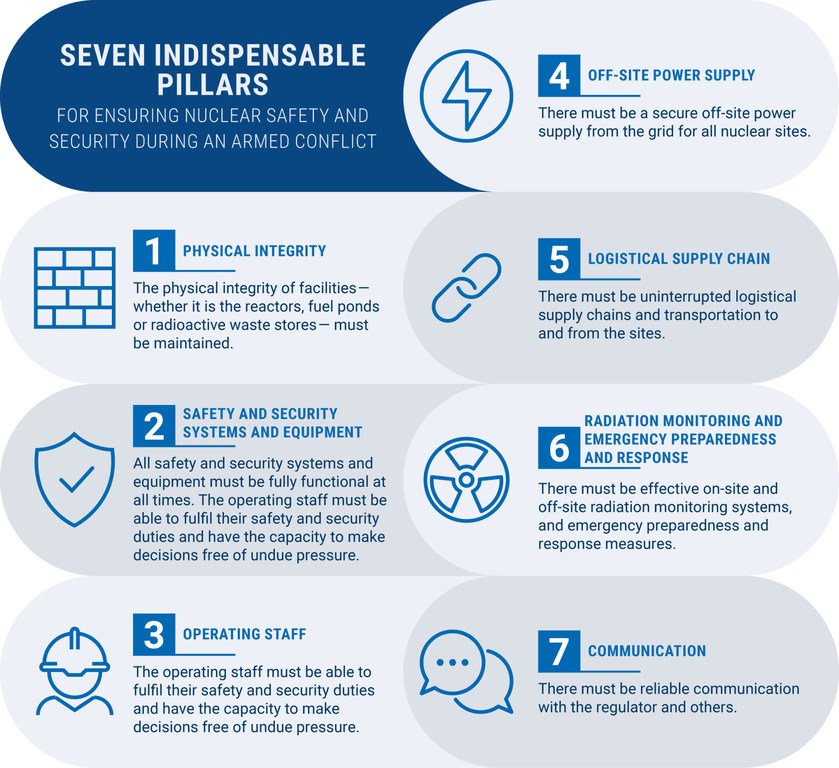
Turning to Ukraine, the IAEA chief warned the situation at the Zaporizhzhia Nuclear Power Plant “remains precarious” and that all seven Pillars of Nuclear Safety and Security have been “fully or partially compromised”.

These include physical integrity; functional safety and security systems and equipment; radiation monitoring and emergency response; secure and reliable off-site power supply; trained staff; an uninterrupted logistic supply chain; and open communication.

“The attacks and the frequent disconnection of the off-site power lines due to military activity are creating a grave situation,” Mr. Grossi said.

All six reactor units at the plant have been in cold shutdown since April, a safety measure long recommended by the IAEA. Despite this, the agency’s ability to ensure the plant’s safety and security remains compromised due to restricted access, he added.

He further reported that Ukraine’s other four nuclear power plants continue to face compromised supply chains for spare parts and high levels of stress among staff.

DPR Korea’s nuclear programme

Mr. Grossi also voiced concern over the continued and further development of the Democratic People’s Republic of Korea’s (DPRK) nuclear programme.

The IAEA has observed intermittent cooling water discharge, consistent with the operation of the Light Water Reactor (LWR) at Yongbyon, along with ongoing activities at the reported centrifuge enrichment facility.

The Nuclear Test Site at Punggye-ri remains occupied and prepared to support a new test.

“The continuation and further development of the DPRK’s nuclear programme is a clear violation of relevant UN Security Council resolutions and is deeply regrettable,” Mr. Grossi said, urging the country to comply fully with its obligations and to cooperate promptly with IAEA.

Rafael Mariano Grossi (right), IAEA Director General, delivers his opening statement at the 1717th Board of Governors meeting held at the IAEA Headquarters, in Vienna.
© IAEA/Dean Calma
 
Rafael Mariano Grossi (right), IAEA Director General, delivers his opening statement at the 1717th Board of Governors meeting held at the IAEA Headquarters, in Vienna.

Japan’s Fukushima Daiichi plant

In Japan, IAEA continues to monitor the discharge of Advanced Liquid Processing System)-treated water from the Fukushima Daiichi Nuclear Power Station, which suffered a meltdown 13 years ago, he reported.

Mr. Grossi confirmed that the discharge is progressing in accordance with the safety plan approved by Japan’s Nuclear Regulation Authority.

“Expert independent analysis of the six batches released so far have confirmed the tritium concentration in each batch of ALPS-treated water released to date is far below Japan’s operational limit.”

Nuclear technology for sustainable development

In his concluding remarks, the head of IAEA underscored the agency’s key role in promoting sustainable development.

“The IAEA is a crucially important vehicle for advancing sustainable development and international peace and security,” he said, urging member states to continue their support for the agency’s indispensable work.


https://news.un.org/en/story/2024/06/1150576


https://creativecommons.org/licenses/by/3.0/legalcode

четверг, 5 июня 2025 г.

UN chief urges world leaders to keep two-State solution ‘alive’


Secretary-General António Guterres speaks to the press at the UN Headquarters, in New York.
UN Photo/Mark Garten
 
Secretary-General António Guterres speaks to the press at the UN Headquarters, in New York.

By Vibhu Mishra
5 June 2025

UN chief urges world leaders to keep two-State solution ‘alive’
 Peace and Security

UN Secretary-General António Guterres on Thursday urged world leaders to revive efforts toward a two-State solution to the Israeli-Palestinian conflict, warning that there is no alternative.

“It is absolutely essential to keep alive the two-State solution perspective with all the terrible things we are witnessing in Gaza and the West Bank,” Mr. Guterres told reporters at UN Headquarters in New York.

He was responding to a question about his message to leaders gathering at a high-level international conference later this month on a comprehensive and lasting peace in the region.

“And for those that doubt about the two-State solution, I ask: What is the alternative? Is it a one-state solution in which either the Palestinians are expelled or forced to live in their land without rights?”

Mandated by the UN General Assembly, the high-level event is aimed at charting an “action-oriented” path toward a comprehensive and lasting peace based on the two-State formula.

The meeting will include thematic roundtables on key issues such as security, humanitarian reconstruction, and the economic viability of a Palestinian state.

Disappointed over failed resolution

Mr. Guterres also expressed deep disappointment following the Security Council’s failure on Wednesday to adopt a resolution demanding an immediate and permanent ceasefire in Gaza, and the release of all hostages.

The text, endorsed by all ten elected members of the Council, received support from the other four permanent members, but was vetoed by the United States.

“We are always disappointed when ceasefires do not materialise, releases of hostages [do not happen] and humanitarian aid is not distributed or is distributed in a way that puts at risk the lives of so many Palestinians,” he said, responding to another correspondent.

The Secretary-General reiterated that only a permanent ceasefire, the unconditional release of all hostages, and unimpeded humanitarian access would allow the UN to deliver meaningful relief to civilians in Gaza.

He emphasised that during previous temporary ceasefires, the UN was able to mobilise large-scale assistance.


https://news.un.org/en/story/2025/06/1164091


https://creativecommons.org/licenses/by/4.0/legalcode
четверг, 15 мая 2025 г.

In Berlin, broad backing for UN peacekeeping as global threats mount


UN peacekeepers conduct a foot patrol along the Blue Line in southern Lebanon.
UNIFIL/Pasqual Gorriz
 
UN peacekeepers conduct a foot patrol along the Blue Line in southern Lebanon.


By Vibhu Mishra
14 May 2025 

Peace and Security

More than 130 countries and international partners threw their weight behind UN peacekeeping at a high-level ministerial summit in Berlin on Wednesday, pledging military, tech and political support.

UN Secretary-General António Guterres meanwhile warned that peace operations are under growing strain and must adapt to meet today’s rising threats.

The two-day conference on peacekeeping, hosted by the Government of Germany, brought together over 1,000 participants – including defence and foreign ministers – to reaffirm commitment to the UN’s flagship tool for maintaining peace and stability.

Tweet URL

It concluded on Wednesday with a wide array of pledges, including 88 military and police units, specialized training, and investments in emerging technologies and strategic communications.

Difference between life and death

“In trouble spots around the world, ‘blue helmets’ can mean the difference between life and death,” Mr. Guterres said in his opening remarks.

“Now more than ever, the world needs the United Nations. And the United Nations needs peacekeeping that is fully equipped for today’s realities and tomorrow’s challenges.”

Germany, which currently contributes troops to UN missions in South Sudan, Lebanon, and Western Sahara, announced €82 million (around $91.7 million) in funding, along with commitments in training, renewable energy solutions and drone technology.

“Germany continues to be a steadfast supporter of UN peacekeeping,” said Defense Minister Boris Pistorius.

Broad and diverse commitments

A total of 74 UN Member States made specific pledges, ranging from uniformed personnel to training and strategic support.

This includes pledges which will bolster military and police units, including airlift and rapid deployment capabilities (53 national contributions), specialized training (59), technological enhancements (18), advancing the Women, Peace and Security Agenda (38) and safety and protection (16).

Eleven countries also committed to improving accountability and conduct, including support to the trust fund for victims of sexual exploitation and abuse, and eight nations supporting the UN’s efforts to counter mis- and disinformation through strategic communications.

Deminers with the UN peacekeeping mission in Mali, MINUSMA, clearing an airstrip in Kidal region. (file photo)
UN Photo/Marco Dormino
 
Deminers with the UN peacekeeping mission in Mali, MINUSMA, clearing an airstrip in Kidal region. (file photo)

Mounting pressures

At a press conference following the meeting, Secretary-General Guterres acknowledged that peacekeepers operate in an increasingly complex and dangerous environment, citing a record number of global conflicts, the targeting of peacekeepers by drones and improvised explosive devices (IEDs) and the rising threat from disinformation campaigns.

“We need to ask some tough questions about the mandates guiding these operations, and what the outcomes and solutions should look like,” he said, speaking alongside German Foreign Minister Johann Wadephul and Defence Minister Pistorius.

“Every context is different, and missions must be adapted accordingly.”

The UN chief also stressed the importance of sustained financial backing, highlighting that many missions continue to struggle with cash flow shortages due to delayed payments from Member States.

“It is absolutely essential that all Member States respect their financial obligations, paying their contributions in full and on time,” he said.

Crucial reforms

The Berlin meeting feeds into the UN’s broader reform efforts, including an ongoing Review of Peace Operations announced in last year’s Pact for the Future, aimed at making peacekeeping and peace enforcement more flexible, cost-effective, and aligned with real-world needs.

This year’s Ministerial also coincides with the 80th anniversary of the United Nations and the 10-year anniversary of the 2015 New York Summit on Peacekeeping. It follows similar high-level meetings in Accra, Seoul, Vancouver and London.

Peacekeeping remains one of the UN’s most visible activities, with over 61,000 uniformed personnel from 119 countries currently deployed across 11 missions, supported by more than 7,000 civilian staff.


https://creativecommons.org/licenses/by/4.0/legalcode
https://news.un.org//en/story/2025/05/1163246

вторник, 25 марта 2025 г.

UN peace missions strained, with trust ‘in short supply’ and widening divisions


UN peacekeepers patrol Mutwanga in the eastern Democratic Republic of the Congo.
UN Photo/Michael Ali
 
UN peacekeepers patrol Mutwanga in the eastern Democratic Republic of the Congo.


By Vibhu Mishra
24 March 2025 
Peace and Security

United Nations peace operations are facing mounting challenges as conflicts become more protracted, geopolitical divisions widen and transnational threats multiply, Secretary-General António Guterres warned on Monday.

Addressing a high-level open debate in the Security Council, he called for urgent reforms to make peacekeeping more adaptable to today’s increasingly complex security landscape.

“Wars are becoming more complex and more deadly. They last longer and are more enmeshed in global and regional dynamics. Negotiated settlements have been harder to achieve,” Mr. Guterres said.

He noted that many conflicts transcend national borders, with terrorism, organized crime and the weaponisation of new technologies posing additional threats. At the same time, multifaceted impacts of climate change are further complicating efforts to secure peace.

Adding to the mix, divisions within the Security Council itself have made it harder to find common ground on approaching and addressing conflicts.

“Trust is in short supply among – and within – countries and regions…this is a grim diagnosis, but we must face facts.”

Gap between mandates and resources

Mr. Guterres highlighted that one of the biggest hurdles facing UN peace operations is the growing gap between what missions are expected to achieve and the resources available to them.

“We see a persistent mismatch between mandates and available resources,” he said, adding that the Council must recognise the limitations of peacekeeping in situations “where there is little or no peace to keep”.

Despite these challenges, the UN chief emphasised that the Organization has the tools to adapt peace operations to better meet modern realities. He highlighted several recent efforts to make missions more effective and responsive.

UN Secretary-General António Guterres addresses the Security Council.
UN Photo/Manuel Elías
 
UN Secretary-General António Guterres addresses the Security Council.

Adapting peace operations

This includes a proposal for Haiti, where criminal gangs have overrun large parts of the country. The UN has a clear role to play in supporting stability and security, he said, while addressing the root causes of the crisis.

Similarly, in Lebanon, the UN Interim Force (UNIFIL) has developed an adaptation plan to strengthen its mandate and support compliance with Security Council resolution 1701.

Another key example is the recent Security Council resolution 2719, which enhanced the UN’s partnership with the African Union (AU), paving the way for stronger collaboration in peace enforcement missions.

“This breakthrough has lifted our partnership with the AU to a new level,” Mr. Guterres said, urging Member States to fully support the initiative.

Appeal for unity

Mr. Guterres noted that work is underway for a comprehensive review of UN peace operations as called for by Member States in the Pact for the Future, adopted in September last year.

The review will examine existing peacekeeping models, explore new approaches and ensure missions have realistic mandates with viable exit strategies and transition plans.

In closing, he urged all nations to overcome divides and provide the unified support necessary for peacekeeping missions to succeed.

“I call on this Security Council to continue working to overcome divisions and disagreements around peace operations and build the unified and consistent political support our peace operations – and the women and men who conduct them – need and deserve.”

https://news.un.org/en/story/2025/03/1161441


https://creativecommons.org/licenses/by/4.0/legalcode
среда, 19 февраля 2025 г.

Amid ‘clear’ threat of nuclear war, Guterres tells Security Council multilateral off-ramp is essential


The Pact of the Future was adopted at a summit at UN Headquarters in September 2024.
UN Photo/Laura Jarriel
 
The Pact of the Future was adopted at a summit at UN Headquarters in September 2024.

18 February 2025 
Peace and Security

Strengthening international cooperation and delivering on a UN pact that calls for reforming global governance, among other measures, was the focus of debate in the Security Council on Tuesday. 

The ministerial-level meeting was convened by China, which holds the rotating Council presidency this month, as the UN prepares to mark its 80th anniversary later this year.

UN Secretary-General António Guterres opened the debate emphasizing that “global solidarity and solutions are needed more than ever” as the climate crisis rages and inequalities and poverty increase.

Peace remains illusive

“As this Council knows well, peace is getting pushed further out of reach — from the Occupied Palestinian Territory to Ukraine to Sudan to the Democratic Republic of the Congo and beyond,” he said.  

“Terrorism and violent extremism remain persistent scourges. We see a dark spirit of impunity spreading.  The prospect of nuclear war remains – outrageously – a clear and present danger.”

Emerging technologies such as Artificial Intelligence (AI) are also a challenge as their “limitless promise…is matched by limitless peril to undermine and even replace human thought, human identity and human control.” 

Secretary-General António Guterres addresses the Security Council meeting on maintenance of international peace and security with a focus on practicing multilateralism, reforming and improving global governance.
UN Photo/Eskinder Debebe

Pact for the Future

Mr. Guterres said “these global challenges cry out for multilateral solutions,” and pointed to the Pact for the Future, adopted by Member States last September.

The agreement “is aimed at strengthening global governance for the 21st century and rebuilding trust” in multilateralism, the UN, and the Security Council.

Provisions include advancing coordination with regional organizations and ensuring the full participation of women, youth and marginalized groups in peace processes.

The Pact outlines support for a stimulus plan to help developing countries achieve the Sustainable Development Goals (SDGs), and revitalized commitment to reform the post-war global financial architecture to better serve the modern world.

It also contains a Global Digital Compact that calls for an AI governance body that allows developing countries to participate in decision-making, marking a first.

Security Council reform

“The Pact also recognizes that the Security Council must reflect the world of today, not the world of 80 years ago, and sets out important principles to guide this long-awaited reform,” said Mr. Guterres.

The Council should be enlarged and made more representative of today’s geopolitical realities, while countries also must continue to improve its working methods to make the body more inclusive, transparent, efficient, democratic and accountable. 

He recalled that these issues have been under consideration by the UN General Assembly for more than a decade. 

Build on momentum 

“Now is the time to build on the momentum provided by the Pact for the Future, and work towards a greater consensus among regional groups and Member States – including the permanent members of this Council – to move the intergovernmental negotiations forward,” he said. 

“Throughout, I call on Members of this Council to overcome the divisions that are blocking effective action for peace.”

He noted that Council members have shown reaching common ground is possible, for example through deploying peacekeeping operations and forging resolutions on humanitarian aid.

Spirited compromise

“Even in the darkest days of the Cold War, the collective decision-making and vigorous dialogue in this Council maintained a functioning, if imperfect, system of collective security,” he said.

“I urge you to summon this same spirit, continue working to overcome differences and focus on building the consensus required to deliver the peace all people need and deserve.”

The Secretary-General said multilateral cooperation is the beating heart of the United Nations, and guided by the solutions in the Pact for the Future, it can become an even more powerful instrument of peace,

“As we look to the challenges around us, I urge all Member States to continue strengthening and updating our global problem-solving mechanisms,” he said. “Let’s make them fit for purpose – fit for people – and fit for peace.”

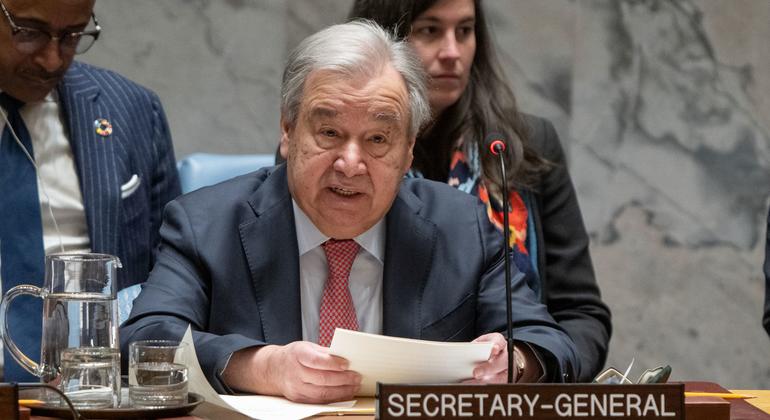
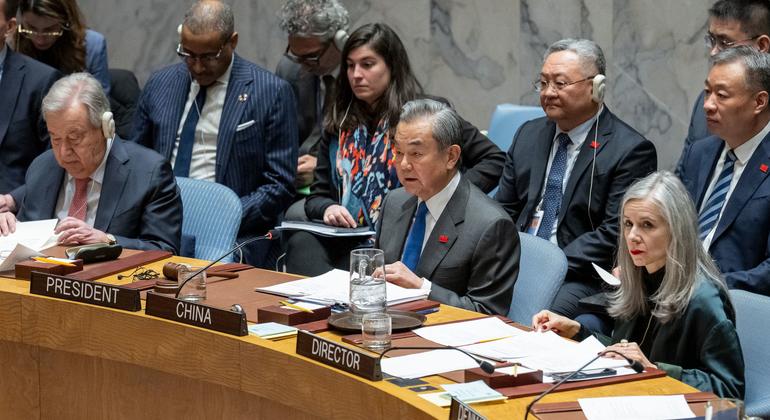
Wang Yi (centre), Minister for Foreign Affairs of the People’s Republic of China, chairs the Security Council meeting on maintenance of international peace and security with a focus on practicing multilateralism, reforming and improving global governance.
UN Photo/Manuel Elías

China stresses need to uphold sovereignty

The meeting was chaired by China’s Foreign Minister Wang Yi who presented four proposals to the Council, including the need to uphold sovereign equality while advancing global governance.

“We must respect the development acts chosen independently by people of all countries, uphold the principle of non-interference in internal affairs, and not impose one's will upon others,” he said.

Countries also must “practice international rule of law, ensure the effective implementation of international law and reject double standards and selective application.”

Mr. Wang said Security Council resolutions are binding and should be observed by all countries. The Council is also entrusted with authority which all nations should uphold.

“Any act of bullying, trickery or extortion is a flagrant violation of the basic norms of international relations. Any unilateral sanction that circumvents Security Council authorization lacks legal basis, defies justification and contradicts common sense,” he said.

Furthermore, a critical part of global governance is ensuring justice prevails, as “international affairs should no longer be monopolized by a small number of countries.”

He said nations of the Global South “have the right to speak up for and defend their legitimate rights and interests, and the fruits of development should no longer be taken by just a few countries.”

Meanwhile, Security Council reform “should continue to emphasize democratic consultation, increase the representation and say of developing countries, especially African countries, and effectively address historical injustice.”

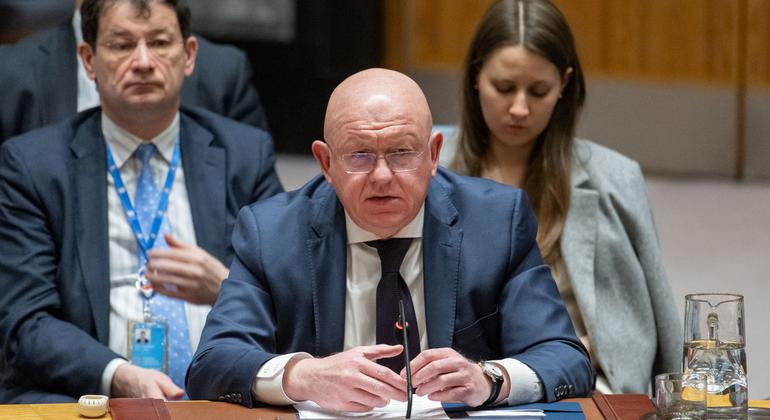
Ambassador Vassily Nebenzia of the Russian Federation addresses the Security Council meeting on maintenance of international peace and security with a focus on practicing multilateralism, reforming and improving global governance.
UN Photo/Manuel Elías

Western countries undermining UN authority: Russia

Despite its strengths and weakness, the UN has fulfilled its founding purpose of preventing a new World War, Russian Ambassador Vasily Nebenzya told the meeting.

He warned, however, that the world is “teetering on the brink of a direct military confrontation between nuclear powers” as western countries undermine UN authority and the primacy of international law.

“We are witnessing a broad application of the practice of unilateral coercive measures being imposed whenever supporters of methods of force in global politics do not manage to push through their desired outcome at the Security Council,” he said.

“Failure to abide by the UN Charter and a reckless approach to Security Council resolutions on a number of acute international issues has now become the hallmark of the West,” he added.

Regarding efforts to resolve the crisis in Ukraine, he said “it is becoming clear who genuinely advocates a more fair, more equal world, and who are living in the past and are striving at any cost to make their geopolitical agendas a reality.”

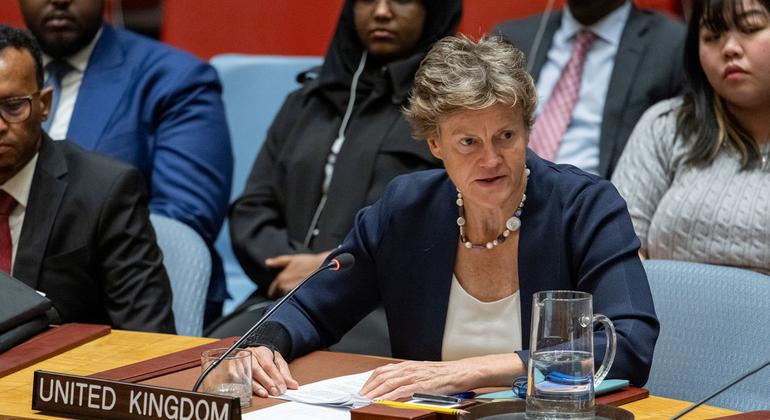
Ambassador Barbara Woodward of the United Kingdom addresses the Security Council meeting on maintenance of international peace and security with a focus on practicing multilateralism, reforming and improving global governance.
UN Photo/Manuel Elías

Redouble efforts to address emerging challenges: UK

United Kingdom Ambassador Barbara Woodward underlined her country’s commitment to the UN.

“As the Secretary-General reminded us and so many speakers today have reiterated, the Pact of the Future demonstrated a clear desire and a clear commitment to reinvigorate the multilateral system, including through reforming the UN and the international financial system,” she said.

She called for new approaches to address emerging challenges, and 2025 – which marks the UN’s 80th anniversary and a year of key summits – is the first step.

The summits will cover issues such as gender equality, ocean preservation, financing for development, and climate change.

“Together, these summits seek to address our shared concerns.  Their success is critical for progress and the UN’s reputation as our multilateral home,” she said.

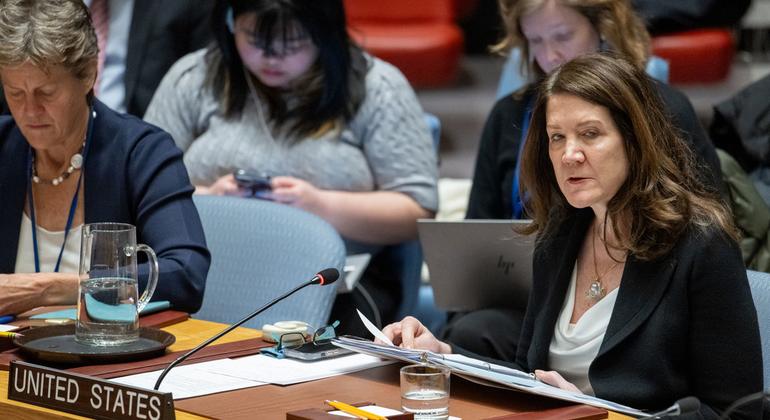
US Deputy Permanent Representative Dorothy Shea addresses the Security Council meeting on maintenance of international peace and security with a focus on practicing multilateralism, reforming and improving global governance.
UN Photo/Manuel Elías

US to scrutinize support to the UN

United States Ambassador Dorothy Shea recalled that her country helped found the UN after the Second World War, “but UN agencies and bodies overall have drifted from their core missions,” she said.

“We need to take a closer look at where this institution is falling short,” she continued. “For example, there is a longstanding, deep anti-Israel bias within the UN that has only grown stronger since Hamas’ brutal attack against Israel on October 7, 2023.”

Regarding the Security Council, she said critical issues that demand attention continually fall by the wayside.

Ms. Shea said the US is currently conducting a review of its support to the UN. It will consider whether the actions of the Organization are serving American interests, and whether reform is now due.

She said the US will not support UN bodies such as the Human Rights Council and will review those such as cultural agency UNESCO “which has a history of antisemitism or anti-Israel sentiment within the organization.”


https://news.un.org/en/story/2025/02/1160246

https://creativecommons.org/licenses/by/4.0/legalcode
пятница, 25 октября 2024 г.

BRICS Summit: Guterres underscores bloc’s role in boosting global cooperation


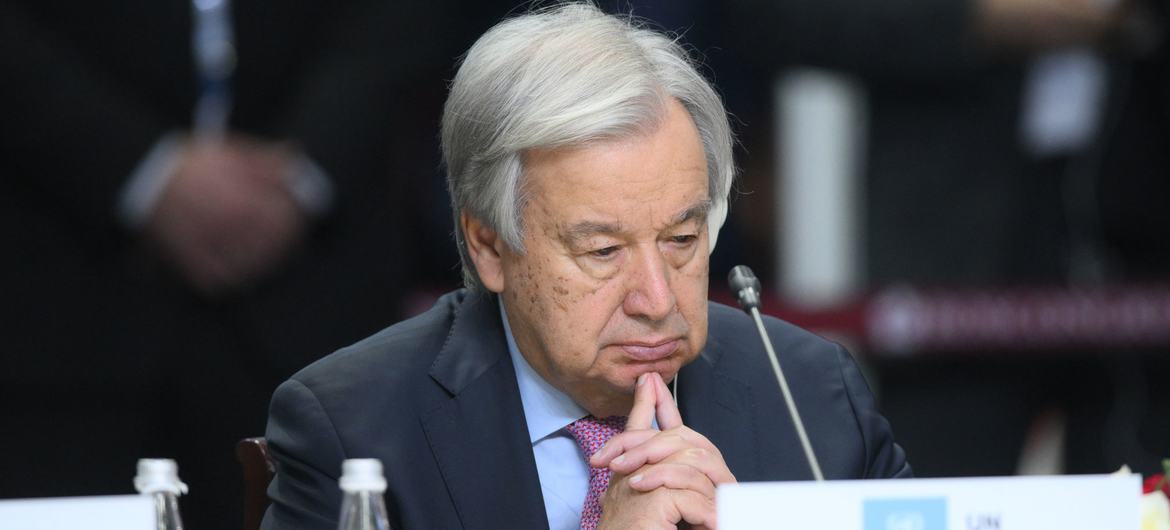
Secretary-General Antonio Guterres attends the 16th BRICS summit in Kazan, Russia.
© Photohost agency BRICS-Russia2024.ru/Vladimir Astapkovich
 
Secretary-General Antonio Guterres attends the 16th BRICS summit in Kazan, Russia.


24 October 2024
 Peace and Security

The BRICS intergovernmental organization can play a greater role in strengthening multilateralism for global development and security, UN Secretary-General António Guterres said on Thursday, in remarks to the group’s summit hosted by Russia in the city of Kazan. 

He urged the bloc to help forge a more equitable global finance system, boost climate action, improve access to technology and work towards peace, particularly in Gaza, Lebanon, Ukraine and Sudan.

BRICS was founded in 2006 by Brazil, Russia, India and China, who were later jointed by South Africa, Iran, Egypt, Ethiopia and the United Arab Emirates. Collectively, they represent nearly half the world’s population.

Address global challenges

Mr. Guterres saluted their valuable commitment and support for international problem-solving.

“But no single group and no single country can act alone or in isolation. It takes a community of nations, working as one global family, to address global challenges,” he said.

They include the increase in conflicts, climate change, rising inequalities and lingering poverty and hunger, as well as “a debt crisis that threatens to smother plans for the future of many vulnerable countries.”

Tweet URL

Furthermore, fewer than one-fifth of the 17 Sustainable Development Goals (SDGs) are on track, the digital divide is growing, and bodies such as the UN Security Council and the Bretton Woods institutions lack representation by developing countries.

Pact for the Future

Insisting that “this must change”, Mr. Guterres pointed to the Summit of the Future, held at the UN in September, which put forward a roadmap for strengthening multilateralism and advancing peace, sustainable development and human rights.

Leaders adopted a Pact for the Future covering sustainable development, international peace and security, science and technology, youth and future generations, and transforming global governance. 

A Global Digital Compact and Declaration on Future Generations are in the annex.  

“The Summit of the Future charted a course to strengthen multilateralism for global development and security.  Now we must turn words into deeds and we believe BRICS can play a very important role in this direction,” he said.

Reform global financial architecture

Mr. Guterres outlined four areas for action, starting with finance.

He said the Pact for the Future calls for accelerating reform of the international financial architecture, which is “outdated, ineffective and unfair”. 

It also includes a commitment to move forward with an SDG stimulus plan to support developing countries by substantially increasing the lending capacity of multilateral development banks.

“Next year’s Conference on Financing for Development and the Summit on Social Development are two milestones to carry these efforts forward,” he said.

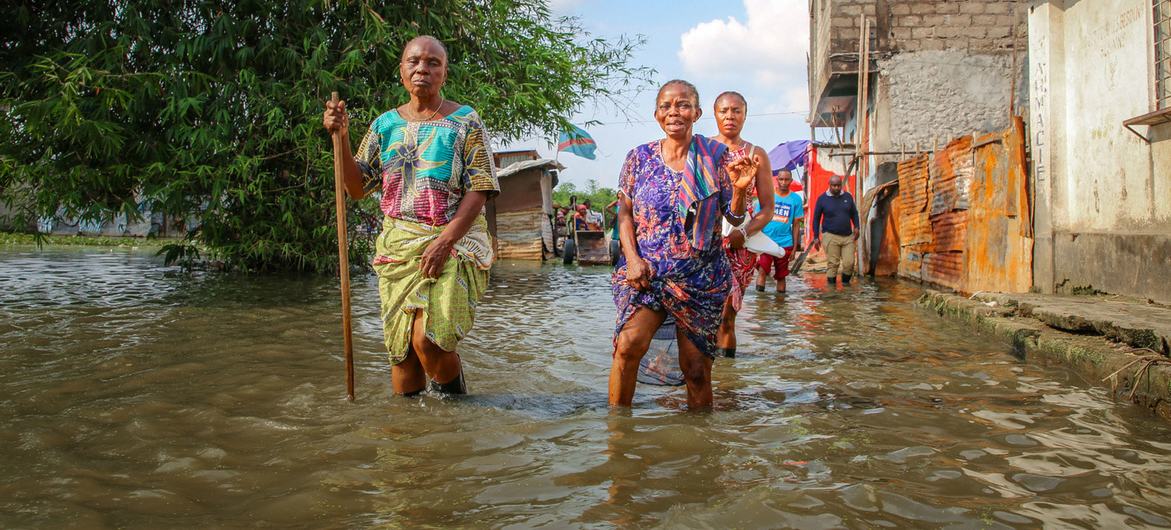
Women wade through flood water in a neighbourhood in Kinshasa, DR Congo. (file)
© UNOCHA/Wassy Kambale
 
Women wade through flood water in a neighbourhood in Kinshasa, DR Congo. (file)

Ambitious climate goals

Addressing climate change, Mr. Guterres stressed the need for “dramatic action to reduce emissions now” to limit global temperature rise to 1.5 degrees Celsius.

He said the COP29 UN climate conference in Azerbaijan next month "starts the clock for countries to produce new Nationally Determined Contributions plans with 2035 targets that are aligned with the 1.5-degree goal.”

The conference “must deliver an ambitious and credible outcome on the new climate finance goal," he added.  Additionally, developed countries must keep their promise to double adaptation and finance, and ensure meaningful contributions to the Loss and Damage Fund.

Access to technology

Meanwhile, every country must be able to access the benefits of technology, and the Global Digital Compact commits to enhanced international cooperation and capacity-building in this area.

“It includes the first truly universal agreement on the international governance of Artificial Intelligence to give every country a seat at the AI table,” he said. 

"It calls for an independent international Scientific Panel on AI and initiating a global dialogue on its governance within the United Nations with the participations of all countries.”

Moreover, the Compact requests options for innovative financing for AI capacity-building in developing countries, he added.

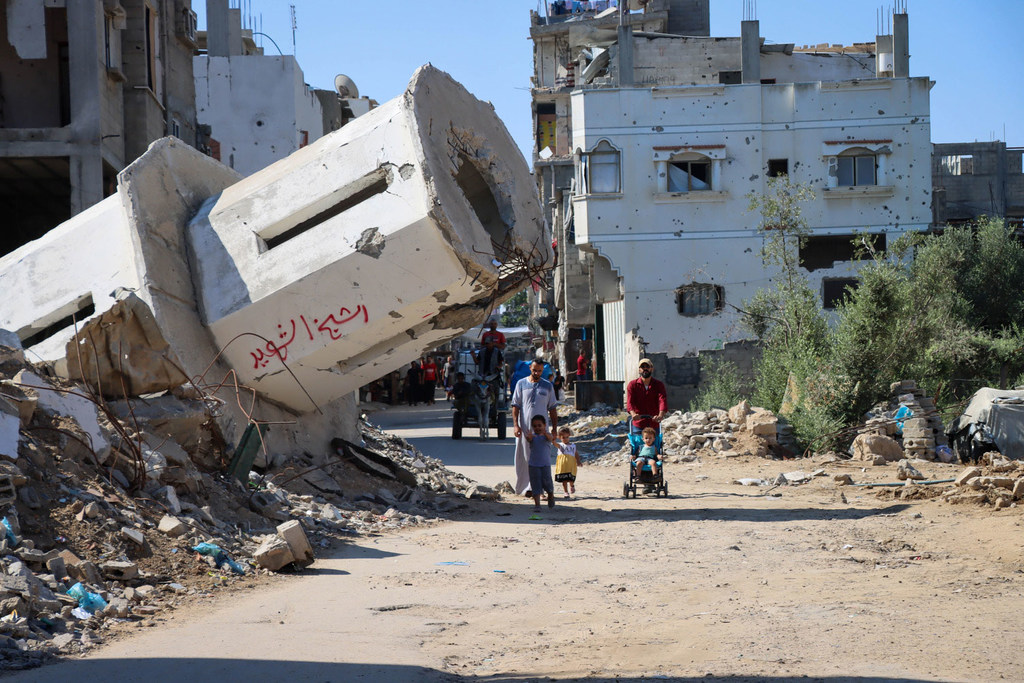
A family walks past a destroyed mosque in Gaza.
© UNOCHA/Themba Linden
 
A family walks past a destroyed mosque in Gaza.

‘We need peace’

For his final point, Mr. Guterres said the international community “must strengthen and update the machinery of peace,” which includes making the Security Council more reflective of the world today. 

He noted that the Pact for the Future contains important steps on disarmament. This includes the first multilateral agreement on nuclear disarmament in more than a decade, as well as steps to address the weaponization of outer space and the use of lethal autonomous weapons. 

“Across the board, we need peace,” he said. 

“We need peace in Gaza with an immediate ceasefire, the immediate and unconditional release of all hostages, the effective delivery of humanitarian aid without obstacles, and we need to make irreversible progress to end the occupation and establish the two-State solution, as it was recently reaffirmed once again by a UN General Assembly resolution.”

Peace is also needed in Lebanon, with an immediate cessation of hostilities, moving to the full implementation of UN Security Council resolution 1701 (2006).

Read our explainer about the resolution here.

“We need peace in Ukraine. A just peace in line with the UN Charter, international law and General Assembly resolutions,” he continued.

“We need peace in Sudan, with all parties silencing their guns and committing to a path towards sustainable peace.”

The Secretary-General recalled that these were the same messages he delivered to the High-Level segment of the UN General Assembly in September. 

“Unfortunately, they remain valid here and now,” he said. “Everywhere, we must uphold the values of the UN Charter, the rule of law, and the principles of sovereignty, territorial integrity and political independence of all States.” 

https://news.un.org/en/story/2024/10/1156086


https://creativecommons.org/licenses/by/4.0/legalcode
четверг, 24 октября 2024 г.

World News in Brief: UNRWA staffer killed in Gaza, Central African Republic update, terror in Türkiye, journalists face financial reprisals


UN agencies operating in Gaza City in May 2024. (file)
© UNOCHA
 
UN agencies operating in Gaza City in May 2024. (file)


23 October 2024
 

A strike in Deir Al-Balah in the central Gaza Strip has led to death of at least one staff member of the UN agency for Palestine refugees, UNRWA, on Wednesday.

“We can confirm that an UNRWA vehicle has been hit in Deir Al-Balah,” a spokesperson confirmed. “So far, we have reports one UNRWA staff member was killed.”

Since the deadly Hamas-led invasion of Israel a year ago triggered the ongoing war, almost 48,000 people in Gaza have been killed during the resulting Israeli offensive, including 230 UNRWA staff members, other humanitarian workers and journalists.

Six UNRWA staff members were among 34 people killed in September when two Israeli airstrikes hit a school-turned-shelter in Gaza.

‘Positive momentum’ in Central African Republic

Tweet URL

The Central African Republic (CAR) with the support of the UN peacekeeping mission in the country (MINUSCA), is experiencing much positive momentum from the recent dissolution of active armed groups, according to the UN’s Special Envoy for the country.

Speaking to the Security Council on Wednesday, Valentine Rugwabiza, Special Representative of the Secretary-General for CAR, highlighted the importance of renewing the Mission’s mandate.

MINUSCA was established in September 2014 in the CAR following a deadly flare up of inter-communal violence between the mainly Muslim Séléka groups and the mainly Christian anti-Balaka movement.

Civilians, top priority

Its mandate includes protection of civilians as the “utmost priority” alongside supporting humanitarian operations, protecting and promoting human rights and the disarmament, demobilisation, reintegration and repatriation of fighters from neighbouring countries.

The CAR has struggled to bring a definitive end to armed rebellions and recurrent violence since the start of the civil war in 2013.

Commending recent progress, Ms. Rugwabiza reported the dissolution of six armed groups and three factions of armed groups signatories which were signatories to CAR’s Political Agreement which “remained effective and resulted in the disarmament and demobilisation of their combatants, with the integration of some of them in the national armed forces”.

Ms. Rugwabiza also underscored local elections as a “key component” of the Agreement which “offers a unique opportunity for enhanced governance at a decentralised level”.

Preparations for local elections have also continued to progress driven by the Government’s sustained commitment and MINUSCA multidimensional support.

Guterres strongly condemns terror attack in Türkiye

Tweet URL

The Secretary-General has strongly condemned a terrorist attack on the facilities of an aerospace company headquarters based near the capital Ankara which left five dead and 22 reportedly injured.

Wednesday’s assault was carried out by two suspects, a man and a woman, who were later “neutralised” by security forces, according to media reports.

No organization has claimed responsibility for the attack so far, which began with a large explosion at the headquarters of Turkish Aerospace Industries’ facilities, while the attackers opened fire both inside and outside the building.

UN chief António Guterres offered his deepest condolences to the victims and their families and wished a speedy and full recovery to those injured.

“The United Nations stands in solidarity with the people and Government of the Republic of Türkiye,” said a statement issued by his Spokesperson’s Office.

UNESCO warns of growing threats to press freedom through misuse of fiscal laws

In an interview with UN News, an expert from the UN culture agency which monitors press freedom has highlighted growing threats to freedom of expression for media workers.

Guilherme Canela, UNESCO's Chief of Section for Freedom of Expression and Safety of Journalists, emphasised on Wednesday that attacks against journalists through the misuse of financial and fiscal legislation are on the rise.

This emerging trend has been revealed in UNESCO’s latest research, which tracks how these laws are being used to harass and silence journalists.


https://news.un.org/en/story/2024/10/1156051


https://creativecommons.org/licenses/by/4.0/legalcode
четверг, 10 октября 2024 г.

‘No end to hell’ in northern Gaza, warns UN aid agency chief


Northern Gaza resident Ahmed Abu Aita gestures towards his house in northern Gaza which has been reduced to rubble.
© UNOCHA
 
Northern Gaza resident Ahmed Abu Aita gestures towards his house in northern Gaza which has been reduced to rubble.


9 October 2024 


The prospect of all-out war in Lebanon appeared undiminished on Wednesday as the head of the UN agency for Palestine refugees, UNRWA, said that there was “no end to hell” in northern Gaza, where lifesaving relief has shut down.

The warning from Philippe Lazzarini, Commissioner-General of UNRWA UNRWA was prompted by renewed evacuation orders from the Israeli military, which “many are refusing because they know too well that no place anywhere in Gaza is safe”.

The development comes amid reports by the local authorities of intense Israeli bombardment in the north of the shattered enclave where ground operations are also underway. Jabalia refugee camp is surrounded, the Israeli Defense Forces (IDF) said at the weekend, before issuing evacuation orders on Tuesday.

Strikes have also been reported in Beit Lahia and Beit Hanoun, towns in the northeast of Gaza, with roads also closed.

“Intensified military operations in the north are forcing us to shut down lifesaving services,” Mr. Lazzarini said on social media on Wednesday.

He added that seven of the UN agency’s schools-turned-shelters are being evacuated, while only two out of eight water wells in Jabalia camp are still operational. Some 400,000 people are believed to remain in the north of Gaza.

Tweet URL

“Children are, as ever, the first and most to suffer,” the UNRWA chief said, adding that hunger was “spreading and deepening again” because “almost no basic supplies” were available.

According to local health authorities in Gaza, at least 45 people were killed and 130 wounded in the last 24 hours. Since Hamas-led terror attacks in multiple Israeli sites that left some 1,250 dead and more than 250 taken hostage, the death toll in Gaza has reportedly reached at least 42,000 people. Another 97,700 have been wounded, often with life-changing injuries.

Devastation in Lebanon

In Lebanon, meanwhile, the UN aid coordination office, OCHA, reported “relentless” and “amplifying” bombardment” into previously unaffected areas, amid ongoing missile strikes on Israel by Hezbollah.

“In a single day – 6 October - more than 30 airstrikes struck the Beirut southern suburbs and surrounding areas, frightening residents and forcing additional displacement from densely populated areas, including Shatila Palestine refugee camp,” OCHA said in an update published Wednesday.

Latest data from the health ministry indicate more than 2,083 collective deaths and 9,869 injuries since 8 October 2023, when Hezbollah rocket fire increased into northern Israel as the war in Gaza erupted. Most casualties in Lebanon have happened in the last two weeks, amid intense Israeli bombardment and ground operations in southern Lebanon.

According to the UN human rights office, OHCHR, 25 per cent of Lebanese territory is affected by Israeli military displacement orders. Displacement orders are issued “on a daily basis” for more than 100 villages and urban neighbourhoods across southern Lebanon, forcing people to flee and pushing many up to 30 km north.

Massive displacement

OCHA reported that in total, some 1.2 million people are now internally displaced, with 180,700 people seeking refuge in 978 shelters, 775 of which are already at full capacity. The violence has also delayed the start of the school year, while the UN Children’s Fund, UNICEF, said that about 350,000 children have been displaced.

“Extensive civilian harm is occurring due to explosive weapons in densely populated areas and forced displacement orders,” OCHA noted. “Urgent action is necessary to shield civilians from escalating violence and ensure that humanitarian and aid workers can safely deliver critical support.”


https://news.un.org/en/story/2024/10/1155501


https://creativecommons.org/licenses/by/4.0/legalcode