Показаны сообщения с ярлыком A.Guterres. Показать все сообщения

четверг, 16 мая 2024 г.

A. Guterres repeats call to Israel to halt Rafah assault as aid stocks dwindle

A. Guterres repeats call to Israel to halt Rafah assault as aid stocks dwindle

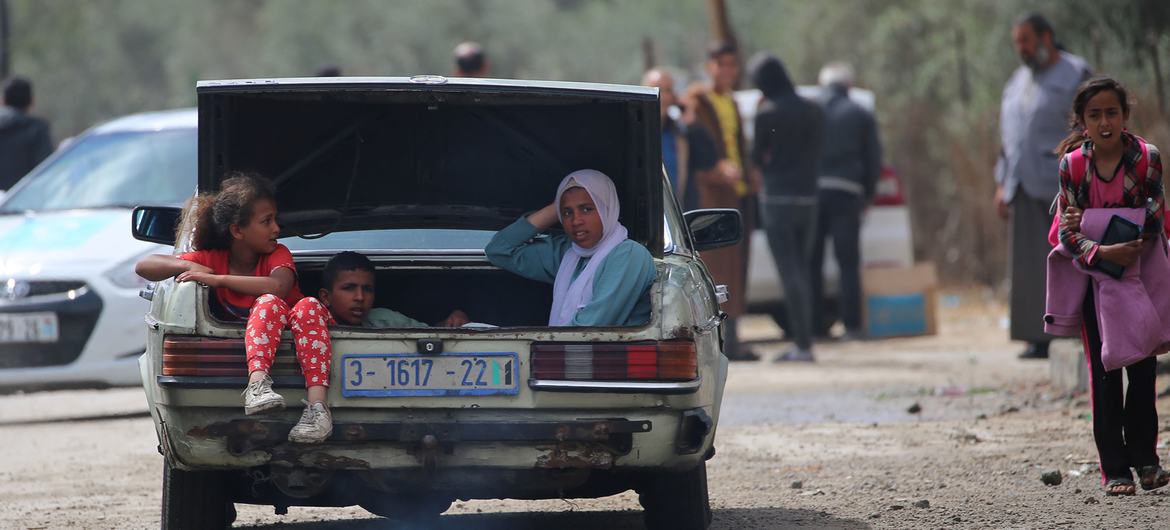
Children travel in the trunk of a car as they leave Rafah in southern Gaza.
© UNICEF/Eyad El Baba
 
Children travel in the trunk of a car as they leave Rafah in southern Gaza.


16 May 202
Peace and Security

UN chief António Guterres reiterated his warning on Thursday against a full-scale assault on Rafah, just as aid teams issued increasingly urgent appeals for safe passage throughout Gaza, to replenish dangerously low stocks of lifesaving supplies.

In a related development, the UN’s top court prepared to hear a new request from South Africa to issue more constraints on Israeli military action in the enclave.

In a call for the “immediate and unconditional release of all hostages” still held in Gaza, the Secretary-General told Arab League leaders at a Summit in Bahrain that nothing justified the “collective punishment” of Palestinians. 

“Any assault on Rafah is unacceptable; it would inflict another surge of pain and misery when we need a surge in life-saving aid,” he added.

Flanked by Philippe Lazzarini, head of the UN agency for Palestinian refugees, UNRWA, Mr. Guterres also renewed his strong backing for the UN agency. It  “remains the backbone of our operations in Gaza and a lifeline for Palestine refugees across the region. It needs full support and funding,” he insisted, as the UN World Food Programme (WFP) issued a new warning about looming famine in Gaza.

Crossing barriers

“Food and fuel stocks will run out in a matter of days,” WFP warned in a social media post on X. “Since 6 May, we have not been able to access and receive aid from the Kerem Shalom crossing. The situation is becoming unsustainable.”

Tweet URL
WFP_MENA

The UN agency highlighted the very real threat that any further escalation of hostilities in Gaza could bring aid operations “to a complete standstill” and lead to a humanitarian catastrophe. 

Although WFP has provided special nutritional foods to pregnant and breastfeeding women along with children under five across Gaza, the UN agency said that as of 11 May distributions were suspended in Rafah “and are only ongoing in Khan Younis and Deir El Balah in a limited capacity”.

In northern Gaza, WFP also warned that rates of acute malnutrition among under two-year-olds “doubled from 15 per cent in January to 30 per cent in March”. 

Humanitarians warn that acute malnutrition is the most deadly form of malnutrition, leaving affected children between three to 12 times more likely to die than a well-nourished child.

The dire assessment comes as the UN agency for Palestinian refugees (UNRWA) reported late Wednesday that 600,000 people – one quarter of Gaza’s population - have now been forcibly displaced from Rafah in the last week, amid ongoing Israeli military activity and evacuation orders.

Another 100,000 people have been uprooted from the north to comply with evacuation orders by the Israeli military, while heavy gun battles have reportedly raged.

Evacuation orders at scale

According to the UN aid coordination office, OCHA, “285 square kilometres, or approximately 78 per cent of the Gaza Strip” are now subject to evacuation orders by the Israeli military.

In its latest update, OCHA reported continuing bombardment “from the air, land and sea…across much of the Gaza Strip, resulting in further civilian casualties, displacement, and destruction of houses and other civilian infrastructure”.

The UN office confirmed reports of ground incursions and heavy fighting in Jabalia in northern Gaza, as well as in Deir al Balah in central Gaza and eastern Rafah in the south. 

“As of 15 May, Rafah crossing remains closed. Kerem Shalom crossing is operational, but the prevailing security and logistical conditions are hampering humanitarian aid deliveries at scale,” OCHA noted.

Echoing those concerns, the WFP insisted that “multiple entry points” for aid are required “to reverse six months of near starvation conditions and avert a famine, steady flows of food supplies, every day and every week…The threat of famine in Gaza never loomed larger.”

South Africa v. Israel

In an effort to halt the military operation in and around the enclave’s southern-most city, South Africa filed a new request to the UN’s top court which it was due to hear on Thursday.

“Urgent provisional measures are required to ensure the survival of Palestinians in Gaza,” the South Africa application said, in its latest claim filed on 10 May.
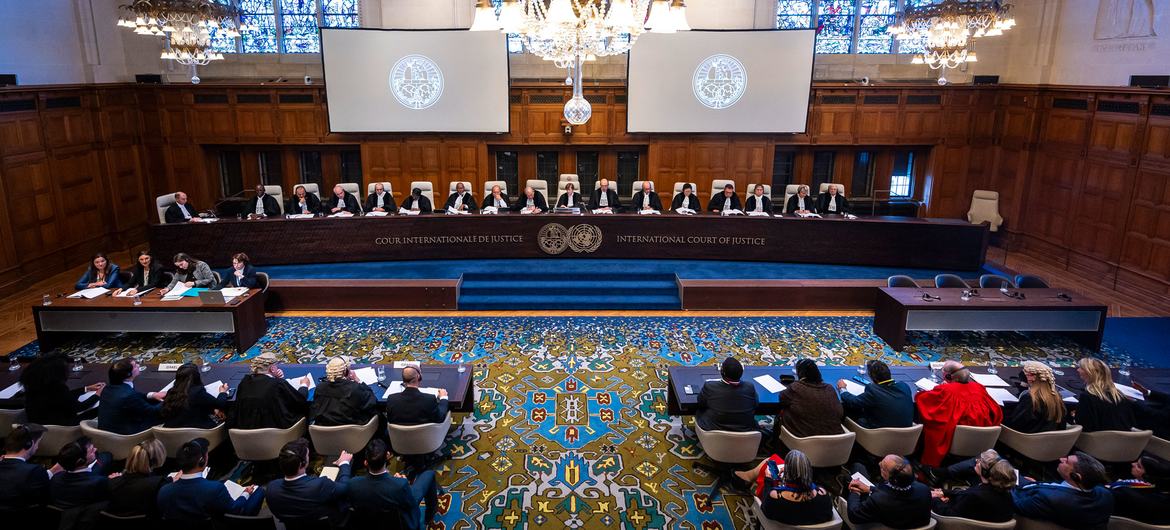
The International Court of Justice delivers its ruling in the case of South Africa v. Israel in The Hague.
© ICJ-CIJ/ Frank van Beek
 
The International Court of Justice delivers its ruling in the case of South Africa v. Israel in The Hague.

“The situation brought about by the Israeli assault on Rafah, and the extreme risk it poses to humanitarian supplies and basic services into Gaza, to the survival of the Palestinian medical system, and to the very survival of Palestinians in Gaza as a group, is not only an escalation of the prevailing situation, but gives rise to new facts that are causing irreparable harm to the rights of the Palestinian people in Gaza.” 

Rafah the last refuge

Rafah is “the last refuge” for Gazans, the South Africa petition continued, adding that the city is also the “last viable centre” for shelter and basic services including medical care. The Israeli military’s seizure of Rafah crossing and the brief closure and ongoing access problems to nearby Kerem Shalom crossing have blocked the main entry points for lifesaving humanitarian aid to Gaza, South Africa also insisted. 

“The remaining population and medical facilities are at extreme risk, given the recent evidence of evacuation zones being treated as extermination zones, the mass destruction and mass graves at Gaza’s other hospitals and the use by Israel of Artificial Intelligence (‘AI’) to identify ‘kill lists’,” ICJ court documents show.

The International Court of Justice previously issued special orders to Israel in late January – known as “provisional measures” – to prevent harm to Gazans, following South Africa’s allegation that Israel was in violation of its obligations as a signatory of the Genocide Convention. There was no explicit call for an immediate halt to Israel’s full-scale military operation in the Strip.

Israel strongly denied the allegations and is scheduled to respond to the latest South Africa request on Friday.


https://news.un.org/en/story/2024/05/1149811


https://creativecommons.org/licenses/by/3.0/legalcode

вторник, 7 мая 2024 г.

Guterres urges Israel, Hamas ‘to show political courage’ and secure ceasefire

Guterres urges Israel, Hamas ‘to show political courage’ and secure ceasefire

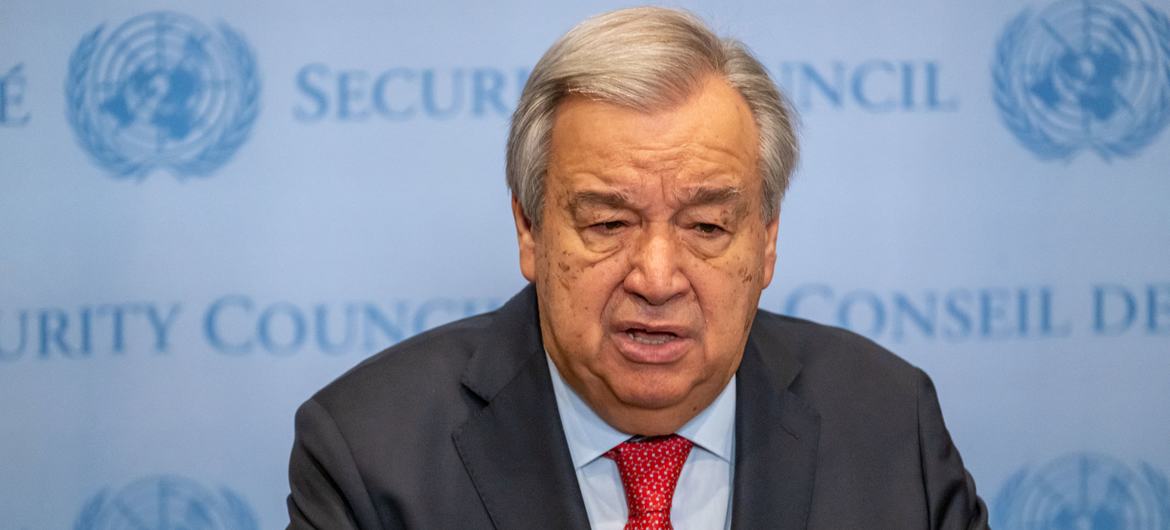
UN Secretary-General António Guterres speaking to the press at the UN Headquarters, in New York.
UN Photo/Mark Garten
 
UN Secretary-General António Guterres speaking to the press at the UN Headquarters, in New York.


7 May 2024

Peace and Security

The UN Secretary-General on Tuesday reiterated his appeal to Israel to stop any escalation in Gaza, amid reports that its forces have taken over key border crossings in Rafah.

In the far south of the Gaza Strip, bordering Egypt, the town of Rafah has been hosting hundreds of thousands of Palestinians driven from elsewhere in the enclave due to the ongoing Israeli military operation.

There are also grave concerns that humanitarian aid stocks are fast running out across the war-torn Strip, and fuel reserves will run out by the end of the day.

“The closure of both the Rafah and Karem Shalom crossings is especially damaging to an already dire humanitarian situation. They must be re-opened immediately,” Secretary-General António Guterres said at a press stakeout at UN Headquarters in New York.

He called on the Israeli Government to stop any escalation and engage constructively in the ongoing diplomatic talks.

Tweet URL
UN_News_Centre

“After more than 1,100 Israelis killed in the Hamas terror attacks of 7 October, after more than 34,000 Palestinians killed in Gaza, haven’t we seen enough?”

Agreement essential

Mr. Guterres underscored the need for an agreement between the Government of Israel and the leadership of Hamas to stop the “unbearable suffering” of both Palestinians in Gaza and the Israeli hostages and their families.

“It would be tragic if weeks of intense diplomatic activity for peace in Gaza, yield no ceasefire. No release of hostages. And a devastating offensive in Rafah,” he said, stressing:

“I reiterate my appeal for both parties to show the political courage and spare no effort to secure an agreement now.”

Human catastrophe

The UN chief further emphasized that a full-scale assault on Rafah will be a “human catastrophe”.

“Countless more civilian casualties. Countless more families forced to flee yet again – with nowhere safe to go. Because there is no safe place in Gaza,” Mr. Guterres said.

“Attacking Rafah will further upend our efforts to support people in dire humanitarian straits as famine looms.”

Call on ‘those with influence’

Mr. Guterres also warned that the repercussions of an attack on Rafah will be felt far beyond the war-ravaged Gaza Strip, the occupied West Bank and the wider Middle East region.

“Even the best friends of Israel are clear: An assault on Rafah would be a strategic mistake, a political calamity, and a humanitarian nightmare,” he said.

“I appeal to all those with influence over Israel to do everything in their power to help avert even more tragedy.”


https://creativecommons.org/licenses/by/3.0/legalcode


https://news.un.org/en/story/2024/05/1149411

суббота, 2 марта 2024 г.

Guterres urges support for Haiti in remarks to regional leaders

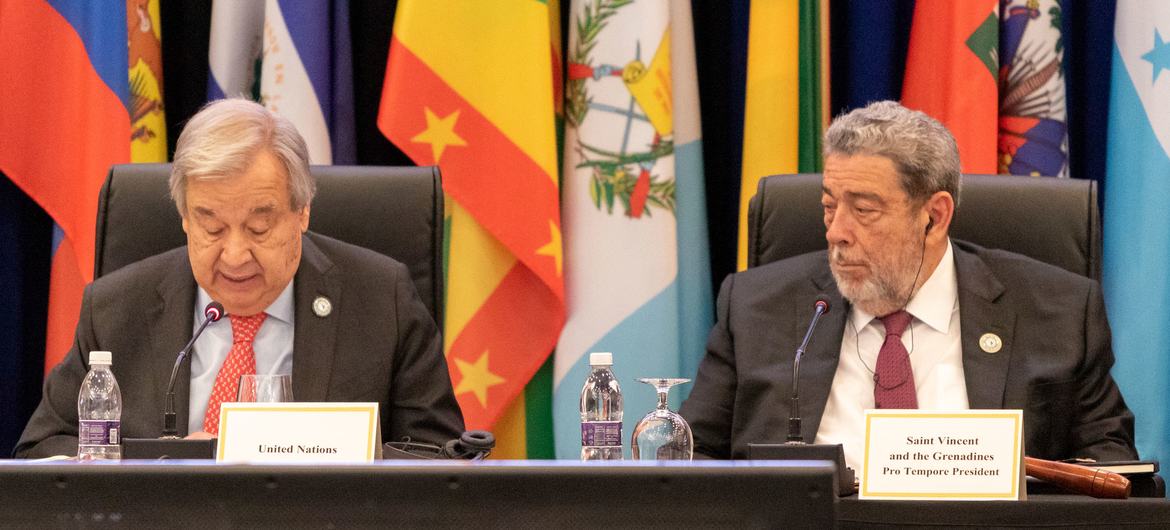
Secretary-General António Guterres (left) delivers remarks at the Eighth Summit for the Community of Latin American and Caribbean States (CELAC) in Saint Vincent and the Grenadines.
UN Photo/Lucanus Ollivierre
 
Secretary-General António Guterres (left) delivers remarks at the Eighth Summit for the Community of Latin American and Caribbean States (CELAC) in Saint Vincent and the Grenadines.


1 March 2024
Peace and Security

UN Secretary-General António Guterres appealed on Friday for greater support for an international mission to help Haiti combat rampant gang violence in remarks to regional leaders meeting in Saint Vincent and the Grenadines. 

The island nation is hosting the latest summit of the Community of Latin American and Caribbean States (CELAC), which comprises more than 30 countries.

With the bloc meeting “to help foster solutions for the region and for the world”, Mr. Guterres highlighted the need for solidarity in the areas of peace and security, sustainable development, social cohesion and climate action.

Tweet URL
antonioguterres

‘Peace is possible’ 

“Latin America and the Caribbean have shown how uniting for peace is possible and makes a difference,” he said. 

He pointed to the “significant strides” made in the peace process in Colombia and the joint declaration signed recently by Guyana and Venezuela aimed at reducing border tensions.

However, he noted that organized crime continues to plague many countries. 

“Arms trafficking has become the most important security threat to the region,” the UN chief said. “It will not be possible to fight it effectively without much stronger international cooperation, from the source to the streets.” 

In this regard, he welcomed the security partnership launched recently by Andean countries to assist Ecuador, while the new Government in Guatemala “offers a chance to advance democratic development, the rule of law and other key aspects of the peace agenda.” 

Help for Haiti

He warned that the already dire situation in Haiti is getting worse by the day, as gangs hold the country hostage and use sexual violence as a weapon. 

Last October, the UN Security Council authorized a multinational security support mission to back-up the national police, which Kenya has offered to lead. Several countries, including CELAC members, made additional pledges of support during an event on the sidelines of the G20 meeting in Brazil last week.

“I welcome these efforts, but much more must be done to secure the deployment of this mission without further delay and a political solution that could resolve the country's fundamental problems,” he said. 

According to news reports, Kenya and Haiti signed a formal security agreement on Friday which will allow the deployment of 1,000 Kenyan police officers which will form the core of the new UN-backed multinational mission.

Kenyan President William Ruto reportedly said that thanks to the breakthrough deal, the mission can now be fast-tracked. The bilateral agreement is a key pre-condition laid down by Kenya's High Court for allowing the police deployment.

Sustainable development stimulus 

Addressing sustainable development, the Secretary-General reported that efforts to achieve a more just and equitable global future are in danger. 

This is occurring at a time when millions in the region are facing hunger and poverty, and as many countries are drowning in debt. 

Last September, world leaders endorsed his proposal for $500 billion in annual financing to boost sustainable development but “unfortunately, the resistance has been severe”.

He expressed hope that the Summit of the Future at UN Headquarters this September will make progress towards reforming “a global financial architecture that is unfair, outdated and ineffective”. 

Climate justice and finance 

The Secretary-General arrived in Saint Vincent and the Grenadines on Thursday. At a press conference that afternoon in the capital, Kingstown, he expressed solidarity with small island developing States who are on the frontlines of the fight against climate change. 

He appealed for greater action to reduce greenhouse gas emissions, which he said “is essentially a responsibility of the G20 countries” as these richer nations are the main polluters. 

“But, we need much more climate justice, which means much more finance available at reasonable cost for adaptation and mitigation for developing countries and in particular for small island developing States,” he said.


https://news.un.org/en/story/2024/03/1147142


https://creativecommons.org/licenses/by/3.0/legalcode