Показаны сообщения с ярлыком Iran. Показать все сообщения

воскресенье, 21 сентября 2025 г.

Iran’s uranium stockpile grows following three years of denied access


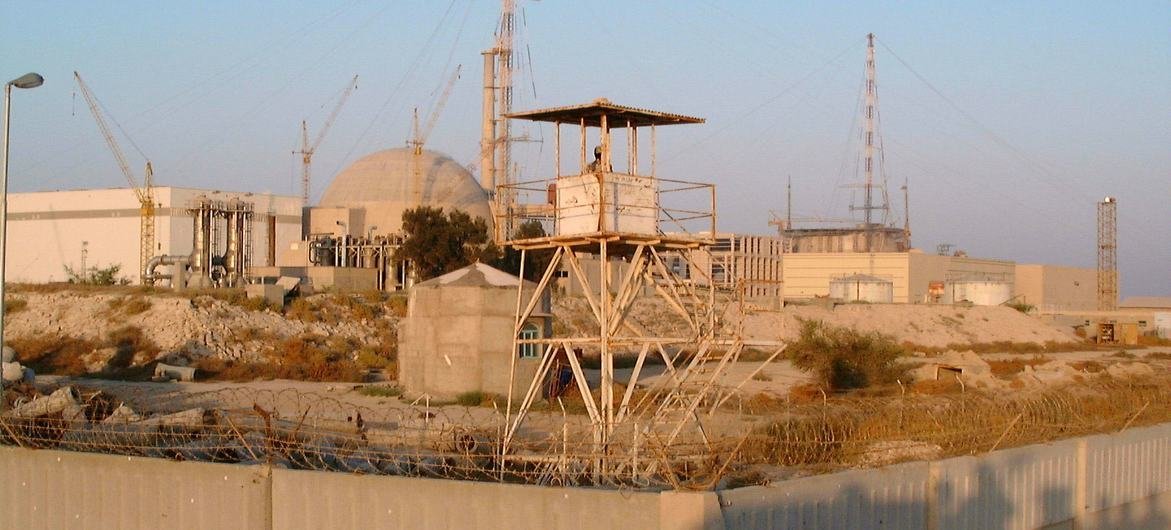
The Busher nuclear power plant in Iran. (file photo)
IAEA/Paolo Contri
 
The Busher nuclear power plant in Iran. (file photo)

3 June 2024
Peace and Security

Iran’s stockpile of enriched uranium continues to increase, the head of the UN atomic watchdog agency said on Monday, adding that it has been three years since the agency was able to access the country.

Addressing the Board of Governors of the International Atomic Energy Agency (IAEA), Director General Rafael Grossi indicated no progress had been made in resolving outstanding issues.

He mentioned that Iran is still not implementing provisions of the nuclear safeguards agreement, and that withdrawal of designations for several IAEA inspectors are yet to be reversed.

“These outstanding safeguards issues…need to be resolved for [IAEA] to be in a position to provide assurance that Iran’s nuclear programme is exclusively peaceful,” Mr. Grossi emphasized.

He also voiced concerns about public statements made in Iran regarding its technical capabilities to produce nuclear weapons and potential changes to its nuclear doctrine, which only deepen apprehensions about the “correctness and completeness” of the country’s safeguards declarations.

Ukraine’s power plants

Nuclear Safety, Security and Safeguards in Ukraine.
© IAEA
 
Nuclear Safety, Security and Safeguards in Ukraine.

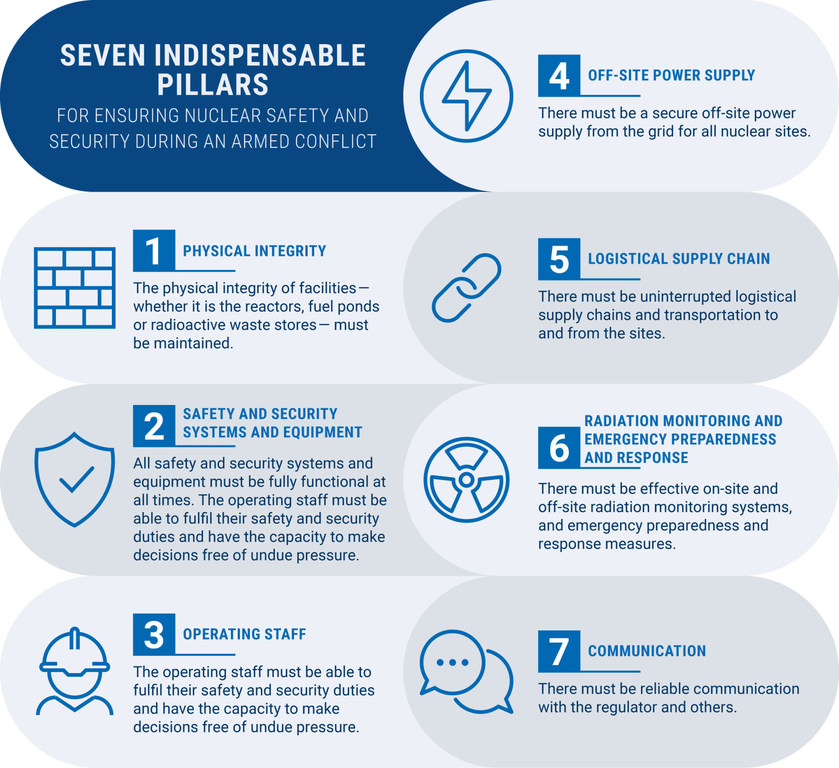
Turning to Ukraine, the IAEA chief warned the situation at the Zaporizhzhia Nuclear Power Plant “remains precarious” and that all seven Pillars of Nuclear Safety and Security have been “fully or partially compromised”.

These include physical integrity; functional safety and security systems and equipment; radiation monitoring and emergency response; secure and reliable off-site power supply; trained staff; an uninterrupted logistic supply chain; and open communication.

“The attacks and the frequent disconnection of the off-site power lines due to military activity are creating a grave situation,” Mr. Grossi said.

All six reactor units at the plant have been in cold shutdown since April, a safety measure long recommended by the IAEA. Despite this, the agency’s ability to ensure the plant’s safety and security remains compromised due to restricted access, he added.

He further reported that Ukraine’s other four nuclear power plants continue to face compromised supply chains for spare parts and high levels of stress among staff.

DPR Korea’s nuclear programme

Mr. Grossi also voiced concern over the continued and further development of the Democratic People’s Republic of Korea’s (DPRK) nuclear programme.

The IAEA has observed intermittent cooling water discharge, consistent with the operation of the Light Water Reactor (LWR) at Yongbyon, along with ongoing activities at the reported centrifuge enrichment facility.

The Nuclear Test Site at Punggye-ri remains occupied and prepared to support a new test.

“The continuation and further development of the DPRK’s nuclear programme is a clear violation of relevant UN Security Council resolutions and is deeply regrettable,” Mr. Grossi said, urging the country to comply fully with its obligations and to cooperate promptly with IAEA.

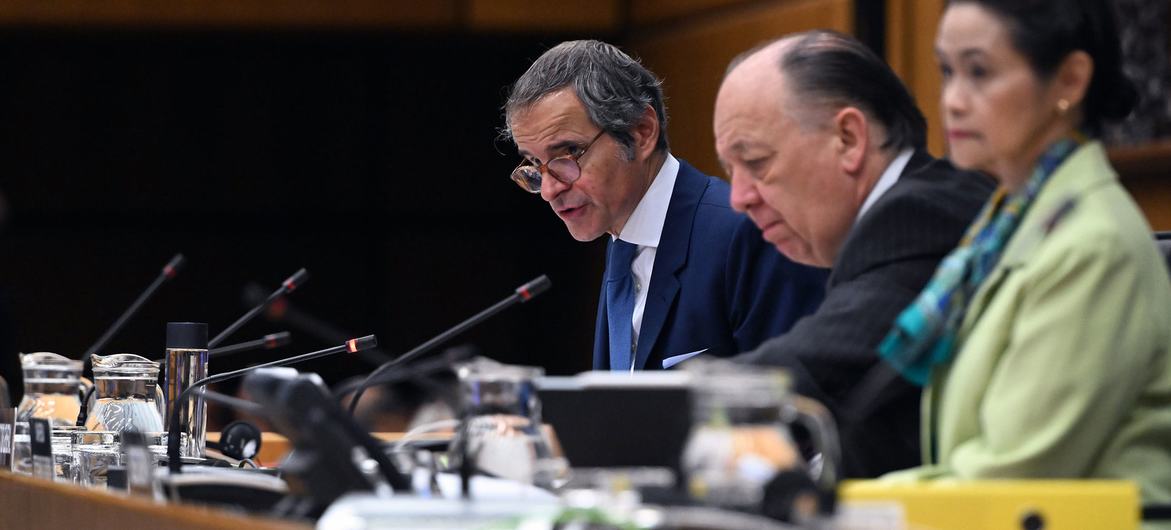
Rafael Mariano Grossi (right), IAEA Director General, delivers his opening statement at the 1717th Board of Governors meeting held at the IAEA Headquarters, in Vienna.
© IAEA/Dean Calma
 
Rafael Mariano Grossi (right), IAEA Director General, delivers his opening statement at the 1717th Board of Governors meeting held at the IAEA Headquarters, in Vienna.

Japan’s Fukushima Daiichi plant

In Japan, IAEA continues to monitor the discharge of Advanced Liquid Processing System)-treated water from the Fukushima Daiichi Nuclear Power Station, which suffered a meltdown 13 years ago, he reported.

Mr. Grossi confirmed that the discharge is progressing in accordance with the safety plan approved by Japan’s Nuclear Regulation Authority.

“Expert independent analysis of the six batches released so far have confirmed the tritium concentration in each batch of ALPS-treated water released to date is far below Japan’s operational limit.”

Nuclear technology for sustainable development

In his concluding remarks, the head of IAEA underscored the agency’s key role in promoting sustainable development.

“The IAEA is a crucially important vehicle for advancing sustainable development and international peace and security,” he said, urging member states to continue their support for the agency’s indispensable work.


https://news.un.org/en/story/2024/06/1150576


https://creativecommons.org/licenses/by/3.0/legalcode

вторник, 25 июня 2024 г.

Effort to restore Iran nuclear deal ‘remains elusive’, Security Council hears


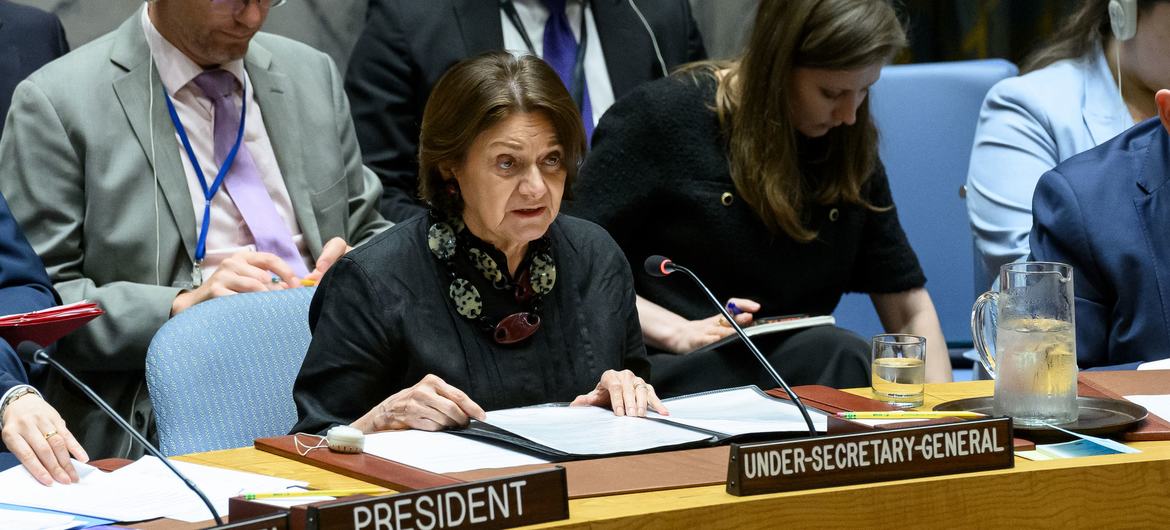
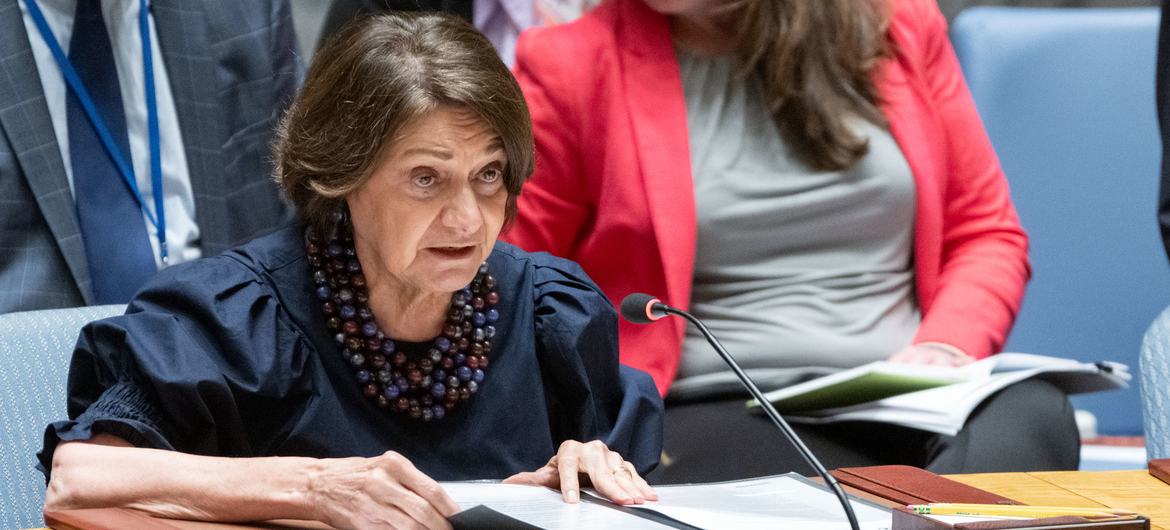
Under-Secretary-General DiCarlo briefs the Security Council.
UN Photo/Loey Felipe
 
Under-Secretary-General DiCarlo briefs the Security Council.


24 June 2024

Peace and Security

Restoring the Iran nuclear deal to its full and effective implementation “remains elusive”, the UN’s top political affairs official said on Monday, adding that participating countries remain at odds with each other.

Rosemary DiCarlo, Under-Secretary-General for Political and Peacebuilding Affairs, was updating ambassadors in the Security Council.

The United States has not returned to the Joint Comprehensive Plan of Action (JCPOA), as the deal is formally called, nor has it lifted or waived the unilateral sanctions it reimposed after its withdrawal in May 2018. Neither has Washington extended waivers over oil trading with Iran.

As for Tehran’s policies, the Government has not reversed any of the steps it has taken since May 2019 which are inconsistent with its nuclear-related commitments.

The 2015 JCPOA lays out the rules for monitoring Iran’s domestic nuclear programme and paved the way for US sanctions to be lifted. It was agreed by Iran, the five permanent members of the Council (China, France, Russia the United Kingdom and the United States) plus Germany together with the European Union.

Tweet URL
UNDPPA

Unable to verify

Ms. DiCarlo also referred to May’s report from the International Atomic Energy Agency (IAEA), in which the nuclear watchdog “observed again that, regrettably, its verification and monitoring continues to be, and ‘seriously affected by the cessation of Iran’s implementation of its nuclear-related commitments under the JCPOA’.”

While the IAEA had not been able to verify the total stockpile of enriched uranium in the country since February 2021, “it estimated that Iran maintains a total enriched uranium stockpile thirty times the amount allowable under the JCPOA,” she said.

This includes increased quantities of uranium enriched to 20 per cent and 60 per cent.

“Such a stockpile of enriched uranium and level of enrichment remain very concerning,” she added.

Pursue dialogue

Further in her briefing, Ms. DiCarlo reiterated the call for JCPOA participants to the Plan and the US “to pursue all possible avenues for dialogue and cooperation”.

“In the current climate, it is crucial to prioritize multilateralism and diplomacy, and to set a course that promotes peace and security,” she highlighted.


Iran nuclear deal: a summary

  • What is the Iran nuclear deal? The 2015 “Joint Comprehensive Plan of Action” (JCPOA), sets out rules for monitoring Iran’s nuclear programme, and paves the way for the lifting of UN sanctions.
  • Which countries are involved? Iran, the five members of the Security Council (China, France, Russia, UK, US), plus Germany, together with the European Union.
  • What is the UN’s involvement? A UN Security Council resolution to ensure the enforcement of the JCPOA, and guarantee that the UN’s atomic energy agency, the IAEA, continues to have regular access to and more information on Iran’s nuclear programme, was adopted in 2015.
  • Why is the deal at risk? The Trump Administration pulled out of the deal in 2018 and re-imposed sanctions. In July 2019, Iran reportedly breached its uranium stockpile limit, and announced its intention to continue enriching uranium, posing a more serious proliferation risk.
https://news.un.org/en/story/2024/06/1151406

https://creativecommons.org/licenses/by/4.0/legalcode

пятница, 19 апреля 2024 г.

Retaliatory spiral in Middle East must end, says UN chief after strikes on Iran


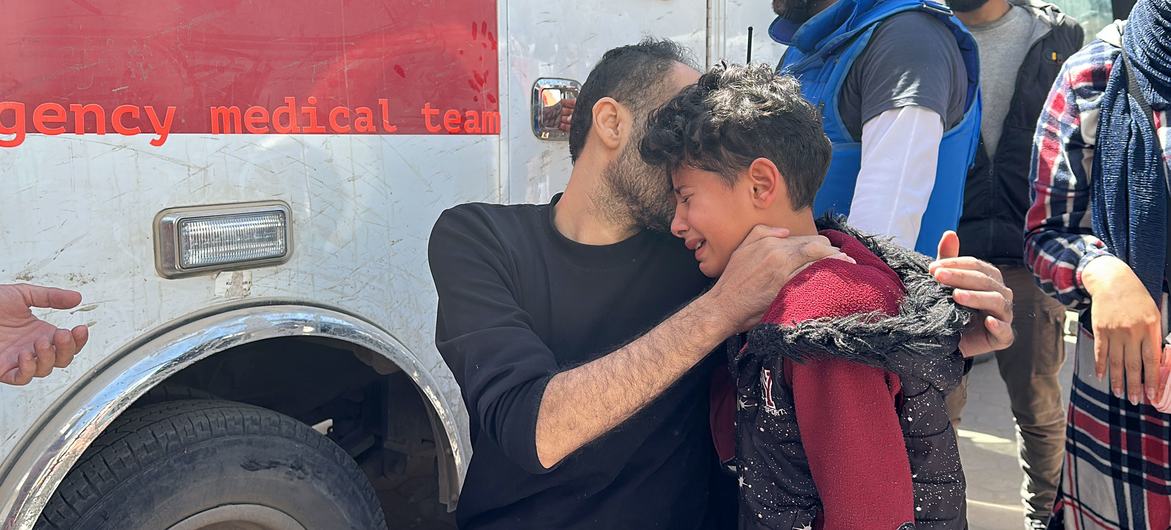
A young boy is treated by a mobile emergency clinic team in Northern Gaza.
© WHO
 
A young boy is treated by a mobile emergency clinic team in Northern Gaza.


19 April 2024
Peace and Security

Following reports of alleged Israeli strikes inside Iran near a nuclear power station early Friday, the UN Secretary-General António Guterres issued a new appeal to all parties to “stop the dangerous cycle of retaliation in the Middle East”.

“The Secretary-General condemns any act of retaliation and appeals to the international community to work together to prevent any further development that could lead to devastating consequences for the entire region and beyond,” he said in a statement issued by his Office.

Echoing those concerns, UN atomic energy agency chief Rafael Grossi urged “extreme restraint” from all sides, after more than six and a half months of war in Gaza that have fuelled fears of a wider regional conflict.

Tweet URL
iaeaorg

“IAEA can confirm that there is no damage to Iran’s nuclear sites" and Director-General Grossi "continues to call for extreme restraint from everybody and reiterates that nuclear facilities should never be a target in military conflicts", the International Atomic Energy Agency said in a tweet following unconfirmed media reports that possible drone strikes had targeted the Iranian province of Isfahan, which is home to nuclear facilities and military garrisons. 

In Geneva, too, the UN human rights office, OHCHR, urged all parties “to take steps to de-escalate the situation” rapidly. 

“(We) call on third States, in particular those with influence, to do all in their power to ensure there is no further deterioration in an already extremely precarious situation,” said OHCHR spokesperson Jeremy Laurence.

Hunger and fear

In Gaza, aid teams offered new insight into the dangers faced by Palestinian civilians – particularly pregnant women and breastfeeding mothers – as a result of the “wanton destruction” of vital medical equipment and widespread “dehydration, malnutrition and fear” among Palestinians.

Speaking to journalists in Geneva, Dominic Allen, Representative for the UN sexual and reproductive health agency (UNFPA) for Palestine, said that there were indications that the number of complicated births is nearly twice what it was before war erupted.

“There is absolutely an increase in the numbers,” he said, adding that pre-war, around 15 per cent of births required some form of emergency obstetric care. Today, some doctors have reported “a doubling of what they previously had dealt with, and this is due to malnutrition, dehydration and fear, which impact the pregnant woman’s ability to give birth safely and carry their baby to full term safely,” the UNFPA official said.

‘Wanton destruction’

Mr. Allen described his latest mission to Gaza to assess the impact of Israeli attacks on healthcare at embattled hospitals in the north, central and southern governorates.

It was clear that the last remaining hospitals in the enclave – including its second largest, Nasser Hospital – are “clinging to life themselves whilst they are a lifeline for the pregnant women of Gaza”, Mr. Allen said via video link from Jerusalem. “What I saw, it breaks my heart…It's indescribable. What we see there is medical equipment, purposefully broken, ultrasounds – which you will know is a very important tool for helping ensure safe births – with cables that have been cut, screens of complex medical equipment like ultrasounds and other with the screens smashed. So, purposeful, wanton destruction in the maternity ward.”

Before intense Israeli bombardment began in response to Hamas-led terror attacks across southern Israel on 7 October, Nasser Hospital in the southern city of Khan Younis had a maternity ward which UNFPA teams have supported and supplied for years.

In order to be fully functional again, the hospital will need reconditioned water and sanitation services and repairs to damaged electricity generators, at a bare minimum. “But, I stood beside the warehouse (where) we delivered supplies many months ago and it was literally burning; there's so much work to do in terms of trying to re-establish that lifeline,” Mr. Allen said.

‘Palpable’ fear

The UNFPA mission, which began on Monday 8 April and ended this Wednesday, was carried out in partnership with the UN World Health Organization (WHO), the UN aid coordination office, OCHA, and the UN agency for Palestinian refugees (UNRWA).

The objective was to visit around 10 hospitals in Gaza, among them Al Aqsa Hospital in central Gaza, which was “overwhelmed with trauma patients” and not supporting maternity care. 

At Emirati Hospital in the south of the enclave, Mr. Allen recounted meeting the medical director of the facility who said that “he no longer sees normal-sized babies.”

Turning to Rafah and continuing fears of an Israeli incursion, the UNFPA officer underscored the “great sense of fear” hanging over the more than 1.2 million people sheltering there.

“There is a palpable fear from the Gazans who I spoke with - the midwives, doctors, pregnant women, my fellow colleagues, who are in Gaza…Right now it's a haven for 1.2 million Gazans; it's not a safe haven, but it's a haven at least.”


https://news.un.org/en/story/2024/04/1148741

https://creativecommons.org/licenses/by/3.0/legalcode

понедельник, 15 апреля 2024 г.

‘Step back from the brink,’ to avert full-scale Middle East conflict, says UN chief

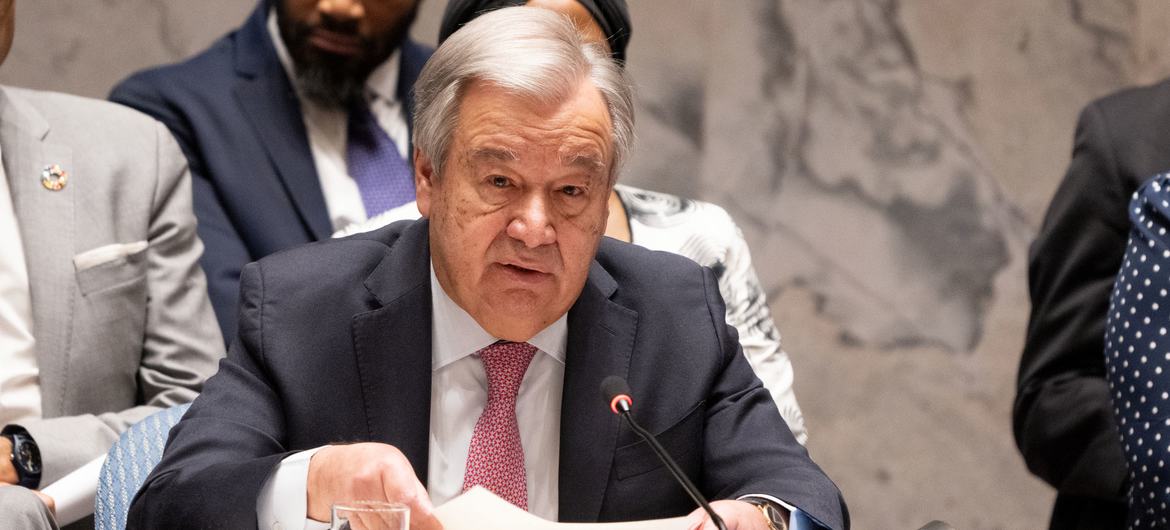
United Nations Secretary-General António Guterres speaks at the UN Security Council following Iran's attacks on Israel.
UN Photo
 
United Nations Secretary-General António Guterres speaks at the UN Security Council following Iran's attacks on Israel.


14 April 2024

Peace and Security

The people of the Middle East are facing a real danger of a devastating full-scale conflict, António Guterres said on Sunday, urging “maximum restraint” across a region “on the brink”, hours after Iran launched attack drones and missiles against Israel overnight Saturday. 

“It is vital to avoid any action that could lead to major military confrontations on multiple fronts in the Middle East...Now is the time for maximum restraint,” the UN Secretary-General told delegates at the opening of an emergency meeting of the UN Security Council. 

Mr. Guterres explained that the emergency session was called by Israel following what it described in a letter as ‘a direct attack launched by Iran... of more than 200 UAVs, cruise missiles, and ballistic missiles towards Israel in clear violation of international law.’

The UN chief added that in a separate letter, Iran stated that it had carried out a series of military strikes on Israeli military objectives ‘in the exercise of Iran’s inherent right to self-defence as outlined...in the UN Charter, and in response to...its armed attack on 1 April 2024 against Iranian diplomatic premises’ – in Damascus.

The aftermath

According to the latest reports, Iran launched hundreds of drones and missiles from its territory toward Israel, with most intercepted.

Several missiles reportedly struck within Israeli territory, one of which damaged an Israeli military facility in the south of the country.

“And overall, a few civilians were injured,” the Secretary-General reported, repeating his strong condemnation of the attacks and his call for an immediate cessation of these hostilities.

‘Responsibility to work for peace’

Recalling the international community’s shared responsibility to engage all parties to prevent further escalation, the Secretary-General added that there was a similar responsibility to secure an immediate humanitarian ceasefire in Gaza, the immediate and unconditional release of all hostages, and the unimpeded delivery of humanitarian aid.

There was a further shared responsibility to stop violence in the occupied West Bank, de-escalate the situation along the Blue Line, and re-establish safe navigation in the Red Sea.

“We have a shared responsibility to work for peace. Regional – and indeed global -- peace and security are being undermined by the hour. Neither the region nor the world can afford more war,” Mr. Guterres concluded.

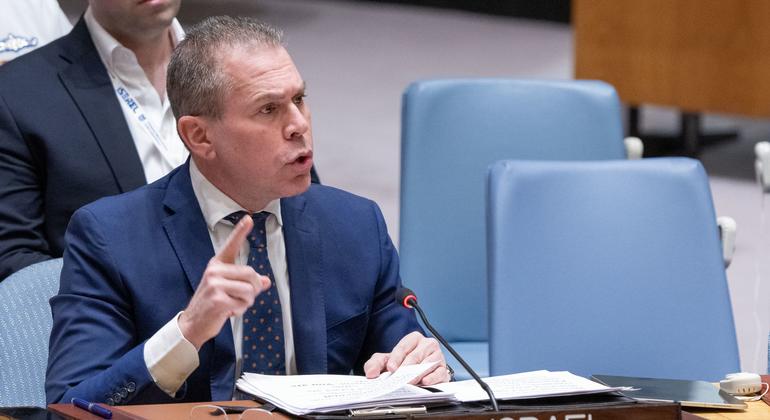
Ambassador Gilad Erdan​ (at table) of Israel addresses the UN Security Council following Iranian attacks on his country.
UN Photo

Israel has been ‘sounding the alarm’

Israeli Ambassador Gilad Erdan said Saturday night’s attacks had been launched from Iranian soil, as well as Lebanon, Syria, Yemen and Iraq.  

“Last night the world witnessed an unprecedented escalation that is clear proof of what can happen when warnings are ignored ... [Israel] was not crying wolf; it was trying to wake the world up to the dangers posed by Iran and Its proxies,” he said, adding: “Israel has been sounding the alarm bells.”

Israel’s representative showed a video of what he called an attack on the Temple Mount, and he asked the Security Council: “What have you done to protect the world from Iran?”

He said that Iran’s actions had long been clear, to arm, fund and train its terror proxies across the globe. But the mask of deniability has been removed: Iran had attacked Israel from its own territory; and Israel was surrounded by Iran’s proxies and being attacked on all fronts.

“The mask has come off and so the world’s complacency must also fall. The only option is to condemn Iran...and ensure that it knows that the world will no longer stand idle.”  

“This attack crossed every red line and Israel reserves the right to retaliate,” he stated.

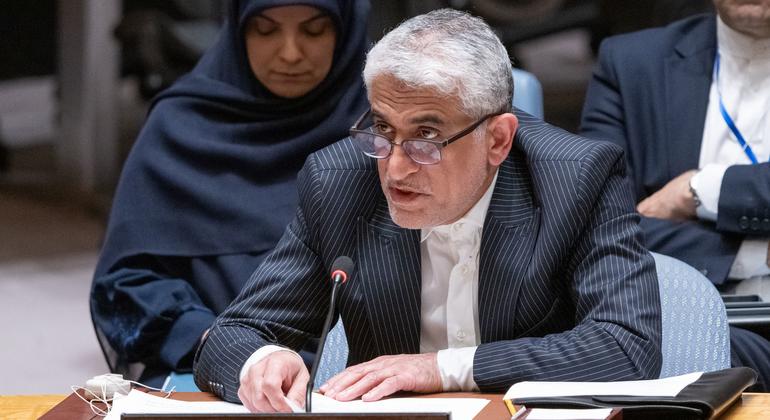
Iran’s ambassador to the United Nations, Amir Saeed Iravani, addresses the Security Council meeting on his country's attacks on Israel.
UN Photo

Council hypocrites shielding Israel

While emphasizing that Israel’s “false and unsubstantiated claims” deserved “no real response,” Ambassador Amir Saed Iravani reiterated Iran’s consistent position that it does not seek escalation or war in the region.  

“Iran's operation was entirely in the exercise of Iran’s inherent right to self-defense. This concluded action was necessary and proportionate. It was precise and only targeted military objectives and carried out carefully to minimize the potential for escalation and prevent civilian harm,” the Ambassador explained.

Yet, it was regrettable, he said, that today certain Council members, including the US, the UK, and France had chosen to “turn a blind eye to reality” and overlook the root causes contributing to the current situation.  

“In hypocritical behavior, these three countries falsely blamed and accused Iran without considering their own failures to uphold their international commitments to peace and security in the region,” said Ambassador Iravani, calling out what he saw as “lies and disinformation” being used to discredit Iran’s right to self-defense.

Moreover, the Council’s inaction faced with “Israeli war crimes against the Palestinian people has only emboldened this regime to continue its violations unchecked” he said, adding that the US and its allies blocked Security Council on Gaza for over six months, protecting Israel from accountability.

“While warning about any further military provocations by the Israeli regime, the Islamic Republic of Iran reaffirms its unwavering determination to defend its people, national security and interests... [we] will not hesitate to exercise this right when required,” he explained. 

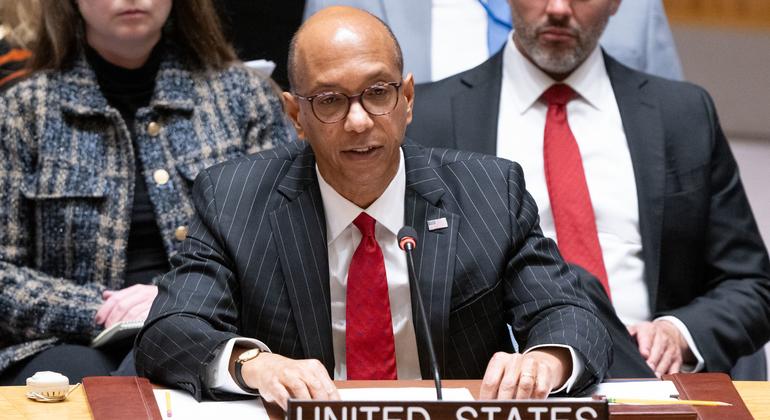
Ambassador Robert Wood of the United States addresses the UN Security Council meeting on Iran's attacks on Israel.
UN Photo

Council must hold Iran accountable

US Deputy Ambassador Robert Wood strongly condemned “the unprecedented attack on the State of Israel by the Islamic Republic of Iran and its militant proxies and partners,” and said, “Iran’s intent was to cause significant damage and death in Israel.”

“Iran’s reckless actions not only posed a threat to populations in Israel, but also to other UN Member States in the region, including Jordan and Iraq,” he said and added: “The Security Council has an obligation to not let Iran’s actions go unanswered.”

“Indeed, for far too long Iran has flagrantly violated its international legal obligations, notably through the actions of its Islamic Revolutionary Guard Corps or IRGC,” he continued and noted: “Iran also was, in a broad sense, complicit in the October 7 attack on Israel because it has provided significant funding and training for the military wing of Hamas.” 

“In the coming days, and in consultation with other member states, the United States will explore additional measures to hold Iran accountable here at the United Nations,” said Mr. Wood.

States or further action against Israel, Iran will be held responsible,” he said, and stressed: “The United States is not seeking escalation. Our actions have been purely defensive in nature.”

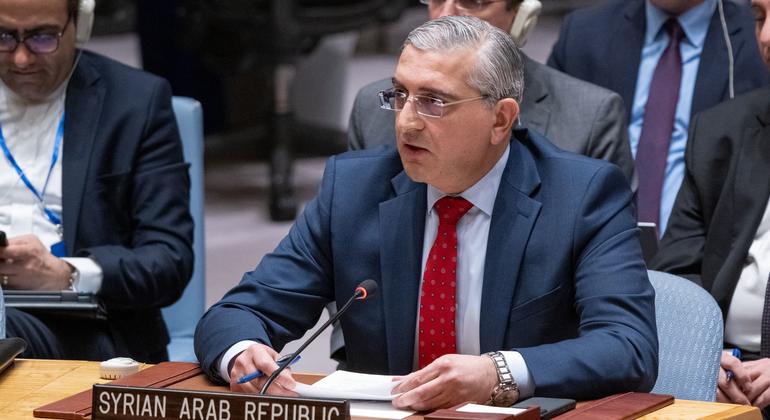
Koussay Aldahhak, Permanent Representative of the Syrian Arab Republic, addresses the Security Council meeting on on Iran's attacks on Israel.
UN Photo/Eskinder Debebe

Hypocrisy, double standards must end

Syrian Ambassador Koussay Aldahhak said that what the Middle East witnessed on Saturday had been the natural and inevitable outcome of repeat aggressions and grave violations of international law and the UN Charter “perpetrated [by the Israeli occupation authorities] in Syria and other countries in the region.”

He said that these violations were carried out in the region with “blind and unlimited” support of the US and had “mistakenly led the Israeli occupation authorities to believe that they are above the United Nations, above international law and above UN resolutions…for decades ... with no response and no consequence.”

The Syrian delegation had warned the United Nations about such activities and had called upon the Organization to put an end to Israel’s crimes. But in all cases, a few countries continued to shield Israel form accountability. Sadly, “the actions by these countries are nothing new.”

Finally, the Ambassador said that Syria holds the US Administration and Israel responsible for any further attacks and escalation in the region. “They must reconsider their destructive polices in our region and against our peoples; they must rectify their activities in the region. Our region has suffered enough,” he said, calling for an end to hypocrisy and double standards.

Moreover, the international community must end the Israeli occupation as well as take immediate action to end the "intentional starving" of the people of Gaza, ensure full humanitarian access to the Strip, and “end illegitimate existence of US military forces in my country, Syria.”


https://news.un.org/en/story/2024/04/1148551

https://creativecommons.org/licenses/by/3.0/legalcode

среда, 3 апреля 2024 г.

UN calls for restraint following attack on Iranian consulate in Damascus


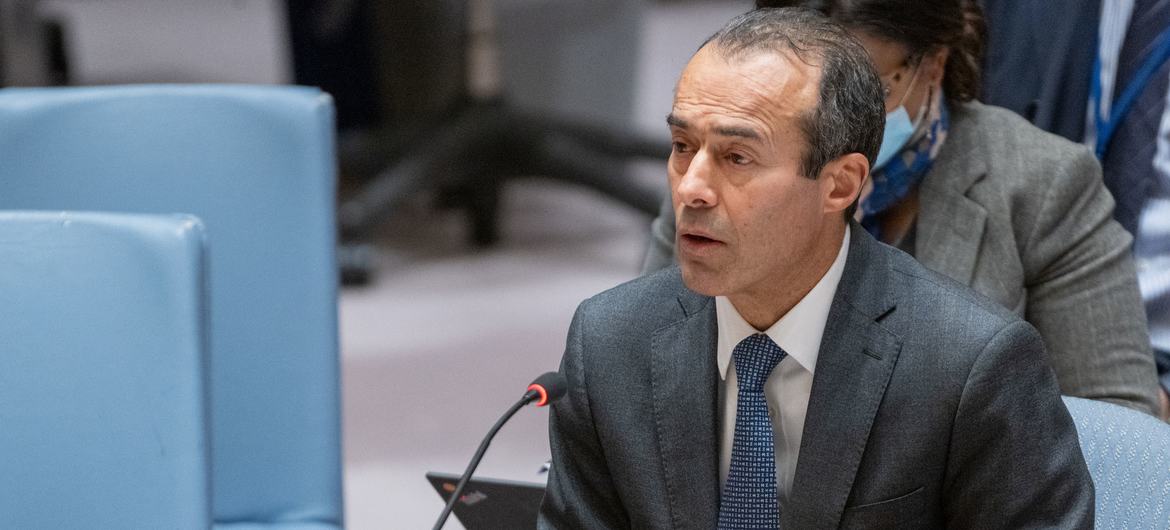
Khaled Khiari, Assistant Secretary-General for Middle East, Asia and the Pacific of the Departments of Political and Peacebuilding Affairs and Peace Operations, briefs the Security Council meeting on threats to international peace and security.
UN Photo/Eskinder Debebe
 
Khaled Khiari, Assistant Secretary-General for Middle East, Asia and the Pacific of the Departments of Political and Peacebuilding Affairs and Peace Operations, briefs the Security Council meeting on threats to international peace and security.


2 April 2024

Peace and Security

A senior UN official on Tuesday urged the Security Council to work to avert further escalation in the Middle East following the deadly airstrike on the Iranian consulate in Syria’s capital, Damascus. 

Briefing ambassadors a day after the attack, Assistant-Secretary-General Khaled Khiari stressed the need for restraint.  

“We appeal to the Council today, as we do every month, to continue to actively engage all concerned parties to prevent further escalation and the worsening of tensions that undermine regional peace and security,” he said. 

Respect diplomatic premises 

UN Secretary-General António Guterres has condemned the attack, his Spokesperson said on Tuesday, reaffirming that the principle of the inviolability of diplomatic and consular premises and personnel must be respected in all cases. 

The UN chief reminded all parties to respect all their obligations under international law, and urged all concerned to avoid attacks that could harm civilians and damage civilian infrastructure. 

Mr. Khiari said Iran sent identical letters to the Secretary-General and the Security Council on Monday stating that Israel had attacked its diplomatic premises in Damascus, killing at least five personnel, including senior military advisors, and injuring others. 

Subsequent media reports indicate that the death toll has risen to 13 - seven Iranian personnel and six Syrian citizens, he added, before reiterating the Secretary-General’s condemnation. 

Uphold territorial integrity 

“The sovereignty and territorial integrity of Member States must be respected in accordance with international law,” said Mr. Khiari, whose portfolio straddles political and peacebuilding affairs as well as peace operations.

“The rules-based international order is essential for international peace and security, which this Council is mandated to maintain.” 

He recalled that the UN Special Envoy for Syria, Geir Pedersen, has kept the Council apprised of the unrelenting violence in the country, which recently marked 13 years of war. 

Six foreign armies are operating on Syrian territory impacting the lives of civilians and putting a peaceful resolution of the conflict farther out of reach. 

Increase in attacks 

“Among them, increasingly lethal attacks on Iran-linked targets in Syria have been attributed to Israel, especially since the current conflict with Hamas in Gaza began on 7 October. Open sources have reported at least a dozen such attacks since the beginning of this year,” he said.

“While Israel has rarely claimed responsibility for any of these incidents, its officials have repeatedly acknowledged its military operations in Syria and have suggested that more such operations will occur in the future,” he added, underlining the need for the Council’s continued engagement.

Mr. Khiari concluded by underscoring the Secretary-General’s appeal for restraint. 

“Any miscalculation could lead to broader conflict in an already volatile region, with devastating consequences for civilians who are already seeing unprecedented suffering in Syria, Lebanon, the Occupied Palestinian Territory, and the broader Middle East,” he said.


https://news.un.org/en/story/2024/04/1148191


https://creativecommons.org/licenses/by/3.0/legalcode

четверг, 4 января 2024 г.

Guterres strongly condemns attack in Iran; over 100 reportedly killed

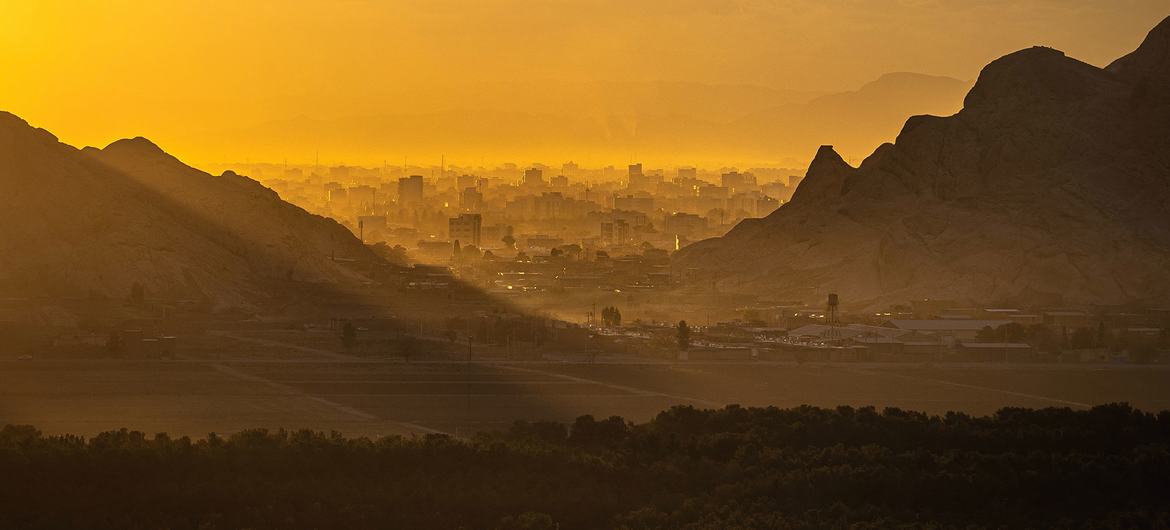
The city of Kerman is in southeastern Iran.
© Unsplash/Mahdi Karbakhsh Ravari
 
The city of Kerman is in southeastern Iran.
3 January 2024
Peace and Security

The UN Secretary-General António Guterres on Wednesday strongly condemned an attack in Iran which has reportedly killed more than 100 people taking part in a commemoration for a former top military general in the eastern city of Kerman.

More than 170 people have also been wounded according to Iranian officials at the scene.

News reports citing local officials said that there were two explosions as thousands were walking along the route to a cemetery in Kerman which is the final resting place of Qassim Suleimani, who was killed in a US drone strike in the Iraqi capital Baghdad four years ago.

Tweet URL

Reports suggest the roadside bombs were detonated by remote control, causing widespread carnage and chaos, in what Iranian authorities are describing as a terrorist attack. 

Given the scale and size of the blasts, it’s likely that the death toll will rise.

Call for accountability

“The Secretary-General expresses his deep condolences to the bereaved families and the people and the Government of the Islamic Republic of Iran. He wishes the injured a speedy recovery”, said Florencia Soto Niño, UN Associate Spokesperson, briefing journalists at the regular noon briefing in New York.

The UN chief called for those responsible, to be held accountable for the deadly blasts.

So far, there has been no claim of responsibility for the attack.


https://news.un.org/en/story/2024/01/1145257


https://creativecommons.org/licenses/by/3.0/legalcode

вторник, 19 декабря 2023 г.

‘All Diplomatic Avenues’ Must Be Exhausted to Restore Iran Nuclear Deal, Under-Secretary-General Tells Security Council, Urging Restraint

9511TH MEETING (PM)
SC/15536

‘All Diplomatic Avenues’ Must Be Exhausted to Restore Iran Nuclear Deal, Under-Secretary-General Tells Security Council, Urging Restraint

Speakers Voice Concern over Arms Transfers amid Middle East Strife

The international community must exhaust “all available diplomatic avenues” to restore the Joint Comprehensive Plan of Action on Iran’s nuclear programme, the United Nations’ top political and peacebuilding official told the Security Council today, even as participants to that Plan disagreed on how to achieve this.

Rosemary DiCarlo, Under-Secretary-General for Political and Peacebuilding Affairs, said that the hopefulness that accompanied the Plan’s adoption eight years ago is now quite diminished.   “The participants are responsible for its fate”, she said, but whether the Plan succeeds or fails matters to everyone in the world, especially at the current dangerous juncture in global security.  Iran must reverse steps inconsistent with its nuclear-related commitments under the Plan, while the United States needs to lift or waive its sanctions, she continued.

“The United Nations will continue to urge the participants to exercise maximum restraint and to exhaust all available diplomatic avenues to restore the Plan,” she stated.

She also provided an overview of actions relating to the restrictive measures set out as part of Council resolution 2231 (2015), which endorsed the Plan of Action.  In that regard, she noted information received from the United States about the supply of unmanned aerial vehicles from Iran to the Russian Federation, as well as letters from Israel about Houthis in Yemen launching missiles and uncrewed aerial vehicles transferred by Iran.  The Russian Federation and Iran rejected the allegations against them, she added.

Also addressing the Council today was Björn Olof Skoog, Head of Delegation of the European Union, who briefed on the work of the Plan’s European Union-led Joint Commission.  He called for restoration of nuclear diplomacy, given that the Plan is essential for stabilizing the Middle East.  De-escalation on the nuclear front will help restore trust, he said, expressing concern that Iran has expanded its nuclear enrichment infrastructure, while its relationship with the International Atomic Energy Agency (IAEA) has deteriorated.  The Union will continue to respond, as necessary, to Iran’s military support to the Russian Federation’s war of aggression in Ukraine, he said.

Vanessa Frazier (Malta), speaking in her capacity as Security Council Facilitator for the implementation of resolution 2231 (2015), stressed the crucial role of IAEA in the verification and monitoring of nuclear activities in Iran.  Acknowledging current challenges, she said that dialogue and multilateralism are essential for ensuring that the Plan as well as Council resolution 2231 (2015) are implemented effectively.

When the floor opened for discussion, Iran’s delegate said that responsibility for the Plan’s current situation rests exclusively with the United States.  That country, along with the European Union, is attempting to shift the narrative and make the victim the culprit, he said, while his country is complying with its obligations under the IAEA Safeguards Agreement.  He also highlighted the “right to cease performing” provision, and said that the steps taken by his country can be reversed as soon as all sanctions are lifted in a verifiable manner. Dismissing allegations about links between the use of unmanned aerial vehicles in Ukraine and resolution 2231 (2015), he said:  “Iran stands prepared to resume the full implementation of its commitments under the Plan, once it is revived”.

The United States’ representative expressed disappointment that the Secretariat did not examine Iran’s transfer of uncrewed aerial vehicles to the Russian Federation.  On 25 November, Moscow launched its largest drone attack yet against Kiev using Iranian-made drones, he said, voicing concern about its unprecedented defence cooperation with Iran.  Calling on the Council to condemn this as an open violation of its resolution, he called on Iran to take actions to build international confidence and discontinue its nuclear provocations.

The Russian Federation’s delegate countered this, adding that while the West is focused on the supposed transfers of Iranian drones to his country, no convincing arguments have been presented to support such claims.  There were no deliveries that violated resolution 2231 (2015), he said.  Further, those calling for investigations are urging the Secretariat to violate Article 100 of the UN Charter, he said, also placing the responsibility for the Plan’s breakdown on the United States, which withdrew from the nuclear deal in 2018.

Germany’s representative wondered why Iran has enriched so much uranium, at an enrichment level of up to 60 per cent.  If it is further processed, it would be enough for three nuclear weapons, he said.  While expressing commitment to a diplomatic solution, he said that Iran is obstructing cooperation with IAEA and transferring hundreds of unmanned aerial vehicles to the Russian Federation, thus supporting its aggression against Ukraine.

The United Arab Emirates’ representative, stating that Houthi militias in Yemen continue to receive weapons from Iran, pointed to the regional security stakes of this matter.  The examination of debris from the cruise missile used in the November 2022 attack shows that its design is similar to those used in attacks on his country, Saudi Arabia and Yemen between 2019 and 2022, he said.  Iran's conduct calls into question the veracity of its claims, contributes to the international community's suspicions of its actions and entrench instability at a time when regional efforts should focus on resolving conflict, he said.

NON-PROLIFERATION

Briefings

ROSEMARY DICARLO, Under-Secretary-General for Political and Peacebuilding Affairs, reported that the Secretary-General still considers the Joint Comprehensive Plan of Action the best available option to ensure that Iran’s nuclear programme remains peaceful.  It is essential for Iran to reverse steps that are not consistent with its nuclear-related commitments under that Plan, while the United States needs to lift or waive its sanctions as outlined in the Plan and extend waivers regarding the trade in oil with Iran, she said.  Citing a recent report of the International Atomic Energy Agency (IAEA), she said that its verification and monitoring remains seriously affected by Iran's cessation of its nuclear-related commitments under the Plan.  The Agency estimates that Iran maintains a total enriched uranium stockpile more than 20 times the allowable amount under the Plan, she added.

Turning to the restrictive measures set out in annex B of Council resolution 2231 (2015), she noted that measures related to missile activities and transfers, as well as an asset freeze, expired the day after 18 October.  The Security Council received three notifications submitted pursuant to the nuclear-related restrictive measures for certain activities consistent with the Plan, she said.  Turning to ballistic missile-related provisions, she said that France, Germany, Iran, Israel, the Russian Federation and United Kingdom provided information concerning a test flight of a space launch vehicle conducted by Iran in September; the letters reflect differing opinions on whether this is inconsistent with the resolution 2231 (2015), she added.

Turning to information related to the supply, sale or transfer to or from Iran of all items, materials, equipment, goods and technology as set out in Council document S/2015/546 which require prior approval of the Council, she said that at the invitation of the Government of Yemen, the Secretariat examined the debris of a cruise missile used in an attack by the Houthis on the Al-Dhabba oil terminal in November 2022.  It was observed that there were similarities between that debris and previously examined components of cruise missiles used in prior Houthi attacks on Saudi Arabia and the United Arab Emirates.  She also noted other examinations, including one pertaining to the ballistic missile components seized by the Royal Navy of the United Kingdom in February 2023.

Further, the United States shared information that it assessed to be clear evidence of the supply of unmanned aerial vehicles from Iran to the Russian Federation, she said, adding that in response letters, Iran and the Russian Federation disputed these allegations.  Further, Israel submitted letters regarding multiple launches of ballistic and cruise missiles as well as uncrewed aerial vehicles, by the Houthis in October and November, she said, adding that according to that country, these were transferred to the Houthis by Iran on or before 18 October in a manner inconsistent with resolution 2231 (2015).  Iran rejected these allegations as groundless while the Russian Federation noted that they are not substantiated, she said.

The adoption of the Plan of Action more than eight years ago was universally hailed as a historic breakthrough, but now the hope that that deal engendered has greatly diminished, she said.  “The United Nations will continue to urge the participants to exercise maximum restraint and to exhaust all available diplomatic avenues to restore the Plan. Indeed, the participants are responsible for its fate.” But whether the Plan of Action succeeds or fails, especially at this extremely dangerous juncture in global peace and security, matters to everyone, she said.

BJÖRN OLOF SKOOG, Head of Delegation of the European Union, speaking on behalf of the High Representative of the European Union for Foreign Affairs and Security Policy in his capacity as Coordinator of the Joint Commission of the Joint Comprehensive Plan of Action, said that the expansion of Iran’s nuclear programme, as documented by IAEA, represents a serious deviation from the Plan’s commitments.  Iran has expanded its nuclear enrichment infrastructure and its stockpile of uranium enriched up to 60 per cent is of great concern.  Iran’s relationship with IAEA has meanwhile further deteriorated.  In addition, Iran has faced serious negative economic consequences following the United States’ withdrawal from the Plan and subsequent reimposition of unilateral sanctions.  Washington, D.C., has also imposed additional sanctions linked to Tehran’s nuclear programme.  For its part, the European Union has lifted all nuclear-related economic and financial sanctions since the Plan’s implementation day, and this remains the case, he said.

In September, the High Representative received a letter from France, Germany and the United Kingdom stating their decision not to lift further sanctions due to Iran’s non-compliance with the Plan since 2019, he said.  Following consultation with all Plan participants on the way forward, the European Council decided to maintain restrictive measures under the non-proliferation regime on Iran.  He voiced concern over Iran’s military support to the Russian Federation’s war of aggression in Ukraine, including through the delivery of drones, which he said was done in violation of resolution 2231 (2015).  Iran must cease military cooperation with a country that is violating every principle of the UN Charter, he said, adding:  “The European Union will continue to respond to this, as necessary.”

Citing the deeply troubling situation in the Middle East, he said that the Plan of Action is an essential part of stabilizing the region. All remaining parties to the Plan and the United States must sustain dialogue in order to address without delay the Iranian nuclear programme.  “Nuclear diplomacy must be restored.”  Accordingly, he urged Iran to resume full cooperation with IAEA and to refrain from stepping farther away from its commitments under the Plan as a first — and minimum — measure.  De-escalation on the nuclear front will help restore trust and could recreate an environment conducive to the resumption of negotiations, which could lead to a fully effective Plan, he said.

VANESSA FRAZIER (Malta), speaking in her capacity as the Security Council’s appointed Facilitator for the implementation of resolution 2231 (2015), introduced the Report of the Joint Commission to the Security Council on the status of the Procurement Working Group’s decisions and on any implementation issues (document S/2023/963).  She said that it provides a factual account of the activities that took place relating to the “2231 format” from 1 July to 14 December.  During this period, 14 notes were circulated within the “2231 format” and four official communications were sent to Member States and the Coordinator of the Procurement Working Group, while six communications from Member States and the Coordinator were received.  IAEA plays an important role in the verification and monitoring of nuclear activities in Iran, as requested under resolution 2231 (2015), she said, adding that its work provides confidence that Iran’s nuclear programme is for exclusively peaceful purposes.

“I report that no new proposals were submitted to the Security Council through the procurement channel during the reporting period,” she said, noting that the procurement channel represents a key transparency and confidence-building mechanism under the Plan and remains operational, as the Procurement Working Group stands ready to review proposals.  The Joint Comprehensive Plan of Action is the best available option to ensure that the Iranian nuclear programme remains exclusively peaceful.  “Despite current challenges, I believe that through dialogue and multilateralism, we can make the utmost effort in ensuring that the Plan and resolution 2231 are implemented effectively, while building upon mutual trust and cooperation,” she said, pledging to work closely with all Council members in an impartial and transparent manner on this issue.

Statements

JOHN KELLEY (United States) said that Iran continues to take increasingly provocative steps and is wilfully hampering IAEA verification activities.  Iran must take actions to build international confidence and discontinue its nuclear provocations, he said, adding that the United States is prepared to use all means necessary to prevent a nuclear-armed Iran.  Reaffirming his country’s commitment to countering Iran’s development, procurement and proliferation of uncrewed aerial vehicles and other dangerous weapons, he thanked the Secretariat for its examination of Iranian-origin ballistic missile components.  However, he expressed disappointment that the Secretariat did not examine Iran’s transfer of uncrewed aerial vehicles to the Russian Federation, adding that the Council should condemn the latter’s acquisition of drones, which are used to attack Ukraine civilian infrastructure and kill Ukrainian civilians.  On 25 November, Moscow launched its largest drone attack yet against Kyiv using Iranian-made drones, he said, adding that in return, the Russian Federation has been offering Iran unprecedented defence cooperation, including on missiles, electronics and air defence.  He went on to say that Iran is seeking billions of dollars’ worth of military equipment from the Russian Federation, in violation of Council resolutions, and that the Council must condemn this.

GENG SHUANG (China), emphasizing that the Plan of Action remains the only right path to resolving the Iranian nuclear issue, said that talks must resume as soon as possible.  The United States, “the initiator of the Iranian nuclear crisis,” must recognize its responsibilities and lift unilateral sanctions and long-arm jurisdiction measures against Iran.  He called for an end to double standards in nuclear non-proliferation, supported the establishment of a nuclear-weapon-free zone in the Middle East and advocated for Israel’s accession to the Treaty on the Non-Proliferation of Nuclear Weapons.  In addition, he urged all parties to refrain from linking the Iranian nuclear negotiations to other issues to serve geopolitical purposes.  Amidst the intensified Israeli-Palestinian conflict, he emphasized the importance of undertaking a fundamental shift from chaos to peace and stability.

ARIAN SPASSE (Albania) said that a lack of transparency continues from the Iranian side.  Iran has continued to accumulate uranium, while its missile programme remains one of the greatest challenges to international non-proliferation efforts.  “Today, Iran holds the largest inventory of strategic missiles in the Middle East, posing an increased threat to countries across the region and beyond.”  Aiming to empower the Houthis in Yemen, Iran has clearly violated resolution 2231 (2015), he said.  Moreover, its provision of missiles and unmanned aerial vehicle technology to its partners and proxies endangers international stability and escalates regional tensions, he said.  “The international community must continue to maintain scrutiny of Iranian ballistic missile activities until Iran finds its path towards diplomacy,” he said.

VASSILY A. NEBENZIA (Russian Federation) said that the failure of the Plan of Action’s full implementation is due to the United States’ withdrawal from the nuclear deal in 2018.  Decisions by the United Kingdom, Germany, France and the European Union to maintain unilaterally anti-Iran restrictions that were supposed to be lifted on 18 October are almost as destructive as the United States’ actions.  “Particular focus is being placed by Western countries on the supposed transfers of Iranian drones to Russia to use in Ukraine and they continue to urge the Secretariat to violate Article 100 of the UN Charter, insisting on so-called investigations,” he said, emphasizing that no convincing arguments have been presented to support such claims, since there were no deliveries in circumvention of the requirements of resolution 2231 (2015).

ALEXANDRE OLMEDO (France) said that Iran has been in violation of its commitments under the Plan of Action and resolution 2231 (2015) for more than four years, while in the past six months, these violations have continued and worsened.  Its stocks of enriched uranium are 22 times greater than the maximum quantity defined in the Plan, he said, adding that Iran continues to install new advanced centrifuges to increase its uranium enrichment capacity.  At the same time, Iran has reduced its cooperation with IAEA. Last September’s withdrawal of accreditation from IAEA inspectors is an unacceptable additional impediment, he said, urging Iran to cooperate with the Agency.  He went on to say that Iran has transferred armed drones, even though such transfers are banned by resolution 2231 (2015).  Some of these drones were transferred to the Russian Federation and used to strike infrastructure in Ukraine.  “The escalation of the nuclear and ballistic programmes in Iran is extremely serious,” he said.

RICCARDA CHRISTIANA CHANDA (Switzerland) said that the Plan of Action — once rightly regarded as a success story for multilateral diplomacy — seems to have become a monument to a bygone era.  Going forward, the Iranian authorities should cooperate — rigorously, transparently and unequivocally — with IAEA.  Iran must also fully respect its commitments under the Plan of Action and the Treaty on the Non-Proliferation of Nuclear Weapons. She expressed concern about substantiated indications of transfers from Iran of ballistic missiles and unmanned aerial vehicles to third countries, such as Yemen and the Russian Federation, warning:  “Recent developments in the region underline the extent to which such transfers can contribute to the escalation of conflict.”  She went on to say that urgent diplomatic efforts are needed to avoid the Plan’s complete collapse.  Hopefully, talks will resume and enable the parties to remember the need to resolve the Iranian nuclear issue, she said.

JAMES KARIUKI (United Kingdom) said that following its refusal to renew the Plan of Action, Iran has escalated its nuclear programme. Along with the European Union, the United Kingdom will continue sanctions on Iran in line with the Plan of Action’s dispute resolution mechanism, he said, emphasizing that his country is fully committed to diplomatic efforts to prevent Tehran from developing a nuclear weapon.  Iran continues producing high-enriched uranium, for which there is no credible civilian justification, calling into question the peaceful nature of Iran’s nuclear programme.  Iran’s missile programme remains of fundamental concern for nuclear non-proliferation, he added.  Moreover, Iran has supplied missiles and drones to armed groups in Iraq, Yemen and Syria, as well as drones to Moscow in plain violation of resolution 2231 (2015). While that resolution’s restrictions on missile activities have been lifted, the Council must hold Iran to account for its proliferation activities, he said.

Ms. FRAZIER (Malta), speaking in her national capacity, said that the Plan of Action remains the best available option to ensure the exclusively peaceful nature of Iran’s nuclear programme.  All parties must refrain from taking further steps away from its implementation.  Commending IAEA verification and monitoring activities, she said that the Agency’s work has been impeded by Iran’s decision to remove all surveillance and monitoring equipment related to the Plan of Action and to withdraw several IAEA inspectors. Spotlighting alleged violations of the provisions contained in annex B of resolution 2231 (2015) before the so-called “Transition Day” — including the launch of a satellite launch vehicle which uses the technology of a ballistic missile reportedly capable of delivering nuclear weapons — she encouraged all parties to address these issues through dialogue and diplomacy.

CAROLYN ABENA ANIMA OPPONG-NTIRI (Ghana) said that the Secretariat’s findings warrant attention and diplomatic consideration.  Iran and the United States must show flexibility to restore the Plan of Action and resolution 2231 (2015), she said, emphasizing that the agreement strikes a balance that allows Tehran to use nuclear energy for peaceful purposes while upholding non-proliferation principles.  All parties must restore the delicate balance in reciprocal obligations within the agreement.  “Our ongoing plea to Iran is to fulfil all its commitments.”  Highlighting the importance of the decision by France, Germany, and the United Kingdom to reconsider sanctions relief, she said that in unity, these measures will contribute to fostering regional stability. She also emphasized the importance of developing a road map for key stakeholders to return to compliance with the agreement.

LILLY STELLA NGYEMA NDONG (Gabon) said that despite implementation challenges, the Plan remains the best framework for reducing threats to international peace and security.  Urging the parties to make concessions, she said that Iran should review measures it has undertaken since 2019, while the United States must lift or renounce its sanctions on Iran.  IAEA should re-establish its verification and monitoring missions in Iran, including the reinstatement of monitoring and control equipment stipulated by the Plan, she said, emphasizing the importance of full cooperation from Iran.  Highlighting Iran’s willingness to comply with its obligations, she said that dialogue should resume without preconditions.  The Plan is key to peace and security in the Middle East and globally, she said, urging the Council to preserve what has already been achieved and to avoid any slippage that would harm collective security.

PEDRO COMISSÁRIO AFONSO (Mozambique) expressed regret that no substantive progress has been made on the implementation of the Plan of Action since the Council’s last meeting on this topic.  This situation represents a challenge to international peace and security in an already sensitive and fragile international context. The Plan is a product of long and protracted negotiations and all signatories must recommit to its very noble objectives and ensure full implementation.  He underscored the importance of confidence-building measures, diplomatic channels and constructive dialogue, with the United Nations at the centre of these efforts.  “For more than seven decades, the norm against deploying destructive weapons, with their unparalleled human costs, has held firm,” he added, noting that for this reason, any peace-loving nation — including Mozambique — advocates for the total elimination of nuclear weapons.

SHINO MITSUKO (Japan) said that Japan is deeply troubled by the expansion of Iran’s nuclear activities, including the increase of stockpiles of highly enriched uranium, and has made high-level diplomatic efforts for Iran to take constructive measures.  “Diplomacy is the only way to address this issue, and Japan encourages all parties to renew their commitment to resolve the outstanding issues,” she stressed, expressing concern that the Gaza conflict could spill over across the region and urging Iran to refrain from any destabilizing actions, including the possible transfer of missiles, unmanned aerial vehicles and other related military technologies.  She noted that within the past three months, the Prime Minister of Japan has met in person with the President of Iran, and also spoken to him via telephone, to directly convey Japan’s concerns and to exchange candid views on a variety of issues.

SÉRGIO FRANÇA DANESE (Brazil) said that recent developments have rendered annexes A and B of resolution 2231 (2015) practically ineffective.  Brazil has been concerned about the Plan of Action since 2018, he said, voicing regret that the United States decided to leave the agreement, as well as Iran’s responses undermining the Plan itself.  Worse, a “cycle of brinkmanship” as well as public statements by key officials have made it clear that trust cannot be rebuilt.  However, the international community cannot accept that there is no multilateral or diplomatic answer to the Iranian nuclear issue. A solution requires the ability to compromise and to “not let the perfect be the enemy of the good”.  Any new framework must begin multilaterally with a Council resolution; it must also involve a greater number of stakeholders and must be clearer on key aspects to avoid disagreement on implementation.  No single agreement will solve all the region’s geopolitical problems, but a new agreement focusing on non-proliferation and delivery systems might be achievable, he said.

MOHAMED ISSA ABUSHAHAB (United Arab Emirates) said the current impasse does not have to be the end of diplomatic engagement on the Plan.  Expressing concern about the increasingly escalatory steps taken by Iran over the past four years that are difficult to justify for a peaceful nuclear programme, he said:  “Iran's conduct calls into question the veracity of its claims and contributes to the international community's suspicions of its actions.”  Iran must give IAEA full access to relevant locations as well as monitoring records and answers to all outstanding questions.  Highlighting regional security stakes, he noted that the Secretary-General’s latest report indicates that Houthi militias continue to receive weapons from Iran.  The examination of debris from a cruise missile used in a November 2022 attack revealed consistencies with previous Iranian-origin cruise missiles, he said, adding that the design of seized missiles is similar to those used in attacks on the United Arab Emirates, Saudi Arabia and Yemen between 2019 and 2022.  These findings further entrench instability at a time when regional efforts are focused on de-escalation and conflict-resolution, he added.

JOSÉ JAVIER DE LA GASCA LOPEZDOMÍNGUEZ (Ecuador) said the Plan of Action remains the best political and diplomatic option available for dealing with the Iranian nuclear issue.  Reiterating that any transfer of unmanned aerial vehicles or other weapons is a violation of the Plan, he recognized the efforts of those seeking to maintain the Plan.  “Ecuador once again calls for dialogue, fully restoring this mechanism, and encourages all parties to resume their efforts to resolve pending issues.”  He urged Iran to commit to full implementation of its obligations under resolution 2231 (2015) and to resume full cooperation with IAEA to rebuild trust among all actors.  Lasting peace and security for all States is based on dialogue and cooperation, he said, calling on all parties to redouble their efforts so that diplomacy prevails.

THOMAS PETER ZAHNEISEN (Germany), noting that Iran now holds a stockpile of enriched uranium exceeding by more than 22 times the limit agreed in the Plan, said that Iran's actions raise serious questions and concerns.  Wondering why Iran has enriched so much uranium, now to an enrichment level of up to 60 per cent, he said that if this amount of highly enriched uranium is further processed, it would be enough for three nuclear weapons.  Iran obstructs cooperation with IAEA and transfers hundreds of unmanned aerial vehicles to the Russian Federation, knowingly supporting that country’s war of aggression against Ukraine and, by doing so, violating resolution 2231 (2015).  “Germany will remain fully committed to seeking a diplomatic resolution to the Iranian nuclear crisis,” he said, calling on Iran to cease its weapons proliferation and to heed the repeated call by IAEA’s Director General to honour its commitments and enable the necessary cooperation.

AMIR SAIED IRAVANI (Iran) said that while Iran has persistently worked towards the Plan’s revival, the United States and European Union are determined not to carry out their obligations under the Plan and resolution 2231 (2015).  Rather, they are attempting to shift the narrative and make the victim the culprit. Following the United States’ withdrawal from the Plan, Iran took remedial measures to restore the delicate balance in reciprocal commitments, he recalled.  Pointing to Tehran’s “right to cease performing” in case of a reintroduction or reimposition of the sanctions, he said that the steps taken by his country can be reversed as soon as all sanctions are lifted in a verifiable manner.  Responsibility for the Plan’s current situation rests exclusively with the United States, he said, accusing that country of forcing Member States to violate resolution 2231 (2015).

Turning to the cooperation with IAEA, he noted Iran’s compliance with its obligations under its Safeguards Agreement that allows for scrutinising Iran’s peaceful nuclear program.  He emphasized the inherent right to enrich uranium for peaceful purposes, refuting allegations of exceeding the 60 per cent enrichment level.  He also dismissed any attempt to establish a link between the use of unmanned aerial vehicles in the conflict in Ukraine and resolution 2231 (2015) as “misleading and entirely unfounded.”  Emphasizing that that resolution has no relevance to regional issues, he accused the United States of supporting Israel’s decades-long aggressions in the region, including current crimes committed in Gaza.  “Iran stands prepared to resume the full implementation of its commitments under the Plan, once it is revived,” he said, noting that this will require all parties to accept their relevant obligations.
https://press.un.org/en/2023/sc15536.doc.htm
https://creativecommons.org/licenses/by/3.0/legalcode

четверг, 17 августа 2023 г.

Security Council Press Statement on Terrorist Attack in Shiraz, Iran

SC/15386

Security Council Press Statement on Terrorist Attack in Shiraz, Iran

The following Security Council press statement was issued today by Council President Linda Thomas-Greenfield (United States):

The members of the Security Council condemned in the strongest terms the heinous and cowardly terrorist attack on innocent people and pilgrims at the Shah-e-Cheragh shrine in Shiraz, Iran, on 13 August.  The attack was claimed by ISIL/Da’esh and resulted in the loss of lives of two Iranians and the injury of eight innocent people.

The members of the Security Council expressed their deepest sympathy and condolences to the families of the victims and to the Government of the Islamic Republic of Iran, and they wished a speedy and full recovery to those who were injured.

The members of the Security Council reaffirmed that terrorism in all its forms and manifestations constitutes one of the most serious threats to international peace and security.

The members of the Security Council underlined the need to hold perpetrators, organizers, financiers and sponsors of these reprehensible acts of terrorism accountable and bring them to justice.  They urged all States, in accordance with their obligations under international law and relevant Security Council resolutions, to cooperate actively with the Government of the Islamic Republic of Iran, as well as all other relevant authorities in this regard.

The members of the Security Council reiterated that any acts of terrorism are criminal and unjustifiable, regardless of their motivation, wherever, whenever and by whomsoever committed.  They reaffirmed the need for all States to combat by all means, in accordance with the Charter of the United Nations and other obligations under international law, including international human rights law, international refugee law and international humanitarian law, threats to international peace and security caused by terrorist acts.


https://press.un.org/en/2023/sc15386.doc.htm

https://creativecommons.org/licenses/by/3.0/legalcode

пятница, 7 июля 2023 г.

Iran nuclear deal: Despite differences, still ‘best available option’, Security Council hears

Rosemary DiCarlo, Under-Secretary-General for Political and Peacebuilding Affairs, briefs the Security Council meeting on non-proliferation.
UN Photo/Eskinder Debebe
 
Rosemary DiCarlo, Under-Secretary-General for Political and Peacebuilding Affairs, briefs the Security Council meeting on non-proliferation.


6 July 2023
Peace and Security

The international deal over Iran’s nuclear programme known as the Joint Comprehensive Plan of Action (JCPOA) has stalled, with the country’s enriched uranium stockpile now more than 20 times over the agreed limit, the UN political affairs chief Rosemary DiCarlo warned on Thursday. 

Briefing the Security Council on the state of the JCPOA, Ms. DiCarlo set the tone for the discussion by stating, “diplomacy is the only way to effectively address the Iranian nuclear issue.”

The 2015 deal sets out rules for monitoring Iran’s nuclear programme and paves the way for the lifting of UN sanctions. It was agreed by Iran, the five permanent members of the Security Council (China, France, Russia, the United Kingdom, the United States), plus Germany, together with the European Union.

The US left the deal in 2018 under former President Donald Trump and has been negotiating its return, so far without any agreement being reached.

The Under-Secretary-General for Political and Peacebuilding Affairs regretted that negotiations to restore the Plan remain stalled even though all participants, including the US, have reaffirmed that “a return to the full and effective implementation of the Plan” was the only viable option.

Devised and endorsed by the Security Council resolution 2231, the Plan offers a solution where Iran’s nuclear facilities are used only for peaceful purposes. In return, sanctions are to be lifted, bringing “tangible economic benefits for the Iranian people”, Ms. DiCarlo said. 

She reiterated the Secretary-General’s appeal to the US to lift or waive its sanctions and to extend waivers regarding the trade in oil with Iran. She also repeated the UN chief’s call on Iran to “reverse the steps it has taken that are not consistent with its nuclear-related commitments under the Plan”.

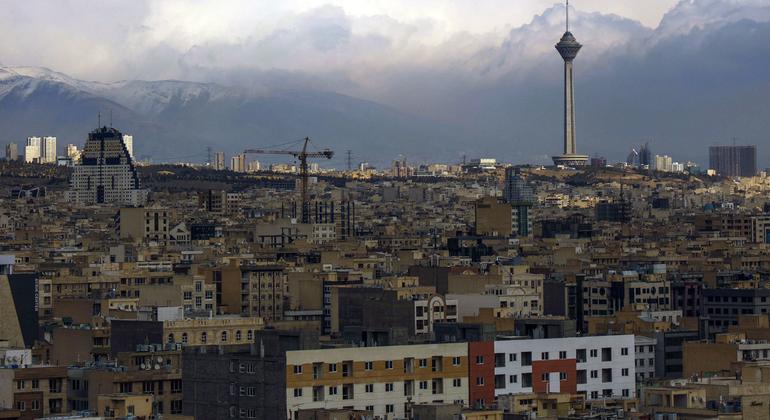
A view of a neighborhood in Tehran, Iran. Among other things, the JCPOA envisages lifting of sanctions, bringing “tangible economic benefits for the Iranian people”.
Unsplash/Anita Filabi
View of Tehran, Iran's capital. Among other things, the JCPOA envisages lifting of sanctions, bringing “tangible economic benefits for the Iranian people”. 

IAEA safeguards

She said following a “welcome” joint statement by the International Atomic Energy Agency (IAEA) and Iran in March, surveillance cameras were installed at workshops where centrifuge parts are manufactured.

The UN-backed nuclear watchdog also reported in May that it had no further concerns regarding the presence of highly enriched uranium, which had been detected at one location.

However, the UN is alarmed that the agency remains unable to verify the stockpile of enriched uranium in the country. Citing the IAEA estimates, Ms. DiCarlo said Iran now has a total enriched uranium stockpile of more than 20 times the allowable amount under the JCPOA. This includes increased quantities of uranium enriched to 20 per cent and 60 per cent. 

Divergent views

Addressing the deal’s ballistic missile-related provisions, she referred to the information received from France, Germany, Iran, Israel, Russia, and the UK about Iran's test flight of a space launch vehicle in March, as well as its testing and unveiling of two new ballistic missiles in May and June. 

“The letters received from Member States continue to reflect the divergent views as to whether this launch and missile developments are inconsistent with the resolution,” Ms. DiCarlo told ambassadors.

She also detailed information received on ballistic missile parts seized by the British Royal Navy in February in international waters in the Gulf of Iran.

While France, Germany, and the UK believe that some were controlled items originating from Iran and transferred contrary to resolution 2231, Iran and Russia said there was no evidence linking the intercepted vessel and its cargo to Tehran and no clear indication that the seized components were of Iranian origin. 

Alleged transfers to Russia, Yemen 

Ms. DiCarlo next detailed letters received from Member States concerning alleged transfers of drones or unmanned aerial vehicles (UAVs) from Iran to Russia, for use on the battlefield in Ukraine, in a manner inconsistent with paragraph 4 of annex B. 

She said their assessment had been determined by comparing debris from other such attacks in the Middle East and publicly available imagery of Iranian UAVs.

They have invited the UN Secretariat to examine debris now stored in Kyiv and elsewhere to make a determination.

Iran and Russia have disputed the imagery of the UAVs, “noting that the accusations were not substantiated by evidence”, said the political affairs chief.

Assuring that the UN “continues to examine the available information”, she added that the Government of Yemen has also invited the UN to examine debris from a cruise missile used in an attack by Houthi rebels on the Al-Dhaaba oil terminal last November.

‘Best available option’

Despite the strongly opposing views aired in the Council from States involved in the JCPOA, Ms. DiCarlo said it remained “the best available option for ensuring the exclusively peaceful nature of Iran’s nuclear programme, as well as for allowing Iran to reach its full economic potential”. 


 https://news.un.org/en/story/2023/07/1138432

https://creativecommons.org/licenses/by/3.0/legalcode

среда, 21 июня 2023 г.

Record executions, large-scale arrests and detentions: New Iran human rights report


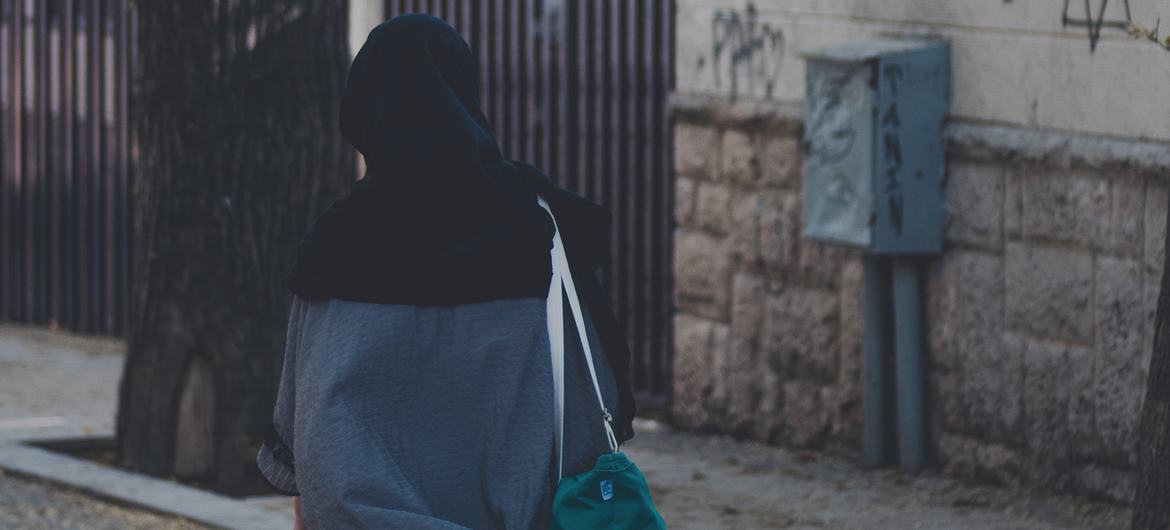
A woman in a hijab walks through the streets of Tehran, the Iranian capital.
Unsplash/Amir Hosseini
 
A woman in a hijab walks through the streets of Tehran, the Iranian capital.
21 June 2023
Human Rights

The latest UN report on the human rights situation in Iran paints a grim picture of a record number of executions in 2022, arrests of thousands of children and numerous allegations of torture and ill-treatment by security forces.


“The overall human rights situation in the Islamic Republic of Iran has markedly deteriorated against the backdrop of continuously worsening socio-economic conditions, aggravated by sanctions and the lingering impact of the COVID-19 pandemic,” said Nada Al-Nashif, UN deputy human rights chief, presenting the report to the Human Rights Council in Geneva.

The report focuses on developments since the onset of nationwide protests following the death of 22-year-old Jina Mahsa Amini on 16 September last year. Three days after she fell into a coma and died in police custody, following her arrest by Iran’s so-called Morality Police.

Hundreds put to death

The report notes with serious concern the high number of death penalty sentences and executions during the reporting period.

“In 2022, 582 people were executed”, noted the Deputy High Commissioner of UN human rights office OHCHR.

“That is a 75 per cent increase compared to 2021 during which 333 people were reportedly executed. There were three children among those executed in 2022. Of the total number of executions, 256 were for drug-related offences.”

Tweet URL

According to Ms. Al-Nashif, this marks the highest rate of drug-related executions in the country since 2017. 

At least 44 children killed

The total detained for taking part in the protests is estimated at around 20,000, the report said.

Thousands of children are estimated to have been among those arrested during the protests, while at least 44 children, including 10 girls, were reportedly killed by security forces using lethal force.

The highest number of deaths was reported in the Sistan and Baluchistan Province, where at least 10 children were killed.

“There have been numerous allegations of torture and ill-treatment of individuals by security forces during arrest and interrogation to extract forced confessions as well as allegations of sexual and gender-based violence committed against women, men and children, especially in detention,” said Ms. Al-Nashif.

“Prison conditions including denial of medical care, dire sanitary conditions, contaminated drinking water and overcrowding, remain of concern.”

Rights diminishing

Since the onset of protests, respect for the right to freedom has significantly deteriorated, the Human Rights Council heard.

State policy was also found to have become more stringent in enforcing mandatory veiling and imposing harsher penalties on women and girls who fail to respect the ruling.

AI tracks veil offenders

“On 15 August 2022, the President signed a decree which includes the introduction of face-recognition technology to track and punish unveiled women or those who actively question compulsory veiling”, said the deputy UN rights chief.

“At the legislative level, new draft provisions to the Penal Code are being considered in parliament to expand the scope of offences for non-compliance, allowing imprisonment, flogging and other punishments.”

The report also noted Iran’s failure to protect the physical and mental well-being of female students and attacks on their right to education.

Suspected poisonings

“As of 2 March of this year more than 1,000 students, the majority of whom are girls, had reportedly been affected by suspected poisoning in 91 schools in 20 provinces. The authorities provided conflicting accounts of these incidents,” noted Ms. Al-Nashif.

Ali Bahreini, Ambassador and Permanent Representative of Iran to the UN in Geneva, rejected the report outright as inaccurate.


 https://news.un.org/en/story/2023/06/1137987

https://creativecommons.org/licenses/by/3.0/legalcode