Показаны сообщения с ярлыком children. Показать все сообщения

среда, 4 сентября 2024 г.

Public Statement by the Chair of the Working Group on Children and Armed Conflict


SC/15809


The Security Council Working Group on Children and Armed Conflict, in connection with the examination of the sixth report of the Secretary-General on children and armed conflict in the Central African Republic (S/2024/93), agreed to address the following messages through a public statement by the Chair of the Working Group.

To all parties to the armed conflict in the Central African Republic: 

  • Expressing grave concern at and its strongest condemnation of the high number of violations and abuses committed against children in the Central African Republic; notably by armed groups, and urging all parties to the conflict, especially armed groups, to immediately end and prevent all abuses and violations against children including those involving the recruitment and use, killing and maiming, rape and other forms of sexual violence, attacks on schools and hospitals, abduction, and the denial of humanitarian access and to comply with their obligations under international law; 
  • Welcoming the continued implementation of the Political Agreement for Peace and Reconciliation in the Central African Republic (hereafter “the Peace Agreement”), which entailed progress on disarmament, demobilization, reintegration and repatriation (DDRR) efforts, community reconciliation and voluntary returns, and the Joint Roadmap for Peace and its expansion to the local level; expressing  concern that, despite encouraging steps, the security situation remained fragile, including due to the deterioration of the security situation in the border areas, and violations and abuses continue to be committed against children; calling upon the signatories to the Peace Agreement to uphold their commitments, including its specific provisions to protect children; noting with concern that some armed groups who are signatories to the Peace Agreement continued to be among the main perpetrators of the six grave violations against children; and urging all parties to work with the United Nations to reinforce their efforts to end and prevent violations and abuses against children; 
  • Calling upon all parties to the armed conflict to further implement the previous conclusions of the Working Group on Children and Armed Conflict in the Central African Republic (S/AC.51/2022/5); 
  • Expressing  concern about the challenges faced by the United Nations country task force on monitoring and reporting in the Central African Republic, including as a result of, inter alia, activities by armed groups, an increase in the indiscriminate use of explosive ordnance, as well as fighters living within their communities, which hampered the ability of the country task force to safely monitor and report on the six grave violations; also expressing concern that, as noted in the report of the Secretary-General, the information contained in the report does not reflect the full extent of the six grave violations committed against children in the Central African Republic during the reporting period, and in this regard urging parties to the conflict to ensure United Nations personnel safe and unhindered access to territories under their control, including for advocacy, and monitoring and reporting purposes; 
  • Stressing the importance of accountability for all violations and abuses against children in armed conflict by all parties, and stressing that all those responsible be brought to justice and held accountable without undue delay, including through timely, impartial and systematic investigations and, as appropriate, prosecution and conviction; and underscoring that all victims and survivors must have access to justice, as well as that all children must have access to gender-sensitive, age-appropriate, disability-inclusive, non-discriminatory and comprehensive child protection services; in this regard, welcoming the efforts of the domestic courts and the Special Criminal Court to advance accountability for the six grave violations against children; 
  • Stressing that the best interests of the child should be a primary consideration, and that the specific needs and vulnerabilities of girls and boys should be duly considered, when planning and carrying out actions concerning children in situations of armed conflict, including by taking all preventive and mitigating actions necessary to avoid and minimize harm and to better protect children during hostilities and from the effects of explosive ordnance; 
  • Expressing deep concern about and condemnation of the  high number of cases of recruitment and use of children, noting that armed groups were responsible for the majority of cases of recruitment and use; noting that children were used for sexual purposes, as well as in combat and support roles such as cooks, porters, running errands, gathering information, and manning checkpoints; further noting that children joined armed groups to protect their communities or themselves, as a means of survival due to poverty, and due to fears of reprisals; strongly urging all parties to the armed conflict to engage with United Nations and to immediately and without conditions release all children from their ranks and hand them over to relevant civilian child protection actors; urging all parties to the conflict to end and prevent further recruitment and use of children under 18 years of age, consistent with their obligations under international law, including the Optional Protocol to the Convention on the Rights of the Child on the involvement of children in armed conflict; also noting in this regard the African Charter on the Rights and Welfare of the Child; and welcoming positive steps taken by the Government including the signing of the Action Plan against the Trafficking of Children in the Central African Republic, with a focus on preventing the use of children by the Armed Forces; 
  • Expressing concern about the deprivation of liberty of children by parties to armed conflict for their alleged association with armed groups; urging all parties to the conflict to release those children and ensure their full reintegration through child protection programmes; emphasizing that children allegedly associated with parties to the conflict should be treated primarily as victims, including those children who are accused of having committed crimes, and that detention should be used only as a measure of last resort and for the shortest appropriate period of time, in line with applicable international law; urging the Government of the Central African Republic to comply with its obligations under the Convention on the Rights of the Child and the Optional Protocol thereto on the involvement of children in armed conflict and recalling that the Government has endorsed the Principles and Guidelines on Children Associated with Armed Forces or Armed Groups (the Paris Principles), and that alternatives to judicial proceedings should be sought for children; welcoming in this regard the release of 57 children who had been detained for their alleged association with armed groups following advocacy measures and a Presidential Decree granting them clemency on 2 December 2022, and calling on parties to the conflict to engage with the United Nations to adopt and implement appropriate handover protocols to facilitate the release of children to civilian child protection actors and prioritize their reintegration; 
  • Encouraging the Government to continue to focus on long-term, sustainable and timely rehabilitation and reintegration programmes and opportunities for children affected by armed conflict that are gender- and age-sensitive and inclusive for children with disabilities, including equal access to health care, psychosocial support and education programmes, as well as to raise awareness and work with communities to avoid stigmatization of these children, to facilitate their return and minimize the risk of re-recruitment, while taking into account the specific needs of children, in order to contribute to their well-being and to sustainable peace and security; welcoming the operationalization of a vocational training centre for children in Ouaka prefecture; further welcoming the fact that implementation of local mechanisms in response to security threats entailed progress on Disarmament, Demobilization, Reintegration and Repatriation (DDRR) efforts, community reconciliation efforts and voluntary returns while  noting with concern that children’s access to sustainable socio-economic reintegration programmes was impaired by ongoing fighting, increases in logistical costs for humanitarian interventions and a decrease in funding for long-term reintegration programmes; 
  • Strongly condemning the killing and maiming of children, notably by armed groups, including during targeted killings as a result of gunshots, explosive ordnance, mutilation, physical assault, assault with a machete, shrapnel, burns and rape; expressing concern that during armed confrontation, Muslim and Fulani civilians, including children, were reportedly attacked and subjected to violations, and urging all parties to the conflict to cease and prevent the killing and maiming of children, including refraining from the indiscriminate use of explosive weapons that cause death or injury to children and destroy the vital infrastructure they rely on, noting that deliberately targeting civilian objects, as such, violates international humanitarian law; 
  • Expressing deep concern at cases of rape and other forms of sexual violence perpetrated against children, including gang rape and abduction for the purpose of sexual slavery; noting that cases of rape and other forms of sexual violence continue to be underreported due to stigmatization, the risk of reprisals, a lack of accountability and the absence of adequate support services for victims and survivors; urging all parties to the conflict to take immediate and specific measures to put an end to and prevent the perpetration of rape and other forms of sexual violence against children; and stressing the importance of providing non-discriminatory and comprehensive specialized services for victims and survivors of sexual violence, including mental health and psychosocial support, health, including sexual and reproductive health services, legal and livelihood support and services, including a child-friendly and safe reporting and response mechanism; acknowledging the increased accountability for sexual violence through the gradual operationalization of the military justice system and proceedings before domestic courts, the Special Criminal Court, and other courts; noting with concern that the customary practice of ‘friendly arrangements’ remained a challenge in addressing accountability for sexual violence and may result in further violations or abuses of children’s rights, including child forced marriage; 
  • While welcoming the notable decrease in attacks on schools and hospitals, continuing to strongly condemn attacks on schools and hospitals in violation of international law; calling on all parties to the conflict to comply with international law and to respect the civilian character of schools and hospitals and to end and prevent attacks or threats of attacks against those institutions and protected persons in violation of applicable international law; and expressing deep concern at the verified incidents of military use of schools and hospitals in violation of  international law; further calling on all parties to the conflict to safeguard, protect, respect and promote the right to education, including in armed conflict; 
  • Strongly condemning the abduction of children, and expressing grave concern at the increase in abductions of children including for recruitment and use and sexual purposes, for ransom and as retaliation, noting that most cases were attributed to armed groups, and calling upon all parties to the conflict to cease the abduction of children and immediately release all abducted children to the relevant civilian child protection actors; 
  • Strongly condemning the incidents of denial of humanitarian access, including injury, abduction, physical assault, killing, threats, and robbing of humanitarian personnel, extortion, collection of levies by armed groups, access denial, destruction of humanitarian goods, and explosive ordnance attacks; noting that a majority of  the incidents were committed by armed groups and unidentified perpetrators; further expressing  concern at the insecurity, which regularly prevented the humanitarian community from delivering vital assistance to communities in need, and calling upon all parties to the conflict to allow and facilitate, in line with international law, including international humanitarian law, safe, timely and unhindered humanitarian access, consistent with the humanitarian principles of humanity, neutrality, impartiality and independence, as well as the United Nations guiding principles of humanitarian assistance and  to respect the exclusively humanitarian nature and impartiality of humanitarian aid and to respect the work of all United Nations agencies and their humanitarian partners without adverse distinction; 
  • Welcoming the dialogue between the United Nations and the Lord’s Resistance Army (LRA)-Achaye on the release of abducted children; urging the faction to end and prevent all violations and abuses and release all abducted children and to refrain from seeking to recapture released children; welcoming the adoption of a command directive prohibiting grave violations against children by the CPC, and urging the CPC to implement this command directive; further calling upon the Mouvement patriotique pour la Centrafrique (MPC), the Front populaire pour la renaissance de la Centrafrique (FPRC) and the Union pour la paix en Centrafrique (UPC) to swiftly implement their respective action plans; and urging all  parties to the conflict to develop, adopt and implement action plans with the United Nations to end and prevent all six grave violations against children affected by armed conflict; 
  • Recalling the Security Council’s readiness to adopt targeted and graduated measures against persistent perpetrators of violations and abuses committed against children, and that the Security Council, by its resolution 2693 (2023) renewed until 31 July 2024 the asset freeze and travel ban measures imposed by resolutions 2127 (2013) 2134 (2014), and 2399 (2018), which apply to individuals and entities as designated by the Security Council Committee established pursuant to paragraph 57 of resolution 2127 (2013) (“2127 sanctions committee”), for actions that undermine the peace, stability or security of the Central African Republic, such as: 
  • Being involved in planning, directing or committing acts that violate international human rights law or international humanitarian law, as applicable, or that constitute human rights abuses or violations in the Central African Republic, including acts involving sexual violence, targeting of civilians, ethnic or religious-based attacks, deliberate attacks on schools and hospitals, abduction and forced displacement; 
  • Recruiting or using children in armed conflict in the Central African Republic, in violation of applicable international law; 
  • Obstructing the delivery of humanitarian assistance to the Central African Republic, or access to or distribution of, humanitarian assistance in the Central African Republic; 
  • Expressing the readiness of the Working Group to communicate to the Security Council pertinent information with a view to assisting the Council in the imposition of targeted measures on perpetrators; 

To all United Nations peacekeeping operations, including the United Nations Multidimensional Integrated Stabilization Mission in the Central African Republic and non-United Nations forces present in the Central African Republic and relevant Member States: 

  • Expressing deep distress over continued concern of sexual exploitation and abuse against children by some United Nations peacekeepers, and strongly condemning all acts of sexual exploitation and abuse; 
  • Calling upon the United Nations and relevant Member States to continue to take appropriate action to prevent sexual exploitation and abuse, including the vetting of all personnel and conducting pre-deployment and in-mission awareness training, to ensure full accountability in cases of such conduct, including through timely survivor-centred investigations of all allegations of sexual exploitation and abuse; to hold perpetrators accountable and repatriate units when there is credible evidence of widespread or systemic sexual exploitation and abuse by those units; to take appropriate disciplinary measures; to report fully and promptly on actions undertaken; to ensure that child victims and witnesses are adequately protected during the investigation process; and to facilitate access to medical and psychological support, as appropriate; and in that respect welcoming the appointment and the work of the Field Victims’ Rights Advocate by the United Nations Multidimensional Integrated Stabilization Mission in the Central African Republic (MINUSCA) and the adoption of a victim-centred approach, enabling most child victims to access services and education/vocation training; 
  • Urging further efforts by relevant Member States to take appropriate preventative action, including the vetting of all personnel and the delivery of robust pre-deployment training concerning sexual exploitation and abuse in accordance with the terms of their memorandums of understanding and other agreements with the United Nations; 

To neighbouring States, United Nations bodies, regional organizations and all international partners: 

  • Encouraging neighbouring States, regional organizations and all international partners to support the peace process, including to end and prevent violations and abuses against children, in a coherent and coordinated manner and through strengthened partnerships; noting that the long awaited local elections provide an essential opportunity to strengthen local governance and to decentralise the peace process; welcoming the second strategic review meeting to take stock of progress in the implementation of the Peace Agreement with members of the Government as well as regional and international partners, including the guarantors and facilitators of the Political Agreement and the Foreign Ministers of Angola and Rwanda and emphasizing the important role of those guarantors and facilitators of the Peace Agreement in using their influence to enhance adherence by armed groups to their commitments; and welcoming the adoption of the joint road map for peace by the International Conference on the Great Lakes Region “Luanda roadmap”; 
  • Calling on the international community, and MINUSCA, in conformity with its mandate, the United Nations country team and the Peacebuilding Fund, to provide coordinated support to build the capacities and enhance the effectiveness of the judicial system, including where appropriate and mandated through the provision of financial and technical assistance to the Central African Republic authorities towards the restoration of the administration of the judiciary, criminal justice and building of child protection systems throughout the country.

To community and religious leaders:

  • Emphasizing the important role of community and religious leaders in strengthening the protection of children affected by armed conflict and fostering reconciliation efforts; 

Urging them to strengthen community-level protection and to publicly condemn and continue to advocate ending and preventing violations and abuses against children, notably those involving the recruitment and use of children, killing and maiming, rape and other forms of sexual violence, attacks and threats of attacks on schools and hospitals, abductions and denial of humanitarian access, including on the basis of religion or ethnicity, and to engage with the Government, the United Nations, and other relevant stakeholders to support the reintegration and rehabilitation of children affected by armed conflict in their communities, including by raising awareness to avoid stigmatization of these children. 

For information media. Not an official record.
https://press.un.org/en/2024/sc15809.doc.htm

https://creativecommons.org/licenses/by/4.0/legalcode

четверг, 1 августа 2024 г.

Skyrocketing violence against children in Sudan demands urgent protection measures: UN report


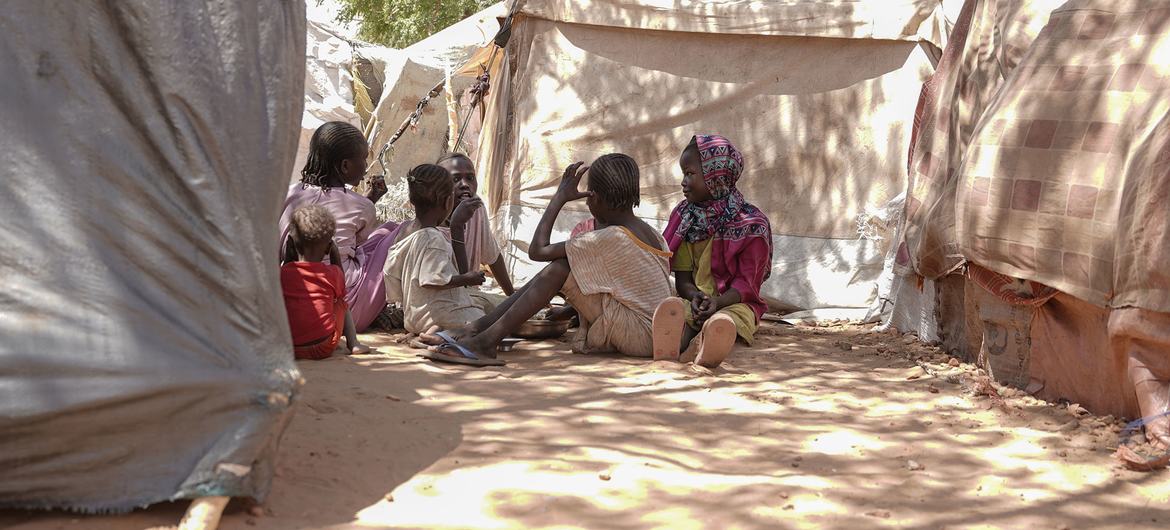
Children sheltering at the Tambasi IDP centre in El Fasher, North Darfur.
© UNICEF/Mohamed Zakaria
 
Children sheltering at the Tambasi IDP centre in El Fasher, North Darfur.


31 July 2024
 Peace and Security

The conflict in Sudan has led to a horrifying surge in violence against children, a new UN report has revealed, underscoring the need for urgent and tangible protection measures.

The report on Children and Armed Conflict in Sudan, released on Tuesday, documented a staggering 2,168 grave violations against 1,913 children in 2022 and 2023 – a significant increase compared to the previous reporting period.

The most prevalent violations included killing and maiming (1,525 cases), recruitment and use of children in combat (277 cases), and sexual violence (153 cases). In addition, 33 children were abducted, 118 schools and hospitals attacked, and there were 62 incidents of denial of humanitarian access to children in need.

The situation worsened dramatically following the outbreak of hostilities between Sudanese Armed Forces (SAF) and the paramilitary Rapid Support Forces (RSF) in April year.

Sheer horror

Virginia Gamba, Special Representative of the UN Secretary-General for Children and Armed Conflict, expressed her horror at the violence.

“I am appalled at the level of violence affecting children, the widespread destruction of civilian infrastructure, including schools and medical facilities and the lack of effective efforts of parties to the conflict to facilitate the delivery of humanitarian assistance to suffering populations, including children,” she said.

“I urge all parties to immediately commit to a durable cessation of hostilities. The future of children in the Sudan depends on it.”

Catastrophic crisis

The humanitarian crisis in Sudan has reached catastrophic levels, with 14 million children in dire need of aid and protection.

Starvation and an imminent risk of famine loom large as humanitarian efforts face significant obstructions.

In addition, about 19 million children are out of school, and many lack access to basic necessities such as food, water, shelter, electricity, education and healthcare, the report said.

Progress undone

The report also noted that the termination of the UN Integrated Transition Assistance Mission in Sudan (UNITAMS) and the departure of its dedicated child protection staff have exacerbated the crisis, reducing the capacity to monitor and report on grave violations against children.

The loss also hampers engagement with the parties to the conflict and efforts to address child protection needs effectively.

Before the April 2023 escalation, there had been some progress, particularly through a 2021 roadmap that had led to the development of a national framework for the release and reintegration of children.

Despite the challenges and the ongoing hostilities, the United Nations has maintained its engagement with all warring parties.


https://news.un.org/en/story/2024/07/1152706


https://creativecommons.org/licenses/by/4.0/legalcode

вторник, 2 июля 2024 г.

Haiti: Violence displaces one child every minute, reports UNICEF

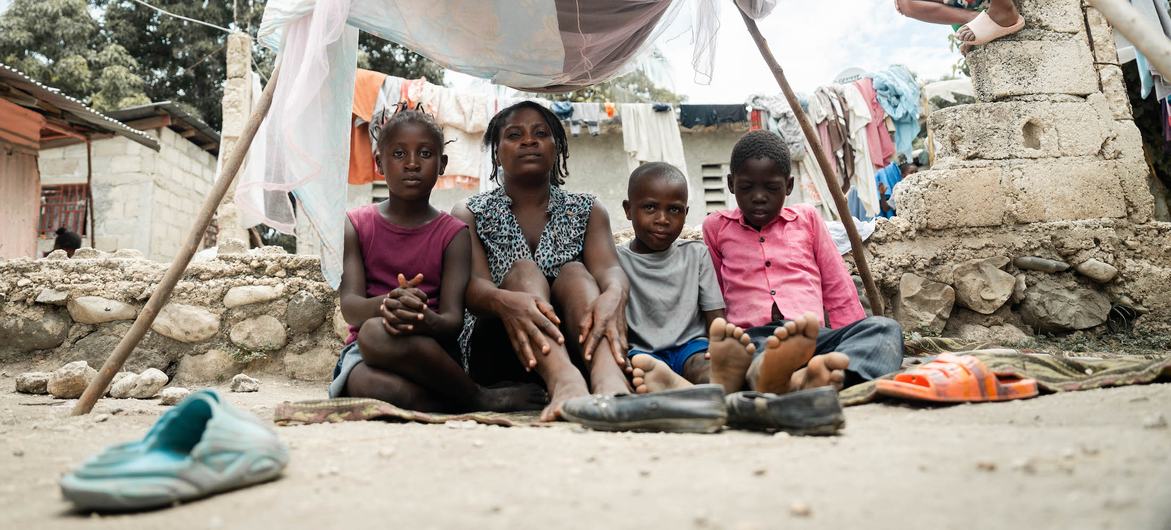
A mother sits with her children in an IDP site in Léogâne, on the outskirts of the Haitian capital, Port-au-Prince.
© UNICEF/Maxime Le Lijour
 
A mother sits with her children in an IDP site in Léogâne, on the outskirts of the Haitian capital, Port-au-Prince.


1 hour ago 

Peace and Security

Continued violence and instability in Haiti has resulted in the displacement of over 300,000 children, with an estimated one child being displaced every minute since March, the UN Children’s Fund (UNICEF) said on Tuesday.

Catherine Russell, UNICEF Executive Director, highlighted the horrific impact of violence on children and adolescents.

“The humanitarian catastrophe unfolding before our eyes is taking a devastating toll on children. Displaced children are in desperate need of a safe and protective environment, and increased support and funding from the international community,” she said.

Across the country, an estimated three million children are in need of humanitarian assistance, against a backdrop of years of political turmoil, widespread poverty, rampant disease and multiple disasters.

Facing heightened risks

Displaced children in Haiti face heightened risks of violence, including sexual assault, exploitation, abuse and family separation. Their access to essential services such as safe spaces, healthcare, and clean water and sanitation is severely disrupted.

Poor hygiene conditions in camps and makeshift settlements increase their susceptibility to diseases like cholera, while school closures and economic constraints driven by the violence have forced many children to abandon their education.

Furthermore, with few other means of survival or protection, children are increasingly forced to join armed groups – a clear violation of their rights and a breach of international law, UNICEF stressed.

Dangers continue to grow

Compounding these challenges, devastating hazards wreaking havoc across the country.

Haiti’s National Emergency Operations Center has warned of a “hyperactive” cyclone season, further threatening the already vulnerable displaced population. Last month, a tornado in Bassin Bleu, Northwest Department, destroyed the homes of 650 children.

The crippled healthcare system that was barely able to cope with demand before the latest escalation of violence will have to contend with a rainy season that is expected to continue to worsen the situation, threatening to spike water-borne diseases, UNICEF warned.

“The needs in Haiti continue to grow, alongside the dangers for children,” Ms. Russell said, adding that everyone has a role to play to change the trajectory, and ensure that children are protected, have education and can access basic services.

“Children should not be paying with their lives and their futures for a crisis created by adults,” she said.


https://news.un.org/en/story/2024/07/1151681


https://creativecommons.org/licenses/by/4.0/legalcode

четверг, 13 июня 2024 г.

UN reports ‘shocking’ rise in violations against children in conflict in 2023


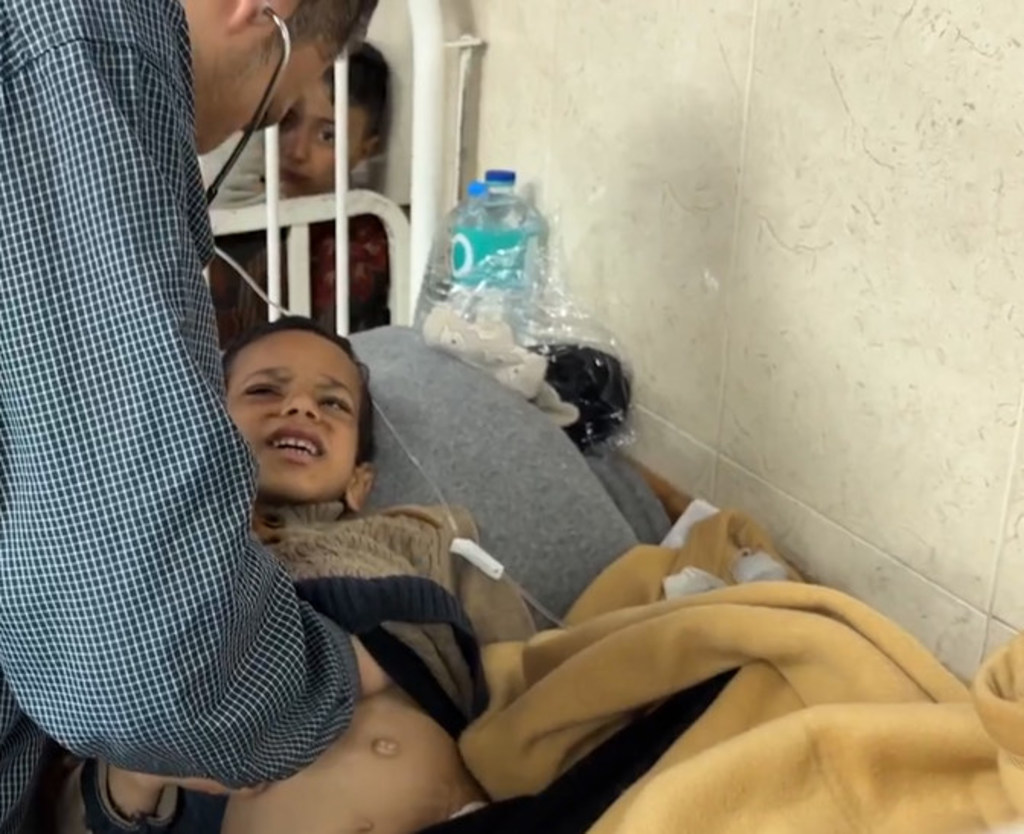
A young boy recovers in hospital in Gaza after the shelter he was living in with his family was bombed.
© UNICEF/Tess Ingram
 
A young boy recovers in hospital in Gaza after the shelter he was living in with his family was bombed.


13 June 2024
Peace and Security

Violence against children caught in armed conflict reached “extreme levels” last year, with a “shocking” 21 per cent increase in extreme violations, UN Secretary-General António Guterres said in a report published on Thursday. 

Children were killed and maimed in unprecedented numbers in places such as Israel and the occupied Palestinian territories, notably Gaza; Burkina Faso, the Democratic Republic of the Congo, Sudan and Ukraine, his annual report on Children and Armed Conflict revealed. 

The alarming increase was due to the evolving nature, complexity, and intensification of armed conflict, as well as the use of explosive weapons in populated areas, the report said. 

UN chief ‘appalled’ 

The UN verified nearly 33,000 grave violations affecting more than 22,500 children, mainly boys, in 26 situations worldwide. 

The highest numbers were for killing and maiming, with 11,649 children affected - a 35 per cent increase over last year’s report.  This was followed by the recruitment and use of 8,655 children and the abduction of 4, 356 more. 

While more than half of the violations were committed by non-State armed groups, including those designated as terrorist by the UN, government forces were the main perpetrators of killings and injuries, attacks on schools and hospitals, and the denial of humanitarian access. 

The conflict in Israel and the occupied Palestinian territories has led to a 155 per cent increase of grave violations against children, the report found. 

“I am appalled by the dramatic increase and unprecedented scale and intensity of grave violations against children in the Gaza Strip, Israel and the occupied West Bank, including East Jerusalem, despite my repeated calls for parties to implement measures to end grave violations,” Mr. Guterres wrote. 

Annual blacklist 

The annual report contains an annex of parties that commit grave violations. As has already been widely reported, for the first time, the Israeli armed and security forces were included for killing and injuring children and attacking schools and hospitals. 

Hamas and Palestinian Islamic Jihad were also added to the list for the first time for killing, wounding and abducting children.  

The report noted that the war in Sudan led to a “staggering” 480 per cent increase in grave violations.   

The Sudanese Army and rival military the Rapid Support Forces (RSF) have been battling for more than a year and both are on the blacklist for killing and maiming children and attacking schools and hospitals. 

The RSF also recruited and used children in addition to committing rape and other sexual violence against them. 

‘We are failing children’ 

Despite the multiplying and escalating crises detailed in the report, more than 10,600 children formerly associated with armed forces or groups received protection or reintegration support last year.  

The UN commenced or sustained engagement with parties to conflict in places such as Burkina Faso, Cameroon, Colombia, the Democratic Republic of the Congo, Iraq, Israel and the occupied Palestinian territory, Mali, Mozambique, Nigeria, Somalia, South Sudan, Syria, Ukraine and Yemen. 

In some cases, this engagement led to the adoption of measures aimed at better protection for children.  

Virginia Gamba, Special Representative of the Secretary-General for Children and Armed Conflict, said the report is “a wake-up call”. 

“We are failing children,” she said. “I call on the international community to recommit to the universal consensus to protect children from armed conflict and I call on States to fulfil their primary responsibility to protect their populations and respect all norms and standards applicable in the conduct of armed conflict situations.” 

"No bullets. One rose for each child." These were the powerful words of 10-year-old Majd during a psychosocial session delivered by the UN Children's Fund (UNICEF) and partners in Sudan.
UNICEF
 
"No bullets. One rose for each child." These were the powerful words of 10-year-old Majd during a psychosocial session delivered by the UN Children's Fund (UNICEF) and partners in Sudan.

https://news.un.org/en/story/2024/06/1151001

https://creativecommons.org/licenses/by/3.0/legalcode

пятница, 12 апреля 2024 г.

Ceasefire the only way to end killing and injuring of children in Gaza: UNICEF


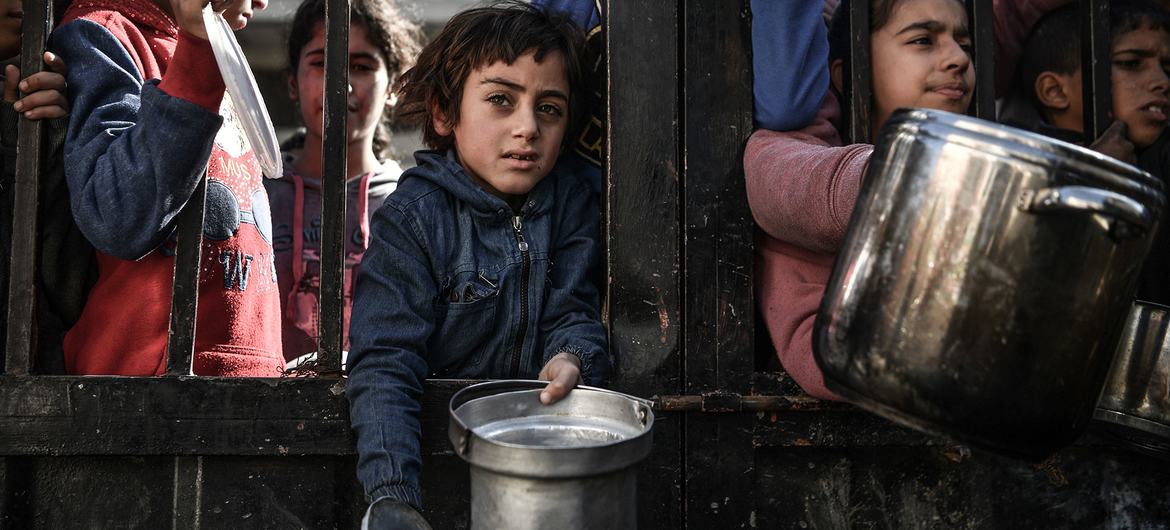
In Gaza, children wait to receive food as the bombardments on the enclave continue. © UNDP PAPP/Abed Zagout
 
In Gaza, children wait to receive food as the bombardments on the enclave continue.


11 April 2024

Humanitarian Aid

Advocating for a ceasefire is the best way to support the people of Gaza, including children in the north who are dying of hunger, a Spokesperson for the UN Children’s Fund (UNICEF) said on Thursday.  

Tess Ingram was part of a UNICEF team that was headed to northern Gaza on Tuesday when their vehicle was hit by live ammunition while waiting at a checkpoint.  

“Luckily, myself and my colleagues, we were all safe. But this just underscores how dangerous it is for humanitarian aid workers in Gaza at the moment: that incidents like this continue to happen when they absolutely shouldn't,” she told UN News, speaking from Rafah in the south.

Tweet URL
UN_News_Centre

‘Critical mission’ rescheduled 

The UN has repeatedly warned of looming famine in Gaza, where roughly 70 per cent of the population in the north is going hungry, and as access restrictions persist.

Ms. Ingram said the UNICEF team had hoped to proceed to the region “because it was such a critical mission with nutrition products for the children who were malnourished in the north of Gaza, among other things.” 

However, after waiting at the holding point for at least another two hours, they decided moving forward was no longer feasible as there would not be enough time to conduct all their activities, and returned to Rafah.

While another mission is being scheduled for the coming days, she stressed the critical need for more aid corridors and, above all, for the fighting to end. 

This interview has been edited for length and clarity. 

Tess Ingram: It's tragic to see anybody suffering from malnutrition, which is such a painful condition, let alone in a place where malnutrition was almost non-existent before October. And it's now skyrocketed in the north of Gaza, because of disruptions to food production, but also because of restrictions on aid access to that area. We've really struggled to get up there with aid.  

And as a result, we know that children are dying of malnutrition there. At least 23 children have reportedly died at the Kamal Adwan Hospital, which is where we were trying to bring these nutrition treatments on Tuesday. 

UN News: Is there a particular story that you heard, a particular child that struck you, that that really resonated with you? 

Tess Ingram: There's a boy that I met, in the middle area at Al-Aqsa Hospital in Dier Al Balah. His name is Omar. He is seven years old.  I wasn't able to speak to him because he was in such a terrible condition, so much pain.  

But I talked to his grandmother, and she was telling me that they had just come down from the north 48 hours earlier, and that in the north they had access to barely any food, and they were relying heavily on grass to sustain them. And you could see how sick Omar is. I really hope that he's okay now.  

The director of pediatrics at the hospital told me that he hoped that Omar would make a full recovery. But concerningly, he said that 90 percent of the children that they're admitting at the moment have some level of malnutrition, which is just shocking. 

Seven-year-old Omar is being treated for malnutrition in Al-Aqsa hospital in Deir Al-Balah after fleeing northern Gaza with his grandmother
UNICEF
 
Seven-year-old Omar is being treated for malnutrition in Al-Aqsa hospital in Deir Al-Balah after fleeing northern Gaza with his grandmother

UN News: Israel said that it has the intention at least to open the Erez crossing into northern Gaza. Has this materialized yet? Were you able to get anything in to relieve the situation? 

Tess Ingram: No, not yet - and that is such a critical step. We really need that crossing to be open, so that we can increase the volume of aid, but also so that we have direct access straight into the north. And that's important for two reasons. One, it'll allow us to bring aid in faster, and at scale to these children and families in the north who desperately need food and nutrition supplies. But also, it will prevent us, as the UN, having to drive through the whole Gaza Strip with our aid, which is important in such a dangerous place. 

UN News: So, you've seen these children, you've seen the conditions there. Is there still time to avoid the famine that the UN has been warning about, or are we already too late? 

Tess Ingram: Look, it's really hard to know. We've said that a famine could happen at any moment between now and May, and I think that still holds in the north of Gaza. For the south, the risk of famine is there. But I think we can still prevent it if we can just flood the Gaza Strip with aid. There is still time to prevent a famine in the middle and south of Gaza. 

Soundcloud

UN News: We've been hearing many calls on the international stage for increased humanitarian access, increased humanitarian aid, in Gaza, but this has been to no avail. What needs to happen to make that happen? 

Tess Ingram: Well, the best way to make that happen is the ceasefire. It is the only way to end the killing and injuring of children. It is the best way to ensure that we can bring in more aid and to distribute that aid at scale, safely to all of the children and families in Gaza in need.

UN News:  You visited hospitals in Gaza, and we know that the healthcare system in the Strip is on the verge of collapse. Can you tell us what that means in practical terms, and in real-life terms?

Tess Ingram: In real-life terms, what that means is doctors are struggling to provide the care that they want to, and that they’re used to in Gaza. It means that supplies are running out. It means that staff are unable to be paid salaries, and many more of them are having to become volunteers. And that's not sustainable because they have to be able to support their families in such desperate conditions.  

It means that children are dying without the appropriate medical care, or they're unable to receive treatment that they need. For example, I met a girl at the European Hospital this week. Her name's Juri and she's nine years old. She is from Rafah, here, at the south of the Gaza Strip.  

And despite this being an area where there hasn't been a ground offensive yet, she was in a building, her grandparents’ house, that was struck. And Juri said the last thing she remembers is playing with birds in a cage at the house, and then waking up in European hospital.  

And she has so many broken bones - the right side of her face and her arm and her wrist. But on the left side of her body, where she was struck by the impact of the blast, she has enormous open wounds that haven't been able to be treated in Gaza.  

When I met her, it had been 16 days since the incident. And she was still lying in a hospital bed with very painful, large, open wounds, waiting, hoping that she might be able to be evacuated from Gaza to get the treatment that she needs. But this has to be unacceptable to the world that a nine-year-old girl who was just visiting her grandparents ends up with such a traumatic injury that cannot be treated, and she's still waiting for help. 

UN News: You spoke about the fact that Rafah currently doesn't have a ground offensive, and there are growing fears, of course, that this incursion is going to happen after the government announced that it actually has a date for that operation. How is UNICEF preparing itself to deal with that? 

Tess Ingram:  We're preparing contingency plans. We're trying to strategize about how we'll continue to do our job. We don't intend to go anywhere. We're going to stay and deliver and make sure that we can continue to provide support to the children and families of Gaza.  

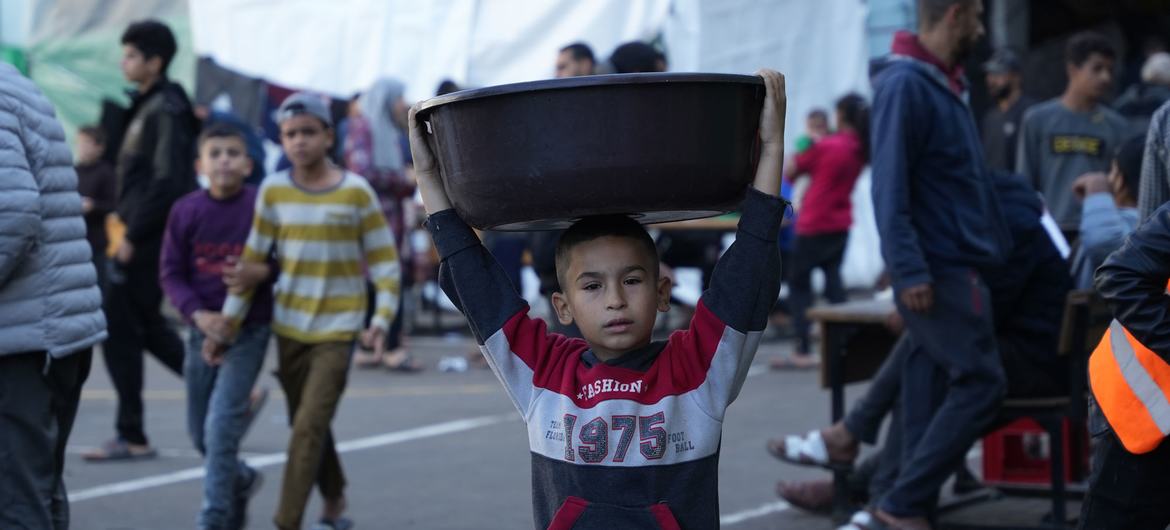
A boy carries a large bowl on his head at the Al-Qastal School in the Gaza Strip.
© WFP/Arete/Abood al Sayd
 
A boy carries a large bowl on his head at the Al-Qastal School in the Gaza Strip.

UN News:  With regard to education, the UN notes that 100 per cent of children in Gaza are out of school. Do you think we lost a generation in Gaza? 

Tess Ingram: Look, 625,000 students haven't had access to education since October. And when I meet kids here, one of the first things they tell me is how much they miss school – miss learning, miss their friends, what their favourite subject used to be. 

These children want to learn. They want to go back to school. But the longer it goes, the harder it becomes. So, we really need to make sure that these children can go back to school as soon as possible in formal learning, but in the meantime have some sort of temporary learning. And that's what we're trying to set up at the moment as UNICEF. 

UN News: Of course, with the attention on the immediate catastrophe at hand, longer-term effects can sometimes be overlooked. What are some of those long-term effects that UNICEF is expecting on children in Gaza? Is there anything being done now to address them once the guns fall silent? 

Tess Ingram: I think something that's often overlooked is the mental health impact of this war. And we know that children are experiencing repeated trauma, which will certainly have long-term impacts. 

If you think about other conflicts around the world, a child may experience one or two incidences of trauma, but generally, then they're able to flee to safety.  

But in Gaza, children are trapped and they're not able to leave. And every day they're experiencing some form of trauma - whether that's, an explosion, losing a family member, not knowing whether somebody is okay - living with that fear day in, day out definitely impacts them. And it can have developmental impacts on their bodies as well. So, this is something that we're very concerned about. 

We're working now to try and mitigate it in the small ways that we can. We can't yet provide counselling because children aren't safe. But what we're doing at the moment is providing recreational activities and psychosocial support in groups so that children can come together and play, or do arts and crafts or drama, or simply counsel each other if they're a bit older, and just for a moment have a sense of community or a sense of childhood.  

I've seen it, and it's a really nice thing to witness - these children laughing and smiling amid the horror around us. 

UN News: Many people want to do something about this situation, but they feel helpless. What can they do to support Gazans? 

Tess Ingram: I think the most important thing that we need to do is to continue advocating for a ceasefire - through whatever channels you are able to - to continue to call for an end to the fighting, because that really is the only way that we're going to be able to end this situation, and end the fear and the death and the destruction for the children of Gaza. 

But until that happens, the other thing that's really important is support for the humanitarian agencies on the ground. We're all here doing our best to try and help the people of Gaza, and we need the international community's support to continue that work.


https://news.un.org/en/interview/2024/04/1148461


https://creativecommons.org/licenses/by/3.0/legalcode

понедельник, 8 апреля 2024 г.

Getting children back to school in deadly gang-ravaged Haiti


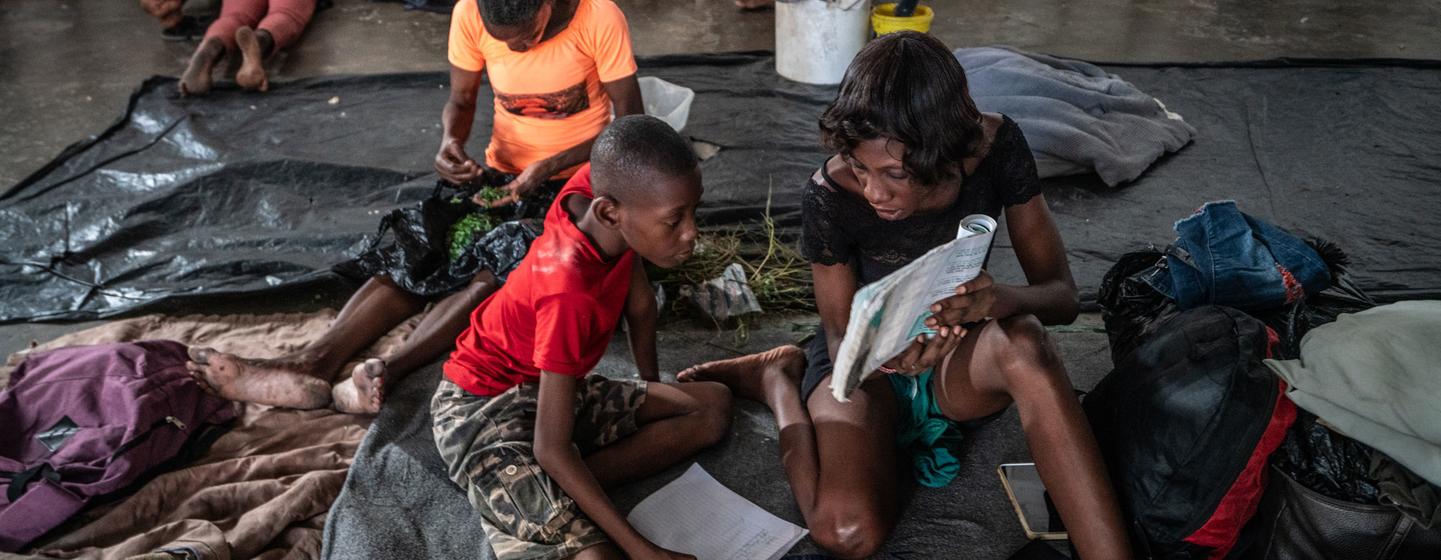
A mother helps her child to study at the Delmas 4 Olympique Boxing Arena where they are now sheltering.


© UNOCHA/Giles Clarke
 
A mother helps her child to study at the Delmas 4 Olympique Boxing Arena where they are now sheltering.


7 April 2024

Culture and Education

Against the backdrop of a humanitarian crisis and gang violence in Haiti, UN agencies are warning that children are suffering not just from a lack of schooling but also through witnessing violence.

Students in the capital Port-au-Prince have missed hundreds of hours of class time over the past year and now, now, more than one million Haitians are facing emergency levels of acute food insecurity, according to a new UN-backed report.

As deadly threats to school security continue in Port-au-Prince, and northern parts of the Artibonite department, UN News examined the situation on the ground and how the UN is responding to the worsening educational crisis.

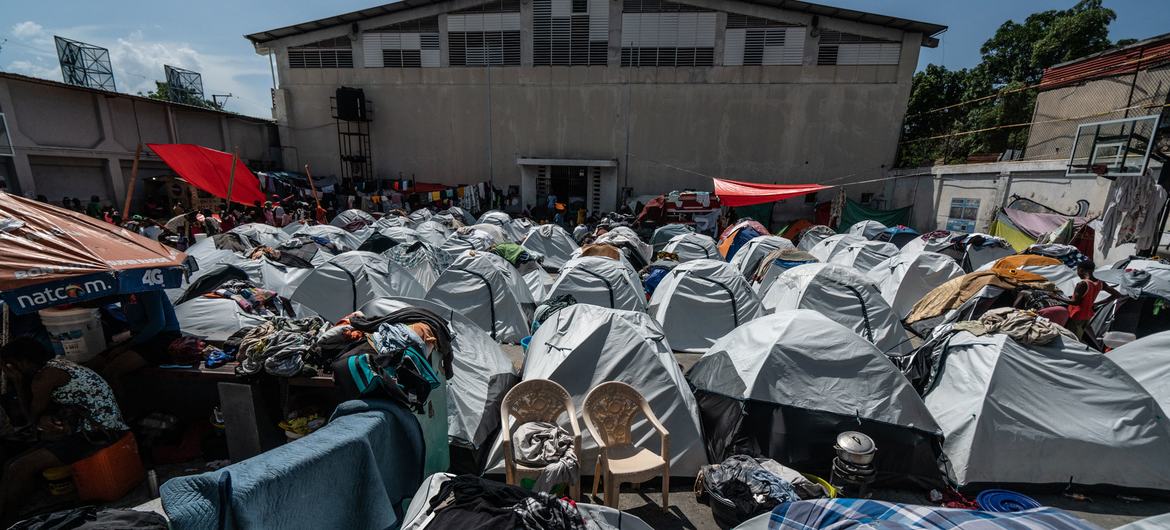
Tents for people who have fled their homes now occupy Gymnasium Vincent, a school and sports complex in downtown Port-au-Prince.
© UNOCHA/Giles Clarke
 
Tents for people who have fled their homes now occupy Gymnasium Vincent, a school and sports complex in downtown Port-au-Prince.

Massive school closures

By the end of January, a total of 900 schools had temporarily closed mainly in Port-au-Prince, depriving around 200,000 children of their right to education, according to UN Children’s Fund (UNICEF).

Many other schools abruptly shut in Port-au-Prince in late February, when armed gangs coordinated breakouts in jails, freeing around 4,500 prisoners.

Gangs reportedly now control 80 to 90 per cent of the capital, and in the ensuing chaos, UN agencies on the ground reported cases of armed groups recruiting children, spiralling violence, looting and destruction.

“The Haitian population is caught in the crossfire,” said Catherine Russell, head of UNICEF. “Spaces for children have been transformed into battlegrounds. Each passing day brings new deprivations and horrors to the people of Haiti.”

Basic security is urgently needed for the lifesaving services and for aid workers to reach those in desperate need, she said, calling for the protection of schools, hospitals and other critical infrastructure children rely on and for safeguarding humanitarian spaces.

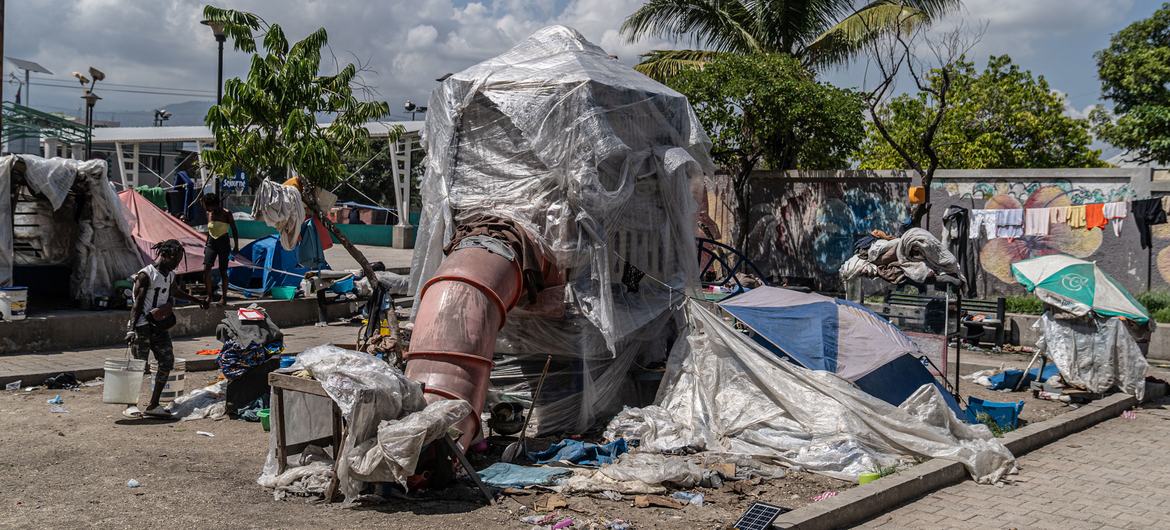
A children’s playground structure becomes a shelter for people in the Tabarre area of Port-au-Prince, Haiti.
© UNOCHA/Giles Clarke
 
A children’s playground structure becomes a shelter for people in the Tabarre area of Port-au-Prince, Haiti.

Classrooms become home

As of late March, violence had displaced at least 362,000 people, with many trapped in the besieged capital and thousands finding temporary shelter in public buildings, including schools.

Each classroom turned into a temporary home for multiple families. Playgrounds became tented shelters. Gymnasiums were transformed into open dormitories for those seeking safety.

“Many schools are not accessible as violence is ramping up around them,” said UNICEF’s representative in Haiti, Bruno Maes. “Some are occupied by gangs, others by displaced people and still more have been looted or destroyed.”

Soundcloud

On the afternoon of 25 March, heavily armed groups entered a downtown Port-au-Prince school and set fire to 23 classrooms. Aid agencies condemned the incident. 

In another incident in the Port-au-Prince neighbourhood of La Saline, 3,500 children were trapped in two schools as gangs fought around them. UNICEF engaged with the armed groups for four days before they could secure the safe release of the children.

UNICEF has urged all parties to safeguard students, educators, parents and educational infrastructure in line with the Safe Schools Declaration, a global political commitment endorsed by 119 countries, including Haiti, for better protection measures and support for continuing education during armed conflicts.

Bruno Maes (centre), the UNICEF representative in Haiti, visits a school in Artibonite.
© UNICEF/Herold Joseph
 
Bruno Maes (centre), the UNICEF representative in Haiti, visits a school in Artibonite.

Terrorised and traumatised 

“The situation is desperate for children,” said UNICEF’s Mr. Maes. “Children are killed, wounded, raped, displaced and denied access to basic services, including school,” adding that they are “terrorised and traumatised”, some after witnessing burnt bodies on the streets.

Amid the very clear dangers, parents “still want to send their children to school”, he said. “Education is at the heart of every Haitian family; people put a very high value on it.” 

As gangs continue to expand their control of vital roads and ports, their grip is extending outside the capital and the threat to school safety is mounting.

Despite this, the majority of schools outside the troubled gang-controlled areas of Port-au-Prince and Artibonite are still functioning. Many have admitted children who have fled because of violence and insecurity, although some parents are unable to pay school fees due to increasing poverty.

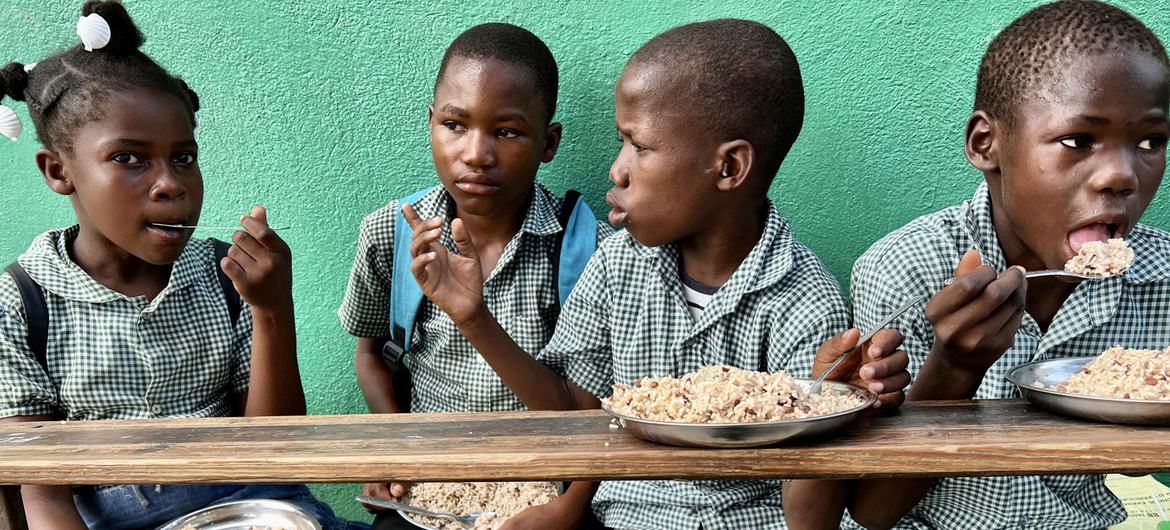
Children in Haiti eat a meal provided as part of WFP's school feeding programme.
© WFP/Jonathan Dumont
 
Children in Haiti eat a meal provided as part of WFP's school feeding programme.

Multipronged response

UN agencies have been working together to provide lifesaving essentials, like food, water and shelter, to thousands of Haitians in need and helping to get children back to school using new approaches.

Efforts include an International Organization for Migration (IOM) initiative currently providing psychosocial support to students forced out of school by the violence, and the World Food Programme (WFP) supports hot meals for 250,000 children across the country.

Part of UNICEF’s work is assisting families affected by violence and displacement to reintegrate children into formal education. Where this is not feasible, the agency works with partners to establish alternative, safe and temporary learning environments.

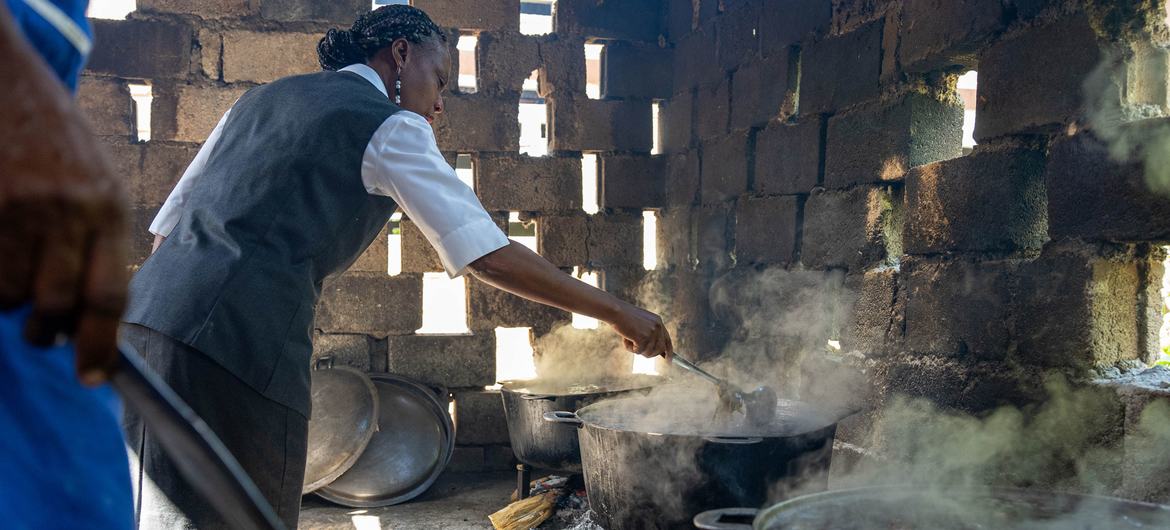
Volunteers prepare school meals with locally-grown ingredients in Gonaives, in northwestern Haiti.
© WFP/Pedro Rodrigues
 
Volunteers prepare school meals with locally-grown ingredients in Gonaives, in northwestern Haiti.

Redefining schools

The goal is to get children back to learning and into school meal programmes, according to a UNICEF report, published in French in late March.

If schools remain shuttered, distance learning can be deployed via radio, television and e-learning platforms. UNICEF is collaborating with the Ministry of Education to find a way to deliver this via Radio Télé Éducative (RTE) broadcasts on Haiti’s national radio station.

Other opportunities for engaging students during the crisis include boosting capacities at schools currently accommodating displaced pupils.

Learn more about what the UN is doing to help Haiti in our explainer here.


https://news.un.org/en/story/2024/04/1148306


https://creativecommons.org/licenses/by/3.0/legalcode

четверг, 4 апреля 2024 г.

‘Shocking Increase’ in Denial of Access to Life-Saving Humanitarian Aid for Children in Conflict Zones Worldwide, Security Council Hears, as Delegates Discuss Solutions


9594TH MEETING (AM)
SC/15651


Presented with data pointing to a spike in warring parties intentionally depriving life-saving humanitarian assistance to children living in conflict zones worldwide, speakers in the Security Council today proposed solutions to ensure aid reaches children in need, including in Gaza. 

The United Nations documented 3,931 verified instances of denial of humanitarian access in 2022 — mostly by Government forces — with the highest figures verified in the Occupied Palestinian Territory, Yemen, Afghanistan and Mali.  Data for the forthcoming 2024 report shows “we are on target to witness a shocking increase” in the denial of access globally, warned Virginia Gamba, Special Representative of the Secretary-General for Children and Armed Conflict.  She stressed that “All parties should be held […] accountable when preventing children from receiving life-saving assistance, which threatens their existence”. 

The denial of humanitarian access is one of the six grave violations monitored by the UN-led Monitoring and Reporting Mechanism on grave violations against children in situations of armed conflict established by Council resolution 1612 (2005).   She underscored that such denial — linked to restrictions on humanitarian activities and movements, interference with aid operations and discrimination of recipients, attacks on civilian infrastructure, violence against and killing of humanitarian personnel, and looting of aid — violates children’s right to life, education and the highest attainable standard of health. 

“We cannot prevent denial of humanitarian access to children unless we understand it and reinforce our capacity to monitor and prevent its occurrence,” she asserted, noting the critical importance of the UN’s engagement with parties to the conflict.

Detailing the critical situation in several contexts, Ted Chaiban, Deputy Executive Director of the United Nations Children’s Fund (UNICEF), said that, in Gaza, widespread destruction of logistical infrastructure, a quasi-blockade on the north of the Strip, repeated denials for or delays in granting access for humanitarian convoys, and electricity and telecommunications blackouts have been devastating for children.  Dozens of children in northern Gaza have reportedly died from malnutrition and dehydration in recent weeks.   

On the world’s worst child displacement crisis — Sudan — he said the blatant disregard for permission to allow aid delivery — essential to protect children from the impact of conflict in Darfur, Kordofan and Khartoum — has greatly intensified their suffering.  As well, in Myanmar, the intensified conflict and increased restrictions on aid have hindered critical assistance, with access to safe water being a major challenge for children living in hard-to-reach areas.

“Children are the first to suffer and the ones who will carry the longest lasting humanitarian consequences,” he said, imploring the Council to strengthen carve-outs designed to protect humanitarian access, press States and non-State armed actors to end denial of such access to children, and support the UN’s efforts to implement monitoring on the ground.

Atim Niger-Thomas, Executive Director of Authentique Memorial Empowerment Foundation, said that — despite striving to remain impartial — humanitarians face the risk of attack and denial of access by both Governments and non-State armed groups.  Calling on States to ensure unimpeded access for humanitarian actors to support children, she urged the Council to invite more local civil society leaders with hands-on practical experience to brief and incorporate monitoring and reporting data on denial of humanitarian access into its broader discussions.  As well, she called on the Council and the UN to strengthen their engagement, ensuring safety nets are carved out for local civil society organizations — “the first and last respondents on the ground”.   

In the ensuing discussion, Council members voiced concern over the consistent denial of humanitarian access for children, detailing the alarming situations for children in Gaza, Sudan, Afghanistan, Ukraine, Haiti, Yemen and Myanmar.  Many also paid tribute to the World Central Kitchen staff members killed by an Israeli strike yesterday in Gaza, recalling that humanitarian personnel should always be protected under international humanitarian law.

“Denying much-needed humanitarian access to children, as a war tactic, is unacceptable and violates children’s rights under international human rights and international humanitarian law,” said the speaker for Mozambique.  Instead, warring parties must implement all relevant resolutions, including resolution 2664 (2022) and the recommendations of the Security Council Working Group on Children and Armed Conflict; enhance cross-border cooperation to ensure safe passage for humanitarian aid; and prohibit denial of access.  “Addressing the root causes of conflict is a more sustainable approach to addressing grave violations against children,” he stressed. 

Underscoring that “any threat to peace and security is a threat to children,” the representative of the United States said that children in conflict zones everywhere require the essentials of life.  In Gaza — where children are suffering war wounds and dying from acute malnutrition — “humanitarian assistance is desperately needed now, and it must be facilitated to mitigate the impact of an impending famine,” she stated.

Adding to that, Malta’s delegate said that without an immediate and permanent ceasefire in Gaza, “the denial of essentials such as food, medicine, and clean water is accelerating acute malnutrition and mortality”. She also spotlighted the deteriorating situation in Haiti, where the escalating violence and displacement have deprived more than 3 million children of essential services. 

The speaker for the Russian Federation observed that “not a single child in Gaza has access to education,” urging the Special Representative to prioritize a visit to the Strip to assess grave violations against children and calling on Israel to provide her with access to the region immediately.

Relatedly, the representative of Algeria said he is “astonished” that in her briefing, Ms. Gamba did not say “a single word” about the dire situation of the children in Gaza.

Also sounding the alarm over the “catastrophe” unfolding in Gaza, China’s delegate said that children there have been forced to move from one place to another under fire, “never to find a safe haven”.  Calling for full implementation of resolution 2728 (2024), he said the blockade of Gaza must be lifted immediately and violators of children’s rights must be held accountable.

Echoing his call for accountability, Guyana’s delegate stressed that the impeding of vital humanitarian support to children must never be condoned.  Denial of humanitarian access for children should be considered as a trigger for listing in the annexes of the Secretary-General’s annual report, she asserted.  Sierra Leone’s representative agreed, noting it is currently the only one of the six grave violations that is not regarded as such. 

Drawing attention to the grim situation for children in the Democratic People’s Republic of Korea, the delegate for the Republic of Korea said that the minors in that country face egregious human rights violations, including the death penalty for distributing South Korean dramas. Moreover, children there face a devastating humanitarian crisis as Pyongyang relentlessly pursues its nuclear and ballistic missile programme.  He cautioned that 17 per cent of the country’s children reportedly suffer from growth stunting due to rampant undernourishment.

Stressing that the denial of humanitarian access for children is cruel and inhumane, the representative of Slovenia declared:  “This has to stop.  How can we consider ourselves a civilization if we are able to inflict so much pain on our most vulnerable members?” 

Briefings

VIRGINIA GAMBA, Special Representative of the Secretary-General for Children and Armed Conflict, underscored that while the Council condemned the denial of humanitarian access to children as one of the six grave violations, parties to conflict continue to impede it.  According to the last Secretary-General’s annual report on children and armed conflict, the UN verified 3,941 cases of denying humanitarian access — making it one of the highest verified violations in 2022.  Data for the forthcoming 2024 report shows “we are on target to witness a shocking increase” in the denial of access globally, she said.  In 2022, the highest figures were verified in the Occupied Palestinian Territory, Yemen, Afghanistan and Mali.  “All parties should be held […] accountable when preventing children from receiving life-saving assistance, which threatens their existence,” she stressed.

She said cases of denial of humanitarian access — linked to restrictions of humanitarian activities and movements; interference with aid operations and discrimination of recipients; direct and indiscriminate attacks on civilian infrastructure; disinformation and detention, violence against and killing of humanitarian personnel; and looting — occur in rural and urban battlegrounds as well as internally displaced persons camps.  This denial has long-lasting effects on children’s well-being and development and may lead to violating their fundamental human rights, including the right to life, education and the highest attainable standard of health.  Also, as seen in Sudan and the Sahel, such denial deprives children of access to safe spaces. 

She further observed that the denial is gendered.  Restrictions to girls’ movement challenge their access to aid in areas where it may be distributed, including in internally displaced persons camps.  Teenage boys could be perceived as associated with an opposing party and, therefore, denied that access.  Bans or restrictions of female humanitarian staff in several situations, including Afghanistan and Yemen, have immediate life-threatening consequences, preventing needs assessments and assistance to women and children and severely harming the quality and effectiveness of humanitarian action.  “Denial of humanitarian access acquires catastrophic proportion among the most vulnerable of all children, those with disabilities,” she cautioned.

Accordingly, she called on all parties to allow and facilitate safe, timely, and unimpeded humanitarian access and refrain from the military use of schools and hospitals.  To this end, the UN’s engagement with parties to the conflict is critical, she pointed out, noting the importance of data on this scourge.  In 2022, Council Members requested her Office to develop a guidance note for improved monitoring and reporting on the denial of humanitarian access violations, she recalled, stressing that this tool will strengthen monitoring and reporting capacities in concerned countries.  Guidance will also assist humanitarian workers to better plan their programmes, identify areas where parties to the conflict could remove obstacles to facilitate humanitarian access to children and refine the accountability elements.  “We cannot prevent denial of humanitarian access to children unless we understand it and reinforce our capacity to monitor and prevent its occurrence,” she asserted, adding:  “We must get on with the job.”

TED CHAIBAN, Deputy Executive Director of the United Nations Children’s Fund (UNICEF), said that “the denial of humanitarian access is a particularly pervasive, multifaceted, and complex grave violation”.  It can mean parties arbitrarily restricting access, including through the suspension of essential services, restrictions of civilians’ movements to reach assistance and protection, and bureaucratic and administrative impediments.  It can also mean outright attacks on facilities providing life-sustaining services, including water and sanitation installations, attacks on humanitarian and medical personnel, and besiegement tactics.  “These actions have devastating humanitarian consequences for children,” he warned.

In Gaza, widespread destruction of logistical infrastructure, a quasi-blockade on the north of the Strip, repeated denials for or delays in granting access for humanitarian convoys, fuel shortages, and electricity and telecommunications blackouts have been devastating for children, he said.  Due to various constraints, children cannot access age-appropriate nutritious food or medical services and have less than two to three litres of water per day.  In March, one in three children under two years of age in northern Gaza suffered from acute malnutrition, a figure that more than doubled in the last two months.  Dozens of children there have reportedly died from malnutrition and dehydration in recent weeks. 

In Sudan, the world’s worst child displacement crisis, the violence and blatant disregard for permission to allow the delivery of humanitarian assistance essential to protect children from the impact of conflict in Darfur, Kordofan, Khartoum and beyond has greatly intensified their suffering.  In Myanmar, the intensified conflict and significant increase in restriction of humanitarian access have hindered critical assistance.  UNICEF partners have had to relocate or postpone planned life-saving responses to ensure staff safety in some areas.  As the country enters the peak of its dry season, access to safe water is a major challenge for an already struggling population, including 6 million children, many living in hard-to-reach areas.

He reported that since the establishment of the Monitoring and Reporting Mechanism, the UN has verified almost 23,000 incidents of denial of humanitarian access, with nearly 15,000 verified over the past five years and 3,931 incidents in the last Secretary-General’s report.  Stressing that “children are the first to suffer and the ones who will carry the longest lasting humanitarian consequences”, he implored the Council to strengthen carve-outs designed to protect humanitarian access, use its influence to press States and non-State armed actors to prevent and end denial of humanitarian access to children and support the UN’s efforts to implement monitoring and advocacy on the ground both through resource allocation and through commitment to work with humanitarians to protect aid access to children no matter where they are.

ATIM NIGER-THOMAS, Executive Director of Authentique Memorial Empowerment Foundation, said humanitarians face risk of attack and denial of access by both Governments and non-State armed groups, despite striving to remain neutral and impartial.  “This is particularly devastating for children, who bear the brunt of conflicts they did not choose,” she said.  A more harmonized approach to issuing and recognizing administrative authorizations for humanitarian field operations is needed to prevent humanitarians from having to cancel distribution activities when State security forces dispute their Government-obtained documents at check points — an issue many civil society organizations face worldwide. 

Children are particularly vulnerable to the consequences of restricted humanitarian access due to their heightened needs for protection, health care, nutrition, and education. She highlighted that in Cameroon education is weaponized by some non-State armed Groups, especially in rural areas, for example, armed groups enforcing a no-school policy.

She recommended strengthening local data collection, as local information and data from civil society ensures real time action to avert some of the negative impact on children of denied humanitarian assistance.  The Council should ensure there are strong, well-funded monitoring and reporting systems worldwide to raise awareness, hold perpetrators accountable, and advocate for action.  “What national organizations want is for the international community to be more concerned with our work, efforts, and safety on the ground,” she said, calling on Member States to use their power at the highest levels of Government and through international forums to ensure unimpeded access for humanitarian actors to support children.  The Council should invite more local civil society leaders with hands-on practical experience to brief, and it should incorporate monitoring and reporting data on denial of humanitarian access into broader Council discussions, reports and resolutions. 

Strengthening the capacity of local humanitarians to navigate challenges and deliver aid effectively is crucial, she said.  Despite learning thanks to support from the Office for the Coordination of Humanitarian Affairs and other partners, gaps remain for local organizations who need funding to access such training.  There needs to be an unlocking of opportunities for civil society organizations to learn and become empowered.  “This must be matched by a commitment to meaningfully include local organizations at every level of the humanitarian decision-making process, including in Council decisions, so that local experiences can help identify and deliver realistic solutions,” she said.

She said local non-governmental organizations will remain in their communities when the UN and international non-governmental organizations leave.  Therefore, she called on the Council and the UN more widely to strengthen their engagement, ensuring support systems and safety nets are carved out for local civil society organizations — “the first and last respondents on the ground”. This will go a long way to ensure better humanitarian access to children around the world.

Statements

The representative of Malta paid tribute to the World Central Kitchen staff members killed by an Israeli strike yesterday in Gaza, recalling that humanitarian personnel should always be protected under international humanitarian law.  Spotlighting instances of denial of humanitarian access, she said that, in Sudan, the escalation of conflict has displaced over 4 million children, making it the world’s largest displacement of children.  Moreover, 14 million children need urgent humanitarian assistance.  “In Gaza, the continued conflict and near-complete lack of humanitarian access have been catastrophic for children,” she stressed, adding that without an immediate and permanent ceasefire, “the denial of essentials such as food, medicine, and clean water is accelerating acute malnutrition and mortality”.  As well, she expressed alarm over the denial of access to children who have been detained, abducted or subjected to inhumane and degrading treatment.  The deteriorating situation in Haiti is equally concerning, she said, noting that the escalating violence and displacement have deprived more than 3 million children of essential services. 

The representative of Mozambique said that “denying much-needed humanitarian access to children, as a war tactic, is unacceptable and violates children’s rights under international human rights and international humanitarian law,” urging all warring parties to create the necessary conditions for humanitarian access to children affected by conflicts.  These include:  fully implementing all relevant resolutions, including resolution 2664 (2022) and the recommendations of the Security Council Working Group on Children and Armed Conflict; enhancing cross-border cooperation to ensure safe passage for humanitarian aid; strengthening enforcement of international humanitarian law and prohibiting denial of access; and raising awareness and advocating for unimpeded humanitarian access.  Donors and development partners should scale up their support to increase humanitarian response and address development needs, particularly at the community level. “Addressing the root causes of conflict is a more sustainable approach to addressing grave violations against children,” he concluded.

The representative of the United States underscored that “any threat to peace and security is a threat to children”.  Children in conflict zones everywhere — such as Sudan, the Sahel, Ukraine and Israel — require the essentials of life.  In Gaza, where thousands of children have been injured and often killed in the last few months, doctors have spoken of treating children suffering war wounds and watching children die from acute malnutrition.  “Humanitarian assistance is desperately needed now, and it must be facilitated to mitigate the impact of an impending famine,” she said.  She hailed the Council’s adoption of resolution 2664 (2022) as an important step to expedite food, medicine and humanitarian aid to conflict areas and uphold sanctions on those putting people at risk. She called on national Governments to integrate humanitarian exemptions into all domestic sanctions regimes; enhanced monitoring and reporting of denial of humanitarian access; protection for those working in conflict zones; and help for children affected by conflict to return to school.

The representative of Ecuador underlined the need to identify strategies to prevent the six grave violations against children and focus on the physical and mental health of victims.  Particularly concerning are cases of State and non-State forces hampering access to humanitarian assistance and destroying schools and hospitals, in breach of international humanitarian law.  The exponential increase of children dependent on humanitarian assistance is connected to the worsening of several variables, including the escalation of conflict-related violence, in particular in Ukraine and Gaza; and the increase in natural disasters resulting from climate change.  Against this backdrop, he underscored the need to increase parties’ awareness vis-à-vis children's rights, create institutions to promote accountability, restore the rule of law, and increase cooperation with local and regional organizations.

The representative of the Republic of Korea urged the Council to stand firm on its zero-tolerance against the denial of humanitarian access to children.  “There can be no room for geopolitical considerations in this regard,” he said, underscoring the need to reinforce child protection capacity on the ground, including the deployment of child protection advisers within UN peacekeeping operations, and the need to develop more systematic and detailed guidelines that reflect the various views of humanitarian actors.  Drawing the Council’s attention to the grim situation for children in the Democratic People’s Republic of Korea, a signatory of the Convention on the Rights of the Child, he said that the minors in that country face egregious human rights violations, including the death penalty for distributing South Korean dramas.  Moreover, children there face a devastating humanitarian crisis as Pyongyang relentlessly pursues its nuclear and ballistic missile programme.  Consequently, some 17 per cent of the country’s children reportedly suffer from growth stunting due to rampant undernourishment, he added.

The representative of Guyana said that despite a robust legal regime, in recent years, humanitarian access for children has consistently been denied. She highlighted situations of malnutrition in Sudan, Gaza — “while food is available but access is restricted by the occupying Power, Israel” — and Haiti.  She called for accountability saying the impeding vital humanitarian support to children must never be condoned.  This includes suspension of aid delivery, attacks on humanitarian workers and convoys, administrative impediments, and the adoption of restrictive laws and decrees related to humanitarian work and workers. Counterterrorism measures and sanctions regimes must be consistent with international law and not restrict or criminalize the delivery of humanitarian aid for children.  “The Security Council must make effective use of the tools at its disposal to combat the incidence of this grave violation,” she said.  Denial of humanitarian access for children should be considered as a trigger for listing in the annexes of the Secretary-General’s annual report. 

The representative of France stressed that “children are the first civilian victims of armed conflicts” - in 2023, more than 150 million children worldwide needed life-saving humanitarian assistance.  Cases of denial of access to humanitarian aid affecting children have increased significantly since the Monitoring and Reporting Mechanism was established in 2005.  The denial of humanitarian access has a disproportionate impact on girls and young girls, who are more likely to be out of school and face higher risks of sexual abuse or forced marriage.  These obstacles to humanitarian assistance for children occur in many conflict zones, including Myanmar, Yemen, Sudan and Burkina Faso.  In Afghanistan, he voiced concern over the policy of segregation that women face and restrictions on humanitarian workers.  In Gaza, the humanitarian situation is catastrophic, with the imminent risk of famine, he cautioned, calling for an immediate and lasting ceasefire.

The representative of Japan said that “the denial of humanitarian access creates human security crises, threatening the dignity of all, especially children”, urging the international community to remove impediments to humanitarian operations, such as explosive weapons, including landmines.  Global efforts must expand to support children’s right to education.  “Every single day counts when it comes to children’s education and development,” he declared.  In 2023, Tokyo provided more than $100 million to UNICEF to protect children’s well-being in Syria, Haiti, Mali, Afghanistan, Ukraine, Ethiopia, and Myanmar.  Recently, it also announced a $12 million grant to UNICEF to support children affected by humanitarian crises in the Middle East and North Africa.  The increase in violations against children is a “crisis of compliance”.  Japan is a proud supporter of national efforts to build legal institutions and develop human resources around the world.  “We are responsible for addressing human security threats and removing any impediments hindering children’s ability to pave their future […] because they deserve to live in dignity”, he concluded.

The representative of China highlighted that children in Gaza are experiencing a catastrophe.  Some have been forced to move from one place to another under fire, “never to find a safe haven”.  He said this questions the conscience of the international community and such a situation should not continue.  Council resolution 2728 (2024) should be fully implemented.  The blockade of Gaza should be lifted immediately so that humanitarian agencies like the United Nations Relief and Works Agency for Palestine Refugees in the Near East (UNRWA) can deliver aid, especially to children. International justice must be upheld and violators of children’s rights must be held accountable.  He underscored that elsewhere children need greater humanitarian assistance, citing Afghanistan, where unilateral sanctions must be lifted, and Syria, where unilateral coercive measures have exacerbated the humanitarian crisis impacting children’s well-being.  All illegal unilateral sanctions should be lifted, he stressed.  In Haiti, where gang violence threatens children, the Council should take concrete measures to uphold the arms embargo. 

The representative of the United Kingdom, spotlighting instances of denial of humanitarian access worldwide, said that, in Sudan, humanitarian obstruction by both the Sudanese Armed Forces and Rapid Support Forces has resulted in the starvation of children.  In Ukraine, the Russian Federation still does not allow humanitarian organizations meaningful access to territories temporarily under its control.  Also, severe humanitarian access restraints persist in Houthi-controlled areas of northern Yemen.  Almost half of all verified incidents of denial of humanitarian access in 2022 occurred in Israel and the Occupied Palestinian Territory, he observed, adding that today, “Palestinian children are facing unfathomable suffering.”  He sounded the alarm over the killing of seven members of World Central Kitchen staff on 1 April and reports that Israel continues to block UNRWA’s access to Northern Gaza where children are “on the brink of starvation”.  “Children are never responsible for wars, but they suffer disproportionately from their impacts,” he said, urging all parties to “do more to protect them”.

The representative of Sierra Leone said that it is yet to be agreed whether the denial of humanitarian access should become a “trigger” for listing in the annexes of the Secretary-General’s annual report on Children and Armed Conflict and that it is currently the only grave violation that is not a “trigger”.  Where there is the denial of humanitarian assistance through the intentional behaviour of certain persons, due consideration should be given to regard it as a “trigger”.  Given his country’s experience with conflict and its horrendous impact on children and the importance of accountability to address impunity, he said that he has “no option but to point out any issue that can be considered to be a trigger of a grave violation”.  Member States and the Council should strengthen conflict prevention tools and strategies, including those for protecting children in conflict situations, as well as accountability mechanisms against child rights violations, including attacks on schools and hospitals and the denial of humanitarian access.

The representative of Slovenia said she is “appalled that denial of humanitarian access to children still exists and is increasing”, adding, “even in wars, there are rules”.  Denying children humanitarian access is cruel and inhumane.  “This has to stop.  How can we consider ourselves a civilization if we are able to inflict so much pain on our most vulnerable members?” she asked.  All parties must guarantee rapid, safe, and unimpeded humanitarian delivery at all times.  She noted that to that end the Council has adopted a humanitarian carve-out in sanctions regimes and said it is imperative that States harmonize their national counter-terrorism legislations.  She highlighted the alarming situations for children in Sudan, Gaza, Afghanistan, Ukraine and Myanmar.  Efforts to safeguard the rights of children must be comprehensive, encompassing prevention, accountability, and rehabilitation, including psychosocial support for children traumatized by armed conflict.  Collaboration among Governments, humanitarian organizations, local communities, and individuals is required to ensure a future where every child is safe from the horrors of war, she added.

The representative of Algeria said he is “astonished” that in her briefing, Ms. Gamba did not say “a single word” on the dire situation of the children in Gaza.  The Israeli occupying Power in Palestine has for months deliberately denied humanitarian access, causing children to die from malnutrition, dehydration and the lack of health care.  Those who will survive will be scarred for life, he said, noting that “their dreams have been shattered”.  Detailing the horrific situation in Gaza, he said that more than 600,000 children are trapped in Rafah, with nowhere safe to go.  According to UNRWA, more children have been killed in recent months than in four years of conflict worldwide.  This Council is responsible for the fate of children affected by war, he said, stressing the need to empower monitoring mechanisms and ensure safe and unhindered passage for humanitarian workers and supplies, without preconditions.

The representative of the Russian Federation said that Israel’s blockade has already resulted in large-scale hunger, with children in northern Gaza already dying of starvation, condemning Israel’s decision to ban entry of UNRWA humanitarian convoys with food into that part of the Strip.  If the overall situation remains unchanged, a similar fate awaits children in the entire Strip.  The current humanitarian delivery volumes, including by air and by sea, are not sufficient and have not improved the harrowing situation.  More than 13,000 children have already died and schools and hospitals have been razed to the ground since October 2023.  “Not a single child in Gaza has access to education,” he pointed out, urging the Special Representative to prioritize a visit to the Strip to assess grave violations against children.  In this regard, she called on Israel to immediately provide the Special Representative access to the region.

The representative of Switzerland said thousands of children worldwide are suffering the consequences of restrictions on humanitarian access.  In Gaza, the first children have died from acute malnutrition.  Sudan is also being pushed towards famine.  “In both Gaza and Sudan, we call on the parties to implement the resolutions of this Council calling for an immediate ceasefire,” he said, adding that “aid deliveries and other humanitarian services must be ensured without further delay — through all possible crossing points and routes”.  All parties must respect international law, in particular international humanitarian law and human rights in all circumstances. Sufficient, predictable funding for aid must be ensured.  Council resolution 2664 (2022) on humanitarian exemptions in all UN sanctions regimes must be fully implemented, thus helping to ensure the flow of funds for humanitarian action and access in highly complex contexts.  The cycles of violence and suffering must be broken by finding political solutions to conflicts, including within the Council, he added.


https://press.un.org/en/2024/sc15651.doc.htm


https://creativecommons.org/licenses/by/3.0/legalcode