Показаны сообщения с ярлыком Middle East. Показать все сообщения

среда, 16 октября 2024 г.

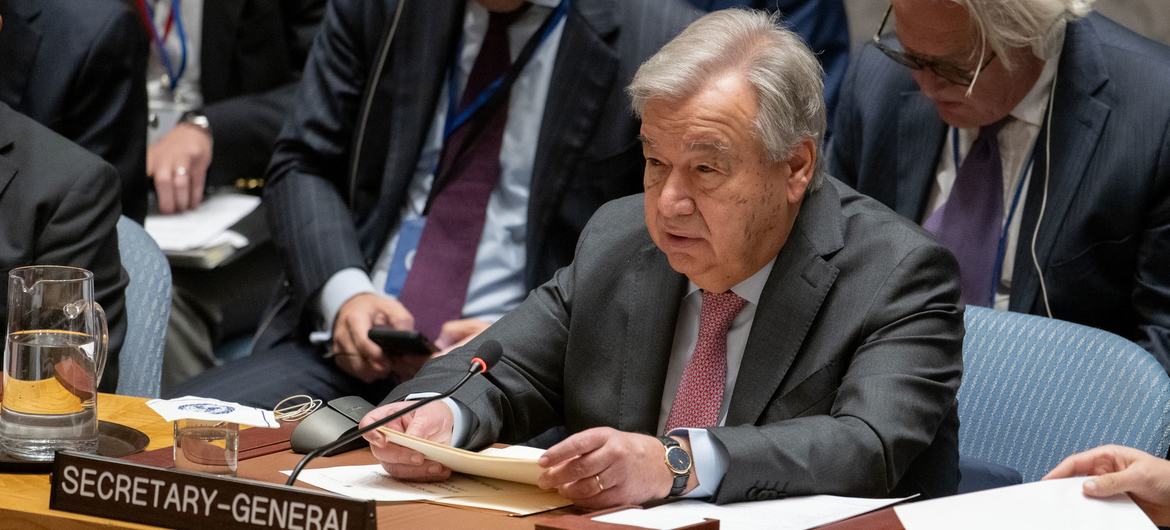
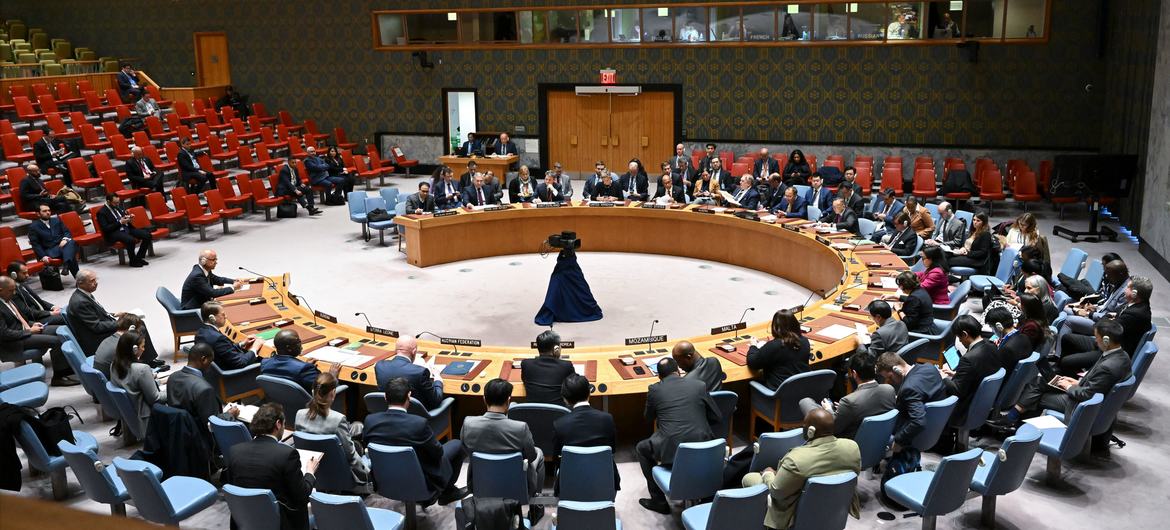
Middle East Facing Dangerous Rise in Violence as Israeli Forces Fire on Peacekeepers in Lebanon, UN Political Affairs and Peace Operations Chiefs Warn Security Council


9746th Meeting* (PM)
SC/15850


Briefing the Security Council on the heels of the firing of Israeli forces on UN peacekeepers in Lebanon earlier in the day, senior UN officials warned of a dangerous uptick in violence in the Middle East, as delegates echoed their calls for a ceasefire, de-escalation and diplomacy.

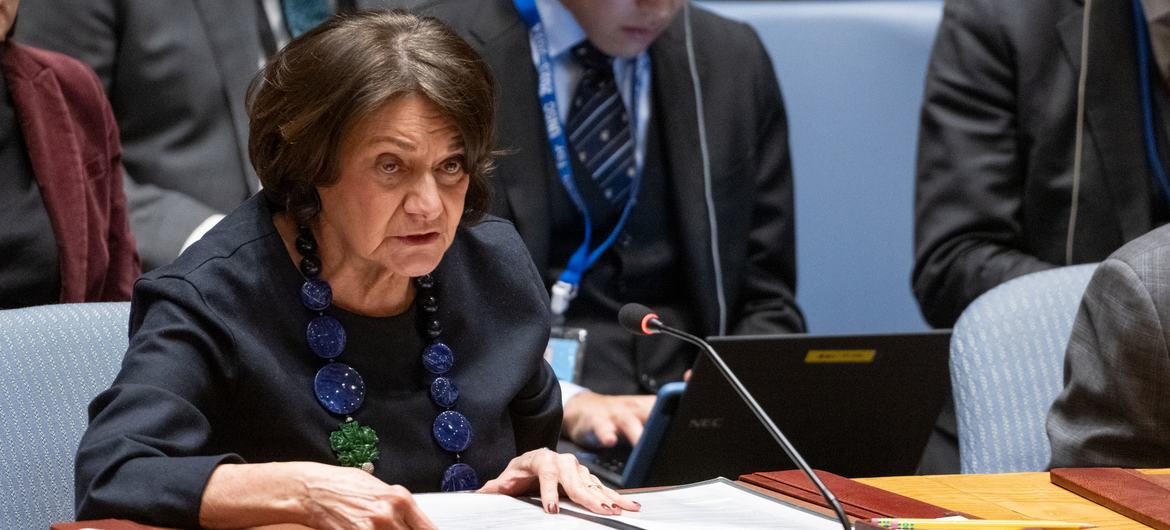
“The conflict in Lebanon, coupled with intensified strikes in Syria and the raging violence in Gaza and the occupied West Bank, points to a region dangerously teetering on the brink of an all-out war,” Rosemary DiCarlo, Under-Secretary-General for Political and Peacebuilding Affairs, warned the 15-nation organ, observing that the situation in the country had become even more alarming since the Secretary-General’s last address before the Council eight days ago.

Recent developments on the ground, starting with a dramatic intensification of exchanges of fire between Hizbullah and the Israel Defense Forces, followed by the commencement of Israeli ground operations into Lebanon on 1 October, has created a “humanitarian emergency”, she said, pointing to the “spiralling” number of dead and wounded.  Over 300 people were killed in Lebanon in the past week alone, placing the death toll since last October at 2,000 people, according to the Lebanese Ministry of Health.

“Our collective inability to stop the violence and stem the bloodshed is damning,” she said, outlining alarming developments, including a health sector under immense pressure, due to air strikes hitting facilities and personnel, and a quarter of Lebanese territory now under so-called evacuation orders by the Israel Defense Forces, who often gave inhabitants as little as two hours’ notice to vacate their homes.  Over 50 people were killed in Israel and more than 60,000 displaced in Israel and Israel-occupied Golan Height since October 2023, she added, urging support for the $425 million Flash Appeal launched last week to assist 1 million people over the next three months.

Against that backdrop, she called on Hizbullah to stop firing rockets and missiles into Israel and urged Israel to stop its bombardment of Lebanon and to withdraw its ground forces.  “The parties must seize the diplomatic options put on the table before them, not the weapons by their side,” she said, adding:  “As the Secretary-General has warned, there is still time, but it is quickly running out.  We must give diplomacy a chance.  NOW.”

“The safety and security of peacekeepers is now increasingly in jeopardy,” said Jean-Pierre Lacroix, Under-Secretary-General for Peace Operations, noting that Israel’s ground operations and intense air bombardment across the country had left much of southern Lebanon — United Nations Interim Force in Lebanon’s (UNIFIL) area of operations — now uninhabited and increasingly uninhabitable.  Hizbullah continues to fire across the Blue Line and is now threatening major population centres in Israel with increasingly high-calibre weapons, he said, pointing to the presence of unauthorized armed personnel, assets and weapons south of the Litani River, in grave violation of Council resolution 1701 (2006).

Meanwhile, since the launch of the Israel Defense Forces’ Operation Northern Arrows on 23 September, UNIFIL has, as of 8 October, detected 5,451 trajectories from south to north of the Blue Line and 610 air attacks by the Forces, he went on.  Today, two peacekeepers were wounded when a UN observation post in UNIFIL’s Naqoura headquarters was hit by tank fire, and Force soldiers fired on a UN position (UNP 1-31) nearby.  “The actions outlined above show little regard for the protections afforded to UN premises and personnel under international law,” he said.

UNIFIL peacekeepers have remained in position, in line with their Council mandate, despite being urged to vacate within 5 kilometres of the Blue Line by the Israel Defense Forces shortly before starting their ground operations, he said, stressing:  “It should be remembered that the ultimate responsibility for ensuring the safety and security of our peacekeepers lies with the actors on the ground.”  He urged the parties to return immediately to a cessation of hostilities and to take real action towards full implementation of Council resolution 1701 (2006).

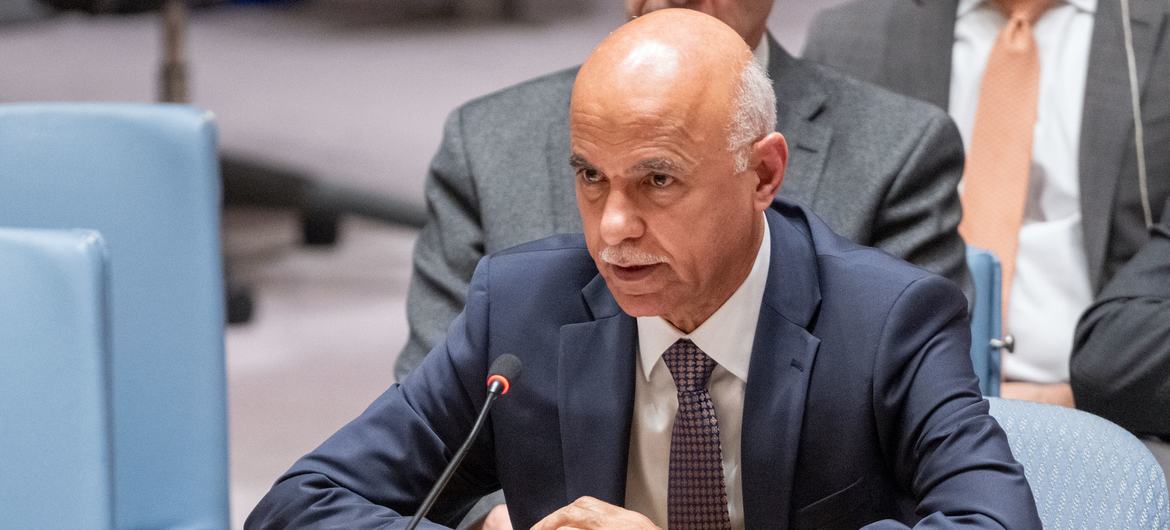
In the ensuing debate, Middle Eastern States condemned the situation, with Lebanon’s representative pointing out that Israel’s attempt to invade his country violated the UN Charter and Council resolution 1701 (2006).  He called on the Council to condemn the invasion and adopt a resolution to end it, imposing Israel’s withdrawal in line with the 1949 Armistice Agreements. Diplomacy has failed to impose a ceasefire, which his country has called for, and so Israel’s “killing, destruction and displacement machine” continues its ground invasion, leading to an “indescribable” humanitarian tragedy.

Pointing to the targeting of a main supply line of the Litani River and Baalbeck, among other sites, he said, “We wonder:  what is the military benefit of targeting a vital border crossing, a water station and a historic archaeological site?  What is the goal of targeting journalists, relief workers, and medical personnel?  Is this the precise surgical military operation they have been talking about?”  He urged contributions to the urgent call for relief, which is only 12 per cent funded.  Only diplomacy and adhering to international law, including Council resolution 1701 (2006), can end the war.  Commending UNIFIL for its courageous decision to not withdraw its forces, he condemned Israel’s attacks on its positions, stressing that Moscow ignores calls of the United Nations and the Secretary-General, and is establishing “a new military reality on the ground to secure unjust outcomes”.

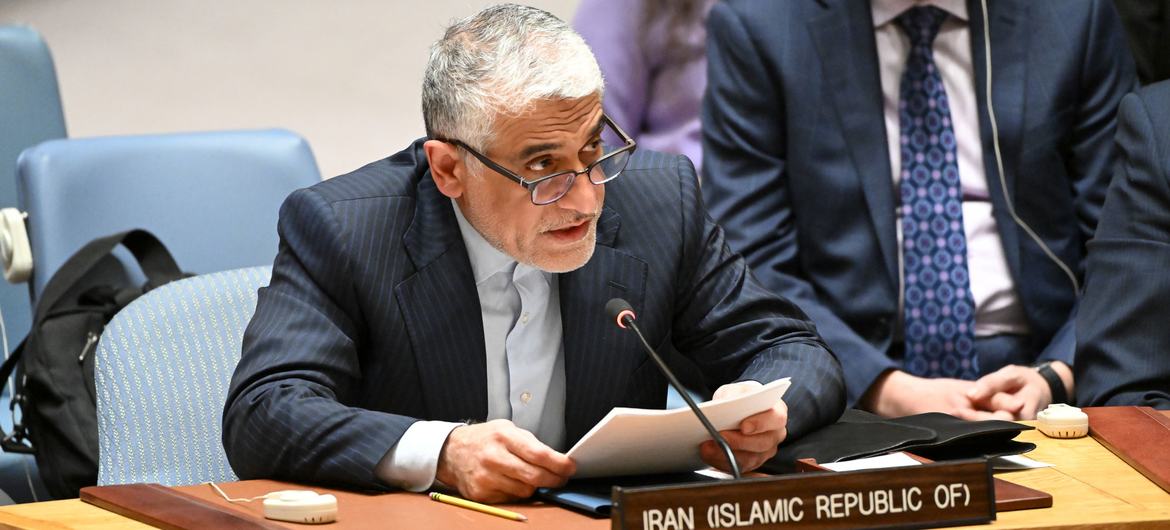
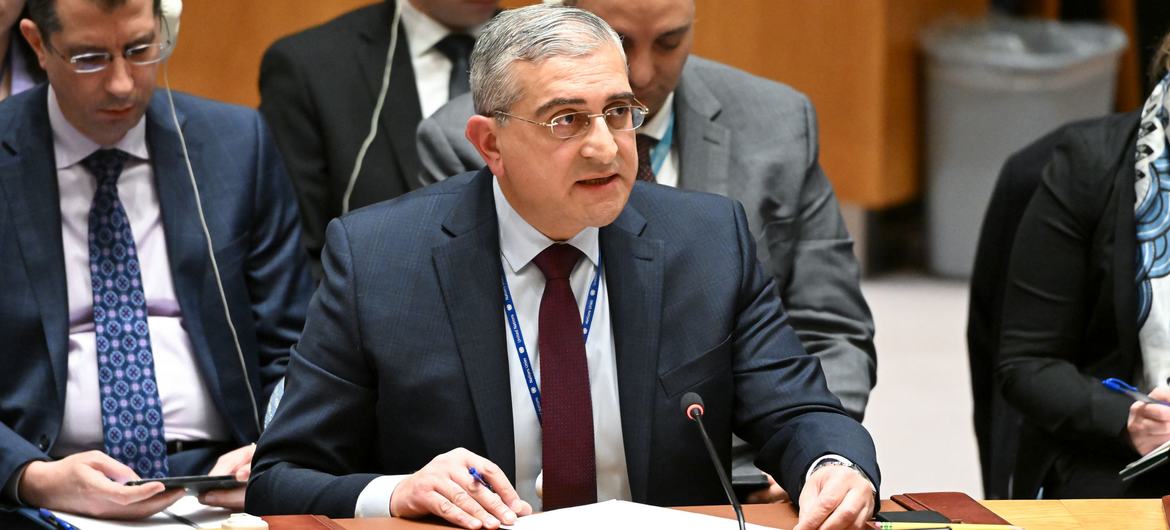
Similarly, Iran’s delegate, voicing solidarity for the Lebanese people, who are enduring “endless acts of aggression of the most notorious terrorist regime in the world”, condemned the continued complicity of the United States, the United Kingdom and other Western States in enabling Israel’s war crimes and genocidal war against the people of Palestine and Lebanon through the provision of advanced weaponry.  Israel assassinated Hizbullah’s Secretary-General Hassan Nasrallah to sabotage any chance of a ceasefire, he said, adding that the “heinous act” proved that Israel’s “real objective is only to provoke a full-scale war across the region”.  Therefore, he called for an immediate ceasefire, for humanitarian aid to flow into Lebanon, and for the Council to hold Israel accountable for its atrocities against the people of Lebanon and Palestine.

Countering those statements, Israel’s delegate said, “This conflict began with the decision made by Hassan Nasrallah to tie his fate, and Hizbullah’s, with Hamas, knowing it would bring suffering on Lebanon and Israel.” Recalling that he had, on 20 September, urged the Council to act before it was too late, said, “Your silence has forced our hand.”  Underscoring the need for a Gaza without Hamas, and for a Lebanon free from Hizbullah’s grip, he called on the Lebanese army and UNIFIL to “step up”, adding that Israeli forces are in close contact with the latter to ensure their safety.  The Council must reform the obligations contained in Council resolution 1701 (2006) and enhance the mechanism.

Asserting that Hizbullah had “established a terrorist state in a failed State”, he told the Lebanese representative that he should sit next to him, and not the Iranian delegate, adding:  “Israel, Lebanon and the free world are on the same side, against the Islamic regime of Iran.”  Lebanon must banish Hizbullah’s destructive influence from its borders, he said, noting the Israeli forces discovery of a Hizbullah tunnel intruding into Israeli territory, containing maps of kibbutzim and terror devices.  Israel will continue its operation to degrade Hizbullah’s capabilities and diminish its terror network in southern Lebanon, he said, calling on the Council to support his country.  “Let this be the day when you stand with Israel and the Lebanese people against the forces of terror; the day when you choose action over silence.”

In further exchanges, Member States underscored that diplomacy is the only way forward, with the representative of France, whose delegation requested the meeting, stating that his country will convene a ministerial conference on 24 October in Paris.  It will bring together Lebanon's partner States, the United Nations, the European Union and international, regional and civil society organizations to restart efforts towards a diplomatic solution based on resolution 1701 (2006), mobilize the international community to meet the protection and emergency needs of the Lebanese population, and heighten support for Lebanon's institutions, in particular the Lebanese Armed Forces.

The representative of Switzerland, Council President for October, who spoke in her national capacity, was among several speakers, including Mozambique and Sierra Leone, calling for an immediate ceasefire and for adherence to Council resolution 1701 (2006), adding:  “There is no military solution to this conflict.”

“Israeli aggression will not stop at Lebanon,” warned Algeria’s representative, reiterating his country’s solidarity with and support of Lebanon.  The only path to ensuring stability in Lebanon and peace in the broader region is the full, immediate implementation of the 2006 text, including deployment of the Lebanese army over all of Lebanese territory, within internationally recognized borders, and the complete withdrawal of Israeli forces from Lebanese lands.

In the same vein, Ecuador’s representative stressed that “today, more than ever, the Lebanese Government must regain effective control over the flow and distribution of weapons” in line with Council resolution 1559 (2004) — a point echoed by Malta’s delegate.

The Republic of Korea’s representative, stressing that “adherence to obligations under international humanitarian law and the protection of civilians are not negotiable”, voiced alarm about the deadly attacks on medical personnel and units by Israel in Lebanon and recent cross-border strikes by Hizbullah appearing to target civilian areas in northern Israel.

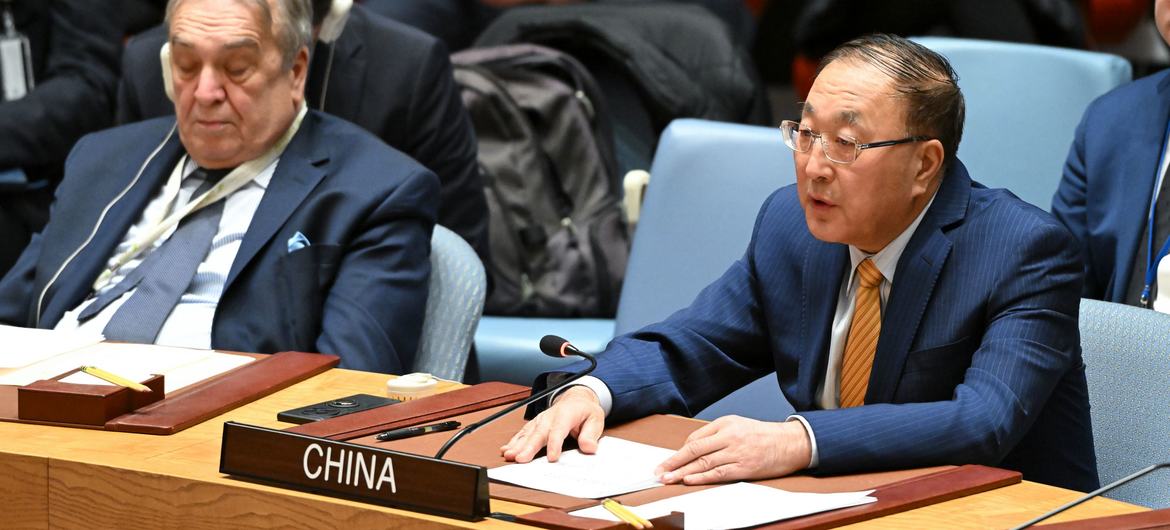
For his part, China’s representative called on Israel “to set aside the obsession with the use of force, make the right political decision, stop violating Lebanon’s sovereignty and territorial integrity, and end its adventurous behaviour that could drag the region into a new catastrophe”. Addressing the Council, he urged “a certain country to stop its passive procrastination, protection and connivance”, and to act responsibly to prevent further destabilization of the situation.

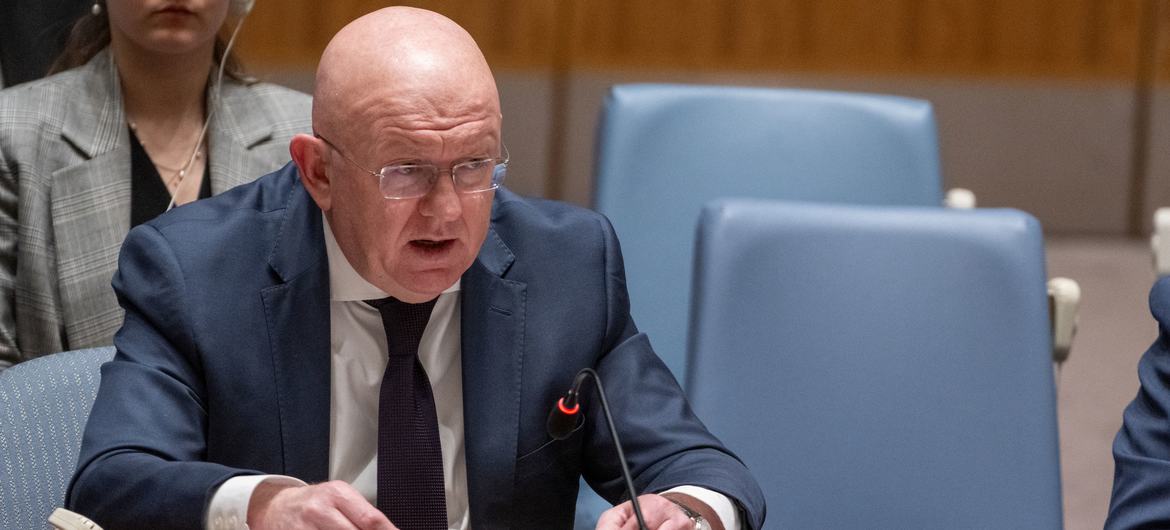
“Israel is choosing escalation over diplomacy,” underscored the Russian Federation’s representative, detailing Israeli Defence Forces’ attacks despite calls for a ceasefire.  “The Security Council is paralyzed, and this is the U.S.’ fault,” he stressed.  Washington, D.C., is still blocking any attempts by Council members to adopt a decision that could help achieve a ceasefire in the region, he added, stressing that “an urgent ceasefire in the Gaza Strip is the main thing that the Security Council should be pursuing”.

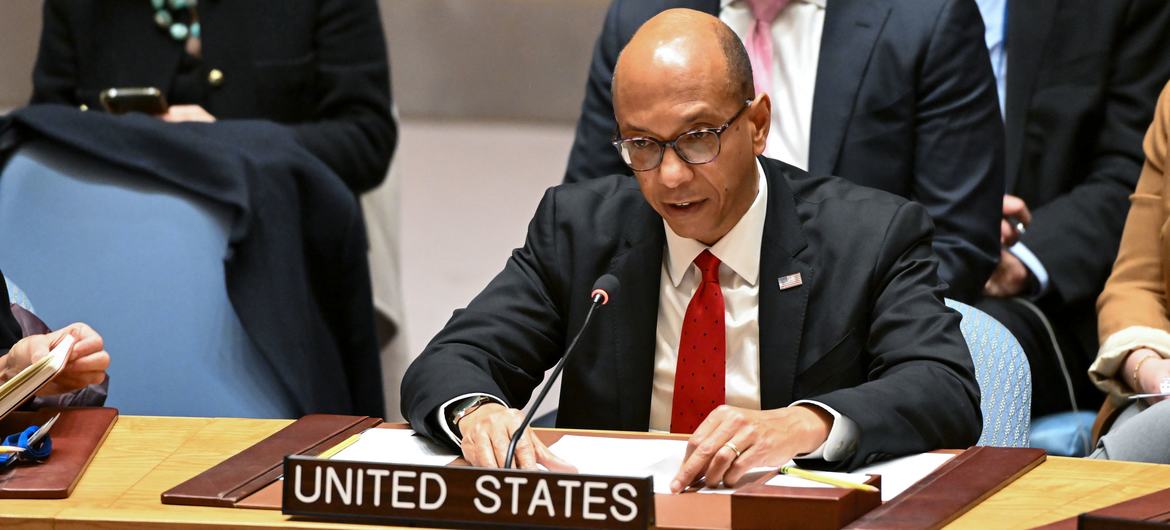
Rebutting that, the United States’ speaker said Iran must be condemned for undermining Lebanon’s sovereignty, and Hizbullah for attacking Israel and for putting its narrow interests ahead of the interests of Lebanon’s people.  All parties, including Israel, must respect the safety and security of UN personnel and premises, and avoid incidents that expose them to risk or harm.  He highlighted his country’s announcement last week of $157 million in humanitarian aid for internally displaced persons in Lebanon, calling on others to support the UN Flash Appeal.

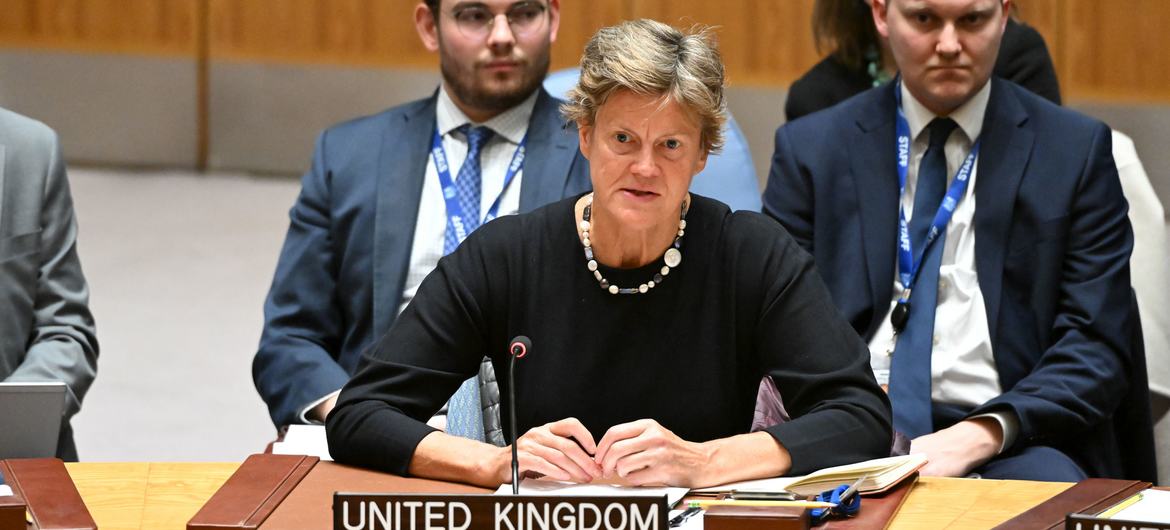
Other Council Members highlighted their respective countries’ contributions to Lebanon’s humanitarian needs, with the representative of the United Kingdom announcing an additional $19.5 million aid package, while Japan’s representative recalled his country’s contribution of over $290 million to Lebanon since 2012, adding that it is considering providing additional assistance.

“This Council must spare no effort to avert a repeat of a Gaza-like scenario in Lebanon,” stressed Guyana’s representative, who voiced concern about the Prime Minister of Israel’s warning to the Lebanese people that their country could become the next Gaza. Citing a plan by the Israel Land Authority to seize the land of the headquarters of the United Relief and Works Agency for Palestine Refugees in the Near East (UNRWA) in Jerusalem, she appealed to the UN and all peace-loving countries to not allow Israel to shutter UNRWA, which provides life-saving support to millions of Palestinians.

Echoing such concerns, Slovenia’s representative warned that “Lebanon is becoming the next Gaza”, expressing alarm by the parallels seen on the ground.  “We have to act, now.  Political, not military, solutions are required,” he said.


https://press.un.org/en/2024/sc15850.doc.htm


https://creativecommons.org/licenses/by/4.0/legalcode

пятница, 20 сентября 2024 г.

Security Council: Middle East envoy warns against escalation, highlights continued Israeli settlement activity


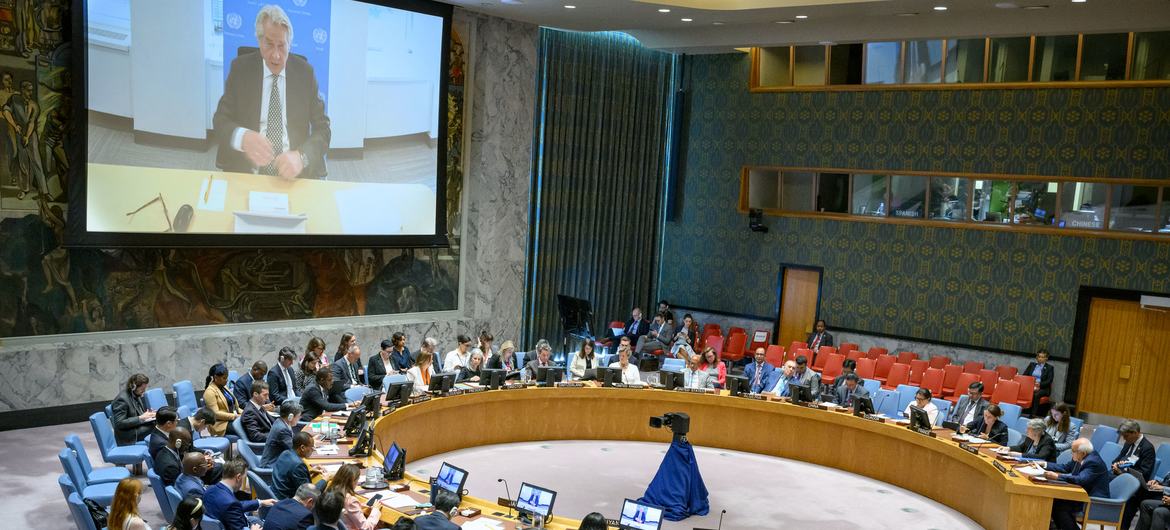
Tor Wennesland (on screen), Special Coordinator for the Middle East Peace Process and Personal Representative of the Secretary-General, briefs the Security Council meeting on the situation in the Middle East, including the Palestinian question.
UN Photo/Loey Felipe
 
Tor Wennesland (on screen), Special Coordinator for the Middle East Peace Process and Personal Representative of the Secretary-General, briefs the Security Council meeting on the situation in the Middle East, including the Palestinian question.

19 September 2024 
Peace and Security

The UN envoy supporting peace efforts between Israelis and Palestinians voiced grave concern over the growing risk of widescale regional escalation during a briefing to the Security Council in New York on Wednesday.  

“The series of explosions across Lebanon and rockets fired toward Israel in recent days adds to the volatility,” said Tor Wennesland, Special Coordinator for the Middle East Peace Process.

He urged all sides “to refrain from steps that will further exacerbate the situation and take immediate steps to de-escalate.”

Settlement activity continues

Mr. Wennesland made the appeal prior to updating ambassadors on the implementation of Security Council resolution 2334 (2016), which demands that Israel end all settlement activities in the Occupied Palestinian Territory, including East Jerusalem.

“Settlement activity has, nevertheless, continued,” he said, speaking via videoconference from Washington, DC, where he will meet with US officials.

The latest UN report on the issue covers the period from 11 June to 11 September, falling amid the ongoing war in Gaza and alarming levels of violence in the West Bank.

During this time, some 6,730 housing units were advanced or approved in the occupied West Bank, including East Jerusalem.  Construction tenders also were published for approximately 1,100 housing units in settlements, including 780 in East Jerusalem.

Relatedly, the Israel Defense Forces (IDF) Central Command signed a military order on 18 July amending a 1995 order that implemented the Oslo Accords - the first direct peace agreement between the sides. 

The move granted the local military commander authority over planning and construction in certain parts of Area B in the West Bank that had been transferred to the Palestinian Authority.

Demolitions and evictions

Demolitions and seizures of Palestinian-owned structures also continued.

“Citing the lack of Israeli-issued building permits, which are almost impossible for Palestinians to obtain, Israeli authorities demolished, seized, or forced people to demolish 373 structures, displacing 553 people, including 247 children. 26 of these structures were donor funded,” he said.

Meanwhile, Israel continued to evict Palestinians from their homes in East Jerusalem.  He highlighted the case of the Shehadeh family who were removed from their home in Silwan on 15 August, in favour of a settler organization, following a Supreme Court ruling.

Mr. Wennesland said the eviction displaced 35 people, while 188 Palestinians, including 111 children, left their occupied West Bank communities due to violence and harassment by settlers, and shrinking grazing land.

He noted that the reporting period also saw the International Court of Justice (ICJissue an Advisory Opinion on 19 July reaffirming that Israeli settlements were being maintained in violation of international law, and that new activity should cease. 

Furthermore, Israel’s continued presence in the Occupied Palestinian Territory was “unlawful” and should be brought to an end as rapidly as possible.

Gaza conflict

Mr. Wennesland also addressed the conflict in Gaza, noting that the UN Secretary-General reported that the level of suffering there is unprecedented in his mandate at the helm of the global body.

The Secretary-General said that in order to address the immense humanitarian needs and improve the intolerable conditions of civilians, Israel must fully open all crossings into the enclave.

Israel must also facilitate the immediate, safe, and unhindered delivery of humanitarian assistance at scale directly to the Palestinian civilian population throughout Gaza, in accordance with its obligations under international humanitarian law.
 

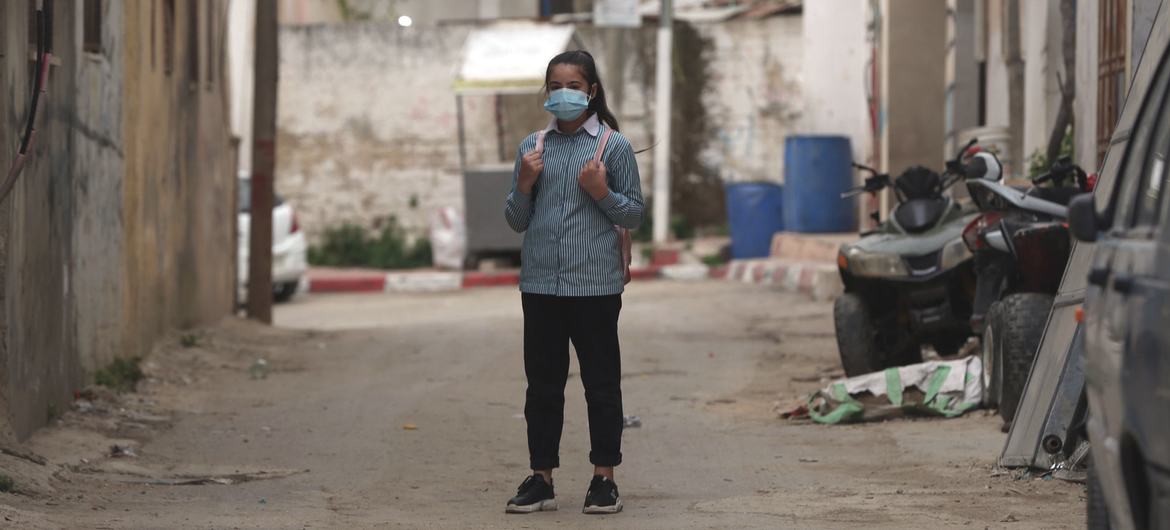
A 13-year-old girl makes her daily trip to her school, which is next to the Bet El Settlement in the West Bank (file).
© UNRWA/Marwan Baghdadi
 
A 13-year-old girl makes her daily trip to her school, which is next to the Bet El Settlement in the West Bank (file).

A question for the Council

The Council also heard a briefing from Helen Clark, a former Prime Minister of New Zealand who also once headed the UN Development Programme (UNDP).

Ms. Clark is a member of the group of eminent global public figures known as The Elders, which has made resolution of the Israeli-Palestinian conflict a priority since its founding in 2007 by the late Nelson Mandela.

She said implementation of resolution 2334 “is acutely relevant to the current devastating phase of the conflict” and to any chance of a two-State solution.

“But its failure so far also poses an existential question: can the Security Council enforce its own resolutions? This is surely crucial to its credibility,” she said.

New approach needed

Ms. Clark emphasized that the Council has a responsibility to chart a path towards a sustainable peace, and a full, immediate and complete ceasefire in Gaza is an indispensable step.  Therefore, it was “deeply disturbing” that a Council resolution calling for a ceasefire remains unimplemented.

She highlighted the need for a new approach, grounded in international law, including enforcement of UN Security Council resolutions. 

Council members who question the binding status of these resolutions, or who use their veto to protect an ally or to oppose a geo-political rival, are eroding the Council’s authority. They also undermine their own reputations and long-term interests,” she said.

Respect ICJ decisions

She added that all UN Member States are also bound to respect and comply with ICJ decisions which includes the provisional measures ordered to protect Palestinians in Gaza.

While non-binding, the ICJ Advisory Opinion “is an authoritative, landmark ruling,” and she urged the UN General Assembly and Security Council to pass resolutions indorsing it and setting out what action is required by Israel, other Member States, and the UN to end the occupation.

“The Elders welcome the passing of the General Assembly Resolution on this issue yesterday. How will the Security Council respond to the Advisory Opinion?” she asked.

Palestine: Uphold international law

The situation in the Occupied Palestinian Territory is “beyond grave”, and “there are no words left to describe Gaza's agony”, the Permanent Observer for the observer State of Palestine told ambassadors.

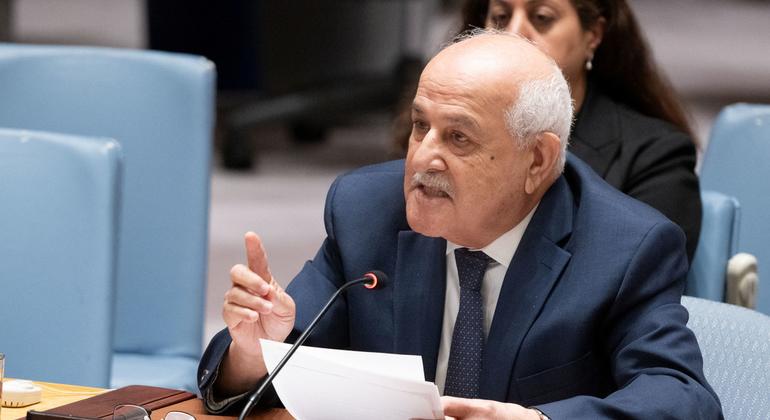
Riyad Mansour, Permanent Observer of the State of Palestine, addresses a Security Council meeting on the situation in the Middle East (file photo).
UN Photo/Eskinder Debebe

Riyad Mansour said Israel “claims for itself all the rights afforded by international law and the Charter of this United Nations, while rejecting and breaching all the obligations”.

He said the Council’s role is to uphold international law, not to bend it to fit Israeli breaches, or to sacrifice the UN Charter to accommodate the country.

“That is the action needed to uphold international law, to implement UN resolutions, including 2334 which we are debating and discussing and reporting on its implementation, not merely more words to decry this abhorrent situation,” he said.

Israel: Whole world at risk

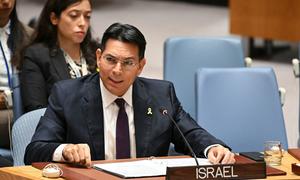
Ambassador Danny Danon of Israel said the Council remains “trapped in endless debates” as the world experiences a period of extraordinary instability.

Ambassador Danny Danon of Israel addresses the Security Council meeting on the situation in the Middle East (file photo).

“We gather here time and time again, like surgeons debating how to stitch a wound while the patient bleeds out before us.  The longer this body remains blind to the reality, the greater the cost that the world will pay,” he warned.

Mr. Danon said Israel is on “the frontline in a battle that threatens the entire region and the world,” and stands firm as it faces down “the forces of the most oppressive regime in the world, the Islamic Republic of Iran.”

He insisted that the Council and the world must wake up to the reality of this threat.

“The dark force driving the violence we see today is not a collection of independent groups. It is Iran pulling the strings,” he said.


https://news.un.org/en/story/2024/09/1154536


https://creativecommons.org/licenses/by/4.0/legalcode

четверг, 22 августа 2024 г.

Middle East: Security Council urged to find path away from ‘vicious cycles of despair'


Gazans respond to evacuation orders issued by the Israeli authorities.
© UNRWA
 
Gazans respond to evacuation orders issued by the Israeli authorities.

22 August 2024 
Peace and Security

“We need a ceasefire now,” says the top UN official for Middle East peace, briefing the Security Council. Follow full coverage as it happened live on our UN News app.

Security Council meets on Middle East as Gaza crisis builds


Today 19:41

Israel: ‘No condemnation of Hamas, no recognition of atrocities’


Uploaded image

UN Photo


Danny Danon, who has just started his second posting in New York as the Permanent Representative of Israel to the UN, said he had returned to a “different UN, a different Israel,” noting that a “war was forced upon us.”


“Ten months ago, a terrorist army invaded southern Israel,” he said, adding it had “committed heinous atrocities,” including the “torture, rape and beheading” of innocent human beings.


He added that it would be “lunacy” for Israel not to expect support from the Security Council to dismantle Hamas “the terrorist organisation responsible for these atrocities."


He said 320 days had passed since the 7 October “slaughter,” but all Israel had heard from the Council was silence, adding that there had been “no condemnation of Hamas, no recognition of the atrocities committed.”

Today 19:23

Today 19:20

 Palestine asks Council 'when are you going to act?'


Uploaded image

UN Photo/Eskinder Debebe


Permanent Observer for the State of Palestine Riyad Mansour said there must be a ceasefire now, in line with the terms of resolution 2735 and with no further conditions and bad faith demands that go against the spirit and the letter of the resolution and that clearly aim at derailing the efforts for a ceasefire.


"When are you going to act?" he asked the Council," he said. "Deal or no deal, there is no excuse for Israel’s continued killing of innocent Palestinian civilians."


President Mahmoud Abbas had declared his intention and the intention of the Palestinian leadership to head to Gaza and called for leaders from around the globe to join him and to support this initiative, Mr. Mansour said.


In this vein, the ambassador called on the Security Council to take part in a visit to the Gaza Strip, to see first-hand "the horrors our people are enduring". He also called on Council members to support and push to secure the ability of President Abbas to reach the Gaza Strip and "work with urgency to stop the genocide and stop the crimes being perpetrated against our people".


The time for waiting is over, he said. The time for the implementation of a two-State solution will begin with a significant step in September, he said, asking the Council to impose an immediate ceasefire and protect all civilians.

Today 19:03

Russia: Council is ‘passive observer of ongoing bloodbath’


Uploaded image

UN Photo


The acting Permanent Representative, Dmitry Polyansky, expressed regret in his speech that the Security Council has not been able to stop the fire in Gaza for ten months and "remains a passive observer of the ongoing bloodbath."


He recalled that two months ago, members of the Security Council adopted a resolution proposed by the United States, which was ultimately ineffective.


"Now is the time to review how this text has affected the situation on the ground," Polyansky stressed. "We can give an unequivocal answer to this: in no way."

Today 18:40

Algeria: 'Time to end the carnage'


Uploaded image

UNRWA


Calling for a halt in fighting and humanitarian pause to ensure the prompt delivery of much-needed polio vaccines, Algerian Ambassador Amar Bendjama outlined the grim horrors on the ground, with Israel’s policies making “Gaza an unliveable place for Palestinians.”


“The situation is catastrophic,” he said. “It worsens on a daily basis, and there is no sign of hope.”

He said a permanent ceasefire is “the only path” to avoid further escalation in the region,” he said, demanding “the immediate and effective implementation of Security Council resolutions, including resolution 2735, which guarantees an end to hostilities, full withdrawal of Israeli occupying forces from Gaza and the return of Palestinians to their homes.


“It must be implemented now,” he said. “It is time to end the carnage in Gaza.”


He said the risk of Gaza’s tragedy duplicating in the West Bank is "very real", and the international community cannot remain silent.

Today 18:26

Today 18:14

China: ‘Blind faith in military victory’


Uploaded image

UN Photo/Eskinder Debebe


Military operations by Israel have continued in the Gaza Strip and there are “new casualties every day,” the Chinese Permanent Representative Fu Cong told the Council, adding that “Israel has turned a deaf ear to calls for a ceasefire.”


He added that Israel continued in its “blind faith in a military victory,” which would lead to more civilian casualties and said that a political solution was the only “fundamental way out” of the crisis.


He urged Israel to fulfill its obligations under international humanitarian law including opening border crossing points to relief aid.


Meanwhile, he warned that peace in the wider region was “hanging by a thread.”

Today 18:02

Tor Wennesland warns of 'uncontrollable escalations'


Watch the full briefing to the Council from UN Special Coordinator for the Middle East Peace Process Tor Wennesland.


Today 18:00

Latest evacuation orders leave civilians dangerously close to the frontline in Gaza


Uploaded image
“Continuous” Israeli military evacuation orders in Gaza threaten already extremely vulnerable people in the enclave with further forced displacement, raising concerns that vital services could soon be cut off, UN humanitarians warned on . . .

Read more at news.un.org.

Today 17:59

UK:  Ceasefire talks 'only way' to avert regional crisis


Uploaded image

UN Photo/Eskinder Debebe


UK Deputy Permanent Representative James Kariuki echoed calls for "an immediate ceasefire".


"All sides need to focus on the recently restarted negotiations led by the US, Egypt and Qatar," he said. "These talks offer a vital opportunity to secure an immediate ceasefire that ends the conflict, gets the hostages out, allows urgent access to aid and de-escalates regional tensions."


Condemning the violence in the West Bank, he said France's Foreign Secretary and Foreign Minister visited Israel and the Occupied Palestinian Territory last week, conveyed three key messages: "that the current ceasefire talks were the only way to avert a full regional crisis; that the humanitarian situation was catastrophic and we needed to see immediate improvements; and that there had to be accountability for the appalling settler violence in the West Bank.


"I hope that we can all unite around those messages today," he said.

Today 17:42

France: Another call to end the war


Uploaded image

UNRWA


Speaking for the French mission, Nathalie Broadhurst reiterated calls to the 15-member Council for an immediate ceasefire in the Gaza Strip to put an end to the “suffering of the civilian population and to enable the massive and unimpeded delivery of humanitarian aid.”


She said that France echoed the concerns of the UN chief about the health situation, and in particular the resurgence of polio cases in Gaza.


“France calls on Israel to take all necessary measures to enable the population to be vaccinated,” she added.

Today 17:33

United States: 'We must speak with one voice'

 Uploaded image

UN Photo/Eskinder Debebe


Security Council members then shared their positions, with US Ambassador Linda Thomas-Greenfield saying that no one in the region should take any action that could undermine talks. Highlighting points for the US bridging proposal for a deal, she said "we now have a path forward to save lives."


"As members of the Council, we must speak with one voice," she said. "This is a decisive moment for ceasefire talks."


The UN and other humanitarian agencies must prepare to provide a surge of assistance into Gaza, including vaccines.


"We urge Israel to continue working with humanitarian agencies to provide polio vaccines," she said, also drawing attention to the ongoing tense situation in the West Bank.


"It is urgent that we secure a ceasefire and a hostage deal now," she said. "Let us do everything in our power...to get over the finish line."

Today 17:20

Save the Children: ‘Surrounded by overwhelming destruction’


Uploaded image

UNRWA


Speaking by video link from Deir Al-Balah in central Gaza, Louisa Baxter, a doctor who heads up the international NGO Save the Children’s Emergency Health Unit told the Council that she was “surrounded by overwhelming destruction,” adding that “more than 1.9 million people have been displaced and are moving through streets filled with rubble, rubbish, and wastewater.”


She told the meeting that “we are seeing the willful and repeated obstruction of humanitarian assistance in Gaza,” and that her team had been waiting for life saving medicines for four months.


Those supplies she said, “are held at the crossing gates by a myriad of rules and restrictions, many of them unwritten and arbitrary.”

Today 17:18

Today 17:08

UN Special Coordinator: 'We need a ceasefire now'


Tor Wennesland, Special Coordinator for the Middle East Peace Process briefing via videolink, said the war in Gaza with all of its human tragedy, the serious risk of regional escalation, and the unresolved Israeli–Palestinian conflict and continued occupation are combining to create a combustible situation in the Middle East.


"Our individual and collective capacities to manage or resolve these crises are stretched beyond their limits. Any spark or miscalculation could set off a series of uncontrollable escalations – embroiling millions more in conflict.


"We need a ceasefire now," he said.


"We must continue all efforts to alleviate human suffering in the region – that means an immediate ceasefire and release of hostages in Gaza, it means diplomatic steps for de-escalation in the region, and it means irreversible moves toward re-establishing a political framework to end the conflict and establish a two-State solution," he stressed.


"If any one of them remains unaddressed then prospects for a more stable, peaceful and secure region will remain elusive."


https://news.un.org/en/story/2024/08/1153441


https://creativecommons.org/licenses/by/4.0/legalcode

вторник, 21 мая 2024 г.

Security Council Hears Briefings on Situation in Middle East


9631ST MEETING (PM)
SC/15701

Security Council Hears Briefings on Situation in Middle East

(Note:  Due to the financial liquidity crisis affecting the United Nations and the resulting constraints, the full press release will be published at a later date.)

THE SITUATION IN THE MIDDLE EAST, INCLUDING THE PALESTINIAN QUESTION

Briefings

TOR WENNESLAND, United Nations Special Coordinator for the Middle East Peace Process, noting that talks for the release of all hostages held in Gaza and a ceasefire ended on 9 May without agreement, said:  “I fear the worst for the beleaguered and terrified civilians in Rafah, for the hostages held in unimaginable conditions for more than 225 days, and for the overstretched humanitarian operation that remains on the brink in the Strip.”  Noting that Israel Defence Forces’ operations and military manoeuvres in and around Rafah have intensified, he said that on 5 May, Hamas launched mortars and rockets at soldiers massed on the Israeli side of Karem Abu Salem/Kerem Shalom crossing, killing four and wounding 10 of them.  Israel Defense Forces’ tank shelling and a series of air strikes in Rafah killed at least 19 Palestinians on the same day, according to the Ministry of Health in Gaza, he said.

The following day, he added, the Israel Defense Forces said it would operate with “extreme force” against Hamas in eastern Rafah and ordered 100,000 Palestinians to immediately evacuate to what it described as an “expanded humanitarian area in Al-Mawasi”.  Stressing that this so-called humanitarian area lacks adequate shelter, food, water and sewage infrastructure, he added that crossings for the entry of humanitarian goods have already been directly affected.  In the wake of the Hamas strike on 6 May, Israeli authorities closed Karem Abu Salem/Kerem Shalom crossing for three days.  The Rafah crossing with Egypt remains closed.  Active hostilities and Israel Defense Forces operations continue to render “nowhere safe in Gaza”, including for humanitarian workers, he said, noting that 193 UN personnel have been killed in Gaza since the start of hostilities.

The current trajectory, he said, will further undermine efforts to scale up the entry of humanitarian goods and their safe distribution to desperate civilians.  Welcoming the opening of the Erez West crossing in Gaza’s north, he noted the immense scale of needs in Gaza and stressed that there is no substitute for the full and increased operation of existing land crossings.  The Secretary-General, as well as numerous international partners, including Egypt, have objected to a military operation in Rafah. Saving lives and addressing the critical needs in Rafah and Gaza more broadly must be the immediate priority, he said, while pointing out that a large-scale military operation in Rafah exacerbates the risk of escalating regional tensions, particularly across the Blue Line with Lebanon.

“There can be no long-term solution in Gaza that is not fundamentally political,” he underscored.  The new Palestinian Government, with eight ministers from Gaza, represents an important opportunity to support tangible steps towards unifying Gaza and the occupied West Bank politically, economically and administratively. Calling on the international community to support the new Government, he called for assistance in addressing its fiscal challenges, strengthening its governance capacity and preparing it to reassume its responsibilities in Gaza and, ultimately, govern the whole of the Occupied Palestinian Territory.  The Palestinian Authority must also be an integral part of planning for Gaza’s recovery and reconstruction.  “Now is the time to lay the foundations for a better future for Palestinians, Israelis and the broader region,” he added.

EDEM WOSORNU, Director, Operations and Advocacy Division, United Nations Office for the Coordination of Humanitarian Affairs, said that the situation in Gaza has been described as a catastrophe, a nightmare and hell on earth.  “To be frank, we are running out of words to describe what is happening” in the Strip.  She noted that living conditions continue to deteriorate particularly in Jabalaya and eastern Rafah and the number of casualties continues to increase.  According to the Gaza Ministry of Health, more than 35,000 people have now been killed in the violence, and more than 79,000 injured, she said.  Gaza’s health-care system is under impossible strain.  In Rafah, 21 medical points, four primary health-care centres and four hospitals are now inaccessible.  In the north, two hospitals, five primary health-care centres and 16 medical points are inaccessible, she said, adding that an estimated 14,000 critical patients currently require medical evacuation.

Seventy-five per cent of the population — 1.7 million people — has been forcibly displaced within Gaza, many of them up to four or five times, including because of repeated evacuation instructions from the Israel Defense Forces.  In the past two weeks, more than 800,000 people have been displaced from Rafah into other areas of Gaza, she said, emphasizing unequivocally that those forcibly displaced must be guaranteed the right to voluntarily return, as international law demands.  Once over-crowded camps and emergency shelters in Rafah have now largely emptied, with most of the displaced seeking refuge in Khan Younis and Deir al Balah.  But the situation at these sites is horrendous, with a dearth of adequate latrines, water points, drainage and shelter.  “Civilians’ essential needs must be met,” she said, adding that these appalling conditions leave serious doubt as to compliance with basic obligations.

The Rafah incursion is making an already fragile aid operation even more difficult, she said.  As of 17 May, the Rafah crossing remains inaccessible for humanitarian cargo, fuel and personnel movement.  Around 82,000 metric tons of supplies are stranded on the Egypt side of the crossing with food spoiling and medicines expiring.  Fuel shortages, meanwhile, impacts the functioning of bakeries, hospitals, water wells and other critical infrastructure.  The crossing at Kerem Shalom is extremely difficult for aid organizations to access from the Gaza side due to hostilities, challenging logistical conditions and complex coordination procedures.  Erez crossing opened and subsequently closed and the newly opened Erez West is now being used for limited quantities of aid but areas in the vicinity are also under evacuation orders.  She welcomed the first aid shipment delivered on 17 May via the floating dock set up by the United States.  But land routes remain the most effective way to deliver the scale of aid needed, she stressed.

The United Nations Senior Humanitarian and Reconstruction Coordinator is actively engaging with relevant parties to accelerate the provision of humanitarian aid, she said, demanding the protection of civilians, their homes and infrastructure.  “We need the facilitation of rapid, unimpeded passage of humanitarian relief into and within Gaza,” she said, adding that all available access points must be open and kept open for a sustained period to allow aid to enter at scale.  Humanitarian and UN staff must also be protected.  Adequate funding, particularly for the United Nations Relief and Works Agency for Palestine Refugees in the Near East (UNRWA), is also needed.  As of 20 May, the 2024 flash appeal is only 25 per cent funded, she said.…


https://press.un.org/en/2024/sc15701.doc.htm


https://creativecommons.org/licenses/by/3.0/legalcode

пятница, 19 апреля 2024 г.

Retaliatory spiral in Middle East must end, says UN chief after strikes on Iran


A young boy is treated by a mobile emergency clinic team in Northern Gaza.
© WHO
 
A young boy is treated by a mobile emergency clinic team in Northern Gaza.


19 April 2024
Peace and Security

Following reports of alleged Israeli strikes inside Iran near a nuclear power station early Friday, the UN Secretary-General António Guterres issued a new appeal to all parties to “stop the dangerous cycle of retaliation in the Middle East”.

“The Secretary-General condemns any act of retaliation and appeals to the international community to work together to prevent any further development that could lead to devastating consequences for the entire region and beyond,” he said in a statement issued by his Office.

Echoing those concerns, UN atomic energy agency chief Rafael Grossi urged “extreme restraint” from all sides, after more than six and a half months of war in Gaza that have fuelled fears of a wider regional conflict.

Tweet URL
iaeaorg

IAEA can confirm that there is no damage to Iran’s nuclear sites" and Director-General Grossi "continues to call for extreme restraint from everybody and reiterates that nuclear facilities should never be a target in military conflicts", the International Atomic Energy Agency said in a tweet following unconfirmed media reports that possible drone strikes had targeted the Iranian province of Isfahan, which is home to nuclear facilities and military garrisons. 

In Geneva, too, the UN human rights office, OHCHR, urged all parties “to take steps to de-escalate the situation” rapidly. 

“(We) call on third States, in particular those with influence, to do all in their power to ensure there is no further deterioration in an already extremely precarious situation,” said OHCHR spokesperson Jeremy Laurence.

Hunger and fear

In Gaza, aid teams offered new insight into the dangers faced by Palestinian civilians – particularly pregnant women and breastfeeding mothers – as a result of the “wanton destruction” of vital medical equipment and widespread “dehydration, malnutrition and fear” among Palestinians.

Speaking to journalists in Geneva, Dominic Allen, Representative for the UN sexual and reproductive health agency (UNFPA) for Palestine, said that there were indications that the number of complicated births is nearly twice what it was before war erupted.

“There is absolutely an increase in the numbers,” he said, adding that pre-war, around 15 per cent of births required some form of emergency obstetric care. Today, some doctors have reported “a doubling of what they previously had dealt with, and this is due to malnutrition, dehydration and fear, which impact the pregnant woman’s ability to give birth safely and carry their baby to full term safely,” the UNFPA official said.

‘Wanton destruction’

Mr. Allen described his latest mission to Gaza to assess the impact of Israeli attacks on healthcare at embattled hospitals in the north, central and southern governorates.

It was clear that the last remaining hospitals in the enclave – including its second largest, Nasser Hospital – are “clinging to life themselves whilst they are a lifeline for the pregnant women of Gaza”, Mr. Allen said via video link from Jerusalem. “What I saw, it breaks my heart…It's indescribable. What we see there is medical equipment, purposefully broken, ultrasounds – which you will know is a very important tool for helping ensure safe births – with cables that have been cut, screens of complex medical equipment like ultrasounds and other with the screens smashed. So, purposeful, wanton destruction in the maternity ward.”

Before intense Israeli bombardment began in response to Hamas-led terror attacks across southern Israel on 7 October, Nasser Hospital in the southern city of Khan Younis had a maternity ward which UNFPA teams have supported and supplied for years.

In order to be fully functional again, the hospital will need reconditioned water and sanitation services and repairs to damaged electricity generators, at a bare minimum. “But, I stood beside the warehouse (where) we delivered supplies many months ago and it was literally burning; there's so much work to do in terms of trying to re-establish that lifeline,” Mr. Allen said.

‘Palpable’ fear

The UNFPA mission, which began on Monday 8 April and ended this Wednesday, was carried out in partnership with the UN World Health Organization (WHO), the UN aid coordination office, OCHA, and the UN agency for Palestinian refugees (UNRWA).

The objective was to visit around 10 hospitals in Gaza, among them Al Aqsa Hospital in central Gaza, which was “overwhelmed with trauma patients” and not supporting maternity care. 

At Emirati Hospital in the south of the enclave, Mr. Allen recounted meeting the medical director of the facility who said that “he no longer sees normal-sized babies.”

Turning to Rafah and continuing fears of an Israeli incursion, the UNFPA officer underscored the “great sense of fear” hanging over the more than 1.2 million people sheltering there.

“There is a palpable fear from the Gazans who I spoke with - the midwives, doctors, pregnant women, my fellow colleagues, who are in Gaza…Right now it's a haven for 1.2 million Gazans; it's not a safe haven, but it's a haven at least.”


https://news.un.org/en/story/2024/04/1148741

https://creativecommons.org/licenses/by/3.0/legalcode

четверг, 18 апреля 2024 г.

Guterres appeals for maximum restraint in the Middle East

Secretary-General António Guterres addresses the Security Council meeting on the situation in the Middle East, including the Palestinian question.
UN Photo/Manuel Elías
 
Secretary-General António Guterres addresses the Security Council meeting on the situation in the Middle East, including the Palestinian question.

18 April 2024


Peace and Security

Recent escalations in the Middle East make it even more important to support efforts towards lasting peace between Israel and a fully independent, viable and sovereign Palestinian state, UN Secretary-General António Guterres told the Security Council on Thursday. 

“Failure to make progress towards a two-State solution will only increase volatility and risk for hundreds of millions of people across the region, who will continue to live under the constant threat of violence,” he said.

Regional conflict, global impact 

With the Middle East “on a precipice”, he appealed for maximum restraint, warning against the far-reaching consequences. 

“One miscalculation, one miscommunication, one mistake, could lead to the unthinkable – a full-scale regional conflict that would be devastating for all involved – and for the rest of the world,” he said. 

Mr. Guterres reiterated his strong condemnation for Iran’s large-scale attack on Israel on Saturday, and an earlier assault on the Iranian consulate in Damascus which Tehran attributed to Israel, saying “it is high time to end the bloody cycle of retaliation.” 

End Gaza hostilities 

Stressing that the international community must work together to prevent any actions that could push the entire Middle East over the edge, he highlighted the need for diplomacy that would lead to de-escalation, starting with Gaza. 

Ending the hostilities in Gaza would significantly defuse tensions across the region,” Mr. Guterres said, repeating his calls for an immediate humanitarian ceasefire and the immediate release of all hostages held in the enclave.

“The horrific terror attacks by Hamas and other Palestinian armed groups on 7 October, including mass killings, the use of sexual violence, torture, and the taking of hostages, were an intolerable denial of the most basic values of humanity, and a breach of the most fundamental rules of international law,” he added.

Gaza ‘humanitarian hellscape’ 

Meanwhile, nearly seven months of Israeli military operations in Gaza “have created a humanitarian hellscape”. Tens of thousands have been killed, including more than 13,800 children, and two million Palestinians are now living under the threat of famine.

Israel recently made several commitments to improve aid delivery, he said. For example, three convoys from the World Food Programme (WFP) were authorized to use the Erez Crossing into northern Gaza to deliver food parcels and wheat flour over a three-day period this week.

Yet, “apparent progress in one area is often cancelled out by delays and restrictions elsewhere”, meaning that “the impact is limited, and sometimes nil.” 

‘Quantum leap’ in aid 

The Secretary-General called for “a quantum leap in humanitarian aid” to avert imminent famine in Gaza, and further preventable deaths from disease.

Conditions on the ground must also be addressed, so that humanitarian agencies can safely deliver aid, he added, noting that nearly 250 aid workers have been killed, including more than 180 UN personnel.

Delivering aid at scale requires Israel’s full and active facilitation of humanitarian operations, including through a functioning humanitarian notification system – and improved and direct communications between humanitarians and military decisionmakers on the ground,” he said.

Soundcloud

West Bank violence 

Mr. Guterres also highlighted “the explosive situation” in the occupied West Bank.  More than 450 Palestinians, including 112 children, have been killed since 7 October. Seventeen Israelis, including a child, have also been killed in the West Bank and Israel during the same period.

Additionally, the reported killing of a 14-year-old Israeli boy over the weekend sparked a new wave of armed settler attacks against at least 37 Palestinian villages in the West Bank. Four Palestinians were killed, including a 17-year-old boy. 

The backdrop to this appalling surge in violence is the continued expansion of Israeli settlements – in themselves a violation of international law – and repeated large-scale Israeli operations in Palestinian areas,” he said. 

Condemning the violence, Mr. Guterres urged Israel to take immediate steps to end the unprecedented levels of settler violence, hold perpetrators to account, and protect the Palestinian population from attacks, violence and intimidation. 

Blue Line, Red Sea 

Efforts towards regional de-escalation  must also address the extremely fraught situation in Lebanon, particularly along the Blue Line which marks the frontier between south Lebanon and northern Israel, Mr. Guterres told the Council.

“Exchanges of fire between Israeli forces and Hezbollah are exacting a mounting toll on civilian communities in Israel and Lebanon. Dozens of civilians have been killed and tens of thousands displaced on both sides of the Blue Line,” he said, appealing for restraint. 

He also drew attention to the crisis in the Red Sea, where Houthi rebels in Yemen continue to attack merchant and commercial ships, disrupting global trade. 

“Armed confrontations on this crucial waterway increase risks across the board: risks to supply chains; risks of an environmental disaster from a damaged cargo ship or oil tanker; risks of a serious escalation and a confrontation between major powers, with appalling political, security, economic and humanitarian repercussions,” he said. 

He urged the international community to unite to prevent escalation in the Red Sea, adding that the people of Yemen must be supported in their efforts towards a just and sustainable peace. 

More to follow


https://creativecommons.org/licenses/by/3.0/legalcode
https://news.un.org/en/story/2024/04/1148701

вторник, 6 февраля 2024 г.

Middle East: Security Council meets on US strikes in Iraq and Syria


The UN Security Council meets on the Threats to international peace and security..
UN Photo/Evan Schneider
 
The UN Security Council meets on the Threats to international peace and security..


5 February 2024
Peace and Security

The UN Security Council held an urgent meeting Monday afternoon at the request of Russia, as the war in Gaza continued to fan tensions across the Middle East, with potentially dramatic consequences for regional peace and security. The UN Political Affairs chief appealed for the Council to help prevent further escalation and ease tensions across the region.

The UN’s Political Affairs chief, Rosemary DiCarlo, briefed ambassadors first, warning that esclating attacks across Middle East fuel chances of miscalculation.

She said that as everyone in the diplomatic world is all too aware, “the tensions that have engulfed multiple countries in the Middle East continue to rise.”

She said the Secretary-General António Guterres had repeatedly warned about the risk of further military escalation “and miscalculation” since the Hamas terror attacks of 7 October set the region aflame.

Rosemary DiCarlo, Under-Secretary-General for Political and Peacebuilding Affairs, briefs the Security Council meeting on threats to international peace and security.
UN Photo/Eskinder Debebe
 
Rosemary DiCarlo, Under-Secretary-General for Political and Peacebuilding Affairs, briefs the Security Council meeting on threats to international peace and security.

“We have witnessed near daily incidents in the region. These include some 165 attacks on United States facilities in Syria and Iraq, prompting US strikes in the two countries”, Ms DiCarlo said. 

On 28 January, a drone attack killed three US service members and injured 40 others at a US base in northeast Jordan, she said, adding that on 2 February the US carried out 85 airstrikes in Iraq and Syria against reported Iranian Islamic Revolutionary Guards Corps (IRGC) Quds Forces and affiliated groups.

“The US said it had targeted command and control operations, intelligence centers and weapons facilities, among other sites, and that it was not seeking conflict in the Middle East or elsewhere,” she reported, noting also that both Syria and Iraq condemned the strikes.

The two countries also claimed the strikes resulted in deaths and injuries of civilians.

Blue Line to the Red Sea

Ms. DiCarlo, UN  Under-Secretary-General for Political and Peacebuilding Affairs, described the febrile situation elsewhere in the region, including between Israeli Defense Forces and Hezbollah across the Blue Line, which separates the armed forces of Israel and Lebanon.

Repeated rocket fire also took place over the occupied Golan between Israel and militias reportedly linked to Iran, as well as airstrikes attributed to Israel by Damascus on multiple locations in Syria, she added.

She also noted the Houthi drone and missile attacks against ships in the Red Sea, and the retaliatory strikes by the US and UK.

“I reiterate the Secretary-General’s call on all parties to step back from the brink and to consider the unbearable human and economic cost of a potential regional conflict,” she urged.

“I appeal to the Council to continue to actively engage all concerned parties to prevent further escalation and the worsening of tensions that undermine regional peace and security,” she said.

Under-Secretary-General for Political and Peacebuilding Affairs Rosemary DiCarlo briefing the Security Council.

5:22 PM

US attacks illegal and unjustified: Iran

Ambassador Amir Saeid Iravani of Iran addresses the Security Council meeting on threats to international peace and security.
UN Photo/Evan Schneider
 
Ambassador Amir Saeid Iravani of Iran addresses the Security Council meeting on threats to international peace and security.

Iran’s Ambassador Amir Saeid Iravani strongly condemned the US strikes against Iraqi and Syrian territories.

“The US military action is illegal, unjustified and blatantly violates the basic norms and principles of international law, and the UN Charter,” he said, also denouncing the joint US-UK strikes against Yemen.

“These illegal actions which targeted civilians and vital infrastructure, jeopardized regional peace and security as well as pose a serious to international peace and security,” he continued.

Ambassador Iravani noted the “desperate attempt” made by the US and UK to “distract attention” away from the root cause of the current situation in the Middle East by falsely blaming Iran.

“It is regretful that the US, a permanent member of the Security Council, has failed to fulfil its obligations under the UN Chapter,” he said, accusing it of playing a destabilizing role in the region and supporting separatist groups in Syria.

He condemned the US role in Iraq where it is continuing its “illegal activities” and presence under the guise of fighting terrorism.

“The US and NATO must respect the Iraqi Government’s decision to terminate their military presence there and withdraw their forces from the country,” he said.

He said Iran had never sought to contribute to the spillover in the region and that it has no military presence in Iraq, and that its military advisers are legally present in Syria, invited by Damascus to fight terrorism.

“Claims that Iran’s bases in Iraq and Syria were attacked are rejected as unfounded and regarded as attempts to shift attention away from the US aggressive actions,” he said.

“It is evident to everyone that the root causes in the region are occupation, aggression and continued genocide and horrific atrocities committed by Israeli regime, and fully supported by the US, against innocent Palestinians in the Gaza Strip and West Bank,” he said.

5:17 PM

The Council must protect the territorial integrity of all States: Iraq

Abbas Kadhom Obaid Al-Fatlawi, Charge d'Affaires of Iraq, addresses the Security Council meeting on threats to international peace and security.
UN Photo/Eskinder Debebe
 
Abbas Kadhom Obaid Al-Fatlawi, Charge d'Affaires of Iraq, addresses the Security Council meeting on threats to international peace and security.

The Deputy Permanent Representative of Iraq Abbas Kadhom Obaid Al-Fatlawi said the crises in the Middle East were all linked.

We have already cautioned against escalation, he said, and Iraq is carrying out a balanced foreign policy to ensure its natural role as a leader in the region and around the world.

He said Iraq had been working very hard to become a factor of stability and to bridge differences throughout the Middle East.

The American attacks are not in line with our relationship with the US, he stated adding that Iraq condemns and categorically rejects any attack on its territory based on futile and illogical pretexts.

We reject all type of attacks against our military bases which are a violation of our sovereignty and security. This Security Council must protect the territorial integrity of all States, he added. 

5:10 PM

‘Flimsy pretexts’ by US: Syria

Ambassador Koussay Aldahhak of the Syrian Arab Republic addresses the Security Council meeting on threats to international peace and security.
UN Photo/Evan Schneider
 
Ambassador Koussay Aldahhak of the Syrian Arab Republic addresses the Security Council meeting on threats to international peace and security.

Syria’s UN Ambassador Koussay Aldahhak said the arguments heard at the meeting were the “same flimsy pretexts and misleading claims the US administration is promoting to justify its repeated attacks”.

This included presenting a “distorted and wrongful interpretation” of the provisions of the Charter, especially Article 51, and that the root causes of conflicts, suffering and instability in the Middle East region are the “wrongful and destructive policies” of the US.

This includes Washington’s “blind and unlimited” support for the Israeli occupation and the atrocities Israel is committing against the Palestinian people, he added.

Ambassador Aldahhak said successive US administrations have misused their permanent membership of the Security Council and interfered thoroughly in the internal affairs of other countries, including Syria.

The US has formed military coalitions outside the umbrella of the United Nations and international legitimacy, perpetrating acts of aggression and occupation.

He stressed that Syria completely rejects all the “pretexts and lies” that the US administration is trying to use to justify its aggression which aims to protect its agents in the region.

Syria also categorically rejects that the territories of Member States become a platform for US election campaigns and for displaying a brute force that undermines the principles of collective security on which the UN was founded, he said.

4:41 PM

Attacks on US service members ‘cannot continue’

Deputy Permanent Representative Robert A. Wood of the United States addresses addresses the Security Council meeting on threats to international peace and security.
UN Photo/Evan Schneider
 
Deputy Permanent Representative Robert A. Wood of the United States addresses addresses the Security Council meeting on threats to international peace and security.

Robert Wood, Ambassador and Deputy Permanent Representative of the US to the UN, said his country’s “necessary and proportional” actions on 2 February in Iraq and Syria against Iran’s Islamic Republic Guards Corps and affiliated militia groups was taken in exercise of the US’s inherent right to self-defence, as reflected in Article 51 of the UN Charter.

He said the loss of three service members on 28 January together with dozens injured, had been “devastating”.

“This is unacceptable, and attacks like it cannot continue,” he said, stating that the actions that the US forces took on Friday were necessary and proportionate, consistent with international law and in exercise of its right to self-defence.

“We also repeatedly stated in previous letters to this Council that the US would take further action to respond to future attacks or threats of attacks against US nationals or US personnel and facilities,” he added.

He noted that the targets struck by the US were carefully selected to avoid civilian casualties and were based on clear and irrefutable evidence that they were connected to the attacks on US personnel.

“President Biden has made clear that these strikes were the start of our response to the deadly attack on Tower 22 in northeastern Jordan,” he said, stressing that the strikes were “separate and distinct” from the coalition strikes in Yemen which were in response to Houthi attacks on vessels in the Red Sea.

“Let me be clear, the US does not desire more conflict in the region when we are actively working to contain and deescalate the conflict in Gaza, and we are not seeking a direct conflict with Iran”, he said, adding that the US will continue will continue to defend its forces against unacceptable attacks.

4:26 PM

UK stresses importance of working with Iraq and Syria to counter terrorism

Ambassador Barbara Woodward of the United Kingdom addresses the Security Council meeting on threats to international peace and security.
UN Photo/Evan Schneider
 
Ambassador Barbara Woodward of the United Kingdom addresses the Security Council meeting on threats to international peace and security.

Barbara Woodward, Ambassador and Permanent Representative of the UK to the UN, said her country “fully supports” all efforts to maintain and enhance international peace and security, including in Iraq and Syria and that it is committed to de-escalation.

She added that the UK fully supported the right of the US to self defence and their right to respond to attacks on its troops and bases.

“Da’esh continued to pose a grave threat to those countries and to the wider region and conducted its biggest attack in years in Iran,” in recent weeks, she said, noting that the group’s ability to “direct, enable and inspire attacks” continues to represent one of the most significant global terrorist threats.

She highlighted the “sole objective” of the global coalition, of which the UK is a member. is to counter Da’esh.

“The UK remains committed to working with our counter-terror partners in Iraq and Syria to counter the threat of Daesh and prevent their resurgence,” she said.

Ambassador Woodward noted that Iran’s political, financial and military support to militant groups was destabilizing the region and hampers efforts to counter Da’esh.

“We call on the regime to reign in these groups and to act now to prevent further attacks by its proxies and partners in Iraq, Syria and Yemen.”

She said the Houthis’ continued attacks on commercial and military vessels in the Red Sea are illegal and unacceptable.

The UK’s actions and presence in the Red Sea is designed to protect innocent lives, preserve freedom of navigation and deter further attacks on shipping.

4:20 PM

No military solution: China

Ambassador Zhang Jun of China addresses the Security Council meeting on threats to international peace and security.
UN Photo/Evan Schneider
 
Ambassador Zhang Jun of China addresses the Security Council meeting on threats to international peace and security.

China’s Ambassador Zhang Jun said that action taken by the US was creating new turmoil in the Middle East. 

History has shown that using military means would not provide any solutions to the problems roiling the Middle East. He said the action by the US would only exacerbate a vicious cycle of tit-for-tat.

He urged the various parties to remain calm, abide by the Charter and international law, cease illegal military operations and prevent the situation from spiralling out of control.

The fundamental reason for the current situation is the failure to implement a ceasefire in Gaza which is a prerequisite for any progress.

He called on all countries concerned to stop acting out of self-interest. “We are standing at a critical crossroads”, he told ambassadors and should not forget that we are all in the same boat.

All nations must remain committed to the common goal of regional stability. 

4:13 PM

Unlawful and irresponsible attacks by US: Russia

Ambassador Vassily Nebenzia of the Russian Federation addresses the Security Council meeting on threats to international peace and security.
UN Photo/Eskinder Debebe
 
Ambassador Vassily Nebenzia of the Russian Federation addresses the Security Council meeting on threats to international peace and security.

Russia’s Ambassador Vassily Nebenzia said the actions of the US in the region were just the latest in a litany of unlawful and irresponsible attacks, against the backdrop of an unprecedented escalation of violence.

Massive airstrikes by the US once again demonstrated to the world the aggressive nature of US policy in the Middle East and Washington’s complete disregard for international law, he continued.

The participation of the UK should not create the illusion of some kind of “international coalition”. 

London has yet to answer for its zeal in supporting the purely provocative actions of its “big brother” in Washington.

Mr. Nebenzia said the US was deliberately trying to drag the largest countries of the Middle East, including Iran, into a regional conflict.

He strongly condemned the aggression by the US against sovereign nations which have increased the level of instability in an already “burning” region.

He called on the international community to unconditionally condemn the reckless actions of Washington and its allies in the Middle East, which have violated the sovereignty of the both Syria and Iraq. 

2:45 PM

The meeting comes against the backdrop of a series of strikes by the United States on targets in Iraq and Syria on Friday.  

The US alleges the sites were used by Iranian-backed militias to launch attacks on troops stationed in the region. Three US service members were killed in one such attack on their outpost in Jordan in late January and dozens were injured.  

According to US military officials, more than 85 targets were struck in Iraq and Syria, including command, control and intelligence centres, munition and logistics supplies, and rockets, drones and missile sites.  

The US has also been joined in recent days by the United Kingdom in what they describe as a defensive operation aimed at Houthi rebel targets in Yemen, which have been used to launch attacks on shipping in the Red Sea.


http://creativecommons.org/licenses/by/3.0/legalcode

четверг, 1 февраля 2024 г.

Security Council: Middle East, including the Palestinian question


9540TH MEETING (AM)
SC/15575

Security Council: Middle East, including the Palestinian question

(Note: A full summary of this meeting will be available at a later time following the meeting's conclusion.)

The Security Council met this morning to discuss the situation in the Middle East, including the question of Palestine.

THE SITUATION IN THE MIDDLE EAST, INCLUDING THE QUESTION OF PALESTINE

Briefing

MARTIN GRIFFITHS, Under-Secretary-General for Humanitarian Affairs and Emergency Relief Coordinator, said “each day that passes only deepens the misery and suffering of people in Gaza”.  The number of people killed in Gaza has reportedly now surpassed 26,000, and the number of injured more than 65,000, according to Gaza’s Ministry of Health. Most are women and children.  Just 14 of the 36 hospitals in Gaza are functional, and those only partially, he cautioned, highlighting severe shortages of medical staff and supplies.  Moreover, fierce fighting has continued in the vicinity of the Nasser and Al-Amal hospitals in Khan Younis, jeopardizing the safety of medical staff, the wounded and the sick, as well as the thousands of internally displaced persons seeking refuge there.  This intense fighting around Khan Younis continues to drive thousands of people into Rafah, which is already hosting over half of Gaza’s population of 2.2 million people.  Across Gaza, over 60 per cent of housing units are reportedly destroyed or damaged, with some 75 per cent of the total population displaced.

Painting a grim picture of Gazans’ abominable living conditions, he said heavy rains are flooding the makeshift tent camps, forcing children, parents and the elderly to sleep in the mud.  Food insecurity continues to mount and clean water is almost completely inaccessible.  With little public health support available, preventable diseases are rife, and will continue to spread.  The further spread of hostilities southwards — along with the increasing deprivation and desperation of people there — can only be expected to increase the pressure for mass displacement into neighbouring countries.  Some Palestinians in Gaza have already been able to leave through Egypt.  Meantime, there are also seriously injured or sick patients unable to receive care in Gaza, and for whom medical evacuations should be swiftly facilitated.  He emphasized that any persons displaced from Gaza must be guaranteed the right to voluntarily return.

Citing the ability of the humanitarian community to reach the people of Gaza with relief as “grossly inadequate”, he stressed that “this is not for want of trying”.  Despite the hazardous conditions on the ground, his Office is distributing food items to shelters and supporting the remaining bakeries, delivering medicines and medical supplies and helping to relocate patients, as well as delivering water, hygiene kits and cleaning kits, tents, tarpaulin sheets and blankets. But the quantities are far from adequate, he said, stressing that, “if the people of Gaza are to receive anything approaching the amount of humanitarian assistance they need and deserve, urgent steps must be taken”.  Accordingly, he called for improved security assurances, enabling safe delivery of supplies, the establishment of a predictable flow of supplies and rapid and unimpeded access.  To expedite delivery, humanitarian supplies must be able to enter Gaza via multiple points from Egypt and Israel.

However, “we continue to face the frequent rejection for entry of much needed items into Gaza by Israel, for unclear, inconsistent and often unspecified reasons”.  At present, his Office’s access to Khan Younis, the Middle Area and North Gaza is largely absent.  The breadth of the humanitarian community — including UN agencies, non-governmental organizations, the International Committee of the Red Cross (ICRC) and the Red Crescent — is collaborating to ensure that aid reaches people in need to the greatest extent possible.  “The beating heart of all this is UNRWA,” he said, adding that the United Nations Relief and Works Agency for Palestine Refugees in the Near East (UNRWA) has provided shelter, food, water and medical assistance.  “All this, even as its own staff are being killed, injured and displaced.”

On the appalling allegations that some UNRWA employees were allegedly involved in the attack in Israel on 7 October, he underlined that they are being addressed transparently.  UNRWA has taken swift action, and an investigation is under way. Nevertheless, he emphasized that “UNRWA’s lifesaving services to over three quarters of Gaza’s residents should not be jeopardized by the alleged actions of a few individuals”.  Likewise, UNRWA’s support for Palestinians in need in the West Bank, Lebanon, Jordan and Syria, must also be safeguarded.  “To put very simply and bluntly:  our humanitarian response for the Occupied Palestinian Territory is completely dependent on UNRWA being adequately funded and operational,” he underscored, citing UNRWA’s indispensable role in terms of distribution, warehousing, logistics and human resources, with 3,000 staff responding to the current crisis.  “Decisions to withhold funds from UNRWA must be revoked,” he asserted, reiterating his call for a ceasefire.

Statements

The representative of Algeria referring to the “historic decision” by the International Court of justice, said that “the time of impunity has come to an end”.  The international community has committed to uphold accountability, he said, emphasizing that the Israeli occupier should not be exempt from facing consequences for its actions and implement the Court’s provisional measures to protect the Palestinian people from genocide.  He emphasized that the only way to achieve this is through a ceasefire, warning of grim consequences if the crisis persists:  a daily death toll of 250 people with 10 children daily subjected to limb amputations without anaesthetic, and 170 babies born at the gates of hospitals.  “Nothing can justify this barbary being visited on the Palestinian people,” he said. The Court’s order reinforced the significance of justice, he stressed, underscoring the responsibility of Israel in ensuring the prompt supply of essential services and humanitarian aid.  The Council must swiftly take measures to ensure that “the voice of justice is heard”, he concluded.

The representative of the United States voiced concern over the dire humanitarian situation in Gaza, underlining the need to expediate unhindered humanitarian access.  Some argued that the provisional measures ordered by the International Court of Justice are a reason to change course; however, the Court’s order is consistent with the United States’ view that Israel has the right to take action to ensure that the terrorist attacks of 7 October cannot be repeated.  “Of course, how Israel defends itself matters,” she stressed, noting that the Court echoed repeated calls by Washington, D.C., for Israel to take all possible steps to minimize harm to civilians and humanitarian workers, increase the flow of humanitarian assistance and address dehumanizing rhetoric. Nevertheless, “we must be honest what the Court did not order:  specifically, it has not ordered an immediate ceasefire, it has not made any findings that this preliminary phase of the proceedings that Israel committed genocide or otherwise violated the Genocide Convention”, she asserted, citing these allegations as “unfounded”.

Instead, she stressed the need to work towards a durable solution through on-the-ground relentless diplomacy.  Washington, D.C., has been working tirelessly with Qatar, Egypt and other regional partners to reach an agreement that would see the hostages come home.  Hamas has a choice:  “it can continue to dig tunnels, plan for its next attacks (…) or lay down its weapons and accept the proposal on the table to release every hostage”, she said.  On the disturbing allegation that 11 UNRWA employees were involved in the 7 October attack, she said it has shaken confidence in the Agency.  Calling for swift and credible investigation, she said UNRWA provides life-saving services under incredibly challenging circumstances in Gaza, contributing to regional stability.  It is vital that the UN take quick and decisive action, strengthen oversight of UNRWA operations and began to restore donor’s confidence.  The United States’ decision to temporarily pause its funding for UNRWA was made independently from other donors.  “It was not a punitive measure, but it was a wake-up call,” she said, calling for fundamental changes at UNRWA.

The representative of Guyana expressed concern about the prevailing humanitarian situation, the continuing death and destruction in Gaza.  She condemned the 7 October attacks on Israel, while calling for the release of all hostages held in Gaza and Palestinians detained in Israeli prisons without trial.  Highlighting the dire conditions, including starvation and disease, faced by those Palestinians who survived attacks, she underscored the need for international efforts, especially from the Council, to end the cycle of bloodshed.  Turning to the alleged involvement of several UNRWA staff members in the 7 October attack against Israel, she voiced alarm over halts in funding to the Agency, emphasizing its critical role in providing support to Palestinians in Gaza.  “A ceasefire is the first and most important step,” she stressed, highlighting the two-State solution as the ultimate remedy to the continuing crisis.

The representative of the United Kingdom called for an immediate suspension of fighting to get vital aid in and hostages out that progresses towards a permanent, sustainable ceasefire.  Her Government again pressed Israel to allow unhindered humanitarian access, while supporting the World Food Programme (WFP) to deliver a humanitarian land corridor from Jordan into Gaza.  Welcoming the call of the International Court of Justice for the immediate release of hostages and the need to get more aid into Gaza, she emphasized that “it is for the Court, not countries, to determine genocide”. Nevertheless, “we were troubled by the way in which this action has been taken”, she added.  It is vital to pave the way for a two-State solution; form a new Palestinian Government for the West Bank and Gaza, accompanied by an international support package; remove Hamas’ capacity to launch attacks against Israel; secure the release of all Israeli hostages; and ensure that Hamas is no longer in charge of Gaza.

The representative of Switzerland, pointing to the catastrophic humanitarian situation in Gaza — a population under siege, subject to bombardments, repeated displacements, famine and epidemics — said “this cannot continue”.  She called for an urgent humanitarian ceasefire, as well as the immediate, unconditional release of all hostages.  Israel must comply with the International Court of Justice’s provisional measures, especially by taking necessary steps to prevent any act of genocide and any incitement to commit it, she said, while describing as “unacceptable” settler attacks on Palestinians in the West Bank.  She expressed deep concern about “the very serious allegations” against UNRWA employees suspected of involvement in the 7 October attacks, underscoring her country’s “zero tolerance for any support for terrorism”.  Citing the urgent need for regional de-escalation, she said the signs are increasingly worrying, particularly on both sides of the Blue Line between Israel and Lebanon.  “This Council must shoulder its responsibilities,” she said.  Switzerland is ready to work towards concerted action in that regard and towards a two-State solution, with Gaza an integral part of a future Palestinian State.


https://creativecommons.org/licenses/by/3.0/legalcode

https://press.un.org/en/2024/sc15575.doc.htm