Показаны сообщения с ярлыком Haiti. Показать все сообщения

среда, 23 октября 2024 г.

Rising Displacement, Criminal Gangs and Corruption Continue to Plague Haitian Life, Slowing Democratic Reform, Speakers Tell Security Council


9757th Meeting (PM)
SC/15859


Delegates Underscore Need for Full Deployment, Funding of Multinational Security Support Mission

Criminal gangs continue to sow violence and terror in Haiti, where more than 700,000 are now internally displaced, a senior United Nations official told the Security Council today, calling for Member States’ support for the still under-resourced Multinational Security Support Mission, which was authorized by the 15-member body in October 2023 to assist the Haitian National Police in restoring law and order in the strife-torn Caribbean nation.

“The security situation remains extremely fragile, with renewed peaks of acute violence,” underscored María Isabel Salvador, Special Representative of the Secretary-General and Head of the United Nations Integrated Office in Haiti (BINUH), noting that, since her last briefing to the Council in July, “the situation in Haiti has regrettably worsened”. Haitians continue to suffer across the country as criminal gang activities escalate and expand beyond Port-au-Prince, spreading terror and fear, committing murders, kidnappings and sexual violence of unprecedented brutality in the affected regions, she said. 

The 3 October brutal gang attack in Port Sondé in the Artibonite Department, which left 115 civilians dead, has further exacerbated the humanitarian crisis, which has seen a 22 per cent increase in the number of internally displaced persons in the last three months, she said.  Since their first deployment in June, the Kenyan contingent of the Support Mission has been joined by counterparts from the Bahamas, Belize and Jamaica.  Around 430 personnel are deployed, “yet it is far from enough”, she stressed.  The Support Mission remains critically under-resourced, which could impact deployment and impede it from carrying out its tasks in support of the Haitian National Police, she warned, urging support for the Haitian security apparatus and funding of the Support Mission.

On the political front, she reported that, on 7 October, Leslie Voltaire succeeded Edgard Leblanc as President of the Transitional Presidential Council, in a modified order of the pro-tempore presidency of the Transitional Presidential Council, amidst corruption allegations against three of its members.  BINUH is working to strengthen collaboration within the two-headed executive and urging them to focus on addressing insecurity, governance reforms and electoral preparations.

The 18 October nomination and installation of seven of the nine members of the Provisional Electoral Council in their functions is a first step in the right direction, she said, urging the remaining sectors to nominate their representatives promptly, ensuring that women and human rights sectors are included in the process.  “To guarantee inclusive, credible and participatory elections […] a steadfast commitment of all stakeholders to revitalizing the national consensus and placing national interests above their own is of the essence,” she stressed. 

Briefing the Council via video-conference was Catherine Russell, designated Principal Advocate on Haiti for the Inter-Agency Standing Committee and Executive Director of the United Nations Children’s Fund (UNICEF), who said that armed groups are regularly committing grave rights violations against children in Haiti.  So far this year, there has been a staggering increase in reported incidents of sexual violence against women and children.  Armed groups are also actively recruiting and using children in their operations.  It is estimated that children account for 30 to 50 per cent of armed group members, she said, used as informants, cooks, and sex slaves, and forced to perpetrate armed violence themselves.  She called on Council members to use their leverage with State actors and armed groups to protect human rights.  Noting that the humanitarian response plan for Haiti remains just 42 per cent funded for 2024, she also called on them to significantly increase flexible humanitarian funding, as well as improve protection support to humanitarian actors on the ground.  Moreover, complementary investments in basic social services, and development assistance to support recovery and resilience-building, must be scaled up, she added.

“Gang rape is used as a weapon and the bodies of women and girls are battlefields,” declared Rosy Auguste Ducéna, Programme Manager, Haiti’s National Human Rights Defence Network.  Pointing to rampant corruption among high-ranking officials and staff who are siphoning off money from Haiti’s public coffers, she said impunity for financial and general crimes has allowed the circulation of weapons in Haiti and ongoing gang violence.  She called on the Council to apply to the fullest extent the arms embargo and asset freeze on those sanctioned and demand that Member States scrupulously respect those sanctions.  She further called on them to appeal to Haitian authorities to adopt appropriate measures to protect women and girls from sexual assault. 

In the ensuing debate, representatives of Council members and countries concerned voiced alarm about ongoing gang violence and underscored the need to establish a strong security foundation in the country.  Speakers also underscored the vital role of the Support Mission to that end, as the nation seeks to restore its democratic institutions. 

The United States’ delegate, co-penholder of the Haitian file, with Ecuador, welcomed that Haitian leaders put aside their differences to work towards putting Haiti on the path to free and fair elections and advancing national priorities established by the Transitional Presidential Council.  “Now is not the time for political infighting.  Now is the time for Haitian national unity in the international fight against gangs,” she stressed. 

The United Kingdom’s representative, voicing shock and alarm over the barbarity and human rights abuses committed by gangs, welcomed renewal of the mandate of the Support Mission, including deployment of personnel from Kenya, Jamaica and Belize as well as pledged contributions from other nations.  The Mission remains vital to support Haitian efforts to resolve instability, she said, highlighting her country’s $6 million pledge to support it through strengthening its human rights compliance framework.

The representative of Guyana, also speaking for Algeria, Mozambique and Sierra Leone, said the scale and brutality of the 3 October attacks in Pont Sonde demonstrate the security crisis’ severity and urgent need for full deployment of the Support Mission.  She called for greater solidarity and cooperation from Member States to address the resource gap impeding the Mission’s full deployment. 

Answering that call, the representative of Japan said his country has provided $14 million to the Support Mission, which includes equipment for the Haitian National Police and improving its academy, appealing to the international community to provide additional assistance. Similarly, the speaker for France spotlighted his country’s €2 million contribution to the UN Trust Fund, as well as its efforts to secure European Union funding. 

The Republic of Korea’s delegate was among several speakers underscoring the need to effectively implement sanctions measures adopted by the Council, particularly the arms embargo, to improve the dire security situation.  Regional countries and organizations have a role to play in preventing the surge in trafficking of arms to these gangs, he said.  His country is undergoing the “necessary internal procedure” to extend support to the Support Mission, he added.

The Russian Federation’s delegate pointed to the “clear picture” put forth by the United Nations Office on Drugs and Crime (UNODC) report and the Panel of Experts of the sources and routes of supply of weapons used by gangs.  All the small arms in their arsenal were North Atlantic Treaty Organization (NATO)-standard, and the main smuggling route appeared to be Florida, from which shipments flowed unimpeded and uninspected.  The United States is ignoring the request to trace the chain of illegal supply, he said, calling for those responsible to be brought to account, including through sanctions. 

The representative of Ecuador called for free, transparent elections to be held, in line with the agreement reached at the 11 March meeting convened by the Caribbean Community (CARICOM), to create a Government free from corruption and impunity, which ensures the rule of law, underlining BINUH’s role in ensuring inclusive dialogue in the transition process.  He also underscored UNODC’s role in implementing measures to combat illicit financial flows and arms trafficking, which fuels transnational organized crime and perverse human exploitation. 

Malta’s delegate voiced alarm about the dire humanitarian situation, due to rising food insecurity and diminished food production, with the escalation of gang activity in Artibonite forcing farmers to abandon their land, as well as a soaring number of internally displaced people, among other concerns.  In that context, she called on humanitarian efforts to be scaled up and intensified, pointing out that Haiti’s Humanitarian Response Plan is drastically underfunded. 

Slovenia’s representative expressed alarm over the increased forced recruitment and exploitation of children by gangs. Urgent action is required to protect their rights and safety and, for those who have been recruited by gangs, to ensure their safe handover to civilian actors for reintegration into society and the opportunity for peaceful childhoods, she said.

China’s representative underlined that the international community’s strong efforts to support the country have thus far yielded few results.  The chances of Haiti overcoming its predicaments are slim without addressing the root causes, he stressed, calling on Haitian authorities and factions to assume their responsibilities and put the interests of the country first.  Considering other options would interfere with the advancement of the Support Mission’s mandate, he said, urging Member States to help implement the stricter arms embargo, in line with Council resolution 2752 (2024). 

For her part, Switzerland’s delegate, Council President for October, speaking in her national capacity, underlined the need to consolidate the country’s resilience in the face of natural disasters, pointing out that Haiti is “highly exposed to natural hazards that threaten existing vulnerabilities”.  Urging increased investments in resilience, she noted that Switzerland is working with local players and Haitian institutions on risk reduction measures in the southern department. 

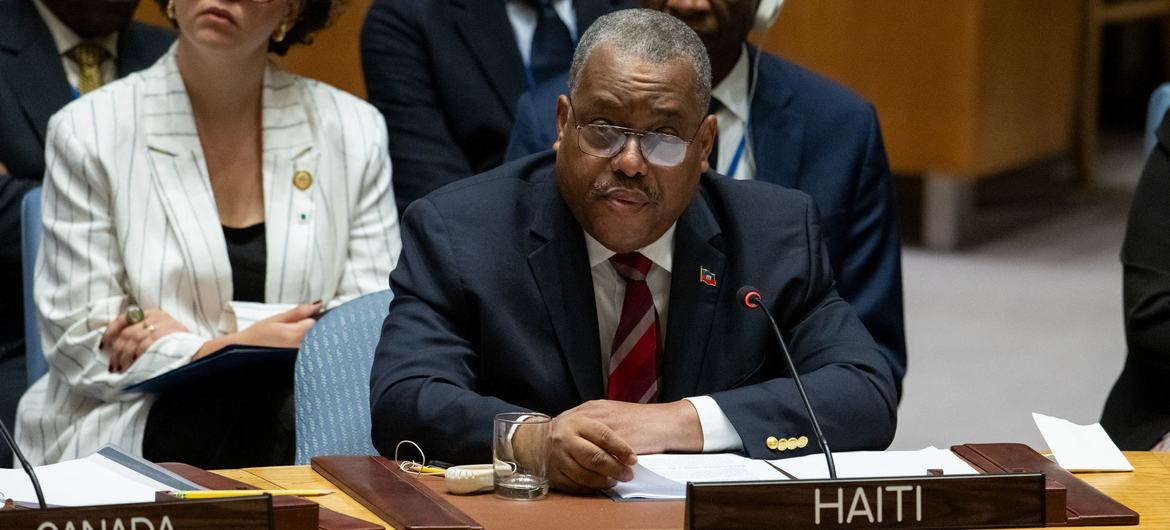
The representative of Haiti, addressing the “massive deportation of Haitians by the Dominican Republic”, said such practices violate fundamental rights and must be in line with the basic principles of international law.  Turning to the situation in his country, he said Haitian security forces continue to face difficulties in maintaining control of contested areas due to lack of human and material resources, echoing calls for urgent financial support.  Recalling the letter of the President of the Transitional Presidential Council to the Secretary-General, he urged Council members to look favorably on the request therein to transform the Support Mission to a peacekeeping mission.

Roberto Álvarez Gil, Minister for Foreign Affairs of the Dominican Republic, voicing concern that violence generated by organized crime in Haiti could spill over into his country, said:  “The Dominican Government cannot accept the foolish call to stop repatriations, as this would be the equivalent of declaring an open border, encouraging more irregular migration to the country.”  While elections are necessary to ensure Haiti’s stability, order must first be restored.  BINUH must remain an essential pillar to support the transitional Government, the Support Mission and organization of the indispensable electoral process, he emphasized.

“A surge in the MSS (Multinational Security Support Mission) personnel deployment is urgently needed,” said the representative of Kenya, noting that his country is working to fulfil its pledge of 1,000 police officers.  Nonetheless, while the Support Mission is a critical and innovative intervention, it is only part of the solution, he said, stressing that Haiti’s stability will only be accomplished through a multi-pronged approach that addresses the root causes of the challenges.


https://press.un.org/en/2024/sc15859.doc.htm

https://creativecommons.org/licenses/by/4.0/legalcode

суббота, 19 октября 2024 г.

Security Council Renews Sanctions Regime on Haiti for One Year, Unanimously Adopting Resolution 2752 (2024)


9752nd Meeting (PM)*
SC/15855


The Security Council today authorized the renewal for one year the sanctions regime on Haiti, continuing a travel ban and asset freeze, and expanding the scope of an arms embargo as well as the designation criteria for those measures initially established in October 2022 and later renewed in October 2023 to quell rampant gang violence and restore security in the crisis-torn nation. (For background, see Press Releases SC/15073 and SC/15455.)

The Council, acting under Chapter VII of the Charter of the United Nations, unanimously adopted resolution 2752 (2024) (to be issued as document S/RES/2752), and in so doing decided that, with respect to those designated for sanctions, actions that threaten the peace, security or stability of Haiti as set forth in Council resolution 2653 (2022) include “engaging in activities that destabilize Haiti through the illicit exploitation or trade of natural resources”.

By the text, the Council also decided that the scope of the arms embargo, which had been amended in Council resolution 2699 (2023), shall include “arms and related material of all types”, as well as “technical assistance, training, financial or other assistance, related to military activities”, as initially stipulated in Council resolution 2653 (2022).  As well, it encouraged greater coordination among the Security Council Committee established pursuant to Council resolution 2653 (2022) and its Panel of Experts, United Nations Integrated Office in Haiti (BINUH), United Nations Office on Drugs and Crime (UNODC) and other regional frameworks, on the implementation of the sanctions, including arms embargo provisions.

Further, the Council decided to extend for a period of 13 months the mandate of the Panel of Experts, which, also by the text, was requested by the 15‑member organ to report on the implementation of the resolution in its regular reporting to the Council.  It also encouraged all Member States to regularly inform the Panel of Experts and the Committee of the concrete actions they have taken to implement effectively the provisions of the present resolution.

Co-Penholders Express Mutual Gratitude for Close Cooperation 

After the vote, the representative of Ecuador stressed that the text’s unanimous adoption is key to addressing the multidimensional crisis in Haiti, which requires a comprehensive response.  “This is the third resolution which we have adopted on Haiti in approximately three months,” she pointed out, recalling the renewal of BINUH’s mandate in July and the extension of the Kenya-led Multinational Security Support mission in September.  The present text is one of the Council’s many available tools to promote a political solution in Haiti and a peaceful, prosperous future for its people and the region, she added.  She thanked the United States, her fellow co-penholder, for its close and positive cooperation and noted that all delegations’ constructive participation in the negotiations made the renewal and further strengthening of the sanctions regime possible. 

Similarly, the United States’ representative thanked Ecuador for its leadership on the text, and all Council members for their support of the sanctions regime.  “The unanimous adoption of this resolution [...] demonstrates our commitment to leveraging available UN tools toward supporting the people of Haiti.”  The Council’s recent designation of Luckson Elan and Prophane Victor shows its determination to hold accountable perpetrators and enablers of gang violence, she added.  The sanctions regime is a key component of broader international efforts to promote peace and stability in Haiti and in the region, but more work needs to be done to strengthen the impact of those sanction measures, she pointed out, urging all Member States to diligently implement all provisions of the resolution.

Other Council Members Hail Targeted, Expanded Provisions 

China’s delegate pointed out that, although over the past year, the sanctions committee has implemented relevant resolutions and actively promoted the arms embargo, the security situation in Haiti has not improved, with gang violence remaining rampant or even spreading.  This indicates the absence of an effective arms embargo, he said, adding that the just-adopted resolution, with its targeted, strengthened and detailed provisions, is an effective response to calls for stronger measures from Haiti, regional countries, and most Council members.  While the Council’s adoption of three resolutions related to Haiti in the past year demonstrates the international community’s determination to help the country overcome the crisis it faces, external support can only address the symptoms, not the cause, he said, underscoring the need to initiate a political process to establish a legitimate, effective Government in Haiti.

The representative of Guyana, speaking also for Algeria, Sierra Leone and Mozambique, commended the next text’s strengthened provisions.  Broadening the scope of the arms embargo to cover all types of weapons and including activities that destabilize the country such as the illicit exploitation and trade in natural resources signalled the Council’s readiness to respond to the evolving situation on the ground and the needs of the Haitian people. 

She underscored the need for greater coordination between the sanctions committee, Panel of Experts and UNODC, Haitian authorities and regional countries, to implement the strengthened measures.  As well, she welcomed progress made in implementing the transitional governance arrangements and called for more robust support to the country to enable it to better tackle the humanitarian and security challenges it faced.

Representative of Haiti Urges Effective Implementation of Resolution 

The representative of Haiti welcomed the text’s unanimous adoption and thanked all Council members, particularly the United States and Ecuador, for having actively worked toward that outcome.  “By passing this decision, the Security Council reaffirms its determination to go after everything that deteriorates the security situation in my country, which [...] represent a serious threat to peace and security in the region,” he emphasized.  Haiti is particularly encouraged by the new provisions in the resolution to make the sanctions regime more effective, he said, citing the broadened scope of the arms embargo to prevent the illicit flow of weapons into and feed the gang violence in Haiti, as well as the expanded scope of activities which destabilize his country. 

He invited Member States to be more proactive in combating the illicit trafficking of weapons, underscoring the provision in the resolution, which calls for greater coordination among the Committee, the Panel of Experts and other stakeholders.  “We just need to move on to […] the effective implementation of this important text,” he said, voicing hope that its main objectives are achieved by the next assessment scheduled next year.


https://creativecommons.org/licenses/by/4.0/legalcode

https://press.un.org/en/2024/sc15855.doc.htm

понедельник, 7 октября 2024 г.

Gang attack in Haiti's Pont Sondé leaves 70 dead


Rampant violence and claimed many lives and displaced hundreds of thousands from their homes in Haiti. (file)
© UNOCHA/Giles Clarke
 
Rampant violence and claimed many lives and displaced hundreds of thousands from their homes in Haiti. (file)


4 October 2024 

Peace and Security

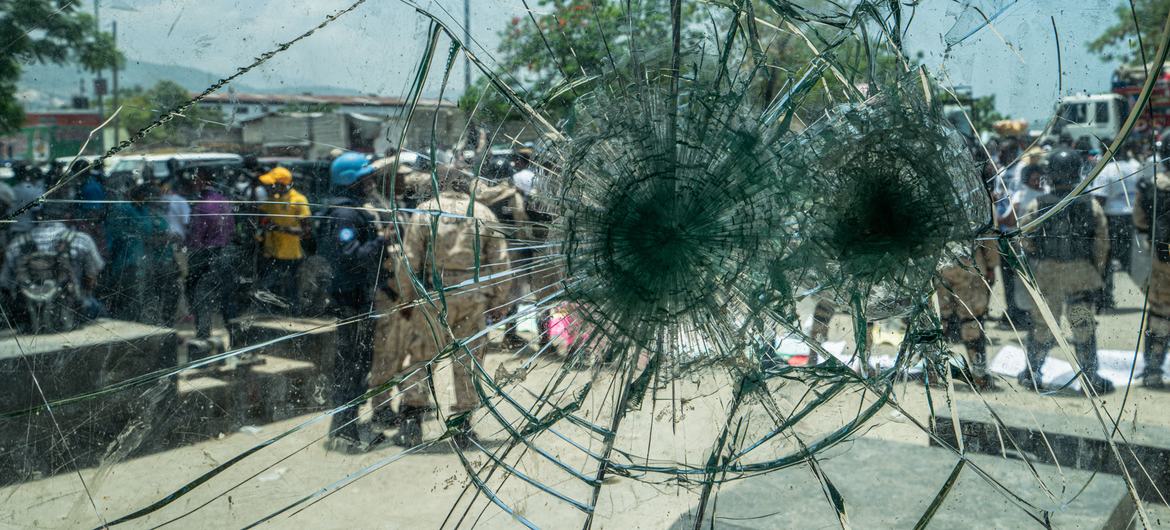
An attack by a notorious gang in the town of Pont Sondé, Haiti, left at least 70 people dead on Thursday, after gunmen armed with automatic rifles opened fire, a spokesperson for the UN human rights office, OHCHR, said on Friday.

Among the victims at the hands of the so-called Gran Grif gang were 10 women and three infants.

“As the attacks unfolded, gang members reportedly set fire to at least 45 houses and 34 vehicles, forcing a number of residents to flee,” said Thameen Al-Kheetan in a statement released in Geneva.

He called for a “prompt and thorough investigation” into the attack, for those responsible to be held to account and guaranteed reparations for the victims and their families.

Rights violations soar

The attack comes in the wider context of indiscriminate gang violence across Haiti, leading to an alarming escalation of human rights violations and large-scale internal displacement.

Over 700,000 people have been forced to flee their homes, making Haiti the country with the largest number of displacements globally due to crime-related violence.

Mass displacement has led to widespread insecurity in the nation, with almost half of Haiti’s 11.9 million civilians in dire need of humanitarian assistance.

The gang violence against the Haitian population has spread from the capital, Port-au-Prince, to isolated rural areas. The pervasive assaults include sexual violence, kidnapping, looting, roadblocks to intimidate and rob civilians and forced recruitment by armed gangs.

‘We cannot turn a blind eye’

The UN refugee agency, UNHCR, is calling for increased and urgent attention, support, and solutions for Haitians affected by violence and insecurity, including those who have been forcibly displaced.

Now more than ever, Haitians need our collective support, and we cannot turn a blind eye,” said UNHCR’s Assistant High Commissioner for Operations Raouf Mazou on Thursday after a three-day visit to the nation.

“Increased funding, enhanced security and international solidarity are essential to providing life-saving humanitarian assistance and restoring stability and hope in Haiti,” he added.

Despite the growing urgency of the crisis, funding for Haiti's humanitarian response remains critically low and the 2024 Humanitarian Response Plan asking for $674 million is currently only 39 per cent funded.

UNHCR is calling on the international community to increase its support to address humanitarian needs and to pursue solutions for displaced populations in Haiti and for people fleeing Haiti.


https://news.un.org/en/story/2024/10/1155381

https://creativecommons.org/licenses/by/4.0/legalcode
вторник, 1 октября 2024 г.

Security Council renews Haiti mission mandate, calls for more action against gangs


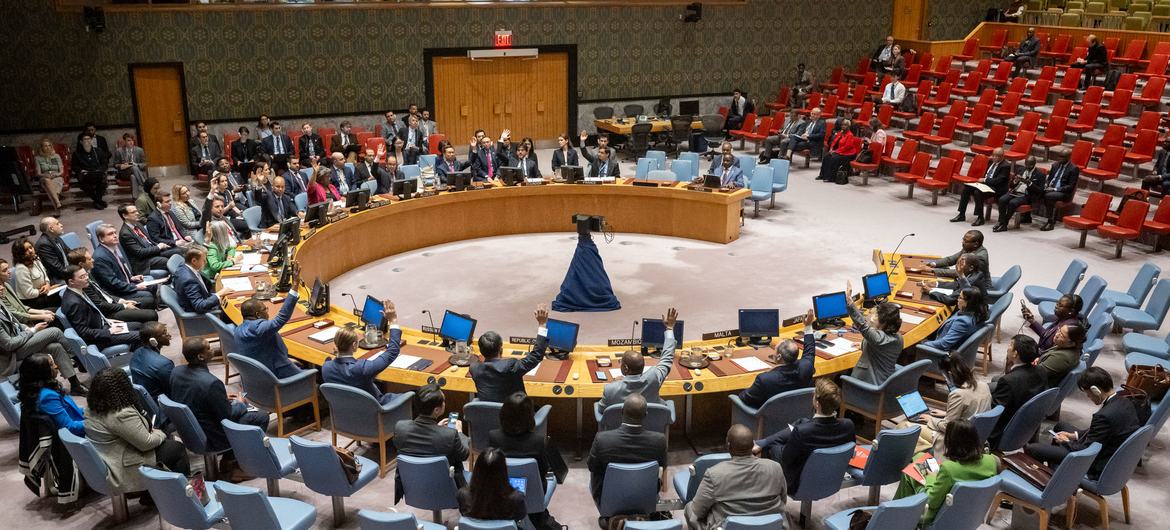
UN Security Council members vote and unanimously adopt resolution extending the mandate of the Multinational Security Support (MSS) mission in Haiti.
UN Photo/Manuel Elías
 
UN Security Council members vote and unanimously adopt resolution extending the mandate of the Multinational Security Support (MSS) mission in Haiti.


By Vibhu Mishra
30 September 2024 


Peace and Security

The UN Security Council on Monday re-authorized the deployment of the Multinational Security Support (MSS) mission to Haiti for 12 months.

The mission was authorized last October to assist Haiti’s beleaguered police force. Led by Kenya, it currently has around 410 police officers on the ground and is expected to grow to around 2,500. For now, the country remains mired in crisis.

The renewal comes as the mission tries to curb rampant gang violence, enable an environment conducive to aid delivery, and create conditions for free and fair elections.

In a unanimous vote on resolution 2751, the 15-member Council urged the MSS mission to speed up its deployment and called on all nations to provide additional voluntary contributions and support.

Tweet URL

The resolution reaffirmed that the UN Secretary-General may offer logistical support to the mission when requested, subject to full financial reimbursement through available voluntary contributions and in full compliance with the UN Human Rights Due Diligence Policy.

Unprecedented security crisis

Last Thursday, Haiti’s transitional President Edgard Leblanc Fils addressed the UN General Assembly, warning that his country faces an “unprecedented security crisis”.

Citizens are living in fear of even moving about freely or going to school, particularly around the capital Port-au-Prince,” he said at the General Assembly’s high-level debate, urging continued UN support.

The rampant violence has also driven humanitarian needs across Haiti, with more than half the population classified as facing “acute levels of hunger”, according to the latest IPC analysis, a global tracking of malnutrition and food insecurity.

US pledges unwavering support  

Following the adoption, United States Ambassador and Permanent Representative Linda Thomas-Greenfield emphasized the international community’s strong message of solidarity with the people of Haiti.

“The world is standing with you, and we are unwavering in our efforts to help restore security and stability and put the country on the path of peace and prosperity,” she emphasized.

She echoed President Leblanc’s call for ensuring long-term sustainability and encouraged the international community to build on the progress achieved by the mission so far.

“Let us work together to build on the progress of the Haiti MSS mission. Let us embrace a new approach that sustains it. Let us protect the fragile but inspiring opportunity to build a better future for the Haitian people,” Ms. Thomas-Greenfield said.

Cité Soleil in downtown Port-au-Prince is particularly affected by high levels of violence and insecurity.
© UNOCHA/Giles Clarke

Haiti calls for fully-fledged peacekeeping force

Antonio Rodrigue, Ambassador and Permanent Representative of Haiti – which does not currently serve on the Council – welcomed the extension but stressed the need for it to become a full UN peacekeeping operation.

He said it had “demonstrated its effectiveness in certain critical areas, specifically through the restoration of security in areas previously controlled by armed gangs.” However, he cautioned that significant challenges remain.

Gang violence continues to tear at the social fabric, with rampant rights violations plunging thousands of families into distress, he said, adding that despite an arms embargo, gangs are still accessing weapons and ammunition.

The Haitian Ambassador underscored the need for increased financial support and reinforcements for the mission and reiterated that transforming it into a peacekeeping operation “appears not just to be necessary but also a matter of urgency.”

Kenya calls for urgent reinforcement and resources

Kenya’s Ambassador to the UN Erastus Lokaale outlined President William Ruto’s recent visit to Haiti, where he had witnessed the Haitian people’s determination to emerge from the multiple crises they face.

He emphasized that the mission had chalked up some initial successes, in collaboration with the Haitian National Police (HNP), laying the groundwork for further progress, including securing the airport and other key infrastructure.  

“With the renewed mandate, the mission is poised to create conditions for Haitian authorities to secure their country and undertake social and economic reconstruction,” he said.

But for that to happen, “the MSS mission must rapidly achieve the full deployment of its envisioned 2,500 personnel, up from the current 410 officers,” he reiterated, as well as “substantial resources”.


https://news.un.org/en/story/2024/09/1155151


https://creativecommons.org/licenses/by/4.0/legalcode
пятница, 12 июля 2024 г.

Top aid officials call for greater solidarity and support for Haiti


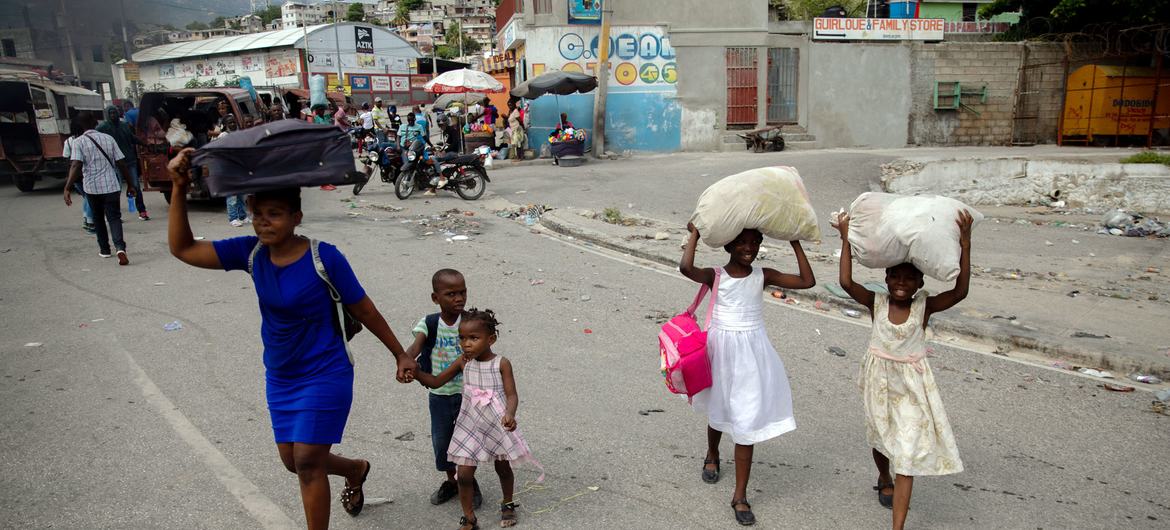
Thousands of families  continue to flee their homes in Port-au-Prince due to gang-related violence.
© UNICEF/Ralph Tedy Erol
 
Thousands of families continue to flee their homes in Port-au-Prince due to gang-related violence.


12 July 2024 

Humanitarian Aid

Three senior humanitarians  appealed on Friday for more support for Haiti, where ongoing gang violence in the capital, Port-au-Prince, is affecting the entire population. 

Although the crisis has sparked immense needs, a nearly $680 million humanitarian plan launched in February is less than a quarter funded.

“It is very clear for many people of Haiti that they are paying the heavy price of the violence, again, that has ravaged the country,” said Edem Wosornu, Director of Operations and Advocacy at UN emergency relief agency OCHA, briefing journalists in New York.

Tweet URL

Lives upended by violence

She was speaking from the Haitian capital alongside Lucia Elmi, Director of Emergency Programmes at the UN Children’s Fund (UNICEF) and Andrea Koulaimah of the European Commission’s Civil Protection and Humanitarian Aid Operations department, known as ECHO. 

The top officials concluded a four-day visit to the Caribbean country, where 11 million people - the entire population - “have in one way or another had their lives shaken by the violence,” according to Ms. Elmi.

The situation has forced nearly 600,000 Haitians to flee their homes, and displacement has risen by 60 per cent since March. Roughly five million people are facing acute hunger, with almost 1.6 million at risk of starvation. 

‘Window of opportunity’

Haiti’s health and education systems have also been heavily impacted. Only two out of five hospitals are functioning, and more than 100 schools have closed, depriving some 200,000 children of an education.

“We have only eight weeks before the start of the new school year, so there is a window of opportunity that we really need to seize to get those schools not only open again but functioning,” she said.

Sexual violence cases rising

Ms. Elmi noted that women and children have been disproportionately affected by the crisis and the level of brutality and violence they have suffered “has been really very, very painful”.  

Sexual violence has increased 400 times with respect to last year, when some 100,000 cases were reported, she said.

She recalled a visit to a centre in Port-au-Prince that supports survivors, including a 14-year-old girl whose family had been kidnapped, and some members killed.  Even though the teenager was raped and beaten for days, she remains determined to finish her studies and become a social worker.

Government commitment assured

The humanitarians travelled to other parts of Haiti, including Gonaïves in the north and Les Cayes, located in the south, and spoke to a wide cross section of people, including farmers, children out of school, mothers and “fierce” women entrepreneurs.  

They also held talks with the authorities, notably new Prime Minister Garry Connille.

Ms. Koulaimah said that although the crisis requires a stronger and better-funded response, it will not be solved by humanitarian aid alone.

It has to be solved by the Haitians themselves, and the Government has assured us of the commitment to do everything in their hands in order to transition out of the current crisis, and they need our support,” she said.

Stressing the need for more funding, she insisted that humanitarian aid is being delivered and “reaching its objective”, despite access difficulties.

Stand with Haiti

Ms. Wosornu added that “Haiti needs real lasting solutions to enhance development”, which includes restoring schools, health centres and other basic services. 

Throughout the visit, Haitians repeatedly called for three simple things: peace, an end to the violence, and to reclaim their lives, she said.

“We wrap up our visit by reiterating our call to the international community to stand with the people of Haiti,” she said.

“We owe it to the women, we owe it to the children, and we owe it to the old men and women and all the people of Haiti that we've met across the country.” 


https://news.un.org/en/story/2024/07/1152061


https://creativecommons.org/licenses/by/4.0/legalcode
четверг, 4 июля 2024 г.

Haiti: UN envoy welcomes democratic progress amidst alarming violence

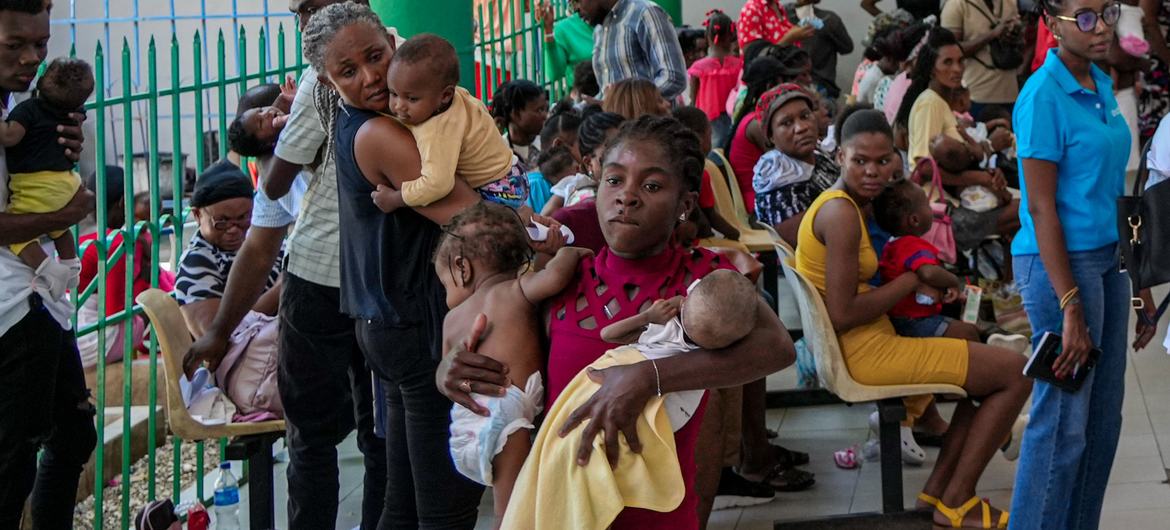
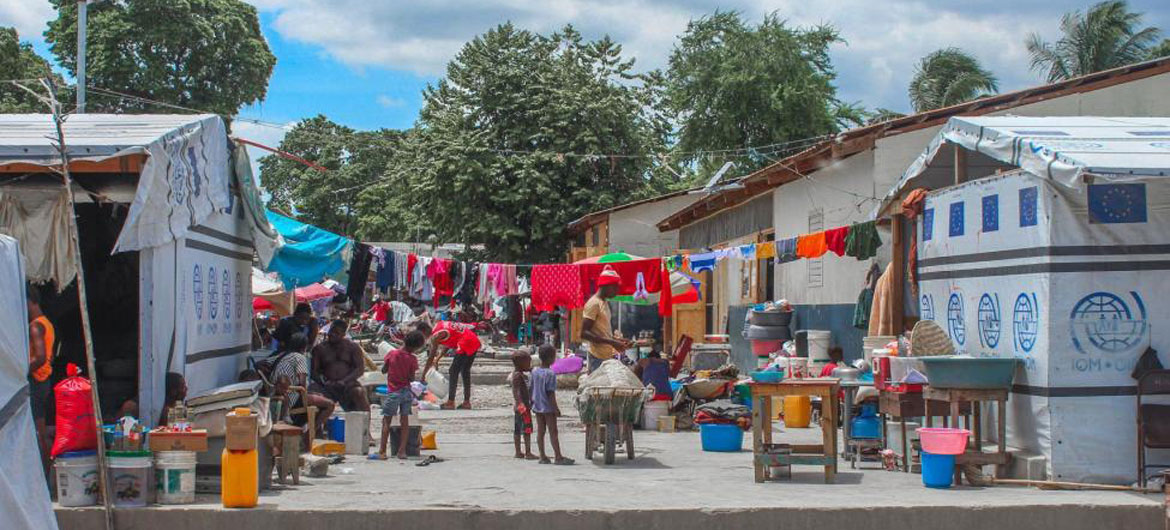
A camp for internally displaced people (IDP) in the Haitian capital, Port-au-Prince.
© IOM
 
A camp for internally displaced people (IDP) in the Haitian capital, Port-au-Prince.


5 hours ago 

Peace and Security

The UN envoy for Haiti on Wednesday welcomed recent strides towards restoring democracy amid alarming levels of violence, while the country’s interim Prime Minister emphasized that the people “continue to fight for a better future.”

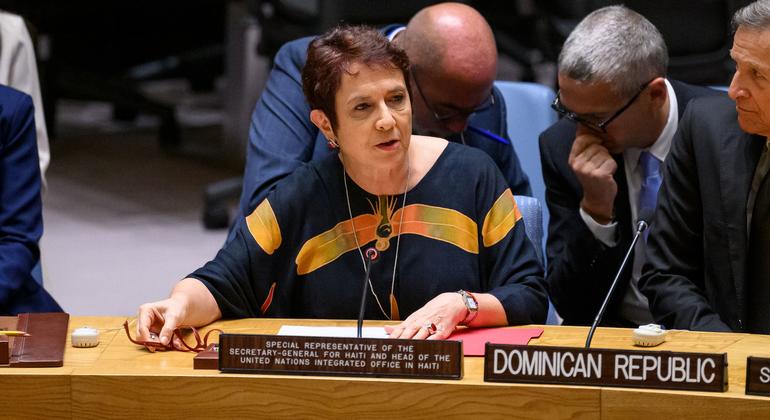
Maria Isabel Salvador, Special Representative of the UN Secretary-General for Haiti, briefed ambassadors at the Security Council, highlighting the installation of the Transitional Presidential Council in April and the swearing-in of an interim Prime Minister and new government in June as “clear indications of progress.

Haiti has been embroiled in a complex crisis, marked by years of political instability, rampant gang violence, disease outbreaks and a series of hazards worsened by climate change.  

Across the country, about 5.5 million people are estimated to need humanitarian assistance, with almost 600,000 people – over half of them children – internally displaced and in urgent need of support.  

Participation of women

She also commended the efforts of the transitional authorities to increase the participation of women and other minorities in key positions in government, with six of the 18 ministries now headed by women, representing 33 percent of all ministries.

Inclusion and diversity are essential to promote a political transition that paves the way for the restoration of State institutions and effectively responds to the needs and expectations of all Haitians,” she said.

Ms. Salvador, who also heads the UN Mission in the country (BINUH), welcomed the new Prime Minister’s commitment to fight corruption and promoting human rights and justice.

Special Representative María Isabel Salvador briefs the Security Council on the situation in Haiti.
UN Photo/Loey Felipe

Realigning priorities

She informed Council members that BINUH is realigning its priorities to support a Haitian-led transition, which includes credible, inclusive and participatory elections, aiming for the installation of elected authorities by February 2026 at the latest.

To that end, she proposed the possibility of enhancing the BINUH’s electoral expertise.

Increasing the participation of women and youth is a fundamental pillar of BINUH’s renewed strategy to support the political process, she highlighted, outlining also its focus on promoting human rights across Haitian society.  

Fight against gang violence

On the security front, Ms. Salvador reported that the base for the Multinational Security Support (MSS) mission, authorized by Security Council resolution 2699 (2023), has been completed. She added that the first group of Kenyan police officers arrived on 25 June for deployment.  

She also welcomed the appointment of a new Director General of the Haitian National Police (HNP), describing it as bringing “new hope to the continuous fight against gang violence.”

That resolution also mandated the MSS mission to establish a human rights oversight mechanism.

As the MSS mission deploys, Ms. Salvador stressed the need to strengthen the human rights area in BINUH to provide the necessary support.  

Looking ahead

Looking ahead, the Special Representative emphasized the importance of establishing a coordination mechanism among national authorities, the MSS mission, the UN, and other partners in Haiti.

She noted that although the Security Council, in resolution 2692 adopted in 2023, authorized a strengthened police component in BINUH, financial constraints and a hiring freeze impeded progress in scaling up the police and corrections area.  

Concluding her briefing, Ms. Salvador reiterated BINUH’s full engagement to work with the Government and stakeholders towards stability, peace and a brighter future for all Haitian men, women, youth and children.

Haitians continue to fight for a better future: Interim Prime Minister

Garry Conille, interim Prime Minister of the Republic of Haiti, addresses the Security Council.
UN Photo/Manuel Elías
 
Garry Conille, interim Prime Minister of the Republic of Haiti, addresses the Security Council.

Also at the Security Council, Garry Conille, interim Prime Minister of Haiti, emphasized that his country’s people “continue to fight for a better future”.

Attending under rule 37 of the Council’s provisional rules of procedure on participation on non-members, Mr. Conille underlined the “urgent need to find a lasting solution to the security problems exacerbated by the activities of criminal gangs.

He urged effective cooperation between national authorities, the MSS mission and BINUH to help re-establish security and restore democratic institutions , which he described as “strategic for the transition.”

Mr. Conille highlighted that since his appointment as interim Prime Minister, he has held several working sessions with the Transitional Presidential Council, anti-corruption and accountability institutions, law enforcement agencies, the private sector and diaspora associations.

Calling for solidarity to help Haiti emerge from the crises that have plagued it for several decades, he stressed that “every day must be used wisely.” 

Click here for full coverage of this meeting from UN Meetings Coverage


https://creativecommons.org/licenses/by/4.0/legalcode
https://news.un.org/en/story/2024/07/1151771

вторник, 2 июля 2024 г.

Haiti: Violence displaces one child every minute, reports UNICEF

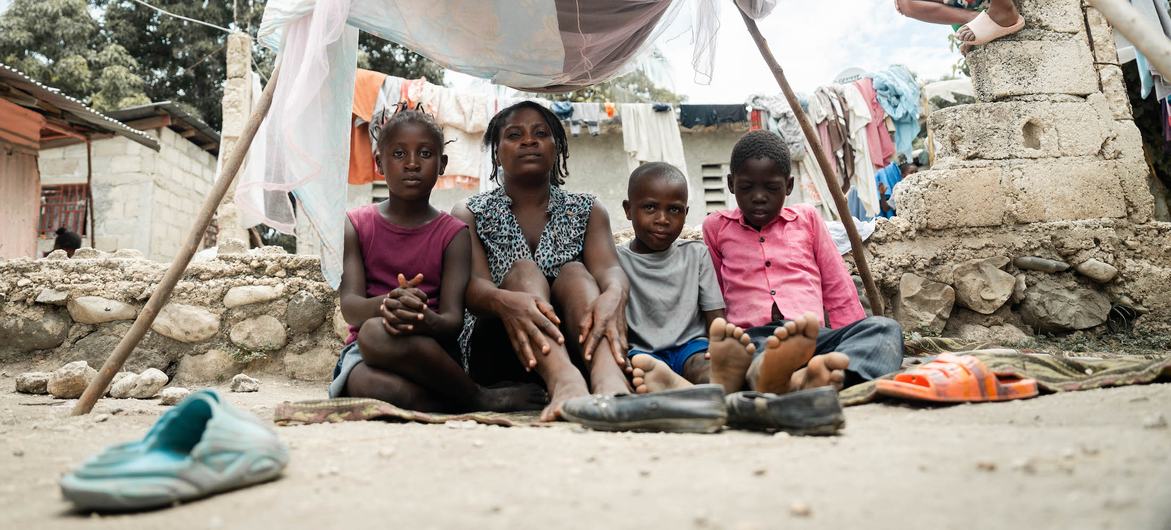
A mother sits with her children in an IDP site in Léogâne, on the outskirts of the Haitian capital, Port-au-Prince.
© UNICEF/Maxime Le Lijour
 
A mother sits with her children in an IDP site in Léogâne, on the outskirts of the Haitian capital, Port-au-Prince.


1 hour ago 

Peace and Security

Continued violence and instability in Haiti has resulted in the displacement of over 300,000 children, with an estimated one child being displaced every minute since March, the UN Children’s Fund (UNICEF) said on Tuesday.

Catherine Russell, UNICEF Executive Director, highlighted the horrific impact of violence on children and adolescents.

“The humanitarian catastrophe unfolding before our eyes is taking a devastating toll on children. Displaced children are in desperate need of a safe and protective environment, and increased support and funding from the international community,” she said.

Across the country, an estimated three million children are in need of humanitarian assistance, against a backdrop of years of political turmoil, widespread poverty, rampant disease and multiple disasters.

Facing heightened risks

Displaced children in Haiti face heightened risks of violence, including sexual assault, exploitation, abuse and family separation. Their access to essential services such as safe spaces, healthcare, and clean water and sanitation is severely disrupted.

Poor hygiene conditions in camps and makeshift settlements increase their susceptibility to diseases like cholera, while school closures and economic constraints driven by the violence have forced many children to abandon their education.

Furthermore, with few other means of survival or protection, children are increasingly forced to join armed groups – a clear violation of their rights and a breach of international law, UNICEF stressed.

Dangers continue to grow

Compounding these challenges, devastating hazards wreaking havoc across the country.

Haiti’s National Emergency Operations Center has warned of a “hyperactive” cyclone season, further threatening the already vulnerable displaced population. Last month, a tornado in Bassin Bleu, Northwest Department, destroyed the homes of 650 children.

The crippled healthcare system that was barely able to cope with demand before the latest escalation of violence will have to contend with a rainy season that is expected to continue to worsen the situation, threatening to spike water-borne diseases, UNICEF warned.

“The needs in Haiti continue to grow, alongside the dangers for children,” Ms. Russell said, adding that everyone has a role to play to change the trajectory, and ensure that children are protected, have education and can access basic services.

Children should not be paying with their lives and their futures for a crisis created by adults,” she said.


https://news.un.org/en/story/2024/07/1151681


https://creativecommons.org/licenses/by/4.0/legalcode
пятница, 21 июня 2024 г.

Haiti faces record displacement amid escalating gang violence


In Haiti, nearly 1.6 million people are facing acute food insecurity levels, increasing the risk of wasting and malnutrition among children.
© UNICEF/Herold Joseph
 
In Haiti, nearly 1.6 million people are facing acute food insecurity levels, increasing the risk of wasting and malnutrition among children.


20 June 2024

Human Rights

Escalating gang violence and political instability in Haiti have forced a record 578,074 people from their homes this year, making it the country with the largest number of displacements due to crime-related violence, UN independent human rights experts said on Thursday.

“Violence, particularly in the capital Port-au-Prince, has reached alarming levels, with armed groups controlling large areas and complicating humanitarian access,” the experts, including the Special Rapporteur on the rights of internally displaced personssaid.

The clashes between gangs and the Haitian National Police have created a “pervasive environment of fear, restricting freedom of movement and access to basic services”, they added.

In the first quarter of 2024 alone, gang-related violence reportedly claimed the lives of or injured 2,500 Haitians, including 82 children.

Women and children have been the worst affected, amid heightened risk of sexual violence and exploitation.

Mass displacement

Many internally displaced persons (IDPs) are living in “overcrowded and inadequate conditions without basic hygiene and sanitation, facing severe shortages of food, water, shelter, and medical care, including a lack of safe and private spaces for psychological support,” the independent experts said.

According to the UN International Organization for Migration (IOM), nationally, 80 per cent of IDPs are living with host families while the remaining  are sheltering  in sites, many in gang-controlled or high-risk areas.

Nearly half of the country’s population is suffering from severe hunger, with 18 per cent at “emergency” level of food insecurity.

Tweet URL
UN_SPExperts

Impact on children and women

Children and women have been disproportionately impacted by the effects of the violence and instability in Haiti, with more than 310,000 women and girls, and 180,000 children among the displaced.

More than half a million children are living in neighbourhoods controlled by armed groups, at heightened risk of violence and child recruitment.  

Furthermore, the growing number of unaccompanied displaced children makes them particularly vulnerable to exploitation, abuse and trafficking by gangs.

The violence and attacks on educational facilities have also forced the closure of nearly 900 schools, affecting almost 200,000 children, disrupting learning and putting children at increased risk.

Sexual violence against women and girls at IDP sites is also surging as gangs continue to use rape as a weapon of terror, the Human Rights Council-appointed independent experts said.  

Call to action

Amidst the alarming situation, the experts called for greater female leadership and participation to ensure a successful political transition in Haiti.

They also urged greater efforts to address root causes of displacement to build sustainable solutions for the future.  

“Durable solutions for IDPs, such as safe return, resettlement, or local integration, require addressing the root causes of displacement, including violence, political instability, and environmental degradation,” they said.  

Independent experts

Appointed by the Geneva-based Human Rights Council and forming a part of its Special Procedures, Special Rapporteurs are mandated to monitor and assess the rights situation in certain thematic or country situations.

They work in their personal capacity, independent of the United Nations and national governments.


https://news.un.org/en/story/2024/06/1151306

https://creativecommons.org/licenses/by/4.0/

пятница, 14 июня 2024 г.

Haiti: UN chief welcomes new government amid ongoing challenges

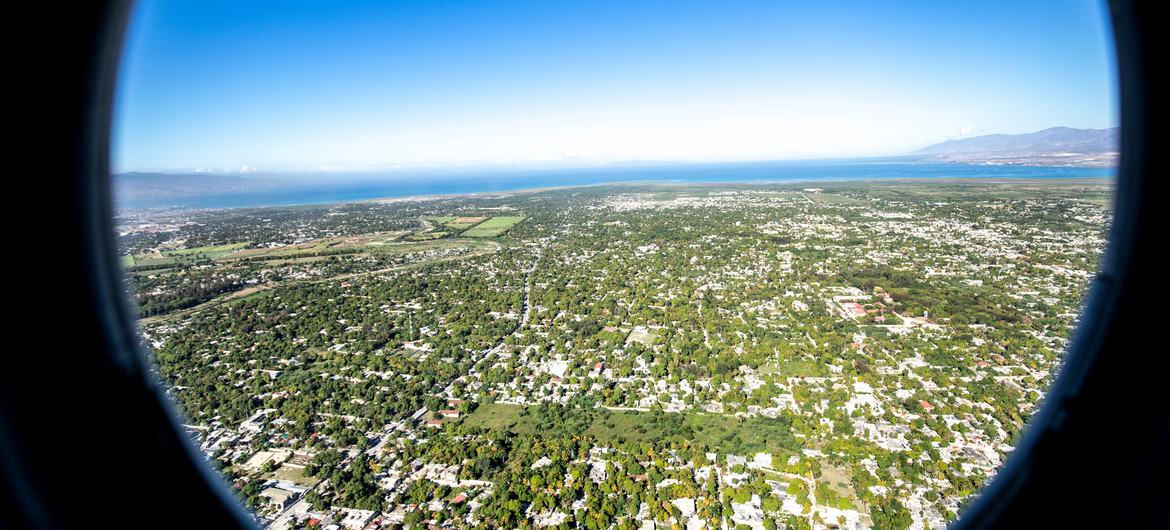
A helicopter flies over Haiti.
© WFP/Theresa Piorr
 
A helicopter flies over Haiti.

13 June 2024
Peace and Security

UN Secretary-General António Guterres on Thursday welcomed the swearing in of Haiti’s new Government, urging stakeholders to continue making progress towards restoring democratic institutions through elections.

The new cabinet, according to reports, completely replaces all the ministers from the government of the former Prime Minister, Ariel Henry, who was forced to step down earlier this year following pressure from criminal gangs that control large parts of the island nation.

The new cabinet includes women ministers in key portfolios.

Security needs

Addressing journalists at the regular press briefing on Thursday, UN Deputy Spokesperson Farhan Haq said the “positive transitional governance milestone” should be accompanied by urgently needed security gains.

The Secretary-General therefore reiterates his call for the swift deployment of the Multinational Security Support (MSS) mission to Haiti to support the Haitian National Police in addressing the dire security situation,” Mr. Haq said.

The UN chief also appealed to Member States to ensure the MSS mission urgently receives the financial and logistical support it needs to succeed, he added.

Humanitarian assistance

Meanwhile, the Office for the Coordination of Humanitarian Affairs (OCHA) reported that the UN and partners are continuing to support those displaced by violence in the capital Port-au-Prince.

Between 8 and 12 June, the World Food Programme (WFP) – UN’s emergency food assistance agency – distributed more than 40,000 hot meals to over 9,000 displaced people in the  city.  

Since the beginning of the year, WFP has distributed more than 1.1 million hot meals to over 120,000 displaced people.

Alongside, the UN Population Fund (UNFPA) supplied 900 dignity kits to women and girls last month, as well as deploying eight mobile clinics providing sexual and reproductive health and gender-based violence services and support.  

The UN International Organization for Migration (IOM) has been offering psychosocial support, including by phone and in camps hosting displaced people (IDPs).

Continued worries

However, the situation in the south remains concerning, with reports of over 268,000 people now displaced, a 95 per cent increase since March.

The health system also continues to face serious challenges, crippled by both the recent violence and years of lack of investment, Mr. Haq said, noting that currently, just 20 per cent of health facilities in Port-au-Prince are functioning normally.

“This year’ Humanitarian Response Plan, which calls for $674 million, is just 23 per cent funded at $156 million,” he added.

Fully funded, the Plan aims to reach 3.6 million of the most vulnerable among the 5.5 million Haitians who need assistance. Key areas for support include protection, medical and healthcare, water and sanitation, and food security.

https://news.un.org/en/story/2024/06/1151041

https://creativecommons.org/licenses/by/3.0/legalcode

четверг, 6 июня 2024 г.

Keep global spotlight on Haiti as millions go hungry, WFP official says


A child with malnutrition is treated at the Hôpital universitaire Justinien in Cap Haitien, Haiti.
© UNICEF
 
A child with malnutrition is treated at the Hôpital universitaire Justinien in Cap Haitien, Haiti.


5 June 2024
Humanitarian Aid

The number of people going hungry in Haiti has reached record levels amid ongoing gang violence, the head of the UN World Food Programme (WFP) there said on Wednesday in the capital, Port-au-Prince. 

“We now have five million people in Haiti that are acutely food insecure, of which 1.6 million are classified as facing emergency food insecurity conditions,” said WFP Country Director Jean-Martin Bauer, speaking via videolink to journalists at UN Headquarters in New York.

These are the highest numbers on record. These are the highest numbers we've had since the 2010 earthquake,” he added. 

Feeding displaced people 

Mr. Bauer’s briefing took place just hours after WFP and sister UN agency the Food and Agriculture Organization (FAO) published their latest hunger hotspots report, calling for action to save lives and prevent starvation in 18 places such as Gaza, Sudan and Haiti.

He spoke from a community kitchen in Port-au-Prince, managed by WFP and a local partner, that prepares thousands of hot meals for people displaced by the rampant gang violence, and ensuing insecurity and human rights violations, that have rocked the city in recent years. 

The UN Security Council has authorized the deployment of a Multinational Security Support Mission to assist the Haitian National Police, which is still in the planning stages. 

Airport shuttered 

The situation in the Caribbean country worsened in early March after gangs tightened their grip on the capital, carrying out coordinated attacks against police stations and other key State institutions, and releasing thousands of prisoners in jail breaks.  Flights were grounded and the Prime Minister, Ariel Henry, resigned. 

Responding to reporters’ questions, Mr. Bauer said that security is the “number one priority” in the face of violence that makes it dangerous for people, including his staff, to even take their children to school, shop for groceries or go to church.

The violence has forced over 360,000 Haitians to flee their homes.  More than 100,000 left Port-au-Prince in March alone, he said, citing data from UN migration agency IOM

Mr. Bauer said this “exodus” from the capital is especially affecting the south of the country, where infrastructure is limited, thus compounding the food crisis. 

Although a new Prime Minister has been nominated, the period since then “has been quite violent, quite unsettled”, he added.   

“The country has been blocked. The main ports for containers, the airport, were not functional for months. They've slowly resumed functioning,” he said. 

A million meals 

Humanitarians have been doing their best to respond to the crisis, and the hot meals programme is just one example of their efforts, he said.  In total, WFP and partners have assisted more than 100,000 people since the start of the year, providing over a million hot meals. 

“Right now, we've been able to use the stocks that we placed in position in Port-au-Prince ahead of the crisis, but those have been running low,” he said.

With the recent re-opening of the port, he expressed optimism that more commodities will flow into the country to sustain humanitarian activities. 

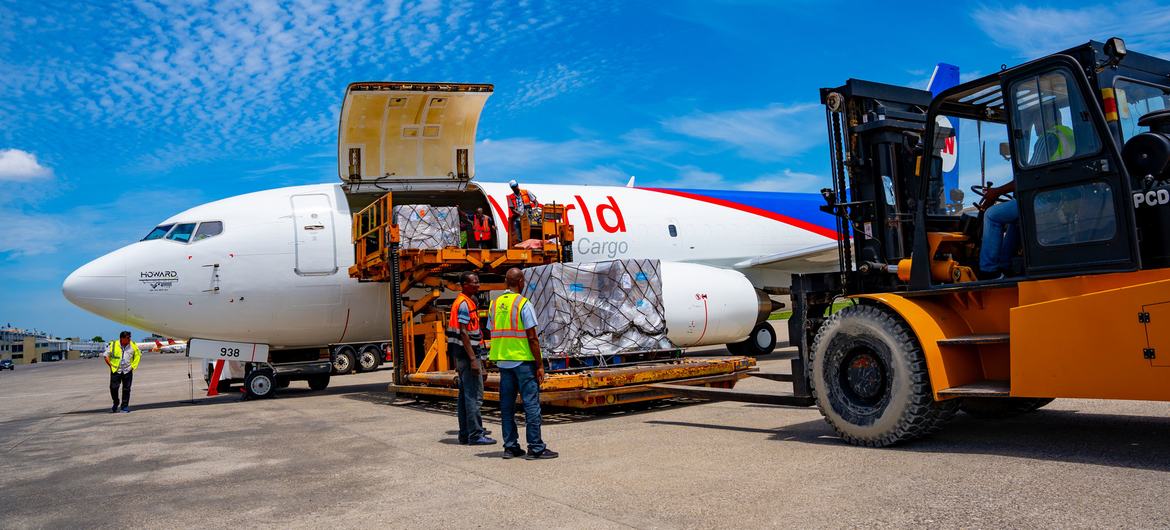
A WFP-chartered cargo plane being unloaded of its 15 MT of desperately needed medical supplies at the Toussaint Louverture International Airport in Port-au-Prince, Haiti.
© WFP/Luc Junior Segur
 
A WFP-chartered cargo plane being unloaded of its 15 MT of desperately needed medical supplies at the Toussaint Louverture International Airport in Port-au-Prince, Haiti.

Aid flown in 

He also pointed to good news.  Last week, a WFP cargo flight transported 15 tonnes of vital medical supplies to the Port-au-Prince airport, marking the first time in months. 

The items were for partners such as the UN Children’s Fund (UNICEF) and the World Health Organization (WHO) who delivered them to local hospitals and clinics. More flights will soon take to the skies

Other “breakthroughs” saw WFP reaching the Cité-Soleil neighbourhood, providing rations to some 93,000 people in May. WFP has also maintained a ferry service linking Port-au-Prince to the north and south of Haiti, bringing food and medical supplies to areas that have been isolated from humanitarian supply chains. 

Pay attention to Haiti 

“But there's a sense of crisis still,” Mr. Bauer said.

This month marks the start of the Atlantic hurricane season which is on track to be “very active” this year.   Food prices in the capital have also increased by nearly 30 per cent since January, representing another blow to the population.

He urged the international community to step up and support Haiti, as a $674 million humanitarian response plan, launched in February, is only around 22 per cent funded. WFP also needs $76 million to continue its lifesaving work in the country. 

“We need to continue having Haiti in the spotlight,” he said.  “We know that in some parts of the world there just hasn't been enough attention on Haiti because we're looking at other crises, we're looking elsewhere, but the crisis in Haiti is here, it's now and it deserves a response.” 


https://news.un.org/en/story/2024/06/1150676


https://creativecommons.org/licenses/by/3.0/legalcode

вторник, 4 июня 2024 г.

World News in Brief: Aid breakthrough for Haiti, police violence in Chicago, celebrating ‘pedal power’


World News in Brief: Aid breakthrough for Haiti, police violence in Chicago, celebrating ‘pedal power’

A WFP-chartered cargo plane being unloaded of its 15 MT of desperately needed medical supplies at the Toussaint Louverture International Airport in Port-au-Prince, Haiti.
© WFP/Luc Junior Segur
 
A WFP-chartered cargo plane being unloaded of its 15 MT of desperately needed medical supplies at the Toussaint Louverture International Airport in Port-au-Prince, Haiti.
3 June 2024Humanitarian Aid

UN humanitarians said on Monday that they have finally been able to deliver truckloads of food to highly vulnerable people in Haiti’s capital, Port-au-Prince, after gang violence prevented access for more than two months.

Jean-Martin Bauer, Country Director in Haiti for the UN World Food Programme (WFP), also said that the UN agency had managed to resume flights into Port-au-Prince international airport.

‘Exceptionally complex’

The security situation remains “exceptionally complex” but it has been possible to reach “the most difficult neighbourhoods” of the Haitian capital, Mr. Bauer said.

Tweet URL
UN_News_Centre

According to WFP, over a two-week period in May, 615 metric tonnes of rice, beans, and vegetable oil were distributed to nearly 93,000 people in Cité Soleil - including breastfeeding mothers and children.

The UN agency also said that “vital” medical supplies had landed in Port-au-Prince airport on Thursday. This marks the first UN humanitarian cargo flight to land in the capital since violence linked to the country’s political and economic crisis erupted in March 2024.

Further progress is needed to access the seaports in Port-au-Prince because without these vital supply routes, “people risk slipping even deeper into hunger”, WFP’s Mr. Bauer insisted.

Rights experts urge action to address systemic racist police violence in Chicago

Independent UN human rights experts on Monday called for action to remedy racialised police violence and misconduct within Chicago’s law enforcement and criminal justice system against people of African and Latino descent.

“Chicago has a long history of law enforcement officials reportedly using torture to extract confessions to serious crimes,” the experts said.  

This resulted in wrongful convictions and incarceration - often for long periods of time without adequate access to healthcare.  

“These heinous alleged human rights violations appear to a significant extent to be rooted in systemic racism and have disproportionately affected people of African and Latin American descent.”

“Lives have been stolen, with a significant ripple effect within communities,” the Human Rights Council-appointed experts continued.

Steps taken at City Hall

City authorities in Chicago have taken steps to address reported human rights violations, including the issuing of a public apology and the establishment of a Torture Inquiry and Relief Commission, to acknowledge, remedy and prevent police torture and misconduct, the Special Rapporteurs and Working Group members said.  

While these initiatives are welcome, there is still a long way to go, they stated. They are concerned that reforms have been piecemeal with systemic barriers to rehabilitation.  

Reports also indicate that alleged human rights violations have taken place largely without real accountability for perpetrators.  

The UN rights experts issued a call for relevant federal, state and local officials to take immediate and comprehensive action in Chicago and have been in contact with the US Government to clarify its obligations under international law.  

“A just society must address past wrongs and put in place all measures to prevent recurrence,” the experts said.

On World Bicycle Day, UN celebrates ‘power of the pedal’

And finally, the UN on Monday celebrated World Bicycle Day, applauding the simple, affordable, clean and environmentally sustainable means of two-wheeled transportation.

In addition to contributing to cleaner air and reducing gridlocks, bicycles make education, healthcare and other social services more accessible to the most vulnerable populations.

Tweet URL
UN_PGA

UN General Assembly President Dennis Francis, speaking in New York, emphasized the critical role of cycling and other non-motorized transport in achieving a sustainable future.

‘Sustainable mobility’

“There are countless ways the bicycle can create an entire ecosystem of sustainable mobility – connecting communities to practical solutions they need to surmount the myriad and daily inequities of poverty, conflict, disaster and emergency,” he said.

He urged everyone to take full advantage of the “power of the pedal”.

“Let us encourage all actors to cultivate a culture of cycling – and in turn, unleash progress across the Sustainable Development Goals (SDGs) to bring about a healthier, safer, greener and more inclusive future for all.”

The General Assembly, in 2018, designated 3 June as World Bicycle Day acknowledging the manual two-wheeler’s uniqueness, longevity and versatility. It encouraged stakeholders to promote bicycling to advance sustainable development, strengthen education, promote health and facilitate social inclusion.

This year, 147 UN staff members and delegates took the UN Bike Month Challenge and between them travelled over 16,500 miles on their bicycles – about the same distance as between New York and Hanoi.


https://creativecommons.org/licenses/by/3.0/legalcode


https://news.un.org/en/story/2024/06/1150591

вторник, 23 апреля 2024 г.

UN envoy urges international solidarity with Haiti as gang violence spirals


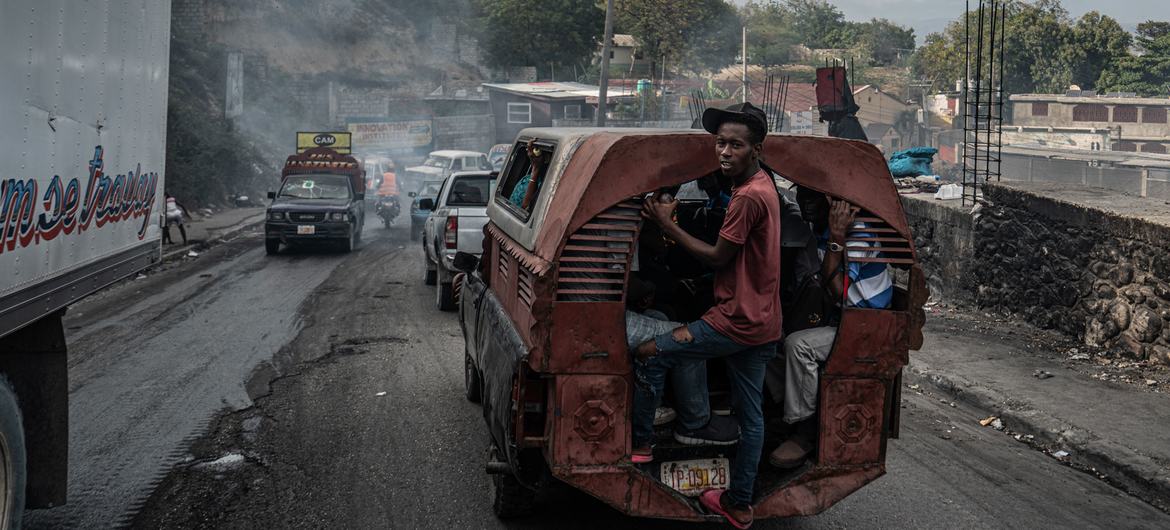
A man hangs onto the back of a bus in the troubled Delmas neighbourhood of Port-au-Prince.
© UNOCHA/Giles Clarke
 
A man hangs onto the back of a bus in the troubled Delmas neighbourhood of Port-au-Prince.


22 April 2024

Peace and Security

As gang violence increases in Haiti, the international community must continue to stand in solidarity with the population, the UN Special Representative for the country told the Security Council on Monday.

“Today, it pains me to note that all speeches and callings had not avoided that some of the worst scenarios for Haiti have become realities in recent months and weeks,” said Maria Isabel Salvador, who also heads the UN mission in Haiti, BINUH.

Speaking from the capital, Port-au-Prince, she said it was impossible to overstate the increase in gang activity in the city and beyond, along with the deterioration of the human rights situation and the deepening of the humanitarian crisis.

Tweet URL
UNDPPA

Last October, the Security Council authorized the deployment of a Multinational Security Support mission (MSS) to assist Haiti’s embattled police force.  

Although more than five million people, roughly half the population, are going hungry and hundreds of thousands have been displaced,  a $674 humanitarian appeal for Haiti is less than nine per cent funded.

Attacks and confrontations

Ms. Salvador recalled that in early March, gangs mounted coordinated attacks against key state infrastructure, including several police stations and two of the main prisons in Port-au-Prince, as well as educational and health facilities, and religious sites. 

They also launched several attacks against the Presidential Palace, sparking violent clashes with the Haitian National Police (HNP), leading to multiple casualties. Furthermore, gang confrontations around the international airport have forced all commercial airlines to halt services.

She noted that roughly 2,500 persons were killed or injured due to gang violence during the first quarter of the year. This represents a 53 per cent increase over the previous reporting period, making it the most violent quarter since BINUH began recording statistics two years ago.

Deploy Multinational Support Mission

Ms. Salvador said the national police - assisted by Haiti’s “modest” Armed Forces of Haiti and advised by BINUH and other international partners - have deployed immense efforts to contain the violence while being targeted by armed gangs. 

“Nevertheless, the severity of the current crisis underscores the gaps in capacity within the national structures and the urgent need for international assistance, namely through the immediate deployment of the MSS,” she said.

On the political front, she noted that Haitian stakeholders have worked to put their differences aside to find a common path towards restoring democratic institutions, including establishing a Transitional Presidential Council following the resignation announcement by President Ariel Henry in March. 

Security critical for progress

A number of other bodies are also expected to be established, including a National Security Council and a Provisional Electoral Council “which is urgently required to set plans in motion for the organization of elections.”

Ms. Salvador noted that despite the recent positive developments on the political front, improving the security situation remains a condition sine qua non for further progress. 

“I cannot stress enough the need to assist Haiti with its efforts to reestablish security,” she said. 

“One and a half years since Haiti requested assistance to enhance security and more than six months since this Council authorized the deployment of the MSS, we must continue to stress the importance of its urgent deployment.”

Catherine M. Russell, Executive Director of the United Nations Fund for Children (UNICEF), briefs the Security Council meeting on the question concerning Haiti.
UN Photo/Eskinder Debebe
 
Catherine M. Russell, Executive Director of the United Nations Fund for Children (UNICEF), briefs the Security Council meeting on the question concerning Haiti.

Children in the crosshairs

Catherine Russell, head of the UN Children’s Fund (UNICEF), appealed for greater support for the humanitarian plan for Haiti.  Of the roughly 5.5 million Haitians who need assistance, three million are children.

She said boys and girls are being injured or killed in the violence each day. Some are being recruited, or join armed groups out of sheer desperation. Recent UNICEF data indicates that anywhere from 30 to per 50 cent of armed groups have children in their ranks.

"Women and girls continue to be targeted with extreme levels of gender-based and sexual violence,” she added.

“Last year, thousands of cases of sexual violence were reported, many of which were perpetrated against children. The true number of cases is likely much higher.”

Humanitarian activities have also fallen victim to the violence as access to the port in the capital has been cut off because of armed group operations in the area.

Ms. Russell said nearly 300 containers of humanitarian supplies are now stranded, including 17 UNICEF containers loaded with nutrition supplements, as well as neonatal, maternal and medical supplies. 

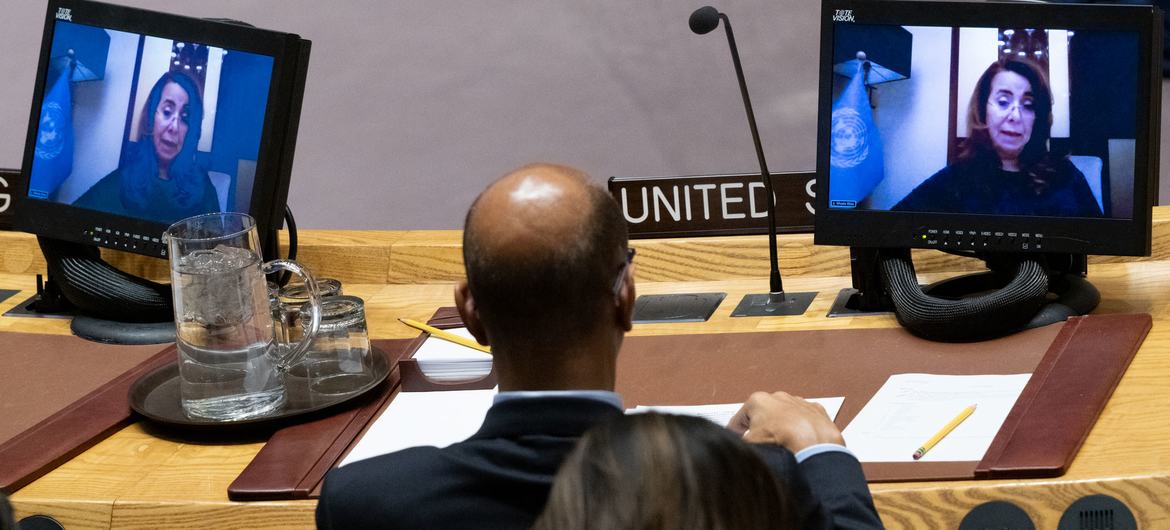
Ghada Waly (on screen), Executive Director of the UN Office on Drugs and Crime, briefs the Security Council meeting on the question concerning Haiti.
UN Photo/Eskinder Debebe
 
Ghada Waly (on screen), Executive Director of the UN Office on Drugs and Crime, briefs the Security Council meeting on the question concerning Haiti.

Stand with Haiti

The Executive Director of the UN Office on Drugs and Crime (UNODC) Ghada Waly, said the violence "is made possible by the continued influx of guns into Haiti and is supported by corruption."

Recent events also suggest concerning signs of collusion between different gangs, she added.

The latest wave of violence saw reported fighting between gangs, but also signs of collaboration between certain groups to carry out attacks.

Furthermore, the attacks targeting key infrastructure were another reminder of the significant increase in firepower that the gangs possess, as weapons continue to flow into Haiti.

“We must stand with Haiti’s institutions and citizens in confronting violence, corruption, and chaos, and in working for a more stable and secure future for the people of Haiti,” she said.


https://news.un.org/en/story/2024/04/1148861


https://creativecommons.org/licenses/by/3.0/legalcode

воскресенье, 14 апреля 2024 г.

Guterres welcomes creation of transitional council in Haiti to choose new leaders


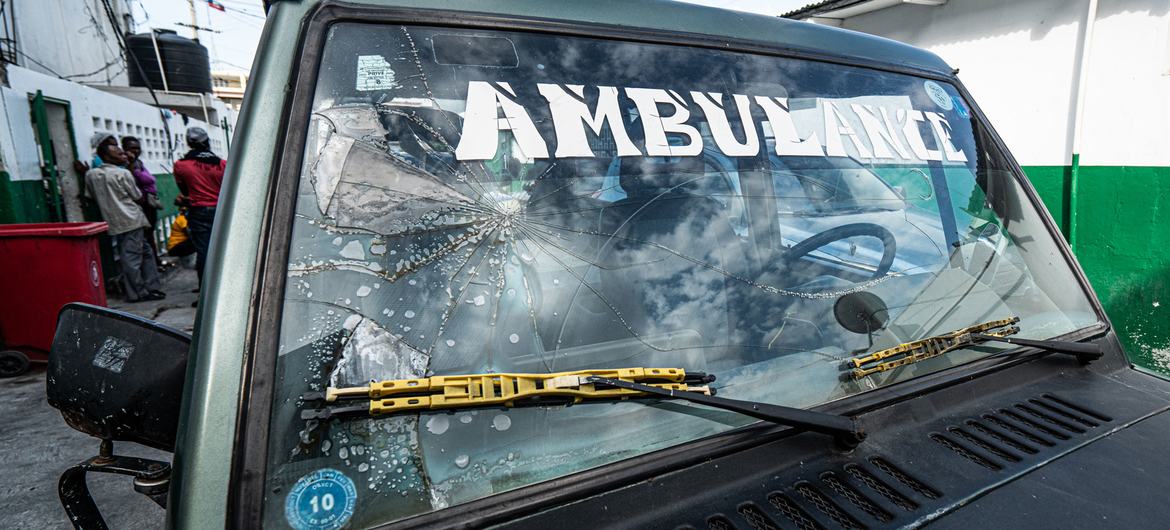
An ambulance at the General Hospital in Port-au-Prince shows signs of being attacked.
© UNOCHA/Giles Clarke
 
An ambulance at the General Hospital in Port-au-Prince shows signs of being attacked.


13 April 2024
Peace and Security

UN Secretary-General António Guterres has welcomed the establishment of a transitional council in Haiti tasked with choosing new political leadership and setting up elections in the crisis-torn Carribean country.

In a statement issued on Saturday by his Spokesman, the UN chief welcomed the publication on Friday, 12 April of a decree formally establishing the Transitional Presidential Council, which is tasked with choosing Haiti’s next prime minister and Cabinet.

“[He] urges all Haitian stakeholders to continue making progress in putting in place transitional governance arrangements, including the timely appointment of an interim Prime Minister and government, and the nomination of the members of the Provisional Electoral Council,” said the statement.

Further, the statement said Mr. Guterres takes note of the functions of the Transitional Presidential Council, including working with all members of the international community to accelerate the deployment of the Multinational Security Support (MSS) mission authorized last year by the UN Security Council.

“He reiterates his call on all Member States to contribute to the MSS,” the statement concluded.

Amid a political vacuum, Haiti’s powerful and well-armed gangs have launched coordinated attacks on various targets since February, including police stations, prisons, airports, and seaports, resulting in the resignation in March of Prime Minister Ariel Henry.

Even as the capital, Port-au-Prince, and much of the surrounding area remains in the grip of rampaging gangs, UN humanitarians are continuing to offer emergency aid to those impacted.

Recently, the World Food Programme (WFP) provided 19,000 meals to displaced civilians in Port-au-Prince, and school lunches to 200,000 children in other provinces.


https://news.un.org/en/story/2024/04/1148541


https://creativecommons.org/licenses/by/3.0/legalcode

понедельник, 8 апреля 2024 г.

Getting children back to school in deadly gang-ravaged Haiti


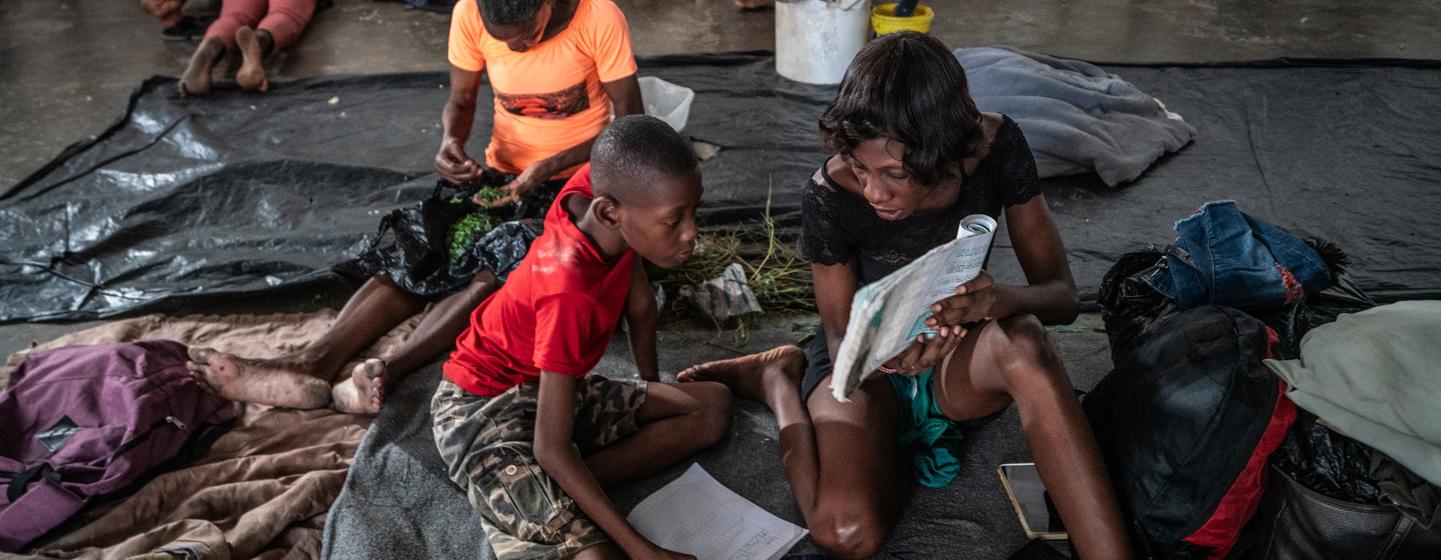
A mother helps her child to study at the Delmas 4 Olympique Boxing Arena where they are now sheltering.


© UNOCHA/Giles Clarke
 
A mother helps her child to study at the Delmas 4 Olympique Boxing Arena where they are now sheltering.


7 April 2024

Culture and Education

Against the backdrop of a humanitarian crisis and gang violence in Haiti, UN agencies are warning that children are suffering not just from a lack of schooling but also through witnessing violence.

Students in the capital Port-au-Prince have missed hundreds of hours of class time over the past year and now, now, more than one million Haitians are facing emergency levels of acute food insecurity, according to a new UN-backed report.

As deadly threats to school security continue in Port-au-Prince, and northern parts of the Artibonite department, UN News examined the situation on the ground and how the UN is responding to the worsening educational crisis.

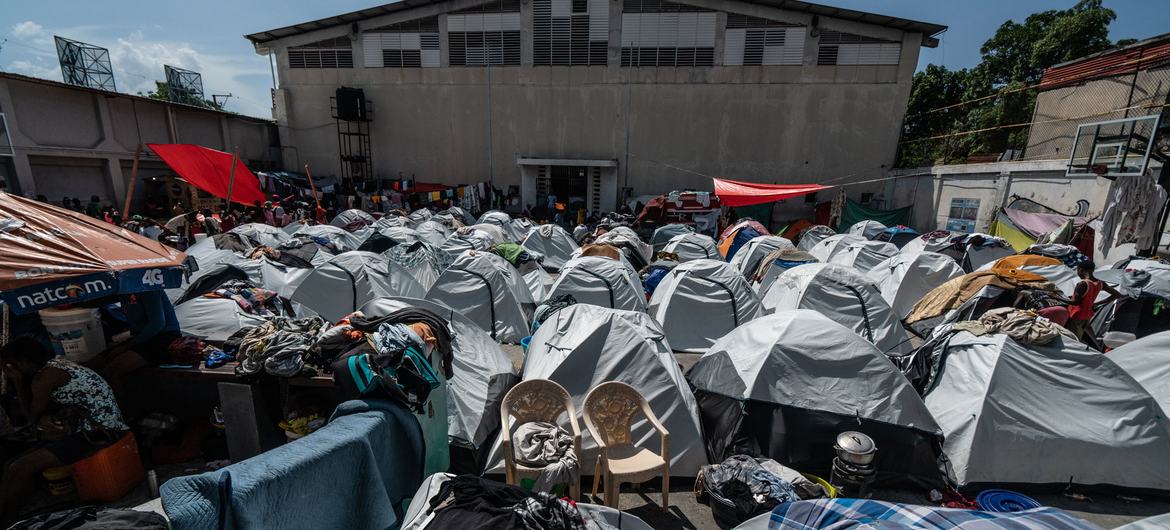
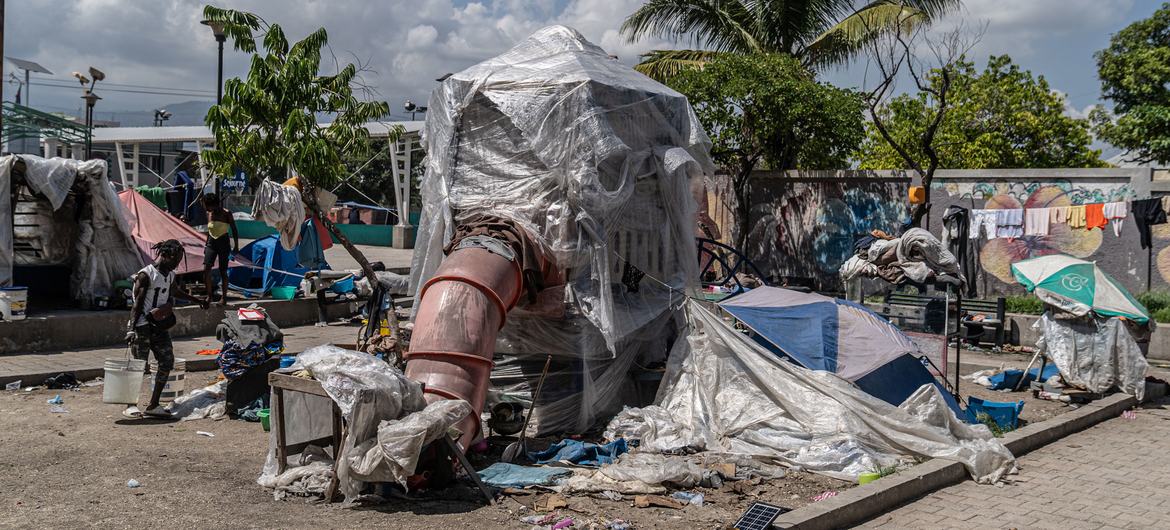
Tents for people who have fled their homes now occupy Gymnasium Vincent, a school and sports complex in downtown Port-au-Prince.
© UNOCHA/Giles Clarke
 
Tents for people who have fled their homes now occupy Gymnasium Vincent, a school and sports complex in downtown Port-au-Prince.

Massive school closures

By the end of January, a total of 900 schools had temporarily closed mainly in Port-au-Prince, depriving around 200,000 children of their right to education, according to UN Children’s Fund (UNICEF).

Many other schools abruptly shut in Port-au-Prince in late February, when armed gangs coordinated breakouts in jails, freeing around 4,500 prisoners.

Gangs reportedly now control 80 to 90 per cent of the capital, and in the ensuing chaos, UN agencies on the ground reported cases of armed groups recruiting children, spiralling violence, looting and destruction.

“The Haitian population is caught in the crossfire,” said Catherine Russell, head of UNICEF. “Spaces for children have been transformed into battlegrounds. Each passing day brings new deprivations and horrors to the people of Haiti.”

Basic security is urgently needed for the lifesaving services and for aid workers to reach those in desperate need, she said, calling for the protection of schools, hospitals and other critical infrastructure children rely on and for safeguarding humanitarian spaces.

A children’s playground structure becomes a shelter for people in the Tabarre area of Port-au-Prince, Haiti.
© UNOCHA/Giles Clarke
 
A children’s playground structure becomes a shelter for people in the Tabarre area of Port-au-Prince, Haiti.

Classrooms become home

As of late March, violence had displaced at least 362,000 people, with many trapped in the besieged capital and thousands finding temporary shelter in public buildings, including schools.

Each classroom turned into a temporary home for multiple families. Playgrounds became tented shelters. Gymnasiums were transformed into open dormitories for those seeking safety.

“Many schools are not accessible as violence is ramping up around them,” said UNICEF’s representative in Haiti, Bruno Maes. “Some are occupied by gangs, others by displaced people and still more have been looted or destroyed.”

Soundcloud

On the afternoon of 25 March, heavily armed groups entered a downtown Port-au-Prince school and set fire to 23 classrooms. Aid agencies condemned the incident

In another incident in the Port-au-Prince neighbourhood of La Saline, 3,500 children were trapped in two schools as gangs fought around them. UNICEF engaged with the armed groups for four days before they could secure the safe release of the children.

UNICEF has urged all parties to safeguard students, educators, parents and educational infrastructure in line with the Safe Schools Declaration, a global political commitment endorsed by 119 countries, including Haiti, for better protection measures and support for continuing education during armed conflicts.

Bruno Maes (centre), the UNICEF representative in Haiti, visits a school in Artibonite.
© UNICEF/Herold Joseph
 
Bruno Maes (centre), the UNICEF representative in Haiti, visits a school in Artibonite.

Terrorised and traumatised 

“The situation is desperate for children,” said UNICEF’s Mr. Maes. “Children are killed, wounded, raped, displaced and denied access to basic services, including school,” adding that they are “terrorised and traumatised”, some after witnessing burnt bodies on the streets.

Amid the very clear dangers, parents “still want to send their children to school”, he said. “Education is at the heart of every Haitian family; people put a very high value on it.” 

As gangs continue to expand their control of vital roads and ports, their grip is extending outside the capital and the threat to school safety is mounting.

Despite this, the majority of schools outside the troubled gang-controlled areas of Port-au-Prince and Artibonite are still functioning. Many have admitted children who have fled because of violence and insecurity, although some parents are unable to pay school fees due to increasing poverty.

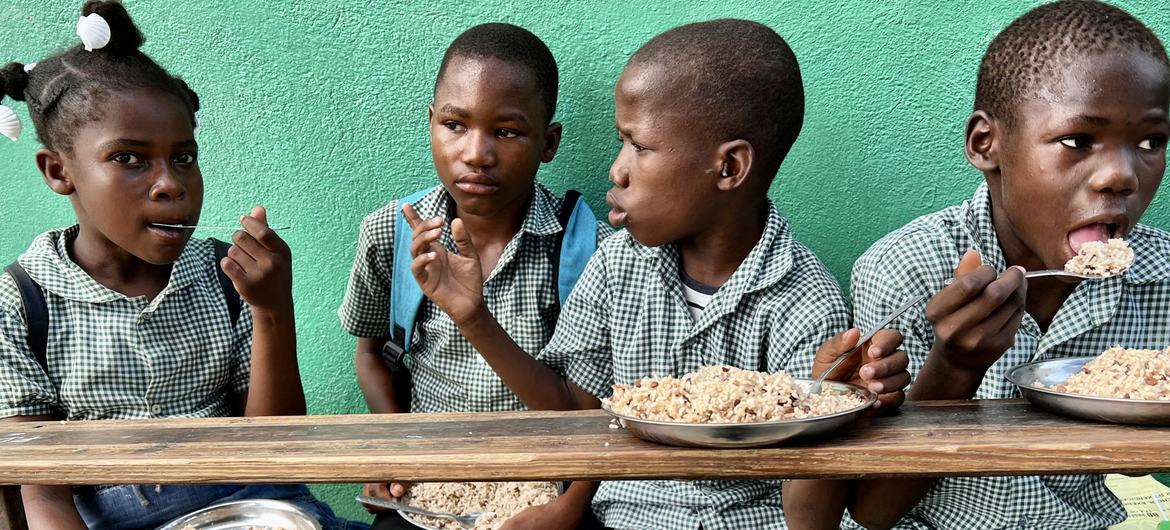
Children in Haiti eat a meal provided as part of WFP's school feeding programme.
© WFP/Jonathan Dumont
 
Children in Haiti eat a meal provided as part of WFP's school feeding programme.

Multipronged response

UN agencies have been working together to provide lifesaving essentials, like food, water and shelter, to thousands of Haitians in need and helping to get children back to school using new approaches.

Efforts include an International Organization for Migration (IOM) initiative currently providing psychosocial support to students forced out of school by the violence, and the World Food Programme (WFP) supports hot meals for 250,000 children across the country.

Part of UNICEF’s work is assisting families affected by violence and displacement to reintegrate children into formal education. Where this is not feasible, the agency works with partners to establish alternative, safe and temporary learning environments.

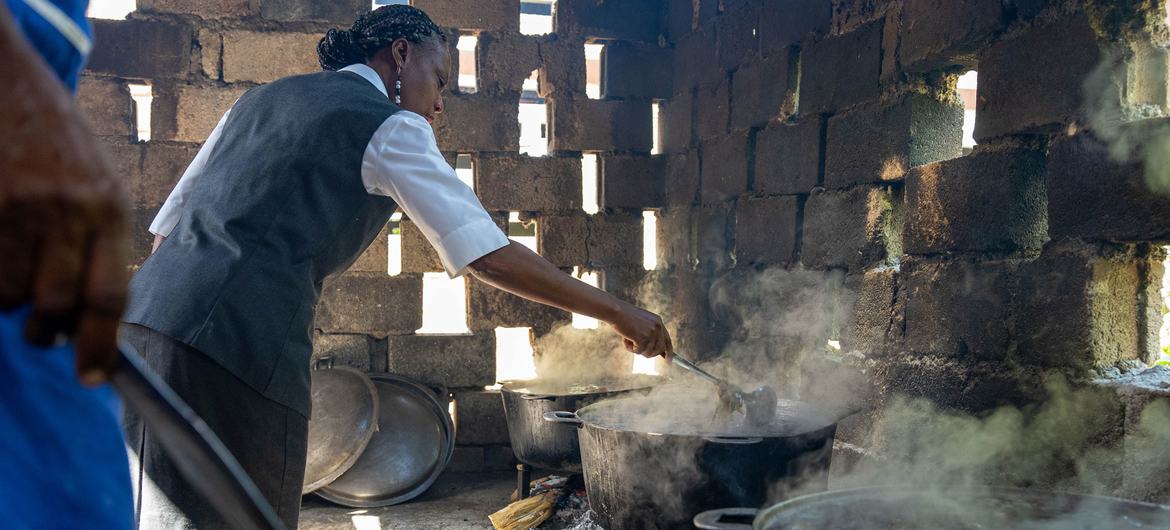
Volunteers prepare school meals with locally-grown ingredients in Gonaives, in northwestern Haiti.
© WFP/Pedro Rodrigues
 
Volunteers prepare school meals with locally-grown ingredients in Gonaives, in northwestern Haiti.

Redefining schools

The goal is to get children back to learning and into school meal programmes, according to a UNICEF report, published in French in late March.

If schools remain shuttered, distance learning can be deployed via radio, television and e-learning platforms. UNICEF is collaborating with the Ministry of Education to find a way to deliver this via Radio Télé Éducative (RTE) broadcasts on Haiti’s national radio station.

Other opportunities for engaging students during the crisis include boosting capacities at schools currently accommodating displaced pupils.

Learn more about what the UN is doing to help Haiti in our explainer here.


https://news.un.org/en/story/2024/04/1148306


https://creativecommons.org/licenses/by/3.0/legalcode