четверг, 3 октября 2024 г.

‘Deadly Cycle of Tit-for-Tat Violence Must Stop,’ Demands Secretary-General, as Security Council Takes Up Situation in Middle East


9738th Meeting (AM)
SC/15841

‘Deadly Cycle of Tit-for-Tat Violence Must Stop,’ Demands Secretary-General, as Security Council Takes Up Situation in Middle East

Israel is Not Above the Law, Must Be Held Accountable, Says Delegate

Amid growing fears of an all out war in the Middle East following recent days’ escalation and exchange of hostilities, United Nations Secretary-General António Guterres today reiterated his appeals for a ceasefire in Gaza, a cessation of hostilities in Lebanon and an end to the violence in the region during another Security Council emergency meeting.

“The raging fires in the Middle East are fast becoming an inferno,” warned the Secretary-General, who exactly one week ago briefed the 15-member organ about the alarming situation.  Lamenting the escalating tensions along the Blue Line and repeated violations of Council resolution 1701 (2006), with “almost daily exchanges of fire by Hizbullah and other non-State armed groups in Lebanon and the Israel Defense Forces”, he stressed that “Lebanese sovereignty and territorial integrity must be respected”. 

“I again strongly condemn yesterday’s massive missile attack by Iran on Israel,” he stressed, noting that such condemnation should have been obvious in the condemnation he expressed on 1 October.  Pointing to the temporary ceasefire proposed by the United States and France to allow for the restart of negotiations, he said, “Israel refused that proposal and stepped up its strikes, including bombing the Hizbullah headquarters where its leader was killed” and conducting a “limited incursion” into southern Lebanon, while “Hizbullah has continued rocket and missile attacks on Israel”.

“This deadly cycle of tit-for-tat violence must stop,” he stressed.  Underscoring that “civilians are paying a terrible price”, with more than 1,700 killed and 364,000 displaced in Lebanon since October 2023, he urged the international community to fully fund the UN’s humanitarian appeal.  Recalling the “atrocious 7 October acts of terror by Hamas”, he said:  “Israel has conducted in Gaza the most deadly and destructive military campaign in my years as Secretary-General”.  As Israel continues its military operations, settlement construction, evictions and land grabs in the occupied West Bank, armed Palestinian groups and Hamas engage in violence, with the latter launching terror attacks that on 1 October killed seven Israelis in Jaffa, he added.

“It is high time for an immediate ceasefire in Gaza, with the immediate and unconditional release of all hostages, the effective delivery of humanitarian aid to Palestinians in Gaza and irreversible progress to a two-State solution,” he emphasized, urging also a cessation of hostilities in Lebanon and “real action” towards full implementation of Council resolutions 1559 (2004) and 1701 (2006) to facilitate diplomatic efforts towards sustainable peace.

In the ensuing debate, speakers echoed the Secretary-General’s grave concern about a war that could engulf the region and pleas for an end to the violence, with several Council members condemning Iran’s ballistic missile attacks on 1 October against Israel and reiterating their steadfast support of Israel’s right to self-defence.

Among them was the representative of France, who requested the meeting and stated that his country “has mobilized its military means in the Middle East to fend off the Iranian threat”.  He called on Iran to abstain from any action that could lead to further destabilization in the region and voiced opposition to any Israeli land aggression in Lebanon.  Further, he urged the parties to consider the France-United States proposal to bring about a ceasefire towards a diplomatic resolution of the conflict.

Similarly, the United Kingdom’s representative called on Iran and its allies to exercise restraint and “step away from the brink”.  She urged both Israel and Hamas to agree to “the ceasefire deal on the table” and called for implementation of a political plan in line with Council resolution 1701 (2006).

“This is the moment for this Council to speak out with one voice and condemn Iran for its unprovoked attack against another Member State and […] to impose serious consequences on the IRGC [Islamic Revolutionary Guard Corps] for its actions,” stressed the representative of the United States, pointing to the Islamic Revolutionary Guard Corps’ support of terrorism and disregard for many of the Council’s resolutions.  Affirming her country’s support for Israel, she said:  “Our actions have been defensive in nature.  The Iran regime will be held responsible for its actions.”

In a similar vein, Israel’s representative said that Iran, in launching on 1 October the largest ballistic missile attack in history, relinquished any deniability and claimed full ownership over Hizbullah’s actions.  Recounting Hizbullah’s crimes over time, including its targeting of fellow Muslims, he said:  “Iran for years has armed terrorists in tyrannical regimes, and their weapons are responsible for the deaths of countless civilians across the globe.”

He demanded immediate crippling sanctions on Iran and the designation of the Islamic Revolutionary Guard Corps as a terrorist organization.  Criticizing Council inaction over Israel’s repeated warnings of the threat posed by Iran, he said that Tehran is “an enemy to all civilized nations”.  “Israel will defend itself; we will act.  The consequences Iran will face for their actions will be far greater than they could have ever imagined,” he warned.

Countering that assertion, Iran’s representative said:  “The apartheid and occupying regime of Israel has continued its brutality in occupied Palestine with full impunity — and now this regime is extending its aggressive war to Lebanon.”  Israel has no intention of pursuing peace or a ceasefire, while the United States, United Kingdom and certain Western States have “given a carte blanche to this aggressive terrorist regime for all sorts of sinister behaviour”.

Iran’s launch on 1 October of a series of missile strikes targeting the military and security positions of the Israeli regime was in full accordance with the inherent right to self-defence under Article 51 of the Charter of the United Nations, he stressed, condemning Council inaction on flagrant breaches of Iran’s sovereignty and territorial integrity.

Lebanon’s representative supported that view, noting the Israeli forces and rows of battle tanks all along the southern borders of his country.  The Israeli Government has ratified the ground invasion of Lebanon, which started on the evening of 1 October, following 11 months of barbaric aggression that spared no civilians, and thus its “claims of a limited surgical military operation” are untrue.

Representatives of other Arab States also took the floor to voice their dismay at Council inaction over the past year and reiterate their calls on the organ to stop Israel’s aggression on Palestinians and States in the region.

“Israel is not above the law, and we must hold it accountable,” emphasized Algeria’s representative, calling for an immediate ceasefire in Gaza and the end of Israeli occupation of Arab lands. The Council must adopt binding resolutions to ensure an immediate ceasefire as it did in other conflicts around the world — as its failure to fulfil its responsibility to maintain international peace and security opens the door for Israel to persist in its violations without any real deterrent, stressed Iraq’s delegate, while Syria’s representative pointed to the reluctance of the United States to “stop this Israeli madness”.

Echoing Arab States’ rebuke of Israel were the representatives of China and the Russian Federation, with the latter pointing out that Israel continued its brutal campaign in Gaza, despite overwhelming demands to stop it, as its American accomplices paralysed deliberations in the Security Council.  On Israel’s declaring of the UN Secretary-General as “persona non grata”, he called on the Organization to respond to the “outrageous act”, which he called “a slap on the United Nations and all of us”.

The representative of Switzerland, Council President for October, speaking in her national capacity, voiced concern about the endangered lives of civilians.  International humanitarian law must be respected by all parties in all circumstances and irrespective of the lawfulness of the use of force.  This includes strict compliance with the principles relating to the conduct of hostilities, such as the distinction between civilians and combatants, proportionality, and precaution in attack, she added.

Guyana’s delegate stressed that the safety and security of all UN and humanitarian personnel, including those attached to the United Nations Interim Force in Lebanon (UNIFIL), must be guaranteed.  Guyana appeals for a renewed investment in peace over aggression.

Like the delegates of Mozambique and Japan, Malta’s delegate warned that escalating hostilities are “only paving the way towards a bleak and desolate future for the entire region”.  “We cannot be silent in light of this deterioration,” she stressed.  Striking a similar tone, the delegate of the Republic of Korea called on the Council to “unite and act”.

“It is now on us, the 15 seated at this table, to unite in our call for an all out ceasefire,” declared the representative of Slovenia.  “We call on all countries and actors to show restraint.  Everyone with influence must exert it,” she added, a plea later echoed by Ecuador’s delegate.

Similarly, Sierra Leone’s delegate, warning that the “ping‑pong retaliatory attacks” in the Middle East can lead to “a mutually assured destruction”, urged the Council to act decisively to halt the violence, enforce a ceasefire and work for the release of hostages and prisoners.  He also called for an end to the occupation of Palestine and for the implementation of the two-State solution.

Italy’s representative, answering the urgent call for diplomacy, said his country, also as Group of Seven rotating President, will continue to work for a diplomatic solution.  With the brutal attacks perpetrated by Hamas on 7 October, the ensuing conflict in the Gaza Strip and the extremely worrisome situation in Lebanon originated by Hizbullah’s continued attacks on Israel, “relaunching the political process has become more urgent than ever”, he stressed.


https://press.un.org/en/2024/sc15841.doc.htm


https://creativecommons.org/licenses/by/4.0/legalcode

Avoid ‘All-Out War’ in Lebanon, Stop ‘Tit-for-Tat Violence’ Engulfing Middle East, Secretary-General Tells Security Council


SG/SM/22400


Following are UN Secretary-General António Guterres’ remarks at the Security Council meeting on the situation in the Middle East, in New York today:

The raging fires in the Middle East are fast becoming an inferno.  Exactly one week ago, I briefed the Security Council about the alarming situation in Lebanon.  Since then, things have gone from bad to much, much worse.

As I told the Council last week, the Blue Line has seen tensions for years.  But since October, exchanges of fire have expanded in scope, depth and intensity.

I stated that the almost daily exchanges of fire by Hizbullah and other non-State armed groups in Lebanon and the Israel Defense Forces are in repeated violation of Security Council resolution 1701 (2006).

I emphasized that the daily use of weapons by non-State armed groups is in violation of Security Council resolutions 1559 (2004) and 1701 (2006).

And I stressed that Lebanese sovereignty and territorial integrity must be respected and the Lebanese State must have full control of weapons throughout Lebanon.

In the few short days since then, we have seen a dramatic escalation — so dramatic that I wonder what remains of the framework this Council established with resolution 1701 (2006).

Israeli forces have conducted relentless air strikes across Lebanon — including Beirut.

The United States and France — with the support of several other countries — have proposed a temporary ceasefire, allowing for the restart of negotiations.

Israel refused that proposal and stepped up its strikes, including bombing the Hizbullah headquarters where its leader was killed.

Hizbullah has continued rocket and missile attacks on Israel.

And yesterday, the Israel Defense Forces conducted what it stated were “limited incursions” into southern Lebanon.

UNIFIL [United Nations Interim Force in Lebanon] peacekeepers remain in position, and the UN flag continues to fly despite Israel’s request to relocate [it].

I reiterate our deep appreciation to the military and civilian members of our UN peacekeeping force — UNIFIL — and to troop-contributing countries.  The safety and security of all UN personnel must be ensured.

Civilians are paying a terrible price — which I utterly condemn.  Since last October, more than 1,700 people have been killed in Lebanon — including over 100 children and 194 women.

Over 346,000 people are confirmed to have been displaced from their homes.   Government estimates put this number as high as 1 million.  Another 128,000 people — both Syrian and Lebanese — have crossed into Syria.

The UN has mobilized all its capacities to provide urgent humanitarian aid in Lebanon and I ask the international community to fully fund our appeal.

Since 8 October 2023, Hizbullah attacks on Israel have killed 49 people — with over 60,000 people displaced from their homes.

It is absolutely essential to avoid an all-out war in Lebanon which would have profound and devastating consequences.

Yesterday, Iran launched approximately 200 ballistic missiles towards Israel.  It stated it was in response to the killings of Hassan Nasrallah and the Islamic Revolutionary Guards Corp commander, Abbas Nilforoushan, last week — as well as that of the Hamas leader, Ismail Haniyeh, in Tehran in July.

Millions of people across Israel and the Occupied Palestinian Territory were forced to seek shelter.  One person was killed from the Iranian strikes — a Palestinian in the occupied West Bank.

As I did in relation to the Iranian attack in April – and as should have been obvious yesterday in the context of the condemnation I expressed — I again strongly condemn yesterday’s massive missile attack by Iran on Israel.

These attacks paradoxically do nothing to support the cause of the Palestinian people or reduce their suffering.

Almost one year has passed since the atrocious 7 October 2023 acts of terror by Hamas and the taking of hostages.

Since last October, Israel has conducted in Gaza the most deadly and destructive military campaign in my years as Secretary-General. The suffering endured by the Palestinian people in Gaza is beyond imagination.

At the same time, the situation in the occupied West Bank, including East Jerusalem, continues to deteriorate with Israeli military operations, construction of settlements, evictions, land-grabs and intensification of settler attacks — progressively undermining any possibility of a two-State solution.

And simultaneously, armed Palestinian groups have also used violence.  Hamas has continued to launch rockets, and just yesterday seven Israelis were killed in a terror attack in Jaffa.

The events of the past week, the past month and indeed nearly the past year make it clear:

It is high time for an immediate ceasefire in Gaza, with the immediate and unconditional release of all hostages, the effective delivery of humanitarian aid to Palestinians in Gaza and irreversible progress to a two-State solution.

It is high time for a cessation of hostilities in Lebanon, real action towards full implementation of Security Council resolutions 1559 (2004) and 1701 (2006), paving the way for diplomatic efforts for sustainable peace.

It is high time to stop the sickening cycle of escalation after escalation that is leading the people of the Middle East straight over the cliff.

Each escalation has served as a pretext for the next.  We must never lose sight of the tremendous toll that this growing conflict is taking on civilians.

We cannot look away from systematic violations of international humanitarian law.  This deadly cycle of tit-for-tat violence must stop.  Time is running


https://press.un.org/en/2024/sgsm22400.doc.htm


https://creativecommons.org/licenses/by/4.0/legalcode

среда, 2 октября 2024 г.

Press Conference by Security Council President on Programme of Work for October


    The Security Council’s programme in October will feature two regular open debates and one signature event, alongside five important mandate renewals, its President for the month said at a Headquarters press conference today.

    Pascale Christine Baeriswyl of Switzerland, which holds the 15-member organ’s rotating presidency for October, said her country was convening only one additional signature event, given that the month was “traditionally the busiest of the year”, and that it is taking up the mantle of the organ at a time when “very serious escalation risks” are cropping up in several parts of the world.  The signature event in question is a briefing on 21 October on the impact of scientific developments on international peace and security, to be chaired by Ignazio Cassis, the Head of the Federal Department of Foreign Affairs of Switzerland, she said.

    The second signature event, the annual open debate on women, peace and security, on 24 October, will be chaired by the President of the Swiss Confederation, with briefings by United Nations Entity for Gender Equality and the Empowerment of Women (UN-Women) Executive Director Sima Sami Bahous and civil society representatives.  The event, titled “Women Building Peace in a Changing Environment”, would draw from insights from a retreat of women mediators from all over the world, held by her country earlier in 2024, she added.

    A quarterly open debate on 29 October will address the situation in the Middle East, including the Palestinian question, she said, adding that discussions on the topic will be needed well before that date, “given recent developments on the ground”.

    Also highlighting an annual briefing on the collaboration between the United Nations and the African Union, which kicked off the packed calendar for the month on 2 October, she said the event will be followed up by a “fireside chat” in upstate New York on 17 October on the implementation of Council resolution 2719 (2023), in which African Union youth ambassadors would participate.  She voiced hope that a joint communiqué would be subsequently adopted. 

    On 27 October, the Council will hold its annual private meeting with the President of the International Court of Justice, Judge Nawaf Salam.  The interaction between the two organizations would focus on how it could have a “stronger preventative role”, given that the international community was turning to the Court more than ever in these times, she added.

    Other briefings during the month would focus on Yemen, Somalia, Libya, Sudan, the Central African Republic, Haiti and Colombia, she went on, adding that “at least a Foreign Minister” would be participating in the latter, a quarterly briefing which would include the mandate renewal of the UN Verification Mission in the country.  There would also be “high-level attendance” at the briefing on 30 October on the United Nations Interim Administration Mission in Kosovo (UNMIK), she added.

    Asked why no meetings were scheduled on Ukraine, when “a lot is happening that is not good”, she replied that meetings on that country would be scheduled when the penholders asked for them. “We will have some soon,” she added.

    Responding to a flurry of questions from correspondents on the unfolding situation involving missile launches by Iran against Israel following the latter’s ground incursion into Lebanon, she said that her delegation was following the rapidly evolving situation and its escalation with “great concern”.  In response to a follow-up question on the same topic, she said that any remarks she made may not be adequate in two hours given that “the situation is evolving rapidly”. Nonetheless, she emphasized, “The urgency is a ceasefire; a cessation of hostilities.”

    Asked by a Lebanese correspondent whether Council resolution 7001 (2006) and Council resolution 1559 (2004), adopted in response to conflicts in her country, were “totally obsolete” in light of Israel’s recent invasion, she said that what was urgently needed was the implementation of these instruments, not new resolutions.  “Like in many contexts, these instruments, if respected, would lead to a durable cessation of hostilities,” she said, adding that both resolutions remained in place, and needed to be respected and implemented.

    Questioned about the Council’s credibility given its failure to produce any “concrete output” on Israel’s hostilities in Gaza, which had spread to Lebanon and Syria, she said that the organ decided four resolutions on the matter, although it was contending with a “huge implementation crisis”.  “We need Security Council resolutions and credible threat to all actors, that there will be consequences if resolutions are not implemented,” she said, adding:  “We need big powers to be credible when they act, and interact.”  While it is frustrating that people are dying while resolutions are not implemented, she asserted that the Council and its diplomacy are “not useless”, pointing out that emergency meetings on the polio campaign in Gaza helped save children’s lives.

    Pressed further on the Council’s inability to bring about peace in Gaza as a new war threatens to break out in Lebanon, in light of meetings held outside the United Nations by the United States, Qatar and Egypt, she said, “Everything which can support forging peace is welcome.”  The Council is a powerful instrument and should be reformed, she said, echoing frustration that it was unable to stop the ongoing escalation. However, she added:  “In a divided world where international law is so systematically disrespected, a policy organ cannot alone change the course of history.”

    For information media. Not an official record.

    https://press.un.org/en/2024/241001_sc.doc.htm


    https://creativecommons.org/licenses/by/4.0/legalcode

    вторник, 1 октября 2024 г.

    Leaders Call for More Just Global Order, Equitable Resource Distribution, as General Assembly Concludes Its Debate


    Seventy-ninth Session,
    17th Meeting (AM)
    GA/12640


    ‘There Cannot be War in Lebanon, Full Stop’, Underlines Foreign Minister, Noting that Suffering on All Sides Must End

    Ministers and delegates emphasized the need for a just global order, equitable resource distribution and global financial reform, while decrying the ongoing unilateral actions that undermine the dignity and development of poorer nations as they concluded the annual high-level general debate.

    Since 26 September, Heads of State and Government, as well as ministers, took the rostrum, taking stock of the state of the world as the General Assembly launched its seventy-ninth session.

    Philémon Yang (Cameroon), President of the General Assembly for the current session, delivered closing remarks, noting that, in the general debate, the organ heard from 190 Member States, including contributions from 71 Heads of State and 53 Ministers.  However, it was disappointing and unacceptable that only about 10 per cent of the speakers were women, he noted.  “This glaring disparity speaks to a deeper issue that we cannot ignore,” he said, underlining the need to “do far better on gender equality”.

    Drawing attention to the extremely dramatic escalation of violence between Israel and Hizbullah in Lebanon, he urged:  “The world must not allow an all-out war to happen in this volatile region.”  Calling on all parties — Israel, Hamas and Hizbullah — to urgently conclude a ceasefire, he said that all States supplying weapons to the region must desist from such actions.  “No sustainable peace will be achieved militarily,” he asserted.

    Echoing the call for de-escalation, Mélanie Joly, Minister for Foreign Affairs of Canada, said:  “There cannot be war in Lebanon.  Full stop.”  “The suffering — on all sides — must end,” she stressed, urging Israel and Hizbullah to accept an immediate ceasefire.  Highlighting the issue of gender equality, she called it “unacceptable” that “for nearly 80 years, no woman has occupied the position of Secretary-General”.  She said that the next leader of the United Nations must be a woman, expressing hope that delegates at the General Assembly in 2025 will address Madam President.  “We, women, have the right to be equal in everything:  education, in employment and every other opportunity,” she stressed.

    “We will not be silent ever.  We denounce and condemn the genocide that the Government of Israel and its ‘First World’ allies have committed, commit and continue to commit against the glorious people of Palestine, against the courageous people of Lebanon and against so many other brave, valiant, dignified people,” said Valdrack Ludwing Jaentschke Whitaker, Minister for Foreign Affairs of Nicaragua.  Underscoring the scourge of climate change on the developing countries, he voiced solidarity with all countries and peoples “affected by barbarism and the brutality which was unleashed and is being unleashed against our Mother Earth and our resources”.  Climate change is none other than selfishness and the pillaging of our earthly resources, he added.

    Elaborating further on the destructive impacts of climate change, Seán Fleming, Minister of State of Ireland, pointed out that those who have contributed least to climate change are among the most vulnerable to its impacts.  “We need collective action, at speed and at scale, to avert the most catastrophic impacts of the climate crisis,” he said, adding that Ireland’s international development budget is at record levels and, per capita, it is one of the strongest providers of humanitarian assistance.

    Among the delegates who emphasized the impact of external actions and lack of global cooperation on the growth and prosperity of nations was Albert Shingiro, Minister of Foreign Affairs and Development Cooperation of Burundi, who said:  “We condemn all those who attach political conditions to development aid while at the same time forgetting that the world is multipolar.”  Unilateral measures destroy the social fabric of countries they are imposed upon, he said, noting that the only path towards true independence requires economic independence.  Pointing out the Government’s plan to put the country on track to be a developed country by 2060, he added:  “Peace without development is a mere pipe dream.”

    Addressing the exploited peoples — peoples left behind — Bakary Yaou Sangaré, Minister for Foreign Affairs, Cooperation and Nigeriens Abroad of Niger, said that it is not the affluent countries that will be finding solutions for them.  “I affirm that these solutions are within us — they consist in refusing to demean ourselves by begging for aid,” he emphasized, calling for partnerships in which natural resources are paid for at the price that they deserve.  “My country is willing to sign partnership agreements with foreign investors based on the principle of win-win cooperation while respecting the dignity of our peoples, which have until now been left behind,” he said.

    Several leaders also highlighted inequalities in the global financial architecture that disproportionately benefits wealthier nations and leaves developing countries struggling to access financial resources.

    The representative of Sri Lanka said that many developing countries face a debt crisis that prevents sustainable development.  “It is a fact that financing challenges remain at the heart of the sustainable development crisis,” he added, calling for reform of the global financial architecture and a more equitable way to address debt.

    Adding to that, the representative of Rwanda stressed that African countries and other marginalized regions have for too long borne “the brunt of global economic shocks without sufficient support from the international community”.  “Security is not only achieved by silencing the guns — it is also achieved by building a fit-for-purpose global governance system,” he said, adding that reform of multilateral financial institutions is complementary to the reform of the Security Council, as both are crucial for creating a more equitable and effective global governance system.

    Statements

    BASSAM SABBAGH, Minister for Foreign Affairs and Expatriates of Syria, noting that tensions internationally have reached a boiling point, pointed out the “disgraceful use of modern technologies as deadly tools to sow death and destruction”.  He accused some countries of draining resources, stealing and imposing unilateral coercive measures that “impoverish and destroy”, instead of investing in achieving sustainable development for all.  Painting a grim picture of Syria’s suffering over the past decade — terrorism, economic blockades and media incitement — he said the country continued its war on terrorism while providing for its people.  Pointing out the failure of the Security Council to end the ongoing Israeli occupation of the Arab territories since 1967, including the Syrian Golan, he said that it has “revealed the true intentions of the collective West”.  “It is a damning proof that the United States has prevented the Council from fulfilling its responsibility,” he said.

    He condemned the Israeli aggression against the Palestinian people and attempts to liquidate United Nations Relief and Works Agency for Palestine Refugees in the Near East (UNRWA), adding:  “We stress the need to hold Israel accountable for the war crimes it is committing”.  Sounding alarm over the unpredictable consequences of the “unfettered by any restrictions” Israeli aggression — with attacks on Syria and Lebanon — he committed to recovering the occupied Syrian Golan, which “is an occupied Syrian territory”. Accusing “certain Western countries” of their interference in Syria, particularly the United States’ illegal military presence and support for separatist groups, as well as the looting of Syria’s natural resources, he demanded “the immediate, full and unconditional lifting of unilateral coercive measures as they amount to a collective punishment of people and a form of economic terrorism”.

    Outlining Syria’s reconstruction efforts, he highlighted the fight against terrorism, pursuit of national reconciliation, facilitation of humanitarian access and support for the return of refugees, while putting a special emphasis on the country’s engagement with the relevant political initiatives as well as on the path of dialogue, diplomacy and international cooperation.  As Syria “heals the wounds”, he stated that the success of these efforts requires “the collective West to stop politicizing humanitarian work and linking it to political conditionality”.  Calling for a Middle East free of weapons of mass destruction, he urged Israel to disarm its nuclear arsenal.

    VALDRACK LUDWING JAENTSCHKE WHITAKER, Minister for Foreign Affairs of Nicaragua, warned that the world is not on a journey to peace. “Every day, we lose heart, we lose our soul,” he added.  “We will not be silent ever.  We denounce and condemn the genocide that the Government of Israel and its ‘First World’ allies have committed, commit and continue to commit against the glorious people of Palestine, against the courageous people of Lebanon and against so many other brave, valiant, dignified people,” he went on to say.  Nicaragua will not yield to brutality.  “We will never be silent,” he stressed, also reiterating:  “We denounce and condemn the aggressions against Syria, Iran and against all other great peoples in their struggles.”

    Nicaragua would defend the principles of sovereignty and independence, the legitimate models of institutions and “our models of self-governance”, he went on to say.  “We stand shoulder to shoulder with all countries and peoples affected by barbarism and the brutality which was unleashed and is being unleashed against our Mother Earth and our resources that is causing what we know today as climate change,” he said.  Climate change is none other than selfishness and the pillaging of our earthly resources.  That pillaging has created myriad disasters, “disasters which are not natural”, disasters which require climate justice, “disasters that have been imposed upon us by selfish slave masters”.

    To the invaders and interventionists “that are dressed in sheepskin, that have the faces of wolves … we say we are people rich in culture, resources and community models”, he said.  “We will not allow ourselves to be converted into needy beggars because we’re not beggars and will not allow you to pretend that we are just because you want to be falsely kind and generous,” he continued.  ALBA, or the Bolivarian Alliance for the Peoples of Our America, is a triumphant alliance.  Nicaragua stands together with Venezuela, Cuba, Bolivia and Honduras, among others, he said, also expressing his support for the Russian Federation “in its major struggles against the beast of fascism”, and China, “a country that teaches us so much”.

    OSMAN SALEH MOHAMMED, Minister for Foreign Affairs of Eritrea, recalled that maintenance of global peace was the main objective of the League of Nations following the First World War. Twenty-five years later, the United Nations was established for the same goal.  However, as the world was plunged into the era of the cold war, culminating in the collapse of the former Soviet bloc, a “precarious unipolar order” was born, which represented the revival of policies of colonialism, slavery and resource theft.  Such policies of “containment”, created by the unipolar order can be seen in Ukraine, he said, noting that they are also used against China for similar gains, while those that wield the strategy “portend to global peace”.

    In his region, the same policies stifle the Palestinian cause and may trigger a wider regional war.  Other conflicts on the African continent under similar pretexts only serve to maintain colonial slavery.  Meanwhile, burgeoning protests movements are stifled in Europe and the United States and traditional coalitions fragment, revealing the dysfunctionality of the “new unipolar order”.  The maintenance of global peace through a just global order has not been achieved. The response must not be “despondency”, he said, rather a redoubling of efforts to obtain those cherished goals. Addressing the “predicament of the Eritrean people which epitomizes in all respects the typical ordeal of other peoples” he recalled that three generations were doomed to pay preciously mainly because the Dulles brothers found that Eritrea did not serve the United States’ strategic interest.  Even following their independence in 1991, nation-building was sabotaged by those same Powers by instigating border conflicts to destabilize his country.

    The economic damage and loss incurred was enormous. Worse, in 2009, Eritrea was subjected to unjustified sanctions.  Unilateral measures and statecraft still plague the region, he added.  Eritrea’s situation “is only the tip of the iceberg” he said, noting that problems imposed upon other peoples in African countries, Latin America, Asia and Europe are also severe, he said, calling for the lifting of unilateral coercive measures on countries including Cuba, Venezuela and Zimbabwe.  The Charter of the United Nations must reckon with the actions of the hegemonic Powers imposing a “law of the jungle” on the world, preventing its people from thriving, through the installation of a new global order guaranteeing peace and stability. The current global situation shows that this cannot be left to chance, he urged, adding that “the forces of hegemony must also be made accountable for their crimes for the dispensation of justice”......

    https://press.un.org/en/2024/ga12640.doc.htm


    https://creativecommons.org/licenses/by/4.0/legalcode


    Security Council Examines Impact of Expired Authorization for European Union’s Operation to Monitor Migrant Smuggling Off Libya


    9737th Meeting (PM)
    SC/15840


    The Security Council debated the legacy and the future of the European Union Naval Force military operation in the Mediterranean (Operation IRINI) today following the expiry of its authorization for Member States to intercept ships suspected of smuggling migrants on the high seas off Libya.

    “Saving lives at sea and providing humanitarian assistance is one of the most basic obligations of humanity,” said Sivanka Dhanapala, Director of the United Nations High Commissioner for Refugees (UNHCR) in New York in his briefing to the 15-member organ.  Noting a reduction of crossings from North Africa via the Mediterranean since 2023, he pointed to a joint 2024 report by UNHCR, International Organization for Migration (IOM) and the Mixed Migration Centre, which indicated high risks of deaths, gender-based violence and trafficking.

    Between January and August 2024, 24 per cent less people departed by sea from North and West Africa towards Europe, he said. While arrivals to Italy decreased, 33,000 people disembarked in Tunisia and 14,000 in Libya.  Over 97,000 Sudanese refugees are estimated to have arrived in Libya to date.  With the recent conflict escalation, more are expected to arrive. 

    Against this backdrop, UNHCR stands ready to support Governments with capacity-development, technical advice and equipment for international protection.  Urging States to enhance search and rescue capacity and implement predictable disembarkation mechanisms, he emphasized that States must also cooperate to investigate and prosecute smuggling and trafficking, create resettlements and complementary pathways, and address the root causes. 

    “What is truly chilling is the number of migrants who pay the ultimate price in their hope to reach Europe,” said Pär Liljert, Director of IOM in New York, reporting that in 2024 IOM’s Missing Migrants Project has documented at least 1,450 deaths in the Mediterranean. 

    Since December 2023, the number of migrants in Libya has continued to increase partially due to the arrival of Sudanese migrants, he said, noting that over 45 per cent of migrants travelling along the Central Mediterranean Route experienced physical violence and 30 per cent were kept in detention-like conditions.  He said:  “The international community should not allow the Sahara Desert and the Mediterranean Sea to continue becoming mass graves of migrants”, urging States to develop a strategic approach to tackle irregular migration.  For that, community involvement is key, he outlined, also calling on States to integrate climate change adaptation and disaster risk reduction into response strategies.  Furthermore, the expansion of humanitarian pathways would reduce the risks associated with irregular migration, he said. 

    In the ensuing discussion, Council Members discussed the impacts of expired resolution 2698 (2023) that authorized a mandate of Operation IRINI, with some pointing to its shortcomings.

    Malta’s representative stressed that the expiration of specific authorizations will not impact the Operation’s mandate and modus operandi, explaining that “these authorizations have never been exclusively directed towards the European Union.”  She added that the continued functioning of the Operation is “sufficiently provided for” under the UN Convention on the Law of the Sea and other international agreements.

    Slovenia’s representative, Council President for September, speaking in his national capacity, added that IRINI's primary mandate — to uphold the implementation of the UN arms embargo on Libya — was renewed in May.  Its secondary task — to support the detection and monitoring of human smuggling and trafficking networks in the Mediterranean — will continue apace without the Council’s authorization, he said. 

    France’s representative, while recognizing that this Operation remains the only actor to enforce the arms embargo off Libya, said that his delegation did not seek to renew the authorizations created by resolution 2240 (2015) because no other actor has used these authorizations.  “The Council’s role is to seek effective solutions and not to instrumentalize discussions on our mechanisms,” he stressed, adding that, in the Mediterranean, the smuggling and trafficking of human beings from Libya deserves everyone’s efforts.

    “The reality is irregular migration is a challenge bigger than just Operation IRINI,” observed the United States’ delegate.  While acknowledging the decision of penholders of resolution 2240 (2015) not to seek renewal of its authorization, he said that, since 2015, the Operation has been “a key component of international efforts” to alleviate the human tragedy of migrant deaths occurring off the coast of Libya and the Mediterranean. 

    Refuting those narratives, the representative of the Russian Federation, which requested this meeting, criticized European Union member States for failing to take measures to rescue sinking ships and for blocking migrant vessels from reaching their shores.  The bloc’s structures were using resolution 2240 (2015) and its subsequent iterations “solely to indulge their harsh repression of migration flows” in the Mediterranean Sea.  Since “that mandate” has ceased, “starting from today”, any operations conducted with migrants should be fully in line with international maritime law and other established norms, she added.  

    Many Council members underscored the importance of tackling root causes of migration and combating human trafficking and illicit smuggling of migrants, with the United Kingdom’s representative stating that his country is supporting the IMO’s work in Libya through funding for returns and reintegration assistance.  It is also building capacity, through the joint UK National Crime Agency and Libyan law enforcement work, to prosecute the leaders of organized criminal gangs.

    For his part, the representative of Ecuador, noting his country’s experience as a country of origin, transit, destination and refuge, emphasized:  “Solutions to irregular migration cannot consist solely of preventing departures; rather, the factors driving migration in countries of origin must be addressed,” including conflicts, lack of opportunities, and the absence of the rule of law.


    https://press.un.org/en/2024/sc15840.doc.htm

    https://creativecommons.org/licenses/by/4.0/legalcode

    Collective effort essential to get DR Congo on firm path to peace


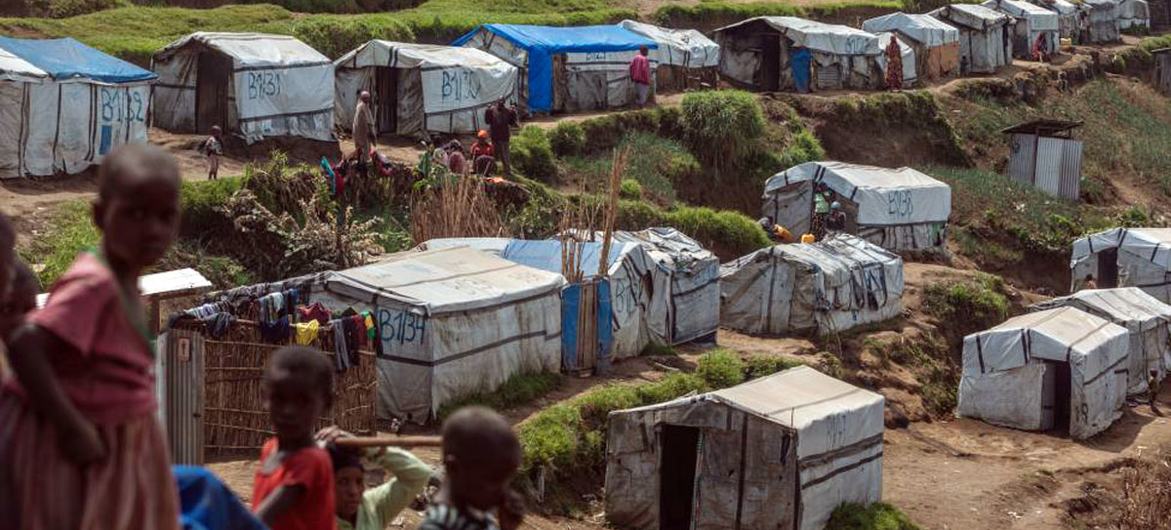
    Millions of people displaced by the ongoing violence in eastern DRC need urgent humanitarian assistance. (file)
    © IOM/Muse Mohammed
     
    Millions of people displaced by the ongoing violence in eastern DRC need urgent humanitarian assistance. (file)

    30 September 2024

     Peace and Security

    Mobilization at the national, regional and international level are needed to support the Democratic Republic of the Congo (DRC) in the face of continued violence in the east, trafficking of natural resources, and other challenges, the UN Security Council heard on Monday. 

    “We need to collectively remain engaged in assisting the country on its path to peace and stability,” said Bintou Keita, the Secretary-General’s Special Representative for the DRC and head of the UN Mission there, MONUSCO.

    Ceasefire and dialogue ‘framework’

    There has been a notable reduction in fighting among warring parties in the volatile east since a 30 July ceasefire - announced by the DRC and Rwanda during a meeting facilitated by Angola - “but peace is not yet won”, she said.

    “However, today, there is an active framework for dialogue between the DRC and Rwanda invested in proactive mediation, sparing no efforts to resolve this conflict, an operational instrument supporting this mediation and genuine prospects for peace which are now possible,” she added.

    Ms. Keita told ambassadors that the DRC has made recent incremental progress in political and institutional reform but daunting challenges remain.

    Natural resource exploitation

    The past few months have seen competition over the exploitation and trade of natural resources which has further entrenched and exacerbated conflict dynamics in the east.

    She said the recent intensification of violence in Ituri province is mainly driven by armed groups’ attempts to control mining areas.

    “As profits have surged with the expansion of semi-mechanized goldmining, armed groups have become militarized entrepreneurs,” she continued. 

    “As a consequence, community leaders and depleted Government forces are struggling to contain armed groups, which have become stronger both militarily and financially.”

    Thousands in profit

    Additionally, the consolidation of the M23 military group’s administrative control over Masisi and Rutshuru territories in neighbouring North Kivu province has allowed it to establish full control over coltan production.  The metallic ore is used in the manufacture of mobile phones and electronic devices.

    Trade from the Rubaya area, which is estimated to supply over 15 per cent of global production of the metal tantalum, generates some $300,000 a month for the group, which she said is deeply concerning and must be stopped.

    “The criminal laundering of the DRC’s natural resources smuggled out of the country is strengthening armed groups, sustaining the exploitation of civilian populations, some of them reduced to de-facto slavery, and undermining peace-making efforts,” Ms. Keita said.

    She warned that “unless international sanctions are imposed on those benefitting from this criminal trade, peace will remain elusive, and civilians will continue to suffer.”

    ADF group attacks

    Meanwhile, eliminating the threat posed by the Allied Defense Forces (ADF) armed group in North Kivu and Ituri “has proven elusive”.  

    The ADF has intensified attacks in recent months, exploiting a vacuum left by Congolese armed forces’ redeployment to fight the M23.  In June, 272 civilians were killed, making it probably the deadliest month ever for the group whose “neutralization remains a priority for the Mission.” 

    Ms. Keita told the Council that since January, some 2.4 million people have been displaced. Many are sheltering in overcrowded sites where they are vulnerable to diseases such as cholera, measles and a new threat, mpox. The DRC is the epicentre of the current epidemic on the continent.

    Political tensions are also growing in the DRC, with opposition parties voicing concern over restrictions on political freedoms, arbitrary arrests, and the shrinking democratic space. 

    Other important issues include the “plague” of sexual and gender-based violence affecting the country.  Humanitarian partners treated over 61,000 victims during the first half of this year - a 10 per cent increase over the same period in 2023. 

    Support peace efforts 

    Ms. Keita said the risks and opportunities that she highlighted require national, regional and international mobilization in order to support the people of the DRC. 

    “First and foremost, we must support peace efforts wherever conflicts exist,” she continued. 

    “The mediation process undertaken by Angola remains the best opportunity for reducing tensions between Rwanda and the DRC, but peace cannot be built in Luanda alone. It also requires investment in the provinces, the territories, the chieftaincies and the villages.” 

    She pointed to UN efforts in this regard. For example, following MONUSCO’s departure from South Kivu in June, the UN has supported the establishment of mechanisms for the unarmed protection of civilians. 

    Consolidating gains, protecting civilians

    The Mission is also working together with national and international non-governmental organizations and religious institutions to consolidate gains achieved after years of investment in communities, women, young people and local institutions.

    Peacekeepers are also continuing to protect civilians in Ituri. Together with the Congolese army, the FARDC, they have established a joint coordination and operations centre in the provincial capital, Bunia, and response times to warnings have dropped. 

    In North Kivu, MONUSCO continues to participate in maintaining a defense zone around the cities of Goma and Sake and is providing guarantees to protect civilians by maintaining bases in several locations, including in areas under M23 control. 

    Modalities for disengagement

    Recalling that MONUSCO ended activities in South Kivu in June, Ms. Keita said that at the request of the authorities, the Mission is now engaged in an evaluation process “to ensure that we consolidate our departure and that we plan for the way forward following our withdrawal.”

    It is estimated that $57 million will be required for the DRC to be able to take over the Mission in the province and the authorities have already committed some $30 million in a display of goodwill. 

    MONUSCO and the Government are working to define modalities for implementing the next steps for the Mission's disengagement, which will be ramped up in the coming weeks. 

    "MONUSCO is leaving, but until our very last day, we will continue to protect civilians, support meaningful peace initiatives, facilitate the delivery of humanitarian assistance and assist the Congolese State in its stabilization efforts," she said.


    https://news.un.org/en/story/2024/09/1155156


    https://creativecommons.org/licenses/by/4.0/legalcode

    Security Council renews Haiti mission mandate, calls for more action against gangs


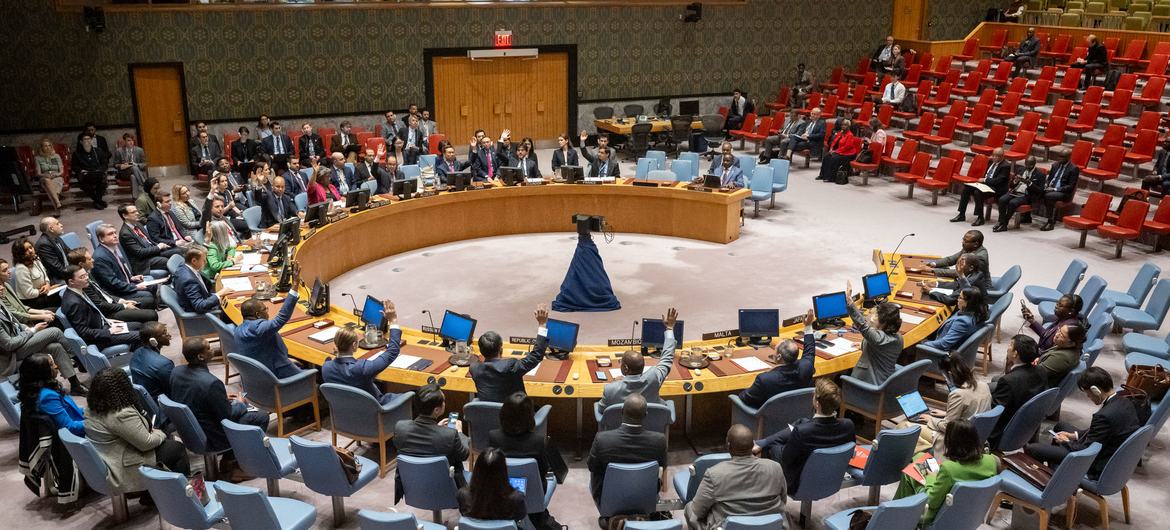
    UN Security Council members vote and unanimously adopt resolution extending the mandate of the Multinational Security Support (MSS) mission in Haiti.
    UN Photo/Manuel Elías
     
    UN Security Council members vote and unanimously adopt resolution extending the mandate of the Multinational Security Support (MSS) mission in Haiti.


    By Vibhu Mishra
    30 September 2024 


    Peace and Security

    The UN Security Council on Monday re-authorized the deployment of the Multinational Security Support (MSS) mission to Haiti for 12 months.

    The mission was authorized last October to assist Haiti’s beleaguered police force. Led by Kenya, it currently has around 410 police officers on the ground and is expected to grow to around 2,500. For now, the country remains mired in crisis.

    The renewal comes as the mission tries to curb rampant gang violence, enable an environment conducive to aid delivery, and create conditions for free and fair elections.

    In a unanimous vote on resolution 2751, the 15-member Council urged the MSS mission to speed up its deployment and called on all nations to provide additional voluntary contributions and support.

    Tweet URL

    The resolution reaffirmed that the UN Secretary-General may offer logistical support to the mission when requested, subject to full financial reimbursement through available voluntary contributions and in full compliance with the UN Human Rights Due Diligence Policy.

    Unprecedented security crisis

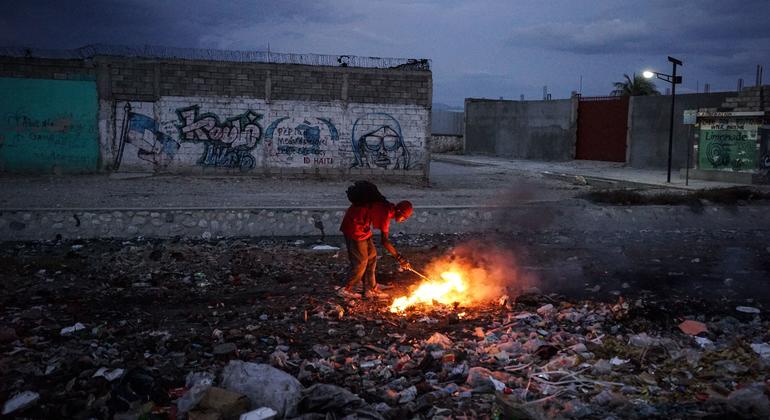
    Last Thursday, Haiti’s transitional President Edgard Leblanc Fils addressed the UN General Assembly, warning that his country faces an “unprecedented security crisis”.

    “Citizens are living in fear of even moving about freely or going to school, particularly around the capital Port-au-Prince,” he said at the General Assembly’s high-level debate, urging continued UN support.

    The rampant violence has also driven humanitarian needs across Haiti, with more than half the population classified as facing “acute levels of hunger”, according to the latest IPC analysis, a global tracking of malnutrition and food insecurity.

    US pledges unwavering support  

    Following the adoption, United States Ambassador and Permanent Representative Linda Thomas-Greenfield emphasized the international community’s strong message of solidarity with the people of Haiti.

    “The world is standing with you, and we are unwavering in our efforts to help restore security and stability and put the country on the path of peace and prosperity,” she emphasized.

    She echoed President Leblanc’s call for ensuring long-term sustainability and encouraged the international community to build on the progress achieved by the mission so far.

    “Let us work together to build on the progress of the Haiti MSS mission. Let us embrace a new approach that sustains it. Let us protect the fragile but inspiring opportunity to build a better future for the Haitian people,” Ms. Thomas-Greenfield said.

    Cité Soleil in downtown Port-au-Prince is particularly affected by high levels of violence and insecurity.
    © UNOCHA/Giles Clarke

    Haiti calls for fully-fledged peacekeeping force

    Antonio Rodrigue, Ambassador and Permanent Representative of Haiti – which does not currently serve on the Council – welcomed the extension but stressed the need for it to become a full UN peacekeeping operation.

    He said it had “demonstrated its effectiveness in certain critical areas, specifically through the restoration of security in areas previously controlled by armed gangs.” However, he cautioned that significant challenges remain.

    Gang violence continues to tear at the social fabric, with rampant rights violations plunging thousands of families into distress, he said, adding that despite an arms embargo, gangs are still accessing weapons and ammunition.

    The Haitian Ambassador underscored the need for increased financial support and reinforcements for the mission and reiterated that transforming it into a peacekeeping operation “appears not just to be necessary but also a matter of urgency.”

    Kenya calls for urgent reinforcement and resources

    Kenya’s Ambassador to the UN Erastus Lokaale outlined President William Ruto’s recent visit to Haiti, where he had witnessed the Haitian people’s determination to emerge from the multiple crises they face.

    He emphasized that the mission had chalked up some initial successes, in collaboration with the Haitian National Police (HNP), laying the groundwork for further progress, including securing the airport and other key infrastructure.  

    “With the renewed mandate, the mission is poised to create conditions for Haitian authorities to secure their country and undertake social and economic reconstruction,” he said.

    But for that to happen, “the MSS mission must rapidly achieve the full deployment of its envisioned 2,500 personnel, up from the current 410 officers,” he reiterated, as well as “substantial resources”.


    https://news.un.org/en/story/2024/09/1155151


    https://creativecommons.org/licenses/by/4.0/legalcode