Показаны сообщения с ярлыком migrants. Показать все сообщения

вторник, 1 октября 2024 г.

Security Council Examines Impact of Expired Authorization for European Union’s Operation to Monitor Migrant Smuggling Off Libya


9737th Meeting (PM)
SC/15840


The Security Council debated the legacy and the future of the European Union Naval Force military operation in the Mediterranean (Operation IRINI) today following the expiry of its authorization for Member States to intercept ships suspected of smuggling migrants on the high seas off Libya.

“Saving lives at sea and providing humanitarian assistance is one of the most basic obligations of humanity,” said Sivanka Dhanapala, Director of the United Nations High Commissioner for Refugees (UNHCR) in New York in his briefing to the 15-member organ.  Noting a reduction of crossings from North Africa via the Mediterranean since 2023, he pointed to a joint 2024 report by UNHCR, International Organization for Migration (IOM) and the Mixed Migration Centre, which indicated high risks of deaths, gender-based violence and trafficking.

Between January and August 2024, 24 per cent less people departed by sea from North and West Africa towards Europe, he said. While arrivals to Italy decreased, 33,000 people disembarked in Tunisia and 14,000 in Libya.  Over 97,000 Sudanese refugees are estimated to have arrived in Libya to date.  With the recent conflict escalation, more are expected to arrive. 

Against this backdrop, UNHCR stands ready to support Governments with capacity-development, technical advice and equipment for international protection.  Urging States to enhance search and rescue capacity and implement predictable disembarkation mechanisms, he emphasized that States must also cooperate to investigate and prosecute smuggling and trafficking, create resettlements and complementary pathways, and address the root causes. 

“What is truly chilling is the number of migrants who pay the ultimate price in their hope to reach Europe,” said Pär Liljert, Director of IOM in New York, reporting that in 2024 IOM’s Missing Migrants Project has documented at least 1,450 deaths in the Mediterranean. 

Since December 2023, the number of migrants in Libya has continued to increase partially due to the arrival of Sudanese migrants, he said, noting that over 45 per cent of migrants travelling along the Central Mediterranean Route experienced physical violence and 30 per cent were kept in detention-like conditions.  He said:  “The international community should not allow the Sahara Desert and the Mediterranean Sea to continue becoming mass graves of migrants”, urging States to develop a strategic approach to tackle irregular migration.  For that, community involvement is key, he outlined, also calling on States to integrate climate change adaptation and disaster risk reduction into response strategies.  Furthermore, the expansion of humanitarian pathways would reduce the risks associated with irregular migration, he said. 

In the ensuing discussion, Council Members discussed the impacts of expired resolution 2698 (2023) that authorized a mandate of Operation IRINI, with some pointing to its shortcomings.

Malta’s representative stressed that the expiration of specific authorizations will not impact the Operation’s mandate and modus operandi, explaining that “these authorizations have never been exclusively directed towards the European Union.”  She added that the continued functioning of the Operation is “sufficiently provided for” under the UN Convention on the Law of the Sea and other international agreements.

Slovenia’s representative, Council President for September, speaking in his national capacity, added that IRINI's primary mandate — to uphold the implementation of the UN arms embargo on Libya — was renewed in May.  Its secondary task — to support the detection and monitoring of human smuggling and trafficking networks in the Mediterranean — will continue apace without the Council’s authorization, he said. 

France’s representative, while recognizing that this Operation remains the only actor to enforce the arms embargo off Libya, said that his delegation did not seek to renew the authorizations created by resolution 2240 (2015) because no other actor has used these authorizations.  “The Council’s role is to seek effective solutions and not to instrumentalize discussions on our mechanisms,” he stressed, adding that, in the Mediterranean, the smuggling and trafficking of human beings from Libya deserves everyone’s efforts.

“The reality is irregular migration is a challenge bigger than just Operation IRINI,” observed the United States’ delegate.  While acknowledging the decision of penholders of resolution 2240 (2015) not to seek renewal of its authorization, he said that, since 2015, the Operation has been “a key component of international efforts” to alleviate the human tragedy of migrant deaths occurring off the coast of Libya and the Mediterranean. 

Refuting those narratives, the representative of the Russian Federation, which requested this meeting, criticized European Union member States for failing to take measures to rescue sinking ships and for blocking migrant vessels from reaching their shores.  The bloc’s structures were using resolution 2240 (2015) and its subsequent iterations “solely to indulge their harsh repression of migration flows” in the Mediterranean Sea.  Since “that mandate” has ceased, “starting from today”, any operations conducted with migrants should be fully in line with international maritime law and other established norms, she added.  

Many Council members underscored the importance of tackling root causes of migration and combating human trafficking and illicit smuggling of migrants, with the United Kingdom’s representative stating that his country is supporting the IMO’s work in Libya through funding for returns and reintegration assistance.  It is also building capacity, through the joint UK National Crime Agency and Libyan law enforcement work, to prosecute the leaders of organized criminal gangs.

For his part, the representative of Ecuador, noting his country’s experience as a country of origin, transit, destination and refuge, emphasized:  “Solutions to irregular migration cannot consist solely of preventing departures; rather, the factors driving migration in countries of origin must be addressed,” including conflicts, lack of opportunities, and the absence of the rule of law.

https://press.un.org/en/2024/sc15840.doc.htm

https://creativecommons.org/licenses/by/4.0/legalcode

вторник, 11 июня 2024 г.

Over 180 migrants dead or missing in latest tragedy off Yemen, UN agency reports


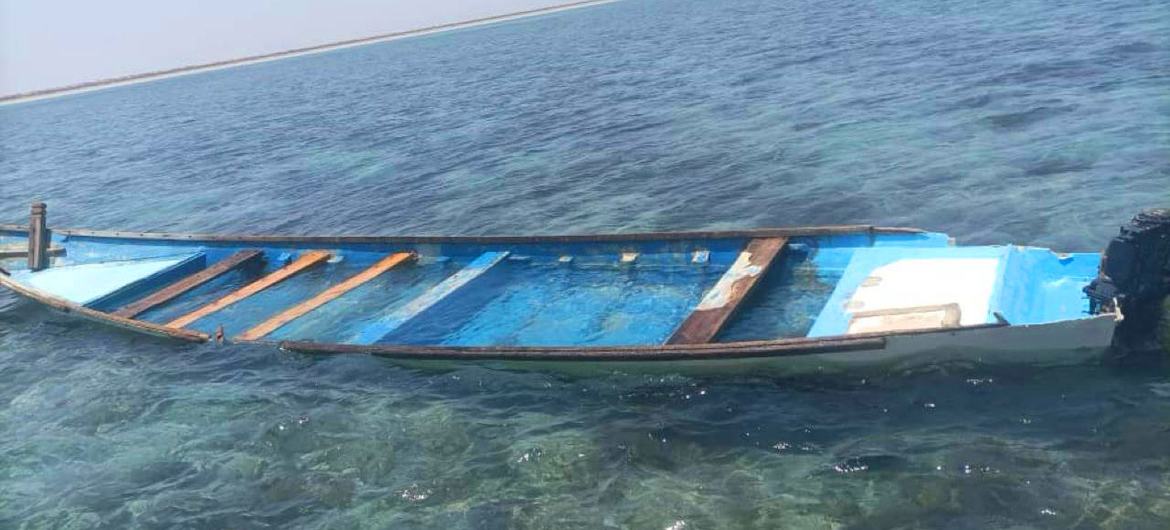
A boat carrying migrants that sank off the coast of northeastern Djibouti in April 2024. Since 2014, over 480 migrants have drowned trying to cross the Gulf of Aden between Yemen and Horn of Africa.
© IOM Djibouti
 
A boat carrying migrants that sank off the coast of northeastern Djibouti in April 2024. Since 2014, over 480 migrants have drowned trying to cross the Gulf of Aden between Yemen and Horn of Africa.


11 June 2024
Migrants and Refugees

At least 49 migrants have been killed, including many women and children, and a further 140 are missing after the boat they were on capsized off the coast of Yemen on Monday, the UN International Organization for Migration (IOM) has reported.

Some 260 people were abroad the vessel that had departed from Bossaso, in northeast Somalia, in the early hours of Sunday, bound for Yemen, about 330 kilometres (about 205 miles) away.

“This recent tragedy is another reminder of the urgent need to work together to address urgent migration challenges and ensure the safety and security of migrants along migration routes,” Mohammedali Abunajela, IOM spokesperson, said in a news release on Tuesday.

“Our thoughts are with the victims and their families as we remain committed to supporting survivors and improving search and rescue efforts in the region.”

Search and rescue efforts are ongoing despite significant challenges due to a shortage of operational patrol boats, a situation further complicated by the ongoing conflict.

IOM support

Seventy-one people, including six children, have been rescued and are being supported by IOM.

The agency has mobilized two mobile medical teams to provide immediate assistance, and its psychologists are providing mental health support.

Local community members, including fishermen, played a crucial role in the aftermath by assisting with the recovery efforts and helping to lay the deceased to rest at a cemetery.

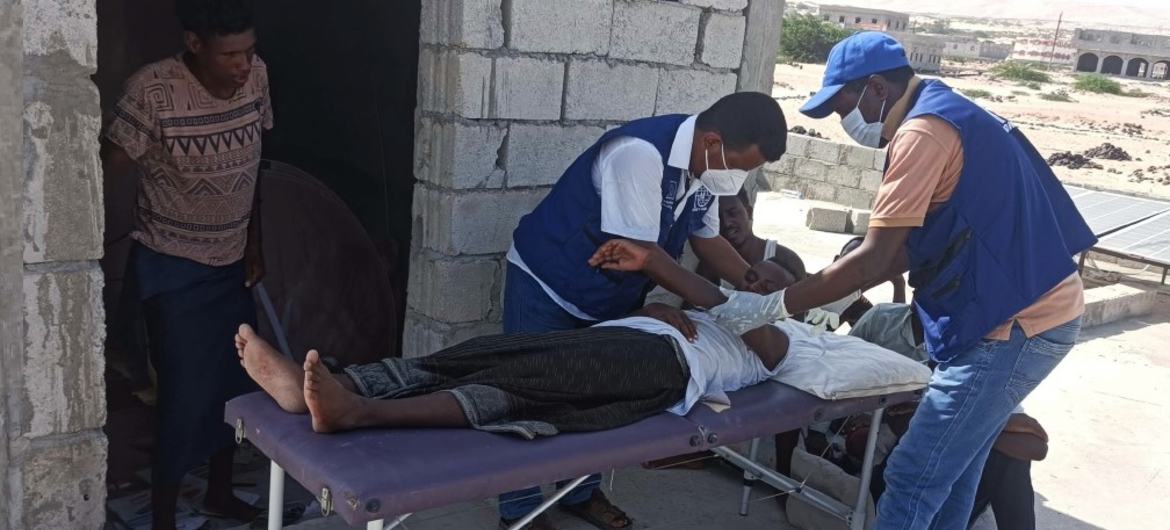
An IOM team provides medical assistance to a survivor.
IOM Photo
 
An IOM team provides medical assistance to a survivor.

Repeated sinkings

The latest tragedy comes on the back of two separate shipwrecks on the same route along the coast of Djibouti, claiming the lives at least 62 migrants.

There has been a sharp rise in migrants travelling from the Horn of Africa to Yemen, spurred by political and economic instability, alongside severe droughts and other extreme weather events in countries like Ethiopia and Somalia.

Despite the ongoing conflict in Yemen, thousands of migrants continue to transit through the country in hopes of reaching Saudi Arabia and neighbouring nations.

The majority of those undertaking the journey rely on irregular routes or smugglers, placing them at an increased risk, including of human trafficking or drowning in rough seas on rickety boats.

Since 2014, IOM has documented 1,860 migrant deaths and disappearances along that route, including 480 due to drowning.

https://news.un.org/en/story/2024/06/1150936


https://creativecommons.org/licenses/by/3.0/legalcode

пятница, 29 сентября 2023 г.

Conflicts, Disasters Driving More Migrants to Risk Mediterranean Crossing, Briefers Warn Security Council Ahead of Libya Mandate Decision


9428TH MEETING (PM)
SC/15427

Conflicts, Disasters Driving More Migrants to Risk Mediterranean Crossing, Briefers Warn Security Council Ahead of Libya Mandate Decision

The Mediterranean remains a perilous route for a swelling number of migrants and asylum seekers trying to reach Europe, Security Council members said today, as they discussed the situation in the high seas off Libya ahead of a decision to renew resolution 2240 (2015), which authorizes States and regional groups to inspect and seize vessels in that area suspected of being used for migrant smuggling or human trafficking.

Ruven Menikdiwela, Director of the New York Office of the United Nations High Commissioner for Refugees (UNHCR), said that while nearly 50,000 refugees and asylum seekers are registered with the refugee agency in Libya, it is not authorized to access the disembarkation points.  As such, many detained refugees are escorted to border areas and expelled to neighbouring countries, mainly Egypt, without procedural safeguards.  “Libya is not a place of safety for the purposes of disembarkation, following rescue at sea,” she stressed, underscoring that any cooperation or assistance provided to Tripoli should uphold the human rights of refugees and migrants.

Pär Liljert, Director of the International Organization for Migration (IOM) Office to the United Nations, reporting that 2,093 deaths were recorded along the central Mediterranean route between January and September, expressed concern over the rise of discrimination and xenophobia directed at migrants and refugees.  Noting that more and more people may embark on perilous journeys due to conflict, disasters and environmental degradation, he urged all States to ensure the dignity of those within their borders through a human rights-based approach that prioritizes lives.

In the ensuing debate, several Council members expressed concerns about abuses of migrants and refugees in Libya.  Some called for a more holistic approach to tackle the drivers of irregular migration and prioritizing assistance, underscoring the importance of Libya’s stabilization to strengthen, while others spotlighted the rescue efforts of the European Union’s Naval Force Mediterranean Operation IRINI.

The Russian Federation’s representative said that his delegation requested the meeting following the information that 3,111 people died in the Mediterranean, while trying to reach Europe.  Tragedies such as the one on 14 June off the coast of Greece, in which 78 people died, demonstrate that the mechanism provided for in resolution 2240 (2015) is not functioning or is ineffective, he added. He questioned whether his European colleagues support investigations into the failure of European border services to aid migrants in distress, and what measures are being undertaken within the Operation IRINI framework.

Mozambique’s representative, also speaking for Ghana and Gabon, said that more must be done to address conflict, terrorism, poverty and climate change — factors that have led to the “worrisome scenario” being seen today. Strongly condemning the arbitrary detention of asylum seekers and refugees in Libya, he called on the national authorities to ensure that migrants are protected from human rights violations.  The stabilization of Libya would allow to strengthen control over its territory and reduce the Mediterranean migrant crisis, he said.

Malta’s representative, emphasizing that the Mediterranean remains a perilous migratory route, said that resolution 2240 (2015) and its renewals reaffirm the Council’s determination to combat the smuggling of migrants and trafficking of persons off the Libyan coast.  Reiterating Malta’s commitment to save lives and respond to displacement crises, she said that the Council should address the root causes of irregular migration and forced displacement through a comprehensive and integrated approach.

France’s representative said that establishing a Libyan State is the only way to end trafficking.  He called for more intensive cooperation among States to prevent dramas such as the ones unfolding in the Mediterranean.  Council members must help counter insecurity, he added, noting that the Wagner Group’s presence in the Sahel fuels terrorism and leads to displacement.

MAINTENANCE OF INTERNATIONAL PEACE AND SECURITY

Briefings

RUVEN MENIKDIWELA, Director of the New York Office of the United Nations High Commissioner for Refugees (UNHCR), reported that between January and August, more than 102,000 refugees and migrants attempted to cross the central Mediterranean from Tunisia to Europe, up 260 per cent compared to 2022.  More than 45,000 made the same journey from Libya.  Some 31,000 people were rescued at sea or intercepted and disembarked in Tunisia and another 10,600 in Libya.  Departures from Algeria remain limited with almost 4,700 arrivals in Spain until August, an increase of 18 per cent compared to 2022.  In total, 186,000 people arrived from January to 24 September by sea in Italy, Greece, Spain, Cyprus and Malta, with more than 130,000 people arriving in Italy.  This constitutes an increase of 83 per cent compared to the same period in 2022.  Moreover, as of September 24, more than 2,500 people were accounted as dead or missing, a two-thirds increase from the same period in 2022.  “Lives are also lost on land, away from public attention,” she said, adding that the journey across Africa to coastal points of departure remains one of the world’s most dangerous.  High departure rates in Tunisia result from the perception of insecurity among refugee communities, following incidents of racially-motivated attacks and hate speech, as well as collective expulsions from Libya and Algeria, she said.

In Libya, nearly 50,000 refugees and asylum seekers are registered with UNHCR, she continued, noting that the refugee agency is not authorized to access the disembarkation points controlled by entities involved in interception and rescue at sea.  Many detained refugees are escorted from Libya to border areas and expelled to neighbouring countries, mainly Egypt, without procedural safeguards.  “Libya is not a place of safety for the purposes of disembarkation, following rescue at sea.”  Turning to the simultaneous arrival of large numbers of people on Lampedusa, and noting its limited reception capacities, she said that UNHCR supports the authorities in “decongesting” the island.  “Italy cannot be left on its own in responding to the needs of the arrivals,” she said, calling for a regional disembarkation and redistribution mechanism for people who arrive by sea.  The challenges of mixed movements of refugees and migrants require a “panoramic” view of population movements, stressing the need for establishing proper, legal, substantive migration pathways, she said.

She went on to set out several urgent recommendations, including human rights safeguards, increased search and rescue at sea, the prosecution of smugglers and traffickers, and resettlement and complementary pathways.  Elaborating, she said that any cooperation or assistance provided to Libya or Tunisia should uphold the human rights of refugees and migrants.  All States around the Mediterranean must urgently step up search and rescue efforts and implement effective and predictable disembarkation mechanisms.  States must also cooperate on a route-based approach to investigate and prosecute smugglers.  Finally, UNHCR urges all States to invest more in development and inclusion in countries of asylum and transit, as well as to remove barriers to family reunification and to expand resettlement quotas for refugees from Libya and other countries in North Africa, she said.

PÄR LILJERT, Director of the International Organization for Migration (IOM) Office to the United Nations, citing recent IOM data, said that between January and September, more than 187,000 people crossed the Mediterranean “in pursuit of a better future and the promise of safety”. Tragically, during the same period, IOM recorded 2,093 deaths along the central Mediterranean route.  “While significant attention is dedicated to deaths at sea, the stories shared by migrants suggest that several tragedies may be going unnoticed, especially during the crossing of the Sahara Desert.”  Although the central Mediterranean is “the most dangerous” route, Greece has seen a 300 per cent increase in arrivals this year, while entries into Italy have numbered 130,000 compared to 70,000 in 2022.

The impact of the conflict in Sudan is visible in the demography of those who arrive in Europe via the central Mediterranean route, he said.  In August, 1,294 Sudanese transited through Tunisia, while crossings from Libya into Tunisia also increased.  Expressing concern that discrimination and xenophobia directed at migrants and refugees are on the rise, he urged all States to ensure the dignity of those within their borders through a human rights-based approach that prioritizes lives.  He added that IOM is also concerned about refugees and migrants who are intercepted at sea and sent back to face appalling conditions and abuse in detention centres.  There were 10,992 such cases as of mid-September, he said.

“As the world is experiencing higher rates of conflict, disasters and environmental degradation than at any time in the past three decades, compounded by glaring inequalities and increased poverty, we can expect more and more people to embark on perilous journeys,” he said.  In this context, IOM recommends that the international community find ways to foster regular migration; enhance regular pathways for migrants who do not qualify for refugee status; ensure that the rights of those in irregular situations are respected; support national and regional efforts to prevent and resolve forced displacements; and increase search and rescue operations and capabilities.  “We must recognize that solutions to irregular migration cannot solely rely on preventing departures, but also on ensuring that we are effectively addressing the various drivers of migration in countries of origin, transit and, oftentimes, in countries of initial destination,” he added.

Statements

VASSILY A. NEBENZIA (Russian Federation) noted that he requested today’s meeting after reading the latest Secretary-General’s report on the implementation of resolution 2652 (2022) (document S/2023/640), which showed that 3,111 people died in the Mediterranean while trying to reach Europe, an increase of 77 per cent from 2022:  “This is a very sordid picture.”  Tragedies such as the one on 14 June off the coast of Greece, in which 78 people died, demonstrate that the mechanism provided for in resolution 2240 (2015) is not functioning or is ineffective, he said, adding:  “Why is this resolution needed if the European Union is unable to properly carry out the functions placed on it on its own request?”  Recalling a remark by the High Representative of the European Union for Foreign Affairs and Security Policy that everything must be done to protect “a blossoming garden from guests from the jungle,” he questioned whether his European colleagues support investigations into the failure of European border services to aid migrants in distress, and what measures are being undertaken within the Operation IRINI framework.  The rights of refugees, internally displaced persons and stateless persons must be protected, he said, adding that the European Union does not extend the solidarity it shows to Ukrainian migrants to those migrating from North Africa and the Middle East.....

https://press.un.org/en/2023/sc15427.doc.htm

https://creativecommons.org/licenses/by/3.0/legalcode

воскресенье, 24 сентября 2023 г.

Regional action essential to address migrant surge through Central America

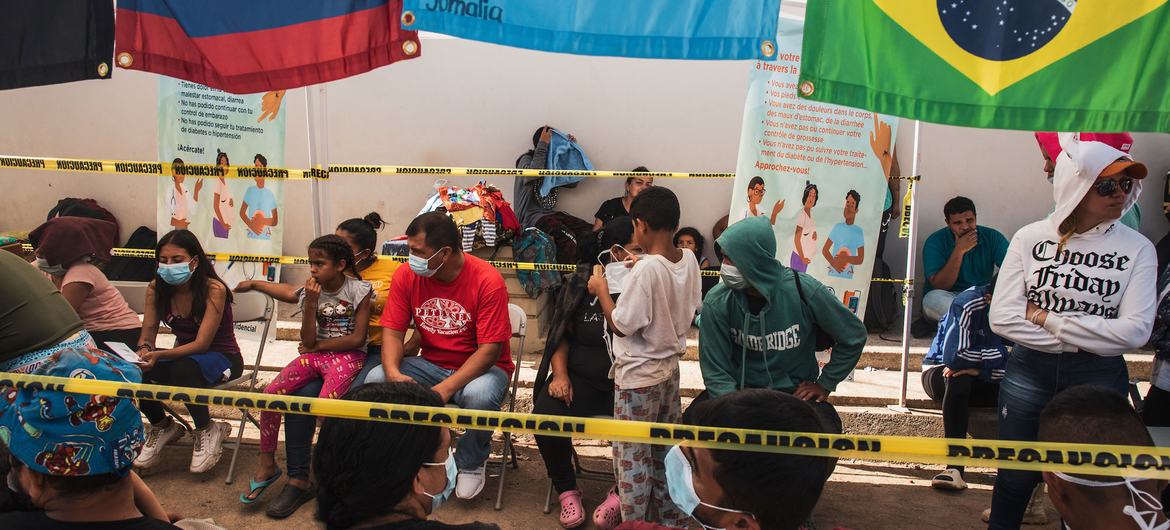
Migrants on their way to the United States are treated at a medical care station in Danlí, Honduras.
© UNOCHA/Vincent Tremeau
 
Migrants on their way to the United States are treated at a medical care station in Danlí, Honduras.

27 September 2023
Migrants and Refugees

With record numbers of people transiting through Central America and Mexico in search of a better life further north, UN migration agency IOM on Wednesday appealed for regional action to address their immediate needs while tackling the drivers of migration.

"The situation underscores the urgent need for the immediate collective involvement of governments from origin, transit and destination countries to provide humanitarian assistance, especially to vulnerable groups like women and children," said Michele Klein Solomon, IOM Regional Director for Central America, North America and the Caribbean.  

Perilous journeys

IOM cited statistics that reveal the magnitude of the problem, noting that Panama’s National Migration Service reported a record number of migrants crossing the perilous Darién jungle from Colombia this year.

Over 390,000 people made the treacherous journey as of 23 September, with 82,000 crossing in August alone - the highest monthly figure on record. Most come from Venezuela, Ecuador and Haiti.  

Tweet URL

Beyond the rise in numbers, IOM said the most significant trend has been the shift by Cuban migrants and those coming from African countries who are increasingly flying to Central America, thus sidestepping the Darién route altogether.  

Meanwhile, only 4,100 migrants from Africa crossed the Darién between January and July of this year, a 65 per cent decrease from the same period in 2022.  

Conversely, Honduras saw a staggering 553 per cent increase in arrivals from Africa, 19,412 people, through its southern border. Similarly, only 524 Cubans were reported in the Darién during this period, compared to the 17,157 arriving by land in Honduras.  

Danger all around

People transiting Central America and Mexico face numerous challenges, IOM said, highlighting the dangers in the Darién jungle.

Migrants have been injured, abandoned on muddy slopes, or swept away by sudden river floodings. They are also vulnerable to robbery, violence and sexual abuse.  

In countries along the route, migrant families find themselves hungry, sleeping in the streets and forced to beg. Many suffer health issues like diarrhoea and dehydration.  

IOM monitors migration movements and supplies life-saving information and assistance throughout Colombia, Central America and Mexico, and provides hygiene items, food, protection services and healthcare.  

Staff also assist with voluntary return operations, infrastructure and shelter support, and carry out communication campaigns to counter false information and alert migrants about the dangers they might face.  

Collaboration and support

IOM warned that despite the efforts of transit nations, UN agencies and humanitarian organizations, the capacity to offer life-saving aid is stretched thin.  

The agency explained that migration drivers are complex, ranging from economic and social factors to environmental and political challenges.

Many have been intensified by the fallouts from the COVID-19 pandemic, recent extreme weather events, and political unrest in countries of origin.  

"The challenges of migration are too vast for any nation in the Americas to tackle alone," said Marcelo Pisani, IOM’s Regional Director for South America.  

"As mandated on the Global Compact on Migration, IOM advocates for a comprehensive, collaborative regional strategy and reaffirms its unwavering support for initiatives that uphold international humanitarian duties, sustainable development objectives, and the fundamental human rights of those on the move."  


https://news.un.org/en/story/2023/09/1141557

https://creativecommons.org/licenses/by/3.0/legalcode