Показаны сообщения с ярлыком Refugees. Показать все сообщения

вторник, 29 апреля 2025 г.

You Are Undermining Your Own Stability’, High Commissioner for Refugees Tells Security Council, Warning against Retrenching from Aid, Multilateralism


9905th Meeting (AM)
SC/16051


In what he described as possibly his last address to the Security Council, the head of the Office of the United Nations High Commissioner for Refugees (UNHCR) warned today that “violence has become the defining currency of our age” — from Sudan to Ukraine, from the Sahel to Myanmar and beyond — and urged the 15-member organ to fulfil its responsibility for maintaining peace.

Despite knowing the gravity of the crises, the Council’s inaction itself is “an indictment”, said Filippo Grandi, UN High Commissioner for Refugees, asserting that the organ has “chronically failed to live up to” its responsibility.

He painted a bleak picture of today’s wars, driven by the “perverse, yet powerful delusion:  that peace is for the weak”, where victory is pursued not through negotiation but by inflicting unbearable suffering.  As a result, “the norms of international humanitarian law… are cast aside, dismissed as easily as the thousands of lives destroyed in the pursuit of supremacy”.  Quoting Pope Francis, he reminded members that “every war represents not only a defeat of politics but also a shameful surrender”.

Highlighting the plight of 123 million forcibly displaced people worldwide, he described their hope for safety and eventual return, noting especially the devastating situation in Sudan, where “one out of every three people” has been displaced.  Refugee-receiving countries are doing their part.  “You must be more committed and more united to do yours,” he urged.

  In Myanmar, he urged breaking eight years of “dangerous inertia” concerning the Rohingya crisis, stressing that while challenges are immense, dialogue with all parties is “a critical first step” towards creating conditions for the safe, voluntary and dignified return of refugees.  “It is a long shot, for sure”, he admitted, but insisted that stagnation is no longer an option, urging the Council to sustain its robust focus on the situation in Myanmar.

Referencing the symbolic moment of the new Syrian flag being raised at the UN on 25 April, he said:  “For the first time in decades, there is a spark of hope, including for the millions of Syrians who remain displaced today, 4.5 million of them refugees in neighbouring countries.”  But achieving lasting solutions will require prioritizing the Syrian people over “long-standing politics, some of which are frankly outdated”.

Finally, he warned against the global trend of retrenching from aid and multilateralism at a critical time for several displacement crises.  “Aid is stability,” he declared, noting that by freezing or cutting aid budgets — which means taking support away from very fragile host countries and abandoning displaced people to their fate — “you are undermining your own stability”.

In the discussion that followed, some members warned of the global trend of aid cuts, while others called for more equal burden-sharing.

China’s delegate emphasized that “solving the refugee problem requires strengthening international cooperation”. However, a certain country has drastically cut foreign aid, forcing many humanitarian organizations to reduce their aid activities.  “This is undoubtedly a serious blow to refugee relief,” he said, warning that more people would be displaced.  He called on developed countries to shoulder their responsibilities by fulfilling their aid commitments and providing more support to refugee-hosting countries and multilateral humanitarian organizations.  He also warned against unilateralism and “hegemonic and bullying” behaviour.

The representative of the United States said that “the UN exists for collective action, and collective action demands collective responsibility”.  Underscoring the responsibility for every Member State to share the burden of humanitarian response to conflict, she said that “the United States has disproportionately shouldered this burden for decades”.

Denmark’s delegate, noting that her country is the fourth-largest donor to UNHCR, pointed out that with the humanitarian system “being reset”, the agency is undergoing dramatic organizational adjustments.  During this period of change, it is vital to collectively support UNHCR in preserving its ability to uphold core aspects of its mandate, she added.

The representative of the Russian Federation said that Western countries, “who have provoked a lion’s share of conflict throughout the world”, are very reluctant to finance UNHCR’s programmes to assist refugees from Syria, Afghanistan, Sudan and many other conflict-ridden countries.

As one of the front-line European Union member States receiving still large numbers of mixed arrivals, Greece contributes to the implementation of the agency’s mandate by hosting a significant number of refugees and asylum-seekers, said its delegate.  Noting his country’s support for the protection of unaccompanied minors, he further expressed concern about the involvement of criminal smuggling networks that exploit human suffering along migration routes.

On that, the representative of the United Kingdom highlighted his country’s initiatives, including holding a successful border security summit, where agreements between participating countries were reached to drive efforts to disrupt organized immigration crime and save lives.

Algeria’s delegate said that a decline in international funding has left millions of vulnerable individuals without access to life-saving assistance, particularly noting the plight of Palestinian refugees in Gaza and the West Bank.  For over half a century, Algeria has hosted Sahrawi refugees who were “forcibly displaced due to the Moroccan occupation of their homeland”.  Despite huge challenges, Algeria — in cooperation with UN agencies and humanitarian partners — has consistently ensured access to basic services for Sahrawi refugees, he added.

Panama’s representative drew attention to Venezuelan nationals who account for a significant portion of displaced persons worldwide.  “We cannot ignore the fact that the current economic situation, the democracy vacuum and the rampant insecurity in Venezuela has worsened the migratory crisis throughout the hemisphere,” he stated, also adding that “our region is going through challenging times with a lack of democratic guarantees and the resurgence of transnational organized crime”.

Pakistan’s delegate, noting that his country has provided shelter, protection and opportunities to millions of Afghans, expressed concern that developing countries — many grappling with their own socioeconomic challenges — continue to shoulder the greatest burden. Meanwhile, developed nations, despite their far greater resources and moral obligations, have increasingly turned inward.  “Physical and political barriers have been erected, closing doors to those most in need,” he said.

“We should shed more light on those who have no choice but to flee their homes due to systematic violations of basic human rights and humanitarian risks, and who risk persecution, torture, or other brutalities if forced to return,” said the representative from the Republic of Korea, adding that “the North Korean escapees are case in point”.

Several speakers highlighted other factors causing mass displacement, with Guyana’s delegate stating that climate change is also becoming a major driver of such movement.  Citing the 2024 global data over the past decade, she said that weather-related disasters have caused 220 million people to be internally displaced.  Slovenia’s representative added:  “Climate-fuelled floods, fires and prolonged droughts now drive families from their homes as ruthlessly as any gunman or bombs.”

Citing Sudanese women fleeing to Chad, Congolese women in displacement camps around Goma, and Rohingya women and girls in long-term refugee camps in Bangladesh, Sierra Leone’s delegate said that climate-induced disasters further compound their vulnerability and increase the severity of such violence.

The representative of France, Council President for April, speaking in his national capacity, highlighted the significance of the Global Compact on Refugees, which has established a framework for concerted action.  “This is an investment in stability,” he emphasized.

Somalia’s delegate was among many who recognized the severe financial constraints facing UNHCR, appealing to all Member States and donors to increase their support.  The agency requires adequate, predictable and flexible funding to fulfil its mandate and respond effectively to growing displacement needs. “Every refugee, regardless of background or skill set, deserves dignity and a durable solution,” he said.

Responding to comments and questions by Council members, Mr. Grandi said that “I am leading an internal effort, which may conclude with the retrenchment of my organization to up to one third of its capacity.”  There will be fewer offices, fewer programmes and fewer operations, he added, noting that UNHCR — founded in 1950 — will “unfortunately” observe its seventy-fifth anniversary in 2025.  “It is not a date to celebrate, but one perhaps on which to reflect on the challenges that we all face, and to try and find some inspiration to address them together,” he concluded.


https://press.un.org/en/2025/sc16051.doc.htm


https://creativecommons.org/licenses/by/4.0/legalcode

вторник, 1 октября 2024 г.

Security Council Examines Impact of Expired Authorization for European Union’s Operation to Monitor Migrant Smuggling Off Libya


9737th Meeting (PM)
SC/15840


The Security Council debated the legacy and the future of the European Union Naval Force military operation in the Mediterranean (Operation IRINI) today following the expiry of its authorization for Member States to intercept ships suspected of smuggling migrants on the high seas off Libya.

“Saving lives at sea and providing humanitarian assistance is one of the most basic obligations of humanity,” said Sivanka Dhanapala, Director of the United Nations High Commissioner for Refugees (UNHCR) in New York in his briefing to the 15-member organ.  Noting a reduction of crossings from North Africa via the Mediterranean since 2023, he pointed to a joint 2024 report by UNHCR, International Organization for Migration (IOM) and the Mixed Migration Centre, which indicated high risks of deaths, gender-based violence and trafficking.

Between January and August 2024, 24 per cent less people departed by sea from North and West Africa towards Europe, he said. While arrivals to Italy decreased, 33,000 people disembarked in Tunisia and 14,000 in Libya.  Over 97,000 Sudanese refugees are estimated to have arrived in Libya to date.  With the recent conflict escalation, more are expected to arrive. 

Against this backdrop, UNHCR stands ready to support Governments with capacity-development, technical advice and equipment for international protection.  Urging States to enhance search and rescue capacity and implement predictable disembarkation mechanisms, he emphasized that States must also cooperate to investigate and prosecute smuggling and trafficking, create resettlements and complementary pathways, and address the root causes. 

“What is truly chilling is the number of migrants who pay the ultimate price in their hope to reach Europe,” said Pär Liljert, Director of IOM in New York, reporting that in 2024 IOM’s Missing Migrants Project has documented at least 1,450 deaths in the Mediterranean. 

Since December 2023, the number of migrants in Libya has continued to increase partially due to the arrival of Sudanese migrants, he said, noting that over 45 per cent of migrants travelling along the Central Mediterranean Route experienced physical violence and 30 per cent were kept in detention-like conditions.  He said:  “The international community should not allow the Sahara Desert and the Mediterranean Sea to continue becoming mass graves of migrants”, urging States to develop a strategic approach to tackle irregular migration.  For that, community involvement is key, he outlined, also calling on States to integrate climate change adaptation and disaster risk reduction into response strategies.  Furthermore, the expansion of humanitarian pathways would reduce the risks associated with irregular migration, he said. 

In the ensuing discussion, Council Members discussed the impacts of expired resolution 2698 (2023) that authorized a mandate of Operation IRINI, with some pointing to its shortcomings.

Malta’s representative stressed that the expiration of specific authorizations will not impact the Operation’s mandate and modus operandi, explaining that “these authorizations have never been exclusively directed towards the European Union.”  She added that the continued functioning of the Operation is “sufficiently provided for” under the UN Convention on the Law of the Sea and other international agreements.

Slovenia’s representative, Council President for September, speaking in his national capacity, added that IRINI's primary mandate — to uphold the implementation of the UN arms embargo on Libya — was renewed in May.  Its secondary task — to support the detection and monitoring of human smuggling and trafficking networks in the Mediterranean — will continue apace without the Council’s authorization, he said. 

France’s representative, while recognizing that this Operation remains the only actor to enforce the arms embargo off Libya, said that his delegation did not seek to renew the authorizations created by resolution 2240 (2015) because no other actor has used these authorizations.  “The Council’s role is to seek effective solutions and not to instrumentalize discussions on our mechanisms,” he stressed, adding that, in the Mediterranean, the smuggling and trafficking of human beings from Libya deserves everyone’s efforts.

“The reality is irregular migration is a challenge bigger than just Operation IRINI,” observed the United States’ delegate.  While acknowledging the decision of penholders of resolution 2240 (2015) not to seek renewal of its authorization, he said that, since 2015, the Operation has been “a key component of international efforts” to alleviate the human tragedy of migrant deaths occurring off the coast of Libya and the Mediterranean. 

Refuting those narratives, the representative of the Russian Federation, which requested this meeting, criticized European Union member States for failing to take measures to rescue sinking ships and for blocking migrant vessels from reaching their shores.  The bloc’s structures were using resolution 2240 (2015) and its subsequent iterations “solely to indulge their harsh repression of migration flows” in the Mediterranean Sea.  Since “that mandate” has ceased, “starting from today”, any operations conducted with migrants should be fully in line with international maritime law and other established norms, she added.  

Many Council members underscored the importance of tackling root causes of migration and combating human trafficking and illicit smuggling of migrants, with the United Kingdom’s representative stating that his country is supporting the IMO’s work in Libya through funding for returns and reintegration assistance.  It is also building capacity, through the joint UK National Crime Agency and Libyan law enforcement work, to prosecute the leaders of organized criminal gangs.

For his part, the representative of Ecuador, noting his country’s experience as a country of origin, transit, destination and refuge, emphasized:  “Solutions to irregular migration cannot consist solely of preventing departures; rather, the factors driving migration in countries of origin must be addressed,” including conflicts, lack of opportunities, and the absence of the rule of law.


https://press.un.org/en/2024/sc15840.doc.htm

https://creativecommons.org/licenses/by/4.0/legalcode

суббота, 30 сентября 2023 г.

Karabakh emergency escalates, thousands still pouring into Armenia: UN agencies

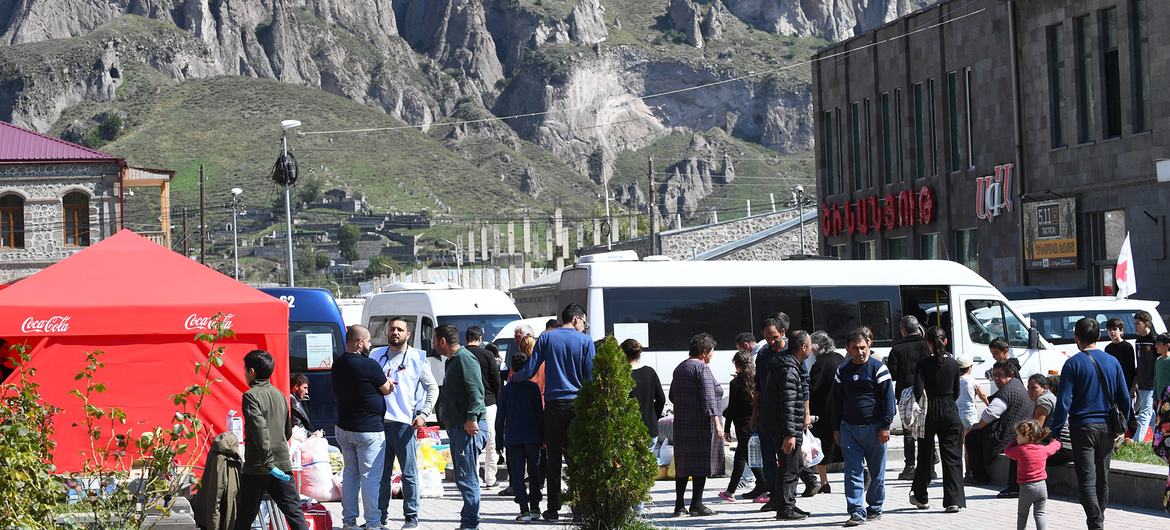
Refugees arrive in the border town of Goris in Armenia.
© UNHCR/Karen Minasyan
 
Refugees arrive in the border town of Goris in Armenia.
29 September 2023
Humanitarian Aid

Over 88,000 refugees from the Karabakh region have fled to Armenia in less than a week and humanitarian needs are surging, the UN refugee agency (UNHCR) said on Friday.

Some 65,000 have already been registered at Government-run centres where long lines have formed.

Late on Friday, UNHCR chief Filippo Grandi tweeted that more than 100,000 refugees had now arrived in Armenia from Karabakh. 

Anxiety and fear

The agency is supporting the refugees with core relief items, said agency representative in Armenia Kavita Belani, who has been on the ground since day one of the crisis.

“People are tired. This is a situation where they’ve lived under nine months of blockade. When they come in, they’re full of anxiety, they’re scared, they’re frightened and they want answers as to what’s going to happen next.”

Ms. Belani said that the most urgent needs included psychosocial support, medication and shelter for everybody, given the high volume of arrivals, as well as targeted support for the most vulnerable: the elderly and children.

The UN Children’s Fund (UNICEF) told reporters in Geneva that 30 per cent of those arriving are minors and many have been separated from their families.

Soundcloud

UN response in full gear

UNICEF is working with the authorities to make sure that family tracing is done right away so that the youngsters can be reunited with their relatives.

UNHCR is leading the inter-agency refugee response and coordination to complement the Armenian Government’s efforts, Ms. Belani said, and an appeal for funding is being finalized.

She stressed that while the response plan was for a duration of six months, the UN was already thinking of longer-term support to help Armenia integrate the new arrivals.

Earlier this week, Alice Wairimu Nderitu, the UN Special Adviser on the Prevention of Genocide, reiterated her “strong concern” over the ongoing situation and called for “all efforts to be made” to ensure the protection and human rights of the ethnic Armenian population who remain in the area and of those who have left.

Tweet URL

Family-tracing

A major concern for humanitarians is that many children have been separated from their families, said Regina De Dominicis, UNICEF Regional Director and Special Coordinator for Refugee and Migrant Response in Europe.

"So we are working in providing first of all psychosocial support and working with the ministries and local authorities as well to make sure that family-tracing is done immediately and families can unite,” 

Since Sunday, Armenian villages near the border with the Karabakh region have turned into makeshift refugee camps.

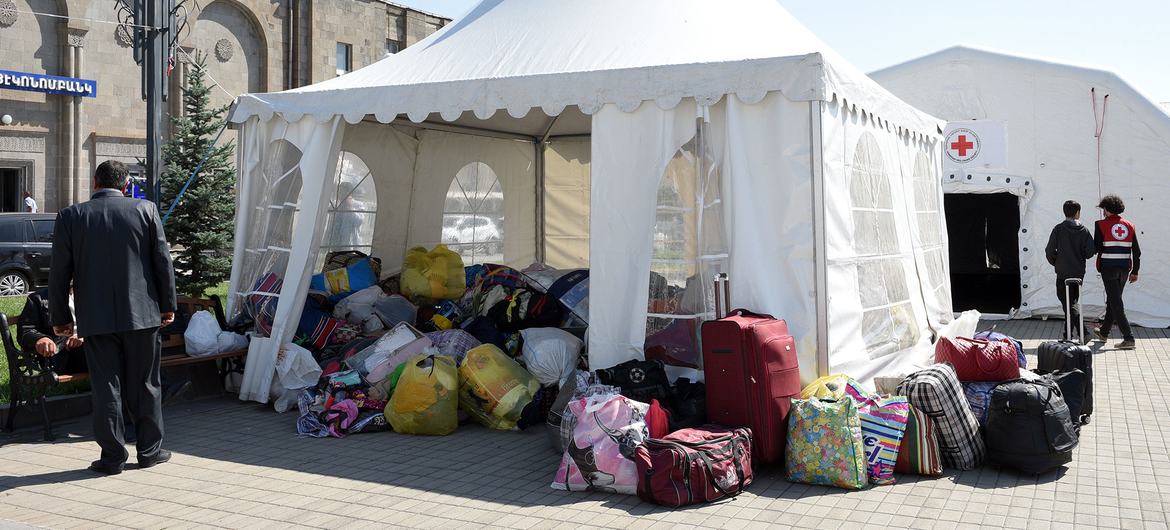
Some of those seeking shelter had only minutes to pack to leave by cars, buses and construction trucks, they said.  While many refugees expressed relief at reaching Armenia from Azerbaijan, they remain traumatized and confused about the future, according to the International Federation of the Red Cross and Red Crescent Societies (IFRC).

“It was so evident on everyone – children, men, women, elderly – the expressions on the faces of those who walk into registration points speak volumes,” said IFRC’s Hicham Diab, speaking from Armenia’s capital Yerevan.

Refugees leave their possessions in a  tent in Goris, Armenia.
© UNHCR/Karen Minasyan
 
Refugees leave their possessions in a tent in Goris, Armenia.

Each face tells a story

“Each face tells a story of hardship, but also of hope, knowing they are in a place where they can receive aid.”

The desperate situation was compounded by an explosion on Monday at a fuel depot in the Karabakh region that killed at least 68 people, according to local authorities.

An additional 105 people are still missing following the blast, which reportedly occurred as many people were lining up to get fuel to help them leave.

Tweet URL

“The priority of the International Committee of the Red Cross (ICRC) in recent days has been on life-saving activities, including the transfer of the wounded to hospitals into Armenia for treatment and bringing in medical supplies,” said Carlos Morazzani, ICRC Operations Manager.

“Over the past week we have transferred around 130 people for medical care and after the explosion…we increased our engagement with all regional authorities.”

UN operation expands

The UN team in Armenia, led by acting Resident Coordinator Nanna Skau, is working with the Government to support the rapidly rising influx.

According to the latest official figures around 93,000 people have crossed into Armenia. The UN Population Fund (UNFPA) is supporting thousands of women in transit centres in the southeastern regions of Syunik and Vayots Dzor with 8,000 dignity kits, including drinking water, sanitary pads and soap.

Some 150,000 health kits have been distributed to support refugees and host communities.

The World Food Programme (WFP) has placed two mobile warehouses in Goris for non-food storage and a mobile kitchen serving up to 3,000 people every day.

The agency’s also delivered around 4,000 food parcels  to support 16,000 people in need in the Syunik region.

The UN Development Programme (UNDP) says it is preparing to launch a psychosocial support scheme to cover the needs of over 12,000 refugees.

UN team heads to region

Briefing correspondents at UN Headquarters the UN Spokesperson announced the Azerbaijani Government had agreed to allow the deployment of a UN mission to the region, due to take place over the weekend.

It would mark the first time in around 30 years that UN teams have gained access, he said.

Led by a senior official from the UN aid coordination office (OCHA) and the UN Resident Coordinator in Azerbaijan, Mr. Dujarric said it would include a technical team from OCHA.

“It's very important that we will be able to get in”, he added.

“While there, the team will seek to assess the situation on the ground and identify the humanitarian needs with both for both people remaining and the people that are on the move.”


https://news.un.org/en/story/2023/09/1141662

https://creativecommons.org/licenses/by/3.0/legalcode

воскресенье, 24 сентября 2023 г.

Regional action essential to address migrant surge through Central America

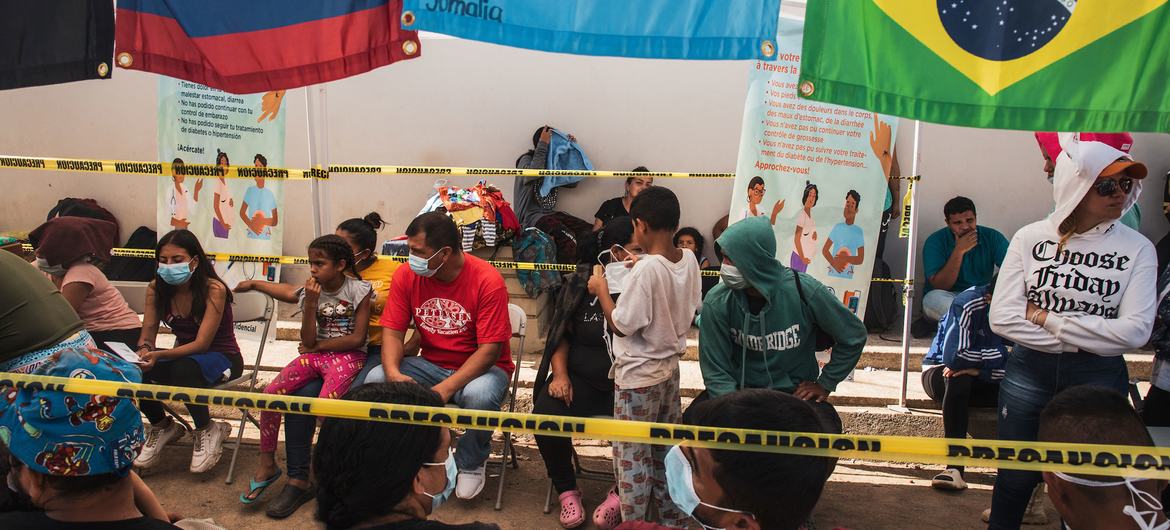
Migrants on their way to the United States are treated at a medical care station in Danlí, Honduras.
© UNOCHA/Vincent Tremeau
 
Migrants on their way to the United States are treated at a medical care station in Danlí, Honduras.

27 September 2023
Migrants and Refugees

With record numbers of people transiting through Central America and Mexico in search of a better life further north, UN migration agency IOM on Wednesday appealed for regional action to address their immediate needs while tackling the drivers of migration.

"The situation underscores the urgent need for the immediate collective involvement of governments from origin, transit and destination countries to provide humanitarian assistance, especially to vulnerable groups like women and children," said Michele Klein Solomon, IOM Regional Director for Central America, North America and the Caribbean.  

Perilous journeys

IOM cited statistics that reveal the magnitude of the problem, noting that Panama’s National Migration Service reported a record number of migrants crossing the perilous Darién jungle from Colombia this year.

Over 390,000 people made the treacherous journey as of 23 September, with 82,000 crossing in August alone - the highest monthly figure on record. Most come from Venezuela, Ecuador and Haiti.  

Tweet URL

Beyond the rise in numbers, IOM said the most significant trend has been the shift by Cuban migrants and those coming from African countries who are increasingly flying to Central America, thus sidestepping the Darién route altogether.  

Meanwhile, only 4,100 migrants from Africa crossed the Darién between January and July of this year, a 65 per cent decrease from the same period in 2022.  

Conversely, Honduras saw a staggering 553 per cent increase in arrivals from Africa, 19,412 people, through its southern border. Similarly, only 524 Cubans were reported in the Darién during this period, compared to the 17,157 arriving by land in Honduras.  

Danger all around

People transiting Central America and Mexico face numerous challenges, IOM said, highlighting the dangers in the Darién jungle.

Migrants have been injured, abandoned on muddy slopes, or swept away by sudden river floodings. They are also vulnerable to robbery, violence and sexual abuse.  

In countries along the route, migrant families find themselves hungry, sleeping in the streets and forced to beg. Many suffer health issues like diarrhoea and dehydration.  

IOM monitors migration movements and supplies life-saving information and assistance throughout Colombia, Central America and Mexico, and provides hygiene items, food, protection services and healthcare.  

Staff also assist with voluntary return operations, infrastructure and shelter support, and carry out communication campaigns to counter false information and alert migrants about the dangers they might face.  

Collaboration and support

IOM warned that despite the efforts of transit nations, UN agencies and humanitarian organizations, the capacity to offer life-saving aid is stretched thin.  

The agency explained that migration drivers are complex, ranging from economic and social factors to environmental and political challenges.

Many have been intensified by the fallouts from the COVID-19 pandemic, recent extreme weather events, and political unrest in countries of origin.  

"The challenges of migration are too vast for any nation in the Americas to tackle alone," said Marcelo Pisani, IOM’s Regional Director for South America.  

"As mandated on the Global Compact on Migration, IOM advocates for a comprehensive, collaborative regional strategy and reaffirms its unwavering support for initiatives that uphold international humanitarian duties, sustainable development objectives, and the fundamental human rights of those on the move."  


https://news.un.org/en/story/2023/09/1141557

https://creativecommons.org/licenses/by/3.0/legalcode