Показаны сообщения с ярлыком Libya. Показать все сообщения

среда, 9 октября 2024 г.

Continued Engagement in Libya Still Needed to Unite Fragmented Government, Support National Reconciliation, Political Unity, Senior Official Tells Security Council


9743rd Meeting (AM)
SC/15847


Highlighting the recent solution to the Central Bank of Libya crisis and the resumption of oil production, the United Nations’ senior official in that country urged Libyan authorities’ and the Organization’s continued engagement to unite the still fragmented Government and to forge a path toward national reconciliation and unity.

Stephanie Koury, Deputy Special Representative and Political Officer for the United Nations Support Mission in Libya (UNSMIL), recalling various Libyan factions’ destabilizing unilateral decisions earlier this year, detailed positive developments since her last briefing. Those include the 2 October assumption into office of a new Central Bank of Libya Governor and Deputy Governor and the 3 October announcement of the National Oil Corporation’s lifting of the force majeure, thereby enabling the full resumption of oil operations and exports.  Commending the constructive engagement of the House of Representatives, the High Council of State and the Presidential Council and other Libyan leaders in finding a solution to the Central Bank crisis, she said further steps remain to be taken, starting with the appointment of a Board of Directors.

“Regrettably, other actions continue to fuel divisions,” she noted, including, among others, the dispute over the authority to adjudicate on constitutional matters.  The task at hand is paving the way to a comprehensive political solution, which addresses the current division of State institutions, the need for a unified Government and the restoration of democratic legitimacy through elections. Detailing other challenges, including human rights violations across the country, she spotlighted positive developments in preparation for elections scheduled in November and the start of cooperation between UNSMIL and Libyan authorities on strengthening human rights standards.  Stressing that “the status quo in Libya has persisted for too long and is unsustainable,” she urged Council support in advancing an inclusive political process in the coming weeks and moving towards national elections.  “The Libyan people deserve better,” she declared.

Addressing the Council via video conference, Hala Bugaighis of the Libyan Women, Peace and Security Advisory Group recalled the women who were killed while standing up for their rights.  Restrictions on women's movements and on civil society organizations and the systematic targeting of women human rights defenders, particularly online, are continuing.  More so, "women were notably absent from the ceasefire agreement negotiations, and thus excluded from key discussions regarding protection of human rights and security sector reform,” she reported, urging UNSMIL to do more to ensure women's participation in all decision-making processes related to the ceasefire arrangements.

Detailing further the absence of women’s meaningful participation in reconciliation efforts and representation in Government, she pointed to the “false sense of political stability” and noted that "efforts to activate the national reconciliation process remain constrained by the interests of both national and international actors”.  The safeguarding of victims’ rights to justice, accountability and reparation, as well as their guaranteed meaningful participation in transition processes, were needed.  Further, she called on the Security Council to, among others, urgently appoint a new Special Representative of the Secretary-General of UNSMIL to facilitate Libya’s transition to a democratic State, renew UNSMIL’s mandate for a full 12 months and demand that all actors end intimidation and attacks against women civil society and political activists.

Also briefing the Council was the representative of Japan, Chair of the Security Council Committee established pursuant to resolution 1970 (2011) concerning Libya, who presented its report for the period from 21 August to 9 October 2024, including its activities related to the arms embargo and assets freeze and its consideration of the interim report of the Panel of Experts.

In the ensuing discussion, Council members welcomed the agreement reached on the Central Bank of Libya and the resumption of crude oil production, with several outlining critical next steps.  Among them was the representative of Mozambique, also speaking for Algeria, Guyana and Sierra Leone, who stressed that the successful implementation of the agreement on the Central Bank of Libya will be crucial for the country's economic and political future.   Urging relevant institutions to work together, he underlined the urgency of appointing the Bank’s Board of Directors, accelerating financial arrangements and establishing a unified national budget.

The Central Bank crisis has demonstrated that “the status quo is ever more unstable”, the United Kingdom’s representative pointed out. While welcoming the agreement for the appointment of the new Governor, she underlined the need for stakeholders to swiftly agree on a Board of Directors that is credible, competent and free from political influence.  Also needed were transparent operations and for all actors to rebuild the Central Bank’s legitimacy and credibility, especially with international institutions.

Echoing that, the United States’ representative called for a robust implementation of the deal that brought an end to the leadership dispute that had damaged the Central Bank’s reputation and undermined the international financial system’s confidence in it.  The swift appointment of a new technocratic qualified Board of Directors would enable the Bank to implement much-needed reform and enact monetary policy to stabilize the Libyan economy, in line with the International Monetary Fund’s Article IV report.  He also called for an east-west budget to be drawn up to enable the equitable distribution of the country’s oil revenue.

Council members were near-unanimous in expressing support for UNSMIL’s role in facilitating a Libyan-led and Libyan-owned political process and promoting a peaceful resolution to current challenges, ahead of its mandate renewal at the end of the month, with some speakers, including Switzerland’s representative, Council President for October, who spoke in his national capacity, encouraging the Secretary-General to appoint a Special Representative as soon as possible.

While echoing that call, the Russian Federation’s representative observed that without the appointment of a new UNSMIL head, “we cannot agree to extend the UNSMIL mandate for a long period”.  Echoing other speakers’ concerns about the dual power structure in Libya and the political impasse, he said an inclusive political process should finalize work on the modalities for the presidential parliamentary elections and a unified Government.  The international community must help in that endeavour, without imposing “artificial timelines or foreign recipes” but by facilitating a genuine dialogue between Libyan protagonists.

Similarly, China’s representative underscored that the international community should continue to support efforts to seek African solutions to African problems.  Strengthened dialogue and consultation were needed to break the political impasse. “The peaceful reconciliation of Libya is now at a critical stage,” he emphasized, calling for the withdrawal as soon as possible of external armed forces and mercenaries in a smooth and orderly manner.  About the Council’s forthcoming consideration of the UNSMIL mandate renewal, China was ready to engage constructively and work toward consensus, he said.

Many speakers underscored the still fragile situation on the ground and the need to relaunch a political process, with the representative of France noting that positive recent steps to resolve the crisis involving the Central Bank were not enough.  The deadlocked political process was fuelling insecurity and instability, following the indefinite postponement of presidential and legislative elections in 2021. The political process needed to be relaunched to form a unified Government and allow for simultaneous elections to be held, according to the will of the Libyan people.

Slovenia’s delegate, highlighting the visit undertaken to Libya last month by Under-Secretary-General Rosemary DiCarlo and her engagement with a wide variety of interlocutors, echoed her sentiment that credible, inclusive national elections are the only way to end the political deadlock and achieve a durable peace.  In that context, the preparations for the holding of local elections are an important step in the democratic process, she said.

Similarly, Ecuador’s delegate appealed to parties to resolve pending issues through dialogue, given the worsening political and security situation.  This would pave the way for unifying institutions and restoring their legitimacy, a goal that could only be achieved through a political process and unified Government that respects civic space, and can hold fair, free and transparent elections that guarantee the participation of women and youth.  However, any reconciliation process must have accountability as one of its pillars, he added.

The representatives of the Republic of Korea and Japan were among speakers who spotlighted the “shocking” report issued by UNSMIL and the Office of the High Commissioner for Human Rights (OHCHR) detailing mass graves, large-scale human rights violations and abuses committed in Tarhuna, between 2013 and 2022.  The latter also voiced support for the International Criminal Court Pre‑Trial Chamber’s granting the Prosecutor’s request to unseal six arrest warrants issued on the matter.  “These crimes are not merely events in Libya’s past,” he said.  Adding to that, Malta’s delegate stressed:  “We need to ensure that all Libyans can enjoy their fundamental human rights.”

Taking the floor, the representative of Libya reported that his country was never formally informed by the Sanctions Committee of correspondence it received requesting permits or exceptions related to frozen assets and the Libyan Investment Authority.  Recalling the Chair’s desire to update working methods, he appealed to the Committee to formally inform Libya of such correspondence.  He also recalled the last Council briefing, reporting that the situation in his country remains the same, and that to date “there is no real progress in the political process”.

Increasing regional and international crises have had a negative impact on the situation in Libya and on the Council and its priorities, he observed.  He urged the Council, among other things, to respect the Libyan Political Agreement and to put an end to some individuals’ or countries’ attempts to deepen the political divide.  Also needed was support for national political processes to resolve pending issues on elections, end the deadlock and organize elections under UN supervision. Noting that he was looking ahead to the African Union’s visit, he called on the international community to support the reconciliation process and help resolve issues toward rebuilding trust among Libyans.


https://press.un.org/en/2024/sc15487.doc.htm


https://creativecommons.org/licenses/by/4.0/legalcode

вторник, 20 августа 2024 г.

Status quo ‘not sustainable’ in increasingly unstable Libya, Security Council hears


A boy walks through a neighbourhood of Tripoli, Libya's capital.
© UNOCHA/Sebastian Brandt
 
A boy walks through a neighbourhood of Tripoli, Libya's capital.


20 August 2024 


Peace and Security

Recent “unilateral acts” by rival sides in Libya have led to a rapid deterioration in political and economic stability coupled with rising insecurity, a senior UN official in the country told the Security Council on Tuesday. 

Stephanie Koury, Deputy Special Representative and Officer-in-Charge of the UN Support Mission in Libya (UNSMIL), said these developments “have increased tension, further entrenched institutional and political divisions and complicated efforts for a negotiated political solution.”

UNSMIL is working to promote de-escalation, and she stressed the need for the Council’s support.

“The status quo is not sustainable,” she said. “In the absence of renewed political talks leading to a unified government and elections, you see where this is heading - greater political financial and security instability, entrenched political and territorial divisions, and greater domestic and regional instability.”  

One country, two governments

Libya remains divided between two rival administrations.  The internationally recognized Government of National Unity (GNU) is based in the northwestern city of Tripoli and led by Prime Minister Abdul Hamid Dbeibeh, while the Government of National Stability (GNS) is based in the east.

The GNU receives advisory support from the High Council of State (HSC), and the eastern government is backed by the House of Representatives (HoR) and the so-called Libyan National Army (LNA).

Ms. Koury said the past two months have seen unilateral security moves by both the LNA and forces affiliated to the GNU, sparking mobilization by the other side.

Heavy armed clashes

Additionally, heavy clashes between two armed groups broke out in Tajoura, east of Tripoli, on 9 August, resulting in deaths, injuries to civilians and the destruction of property. Local mediation efforts were able to defuse the situation.

“Unilateral actions by political and security figures are also undermining stability in other ways,” she added. 

“Unilateral attempts to unseat the Central Bank Governor are met with countervailing attempts to maintain him.  Attempts to unseat the Prime Minister and his Government are met with attempts to maintain him.”

Similar actions are also causing problems and instability in the economic sphere.

Budget battle

Following months of efforts to develop a unified budget - with representatives from the east, west and south participating - the HoR adopted a supplementary budget allocation last month that was “submitted unilaterally by the House of Representatives-designated government,” she said, which western leaders denounced.

She noted that efforts to change the Central Bank Governor continue. Libya’s Presidency Council recently issued a decision to name a new Governor and form a Board of Directors, which the HoR rejected.

“These efforts are fueled by the perception that the Central Bank is not acting in a manner transparent and with fair governance to both east and the west in terms of allocation of resources,” she said.

De-escalation and dialogue

Ms. Koury reported that UNSMIL and UN Member States have been actively working to diffuse the situation.

“As a first step, UNSMIL is working to help facilitate an overall de-escalation and is proposing talks to develop a set of confidence building measures between all parties to bring an end to unilateral actions and create a more conducive environment for resuming the political process,” she said.

“Among other things, these types of measures would aim at ending unilateral actions and commitment to that, restoring confidence in the Central Bank, ensuring that moves by military and security actors are coordinated so as to prevent mobilization and fears among others.”

Libyans frustrated and fearful

Meanwhile, Libyans are frustrated with the status quo in their country and the toll it is taking on their lives.

“Many express fear now about war once again erupting around clashes between armed groups. They also express fear about their ability to speak, share their political views, in a space free from threats. Youth do not see a future, except to try to leave.  This is not acceptable.”

She told the Council that UNSMIL is using its good office’s role with focus on helping to de-escalate tensions, preserving stability and fostering confidence building measures, and preparing for the convening of Libyan-led political talks. 

“Advancing the political process, while maintaining stability, is the key priority for UNSMIL”, she said, telling ambassadors, “I count on your support to take this forward.”

Local elections progressing

Despite the difficult context, local elections are moving forward and expected to take place in mid-October. Roughly 210,000 people have registered to vote and distribution of voter cards, as well as registration of candidates, began on 18 August.  

“Unfortunately, female turnout remains relatively low, constituting only 30 per cent of the registered voters,” Ms. Koury said. 

“I am also concerned there will be low participation of women as candidates,” she added, calling for more proactive measures to address the “many hurdles” they face, including intimidation, online violence and verbal attacks.

Extremist groups and organized crime

Turning to other matters, Ms. Khoury said extremist organizations maintain access and presence in Libya by leveraging their connections with local and transnational organized crime. 

This growing relationship is particularly concerning as weapons have reportedly been coming into the country, in violation of an arms embargo.

On the humanitarian front, she reported that flooding in southwestern Libya on 16 August displaced an estimated 5,800 people.  The UN Country Team has responded, dispatching humanitarian supplies, in coordination with the authorities.

The number of Sudanese refugees in Libya has also risen to 97,000 following the outbreak of war in April 2023.  Most are arriving in al-Kurfa, where they face challenging conditions, however a UN plan for the refugees is only 21 per cent funded.


https://news.un.org/en/story/2024/08/1153376


https://creativecommons.org/licenses/by/4.0/legalcode

среда, 19 июня 2024 г.

Security Council Briefed by Deputy Special Representative for Political Affairs for Libya

    9661ST MEETING (AM)
    SC/15737


(Note:  A complete summary of today's Security Council meeting will be made available upon completion.)

THE SITUATION IN LIBYA

Briefing

STEPHANIE KOURY, Deputy Special Representative and Political Officer for the United Nations Support Mission in Libya (UNSMIL), said that, in her ongoing consultations in the east and west, “overwhelmingly, citizens conveyed the need for a political agreement so that credible national elections can be held to restore legitimacy to all institutions”.  The importance of including details and mechanisms for enforcement in any future political agreement to help ensure adherence has been emphasized.  Addressing underlying conflict drivers has been raised, including economic, security structure and governance issues.  The need for more decentralization, inclusiveness, fairness and transparency was widely expressed.  Libyans are calling for a national political solution and local elections.  She highlighted that in June the High National Elections Commission opened voter registration for municipal elections in 60 municipalities, with over 30,000 people registering so far.  “This is an important step, although voter registration, in particular female voter registration, remains quite low.”  The Commission, with UNSMIL, is encouraging greater registration, but 10 of 12 in-person registration centres in the eastern municipalities have been prevented from opening.  She urged the authorities to allow them to open.

She underlined that Libyans are concerned about conflict prevention and preserving stability.  There were clashes in April in Tripoli’s Ain Zara district, in May in Al-Jmail and Al-Zawiya, and a car bombing last week in Tripoli, alongside reports of continued arms build-up in the country.  These are “a stark reminder of the fragility of Libya’s security landscape” and underscore the “importance of unified, reformed security sector institutions and the importance of local mediation efforts”.  While no violation of the ceasefire was recorded during the reporting period, progress on the withdrawal of foreign forces, foreign fighters and mercenaries remains stalled.  The security situation in several neighbouring countries has disrupted contact initiated by the 5+5 Committee with the liaison committees established by these nations.

For many, she noted, the economic situation is difficult, with high prices and inequitable distribution of resources and opportunities.  “Unifying the national budget is an absolute necessity,” she said, urging all stakeholders to resolve remaining differences to ensure its swift adoption and transparent implementation.  Expressing deep concern over reports of a repetitive pattern of abduction or arbitrary arrest and detention, she said that UNSMIL will continue to call for transparent and independent investigations into any deaths of men and women in custody and disappearances.  Migrants, refugees and asylum seekers continue to experience horrible human rights violations.  A comprehensive legal and policy framework is needed to address their situation. On 28 May, UN agencies and humanitarian partners in coordination with Libyan authorities launched the 2024 Sudan Refugee Response Plan for $43.8 million to meet the needs of 195,000 Sudanese refugees and host communities.

Underlining that it is critical to advance national reconciliation and transitional justice, she commended the work of the Presidential Council and the House of Representatives Justice and Reconciliation Committee for agreeing on one draft law that upholds victims’ rights and adheres to international standards. UNSMIL launched in May its new youth engagement strategy to empower young people, focusing on training, advocacy and networking, and in June completed its first annual training programme for 30 young women leaders from across Libya, with a second following in September.  She underscored that “the status quo is not sustainable”, noting that, “while institutional and political divisions keep deepening, ordinary Libyans long for peace, stability, prosperity and reconciliation”.  She called for “resolute and united action” to advance the political process, with the international community’s support.

Statements

The representative of the United Kingdom welcomed the Libyan High National Election Commission’s 9 June announcement that it has opened voter registration for municipal elections in 60 municipalities, urging Libya’s leaders to provide the support necessary to enable successful delivery of the same.  Expressing concern over the growing humanitarian crisis in Kufra, which is receiving increasing numbers of refugees fleeing the war in Sudan, she called on Libyan authorities to facilitate humanitarian access for UN agencies and international organizations.  She also noted that the relevant Panel of Experts continues to describe the arms embargo on Libya as “totally ineffective” because Member States are providing military support to parties to the conflict, controlling supply chains and ignoring their obligations under Council resolutions.  “These actions expose the vested interests of certain Member States and confirm to the international community — and to Libya — that they are not committed to Libyan sovereignty, prosperity or security,” she stressed.

The representative of Sierra Leone, also speaking on behalf of Algeria, Guyana and Mozambique, underscored that it is crucial the Secretary-General promptly appoints a successor to the Special Representative for Libya and Head of UNSMIL.  Expressing his grave concern about the political situation, he said that ending the stalemate and holding elections to unify Libya “is a race against time”.  All stakeholders must engage in UNSMIL’s mediation efforts and move from entrenched positions to facilitate national elections.  The security risks will continue if the political trajectory remains frozen, he noted.  The absence of a cohesive governing body, unified security forces and a united strong stance on Libya from the Council mean the continued existence of external influences.  The Council must collaborate to prevent Libya from becoming a safe haven for terrorist-affiliated non-State armed groups.

He underlined that meetings, such as the one in May in Tunis, of Libyan security actors to discuss a common code of conduct are essential to establish a unified and coordinated security approach. Though heartened that the ceasefire agreement still holds, he expressed concern over the Sudanese and Libyan conflicts being intertwined.  Noting that ongoing violations of the arms embargo reveal it to be “totally ineffective”, he urged all Member States to fully enforce it.  He called for the rescheduling of the National Reconciliation Conference.  Humanitarian aid needs easier access, via coordination by Libyan leaders, and a coordinating mechanism to address needs would help.  The authorities, with the support of the international community, must improve migrants and refugees’ plight.  Gravely concerned about obstacles to elected members accessing the Council’s documentation, he urges Council members to seriously consider this issue.

The representative of France, urging collective focus on organizing free, transparent and inclusive presidential and legislative elections in Libya, said that establishing a new, unified Government is critical to end the current impasse.  In that context, she welcomed the High National Election Commission’s announcement that municipal elections will be held in 2024, urging Libyan authorities to prepare by allocating the necessary budget and ensuring that security conditions are met for the smooth conduct of elections.  Turning to the security situation — where “borders are porous, foreign intervention is growing, militias are expanding their foothold and myriad forms of trafficking are proliferating” — she stressed that this is undermining Libyan and regional stability.  Key to restoring that stability is the withdrawal of all foreign combatants from Libya.  Also expressing concern over human rights violations in Libya — pointing to “information related to arrests, arbitrary detentions and forced disappearances” — she encouraged Libyan authorities to facilitate international access to detention centres.

The representative of Japan underscored that the lack of a political process is negatively impacting Libya’s economic, social and security situation, as well as regional stability. “Japan again urges all the concerned stakeholders to place the desires of the Libyan people above their own interest,” he said, calling for dialogue between key players under the UN’s auspices. He appreciated the opening of voter registration for municipal council elections in 60 municipalities and called for its swift initiation in the other 46 municipalities.  Welcoming the unification of the Central Bank of Libya and the establishment of the High Financial Committee, he said fair and transparent distribution of national revenue is imperative for leaders to place the people’s interest first.  The recent meeting in Tunis is encouraging regarding coordinating security, and efforts towards the withdrawal of foreign fighting entities must continue.

The representative of Ecuador, welcoming the “significant progress” made towards opening voter registration for municipal elections, observed that “electing representatives at the local level has a positive impact and promotes development and stability in the country”. To that end, Libyan authorities must ensure that citizens can exercise their right to vote, and cooperation to strengthen institutional infrastructure to carry out this process successfully is important.  He also emphasized that a comprehensive national reconciliation process that “addresses the causes of division and includes demands for truth and justice” is key to achieving lasting peace in Libya.  Noting the recent recovery of 11 bodies and the rescue of dozens of people off the coast of Libya as “further evidence of the serious situation being faced by migrants”, he called on Libyan authorities — in cooperation with the international community — to protect the rights of those who are “part of migration movements” and to dismantle the trafficking networks operating in the country.

The representative of the Russian Federation stressed the need for unifying processes in Libya, but underscored that there has been no progress due to external players’ diverging interests, insufficiently effective international mediation efforts and local authorities’ desires to maintain the status quo.  Moving beyond this impasse requires nationwide elections.  She hoped parties would soon reach an agreement on electoral legislation.  Actors with significant support should not be excluded from the polls, including representatives of the former Government, otherwise, they will contest the election results.  She feared that supposed concerns from within the Council over enhancing the Libyan army’s professional level are a pretext for advancing national interests.  Weapon deliveries and mercenaries’ presence need to end, which have been apparent since the North Atlantic Treaty Organization’s (NATO) illegal aggression in 2011.  She expressed concern about foreign financial structures being persistently manipulated, posing a threat to the safety of frozen Libyan assets.  Irrelevant parts of the Sanctions List should be revised, she added.

The representative of Switzerland, welcoming the recent announcement of municipal elections, said that they would be “an important first step in restoring citizens’ confidence in their authorities and in the country’s stability”.  Holding such elections also presents several challenges, however, and the authorities and institutions concerned must facilitate the process of organizing them. “The successful holding of elections at the local level could pave the way for elections at the national level,” she observed.  Turning to reports that “arbitrary detentions have been normalized in a climate of impunity” in recent years, she said that such practices “effectively muzzle political opponents — or those perceived as such — and spread a climate of fear that is not conducive to the exercise of political rights”.  Further, they are used against representatives of certain social, political or religious minorities; worsen tensions between communities; and represent a significant obstacle to long-term reconciliation efforts. “Individuals detained arbitrarily must be released unconditionally,” she stressed.

The representative of the United States said a unified international voice supporting the security, economic, political and humanitarian tracks will be crucial to make concrete progress for Libyans.  He said that he was pleased the UN-Libya Vessel Inspection Authority was renewed in May for another 12 months.  The measure serves as a deterrent to potential sanctions violators and facilitates information-sharing about trafficking off Libya’s coast — itself crucial due to the increase in arms embargo violations.  He welcomed the Panel of Experts’ work and identification of those involved in embargo and other sanctions violations.  Recent reports of Russian Federation naval vessels unloading military hardware in Libya are concerning.  He underlined that progress towards military integration is key to reaffirming Libyan sovereignty.  Economic instability is fuelling national divisions, he noted.  A unified budget and a transparent system for oil revenue management are needed.  Human rights violations and the influx of Sudanese refugees must be addressed.

The representative of Malta, expressing regret that “unsustainable political paralysis persists” in Libya, said that her delegation looks forward to addressing the current leadership gap within UNSMIL — “as we fear a prolonged gap will only solidify the status quo”.  She also expressed hope that Libyans who exercise their right to elect municipal leaders “will be similarly empowered to do so at the national level”.  Turning to structural threats to Libya’s stability, she said these include the volatile political situation; the continued presence of foreign fighters, forces and mercenaries; and the proliferation of weapons under the control of various State and non-State actors.  Full compliance with the arms embargo and broader sanctions framework is essential, and she said that the asset freeze “is meant to exist for the benefit of Libya and its people”.  Therefore, Libyan funds held abroad must continue to be identified and fully safeguarded for eventual repatriation.

The representative of Slovenia said the political stalemate and its security, economic and humanitarian impacts affect the capacity to manage crises as they arise, for instance in disaster preparedness and extreme weather responses.  She called on all actors to show the political will required to put the Libyan people first and engage in good faith and without preconditions with the UN’s efforts.  She welcomed progress towards local elections, urging authorities to facilitate the High National Elections Commission’s work, and hoped to see presidential and parliamentary elections follow.  The absence of any political progress only empowers armed actors in Libya, she underlined, adding:  “It is regrettable that armed groups have growing influence in the country.”  She called for full implementation of the ceasefire agreement and the withdrawal of all foreign fighting entities.  She expressed concern that the arms embargo remains ineffective and urged States to respect it.

The representative of China said that dialogue is “the only way out of the political impasse in Libya”, expressing hope that all parties resolve their differences through consultation and continue to advance the political process.  “The UN is a major channel for mediation on the Libyan issue,” he stressed, calling on the international community and UNSMIL to continue supporting a political process led and owned by Libyans, to respect Libya’s sovereignty and territorial integrity and to avoid imposing external solutions.  Stating that recent clashes in Zawiya and elsewhere are “a stark reminder of the fragility of the security landscape”, he urged all parties in Libya to act in the best interests of the country, and its people to “be rational” and to exercise restraint.  He added that “relevant European countries” should protect migrants’ and refugees’ right to life, and that the Council should proactively address Libya’s legitimate concerns regarding its assets frozen abroad.

The representative of the Republic of Korea, Council President for June, speaking in his national capacity, stressed the need for continued international and regional engagement towards Libya’s unity and a unified Government.  He urged that UNSMIL’s role as mediator and facilitator continue without any pause.  “The current precarious situation in Libya does not allow for wasting time.”  He welcomed the opening of voter registration and urged all authorities to fully support the holding of elections in 2024.  Parties should refrain from providing arms to actors in Libya, which threatens to inflame instability.  There must be implementation of the arms embargo and sustained attention on human rights and the humanitarian situation, including the plight of refugees and migrants. He noted the influx of people from Sudan due to the conflict there and welcomed the holding of an international conference on border security and combating illegal immigration next month in Tripoli.

The representative of the Russian Federation, taking the floor a second time, said that “traditional friendly Russian-Libyan cooperation” is carried out pursuant to all international obligations.  She added that “nobody can compare” to what the United States and several European States created in Libya and the region in 2011 — “and the havoc they wrought there”.

The representative of the United States, responding, said: “We know what they’re doing — they’re violating sanctions — and we’ll continue to call it out as need be.”

The representative of Libya said that, while Libyans follow the Council’s meetings, “they feel that there is a repetition of statements and they know the results in advance”.  There has been “no real, tangible progress in the political process” and stagnation persists, he said — especially with the Special Envoy’s post vacant. Urging that the solution be left “in the hands of Libyans”, he underlined the need to continue on the political path — especially when a new Special Envoy is assigned — and to “build on what has been consensual so far”.  He also urged support for domestic efforts to unite all national police and security forces; implementation of all provisions of the ceasefire agreement, including ending all foreign presence on Libyan territory; and necessary attention to national reconciliation.  The latter, he stressed, is the only way to rebuild the social cohesion that will be the basis for building trust among Libyans.

“Without that, we cannot reach a real reconciliation,” he underscored.  While addressing the country’s economic situation, migration issues and terrorism are all important, he said that this will not be possible “until we find a real solution to the political problem and unite the country”.  Libyan people “are tired and fed up” with the vicious cycle that has been ongoing for decades; with “being lectured on what to do and what not to do”; with the Council’s inability to implement its resolutions and hold spoilers accountable — “whether they are individuals, groups or countries”; and with using Libya as a proxy for certain countries’ and regional Powers’ “selfish, greedy battles — some of which have colonial ambitions”.  He added:  “We are tired from all of that, and I guess it is about time to leave Libya alone and to free it from this Council.”


https://press.un.org/en/2024/sc15737.doc.htm


https://creativecommons.org/licenses/by/3.0/legalcode

суббота, 1 июня 2024 г.

Adopting Resolution 2733 (2024) with 9 Votes in Favour, 6 Abstentions, Security Council Authorizes One-Year Extension of Measures to Implement Arms Embargo against Libya

    9644TH MEETING (PM)
SC/15716

Adopting Resolution 2733 (2024) with 9 Votes in Favour, 6 Abstentions, Security Council Authorizes One-Year Extension of Measures to Implement Arms Embargo against Libya

The Security Council today decided to renew measures designed to implement the arms embargo against Libya for another year, in particular those authorizing Member States — acting nationally or through regional organizations — to inspect vessels on the high seas off Libya’s coast believed to be in violation of the arms embargo imposed on that country.

The representative of Malta, introducing the draft resolution, emphasised that in line with international law, the European Union Naval Force Mediterranean Operation IRINI is proof of the bloc’s commitment to contribute to the return to peace and stability in Libya.  She recalled that Operation IRINI has inspected 27 vessels, performed more than 14,000 hailings, more than 600 friendly approaches and provided over 50 special reports to the UN Panel of Experts.  France and Malta conducted significant outreach with all Council Members, Libyan authorities and other stakeholders, engaged in the spirit of compromise and displayed flexibility to reconcile diverging views.

Adopting resolution 2733 (2024) (to be issued as document S/RES/2733(2024)) by a recorded vote of 9 in favour (Ecuador, France, Japan, Malta, Republic of Korea, Slovenia, Switzerland, United Kingdom, United States) to none against, with 6 abstentions (Algeria, China, Guyana, Mozambique, Russian Federation, Sierra Leone), the Council extended the authorizations set out in its resolution 2684 (2023) for a further 12 months.

By terms added by the penholders — France and Malta — after deliberations, altering and adding to paragraphs 5 of resolution 2292 (2016), the text authorized all Member States, acting nationally or through regional organizations, to seize and dispose — through destruction or rendering inoperable — of such items or, subject to approval by the Committee established pursuant to resolution 1970 (2011) concerning Libya within 90 days after request, dispose — such as through storage or transfer to a State other than the originating or destination States for disposal — of such items, without prejudice to the right of the Member State, acting nationally or through regional organizations, to safely retain those items in a holding area prior to disposal.

Furthermore, the Council decided that the Member State, acting nationally or through regional organizations, who seizes and disposes of such items shall notify the 1970 Committee of such disposal within 30 days, providing details of all items and the precise manner in which they were disposed of. In addition, the Committee shall be deemed to have refused the request in the absence of an approval within 90 days, subject to any extension to that period agreed by the Committee, and following any such lack of approval, the relevant State, acting nationally or through a regional organization, may submit an updated request for the Committee’s approval.

The representative of the United States, speaking in explanation of position, welcomed the adoption of the resolution, but voiced disappointment with the newly inserted requirement that Committee approval must be obtained prior to some modes of disposal of seizures.  This would unnecessarily politicize and significantly impede the interdiction process, he said.  He thanked the European Union, nonetheless, for dedicating its resources to monitor and disrupt illicit activities at sea and in the air off the coast of Libya and called on other Member States to make use of that authority as well.

However, the representative of Sierra Leone, also speaking for Algeria, Guyana and Mozambique, noted that the four countries abstained on today’s adoption because the proposed amendments on strengthening the role of the 1970 Committee in the decision-making about the disposal of prohibited seized items were not reflected in the text adopted.  Despite several calls on the penholders to consider the legitimate concerns of the four countries for greater transparency and strengthening of the Sanctions Committee’s role in the disposal of seized items, they were not appropriately given due consideration.  Thus, the resolution did not adequately address their key concerns nor “reflect the spirit of compromise that guided our deliberations”, he stressed.

He further noted that rigorous and transparent enforcement of the arms embargo is crucial to de-escalate violence, protect civilians and create an environment conducive for political solution in Libya.  “We owe it to the people of Libya to take concrete actions to hold the inflow of arms that have fuelled such devastation,” he stated.

The representative of the Russian Federation, who also abstained, said that her country had harboured hope that the mechanism would contribute to curbing the illicit arms trade in Libya and consequently help facilitate political resolution to the protracted conflict in the country.  However, the European Union Naval Force Mediterranean Operation IRINI — which assumed sole ownership of the inspections under this regime — “in no way helped to achieve this goal”. Moscow has raised concerns about Operation IRINI, its geographical scope, functions, features and accountability year after year.  Spotlighting the Operation’s chronic shortfalls, she said that “the bloc’s brainchild has not generated any effective results in stabilizing the situation on the ground”.

Echoing those delegates’ concerns, China’s representative, who also abstained, said that during consultations on the draft, his delegation and many other Council member, proposed to improve the monitoring mechanism for the arms embargo on Libya to ensure that the Sanctions Committee approves the disposal of the embargoed items being seized.  While the penholders made some improvements, he said the draft still allows for the arbitrary disposal of seized items.  This is not conducive to upholding the authority of the monitoring mechanism and, more importantly, runs counter to the wishes of the host country and the call of the African members in the Council.


https://press.un.org/en/2024/sc15716.doc.htm

https://creativecommons.org/licenses/by/3.0/legalcode

вторник, 14 мая 2024 г.

UN envoy decries continued political stalemate in Libya


A boy walks through a neighbourhood of Tripoli, Libya's capital.

UN envoy decries continued political stalemate in Libya

© UNOCHA/Sebastian Brandt
 
A boy walks through a neighbourhood of Tripoli, Libya's capital.


14 May 2024

Peace and Security

The outgoing head of the UN Support Mission in Libya (UNSMIL) urged leaders to end their stalemate and bring the country back on the path to peace and stability, in an exclusive interview with UN News.

The oil-rich nation has grappled with multiple challenges since the overthrow of President Muammar Gaddafi in 2011. The postponement of national elections, originally planned for December 2021, has further deepened the crisis.

Last November, UN Special Representative Abdoulaye Bathily invited leaders of Libya’s five key institutions – the Government of National Unity, the House of Representatives, the High Council of State, the Libyan National Army and the Presidency Council – to talks in efforts to break their impasse.

“I call again on them, really, to have a sense of history…to think about the future of their country,” he told UN News.

Mr. Bathily also discussed the dire situation of Libya’s population and renewed geopolitical interest in the country on the part of some regional and international powers, sparked by crises including conflict in Ukraine and neighbouring Sudan, and instability in the Sahel.

This interview has been edited and condensed for clarity and length.

Abdoulaye Bathily: Libya has been undergoing different transition regimes since 2011, and all have decided at one point or another to create conditions for elections so that there will be peace and stability in the country. However, what we have seen over the last decade is that those have just been good intentions which have been proclaimed, but not implemented.

Libya is not a poor country; there are enough resources for every Libyan to live in prosperity

Moreover, we have seen that all those transitional leaders in Libya continued their rivalry, and they were not actually interested in elections taking place. They were not interested in stabilising the country and fuelled tensions in the country, and even fuelled rivalries among their supporters – the armed groups – which support them, respectively. Also, we have seen that they are very happy vis-à-vis the current situation whereby they can share the fruits of government among themselves.

Libya is not a poor country. Despite this crisis, Libya still produces 1.3 billion barrels of oil a day. There are enough resources for every Libyan to live in prosperity. However, what we have seen is that the ordinary Libyan has become impoverished over the last 10 years.

UN News: You warned that the renewed scramble for Libya among internal and external players is rendering a solution elusive. Why are we seeing this scramble being renewed recently?

Abdoulaye Bathily: At one point during the conflict, there was some degree of consensus among international and regional players that they should help the Libyans strike a deal for a consensus, for a political settlement, which will bring together all the Libyan leaders, unite the country and, of course, bring back peace and stability.

However, what I have seen over the past months is that on account of the impact of the Ukrainian crisis on Libya – both in terms of wealth, oil and gas, but also the military and geopolitical position of Libya in the central Mediterranean – this geographical position of Libya has renewed a kind of geopolitical interest of a number of regional and international powers.

The Ukrainian crisis has brought a new dimension to the Libyan crisis because of the economic and geopolitical consequences. At the same time, the war in Sudan has also had an impact over recent months on both the security situation and economic situation.

Beyond the immediate southern border of Libya, you have the crisis in the Sahel, which also has worsened over the last months in Mali, Burkina Faso and, of course, the refugee situation in Chad. All this has impacted tremendously on the internal situation in Libya.

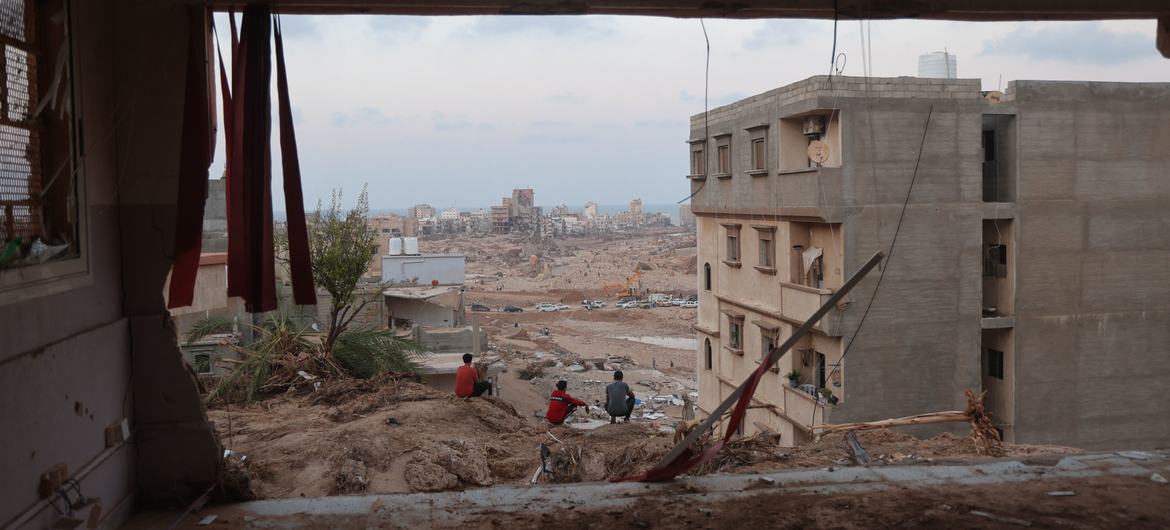
People gather outside a flood-damaged apartment building in Derna, eastern Libya.
© UNICEF/Mostafa Alatrib
 
People gather outside a flood-damaged apartment building in Derna, eastern Libya.

UN News: In a statement this month, UN Security Council members expressed their gratitude to you and reaffirmed their commitment to an inclusive, Libyan-led and Libyan-owned political process facilitated by the United Nations. What’s your take on this?

Abdoulaye Bathily: I welcome this statement and hope that what we call a Libyan-led and Libyan-owned process will be carried out by good faith Libyan actors. This is a problem we always had in Libya because as long as those leaders who have been unwilling to engage in an inclusive negotiation process for a peaceful settlement can continue to monopolise the political process, I’m afraid we cannot have a solution in Libya.

UN News: What are the latest efforts by UNSMIL to reverse the intentional defiance to engage in earnest and a tenacity to delay elections in Libya?

Abdoulaye Bathily: The High State Council, Presidential Council, Government of National Unity and the Libyan National Army are the structures today that can make peace or make war in Libya, who are at the heart of problem in the country. This is why, for us, this was seen as an inclusive mechanism which could bring a peaceful settlement, if they are willing to do so.

Unfortunately, some of them have put conditions or preconditions. Also, they have been unfortunately supported by some outside players who have taken parallel initiatives which tended to neutralise our initiatives. As long as those same players are supported in one way or the other by outside players, we cannot have a solution.

This is why I said to the Council that it is important that all the international players and all the regional players not only speak the same language, but also act accordingly to support a peaceful and inclusive process in Libya.

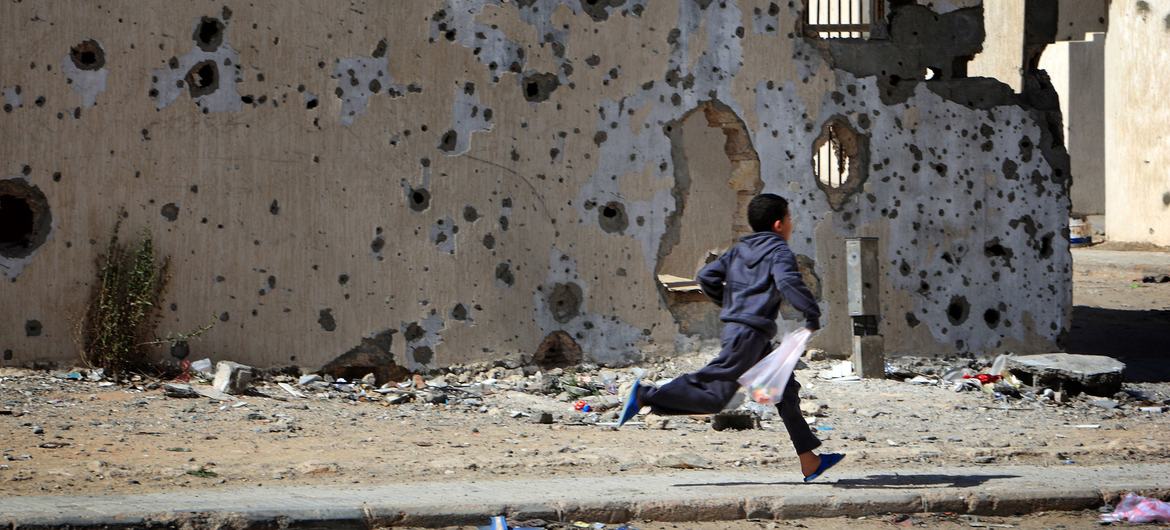
A boy runs past damaged buildings, defaced by shelling during the conflict, on his way home from shopping, in the city of Sirte. (file)
© UNICEF/Giovanni Diffidenti
 
A boy runs past damaged buildings, defaced by shelling during the conflict, on his way home from shopping, in the city of Sirte. (file)

UN News: While the political stalemate in Libya persists, the economic situation is becoming severely strained. What are your latest observations in that respect?

Abdoulaye Bathily: The deterioration of the economic situation is obvious for everybody. The Libyan pound has been really going down against the dollar. The purchasing power of citizens is becoming lower and lower, and there are a lot of complaints among citizens about this. Despite the country’s huge wealth, the majority of the population do not benefit.

Today, Libya has gone backward. There is more poverty and insecurity and less democracy and security for the bulk of the population. This is the reality in Libya today, unfortunately.

UN News: You also voiced concern over the presence of armed actors and heavy weaponry in the capital, Tripoli. Can you tell us more about the security situation there and in Libya in general?

We all know that Libya today is almost an open supermarket of arms; Libya is increasingly becoming a sort of mafia state

Abdoulaye Bathily: We all know that Libya today is almost an open supermarket of arms, which are used for internal political competition among armed groups, but also used in the arms deals, in the arms race and in the arms trade with their neighbours and beyond.

The security situation is more and more concerning for the citizens because all these groups are competing for more power and more access to the wealth of the country, and therefore, their rivalries heighten the tensions throughout Libya and particularly in western Libya.

UN News: Another issue plaguing Libya is the dire situation of migrants and refugees. Can you tell us more about this?

Abdoulaye Bathily: Migration is one of the burning issues in Libya today. As we know, there is a lot of human trafficking. Unfortunately, because of the security situation, there is no hope that we can think of this situation improving in the mid-term or even long-term.

Libya is increasingly becoming a sort of mafia state, which is dominated by a number of groups involved in trafficking gasoline, migrants, metals such as gold and drugs. All this trafficking is interlinked and conducted by the same groups of individuals who are clearly identified in different areas of Libya, in the neighbouring countries and across the Mediterranean.

UN News: As you prepare to leave office, what would be your final message to the key Libyan stakeholders who, as you said before, have not budged from their preconditions to attend the talks you invited them to last year?

Abdoulaye Bathily: I call again on them to have a sense of history and to think about the future of their country. They have to take the moral responsibility before their country. I would also extend a call to their mentors, to those who support them in continuing to keep this stalemate which is detrimental to the interests of the Libyan people and to the region, not only North Africa, but the Sahel.

It is time that the Libyan people, who have been aspiring for peace and stability, to have access to that peace and stability they have been longing for.


https://news.un.org/en/story/2024/05/1149716


https://creativecommons.org/licenses/by/3.0/legalcode

четверг, 30 ноября 2023 г.

Security Council 1970 Sanctions Committee Amends Five Entries on Its Sanctions List

SC/15508

Security Council 1970 Sanctions Committee Amends Five Entries on Its Sanctions List

On 29 November 2023, the Security Council Committee established pursuant to resolution 1970 (2011) concerning Libya enacted the amendments, specified with strikethrough and/or underline, in the entries below on its Sanctions List of individuals and entities......


https://press.un.org/en/2023/sc15508.doc.htm


https://creativecommons.org/licenses/by/3.0/legalcode

среда, 29 ноября 2023 г.

Security Council Committee concerning Libya Grants Humanitarian Travel Exemption, Valid for Six Months, to Two Listed Individuals

SC/15507

Security Council Committee concerning Libya Grants Humanitarian Travel Exemption, Valid for Six Months, to Two Listed Individuals

On 24 November 2023, the Security Council Committee established pursuant to resolution 1970 (2011) concerning Libya decided to grant a humanitarian travel exemption, pursuant to paragraph 16(a) of resolution 1970 (2011), effective from 1 December 2023 through 31 May 2024, to the following two individuals: 

  • LYi.019: Safia Farkash al-Barassi
  • LYi.012: Mohammed Muammar Qadhafi

Accordingly these two individuals may undertake unlimited travel for humanitarian purposes during the above-mentioned time frame.

Under the humanitarian travel exemption granted, travel information shall be provided by the aforementioned individuals for information purposes of the Committee prior to and within one month after travel, as per the Provisional Guidelines of the Committee and the Committee’s Implementation Assistance Notice (IAN) #4, both available at www.un.org/securitycouncil/sanctions/1970.  The Committee could consider extending or renewing the exemption, should circumstances warrant.  Any future decision would take into account the level of information provided.

Furthermore, during the above-mentioned time frame, any State(s) allowing any of the two individuals to travel into or through their territories shall be required to notify the Committee within 48 hours after arrival or passage within their territory.  The notification should be in writing, indicating date of entry and expected duration of stay.

https://press.un.org/en/2023/sc15507.doc.htm


https://creativecommons.org/licenses/by/3.0/legalcode

пятница, 20 октября 2023 г.

Security Council Extends Measures against Illicit Petroleum Exports from Libya, Panel of Experts’ Mandate, Unanimously Adopting Resolution 2701 (2023)

9445TH MEETING (AM)
SC/15456

Security Council Extends Measures against Illicit Petroleum Exports from Libya, Panel of Experts’ Mandate, Unanimously Adopting Resolution 2701 (2023)

The Security Council today extended the authorization of measures to stop the illicit export of petroleum products from Libya and the mandate of the panel of experts helping to oversee this process.

Adopting resolution 2701 (2023) (to be issued as document S/RES/2701/(2023)) by a unanimous vote, the 15-member Council, acting under Chapter VII of the United Nations Charter, decided to extend the authorization of its previously imposed measures against the illicit export of crude oil and other petroleum products from Libya until 1 February 2024.

Seriously concerned about continuing violations of the arms embargo imposed on Libya in February 2011, it demanded full compliance by all Member States with that prohibition.  The Council reiterated that individuals and entities determined by the United Nations Sanctions Committee to have violated the provisions of resolution 1970 (2011), including the arms embargo, or assisted others in doing so, are subject to designation.  It called on Libya’s Government to improve implementation of the embargo, including at all entry points.

On the related travel ban and assets freeze, Member States — particularly those in which designated individuals and entities are based — were called upon to report to the 1970 Committee on their respective actions to effectively implement both measures in relation to all individuals on the sanctions list.

Also through the resolution, the Council renewed the mandate of the Panel of Experts assisting the Committee in carrying out its mandate until 1 February 2025 and decided that the Panel shall submit an interim report on its work no later than 15 June 2024, followed by a final report no later than 15 December 2024 with its findings and recommendations.

Further, the Council called on all parties to implement the 23 October 2020 ceasefire agreement in full and urged Member States to respect and support the withdrawal of all foreign forces, foreign fighters, and mercenaries from Libya without further delay.

The representative of Japan, Chair of the Libya Sanctions Committee, spoke after the resolution’s adoption and said his delegation voted in favour of it because it continues to be relevant to maintaining international peace and security.  The text achieved a balance between a message against those who threaten peace in Libya, on the one hand, and a robust call to protect frozen assets for the future benefit of the Libyan people, on the other.  He welcomed the Council’s fulfilment of its responsibility by unanimously adopting the resolution today and expressed his commitment to contributing to its robust implementation.


https://press.un.org/en/2023/sc15456.doc.htm

https://creativecommons.org/licenses/by/3.0/legalcode

пятница, 29 сентября 2023 г.

Security Council Renews Authorization to Inspect Vessels Suspected of Smuggling Migrants, Human Trafficking from Libya, Adopting Resolution 2698 (2023)

9429TH MEETING (AM)
SC/15428

Security Council Renews Authorization to Inspect Vessels Suspected of Smuggling Migrants, Human Trafficking from Libya, Adopting Resolution 2698 (2023)

The Security Council today decided to renew, for a period of 12 months, its prior authorization allowing Member States to inspect vessels on the high seas off Libya’s coast, when there are reasonable grounds to believe they are participating in acts of migrant smuggling and human trafficking. 

Adopting resolution 2698 (2023) (to be issued as document S/RES/2698 (2023)) by a vote of 14 votes in favour and none against, with one abstention (Russian Federation), the Council condemned all acts of migrant smuggling and human trafficking into, through and from the Libyan territory and off the coast of Libya, which undermine further the process of stabilization of that country and endanger the lives of hundreds of thousands of people.

Through the text, the Council also called upon Member States to place the human rights and immediate needs of migrants and refugees at the core of their efforts to prevent and counter smuggling and trafficking. In addition, it called upon all States with relevant jurisdiction to investigate and prosecute persons responsible for acts of migrant smuggling and human trafficking at sea, in accordance with their obligations under international law.

By further terms of the text adopted today, the Council renewed the reporting requirements provided for in Council resolution 2240 (2015) and requested the Secretary-General to report to the Council 11 months after the adoption of the resolution on its implementation.

Malta’s representative, speaking prior to adoption, said the resolution aims to send a strong message to those seeking to profit from the suffering of migrants.  It also seeks to put human rights and needs of migrants and refugees at the core of efforts to counter smuggling and trafficking off the coast of Libya. Therefore, it intends to effectively manage mass migration, while respecting human rights law, she added.

The Russian Federation’s delegation, speaking after adoption, said that he had abstained because a Council briefing on the issue, convened on 28 September at his country’s request, failed to provide answers to the question of why the resolution was needed if the European Union is unable to discharge the functions that it asked for.  He explained that during consultations, he pointed out that a limited rollover would be wrong, adding:  “Anyone who knows the situation or read the Secretary-General’s report on the implementation of Council resolution 2240 (2015) and subsequent resolutions knows they are not working.”


https://press.un.org/en/2023/sc15428.doc.htm


https://creativecommons.org/licenses/by/3.0/legalcode

Conflicts, Disasters Driving More Migrants to Risk Mediterranean Crossing, Briefers Warn Security Council Ahead of Libya Mandate Decision


9428TH MEETING (PM)
SC/15427

Conflicts, Disasters Driving More Migrants to Risk Mediterranean Crossing, Briefers Warn Security Council Ahead of Libya Mandate Decision

The Mediterranean remains a perilous route for a swelling number of migrants and asylum seekers trying to reach Europe, Security Council members said today, as they discussed the situation in the high seas off Libya ahead of a decision to renew resolution 2240 (2015), which authorizes States and regional groups to inspect and seize vessels in that area suspected of being used for migrant smuggling or human trafficking.

Ruven Menikdiwela, Director of the New York Office of the United Nations High Commissioner for Refugees (UNHCR), said that while nearly 50,000 refugees and asylum seekers are registered with the refugee agency in Libya, it is not authorized to access the disembarkation points.  As such, many detained refugees are escorted to border areas and expelled to neighbouring countries, mainly Egypt, without procedural safeguards.  “Libya is not a place of safety for the purposes of disembarkation, following rescue at sea,” she stressed, underscoring that any cooperation or assistance provided to Tripoli should uphold the human rights of refugees and migrants.

Pär Liljert, Director of the International Organization for Migration (IOM) Office to the United Nations, reporting that 2,093 deaths were recorded along the central Mediterranean route between January and September, expressed concern over the rise of discrimination and xenophobia directed at migrants and refugees.  Noting that more and more people may embark on perilous journeys due to conflict, disasters and environmental degradation, he urged all States to ensure the dignity of those within their borders through a human rights-based approach that prioritizes lives.

In the ensuing debate, several Council members expressed concerns about abuses of migrants and refugees in Libya.  Some called for a more holistic approach to tackle the drivers of irregular migration and prioritizing assistance, underscoring the importance of Libya’s stabilization to strengthen, while others spotlighted the rescue efforts of the European Union’s Naval Force Mediterranean Operation IRINI.

The Russian Federation’s representative said that his delegation requested the meeting following the information that 3,111 people died in the Mediterranean, while trying to reach Europe.  Tragedies such as the one on 14 June off the coast of Greece, in which 78 people died, demonstrate that the mechanism provided for in resolution 2240 (2015) is not functioning or is ineffective, he added. He questioned whether his European colleagues support investigations into the failure of European border services to aid migrants in distress, and what measures are being undertaken within the Operation IRINI framework.

Mozambique’s representative, also speaking for Ghana and Gabon, said that more must be done to address conflict, terrorism, poverty and climate change — factors that have led to the “worrisome scenario” being seen today. Strongly condemning the arbitrary detention of asylum seekers and refugees in Libya, he called on the national authorities to ensure that migrants are protected from human rights violations.  The stabilization of Libya would allow to strengthen control over its territory and reduce the Mediterranean migrant crisis, he said.

Malta’s representative, emphasizing that the Mediterranean remains a perilous migratory route, said that resolution 2240 (2015) and its renewals reaffirm the Council’s determination to combat the smuggling of migrants and trafficking of persons off the Libyan coast.  Reiterating Malta’s commitment to save lives and respond to displacement crises, she said that the Council should address the root causes of irregular migration and forced displacement through a comprehensive and integrated approach.

France’s representative said that establishing a Libyan State is the only way to end trafficking.  He called for more intensive cooperation among States to prevent dramas such as the ones unfolding in the Mediterranean.  Council members must help counter insecurity, he added, noting that the Wagner Group’s presence in the Sahel fuels terrorism and leads to displacement.

MAINTENANCE OF INTERNATIONAL PEACE AND SECURITY

Briefings

RUVEN MENIKDIWELA, Director of the New York Office of the United Nations High Commissioner for Refugees (UNHCR), reported that between January and August, more than 102,000 refugees and migrants attempted to cross the central Mediterranean from Tunisia to Europe, up 260 per cent compared to 2022.  More than 45,000 made the same journey from Libya.  Some 31,000 people were rescued at sea or intercepted and disembarked in Tunisia and another 10,600 in Libya.  Departures from Algeria remain limited with almost 4,700 arrivals in Spain until August, an increase of 18 per cent compared to 2022.  In total, 186,000 people arrived from January to 24 September by sea in Italy, Greece, Spain, Cyprus and Malta, with more than 130,000 people arriving in Italy.  This constitutes an increase of 83 per cent compared to the same period in 2022.  Moreover, as of September 24, more than 2,500 people were accounted as dead or missing, a two-thirds increase from the same period in 2022.  “Lives are also lost on land, away from public attention,” she said, adding that the journey across Africa to coastal points of departure remains one of the world’s most dangerous.  High departure rates in Tunisia result from the perception of insecurity among refugee communities, following incidents of racially-motivated attacks and hate speech, as well as collective expulsions from Libya and Algeria, she said.

In Libya, nearly 50,000 refugees and asylum seekers are registered with UNHCR, she continued, noting that the refugee agency is not authorized to access the disembarkation points controlled by entities involved in interception and rescue at sea.  Many detained refugees are escorted from Libya to border areas and expelled to neighbouring countries, mainly Egypt, without procedural safeguards.  “Libya is not a place of safety for the purposes of disembarkation, following rescue at sea.”  Turning to the simultaneous arrival of large numbers of people on Lampedusa, and noting its limited reception capacities, she said that UNHCR supports the authorities in “decongesting” the island.  “Italy cannot be left on its own in responding to the needs of the arrivals,” she said, calling for a regional disembarkation and redistribution mechanism for people who arrive by sea.  The challenges of mixed movements of refugees and migrants require a “panoramic” view of population movements, stressing the need for establishing proper, legal, substantive migration pathways, she said.

She went on to set out several urgent recommendations, including human rights safeguards, increased search and rescue at sea, the prosecution of smugglers and traffickers, and resettlement and complementary pathways.  Elaborating, she said that any cooperation or assistance provided to Libya or Tunisia should uphold the human rights of refugees and migrants.  All States around the Mediterranean must urgently step up search and rescue efforts and implement effective and predictable disembarkation mechanisms.  States must also cooperate on a route-based approach to investigate and prosecute smugglers.  Finally, UNHCR urges all States to invest more in development and inclusion in countries of asylum and transit, as well as to remove barriers to family reunification and to expand resettlement quotas for refugees from Libya and other countries in North Africa, she said.

PÄR LILJERT, Director of the International Organization for Migration (IOM) Office to the United Nations, citing recent IOM data, said that between January and September, more than 187,000 people crossed the Mediterranean “in pursuit of a better future and the promise of safety”. Tragically, during the same period, IOM recorded 2,093 deaths along the central Mediterranean route.  “While significant attention is dedicated to deaths at sea, the stories shared by migrants suggest that several tragedies may be going unnoticed, especially during the crossing of the Sahara Desert.”  Although the central Mediterranean is “the most dangerous” route, Greece has seen a 300 per cent increase in arrivals this year, while entries into Italy have numbered 130,000 compared to 70,000 in 2022.

The impact of the conflict in Sudan is visible in the demography of those who arrive in Europe via the central Mediterranean route, he said.  In August, 1,294 Sudanese transited through Tunisia, while crossings from Libya into Tunisia also increased.  Expressing concern that discrimination and xenophobia directed at migrants and refugees are on the rise, he urged all States to ensure the dignity of those within their borders through a human rights-based approach that prioritizes lives.  He added that IOM is also concerned about refugees and migrants who are intercepted at sea and sent back to face appalling conditions and abuse in detention centres.  There were 10,992 such cases as of mid-September, he said.

“As the world is experiencing higher rates of conflict, disasters and environmental degradation than at any time in the past three decades, compounded by glaring inequalities and increased poverty, we can expect more and more people to embark on perilous journeys,” he said.  In this context, IOM recommends that the international community find ways to foster regular migration; enhance regular pathways for migrants who do not qualify for refugee status; ensure that the rights of those in irregular situations are respected; support national and regional efforts to prevent and resolve forced displacements; and increase search and rescue operations and capabilities.  “We must recognize that solutions to irregular migration cannot solely rely on preventing departures, but also on ensuring that we are effectively addressing the various drivers of migration in countries of origin, transit and, oftentimes, in countries of initial destination,” he added.

Statements

VASSILY A. NEBENZIA (Russian Federation) noted that he requested today’s meeting after reading the latest Secretary-General’s report on the implementation of resolution 2652 (2022) (document S/2023/640), which showed that 3,111 people died in the Mediterranean while trying to reach Europe, an increase of 77 per cent from 2022:  “This is a very sordid picture.”  Tragedies such as the one on 14 June off the coast of Greece, in which 78 people died, demonstrate that the mechanism provided for in resolution 2240 (2015) is not functioning or is ineffective, he said, adding:  “Why is this resolution needed if the European Union is unable to properly carry out the functions placed on it on its own request?”  Recalling a remark by the High Representative of the European Union for Foreign Affairs and Security Policy that everything must be done to protect “a blossoming garden from guests from the jungle,” he questioned whether his European colleagues support investigations into the failure of European border services to aid migrants in distress, and what measures are being undertaken within the Operation IRINI framework.  The rights of refugees, internally displaced persons and stateless persons must be protected, he said, adding that the European Union does not extend the solidarity it shows to Ukrainian migrants to those migrating from North Africa and the Middle East.....

https://press.un.org/en/2023/sc15427.doc.htm

https://creativecommons.org/licenses/by/3.0/legalcode

вторник, 19 сентября 2023 г.

Security Council Committee on Libya Discusses Final Report of Panel of Experts

Security Council Committee on Libya Discusses Final Report of Panel of Experts

On 18 August 2023, the Security Council Committee established pursuant to resolution 1970 (2011) concerning Libya held informal consultations to consider the final report of the Panel of Experts on Libya, submitted in accordance with paragraph 13 of resolution 2644 (2022).

The Committee heard a presentation by the Coordinator of the Panel on its final report, which covered a range of issues, including acts that threaten the peace, stability or security of Libya, particularly the acts of Libyan armed groups; violations of international humanitarian law and human rights, including in the context of human trafficking and migrant smuggling; violations of the arms embargo; illicit exports of refined petroleum products; and implementation of the assets freeze.  The presentation was followed by an interactive discussion between Committee members and the Panel of Experts.  In the discussion, Committee members expressed their support for the work of the Panel.

The Committee discussed the recommendations contained in the final report and is currently considering follow-up action in relation to those four recommendations addressed to the Committee.


https://press.un.org/en/2023/sc15415.doc.htm

https://creativecommons.org/licenses/by/3.0/legalcode

среда, 23 августа 2023 г.

Presidential, Parliamentary Elections in Libya Only Way to Restore Legitimacy of Country’s Institutions, Delegates Tell Security Council

SC/15392

Presidential, Parliamentary Elections in Libya Only Way to Restore Legitimacy of Country’s Institutions, Delegates Tell Security Council

Women’s Rights Activist Expresses Concern over Severe Restrictions on Civil Society Space, Stresses Need for Legal Reform, International Cooperation

Libya needs more than ever to close the current page of institutional fragmentation, a senior United Nations official today told the Security Council, calling for an inclusive political agreement that would pave the way for peaceful and transparent elections across the country.

Abdoulaye Bathily, Special Representative of the Secretary-General and Head of the United Nations Support Mission in Libya (UNSMIL), said his exchanges with local actors throughout the country illustrate that Libyans want to end successive interim arrangements towards an elected and legitimate leadership.  All Libyan leaders have agreed to amendment of the draft laws, he said, urging the country’s two chambers to finalize and make electoral laws implementable towards a reasonable electoral timeline.  “The electoral landscape should be a level playing field for all candidates”, he stressed, noting that citizens yearn for unified political, military, security and economic institutions to safeguard the territorial integrity and national identity of the country.

Highlighting economic progress, he noted that the reunification of the Central Bank of Libya as a sovereign Libyan institution has been finalized.  However, the fragile stability that had prevailed in Tripoli since August 2022 was shattered by fierce armed clashes on 14 and 15 August between the Deterrence Apparatus for Combating Organized Crime and Terrorism and the 444 Brigade, with 55 killed.  Stressing the need for all parties to preserve security gains achieved in recent years, he said UNSMIL will continue to engage relevant actors to advance the reunification of military and security institutions.

Voicing concern over severe restrictions on civil society space in Libya, Noura Al Jerbi, civil society briefer and women’s rights activist, spotlighted draconian laws and regulations, unwarranted investigations and enforced disappearance of human rights defenders and activists.  Libya’s legal framework only serves to supress civil society, she asserted, calling for a new civil society law and an independent civil society commission whose work will not be subject to interference from political authorities or the security sector.  Detailing new procedures which discriminate against females by imposing unjust restrictions on women’s travel in Libya, she stressed the need for legal reform and international cooperation.

Also briefing the Council today was Ishikane Kimihiro (Japan), in his capacity as Chair of the Council Committee established pursuant to resolution 1970 (2011) concerning Libya.  He detailed the Committee’s work from 20 June to 22 August 2023.  The update for the two-month period covered acts by armed groups that threaten the peace and security of the country; violations of human rights, including human trafficking and migrant smuggling; illicit exports of petroleum products; and implementation of the asset freeze.  He further discussed the arms embargo, the travel ban and the sanctions list, including new delisting requests received by the Committee.

In the ensuing debate, Council members underscored that presidential and parliamentary elections in Libya are the only way to restore the legitimacy of the country’s institutions.  However, security is also a precondition for an environment conducive to elections, numerous delegates pointed out, as they expressed concern about the fragile security context recently manifested in armed clashes between rival groups in Tripoli.

“We have already seen the cost of violence and instability in Libya’s neighbourhood this year, from Sudan to Niger,” said the representative of the United Kingdom with regard to the recent violence in Tripoli.  It is imperative that civic space is protected to allow Libyans to hold their leaders accountable and to empower everyone to play a role in developing an open, democratic society that allows for freedom of association and assembly, he underscored.

The representative of China welcomed the work of the joint 6+6 committee in reaching the draft electoral law and its approval by Libya’s House of Representatives.  Citing external interference and pressure as important sources of instability in Libya, he urged the international community to adhere to the principle of a Libyan-led and -owned process, instead of blindly imposing solutions........


https://press.un.org/en/2023/sc15392.doc.htm

https://creativecommons.org/licenses/by/3.0/legalcode