Показаны сообщения с ярлыком Gaza. Показать все сообщения

четверг, 10 октября 2024 г.

‘No end to hell’ in northern Gaza, warns UN aid agency chief


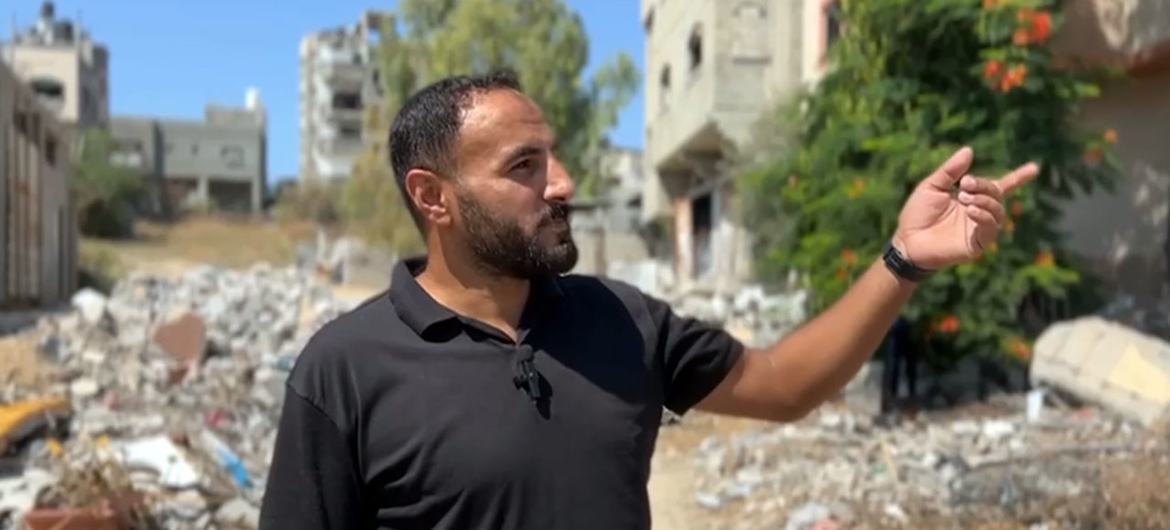
Northern Gaza resident Ahmed Abu Aita gestures towards his house in northern Gaza which has been reduced to rubble.
© UNOCHA
 
Northern Gaza resident Ahmed Abu Aita gestures towards his house in northern Gaza which has been reduced to rubble.


9 October 2024 


The prospect of all-out war in Lebanon appeared undiminished on Wednesday as the head of the UN agency for Palestine refugees, UNRWA, said that there was “no end to hell” in northern Gaza, where lifesaving relief has shut down.

The warning from Philippe Lazzarini, Commissioner-General of UNRWA UNRWA was prompted by renewed evacuation orders from the Israeli military, which “many are refusing because they know too well that no place anywhere in Gaza is safe”.

The development comes amid reports by the local authorities of intense Israeli bombardment in the north of the shattered enclave where ground operations are also underway. Jabalia refugee camp is surrounded, the Israeli Defense Forces (IDF) said at the weekend, before issuing evacuation orders on Tuesday.

Strikes have also been reported in Beit Lahia and Beit Hanoun, towns in the northeast of Gaza, with roads also closed.

“Intensified military operations in the north are forcing us to shut down lifesaving services,” Mr. Lazzarini said on social media on Wednesday.

He added that seven of the UN agency’s schools-turned-shelters are being evacuated, while only two out of eight water wells in Jabalia camp are still operational. Some 400,000 people are believed to remain in the north of Gaza.

Tweet URL

“Children are, as ever, the first and most to suffer,” the UNRWA chief said, adding that hunger was “spreading and deepening again” because “almost no basic supplies” were available.

According to local health authorities in Gaza, at least 45 people were killed and 130 wounded in the last 24 hours. Since Hamas-led terror attacks in multiple Israeli sites that left some 1,250 dead and more than 250 taken hostage, the death toll in Gaza has reportedly reached at least 42,000 people. Another 97,700 have been wounded, often with life-changing injuries.

Devastation in Lebanon

In Lebanon, meanwhile, the UN aid coordination office, OCHA, reported “relentless” and “amplifying” bombardment” into previously unaffected areas, amid ongoing missile strikes on Israel by Hezbollah.

“In a single day – 6 October - more than 30 airstrikes struck the Beirut southern suburbs and surrounding areas, frightening residents and forcing additional displacement from densely populated areas, including Shatila Palestine refugee camp,” OCHA said in an update published Wednesday.

Latest data from the health ministry indicate more than 2,083 collective deaths and 9,869 injuries since 8 October 2023, when Hezbollah rocket fire increased into northern Israel as the war in Gaza erupted. Most casualties in Lebanon have happened in the last two weeks, amid intense Israeli bombardment and ground operations in southern Lebanon.

According to the UN human rights office, OHCHR, 25 per cent of Lebanese territory is affected by Israeli military displacement orders. Displacement orders are issued “on a daily basis” for more than 100 villages and urban neighbourhoods across southern Lebanon, forcing people to flee and pushing many up to 30 km north.

Massive displacement

OCHA reported that in total, some 1.2 million people are now internally displaced, with 180,700 people seeking refuge in 978 shelters, 775 of which are already at full capacity. The violence has also delayed the start of the school year, while the UN Children’s Fund, UNICEF, said that about 350,000 children have been displaced.

“Extensive civilian harm is occurring due to explosive weapons in densely populated areas and forced displacement orders,” OCHA noted. “Urgent action is necessary to shield civilians from escalating violence and ensure that humanitarian and aid workers can safely deliver critical support.”


https://news.un.org/en/story/2024/10/1155501


https://creativecommons.org/licenses/by/4.0/legalcode

вторник, 17 сентября 2024 г.

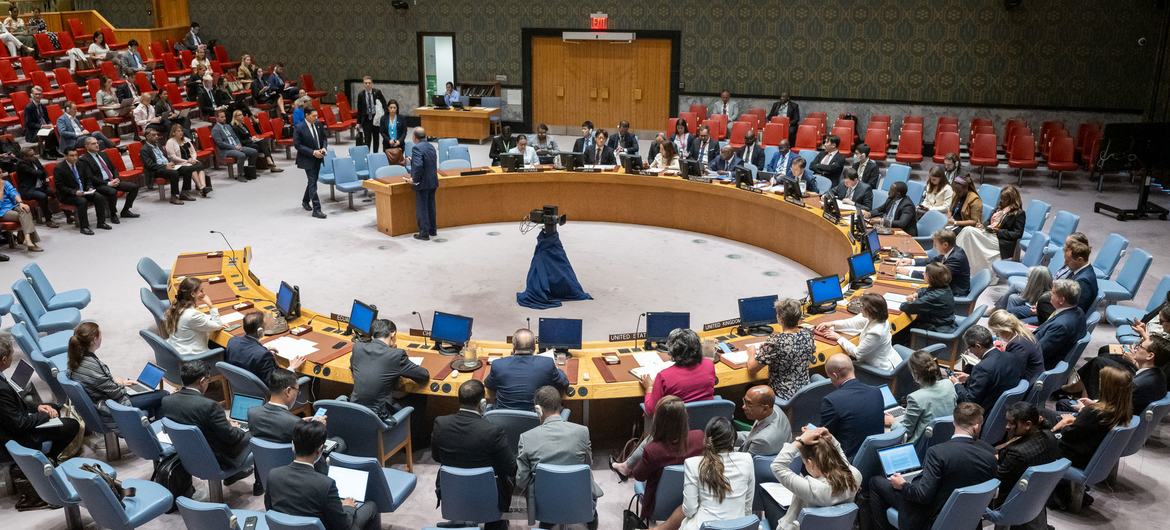
More action on the ground needed to save civilian lives in Gaza, top UN official tells Security Council


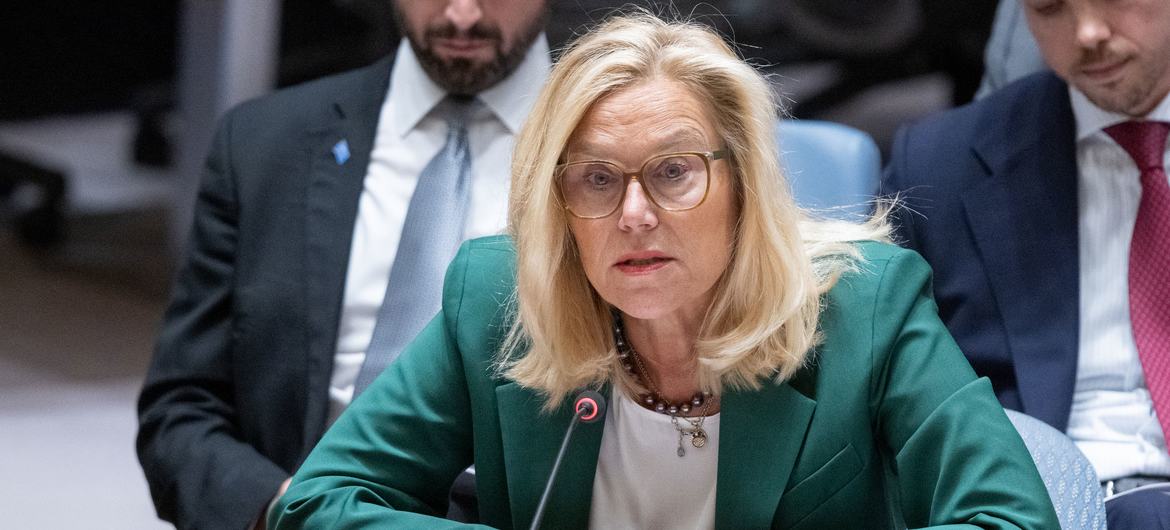
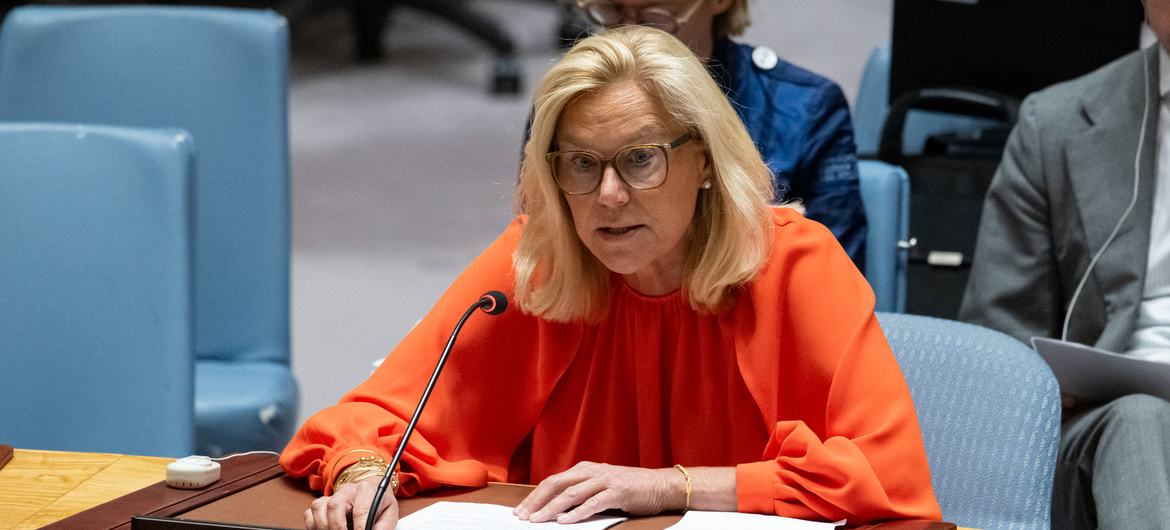
Sigrid Kaag, Senior Humanitarian and Reconstruction Coordinator for Gaza briefs the Security Council meeting on the situation in Gaza.
UN Photo/Eskinder Debebe
 
Sigrid Kaag, Senior Humanitarian and Reconstruction Coordinator for Gaza briefs the Security Council meeting on the situation in Gaza.


16 September 2024

 Humanitarian Aid

Not enough progress is being made in getting desperately needed aid and commercial goods into Gaza, the UN Senior Humanitarian and Reconstruction Coordinator for the Strip said in a briefing to the Security Council on Monday. 

Sigrid Kaag updated ambassadors on the implementation of resolution 2720, adopted last December, which established her mandate following the brutal 7 October Hamas-led attacks on Israel and the start of hostilities in Gaza.

She was also tasked with establishing a UN mechanism for accelerating the provision of humanitarian relief consignments to the enclave, operationalized and managed by the UN Office for Project Services (UNOPS).

Supply routes established

Ms. Kaag said “the 2720 Team” has continuously engaged on access issues, addressed obstacles, and proposed solutions to enable assistance by all aid partners, including the UN agency that assists Palestine refugees, UNRWA, which she called the “backbone” of humanitarian operations in Gaza.

She recalled that 11 months ago, the enclave was largely cut off from most of its supply lines, with all but one access point closed.

Despite the complex situation, her mission has negotiated and strengthened supply lines and systems, as well as additional routes, in efforts to facilitate, accelerate and expedite aid flows in a sustained and transparent manner.

These routes cover supplies from or via Egypt, Jordan, Cyprus, the West Bank and Israel. 

Humanitarian aid goals unmet

However, Ms. Kaag said systems in place today are not a substitute for the political will required to reach civilians in Gaza and respond to their needs.

“Effective humanitarian operations require the right quality, quantity, and a broad range of goods to meet the daily needs of civilians in Gaza. That goal is not being met,” she said.

Additionally, ongoing hostilities across the Strip, the breakdown of law and order, and the looting of supplies are significant impediments to UN efforts to distribute assistance there.

Humanitarians also face denials, delays and lack of safety and security, as well as poor logistical infrastructure.

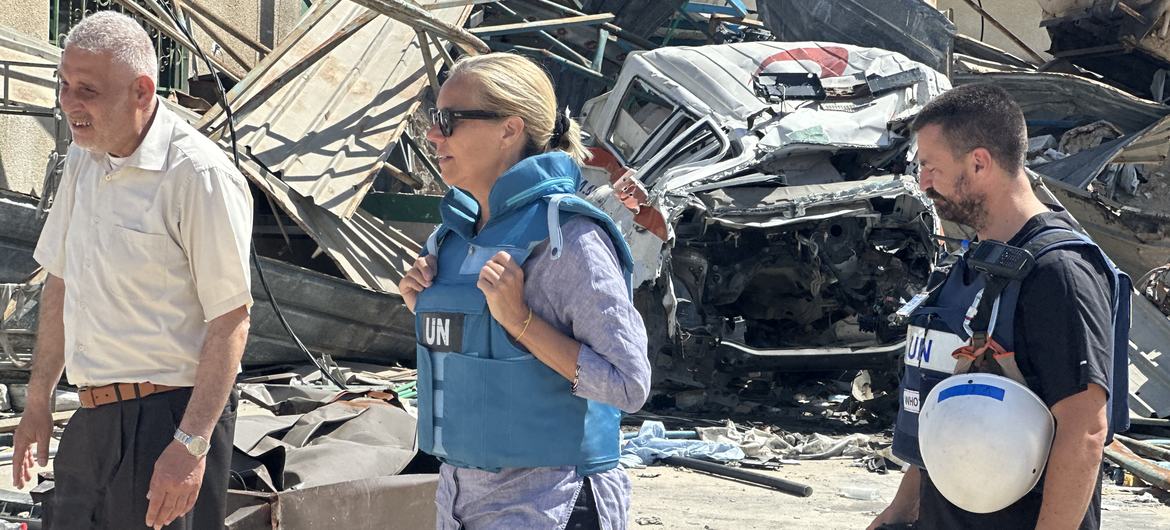
UN Senior Humanitarian and Reconstruction Coordinator, Sigrid Kaag, visiting the Nasser Medical complex in Khan Younis, Gaza (file).
OCHA / Olga Cherevko
 
UN Senior Humanitarian and Reconstruction Coordinator, Sigrid Kaag, visiting the Nasser Medical complex in Khan Younis, Gaza (file).

Lives at stake

Ms. Kaag said “this continues to hamper relief operations despite recent approvals provided for trucks, satellite phones and other equipment,” and engagement on these issues is ongoing.

She said “commitments and intentions need to be translated into tangible actions on the ground”, warning that “any delay in implementation comes at direct cost of human lives.”

Areas for action

In the meantime, her mission continues to focus on securing access for a diverse range of goods from the humanitarian and commercial sector, highlighting critical areas.

“Modest progress in select areas, such as waste and sewage management, has been made. However, this does not address the totality of the need. For example, cash, prepositioned fuel and hygiene items are urgently needed,” she said.

Furthermore, the scope of humanitarian items allowed entry remains too restricted, she added, while the UN also urgently needs the entry of further vital security communications and tracking equipment.

Implement agreed protocols

Ms. Kaag said a new Joint Coordination Board is now operational but noted that “recent security incidents, including shootings at humanitarian convoys, are unacceptable and demonstrate that agreed protocols and procedures still need comprehensive on-time implementation.”

She also hailed the recent medical evacuation of 251 patients and family members to the United Arab Emirates - the largest from Gaza to date.  Yet over 14,000 patients still require specialized medical treatment outside Gaza, showing that much more has to be done.

Recovery cannot wait

Stressing that “humanitarian assistance is only a temporary pathway to alleviate suffering”, Ms. Kaag upheld that a comprehensive, just and lasting peace can only be realized through a two-State solution between Israelis and Palestinians.

“In this light, the recovery and reconstruction of Gaza should not wait,” she said, emphasizing the need for education, healthcare, housing, in addition to establishing governance and security arrangements.

“The UN’s position is clear,” she continued.  “The Palestinian Authority must resume its full responsibilities in Gaza. Prime Minister (Mohammed) Mustafa’s cabinet has developed comprehensive plans to restore local governance, security and re-establish the rule of law.”

Relatedly, international planning efforts by the UN, the European Union, the World Bank and others are ongoing in support of the Palestinian Authority, she said, and her mission has developed financing options for the international community to consider.

Mechanism up and running

Meanwhile, UNOPS is committed to supporting Ms. Kaag’s mandate, Executive Director Jorge Moreira da Silva told the Council.

He said the UN mechanism has been running a database covering humanitarian aid consignments into Gaza that has been operational since May and is publicly accessible. 

So far, 229 consignments have requested clearance and 175 have been approved, 101 have been delivered, 17 are pending clearance, and 37 have been rejected. 

This translates into more than 20,000 metric tonnes of humanitarian aid cargo delivered, including food and nutrition, shelter items, water and sanitation (WASH) supplies and medical aid.

Jordan aid corridor

“The consignments were primarily delivered through the Jordan corridor, the direct route from Jordan to Gaza that was formalized and regularized under the mechanism to provide much needed predictability and regularity and to address the backlog challenges that accompanied convoys undergoing multiple inspection and transloading points,” he said.

He explained that humanitarian health consignments delivered via this route pass through a single inspection point in Jordan and a single transloading point in Gaza. Prior to the UN mechanism, there were three inspection points and four transloading points. 

A smaller portion of the consignments was delivered through the Cyprus corridor – “a vital supplementary route for delivering humanitarian aid to Gaza” which “is not intended to replace or divert attention from existing land or sea corridors, but rather to enhance overall capacity.”

Confidence-building and transparency

He added that in response to donor requests, UNOPS stands ready to address current logistical challenges for the Cyprus corridor “by offering an end-to-end solution ensuring the coordinated, efficient and transparent delivery of aid.”

To support the regularization of the corridors under the UN mechanism, UNOPS has deployed 14 international monitors to Cyprus and Jordan who verify the humanitarian nature of each consignment, facilitate approval for the shipments to proceed to Gaza, and track the journey from point of origin until handover to the final consignee in Gaza for onward delivery. 

“This very mechanism fosters confidence building among all and provides transparency, informing all of us that what was sent to Gaza indeed make its way to its final destination,” he said.

Regarding consignments that are not permitted, the UN mechanism always requires a justification.

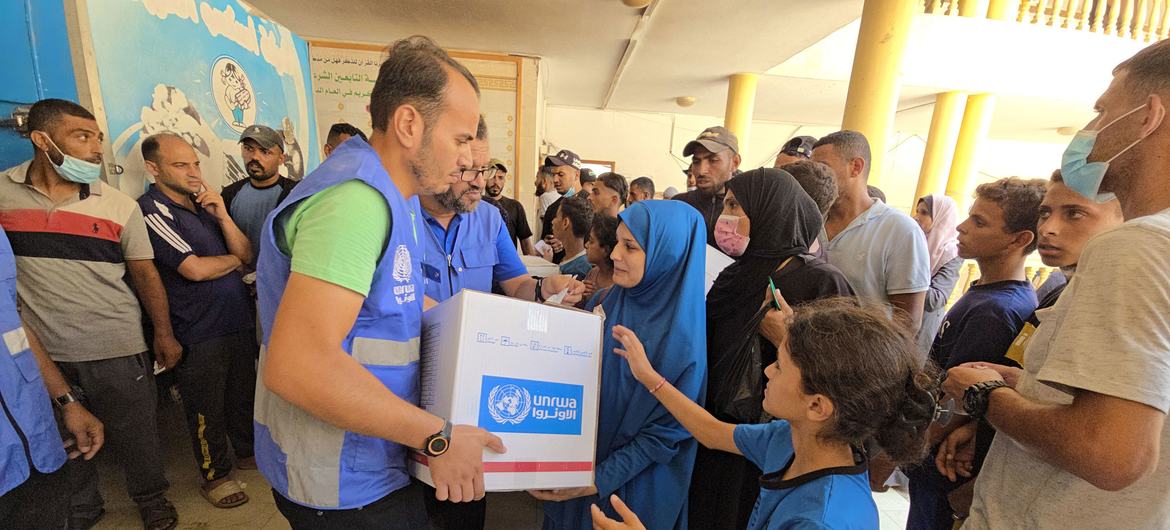
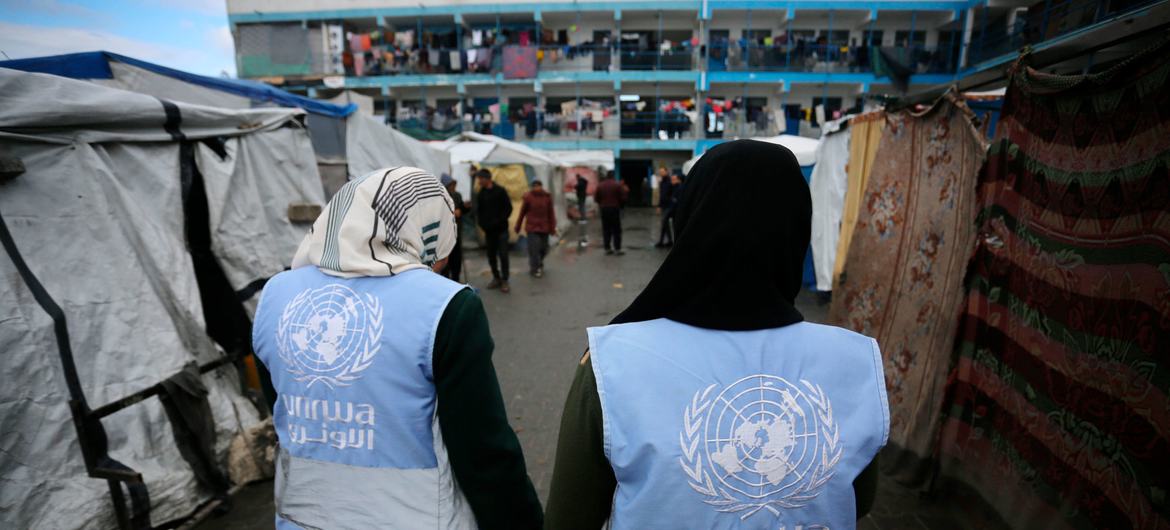
UNRWA continues to offer support to people in Gaza.
© UNRWA
 
UNRWA continues to offer support to people in Gaza.

Allow more aid

Mr. Moreira da Silva said UNOPS alongside Ms. Kaag’s Office continues to call for more items and consigners to be allowed to enter Gaza.

“Eleven of our international monitors are also ready to deploy inside Gaza, in order to reinforce this important verification and tracking mechanism as an additional enabler of our collective efforts to accelerate and increase the amount of humanitarian aid reaching the civilian population in Gaza,” he said.

‘Vital lifeline’ from Egypt

He then turned to the Egypt corridor, which has served as “a vital lifeline” for delivering aid to Gaza since the conflict erupted.

UNOPS is working closing with the Egyptian authorities to fully integrate the route into the mechanism and a team will be in Cairo this week to finalize the process.

“Once completed, the 2720 mechanism will provide a comprehensive real-time overview of all humanitarian cargo entering to Gaza from every supply route. This will enable better prioritization, tracking and monitoring of relief efforts right up to the point of delivery,” he said.

Supporting all routes

He told the Council that UNOPS has committed to support the full operational capacity of each corridor. 

The Office is procuring 280 trucks for the Jordan route, in addition to constructing 10 additional warehousing spaces for the Jordan Hashemite Charity Organization, and establishing two truck holding areas at the King Hussein Bridge border crossing and inspection site.

UNOPS is also securing 38 trucks for use by humanitarians inside Gaza to enable delivery of aid consignments arriving via the different corridors.

“We have procured the necessary armoured vehicles, communications and other security equipment that will enable the operational capacity of the mechanism’s international monitors inside Gaza, the 11 monitors, without exerting pressure on the already limited resources of the rest of the humanitarian community,” he said.

The UNOPS chief thanked Member States for their financial support to the UN mechanism. He underscored that effective delivery of aid at the scale required will not be possible without political will, necessary security and safety guarantees, and an enabling environment.


https://news.un.org/en/story/2024/09/1154371

https://creativecommons.org/licenses/by/4.0/legalcode

четверг, 5 сентября 2024 г.

UN demands hostage release, urges protection and aid for Gaza civilians


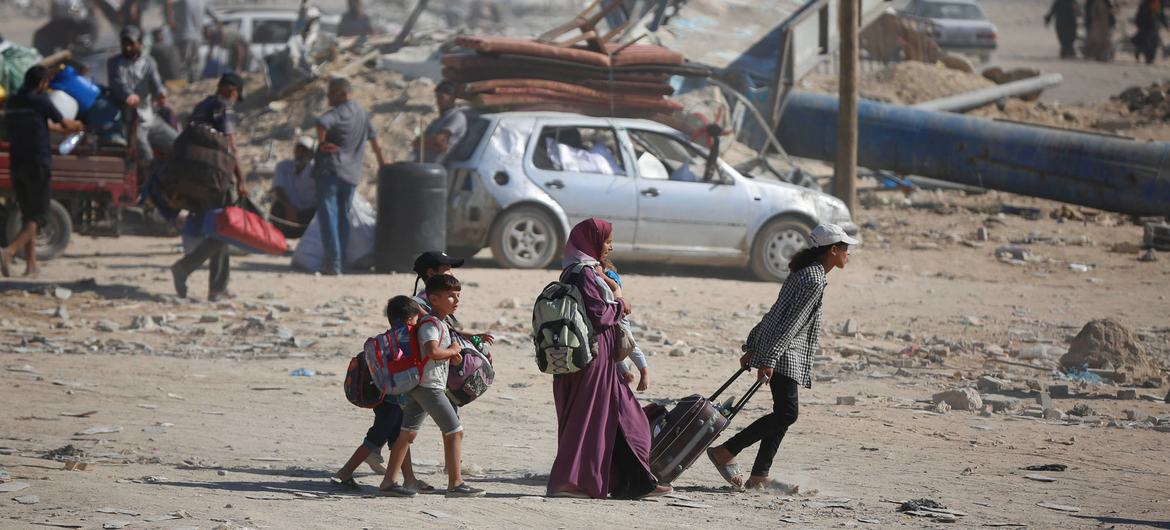
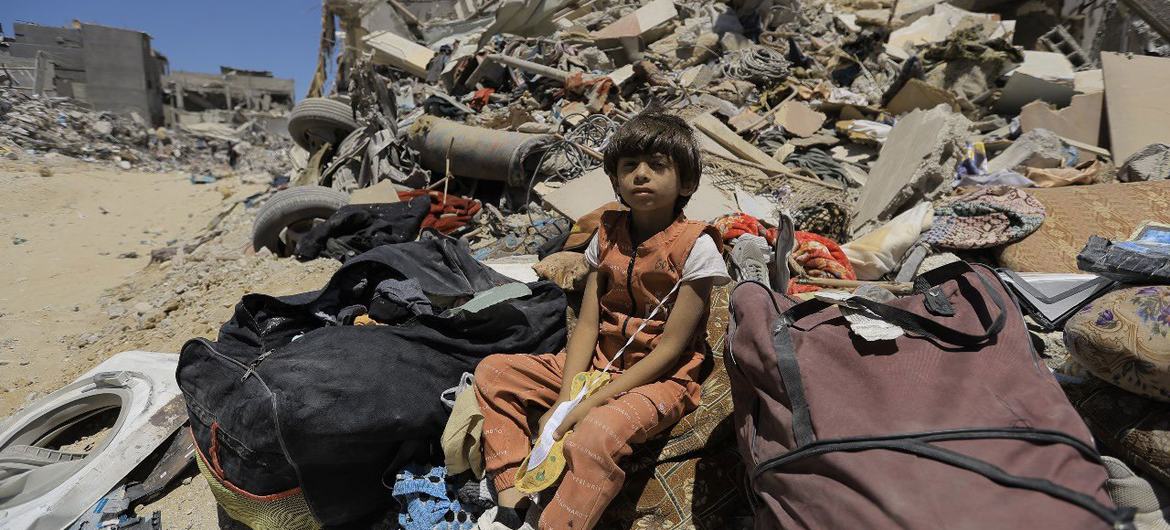
A family carries their belongings as they walk across rubble and ruin in Gaza.
© UNRWA
 
A family carries their belongings as they walk across rubble and ruin in Gaza.


By Vibhu Mishra
4 September 2024
 Peace and Security

Top UN political and humanitarian officials on Wednesday renewed urgent appeals for the unconditional release of all hostages in Gaza, while emphasizing the need to ensure aid and protection for desperate civilians being continually displaced inside the war-battered enclave.

Rosemary DiCarlo, Under-Secretary-General for Political Affairs, and Edem Wosornu, Director of Operations for humanitarian coordination wing, OCHA, were briefing ambassadors in the Security Council, against the backdrop of the recovery of the bodies of six hostages killed in Gaza and polio vaccination campaign which began at the weekend.

The urgent meeting was requested – separately – by both Algeria and Israel. According to media reports, Israel demanded the Council condemn Hamas in the strongest possible terms and address the dire situation of the hostages still held in captivity.

Algeria reportedly requested the meeting to discuss the worsening situation in Gaza and the West Bank.

Next month will mark the somber one year-mark of the 7 October terror attacks by Hamas and other Palestinian armed groups in southern Israel, in which more than 1,250 Israeli and foreign nationals were killed and around 250 were abducted and taken into Gaza.

At least 101 hostages – including some remains of those declared dead – remain in Gaza, which has been under a relentless Israeli military onslaught that has claimed more than 41,000 Palestinian lives, according to the Strip’s health authorities.

Heartbreaking news

Ms. DiCarlo recalled her meeting last November with the parents of Hersh Goldberg-Polin, one of the hostages killed.

She said that according to the Israeli Government, the hostages had been shot multiple times at close range and that they were killed by Hamas shortly before Israeli soldiers were able to reach them inside a tunnel in Rafah.

Under-Secretary-General DiCarlo briefs the Security Council.

Following the recovery of the bodies, Hamas announced that militants guarding hostages in the buildings and tunnels of Gaza had new instructions to kill hostages before they could be recovered alive by Israeli forces, she added.

“I echo the words of the Secretary-General once again: all hostages must be released immediately and unconditionally,” Ms. DiCarlo reiterated.

“For as long as they are held, in accordance with international legal obligations, they must be treated humanely and allowed to receive visits and assistance from the International Committee of the Red Cross (ICRC).”

Ms. DiCarlo also updated on the situation in the occupied West Bank, including East Jerusalem, included the latest on large-scale Israeli military operations, settler attacks and armed Palestinian violence against Israelis.

‘No limits’ to brutality

Briefing alongside Ms. DiCarlo, Ms. Wosornu highlighted the death and destruction across the Gaza Strip, stating “the brutality of this conflict seems to know no limits.”

“We see this in the many attacks harming humanitarian workers: 295 humanitarian workers killed since 7 October [2023],” she added.

Many humanitarian assets, including several UN vehicles “have been directly hit in more than a dozen separate incidents even though their movements were notified,” she said.

Ms. Wosornu outlined the fallout from this, limiting the delivery of lifesaving aid to those in desperate need, such as the temporary suspension of staff movements by the UN World Food Programme (WFP) following an attack on one of its convoys last week.

A wide view of the Security Council meeting.
UN Photo/Manuel Elías
 
A wide view of the Security Council meeting.

Polio pauses, rare ray of hope

Both UN officials welcomed the local humanitarian pauses, which enabled the launch of the emergency polio vaccination campaign.

“The polio pauses are a rare ray of hope and humanity amid the horror in Gaza,” Ms. DiCarlo said, noting that the images of young children receiving their vaccinations amid utter ruin “are both moving and distressing.”

She added that the arrangements established between UN agencies and the Israeli Defense Forces (IDF) to pause military activity in the designated vaccination areas “have so far been respected”.

Humanitarians remain

Ms. Wosornu further noted that humanitarians – despite overwhelming challenges – remain on the ground, providing essential assistance, including food and shelter and protection, as best as they can.

OCHA Director Wosornu briefs the Security Council.

Food rations are being distributed, albeit at reduced levels, with wheat flour prioritized only for the 14 bakeries supported by humanitarian actors.

Tents are also being distributed, though they are insufficient to match the needs of repeatedly displaced families, especially with the approaching cold and rainy weather.

Turn promises into reality

She urged the Security Council “to turn its promises into reality and end the suffering.”

“We once again appeal to Council Members and all Member States to achieve an immediate cessation of hostilities and a sustained ceasefire in Gaza, and to de-escalate the situation in the West Bank,” she urged.

“Resolutions passed by this Council promised an immediate ceasefire in Gaza. They also called for the release of hostages. Yet, months later, the violence continues, thousands more people have been killed, and hostages separated from their families.”


https://creativecommons.org/licenses/by/4.0/legalcode

https://news.un.org/en/story/2024/09/1153966

суббота, 13 июля 2024 г.

Gaza: There is no alternative to UNRWA, Guterres declares


UNRWA has been providing vital humanitarian assistance to civilians affected by the ongoing conflict. (file photo)
© UNRWA
 
UNRWA has been providing vital humanitarian assistance to civilians affected by the ongoing conflict. (file photo)


12 July 2024

 Humanitarian Aid

UN Secretary-General António Guterres, standing alongside top officials in New York on Friday, underscored the essential need to bolster the UN agency assisting Palestine refugees (UNRWA) across the Middle East amid continued attacks on its mandate, staff, premises and operations.

Speaking at a pledging conference for the agency, the UN chief outlined the countless challenges facing Palestinian civilians in Gaza who are “forced to move like human pinballs across a landscape of destruction and death”.

“Hopelessness is the greatest ally of instability,” he warned, stressing that through its work, “UNRWA is one of the greatest factors providing hope and stability across a troubled region.”

The agency has been supporting critical services including education, health and social services to some 5.9 million Palestine refugees, including vulnerable groups such as women, children, and persons with disabilities.

It also administers 58 refugee camps, addressing the dire humanitarian needs of over 1.6 million people across Jordan, Lebanon, Syria, the Gaza Strip, and the West Bank, including East Jerusalem.

The annual pledging conference, held under the auspices of the General Assembly, serves as a vital platform to raise funds for these operations.

Tweet URL

This year is different

This year, however, the conference is being held under vastly different circumstances.

Gaza has become a place of immense suffering amidst daily military barrages in a conflict that was precipitated by the 7 October terror attack by Hamas and other Palestinian armed groups in southern Israel. Over 1,200 Israelis were killed and over 200 were taken hostage. Dozens among them still remain in captivity, presumed to be in Gaza.

In the Gaza Strip, more than 38,000 Palestinians are reported to have been killed, a further 88,000 injured and about 90 per cent of population displaced – many several times.  

Tensions are also boiling over in the West Bank, and there are mounting fears of a spillover of the war into Lebanon as Israeli forces exchange daily fire with Hezbollah militants.

With humanitarian needs across the enclave sharply skyrocketing, UNRWA also faces a severe funding crisis, with many donors suspending their funding after allegations made by Israel that some agency personnel were involved in the 7 October attacks.  

Lacking clear evidence, many donor countries have resumed contributions following UN actions in response.

Of the 12 people implicated, the agency terminated the contracts of 10, another two are confirmed dead. An investigation by UN’s Office of Internal Oversight Services (OIOS) was also immediately launched and is ongoing.

Separately and prior to the allegations, the Secretary-General commissioned former French Foreign Minister Catherine Colonna to lead an independent review to assess UNRWA’s commitment to the humanitarian principle of neutrality.  

She submitted her final report in April with key recommendations, which are being implemented.

UNRWA nevertheless faces massive gaps in matching resources with the needs and requires $1.2 billion to cover critical humanitarian needs until the end of the year.

Secretary-General Guterres speaking at the pledging conference.

There is no alternative

The UN chief warned that without more support and financing for UNRWA, Palestine refugees “will lose a critical lifeline and the last ray of hope for a better future.”

“My appeal to everyone is this: Protect UNRWA, protect UNRWA staff, and protect UNRWA’s mandate – including through funding. Let me be clear: there is no alternative to UNRWA,” he stressed.

Mr. Guterres once again underscored the need to end the ongoing war, starting with an immediate humanitarian ceasefire in Gaza and an immediate and unconditional release of all hostages.

“Ultimately, only a political solution can bring an end to this conflict – one that realizes a vision of two States – Israel and Palestine – living side by side in peace and security, with Jerusalem as the capital of both States,” he said.

“I urge you to act now: act to instil hope in a place where it is in short supply; act to uphold the mandate of this General Assembly to sustain UNRWA; act in solidarity with Palestine Refugees and all the Palestinian people,” the UN chief concluded.

Question of survival

General Assembly President Dennis Francis echoed the Secretary-General’s call for support, urging donors to “transform rhetoric into reality” by ensuring that agency is sufficiently funded.

He urged all stakeholders – UN Member States as well philanthropic organizations, the private sector and individuals to contribute to the agency.

“This is not merely about funding, nor about the survival of an agency. It is about people and the survival of Palestine refugees – especially the children – across the Gaza Strip, Jordan, Lebanon, Syria, the West Bank, and East Jerusalem,” he said.

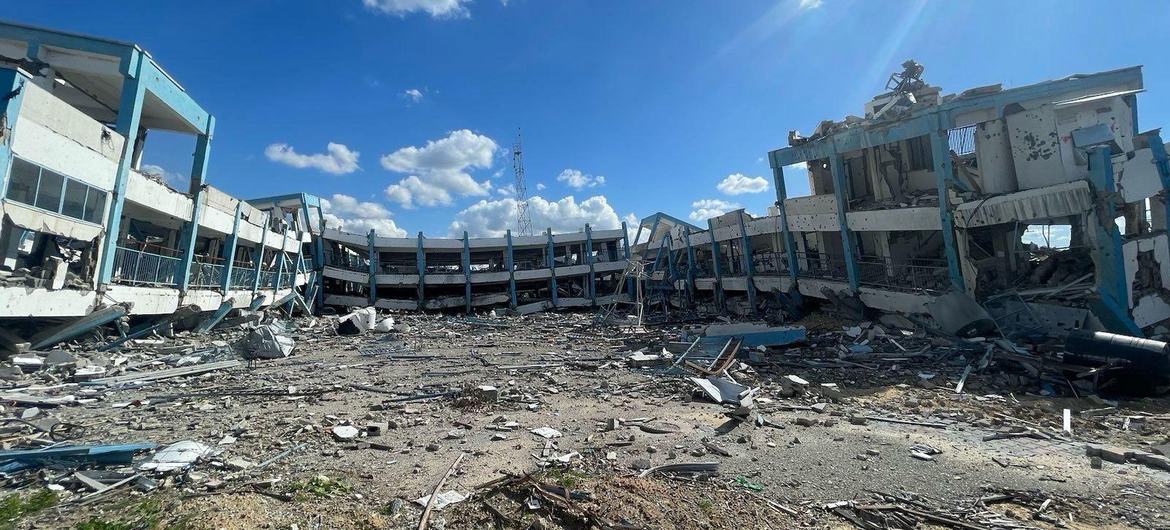
Nearly 190 UNRWA installations, many sheltering displaced people, have been damaged or destroyed during the conflict. Pictured here, the remains of an UNRWA school.
© UNRWA
 
Nearly 190 UNRWA installations, many sheltering displaced people, have been damaged or destroyed during the conflict. Pictured here, the remains of an UNRWA school.

Suffering everywhere

UNRWA Commissioner-General Philippe Lazzarini emphasized the immense suffering of both Palestinians and Israelis. He once again condemned the October 7 attack and called for the immediate release of all hostages.

Gaza has been “decimated”, he said, with over two million people living in dire conditions.  

Children and women are particularly affected, with many children killed or severely injured. He highlighted a similar tragedy unfolding in the West Bank, with hundreds of Palestinians killed by Israeli forces and settlers.

Targeted because UNRWA protects

Mr. Lazzarini also stressed that despite decades of providing stability and essential services, UNRWA is struggling under relentless attacks, with significant loss of life and damage to its facilities.

Tweet URL

He also decried the mistreatment of UNRWA personnel and the use of its premises for military purposes by both Palestinian armed groups and Israeli forces, and criticized efforts to dismantle UNRWA, including social media attacks and legislative moves to label it a terrorist organization.

“UNRWA is targeted,” he stressed, “because of its role in safeguarding the rights of Palestine refugees, and because it embodies an international commitment to a political solution.”

He warned that a failure to push back will leave other UN entities and international organizations exposed to similar attacks.

UNRWA is the backbone

The UNRWA Commissioner-General reiterated that the agency “is the backbone" of the humanitarian response in Gaza, and that it will remain critical for the transition from ceasefire to “day after”, providing essential services.  

“If we maintain the status quo, the agency will crumble and millions of children, women and men will pay a heavy price”, he concluded.

Strong message of solidarity

At a press conference later in the day (► video), Mr. Lazzarini highlighted the “strong message of solidarity and support” the agency had received at the pledging conference.

“The day started with the commitment [expressed] by 118 Member States, it was re-echoed at the conference,” he said, adding that pledges announced by Member States would sustain UNRWA’s core budget until end September.

“The agency now has enough resources to function until the end of September…basically this means in the coming couple of months, I will focus to make sure we are bridging the financial gap between September and the end of December.”

He added that his concern remains that UNRWA’s $1.2 billion emergency appeal for the ongoing crisis in the Occupied Palestinian Territory and the separate $416 million appeal for the regional crisis, “remain severely underfunded.”

UNRWA’s core programme budget goes directly towards serving more than 5.6 million Palestine refugees it is mandated to protect and assist. Under this mandate, it delivers essential services in the areas of education, health, protection, relief and social services, microfinance and camp improvement.

The emergency appeals focus on responding to the crisis with critical humanitarian and lifesaving interventions.

https://creativecommons.org/licenses/by/4.0/legalcode

четверг, 4 июля 2024 г.

Gaza ‘split in two’ as civilians, humanitarians reset lives, aid efforts


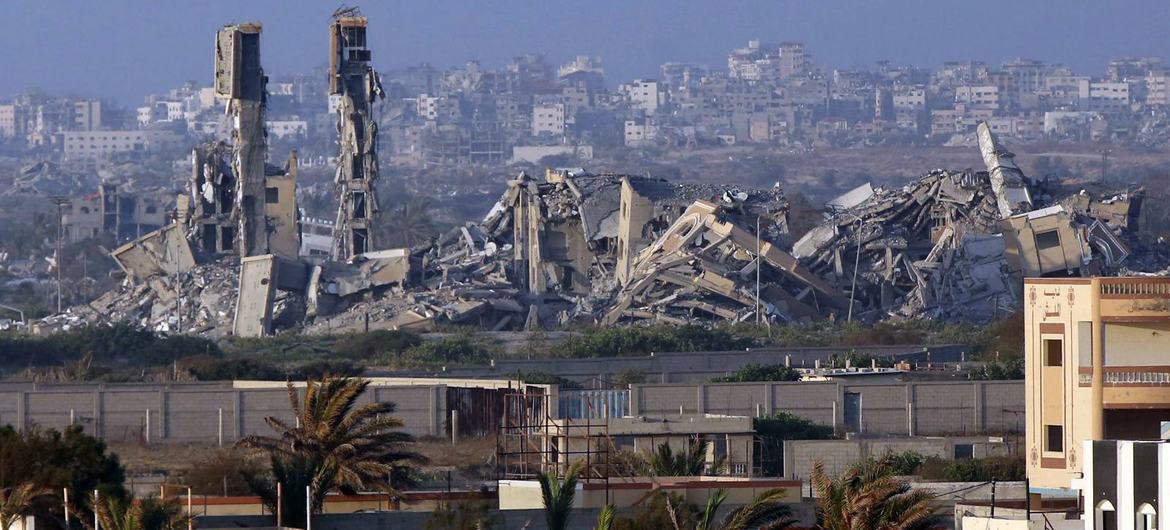
Much of Gaza has been destroyed in the conflict.
© UNRWA
 
Much of Gaza has been destroyed in the conflict.


3 July 2024 

Peace and Security

The Gaza Strip is virtually “split in two”, with blockades not only restricting the movement of displaced people seeking shelter, but also aid workers trying to assist civilians in desperate need, a UN relief official said on Wednesday.

Speaking via video link from Jerusalem, Andrea De Domenico, head of the UN Office for the Coordination of Humanitarian Affairs (OCHA) in the occupied Palestinian territory (OPT), said people have been forced to “completely reset their lives over and over again.”

“People, in the last nine months, have been moved around like ‘pawns in a board game’ – forced from one location to the next, to the next [and] to the next, irrespective of our ability of support them and irrespective of the availability of services wherever they land,” he said.

Tweet URL

Humanitarians, meanwhile, also have to relocate their base of operations and evacuate from one location to another, as the military operations shift focus.

“The military operations are pushing [us] again and flipping the table,” he said.

He added that as discussions were being held with all stakeholders, including Israeli authorities on bringing aid supplies into Gaza and distributing it, the latest evacuation orders in Khan Younis have “wiped” out all the hard work.

Life beyond imagination

According to estimates, 1.9 million people in the war-ravaged enclave are internally displaced – including people displaced up to nine or 10 times.

“They have been forced to move because of the patterns of the war, heavy fighting that has impacted them whenever they took the risk to stay, where [they had] houses or where [they had] tents, huts and makeshift shelters,” he added.

Mr. De Domenico noted that humanitarians have to restart their efforts “over and over again”, while the displaced must figure out where they can find food, water, and medical help, and reacquaint themselves with their neighbours if they do not have families.

“And that has stripped apart – again and again and again – and people have to reinvent their ability to cope with condition of lives that are beyond imaginable,” he said.

He also emphasized that as the war goes on, it continues to generate more pain, suffering and humanitarian needs. However, humanitarians are “struggling to deliver.”

“We are there to stay and to deliver, to help the people but delivering for us is a daily struggle … literally we have to make gigantic efforts to sustain some lifeline of our services.”

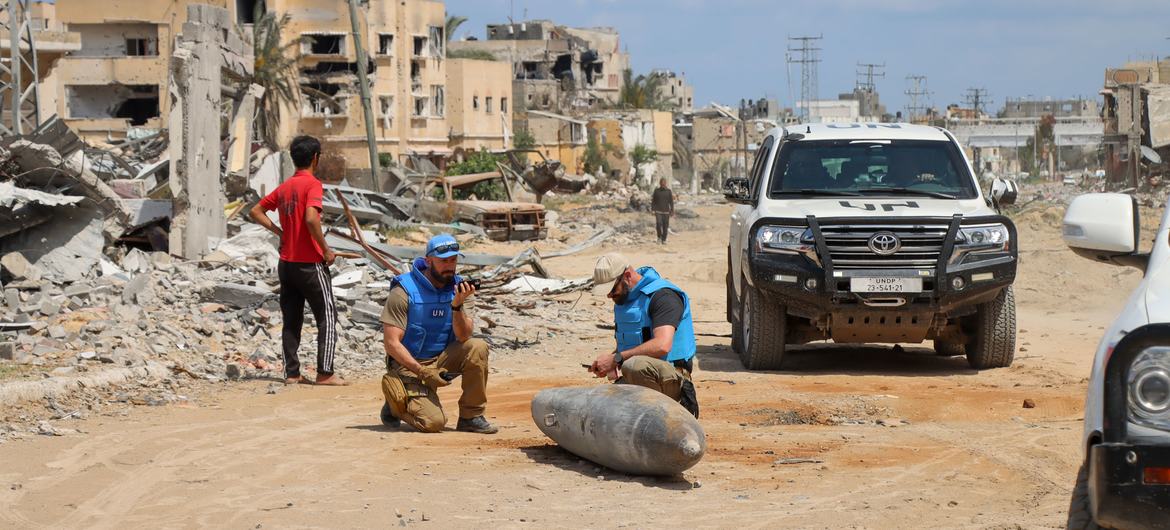
A UN team inspects an unexploded  bomb lying on a main road in Khan Younis, Gaza.
© UNOCHA/Themba Linden
 
A UN team inspects an unexploded bomb lying on a main road in Khan Younis, Gaza.

‘Enough of this war’

The OCHA official outlined the challenges for aid workers, explaining that before the war, the humanitarian hub was in Gaza City, in the north.

“Then in the night between 11 and 12 October, in the middle of the night, Israeli authorities ordered us to abandon those facilities and move south … we had to comply … to protect the lives of our staff,” he said.

“We left with a feeling of guilt because we knew that we were leaving behind civilians and since then we have been quite determined to not being pushed every time by the conditions to move, unless really the safety comes into [question].”

“We really need to draw a line … enough of this war that keeps on tearing apart the life of people.”

‘Nowhere and no one is safe’

Mr. De Domenico reiterated that “nowhere and no one is safe” in Gaza, neither the civilians nor humanitarians.

So far, at least 274 aid workers and volunteers have been killed – many while they were working, others at home with their families.

“[Humanitarians] risk their life every day and there are [few, if any] humanitarian installations that have been spared when the frontline moves … despite our efforts to notify the locations, the reality … is frequently those places are hit,” he added.


https://news.un.org/en/story/2024/07/1151751


https://creativecommons.org/licenses/by/4.0/legalcode

среда, 3 июля 2024 г.

Gaza is a ‘maelstrom of human misery’


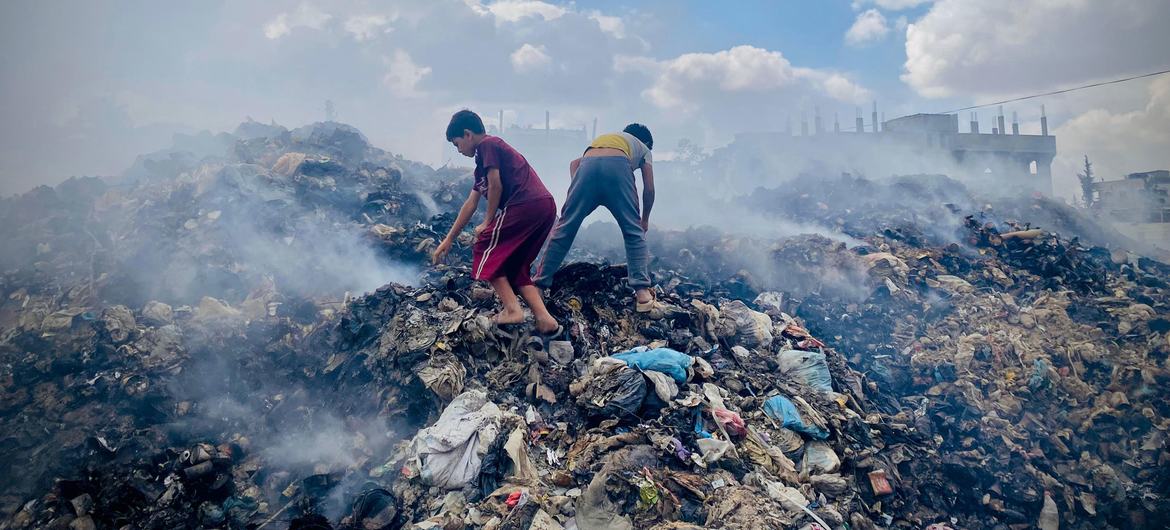
Over 330,000 tonnes of waste have accumulated in or near populated areas across Gaza, posing catastrophic environmental and health risks.
© UNRWA
 
Over 330,000 tonnes of waste have accumulated in or near populated areas across Gaza, posing catastrophic environmental and health risks.

2 July 2024 


Peace and Security

With their homes shattered and lives upended by war, civilians in Gaza are clinging to their dignity under the most inhumane conditions, Sigrid Kaag, the UN Senior Humanitarian and Reconstruction Coordinator, said on Tuesday.

Public services have collapsed and over 1.9 million have now been displaced, she told ambassadors at the Security Council, underscoring the critical need for a full, immediate and complete ceasefire, release of all hostages and unhindered aid across the enclave.

“The war has not merely created a humanitarian crisis, it has unleashed a maelstrom of human misery,” she stated.

Tweet URL

International humanitarian and human rights laws must be respected by all, Ms. Kaag stressed.

“Protection of civilians remains the paramount priority ... UNRWA must be allowed to deliver on its mandated role.”

Key political engagement

Ms. Kaag briefed Council members of her continued engagement with Government stakeholders, including Israeli Prime Minister Benjamin Netanyahu and key cabinet ministers.

She said that Prime Minister Netanyahu has made commitments to expedite the delivery of essential supplies for water, sanitation, waste management, and medical and educational needs.  

She added that there has also been an increase in the volume of commercial cargo entering Gaza, “albeit irregularly”.  

“We are in discussion to ensure commercial supplies are in line with the immediate needs of the population,” she added.

Framework for aid delivery

Ms. Kaag further noted that Security Council resolution 2720 (2023), which set up the mandate of the Senior Coordinator, established a framework to expedite, streamline and accelerate the delivery of humanitarian assistance throughout Gaza.

“As expected, this has been fraught with challenges,” she said, underscoring the importance of political will, alongside the enabling environment and conditions on the ground.

She updated ambassadors on progress towards the establishment of a Mechanism for monitoring and verification of humanitarian assistance, noting that UN monitors are preparing to deploy to its newly set up offices in Gaza.

“The Mechanism will also serve as the main platform to facilitate entry into Gaza of all critical humanitarian items, consolidating existing practices, further to the intent of the resolution,” she said, urging UN Member States to continue to preposition supplies and to allocate financing to aid agencies.

Senior Coordinator Sigrid Kaag briefing the Security Council.
UN Photo/Manuel Elías
 
Senior Coordinator Sigrid Kaag briefing the Security Council.

Options are also discussed on the feasibility and longer-term planning of the Cyprus Maritime Corridor with direct access to Gaza, she added.

Planning for reconstruction

Ms. Kaag emphasized that while humanitarian assistance will be required “for years to come”, planning and preparing for early recovery and reconstruction is equally important, urging Council members to consider immediate actions that complement and support the humanitarian response.

“We cannot ask Palestinian civilians to put their future on hold while they cling to their human dignity under inhumane conditions,” she said.

The Senior Coordinator also highlighted that the Palestinian Authority (PA) has a critical role in Gaza, integral to the enclave’s recovery and reconstruction, and urged the international community to ensure the PA’s financial stability and support its reform, governance, and other capacities necessary to reassume its responsibilities.

Senior Coordinator Kaag briefing the Security Council


https://news.un.org/en/story/2024/07/1151706

https://creativecommons.org/licenses/by/4.0/legalcode

четверг, 27 июня 2024 г.

We’ll never abandon Gaza, pledges top UN aid official


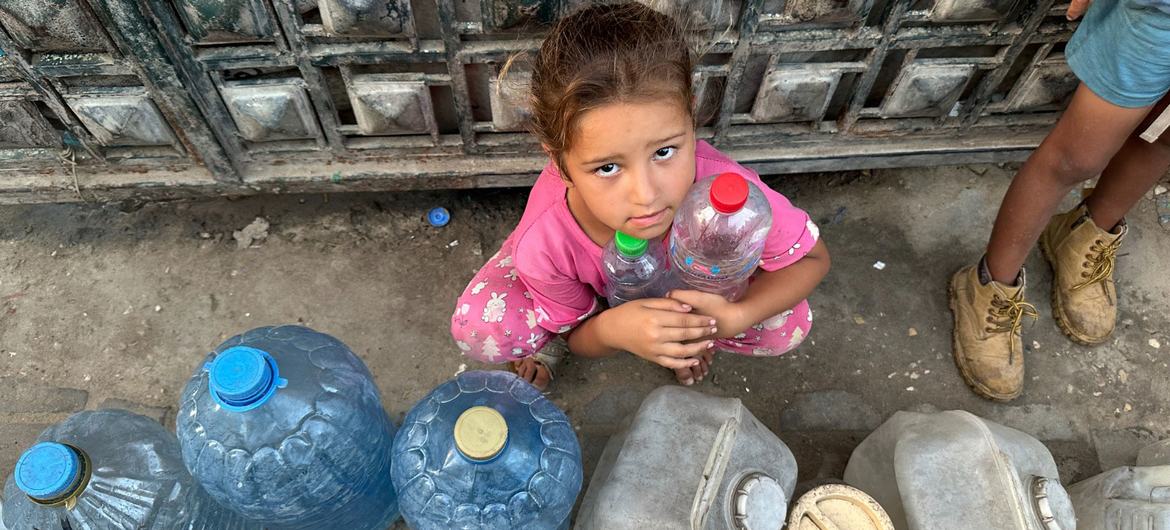
A child waits to fill water containers in Gaza.
© UNRWA
 
A child waits to fill water containers in Gaza.


By Daniel Johnson in Geneva
8 hours 56 minutes ago

 Humanitarian Aid

UN aid teams and partner organizations remain deeply committed to delivering lifesaving supplies to Gazans in need, despite the increasing dangers of working there, the Organization’s top aid official said on Wednesday.

Responding to media reports on Tuesday that the UN had warned the aid effort may have to stop unless the security situation and coordination with the Israeli military improved, Emergency Relief Coordinator Martin Griffiths denied that any “ultimatum” had been given.

Tweet URL

“We continue, as we have done for these many, many months to negotiate with the Israeli authorities and others with a lot of help, by the way, from the US, as you know, to get the right conditions to allow it to be delivered safely and securely,” he told UN News in an exclusive interview, just days before he is due to step down from his post.

No retreat from aid mission

“We're not running away from Gaza, at all, but what is true now - and I think that's the basis for this story - is of course that we are particularly concerned about the security situation in Gaza, and it is becoming more and more difficult to operate.”

The UN relief chief’s comments follow the publication on Tuesday of the latest dire assessment of food insecurity in Gaza, which highlighted the “high risk” of famine across the whole Gaza Strip “as long as conflict continues and humanitarian access is restricted”.

“Aid can make a difference, that's why we need to get all these crossings open,” Mr. Griffiths said.

“That’s why we need safety and security, that's why we need the pier to restart and get that aid off the beach if that can be done too. We need all hands on deck for this…We'll keep on at it. But we fail them daily every time we're not able to get aid through to the people who need it.”

Political focus is key

“The problem is a political one, that's the real effort, that must be the focus of all our efforts. And indeed, one of the interesting aspects of the Middle East is that there is a lot of political diplomacy, a lot of mediation going on”, he continued.

“By the way, I wish we could see that elsewhere, like in Sudan, but we need to see it bring results.”

After almost nine months of war sparked by Hamas-led terror attacks and hostage-taking in Israel, UN aid agencies continue to report ongoing strikes across Gaza by the Israeli military, resulting in civilian casualties, massive forced displacement and the destruction of houses and other public services.

Soundcloud

Intense strikes continue

In its latest update, the UN agency for Palestinian refugees, UNRWA, reported “especially intense” airstrikes in central Gaza in recent days, particularly in Bureij, Maghazi and Nuseirat refugee camps and eastern Deir Al Balah.

Meanwhile, the Israeli military’s ground offensive “continues to expand”, UNRWA noted, particularly in the southern regions of Gaza City and eastern Rafah, causing further suffering and further “destabilizing” humanitarian aid flows.

In addition to the war in Gaza, deadly violence has continued unabated against Palestinians in the West Bank, while a renewed escalation between Israel and Hezbollah militants across the frontier with Lebanon prompted a warning from the UN Secretary-General that one false move could trigger a catastrophe for the whole region and beyond.

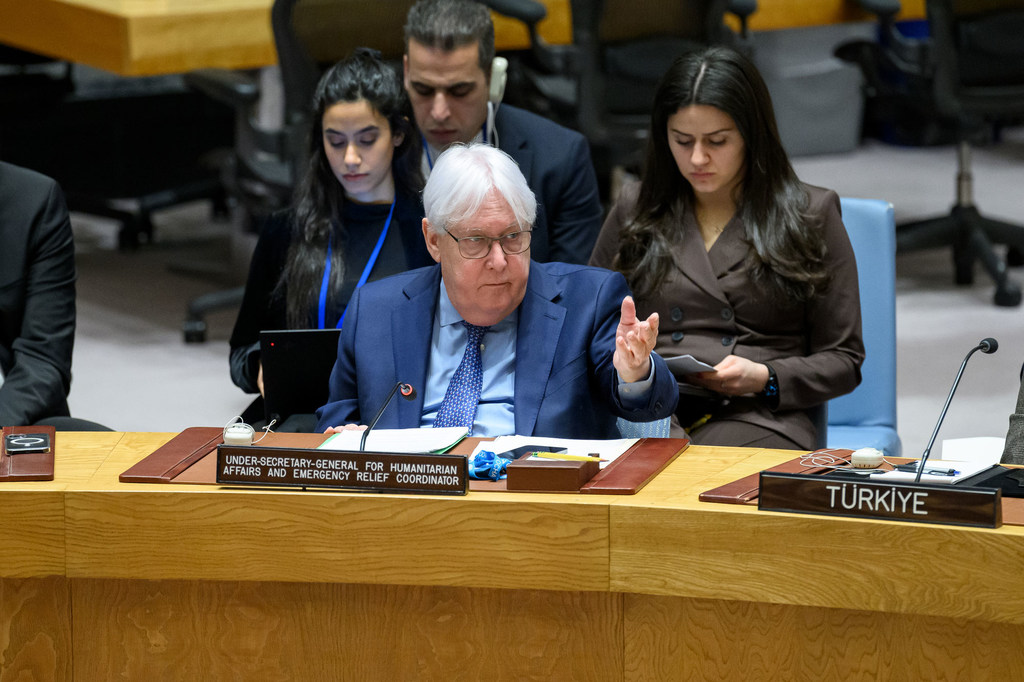
Martin Griffiths, Under-Secretary-General for Humanitarian Affairs and Emergency Relief Coordinator, briefs on the humanitarian situation in the Middle East.
UN Photo/Loey Felipe
 
Martin Griffiths, Under-Secretary-General for Humanitarian Affairs and Emergency Relief Coordinator, briefs on the humanitarian situation in the Middle East.

Emergency provider

Beyond Gaza, Mr. Griffiths defended the Organization’s role in providing help to people in emergencies around the world.

“We delivered aid to 144 million people last year, that's two-thirds of what we hoped to reach at a time when funding was problematic,” he said. “The aid agencies are doing an extraordinary job, and in particular within a global aid agency, the frontline deliverers.”

As staggering as the number of people receiving assistance may be, many tens of millions more remain beyond the UN’s reach, for lack of funding.

‘Astonishing disparity’

“The disparity between the amount of money - you know, more than $2 trillion a year spent on war - and the amount of money spent on humanitarian aid for peace-making is an astonishing disparity. And it's a shameful one.”

He added: “We have to get rid of the notion that investing more than $2 trillion in war is a way of getting security in this world - it is not the way to secure this world. The way to secure this world is through people in general to their neighbors being kind to their neighbors too.

Reflecting on his four decades working “on the edges of war zones” and in the diplomatic corridors of power, UK national Mr. Griffiths insisted on the need for radical reform on the global humanitarian system, given the rising needs and protracted emergencies.

Changes may yet come, he noted, pointing to the fact that the “UN and civil society, host governments across the world and regional organizations” should “start looking at the fact that power is being redistributed in this world today.

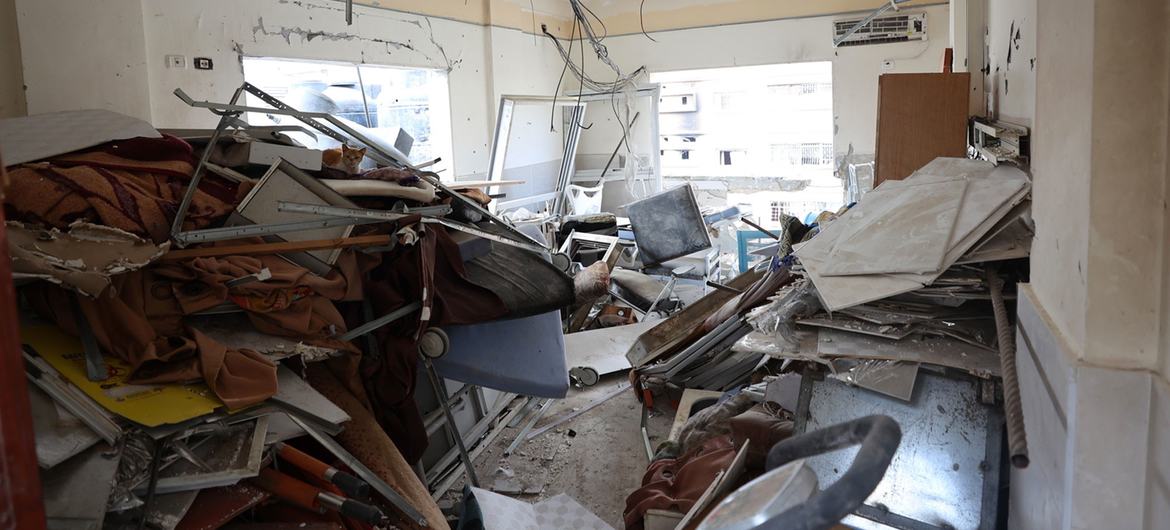
The Al-Amal hospital in southern Gaza lies in ruins.
© WHO
 
The Al-Amal hospital in southern Gaza lies in ruins.

Trust the people

“And maybe that's not a bad thing either…We need to do this all at the behest of the people in those communities not what we think is best, but what they know is best.”

This point was made clear to the veteran humanitarian in Sudan where he met representatives from civil society organizations manning emergency treatment rooms “on those front lines, back in Khartoum, across the country. They don't go away, they are the standard I think, for all of us to be able to say, ‘Yes, this (work) is definitely worth it.”

Just days before he steps down as UN Emergency Relief Coordinator – a role UN insiders concede is among the most punishing in the UN system, given its constant travel and media attention – Mr. Griffiths rejected the “incredibly self-indulgent” suggestion that he might slow down in Geneva, where he and his family have lived for years.

‘One life saved’

He also remained coy about the possible identity of his future successor, who will take over the UN Office for the Coordination of Humanitarian Affairs, OCHA – although he offered one piece of advice: “I believe this fundamentally from my, life, one life saved - one life saved - makes it worthwhile. And I am amazed by the resilience of communities. And I am amazed by the courage of aid workers.”


https://news.un.org/en/story/2024/06/1151501


https://creativecommons.org/licenses/by/4.0/legalcode

среда, 26 июня 2024 г.

Security Council: Regional crisis deepens as Gaza war grinds on


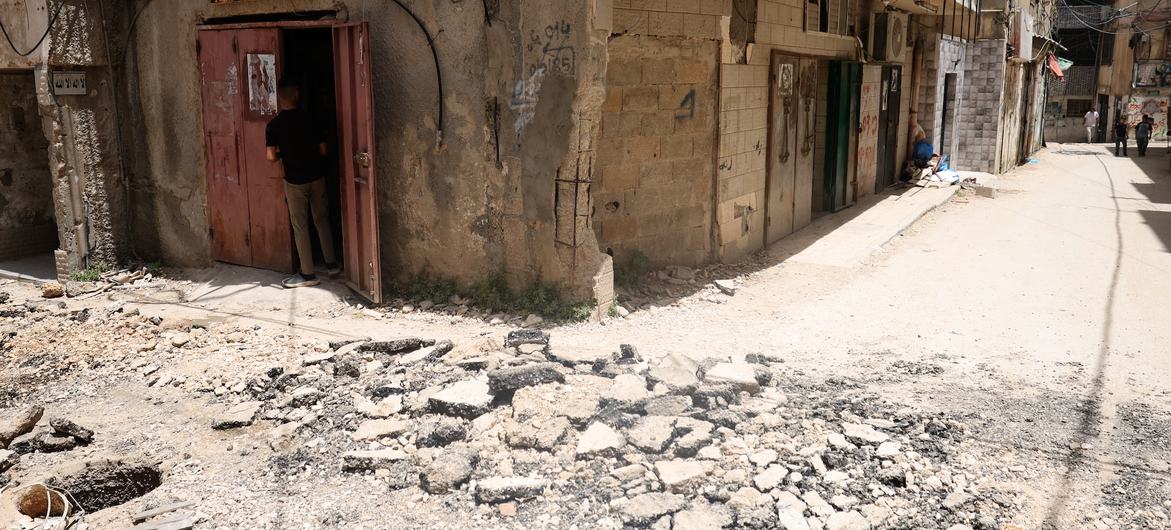
Damaged roads, buildings, and infrastructure due to the ongoing escalation of violence in Jenin, in the occupied West Bank.
© UNICEF/Alaa Badarneh
 
Damaged roads, buildings, and infrastructure due to the ongoing escalation of violence in Jenin, in the occupied West Bank.


4 hours 7 minutes ago 
Peace and Security

While the situation in Gaza remains catastrophic, ongoing Israeli settlement expansion and escalating violence in the occupied West Bank is ratcheting up tension across the whole region, the UN’s Middle East envoy said on Tuesday.

Tor Wennesland, UN Special Coordinator for the Middle East Peace Process, was briefing ambassadors during one of his regular briefings in the Security Council.

“I reiterate that all Israeli settlements in the occupied West Bank, including East Jerusalem, have no legal validity and are in flagrant violation of international law and relevant UN resolutions,” he said.

“I urge the Government of Israel to cease all settlement activity immediately.”

He also noted intensified armed exchanges between Palestinians and Israeli security forces alongside lethal attacks by Palestinians against Israelis and by Israeli settlers against Palestinians.

“All perpetrators of violence must be held accountable and swiftly brought to justice,” he added, reiterating that the occupying security forces “must exercise maximum restraint and use lethal force only when it is strictly unavoidable to protect life.”

Israel-Hezbollah tensions

Mr. Wennesland also expressed serious concerns about the risk of escalation between Israel and Hezbollah along the Blue Line – the frontier separating Lebanese and Israeli armed forces – calling for urgent steps to de-escalate.

He reiterated the Secretary-General’s concern that further military escalation will only guarantee more suffering, more devastation to communities on both sides, and “more potentially catastrophic consequences for the region”.

Tensions along the Blue Line have been deteriorating since Israel launched its offensive in the Gaza Strip following the brutal 7 October attack by Hamas and other Palestinian armed groups against communities in the country’s south.

Several people have lost their lives, tens of thousands are displaced, and houses and whole neighbourhoods destroyed.

Special Coordinator Tor Wennesland briefing the Security Council.

‘Catastrophic, horrifying’ situation in Gaza

Meanwhile, in the Gaza Strip, civilians continue to bear the devastating impact of the hostilities and an unprecedented humanitarian crisis.

Mr. Wennesland told ambassadors he’d witnessed the deteriorating security situation on each of his visits and characterized the scope of death and destruction as “catastrophic and horrifying”.

The use of explosive weapons by Israel in densely populated areas has destroyed entire neighborhoods and damaged hospitals and other civilian infrastructure, as well as UN premises, he said, expressing his unequivocal condemnation the killing and maiming of civilians in Gaza, including women and children.

Ongoing military operations and a “near total breakdown” of civil order have resulted in multiple reported incidents of theft of relief supplies and shootings that posed significant risks to the population and humanitarian workers.

He underscored the urgent need for effective mechanisms for humanitarian notification, safe conditions for aid operations, and sufficient access to humanitarian needs.

Fiscal crisis

Mr. Wennesland voiced deep concern over the Palestinian Authority (PA)’s fiscal situation amidst broader economic and security concerns across the occupied West Bank.  

He referred to an announcement by the Israeli Finance Minister to continue blocking the transfer of clearance revenues to the PA and end corresponding banking arrangements between Israeli and Palestinian institutions by the end of the month.  

These measures could severely worsen the financial crisis and disrupt the entire Palestinian financial system, the UN Special Coordinator warned.


https://news.un.org/en/story/2024/06/1151441


https://creativecommons.org/licenses/by/4.0/legalcode

понедельник, 24 июня 2024 г.

Chief of key UN agency in Gaza warns ‘entire generation’ could be lost


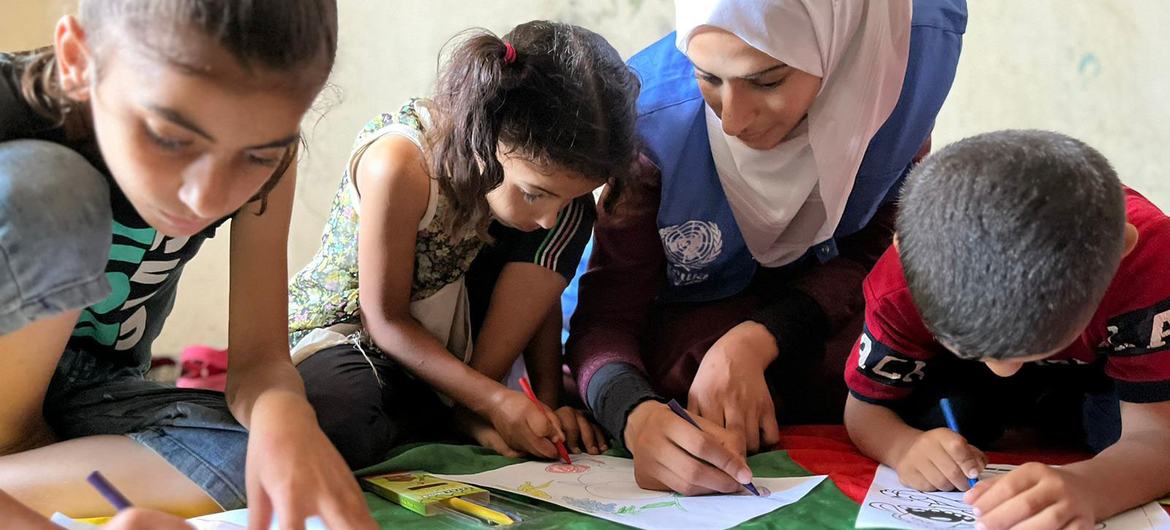
UNWRA staff are providing children with support to help them through the trauma of war.
© UNRWA
 
UNWRA staff are providing children with support to help them through the trauma of war.

24 June 2024
Peace and Security

The head of the main UN agency responsible for Palestinian refugees, UNRWA, issued a stark warning on Monday that it “will crumble” unless funding is found quickly, with an “entire generation” of children at risk of being condemned to “poverty…hatred, resentment and future conflict”. 

In a plea for political and financial support from Member States, UNRWA Commissioner-General Philippe Lazzarini underscored that the agency was “staggering under the weight of relentless attacks in Gaza”, after nearly nine months of intense Israeli bombardment and ground operations.

“The pressures on the agency today are greater than ever before,” he insisted.

Tweet URL
UNRWA

In addition to the 193 UNRWA personnel killed since Hamas-led terror attacks and hostage-taking sparked the war, Mr. Lazzarini detailed the sheer scale of the destruction to UN premises.

More than 180 installations have been damaged or destroyed since 7 October and “at least 500 people” have been killed seeking protection under the UN flag, he explained. 

“Our premises have been used for military purposes by Israel, Hamas and other Palestinian armed groups,” the UNRWA chief told a meeting of the Advisory Commission in Geneva. “Our convoys have come under attack despite coordinated movement with Israeli authorities in the West Bank…operational space is shrinking.”

Highlighting how Gaza is now “a living hell” for more than two million people there, the senior humanitarian official noted that children continue to die of malnutrition and dehydration, “while food and clean water wait in trucks” outside the enclave.

And amid increasing reports of a collapse in law and order, Mr. Lazzarini pointed to rampant looting and smuggling now happening, delaying the delivery of desperately needed humanitarian aid.

Among Gaza’s most vulnerable, children are among the worst-affected by the ongoing war, he insisted, with more than 625,000 “deeply traumatized” youngsters  “living in the rubble” and without access to education.

“Some 300,000 of them were enrolled in nearly 290 UNRWA schools before the war but those who are now out of school “are at risk of violence and exploitation, child labour, early marriage, and recruitment by armed groups”, the UNRWA chief insisted.

“Without decisive intervention to resume education, we will condemn an entire generation to poverty and sow the seeds of hatred, resentment, and future conflict.”

West Bank chaos

While Gazans repeatedly displaced by the war “are clinging to life”, the UNRWA chief issued an equally bleak assessment of the situation in the occupied West Bank, where some 500 Palestinians have been killed since October.

“Daily attacks by Israeli settlers, military incursions, and the destruction of homes and critical infrastructure are part of a well-oiled system of segregation and oppression,” the Commissioner-General said.

Lebanon alert

Intensifying clashes on the Israel-Lebanon border also threaten a “full-blown war”, Mr. Lazzarini continued, as he pointed to millions of “anxious and afraid” Palestine refugees in the occupied Palestinian territory, Lebanon, Syria and Jordan watching events in Gaza and the West Bank unfold.

“Most have been living in camps for generations, often with limited rights and in grinding poverty, waiting for a political solution that will bring an end to their plight. Today, they are witnessing the greatest Palestinian tragedy since the Nakba,” he said, in reference to the 1948 events that led to the uprooting of some 750,000 Palestinians from their homes.

“As they have done for 75 years, they are looking to UNRWA for protection and the fulfillment of basic human rights.”

In an appeal for support to scale up UNRWA’s assistance to Palestine refugees, Mr. Lazzarini raised the possibility of the agency not being operational “beyond August”.

This depended on UNRWA receiving both planned financial donations and new contributions, he explained, adding that $1.2 billion was needed to cover critical humanitarian needs until the end of the year. To date, the appeal is only 18 per cent funded.


https://news.un.org/en/story/2024/06/1151366


https://creativecommons.org/licenses/by/4.0/legalcode

воскресенье, 16 июня 2024 г.

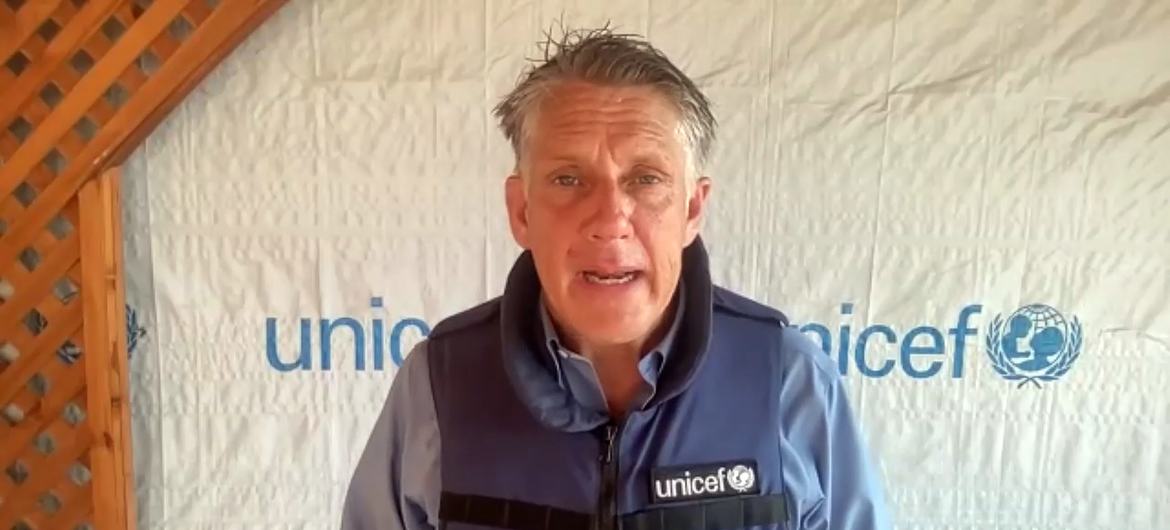
On the ground in Rafah: UNICEF reports ‘lethal’ lack of water, services

Speaking from Gaza, UNICEF spokesperson James Elder told UN News "this is and has been a war on children."

 I’ve seen the opposite of hope. We can’t allow the normalisation of this. 

UN News/Abdelmonem Makki
 
Speaking from Gaza, UNICEF spokesperson James Elder told UN News "this is and has been a war on children."
15 June 2024Humanitarian Aid

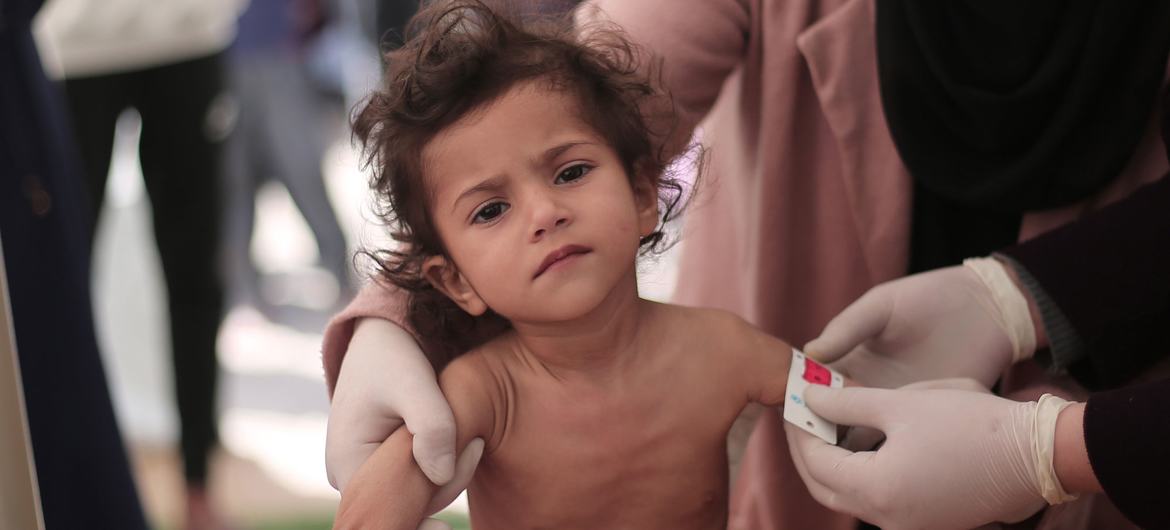
Almost 3,000 malnourished children are at risk of dying before their families’ eyes in Gaza, where the eight-month-long war continues, according to the UN Children’s Fund (UNICEF) as spokesperson James Elder told UN News on Saturday about the situation on the ground in the besieged and bombarded enclave.

Speaking from Gaza, Mr. Elder described a dire landscape, with a focus on child malnutrition and the devastating impact of the ongoing conflict amid growing concerns of famine.

Tweet URL
1james_elder

The destruction of health facilities, including specialised centres that are critical for staving off malnutrition, has severely hampered efforts to address severe hunger among children against a backdrop of constant bombings and attacks alongside the “lethal” lack of access to basic necessities that have already left children physically and psychologically scarred.

The UNICEF spokesperson emphasised the urgent need for a ceasefire to address the humanitarian crisis, get the hostages home and allow for the delivery of aid, education and medical care.

The interview was edited for length and clarity.

James Elder: If we focus on the nutritional situation, it was an immense effort from colleagues and partners over the last months to create stabilisation centres to address malnutrition. When that massive offensive came into Rafah [last month], forcing another million people who surely had already moved three, four or five times, we lost those stabilisation centres. The thousands of children who were being given the nutrition they needed suddenly disappeared again into the community. That’s perilous in a place where we know there’s a lethal lack of water and a dangerous, dangerous lack of sanitation.

So, now we start again. We have incredible partners. I’ve got amazing colleagues. All other agencies rally around. But, it’s again about now getting stabilisation centres and nutrition points into what are the tented camps so we can identify mothers who are desperate to get the support. But, they need to know it’s there. That’s the nutritional side, just one angle to which children are under attack. They’re under attack on the ground from that lack of nutrition, lack of sanitation, consistent restrictions on aid and very much so still from the skies.

I know it’s been 250 days. I know there’s a great risk of normalisation of this. There is nothing normal about the constant these children here are living, and there’s nothing normal about the last three nights of relentless bombardments. Drones surely meant no child could sleep there. There’s certainly nothing normal about the horrific wounds of children that I saw just a few hours a day in Al Aqsa Hospital. I spoke to families of children where they were in a sleep at five in the morning on the third floor and suddenly, in a moment, they’re under rubble. Mothers and children were killed or wounded or children have lost a mother. This has been continuous for 250 days. Children and their families really now are physically and psychologically just holding on.

UN News: How many hospitals are working now in the areas you were able to visit?

James Elder: We are now at a handful that are partially functioning from a previous total of 36 hospitals and healthcare centres in Gaza. Al-Aqsa Hospital [in central Gaza] took the brunt of those people after the [military] operation on Saturday. It was already overflowing because they’re in a state of war.

I visited on Tuesday, when there were scores of people with brutal wounds of war on the floors, mattresses, anywhere they could find. They needed attention. There were children with blast injuries, with burns, these awful injuries. Remembering a bomb blast picks up anything and everything, from bricks to tiles and shrapnel and does terrible things to a child’s body. As a doctor said to me, there are no hospitals in the world that could manage what we’re doing.

At the same time, there is the immense spirit of people here, of the Palestinians of Gaza. Nassar Hospital, which was the second biggest hospital was gutted inside after Khan Younis had been devastated, and it’s been restored and is partially functioning. That’s just on the back of people’s resolve, strength and determination. However, we have seen the systematic devastation of these health care system, and it too is holding on by a thread.

Many children in Gaza are showing signs of  severe acute malnutrition and drastic weight loss.
© UNICEF/Eyad El Baba
 
Many children in Gaza are showing signs of severe acute malnutrition and drastic weight loss.

UN News: Now only two of the three specialised nutrition stabilisation centres in Gaza remain open. Does UNICEF have any alternative plans to fill this vacuum?

James Elder: Absolutely. It is to get another stabilisation centre up and running in Rafah as well as smaller centres. Yesterday, I was at a tented camp and there was, with a partner, not a stabilization centre, but a smaller centre where they are doing testing, giving, therapeutic food to mothers and doing outreach in the community to make sure people come to them. Word spreads very quickly.

That’s the sort of thing we can do. On Wednesday, I was in a convoy trying to get aid to distribute to our partners while training them. It sounds strange to train partners in malnutrition screening and response, but that’s because before this war, Gaza didn’t really have a severe malnutrition problem.

So, there’s training, supply delivery and then, as best we can, trying to set up those bigger stabilisation centers. Again, even though knowing this, this war keeps moving and people keep being forced from their homes. Our operations, like all other agencies, keep being disrupted.

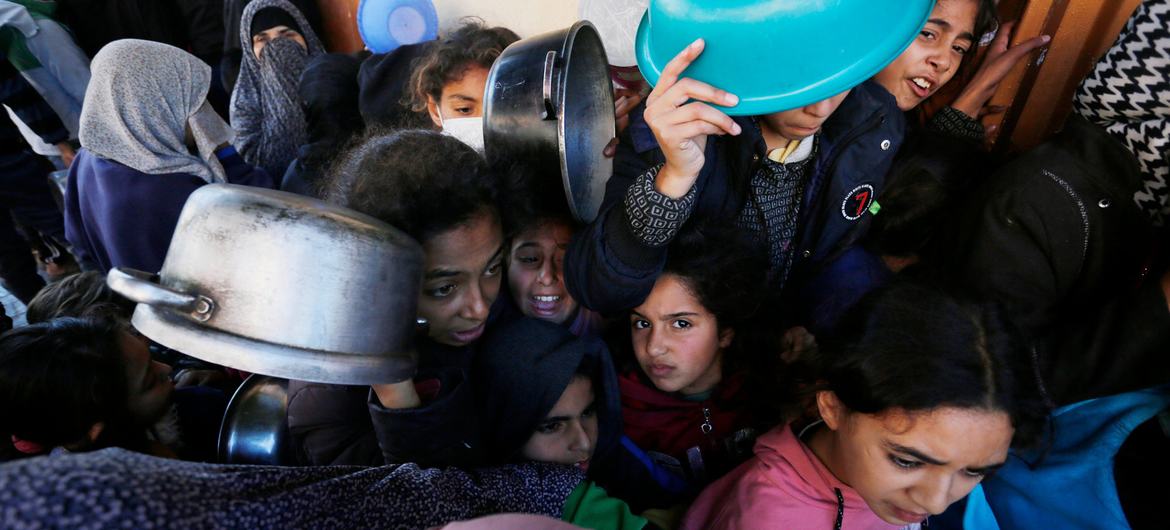
More than one million people in Gaza face severe food insecurity.
© UNRWA
 
More than one million people in Gaza face severe food insecurity.

UN News: You took to social media to discuss the challenges that UNICEF faces in delivering supplies to the children of Gaza. Can you please elaborate on that? 

James Elder: This specific example was Wednesday. We had a truck of malnutrition and medical supplies for 10,000 children. We had all the approvals, which is normal terrain. Yet, when we moved on Wednesday, what was basically a 40-kilometre round trip took 13 hours, with eight hours stuck at checkpoints or nearby. There were great discussions over whether we had a truck or whether we had a van.

In the end, that truck with nutrition and medical supplies for 10,000 children was returned. We weren’t able to get it through. Now, we will get it back and make that trip again, remembering such is the precarious, dangerous state of trying to deliver aid in the Gaza Strip. More of my UN colleagues have been killed during this eight month war than in any other conflict in the history of the United Nations.

It’s not so easy as just turning around the next day. We require two armored vehicles every time we move. UNICEF distributes tents as well as deliver fuel for desalination plants. We also have a lot of programmatic work. That was hugely disappointing. That was supplies that needed to go to those partners and children.

Even as we waited for hours near one of those checkpoints called a holding point, I was watching fishers. No doubt they had previous professions as accountants, lawyers and other jobs, but now all jobs and economies are being battered. Here they were fishing just using a single net, throwing it and trying to catch some fish for their family. Suddenly a tank came, and the next thing, there was firing from the position from the area around the Israeli military checkpoint, and two fishermen were shot. We didn’t know if they were dead. A WHO paramedic colleague radioed the authorities to ask if we could possibly get these two people to see if we could give them medical care. That was denied. That care was denied. Eventually, half an hour later, other fishers returned with body bags and we discovered that the two men were in fact dead. One had been shot in the back, and one who had fishing net still around his foot was shot in the neck.

Over 330,000 tonnes of waste have accumulated in or near populated areas across Gaza, posing catastrophic environmental and health risks.
© UNRWA
 
Over 330,000 tonnes of waste have accumulated in or near populated areas across Gaza, posing catastrophic environmental and health risks.

UN News: People are running for their lives, but many schools in Gaza have been destroyed due to this war. What do you think the long-term consequences of this?

James Elder: The world should be terrified of the long-term consequences. Because we know that the longer a war goes on, the more damage it does psychologically to children. UNICEF knows that from a Yemen or Afghanistan. We are in uncharted territory when it comes to the mental health of children here.

We are in uncharted territory when it comes to the mental health of children here

At the same time, while as long as this continues, this is no place for a child to get treatment. I’ve sat with children. A little boy, Omar, who was sort of doing his own psychological treatment for himself. He would shut his eyes and try and remember his parents. His mother, father and twin brother were killed in their home. He would close his eyes to try and remember them. He didn’t want to lose them in his memory as he lost them on the ground.

I saw Omar in November and saw him again two days ago. He’s no longer able to recall what his parents looked like. Children are having to do their own mental health care. The reason the world should be concerned about this is that any economist, any demographer will tell you with a young population like Gaza’s, give them the right skills, the right education, the right opportunity and you get a demographic boom. You know, it’s the envy of aging countries well, but you have to give them those skills.

The opposite of that is happening right here: lasting violence. Children are being denied the most basic rights and are seeing death. There is nowhere near any education or universities as well. I think there are reports of hundreds of professors having been killed.

Again, this all comes back to a ceasefire. A ceasefire enables children to go to school, enables us to get aid safely and gets the hostages home. A mother said “I could go to bed if there was a ceasefire and promise my daughter that she will wake up tomorrow morning.”

Parents cannot do that right now.

UN News: You’ve been consistently emphasizing the urgent need for a ceasefire. To address this, humanitarian crisis in Gaza, yet war continues. What’s your message to the world? 

James Elder: I think the message has to be, as we’ve heard from the Secretary-General, from my own executive director, from the start, a ceasefire gets hostages home and stops the bombardment. Those parties that have the power over the ceasefire have to be connected with the suffering of people here. It would seem that that’s not happening.

This is and has been a war on children. We do not say that lightly. We do not say that is a headline. We say that based on evidence, based on the disproportionate impact this war is having on boys and girls. So, a ceasefire is the only solution. As my executive director said many months ago to the Security Council, the killing of children in Gaza and the devastation of Gaza will not bring peace to children or the region.

More than one million people, most displaced several times, have been forced to flee once again in search of safety.
© UNRWA
 
More than one million people, most displaced several times, have been forced to flee once again in search of safety.

UN News: This is your second mission to the Gaza Strip. Have you seen any signs of hope or anything different during this time in Gaza?

James Elder: It’s my third trip after being here in November and March. Now, I’ve seen the opposite of hope. I’ve seen hope extinguished. I’ve seen hope rise with the Security Council resolution in March, and I felt that in the air. I spoke to people and the sense that the war may be coming to an end was an amazing feeling and sense to see.

Then that literally got bombed away. So, there are a mix of people. There are those who will say to me that all they have left is hope after their home was destroyed, husband and children killed and they can no longer feed regularly their other children and they lost their job.

There are others who will say to me, there have been so many Security Council resolutions, I’ve lost count, more fearfully, more heartbreakingly. There will be others, like more than a handful of young people who tell me that they hope a missile hits their tent and ends this.

This is the perilous psychological state people are in right now. We cannot allow the world to turn away. We can’t allow the normalisation of this. There is nothing normal about this malnutrition crisis. There is nothing normal about the relentless bombardments and all the horrors that I see in hospitals. There is certainly nothing normal about children and their families living in a constant state of fear.


https://news.un.org/en/interview/2024/06/1151131


https://creativecommons.org/licenses/by/3.0/legalcode

четверг, 13 июня 2024 г.

Waiting would be ‘death sentence’ for millions on brink of starvation: Relief chief


This seven-year-old with severe acute malnutrition and dehydration was transferred to a field hospital in southern Gaza in April amid the looming famine in the north.
© WHO
 
This seven-year-old with severe acute malnutrition and dehydration was transferred to a field hospital in southern Gaza in April amid the looming famine in the north.


12 June 2024
Humanitarian Aid

Millions of people are teetering on the brink of starvation as conflict rages across many corners of the world. Nowhere is this more evident than in Sudan and Gaza, UN Emergency Relief Coordinator Martin Griffiths said on Wednesday. 

“War is pushing millions of people to the brink of starvation. Only technicalities prevent famines from being declared, as people are already dying of hunger,” said Mr. Griffiths.

“Waiting for an official declaration of famine before acting would be a death sentence for hundreds of thousands of people and a moral outrage,” he added. 

As the G7 major economies prepare to meet on Thursday, Mr. Griffiths is calling on leaders in the most developed nations to immediately use their political leverage and financial resources to support aid organizations in their efforts to reach all those in need.

The G7, consists of Canada, France, Germany, Italy, Japan, the United Kingdom and the United States. The UN Humanitarian Affairs chief said they should wield their influence to stop such a ‘preventable scourge’ from taking the lives of innocent civilians. 

'Choice between inaction and oblivion’

In the latest Hunger Hotspots report, the Food and Agriculture Organization (FAO) and the World Food Programme (WFP) are warning that acute food insecurity is set to worsen from June to October 2024 in 18 hunger hotspots.

Tweet URL
UNReliefChief

While urgent attention is required in several hotspots where starvation looms - including Haiti, Mali, and South Sudan - immediate action is especially critical in war-ravaged Gaza and Sudan. 

“Nowhere is the choice between inaction and oblivion so clear as in Gaza and Sudan,” said Mr. Griffiths.

Half the population of Gaza, almost one million people, is expected to face death and starvation by the middle of July, according to the UN Relief Chief.

 Meanwhile, in Sudan, at least five million are on the brink of starvation. Communities in more than 40 hunger hotspots there are at high risk of falling into famine in the next month, including in the war-torn areas of Aj Jazirah, Darfur, Khartoum and Kordofan.

In both Gaza and Sudan, violence, unacceptable restrictions, and insufficient funding are keeping aid workers from delivering necessary lifesaving assistance. 

“This must change – we cannot afford to lose even a minute,” said Mr. Griffiths. 

Role of G7 

While humanitarian aid will help to counter mass starvation, it is not the ultimate solution to the problem. According to Mr. Griffiths, that rests with the G7’s readiness to bring their political influence and financial resources to the table.

However, above all, “the world must stop feeding the war machines that are starving the civilians of Gaza and Sudan,” Mr. Griffiths said. 

“It is time instead to prioritize the diplomacy that will give people back their futures – and tomorrow, the G7 is at the helm,” he added. 


https://news.un.org/en/story/2024/06/1150976


https://creativecommons.org/licenses/by/3.0/legalcode