суббота, 28 октября 2023 г.

Explainer: What is a UN General Assembly emergency special session and why it matters

The first ever emergency special session of the UN General Assembly on the Middle East takes place in 1956.

Explainer: What is a UN General Assembly emergency special session and why it matters

UN Photo
 
The first ever emergency special session of the UN General Assembly on the Middle East takes place in 1956.
27 October 2023
Peace and Security

As the UN’s 193 Member States meet on how to address the ongoing Israel-Palestine crisis, we took a look at how the current rarely convened General Assembly emergency special session came about, what it means and why it matters.

What’s an emergency special session?

When the UN Security Council is unable to shoulder its primary responsibility to maintain international peace and security, as has thus far been the case following the 7 October outbreak of the latest Israel-Palestine crisis, the General Assembly can consider the matter immediately in an emergency special session.

UN Member States can request the Assembly President to convene such a session, with a view to making appropriate recommendations for collective measures, including calling for ceasefires, and in the case of a breach of the peace or act of aggression, as a last resort, the use of armed force when necessary.

At the first plenary meeting of an emergency special session or upon its resumption, as is the case with the current tenth session, the Assembly typically hears from the country or countries of concern. Member States then debate the issue and vote on a draft resolution.

If adopted by a two-thirds majority, the non-binding General Assembly resolution provides guidance for nations. Some of these past session resolutions have contained, for example a request for an advisory opinion from the International Court of Justice (ICJ), and a request for an international UN-led force to intervene to secure and supervise the cessation of hostilities.

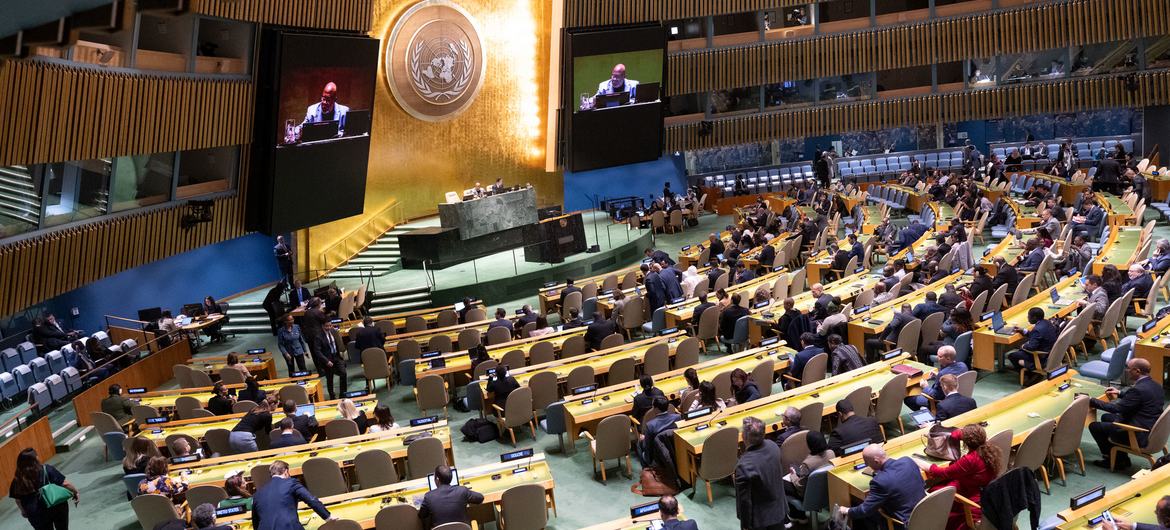
The General Assembly emergency special session meeting on the situation in the Occupied Palestinian Territory enters its second day of deliberations.
UN Photo/Evan Schneider
 
The General Assembly emergency special session meeting on the situation in the Occupied Palestinian Territory enters its second day of deliberations.

What triggers emergency special sessions?

An emergency special session swiftly happens when the UN Security Council is deadlocked. That occurs when one of the five permanent Council members (China, France, Russia, United Kingdom, United States) uses their UN Charter-mandated veto power to quash a related draft resolution.

While veto use can also be quickly scrutinized at a regular General Assembly meeting, emergency special sessions are one option the UN membership has to debate urgent peace and security matters.

That’s what happened this week regarding the Israel-Palestine crisis. The Council’s failure to agree on multiple resolutions triggered a group of UN Member States to submit a request to the Assembly President.

Journalists work late into the night at UN Headquarters during the first emergency special session in 1956.
UN Photo
 
Journalists work late into the night at UN Headquarters during the first emergency special session in 1956.

What makes these sessions ‘special’?

Only 11 emergency special sessions have been called in the last 73 years. The eleventh was convened, following a Security Council veto, six days after Russia’s full-scale invasion of Ukraine in 2022, resulting in a broadly supported resolution on the crisis.

What makes it ‘special’ is that despite Council disunity, the countries of the world can address urgent global peace and security matters together. At the request of Member States or the Council itself, the Assembly President shall convene an emergency special session within 24 hours.

The establishment and guiding rules of these sessions came after the outbreak of the Korean Peninsula conflict in 1950, when the Assembly adopted its landmark “Uniting for peace” resolution.

Another unique element is that unlike the 15-member Security Council, a veto cannot be used in the 193-member General Assembly. If a two-thirds majority of the Assembly votes in favour, a proposed draft resolution is adopted.

What’s another difference between the Council and the Assembly? While the former’s resolutions are legally binding, the latter’s are not.

The then UN Secretary-General Dag Hammarskjöld (standing second from left) in conversation in the Delegates Lounge at UN Headquarters following an emergency special session in 1958.
UN Photo
 
The then UN Secretary-General Dag Hammarskjöld (standing second from left) in conversation in the Delegates Lounge at UN Headquarters following an emergency special session in 1958.

Hot spot: Middle East

Six of the 11 Assembly emergency special sessions relate to the Middle East.

The first ever such session was held in 1956 to consider the 1949 Arab-Israeli armistice agreements, which had been “disregarded” amid foreign military presence on Egypt’s territory near the Suez Canal.

During that session, the Assembly adopted a package of resolutions that, among other things, requested, “as a matter of priority, the Secretary-General to submit to it within 48 hours a plan for the setting up, with the consent of the nations concerned, of an emergency international United Nations Force to secure and supervise the cessation of hostilities”.

Other emergency special sessions were convened on matters in the Middle East in 1958 and 1967, the question of Palestine in 1980, and the situation in the occupied Arab territories in 1982.

Open 24/7

At the request of UN Member States, meetings of an emergency special session can be reconvened at any time and have been over the years.

That’s what happened last week, when a deadlocked Security Council led a group of nations submitted such a request to the Assembly President to reconvene the tenth emergency special session. 

Convened for the first time in 1997, the session pertains to the matter of illegal Israeli actions in Occupied East Jerusalem and the rest of the Occupied Palestinian Territory.

At the outset of the resumed tenth session on 26 October, the Assembly heard from the UN Permanent Observer State of Palestine. Member States then opened their debate of the matter.

Though non-binding, the draft resolution overwhelmingly calls for peace.

Want to know who voted on what resolution and why? The UN Dag Hammarskjöld Library holds voting records, explanations of vote and related resolutions from all emergency special sessions here.


https://creativecommons.org/licenses/by/3.0/legalcode


https://news.un.org/en/story/2023/10/1142922


пятница, 27 октября 2023 г.

Syrian war at ‘worst point’ in four years, says Commission of Inquiry head

A girl helps her sister on their way home from school in Idlib, northwest Syria (file).
© UNOCHA/Ali Haji Suleiman
 
A girl helps her sister on their way home from school in Idlib, northwest Syria (file).
27 October 2023
Human Rights

The world cannot forget about Syria, the Head of the Independent International Commission of Inquiry on the country has said, while also highlighting how the war there is connected to the conflict raging in the Middle East. 

Paulo Pinheiro spoke to UN News this week after presenting his latest report to the UN General Assembly’s Third Committee, which examines a range of social, humanitarian affairs and human rights issues.

The Syrian war, which began in March 2011, is at its “worst point” in four years, he said, while stressing that the escalating violence is not a consequence of any other conflict.

International involvement

“This aggravation is a result of the presence of different Member States in the theatre of operation,” he said, listing Türkiye, Russia, and the United States, as well as forces connected to the Kurdish population in the northeast.

The Commission of Inquiry was established by the UN Human Rights Council in Geneva in August 2011 to investigate all alleged violations of international human rights law in Syria since the start of the war.

Although not in his mandate, Mr. Pinheiro pointed to two situations in Syria that he said are linked to the current conflict between Israel and Palestine, with the first being Israeli airstrikes against the airports in Damascus and Aleppo – both critical for humanitarian aid flows into the country.

“Another connected complicator is the presence of Hezbollah - that is a political force, military force, in Lebanon but it is also present in the theatre of operations in Syria,” he said.

Soundcloud

‘Competition’ for coverage

Mr. Pinheiro also lamented “the competition for visibility in the international media”, saying “at this time, it's difficult to try to remind the world that the war in Syria continues.”

The UN and partners continue to respond to the immense humanitarian needs in Syria, where more than 15 million people require assistance– a 9 per cent increase over last year.

Last month, the UN welcomed the resumption of aid deliveries into northwest Syria via a border crossing with Türkiye.

The Bab al-Hawa border crossing had closed in July after the UN Security Council failed to reach consensus on two competing resolutions seeking to renew the aid corridor.

Some four million people in northwest Syria - the last rebel-held stronghold - rely on the lifeline, which was established nearly a decade ago through a UN Security Council resolution.  

Communities on both sides of the border were also devastated by deadly earthquakes in February, contributing to rising needs. 


https://news.un.org/en/story/2023/10/1142907


https://creativecommons.org/licenses/by/3.0/legalcode

Secretary-General Deeply Alarmed by Sharp Increase in Number of Journalists Killed, Threatened, Detained Worldwide, Urges Better Safeguards, in Observance Message

SG/SM/22008

Secretary-General Deeply Alarmed by Sharp Increase in Number of Journalists Killed, Threatened, Detained Worldwide, Urges Better Safeguards, in Observance Message

Following is UN Secretary-General António Guterres’ message on the International Day to End Impunity for Crimes against Journalists, observed on 2 November:

Journalists and the media fulfil a vital role in society, upholding and enabling democracy and holding power to account.  They are essential to strong and accountable institutions and to achieving the Sustainable Development Goals.

But, this important position puts journalists at risk.  Their commitment to investigating and revealing the truth means they are often targeted for attack, illegal detention and even death.

In 2022, according to the United Nations Educational, Scientific and Cultural Organization (UNESCO), at least 88 journalists were killed for doing their jobs — a sharp increase on the preceding years.  The current conflict in Israel and the Occupied Palestinian Territory is taking a horrific toll on journalists.

But, the majority of journalists who are killed are not war reporters; they are working in countries that are at peace, investigating corruption, trafficking, human rights violations and environmental issues.

I am deeply alarmed by these figures, and by the rise in threats of all kinds against journalists.  Detention of journalists is at an all-time high.  Online harassment of journalists, particularly women, is being used as a tool to silence them. We need better safeguards to defend the journalists who are keeping us informed.

On the International Day to End Impunity for Crimes against Journalists, we call on all States to prevent violence against journalists, to provide a safe environment for them to go about their jobs, to bring to justice those who commit crimes against journalists and media workers, and to ensure support for victims and survivors.

Today and every day, we are grateful to the journalists and all media professionals who risk their health and lives to keep us informed, and to keep the truth alive.


https://press.un.org/en/2023/sgsm22008.doc.htm

https://creativecommons.org/licenses/by/3.0/legalcode

Speakers Raise Concerns about Draft Text on Peace and Space Technology as Fourth Committee Resumes Debate on Outer Space Issues

 
16TH MEETING (AM)
GA/SPD/789

Speakers Raise Concerns about Draft Text on Peace and Space Technology as Fourth Committee Resumes Debate on Outer Space Issues

The Fourth Committee (Special Political and Decolonization) resumed its general debate on international cooperation in the peaceful uses of outer space, with some speakers expressing concern about a draft resolution titled “Space technology for promoting peace” (document A/C.4/78/L.5), which is being put forward by the Russian Federation.

Canada’s representative, also speaking also on behalf of Australia and New Zealand, said that the Russian Federation violated the consensus procedure by introducing a resolution to the Committee without its first being discussed by the Committee on the Peaceful Uses of Outer Space. Abandoning the consensus approach will do irreparable harm to the Outer Space Committee, she warned.

Switzerland’s delegate, in the same vein, said that the Russian Federation did not follow the consensual processes and requested that the text be revised.

The Russian Federation’s representative, speaking in exercise of the right of reply, countered that Western countries have decided collectively to use civilian space systems for military purposes and confrontations.  They cannot acknowledge the political importance of using such systems to promote peace, but instead criticize his delegation’s text, he said.

The United States’ representative cautioned that Member States should not discuss matters beyond the Fourth Committee’s mandate.  “We have achieved so much in this Committee, not through brinksmanship or voting, but through consensus,” she said.

Other speakers highlighted their countries’ accomplishments in space exploration and emphasized the importance of international cooperation, including in the Outer Space Committee.  Several argued that the growing number of space actors should prompt stronger outer space regulations.

India’s representative highlighted his country’s most recent successes in space — the successful landing of the Chandrayaan-3 spacecraft near the Moon's south pole and the launch of the Aditya L1 solar observatory mission, which will enhance understanding of solar activities.

China’s delegate said that order in outer space should be maintained through the framework of the Treaty on Principles Governing the Activities of States in the Exploration and Use of Outer Space, including the Moon and Other Celestial Bodies, also known as the Outer Space Treaty, regardless of how space activities may evolve or whether they are conducted by governmental or non-governmental entities.

The Fourth Committee will reconvene at 10 a.m. on Friday, 27 October, to conclude its general debate on international cooperation in the peaceful uses of outer space and to take action on related draft resolutions.


https://press.un.org/en/2023/gaspd789.doc.htm

https://creativecommons.org/licenses/by/3.0/legalcode

Frustration Mounts in First Committee as Reversing Paralysis in UN Disarmament Machinery Defies Political Consensus

SEVENTY-EIGHTH SESSION,
 
22ND & 23RD MEETINGS (AM & PM)
GA/DIS/3726

Nuclear-Weapon-Free Zones Show States’ Refusal to Be Bound by Inaction

The Russian Federation is attempting to “bring down the entire disarmament house” for its immediate geopolitical goals, the First Committee (Disarmament and International Security) heard today as its thematic debate concluded on regional security and began on the UN disarmament machinery.

Noting that current problems go far beyond the disarmament machinery’s inadequacies, the United States’ representative said the Russian Federation is exploiting procedural rules to obstruct progress and veto anything with which it does not agree.  Today’s world is characterized by tumultuous competition and potential conflict among shifting Powers, with the tense geopolitical environment making rapid progress difficult, he said.

The Russian Federation’s delegate said certain States misuse the Conference on Disarmament to “settle political scores” and push their priorities.  Western calls to revise the current architecture with non-binding rules is unacceptable and fraught with confrontation.  Member States should adhere to the structure’s rules and procedures. 

The representative of Pakistan said finding a procedural fix for a substantive security problem will not break the impasse.  What is essential is recognizing the principle of all States’ equal right to security.  All discussions and approaches must be grounded in this basic premise.  The Conference on Disarmament’s strength lies in all militarily significant States participating on an equal footing.

Bangladesh expressed deep concern over the erosion of the rules-based multilateral system in disarmament, non-proliferation and arms control.  “We can no longer afford to be caught in the never-ending loop”, he said, adding that continued impasse is entirely unsustainable.  He advocates for a more focused First Committee and a review of its working methods to enhance efficiency and relevance. 

The United Kingdom maintained that while the disarmament machinery, like the rest of the multilateral system, “is far from perfect, it is the best we have”, its representative said.  Voicing concern about the prevailing climate of deep mistrust between States, the bad faith of some delegations and the abuse of the practice of consensus, he expressed regret over “our collective failure to identify our common interest” in further strengthening and developing the disarmament and non-proliferation architecture.

It is not “mission impossible”, said China’s delegate, who noted some modest progress.  The UN disarmament machinery does not work in a vacuum, he said, adding that neither the machinery nor its rules of procedure can be blamed for the current problems.  Member States should have confidence in it.  The solution, he said, lies in upholding true multilateralism. 

During the thematic debate on regional disarmament and security, several speakers converged around the complementary relationship between regional and global disarmament efforts. Among them was Brazil’s representative, who deemed nuclear-weapon-free zones as an excellent example of synergy between regional and global efforts toward a nuclear-weapon-free world. Through these zones, non-nuclear-weapon States are turning the tables and exercising their agency, refusing to be shackled to others’ whims.  Regional Powers refused to cross their arms in despair and have been exerting tireless efforts to stave off risk of nuclear contagion, the speaker said.

In the Middle East, however, a nuclear-weapon-free zone has remained elusive despite urgent and persistent appeals. Procrastination in implementing the General Assembly’s 1995 resolution on the issue has negative repercussions, Iraq’s delegate warned.  The region must quickly create such a zone through fundamental steps, including the denuclearization of the “Israeli entity”, he stressed.

The First Committee will reconvene at 3 p.m. on Thursday, 26 October, to conclude its thematic debate on the disarmament machinery....


https://creativecommons.org/licenses/by/3.0/legalcode

https://press.un.org/en/2023/gadis3726.doc.htm

четверг, 26 октября 2023 г.

DAY ONE: UN General Assembly convenes emergency meeting on Gaza

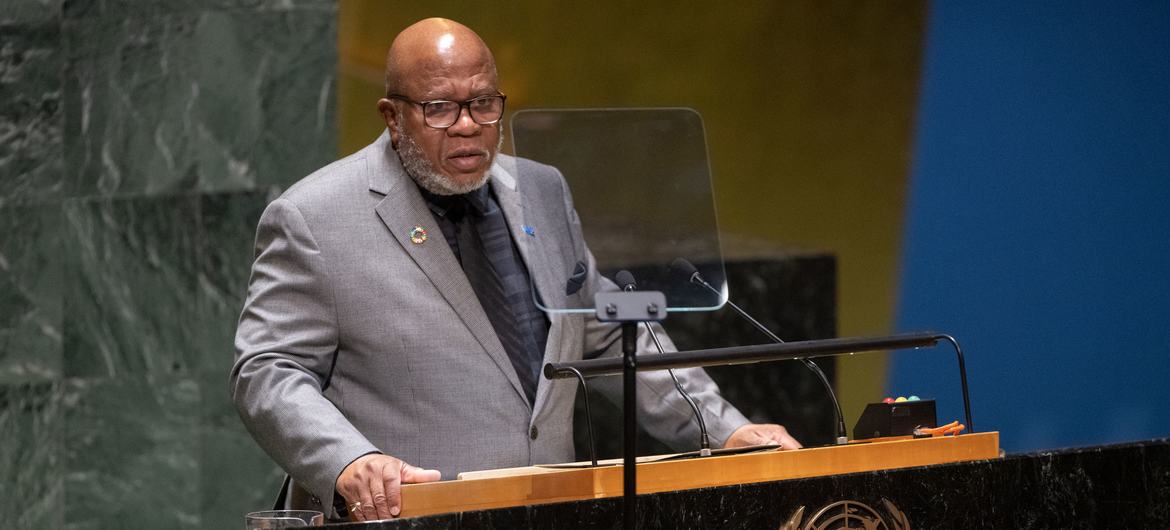
UN General Assembly President Dennis Francis  (on screen) addresses the resumed 10th Emergency Special Session meeting on the situation in the Occupied Palestinian Territory.
UN Photo/Manuel Elías
 
UN General Assembly President Dennis Francis (on screen) addresses the resumed 10th Emergency Special Session meeting on the situation in the Occupied Palestinian Territory.
Peace and Security

The United Nations General Assembly on Thursday morning held an emergency special session on the Israel-Palestine crisis, amid continuing deadlock in the Security Council and with conditions in the besieged enclave of Gaza growing more dire by the hour.

The UN's main deliberative body will continue its emergency special session on the ongoing Israel-Palestine crisis on Friday, amid continuing deadlock at the Security Council.

A dozen of the 110 speakers due to take the floor spoke on Thursday and we’ll continue coverage here on Friday for day two.

The emergency session is expected to vote tomorrow on a Jordanian-backed draft resolution on the crisis.

Among the expected speakers on Friday are the United States, Qatar, Saudi Arabia, Egypt as well as the European Union, the African Union and the League of Arab States.

DAY 1 HIGHLIGHTS

  • The session convened under the “Uniting for Peace” mandate, empowering the Assembly to act when the Security Council is deadlocked over a critical matter of international peace and security
  • Assembly President Dennis Francis called for an immediate and unconditional humanitarian ceasefire and the opening of aid corridors to save lives
  • The State of Palestine spoke first, making a powerful appeal to stop the killing for the sake of “all those who can be saved”
  • Israel spoke next in another powerful address, describing the brutality of Hamas attacks on Israeli civilians and others, stressing that its siege of Gaza and war against the militant group is to ensure that such “depravity and atrocity never occurs again”
  • Jordan, on behalf of the Arab Group, said it will table a resolution to “make a stand for peace”, after Security Council’s repeated failure to reach any consensus

1:03 PM

The President of the General Assembly Dennis Francis brought Thursday's emergency session to a close saying it would reconvene at 10 am on Friday.

Many key countries with a stake in the region have yet to take the iconic podium in the Assembly Hall, and tomorrow's speakers' list will likely see the session last through the entire day. 

For an explainer on how the Security Council and General Assembly work in times of acute international crisis and what happens when no agreement on action can be reached, check out our piece here.

12:47 PM

Mauritania bemoans lack of consensus

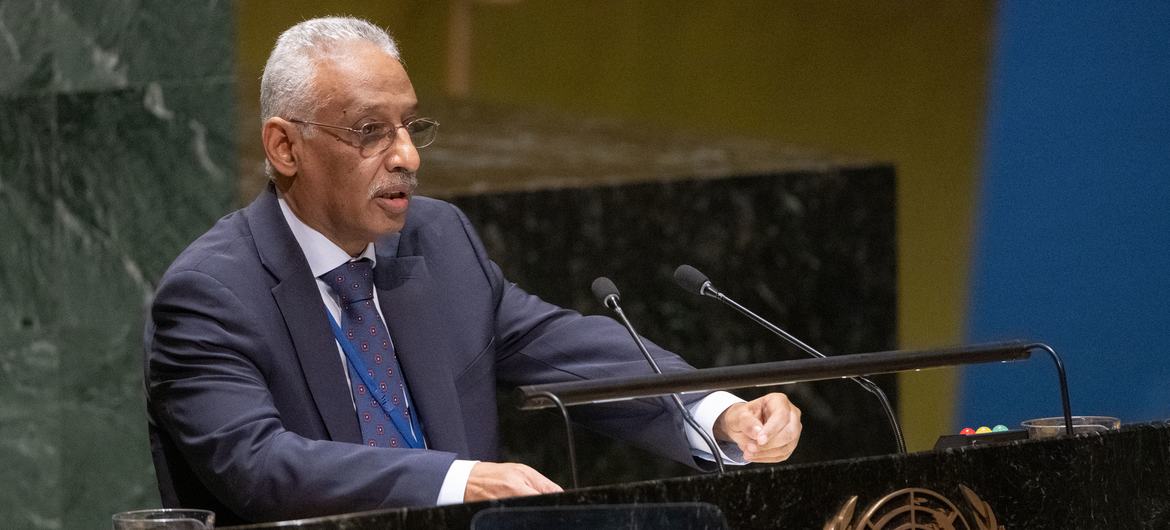
Ambassador Sidi Mohamed Laghdaf of Mauritania addresses the resumed 10th Emergency Special Session meeting on the situation in the Occupied Palestinian Territory.
UN Photo/Manuel Elías
 
Ambassador Sidi Mohamed Laghdaf of Mauritania addresses the resumed 10th Emergency Special Session meeting on the situation in the Occupied Palestinian Territory.

Sidi Mohamed Laghdaf, Ambassador of Mauritania to UN, spoke on behalf of the Organization of Islamic Cooperation saying the absence of any moral, legal, or political consensus has only emboldened the occupying power to carry on with impunity its illegal policy of colonial settlement and annexation.

He pointed to Israel's years-long blockade, forced displacement of Palestinian civilians, systematic ethnic cleansing, organized acts of terrorism, and desecration of holy places, including Jerusalem's Al-Aqsa Mosque.

He added that Israel was persisting with its denial of the violation of the inalienable right of people to self-determination and independence. This unacceptable situation must be brought to an end, he said.

11:51 AM

Iran slams 'genocide'

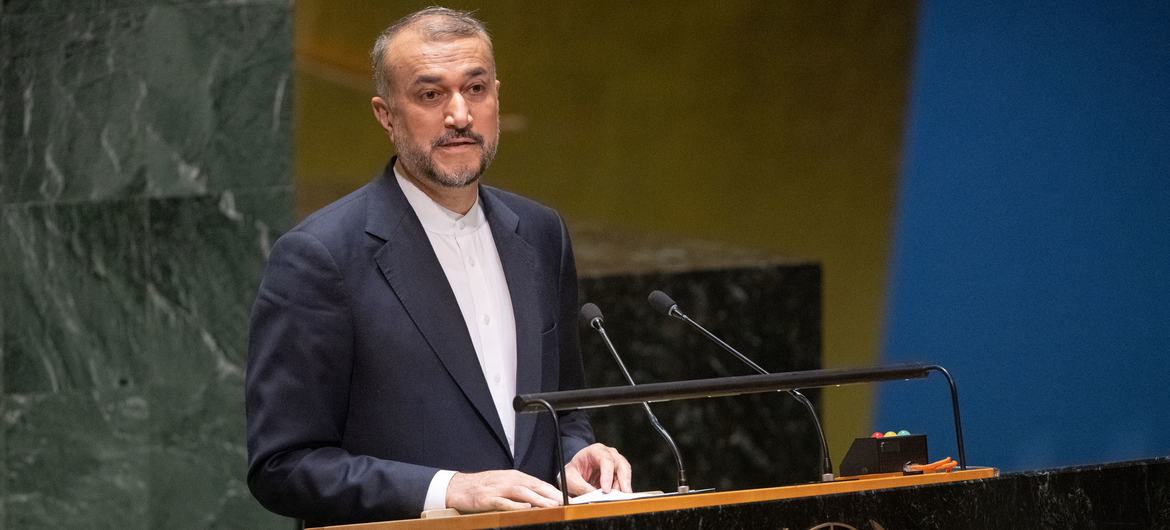
Hossein Amir-Abdollahian, Minister of Foreign Affairs of Iran, said that it has been three weeks that the international community has been a witness to the “war crime and genocide of the occupying Israeli regime in Gaza and the West Bank of Palestine.”

Foreign Minister Hossein Amir-Abdollahian of Iran addresses the resumed 10th Emergency Special Session meeting on the situation in the Occupied Palestinian Territory.
UN Photo/Manuel Elías
 
Foreign Minister Hossein Amir-Abdollahian of Iran addresses the resumed 10th Emergency Special Session meeting on the situation in the Occupied Palestinian Territory.

He said that the US and several European countries sided with Israel and they refer to the Palestinian liberation movement as "terrorists”.

“Unfortunately this is the state of our world today. This is the situation of the Security Council, which was supposed to try to establish world peace and security,” he said.

Mr. Amir-Abdollahian called on the US to work for peace and security and not war against people, women and children, stating “instead of sending rockets, tanks and bombs, to be used against Gaza, the United States should stop supporting genocide in Gaza and Palestine.”

Hamas ready to release civilian hostages

“I say frankly to the American statesmen who are now managing the genocide in Palestine, that we do not welcome the expansion of war in the region, but I warn if the genocide in Gaza continues, they will not be spared from this fire,” he stressed.

“It is our home and West Asia is our region, we do not compromise with any party and any side, and we have no reservation when it comes to our homes’ security."

He also noted that according to Iranian negotiations, Hamas is ready to release civilian prisoners, on the other hand the international community should support the release of 6,000 Palestinians held in Israeli prisons.

11:28 AM

We must stand for peace: Jordan

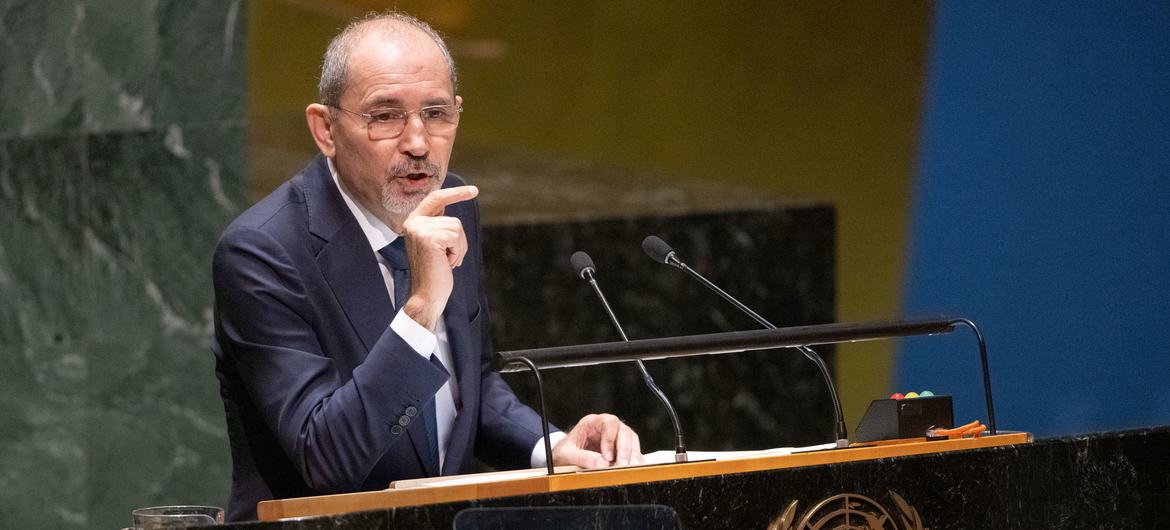
On behalf of the Arab Group, Jordan’s Deputy Prime Minister Ayman Safadi said “there is no room for grey areas”.

Foreign Minister Ayman Safadi of Jordan addresses the resumed 10th Emergency Special Session meeting on the situation in the Occupied Palestinian Territory.
UN Photo/Manuel Elías
 
Foreign Minister Ayman Safadi of Jordan addresses the resumed 10th Emergency Special Session meeting on the situation in the Occupied Palestinian Territory.

“We must stand for peace, our human values and the UN Charter,” he said. “History will judge us. Say no to war. Say no to the killing. Call out war crimes.”

As the killing continues, he said the Israeli Government have cabinet members that call for “wiping out Palestinians from the face of this Earth”.

“Israel is making Gaza a hell on Earth,” he said. “The trauma will haunt generations to come.”

Israel must uphold values, he said. “The right to self-defence is not a right to impunity; Israel cannot remain above the law,” he said. “Let the guns go silent and let the will to live and let live prevail. Let’s restore faith in the peace process as the only path to ending this conflict once and for all.”

Mr. Safadi said Jordan, on behalf of the Arab Group, will table a draft resolution after the UN Security Council failed to do so again on Wednesday.

“Vote for it; make a stand,” he said.

“Let’s make a collective cry, a cry out against more bloodletting,” he said. “Let’s unite for peace.”

“Make a stand for peace, make a stand for life, make it clear, make it firm,” he said, calling for a moment of silence for all the civilians and innocents who have perished during this war. 

10:58 AM

At war with Hamas: Israel

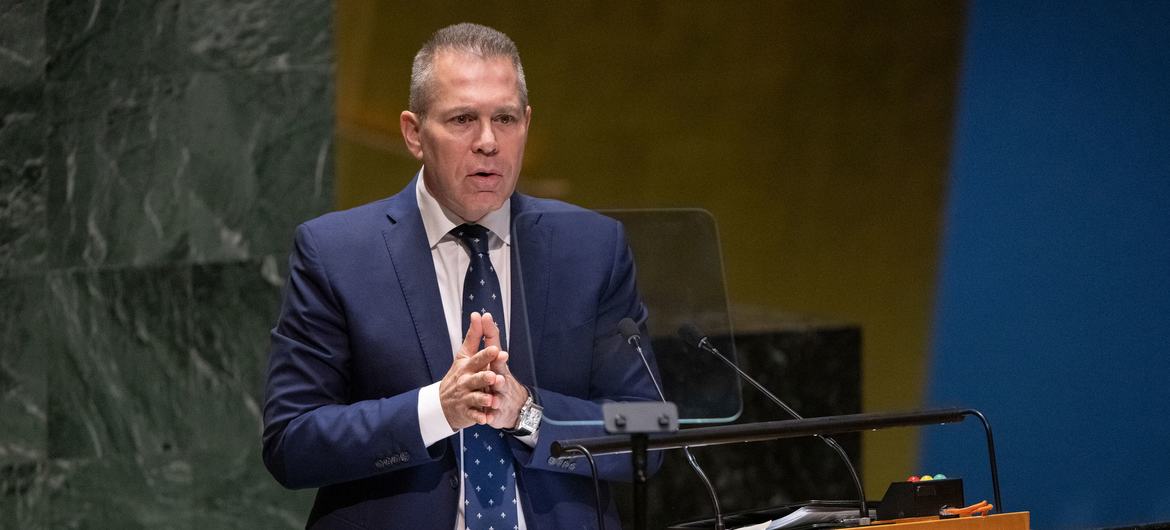
Gilad Erdan, Ambassador and Permanent Representative of Israel to UN, said that the 7 October massacre and what ensued “has nothing” to do with the Palestinians, the Arab-Israeli conflict or the Palestinian question.

Ambassador Gilad Erdan of Israel addresses the resumed 10th Emergency Special Session meeting on the situation in the Occupied Palestinian Territory.
UN Photo/Manuel Elías
 
Ambassador Gilad Erdan of Israel addresses the resumed 10th Emergency Special Session meeting on the situation in the Occupied Palestinian Territory.

“This is not a war with the Palestinians, he said. "Israel is at war with the genocidal jihadist Hamas terror organization. It is the law abiding democracy of Israel against modern day Nazis."

He went on to note that Hamas does not care about Palestinian people, peace or dialogue. Its only goal is to “annihilate Israel and murder every single Jew on the face of the Earth.”

Mr. Erdan spoke of the brutal killings of innocent Israeli civilians and intentional targeting of Israeli medical teams that were trying to help the injured during the terror attack. He questioned the “hypocrisy” that there is not a single condemnation of the barbarity against Israelis.

“The hypocrisy is beyond belief,” he stressed.

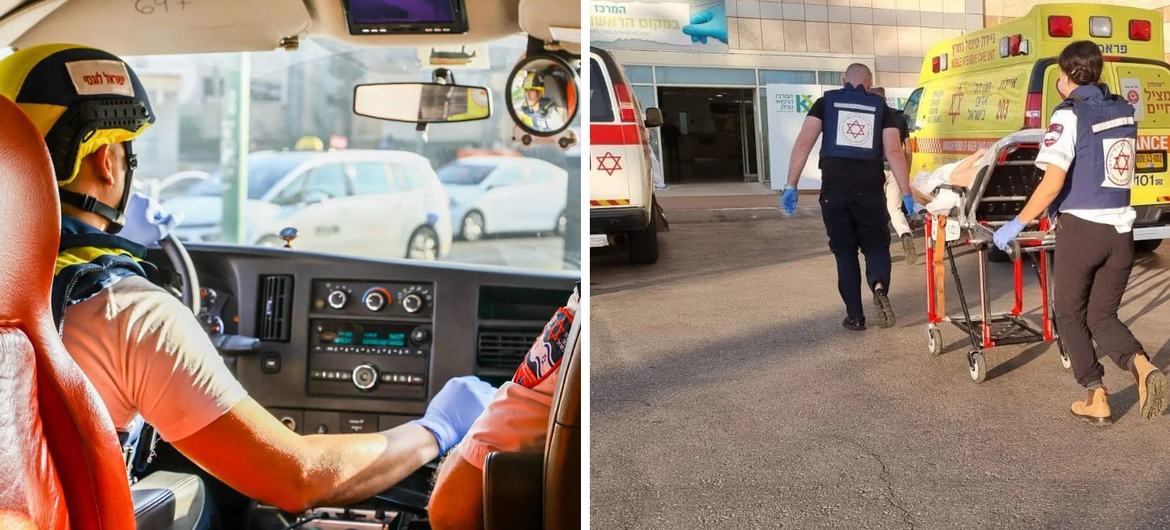
Emergency workers in Israel respond to missile attacks.
© Magen David Adom Israel
 
Emergency workers in Israel respond to missile attacks.

From the podium of the General Assembly Hall, Ambassador UN Erdan presented a video on a tablet, turning the screen towards the delegates, that he said depicted a brutal decapitation with a garden tool against a helpless agricultural worker from Thailand.

'No words' for evil of Hamas

“There are no words in any language to describe the evil we just witnessed,” at the hands of a Hamas militant, he said, adding that it is not describable because it has no place in humankind.

“ISIS was the Islamic State of Iraq and Syria and Hamas is the Islamic State of Gaza. Just as was done with ISIS, Hamas must be no more,” he declared, stating that the goal of Israel is to “completely eradicate Hamas’ capabilities and we will use every means at our disposal to accomplish this.”

“Not for revenge, not for retaliation. But to ensure such depravity and atrocity never occurs again,” said the Israeli ambassador.

10:32 AM

Meeting amidst death in Gaza: Palestine

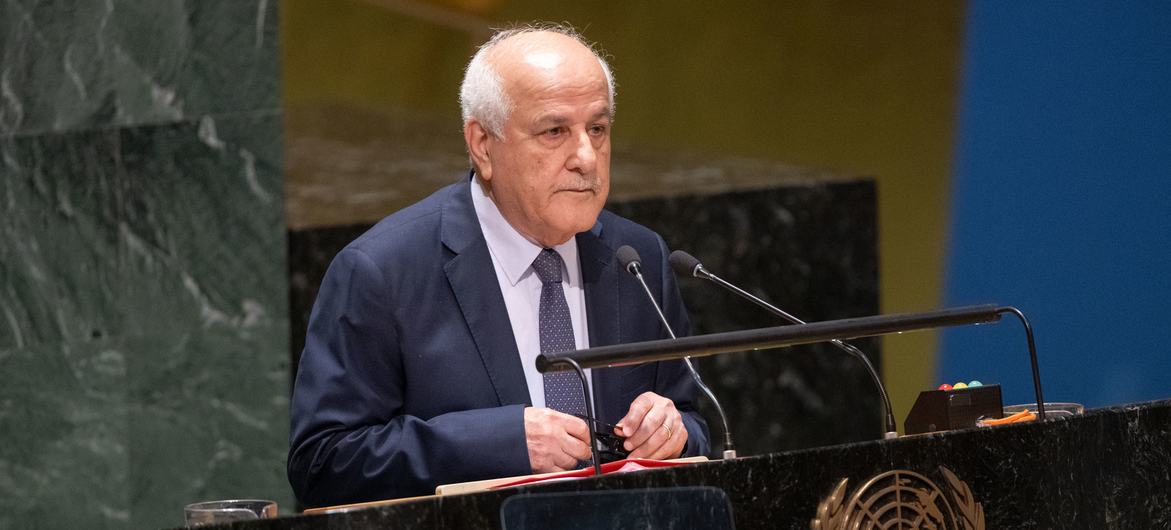
“We are meeting here while Palestinians in Gaza are under the bombs,” Riyad Mansour, Permanent Observer of the State of Palestine, said, speaking first. 

Riyad Mansour, Permanent Observer of the State of Palestine to the United Nations, addresses the resumed 10th Emergency Special Session meeting on the situation in the Occupied Palestinian Territory.
UN Photo/Manuel Elías
 
Riyad Mansour, Permanent Observer of the State of Palestine to the United Nations, addresses the resumed 10th Emergency Special Session meeting on the situation in the Occupied Palestinian Territory.

“You are speaking while families are being killed, while hospitals are coming to a halt, while neighbourhoods are being destroyed, while people are fleeing from one place to another with no safe place to go.”

“There is no time to mourn,” he said tearfully, pointing to the rising death toll. “If you do not stop it for all those who have been killed, stop it for all those who can be saved.”

Citing personal accounts of life on the ground, he said humanitarian aid is badly needed. Hospitals are operating without anaesthetics, with doctors and patients alike wondering if help is on the way.

“This time, it’s just too much,” he said.

Mr. Mansour, recalling Israel’s recent comments in the UN Security Council about how its people are suffering, said Palestinians are suffering too. Israel’s representative had called to “release the hostages, then takes two million Palestinians hostage”, he added.

There are 1,000 Palestinians killed every day, he said, adding that nothing can justify war crimes and crimes against humanity.

“Why not feel a sense of urgency to ending the killing,” he said. “You are setting us back 80 years by trying to justify what Israel is doing now.”

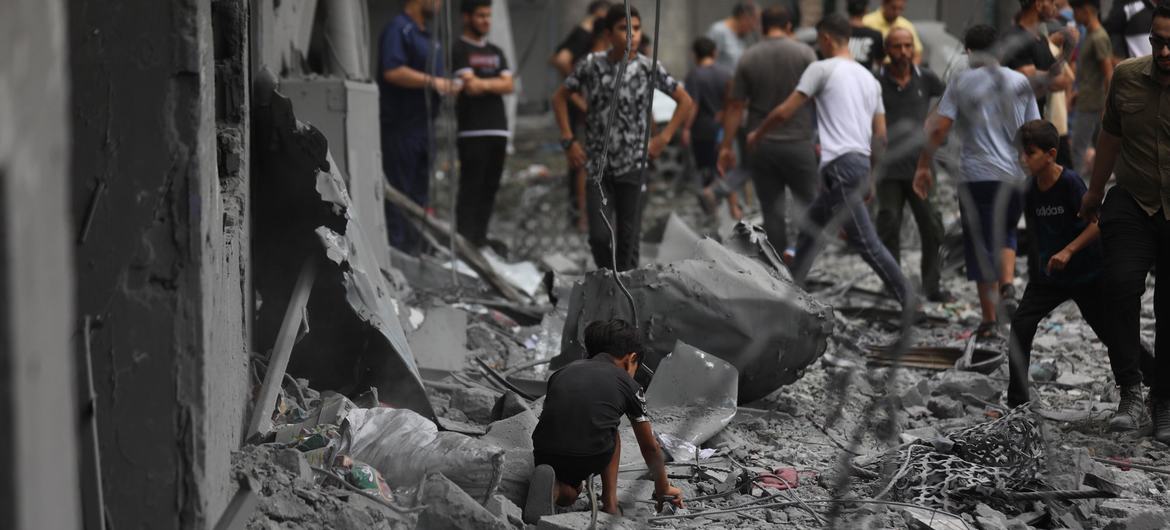
The Al Shati refugee camp in Gaza has been hit by air strikes.
© UNICEF/Mohammad Ajjour
 
The Al Shati refugee camp in Gaza has been hit by air strikes.

Decades of occupation

Palestinians have survived decades of occupation, 16 years of a blockade and five wars in Gaza, he said.

The answer to the killing of Israelis and Palestinians is not more killing, he said, asking the UN membership to uphold UN principles and keep future generations from the scourge of war.

“The only path forward is justice for the Palestinian people,” he said.

“Vote to stop the killing, vote to stop this madness,” he said. “Choose justice, not vengeance. Choose peace, not more wars. Vote to put an end to almost three weeks of the worst double standards we have seen in decades. Do not miss this chance. Lives are hanging in the balance. Please, save lives, save lives, save lives.”

10:17 AM 

Protect and save lives: Assembly President

Mr. Francis said he was "deeply disturbed and distraught" at the events unfolding in Israel and Palestine.

"Yet again, we gather amidst the gravest escalation of violence and hostility in the Middle East in decades."

The violence "must end now", he declared, calling for an immediate and unconditional humanitarian ceasefire and the opening of aid corridors.

He voiced his condemnation of the attack on Israel by Hamas on 7 October, stating “the brutality of the Hamas assault is shocking and unacceptable and has no place in our world.”

He also condemned the indiscriminate targeting of innocent civilians in Gaza and the destruction of critical infrastructure by Israel, he said, adding that “the ceaseless bombardment of the Gaza Strip by Israel and its consequences are deeply alarming.”

Assembly President Francis underscored that the preeminent priority of the collective UN membership “must be to protect and to save civilian lives.”

“All parties to this conflict must abide by international humanitarian law, and immediately create the necessary conditions to allow for an opening of humanitarian corridor to the Gaza Strip,” he said, emphasizing that urgently needed lifesaving assistance must reach those in need.

He also praised the work of UN personnel in Gaza, offering condolences to the families of the 35 UNRWA staff members who were killed since the start of the crisis.

General Assembly President Dennis Francis addresses the resumed 10th Emergency Special Session meeting on the situation in the Occupied Palestinian Territory.
UN Photo/Manuel Elías
 
General Assembly President Dennis Francis addresses the resumed 10th Emergency Special Session meeting on the situation in the Occupied Palestinian Territory.

10:10 AM

Session starts

The President of the General Assembly Dennis Francis gavelled the session open shortly after 10 but he will make the first address in the ornate General Assembly Hall.

He reminded delegates that the emergency session is reconvening following a request by Member States and letters signed by Jordan, Mauritania, Nicaragua and Russia, together with Syria.

Members who have not paid their dues aren't allowed to vote in General Assembly meetings like this, but Mr. Francis agreed by general consent to allow those in arrears a waiver so they can take part. 

09:00 AM (New York)

The tenth Emergency Special Session of the Assembly is expected to start at 10 AM, New York time, and as of now, 110 speakers are inscribed on the list.

The State of Palestine is expected to address Member States first, with Israel expected to go second.

Tweet URL

Emergency Special Session

Under the “Uniting for Peace” landmark resolution, adopted by the General Assembly in 1950, the body can convene an “emergency special session” within 24 hours, should the Security Council “fail to exercise its primary responsibility” for the maintenance of international peace and security.

This tenth Emergency Special Session was convened for the first time in April 1997, following a request from Qatar. It followed a series of Security Council and General Assembly meetings regarding the Israeli decision to build a large housing project in an area of East Jerusalem.

The Session last came together on 13 June 2018 to consider a draft resolution entitled “Protection of the Palestinian civilian population”.

At the end of that session, the Assembly decided to adjourn “temporarily and to authorize the President of the General Assembly at its most recent session to resume its meeting upon request from Member States.”

Ongoing crisis

According to several UN agencies on the ground, critical lifesaving supplies, fuels to keep hospitals running and drinking water is running out.

Meanwhile on Wednesday, the Security Council failed to adopt two resolutions on addressing the humanitarian crisis. China and Russia vetoed a United States-led draft resolution and a second Russian-backed resolution failed to secure sufficient votes in favour.

This followed failures for unity at the Council, last week. A Russian-led draft resolution calling for an “immediate humanitarian ceasefire” was voted down last Monday and the following Wednesday, the US vetoed a Brazilian-led text that urged “humanitarian pauses” to deliver aid to millions in the Gaza Strip.


https://news.un.org/en/story/2023/10/1142847
https://creativecommons.org/licenses/by/3.0/legalcode

International support critical to forge lasting peace in Central African Republic

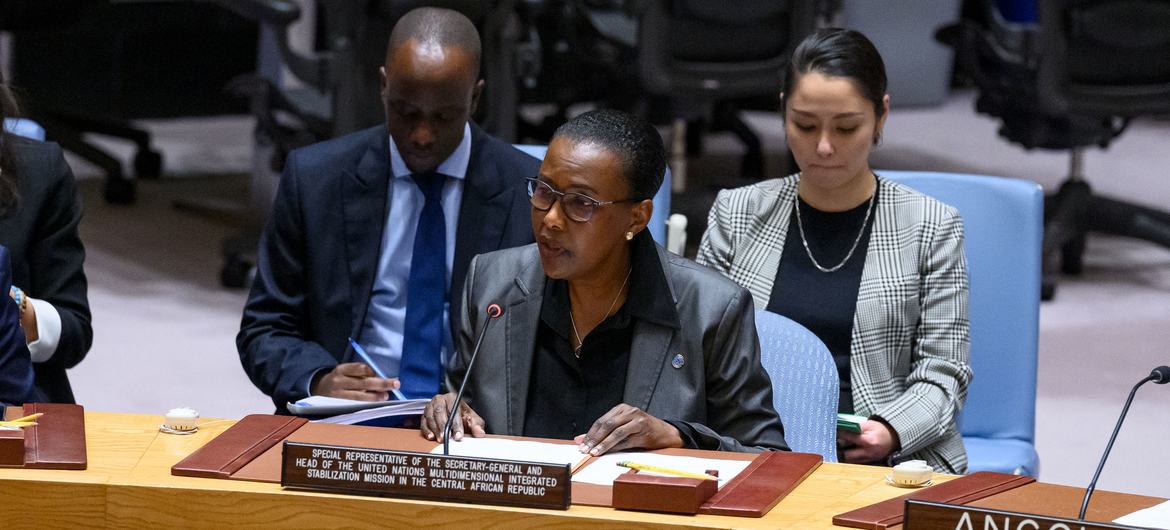
Valentine Rugwabiza, Special Representative of the Secretary-General in the Central African Republic, briefs the Security Council meeting on the situation in the country.
UN Photo/Loey Felipe
 
Valentine Rugwabiza, Special Representative of the Secretary-General in the Central African Republic, briefs the Security Council meeting on the situation in the country.
Peace and Security

Progress has been made in advancing a 2019 peace agreement in the Central African Republic (CAR) but the support of the international community is still vital, the UN Special Representative Valentine Rugwabiza told the Security Council on Thursday. 

Ms. Rugwabiza, who also heads the UN Mission in the country, MINUSCA, presented its latest report covering developments in the wake of the 31 July constitutional referendum.

She said MINUSCA continues to support Government efforts to “decentralize” the peace process with armed groups, including recent initiatives to extend state presence in areas that have been stabilized through the Mission’s assistance.

“The strength and commitment of international financial partners and development actors in this regard remains central in order to build on the security gains that were so dearly obtained, be that through investments or stabilization programmes aimed at providing basic services, or through socio-economic lasting subsistence measures for the population,” she said, speaking through an interpreter.

Government commitment 

Ms. Rugwabiza also welcomed President Faustin Toudera’s renewed commitment to speeding up implementation of the peace agreement, as expressed in his remarks to the UN General Assembly last month.

National ownership was again on display at a meeting to review the peace process, convened last Monday with the guarantors and facilitators of the accord and its joint roadmap.

The meeting highlighted the disbanding of nine signatory armed groups and their various wings, progress on DDR (disarmament demobilization and reintegration), security sector reform, border management, among other issues, and she said it was essential to build on this momentum.

Plans for local elections starting in October 2024 have also resumed, providing an opportunity to both step up resource mobilization and revise the electoral code in line with the new Constitution.

Volatile security situation

Meanwhile, the security situation remains volatile in certain areas outside the capital, Bangui, particularly in border regions.

MINUSCA has been strengthening operations in the prefectures of Upper Kotto and Vakanga to better protect civilians and deter threats by armed groups.

In Upper Mbomo, UN peacekeepers also facilitated their first joint deployment with the national defence forces to an area where they were previously absent, following an intensification in clashes between the UPC armed group and a new militia called Azande Ani Kpi Gbe.

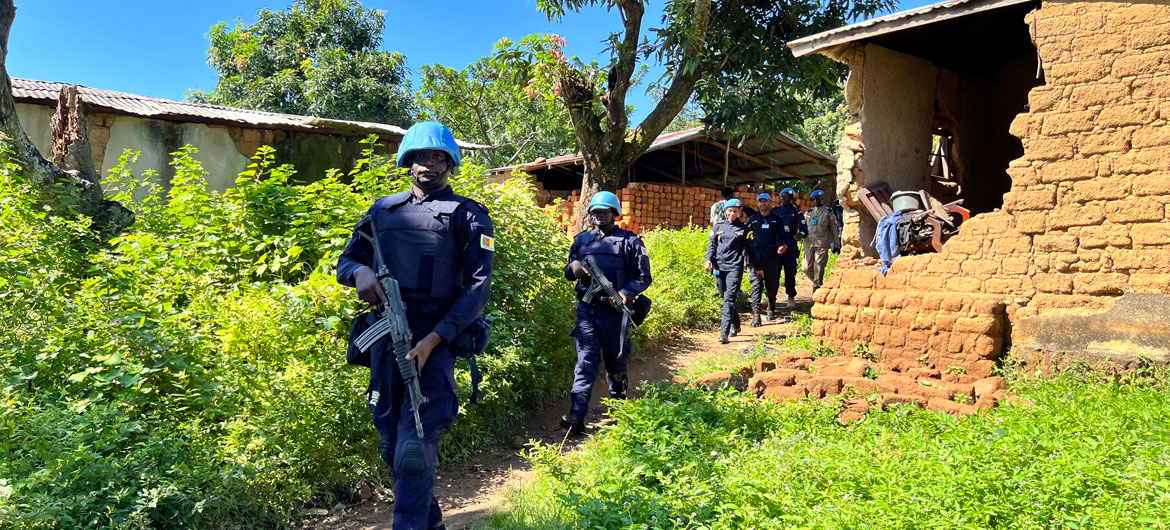
UN peacekeepers patrol Bouar, in western Central African Republic.
© MINUSCA
 
UN peacekeepers patrol Bouar, in western Central African Republic.

War and peace

Ms. Rugwabiza said the militia this month informed MINUSCA of its decision to declare a ceasefire, join the DDR process and promote social cohesion.

“These results once again illustrate the effectiveness of concerted efforts, even if much remains to be done, including with regard to strengthening the capacities of national security and defense institutions,” she said. 

Recent months have also seen the facilitation of the voluntary repatriation of former combatants from the Lord's Resistance Army (LRA) after more than 15 years in Upper Mbomo, where they presented a real and ongoing threat to civilians.

Similarly, she also welcomed an agreement signed in September between the CAR and South Sudan which should help boost coordinated response to cross-border threats.

The reporting period also saw an influx of refugees from Chad and war-torn Sudan, creating significant challenges and increasing humanitarian needs.

Critical shortfalls at MINUSCA

Turning to MINUSCA itself, Ms. Rugwabiza reported that the mission has been reconfiguring its security arrangements to optimize effectiveness. This includes reducing the number of operational temporary bases and improving living and working conditions, particularly for staff deployed in remote areas.

“In order to preserve the values of the United Nations and maintain the trust of the population everywhere that we operate, MINUSCA will continue to strengthen prevention and risk management of risks of sexual exploitation and abuse by working with the country team at the United Nations in order to assist victims that have been identified,” she said.

Increased surveillance has resulted in a reduction of new cases reported this year, and efforts will be increased in line with the UN’s zero-tolerance policy for sexual exploitation and abuse, she added.

MINUSCA also faces critical gaps in air and land transport capacity, and in supply chain, inhibiting mobility. The situation is affecting the well-being, safety and security of peacekeepers, and also operational response.

For example, convoys can take up to several weeks just to travel from the capital to the northeast. Furthermore, most roads are impassable during the rainy season, which lasts seven months.

Ms. Rugabizwa said MINUSCA is planning to implement recommendations made in a recent global assessment of logistical capacity “if we are given the budget”, appealing to the Council for support.

She also paid tribute to the sacrifice of UN peacekeepers serving at the Mission, noting that three ‘blue helmets’ have been killed in “land transport accidents” this month alone. 


https://news.un.org/en/story/2023/10/1142857

https://creativecommons.org/licenses/by/3.0/legalcode