Показаны сообщения с ярлыком Central African Republic. Показать все сообщения

четверг, 1 января 2026 г.

Results expected 5 January after landmark elections in Central African Republic


Results expected 5 January after landmark elections in Central African Republic

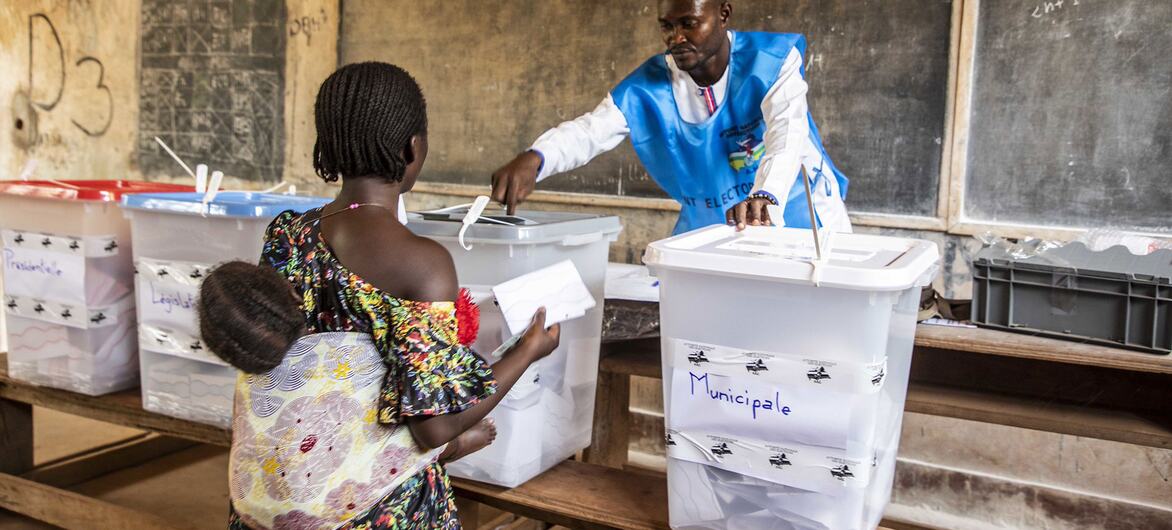
A woman carrying a child places a ballot into a transparent ballot box labeled 'Municipale' while an election official observes in a classroom setting.
MINUSCA
 
A woman, carrying a baby, casting her votes during the elections.


By Vibhu Mishra
31 December 2025 
Peace and Security

Voting proceeded largely as planned in the Central African Republic’s first-ever combined presidential, legislative, regional and municipal elections, and ballot counting is now complete, the UN peacekeeping mission (MINUSCA) said on Wednesday, with results expected to be announced on 5 January.

According to MINUSCApreliminary reports from observers indicate that more than 99 per cent of polling stations across the country opened as scheduled on election day.

The transfer of envelopes containing the results from 19 prefectural capitals to the national capital, Bangui, is now underway, with logistical and security support from the mission.

The 28 December vote marked an unprecedented moment in the country’s political history, bringing together four ballots in a single electoral exercise. Municipal elections, in particular, had not been held in the Central African Republic (CAR) since 1988 and were a key provision of the 2019 Political Agreement for Peace and Reconciliation.

Vast, sparsely populated and landlocked, CAR is crisscrossed by dense forests, rivers and long, often impassable roads. Outside Bangui, many communities are reachable only by air or days-long journeys.

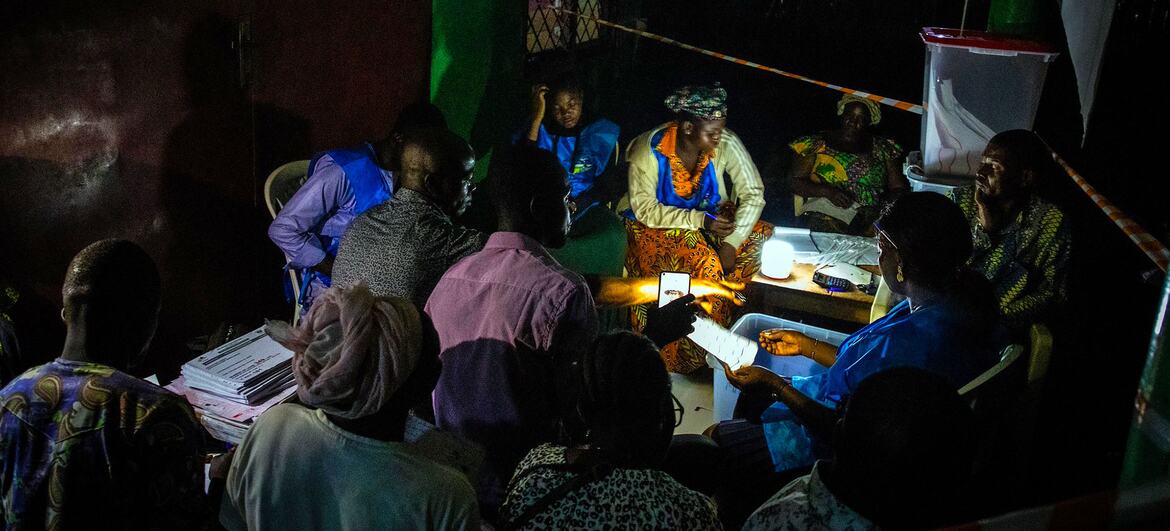
A group of people gathered around a table at night, counting ballots during an election under the light of a small lamp, with a ballot box in the background.
MINUSCA
 
Ballots are counted under flashlights after the elections in Central African Republic.

Extensive UN support for complex operation

MINUSCA said it worked closely with national authorities and UN agencies to support the electoral process, delivering all voting materials on time despite difficult terrain and security constraints.

In total, the mission carried out 84 flights and eight road convoys to transport more than 230 tonnes of election materials, including ballot papers, indelible ink, voter cards, voting booths and ballot boxes.

Electoral materials were delivered to 6,679 of the country’s 6,700 polling stations, allowing them to function normally across 20 prefectures.

On the technical and operational front, some 34,500 people – including electoral agents, supervisors and polling station staff – were trained with UN support.

Security measures

Security for the polls was reinforced through the deployment of additional national troops and police, supported logistically by MINUSCA, alongside strengthened patrols by UN peacekeepers and police personnel.

The mission also provided Central African armed forces and internal security personnel with vehicles and motorcycles to reach remote and isolated areas.

Speaking at a press conference in Bangui on Wednesday, the Special Representative of the Secretary-General for CAR, Valentine Rugwabiza, said the mission had successfully fulfilled its mandate despite operating in a challenging environment.

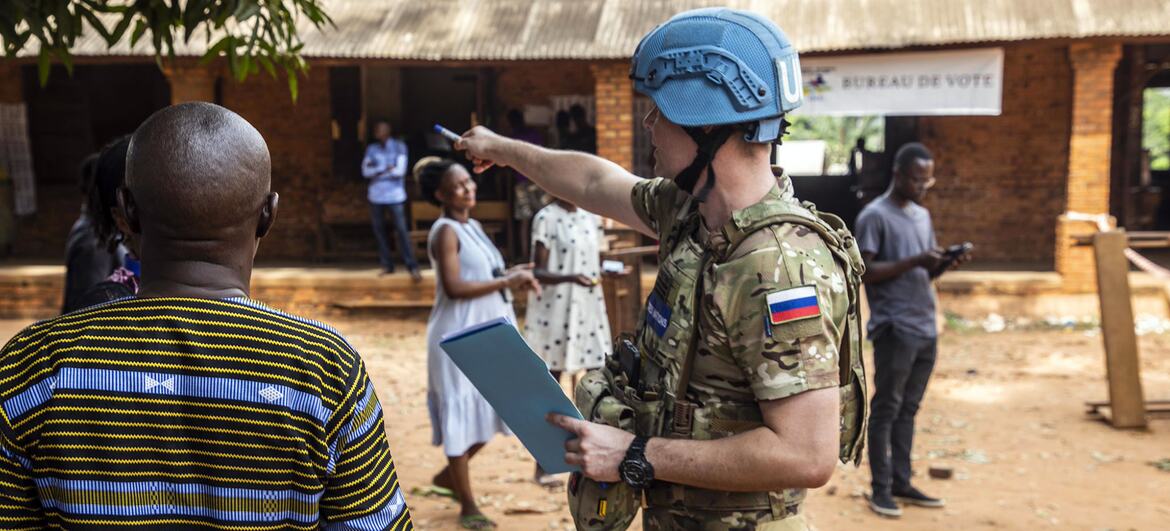
A UN peacekeeper in a blue helmet and military uniform points at a ballot box while overseeing an election at a 'Bureau de Vote' in Africa.
MINUSCA
 
UN peacekeepers on patrol at a polling centre in the capital Bangui during the elections.

Incident in Haut-Mbomou

Ms. Rugwabiza strongly condemned an attack in Bambouti, in the south-eastern Haut-Mbomou prefecture near the border with South Sudan, which prevented voting from taking place in that locality due to insecurity.

The attack, carried out by the Azandé Ani Kpi Gbe (AAKG) armed group, also involved hostage-taking, including the sub-prefect.

She said MINUSCA has been working around the clock since Sunday to facilitate the release of those taken hostage.

Results expected next week

The National Elections Authority (NEA) is expected to announce the preliminary results of the presidential election on 5 January 2026.


https://news.un.org/en/story/2025/12/1166688


https://creativecommons.org/licenses/by/4.0/legalcode

четверг, 27 июня 2024 г.

UN mission boosts presence in Central African Republic’s conflict-stricken southeast


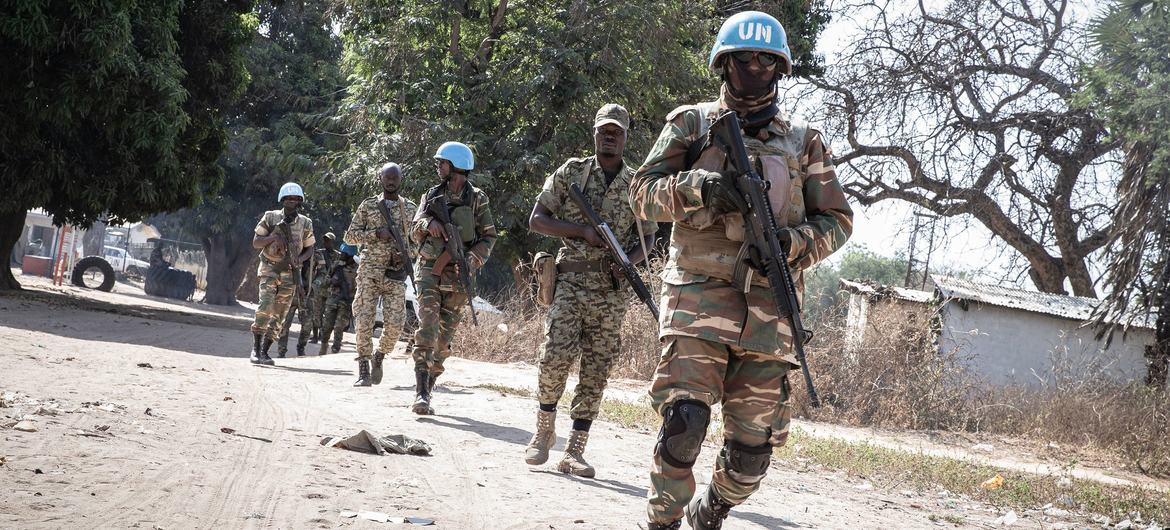
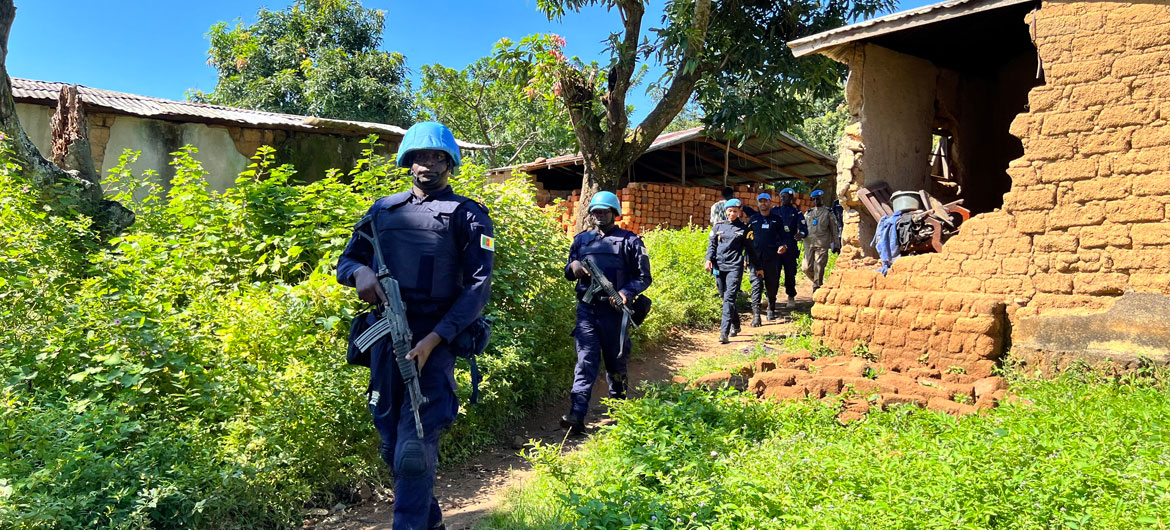
MINUSCA peacekeepers on patrol in rural Central African Republic.
© MINUSCA/Herve Serefio
 
MINUSCA peacekeepers on patrol in rural Central African Republic.


1 hour 45 minutes ago 

Peace and Security

The UN peacekeeping mission in the Central African Republic (CAR) has expanded its presence in the country’s southeast to prevent further violence in areas heavily affected by conflict and systemic issues.

Briefing ambassadors at the Security Council on the situation in the country, head of the UN mission Valentine Rugwabiza stated that the additional deployment also facilitated the delivery of humanitarian aid in the restive and hard-to-access Haut Mbomou region.

Bordering South Sudan and the Democratic Republic of the Congo, the region – which is larger than Switzerland - has been a hotspot of conflict due to its strategic importance and limited accessibility.

“Within a very short time, working closely with national and local authorities, local communities, and humanitarian partners, the mission is making tangible and transformative progress on the security, humanitarian and peacebuilding fronts in Haut Mbomou,” she said.

The expansion MINUSCA’s footprint there also paved the way for the extension of civilian authorities and CAR security forces through the ongoing rehabilitation of the Bangassou-Obo-Bambouti axis.

Mission background

The UN mission was established in September 2014, following a deadly flare up of inter-communal violence between the mainly Muslim Séléka groups and the mainly Christian anti-Balaka movement.

Its mandate includes protection of civilians as the “utmost priority”, alongside supporting humanitarian operations; protecting and promoting human rights; and the disarmament, demobilization, reintegration and repatriation of fighters from neighbouring countries.

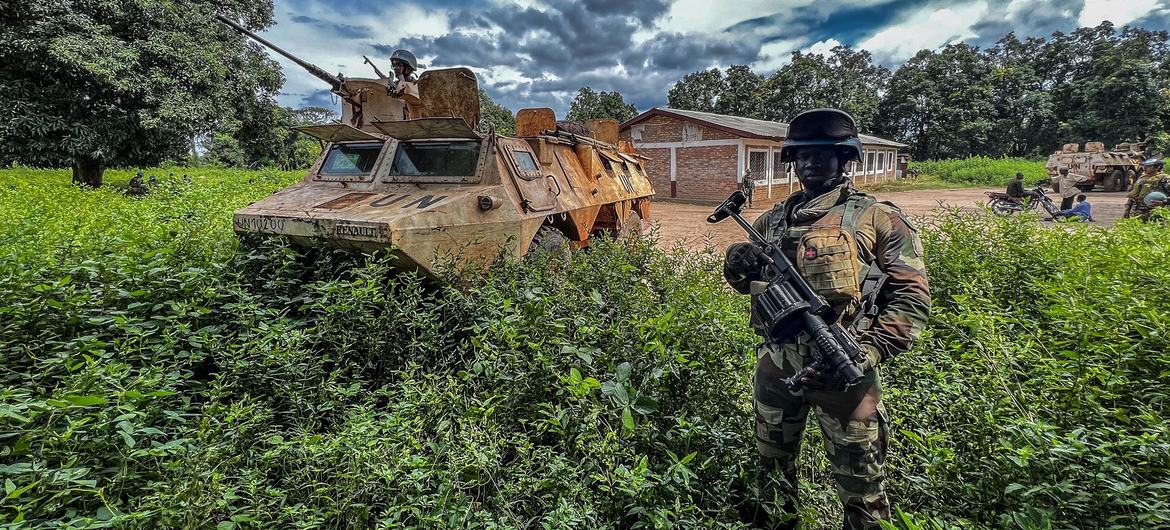
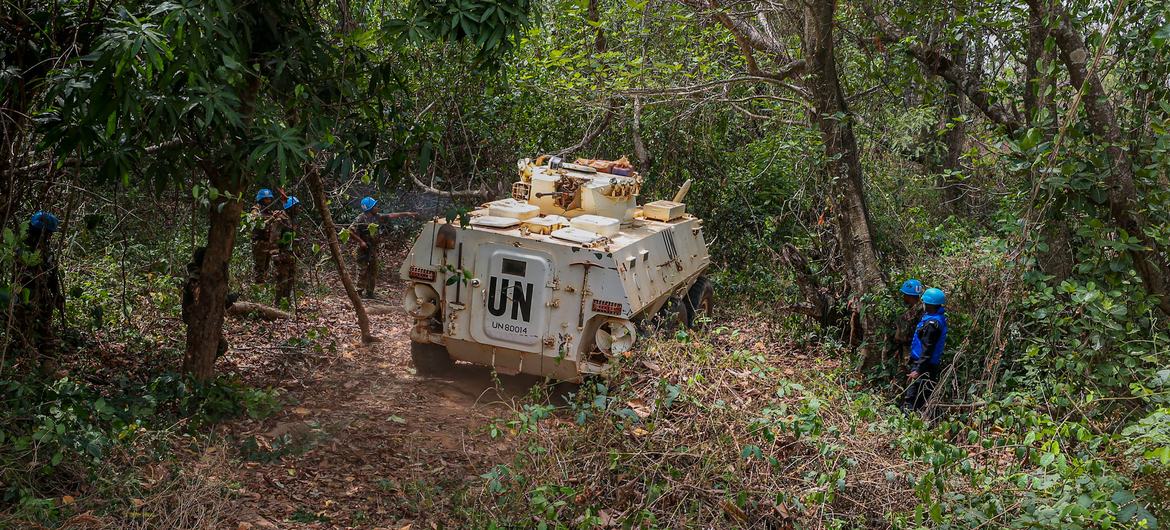
A joint MINUSCA-CAR armed forces patrol in the Haut Mbomou prefecture. (file)
© MINUSCA
 
A joint MINUSCA-CAR armed forces patrol in the Haut Mbomou prefecture. (file)

Farmer-herder conflict

Recurrent political and security crises in the Central African Republic have made transhumance (seasonal changes in grazing patterns for animal herding communities) a trigger for violence.  

Ms. Rugwabiza referred to the recent killing of 16 civilians in Limé village, in the west of the country, due to conflict over land between local farmers and cattle owners.

The incident, she stressed, was a “stark reminder” of the urgent need to reverse the dynamics of violence and to reposition livestock farming and transhumance to help forge peaceful coexistence, stabilization and economic development.

Upcoming elections

Special Representative Rugwabiza further updated ambassadors on preparations for local elections, scheduled to take place in October for the first time in over 36 years.

She emphasized that MINUSCA will continue to provide multifaceted support to election preparations – a key provision of the Political Agreement for Peace and Reconciliation in the CAR.

This includes through awareness-raising to mobilize broad and safe participation, particularly of women, she stated.

Fighting misinformation

In her briefing, Ms. Rugwabiza voiced deep concern over the “continuous campaign” of mis and dis-information which are a threat to MINUSCA personnel and the mission’s objectives.

This, she said, “further complicates” an already challenging environment for peacekeepers.

“I call on the Government to hold accountable identified individuals, including public servants, channelling and echoing such campaigns which … constrain the mission’s ability to implement tasks mandated by the [Security] Council and requested by CAR national authorities,” she added.

Video feed of the Security Council meeting on the situation in Central African Republic.


https://creativecommons.org/licenses/by/4.0/legalcode
https://news.un.org/en/story/2024/06/1151566

пятница, 14 июня 2024 г.

Panel of Experts Briefs Security Council’s Central African Republic Sanctions Committee on Final Report

SC/15733

Panel of Experts Briefs Security Council’s Central African Republic Sanctions Committee on Final Report

On 3 June 2024, the Coordinator and members of the Panel of Experts briefed the Security Council Committee established pursuant to resolution 2127 (2013) concerning the Central African Republic on the Panel’s final report submitted in pursuance of resolution 2693 (2023).

During the briefing, the Coordinator provided an overview of the report’s key findings and recommendations in accordance with the Panel’s mandate.  Following the Panel’s overview, members of the Committee thanked the Panel for its briefing and conveyed questions and comments in connection with the report and subsequently considered the report’s recommendations, including possible actions by the Committee.


https://press.un.org/en/2024/sc15733.doc.htm

https://creativecommons.org/licenses/by/3.0/legalcode

среда, 21 февраля 2024 г.

Security Council: The Situation in the Central African Republic

9554TH MEETING (AM)
SC/15598

Security Council: The Situation in the Central African Republic

Note: Full coverage of today's meeting of the Security Council will be available after its conclusion.

THE SITUATION IN THE CENTRAL AFRICAN REPUBLIC (S/2024/170)

Briefing

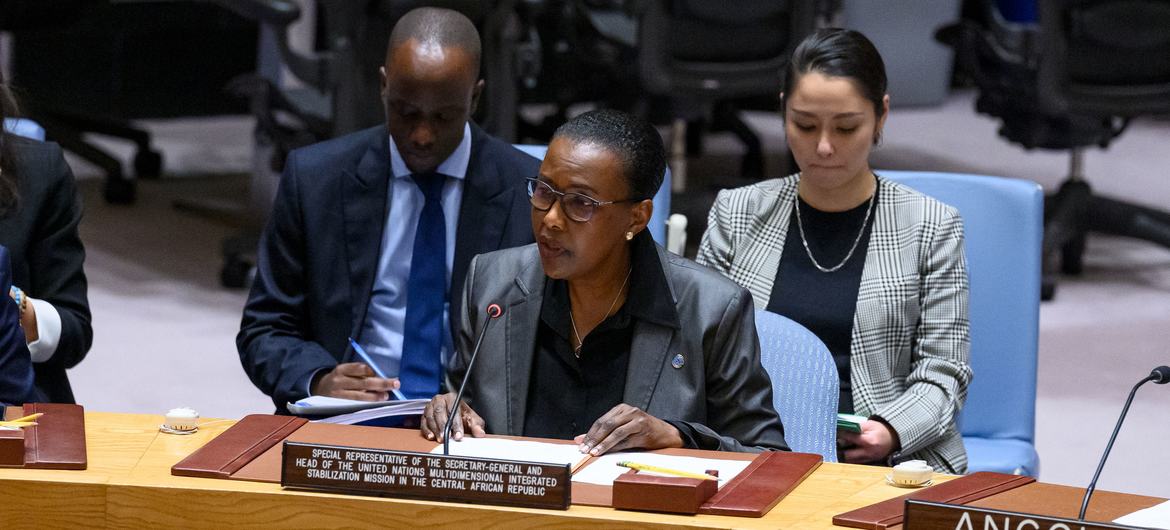
VALENTINE RUGWABIZA, Special Representative of the Secretary-General and Head of the United Nations Multidimensional Integrated Stabilization Mission in the Central African Republic (MINUSCA), reported on the latest developments in that country since 16 October 2023. On 6 February, a special meeting was held to mark the fifth anniversary of the signing of the Political Agreement for Peace and Reconciliation.  At the meeting, the Commissioner for Political Affairs, Peace and Security of the Economic Community of the Central African States (ECCAS) commended the achievements, including the self-dissolution of nine armed groups and the maintenance of former leaders of armed groups in the current Government, and called on the remaining original signatories to rejoin the peace and political process.

Turning to MINUSCA’s mandate, she said that on 15 January, a mission patrol fatally hit an explosive ordnance device while returning from escorting a humanitarian convoy to Nzakoundou — the recent epicentre of an attack by suspected elements of the 3R armed group.  “It is critically important that we understand the sources and origins of the EODs through application of proper intelligence gathering and equally pursue cross-border cooperation to stem the tide of weapons flow across boundaries into [Central African Republic] territory,” he said.  Explosive ordnance devices and light weapons are not only a threat to the population and peacekeepers but the most serious constraint to delivering humanitarian assistance in the country’s western region, home to 50 per cent of the population.  She praised the Central African Republic Government for the December 2023 adoption of its 10-year national policy for border management to stem the flow of weapons — which calls for border cooperation among regional States including through the activation of the border commissions.

She went on to request the Council’s support for “an urgent, dedicated and truly multidimensional response to this threat both for the protection of civilians and the safety of peacekeepers”, also underscoring the need to prevent the spread of these lethal weapons to other parts of the country.  This approach should include investing in situational awareness and entail enhanced pre-deployment training for peacekeepers and capacity-building for national defence and security forces.  It should also promote communities’ awareness and sensitization on the threat posed by those weapons.  The Central African Republic is a vast country with a tropical climate, dense forests and replete with unpassable terrains.  The roads are mostly dirt tracks with only 3 per cent asphalted, constituting a major challenge to the mobility of MINUSCA’s troops and the national defence and security forces and therefore to the mandates to protect civilians and extend State authority over its territory.

These problems are further compounded by the Mission’s limited transport and logistics capacities, she said, citing its limited air assets and the lack of a bulk cargo aircraft.  The Council elevated the restoration and extension of State authority to a priority task for MINUSCA but this has not been accompanied by additional resources for its implementation.  She therefore asked Council members and all Member States to avail MINUSCA with the requisite transport and logistic means.  The magnitude of the need for security sector reform and restoration of State authority cannot be supported by MINUSCA alone, she pointed out, encouraging States and partners with relevant expertise and institutional capabilities to support the country’s efforts to build a professional national army and internal security forces.  “There is no alternative to lasting securization of CAR population and preservation of the sovereignty of its territory,” she stressed.

Statements

The representative of France said “pursuing the peace process is essential to silence the guns” and welcomed the efforts made in this direction by the Central African authorities.  Disarmament, demobilization, reintegration and repatriation efforts must continue, he asserted, highlighting the results obtained by the Central African authorities — in conjunction with MINUSCA — in the fight against armed groups.  Regarding the insecurity that persists due to cross-border movements of armed groups, cooperation with regional countries and organizations — including the African Union — is essential.  He condemned the violations of international humanitarian law and human rights law committed by armed groups and Russian mercenaries, notably Wagner.  On the precarious security situation, he said the risk of deterioration is real with the increase in the number of refugees and asylum seekers linked to the crisis in Sudan.  He underscored the importance of dialogue between the Government and the opposition in consolidating the progress achieved.

The representative of the United States highlighted the importance of the Central African Republic, as well as MINUSCA’s efforts to mitigate the threat posed by explosive ordinance.  Through the Mission’s new mandate, the Council facilitated the extension of State authority, he said, recognizing this effort as critical to lasting peace.  He also welcomed MINUSCA’s contribution to building capacity for defence and security forces to assume primary responsibility for national security. However, he sounded alarm over reports that the Kremlin-backed Wagner Group and the Central African Armed Forces, following a 24 December operation, burned an entire village to the ground displacing 750 households.  This undermines efforts to extend State authority, protect civilians and invest in stabilization.  Reports of human-rights violations and abuses — including reports of sexual and gender-based violence — are also worrisome, and their perpetrators must be held to account.

Noting the great humanitarian need in the country, he commended MINUSCA’s facilitation of humanitarian access and called on all countries to allow for full and unimpeded delivery of humanitarian aid.  Additionally, holding local elections is an important step towards stabilization and must be conducted in a transparent manner, with full participation by women and youth.  Further, obstruction of MINUSCA’s convoys — which often went on joint operations with Wagner personnel — is inconsistent with the country’s obligation to allow the Mission full and unrestricted freedom of movement throughout the country.  This limits its ability to protect civilians, he stressed, also stating that the Government’s restrictions on unmanned aerial systems hinder the Mission’s ability to maintain awareness within a dynamic security environment and puts peacekeepers at increased risk.  As well, the scourge of disinformation undermines MINUSCA’s work and elevates the threat to peacekeepers, he cautioned.

The representative of Sierra Leone, also speaking for AlgeriaGuyana and Mozambique, expressed concern about the disagreements regarding President Faustin-Archange Touadera’s dialogue in the political opposition and among the leaders of some armed groups, as well as the detention of a member of parliament by the national defense and security forces.  Encouraging continued dialogue on the President’s initiative to appeal to political actors abroad to return and participate in the country’s political and development process, he also highlighted the current volatile security situation. Condemning the repeated attacks by armed groups against humanitarian actors, MINUSCA and the Central African Armed Forces, he said that given the country’s internal security challenges, the Mission must sustain its current level of mobilization.  Welcoming MINUSCA’s training and capacity-building initiatives for the country’s security forces, he called for international support for this work.

Turning to the electoral process, he welcomed the approval of the new electoral code.  The outcome of the election will determine the political future of the country.  Promoting women’s participation is essential as is the security of the upcoming elections, he said, calling for strengthened cooperation between the country’s defense and security forces and MINUSCA.  “The actual holding of these elections is eagerly awaited by the people of the Central African Republic, who aspire for lasting peace, as well as free, fair and credible elections,” he stressed.  Voicing concern about the increase in human rights violations and the persistence of conflict-related sexual violence, he called for the immediate release of all children being held captive and noted the influx of internally displaced persons and refugees as a result of conflicts in neighboring countries as well as the effects of climate change. Calling for the free movement of humanitarian workers, he reaffirmed support for the Mission and the Central African Republic’s independence and territorial integrity. 

The representative of the Republic of Korea said that the Central African Republic “is at a critical juncture in its State-building efforts”.  The peace process must progress for the country to achieve stability, he observed, urging the Government to pursue dialogue with armed groups.  For their part, all such groups must lay down their weapons and participate in the peace process without delay.  Further, conducting local elections by October 2024 is vital for democratic governance.  Voicing concern over the volatile security situation, especially along the borders with Sudan and Chad, he said that porous borders allow cross-border incursions, recruitment and movement by armed combatants, undermining regional stability. Increased use of explosive ordnance is another recently growing threat, jeopardizing security operations and humanitarian access.  It is also alarming that the number of human-rights violations in the country increased by 30 per cent in just four months, he added.

The representative of Japan said it is encouraging that the Government of the Central African Republic continues to make efforts to advance the disarmament, demobilization, reintegration and repatriation process for armed groups.  Turning to the local elections planned for the latter half of the current year, she said the presence of elected local leaders is key for building a resilient community where former combatants are reintegrated.  Local elections will be crucial to encourage anti-Government armed groups to lay down their arms and find their way in politics.  Thus, the forthcoming election can serve as an opportunity to fundamentally change political dynamics.  Her country, in partnership with the United Nations Entity for Gender Equality and the Empowerment of Women (UN-Women), has been engaged in emergency assistance for basic services and helping with the protection mechanism tackling violence against women and girls in the border areas. 

The representative of the United Kingdom welcomed the achievements from closer cooperation between MINUSCA and the Central African Republic authorities following the Council’s reprioritization of the Mission’s tasks. The country’s commitments to establish human rights mechanisms to implement the political agreement on peace and reconciliation and prepare for local elections this year provide a basis for lasting security and prosperity.  The authorities, with MINUSCA support, must deliver on these commitments.  The country’s security “will not come through the wrong partners”, she asserted, warning that the Wagner Group’s human rights abuses against civilians threatened to cause prolonged insecurity and undo achievements.  There must be accountability for all human rights abuses no matter who commits them, she stressed, also calling for the timely publication of MINUSCA’s annual human rights reports.  The Mission’s strategic review should focus on how it can further prepare for a sustainable transition.

The representative of China said that the political and security situation in the Central African Republic has been continuously improving.  “The international community should help [the country] consolidate the current positive momentum and inject new impetus into its peace and development,” he stressed. Thanks to the Government’s active implementation of the peace agreement, some armed groups announced their adherence to it.  The international community should provide necessary financial and technical support to the country’s peace process.  As well, he underscored that the human rights situation should be objectively evaluated and not used as a tool to interfere in the country’s internal affairs. Further, MINUSCA should continue to enhance its capacity to protect civilians — as mandated by the Council — and support the country’s armed forces.  Close attention should also be paid to the spillover effect of the situation in Sudan and Chad.  Per the country’s needs, he emphasized that “the Council should optimize and streamline MINUSCA’s mandate and rationalize its staffing level and size.” 

The representative of Ecuador, noting the volatile security situation, called for continued efforts to implement the joint road map as well as the regional conference of the Great Lakes, with the participation of guarantor countries Angola and Rwanda.  State presence must be reinforced throughout the Central African Republic’s territory, he said, also emphasizing the need to operationalize border-management policies.  Cooperation with neighbouring countries — particularly Chad — is crucial, and he urged international financial institutions to continue supporting the country and assisting its recovery from external shocks.  MINUSCA’s work in combating hate speech and disinformation is vital for expanding the civil space, he said, also highlighting the Mission’s work to promote the participation of women in local elections.  Also noting the 30 per cent increase in serious violations of human rights, he said it is essential to combat impunity.

The representative of Malta expressed concern about the estimated 30 per cent increase in human rights violations and abuses during the reporting period and commended MINUSCA’s efforts in engaging with militias to prevent the recruitment and use of children, as well as other grave violations.  Her country fully supports initiatives aimed at preventing sexual and gender-based violence, including forced marriage, and sexual slavery.  MINUSCA’s freedom of movement remains a vital component of its mandate.  The restriction on the use of drones is unacceptable, as it poses a deliberate threat to the safety and security of peacekeepers.  Unmanned aerial vehicles are important for observing areas in advance of MINUSCA patrols, she said. 

The representative of Slovenia expressed concern about the volatile security situation in the Central African Republic and the high number of civilian casualties, including an alarming increase in the number of reported grave violations against children.  “We call on all remaining armed groups to return to the Political Agreement for Peace and Reconciliation and the Luanda Road Map,” she said.  For the peace process to succeed, it must be accompanied by an inclusive political dialogue with all political actors and all segments of society within the Central African Republic.  Additionally, holding free and fair elections can significantly contribute to reducing intercommunal tensions and enhancing stability, she pointed out, urging the Central African Republic to ensure the credibility of the electoral process, including by preventing the spread of misinformation.  She further called on the Central African Republic to immediately lift any restrictions that limit the prompt and effective use of unmanned aerial vehicles by MINUSCA at any time of day. 

The representative of Switzerland emphasized that the sustainable disarmament, demobilization and reintegration of ex-combatants is essential to encourage other armed actors to join the process.  Additionally, holding inclusive, transparent, democratic and peaceful local elections will be crucial to decentralize the peace process.  He also stressed that progress made on the security and humanitarian fronts must be further consolidated, highlighting MINUSCA’s efforts to extend State authority throughout the country.  Despite a reduction in emergency humanitarian needs, the situation remains fragile in certain areas, and intensified activities by armed groups during the dry season — particularly in border areas — threaten the safety of civilians.  Protecting civilians must remain a priority, given that climate change is increasing instability in the region.  In this context, he reiterated the importance of authorizing the use of reconnaissance tools, such as drones, by MINUSCA to implement its mandate to protect civilians and ensure the safety of its personnel.

The representative of the Russian Federation, expressing concern about attacks on foreign nationals and natural resource extraction facilities as well as the use of unmanned aerial vehicles, said security threats emanate primarily from areas bordering neighboring countries, particularly Chad, Sudan and Cameroon.  Also noting the increase in humanitarian needs due to the conflict in Sudan and growing instability in Chad, he said it is essential not to politicize external assistance and fully fund the humanitarian appeal.  Thousands of former fighters have laid down their arms, while the municipal elections planned for this year will constitute a milestone.  The situation in the Central African Republic is consistently improving even as challenges remain, he said, commending its leadership and recalling Moscow’s support for the country during a difficult time.  Regretting that the United States has taken a position that involves “painting everything in somber tones” and refusing to recognize Bangui’s success, he said “this happens to all States where Washington is unable to achieve its goals”.

The representative of the Central African Republic acknowledged the Special Representative’s leadership and substantial progress in implementing the Mission’s mandate.  His country remains convinced that the independent review of MINUSCA to be carried out shortly will be another opportunity — after 10 years on national territory — to improve the Mission’s effectiveness and efficiency in restoring stability to his country.  Noting a significant drop in the number of people in dire humanitarian circumstances, the improved security situation and the implementation of some development programmes, he described those as “a vote of confidence” in the strategy to support and restore State authority throughout the territory.  That strategy must be pursued and further bolstered to support the deployment of national defence and security forces as well as administrative, health-care, education and traditional staff.

He said that the Central African Republic is also focusing on socioeconomic recovery as a driver for peace and stability.  Unfortunately, it faces enormous constraints due to sanctions, which deprives the country of the resources needed to achieve the Sustainable Development Goals.  He rejected the double standards of some Council members when it comes to human rights issues in his country.  “Some remain silent and yet when it comes to the CAR, suddenly they find their voice,” he said.  This pick-and-choose expression of outrage will not promote mutual understanding about the key issues.  The Government has adopted a national human rights policy and a national strategy to combat gender-based and conflict-related sexual violence.

Consolidating peace and security in the Central African Republic means first and foremost addressing security challenges created by the CPC terrorist groups, which are using increasingly worrying means, such as anti-personnel mines and drones, he said.  The Government took measures on 3 February to suspend all drone flights.  On 21 February, however, the Minister for National Defense issued a circular that provides an exemption from this measure.  He then turned to the notification made on 14 November 2023 by a permanent Council member concerning the dispatch of military equipment to the Central African Republic without consulting with his Government.  “The Security Council cannot be a stumbling block that increases our vulnerability,” he said, requesting the relevant sanctions committee to provide information that would justify this notification.


https://press.un.org/en/2024/sc15598.doc.htm

https://creativecommons.org/licenses/by/3.0/legalcode

четверг, 26 октября 2023 г.

International support critical to forge lasting peace in Central African Republic

Valentine Rugwabiza, Special Representative of the Secretary-General in the Central African Republic, briefs the Security Council meeting on the situation in the country.
UN Photo/Loey Felipe
 
Valentine Rugwabiza, Special Representative of the Secretary-General in the Central African Republic, briefs the Security Council meeting on the situation in the country.
Peace and Security

Progress has been made in advancing a 2019 peace agreement in the Central African Republic (CAR) but the support of the international community is still vital, the UN Special Representative Valentine Rugwabiza told the Security Council on Thursday. 

Ms. Rugwabiza, who also heads the UN Mission in the country, MINUSCA, presented its latest report covering developments in the wake of the 31 July constitutional referendum.

She said MINUSCA continues to support Government efforts to “decentralize” the peace process with armed groups, including recent initiatives to extend state presence in areas that have been stabilized through the Mission’s assistance.

“The strength and commitment of international financial partners and development actors in this regard remains central in order to build on the security gains that were so dearly obtained, be that through investments or stabilization programmes aimed at providing basic services, or through socio-economic lasting subsistence measures for the population,” she said, speaking through an interpreter.

Government commitment 

Ms. Rugwabiza also welcomed President Faustin Toudera’s renewed commitment to speeding up implementation of the peace agreement, as expressed in his remarks to the UN General Assembly last month.

National ownership was again on display at a meeting to review the peace process, convened last Monday with the guarantors and facilitators of the accord and its joint roadmap.

The meeting highlighted the disbanding of nine signatory armed groups and their various wings, progress on DDR (disarmament demobilization and reintegration), security sector reform, border management, among other issues, and she said it was essential to build on this momentum.

Plans for local elections starting in October 2024 have also resumed, providing an opportunity to both step up resource mobilization and revise the electoral code in line with the new Constitution.

Volatile security situation

Meanwhile, the security situation remains volatile in certain areas outside the capital, Bangui, particularly in border regions.

MINUSCA has been strengthening operations in the prefectures of Upper Kotto and Vakanga to better protect civilians and deter threats by armed groups.

In Upper Mbomo, UN peacekeepers also facilitated their first joint deployment with the national defence forces to an area where they were previously absent, following an intensification in clashes between the UPC armed group and a new militia called Azande Ani Kpi Gbe.

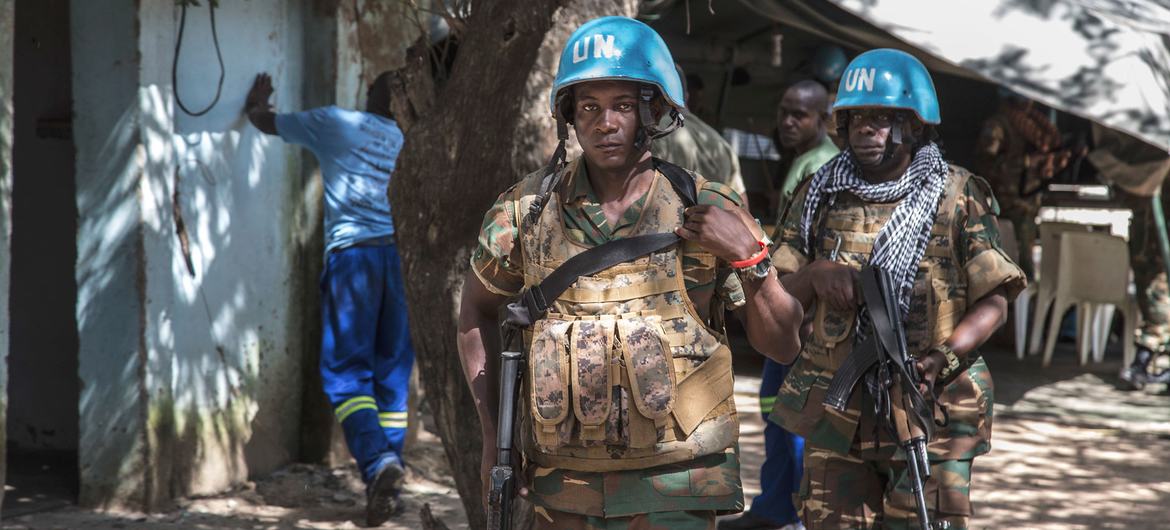
UN peacekeepers patrol Bouar, in western Central African Republic.
© MINUSCA
 
UN peacekeepers patrol Bouar, in western Central African Republic.

War and peace

Ms. Rugwabiza said the militia this month informed MINUSCA of its decision to declare a ceasefire, join the DDR process and promote social cohesion.

“These results once again illustrate the effectiveness of concerted efforts, even if much remains to be done, including with regard to strengthening the capacities of national security and defense institutions,” she said. 

Recent months have also seen the facilitation of the voluntary repatriation of former combatants from the Lord's Resistance Army (LRA) after more than 15 years in Upper Mbomo, where they presented a real and ongoing threat to civilians.

Similarly, she also welcomed an agreement signed in September between the CAR and South Sudan which should help boost coordinated response to cross-border threats.

The reporting period also saw an influx of refugees from Chad and war-torn Sudan, creating significant challenges and increasing humanitarian needs.

Critical shortfalls at MINUSCA

Turning to MINUSCA itself, Ms. Rugwabiza reported that the mission has been reconfiguring its security arrangements to optimize effectiveness. This includes reducing the number of operational temporary bases and improving living and working conditions, particularly for staff deployed in remote areas.

“In order to preserve the values of the United Nations and maintain the trust of the population everywhere that we operate, MINUSCA will continue to strengthen prevention and risk management of risks of sexual exploitation and abuse by working with the country team at the United Nations in order to assist victims that have been identified,” she said.

Increased surveillance has resulted in a reduction of new cases reported this year, and efforts will be increased in line with the UN’s zero-tolerance policy for sexual exploitation and abuse, she added.

MINUSCA also faces critical gaps in air and land transport capacity, and in supply chain, inhibiting mobility. The situation is affecting the well-being, safety and security of peacekeepers, and also operational response.

For example, convoys can take up to several weeks just to travel from the capital to the northeast. Furthermore, most roads are impassable during the rainy season, which lasts seven months.

Ms. Rugabizwa said MINUSCA is planning to implement recommendations made in a recent global assessment of logistical capacity “if we are given the budget”, appealing to the Council for support.

She also paid tribute to the sacrifice of UN peacekeepers serving at the Mission, noting that three ‘blue helmets’ have been killed in “land transport accidents” this month alone. 


https://news.un.org/en/story/2023/10/1142857

https://creativecommons.org/licenses/by/3.0/legalcode

пятница, 11 августа 2023 г.

Chair of Security Council Sanctions Committee concerning Central African Republic Briefs on His Visit to Central African Republic from 6 to 9 June 2023

SC/15382

Chair of Security Council Sanctions Committee concerning Central African Republic Briefs on His Visit to Central African Republic from 6 to 9 June 2023

On 24 July 2023, the Security Council Committee established pursuant to resolution 2127 (2013) concerning the Central African Republic heard a briefing from Harold Adlai Agyeman, Chair of the Committee, in connection with the report of his visit to the Central African Republic from 6 to 9 June 2023.

During the briefing, the Chair expressed the view that the visit had allowed his delegation to continue discussions with the Central African Republic authorities on many issues of importance to both the Government and the Committee.  These included discussions on the arms embargo; the revitalization or establishment of mixed/joint bilateral commissions; views of armed groups concerning the implementation of the peace agreement; implementation of individual sanctions measures (asset freeze and travel ban); the expansion of zones certified as compliant by the Kimberley Process; and the humanitarian context.  The Chair had expressed his intention to counterparts in the Central African Republic that after his visit, both himself and his delegation would take note of the issues raised during the renewal of the sanctions regime concerning the Central African Republic.  Following the visit, on 27 July 2023, the Security Council adopted resolution 2693 (2023), which principally no longer requires the Government of the Central African Republic to submit notifications to the Committee to obtain weapons.

Members of the Committee expressed appreciation for the Chair’s briefing as well as the report of his visit.


https://press.un.org/en/2023/sc15382.doc.htm

https://creativecommons.org/licenses/by/3.0/legalcode

вторник, 11 июля 2023 г.

UN chief condemns deadly attack on peacekeepers in Central African Republic


UN peacekeepers patrol a town in northeastern Central African Republic (file photo).
MINUSCA/Hervé Serefio
 
UN peacekeepers patrol a town in northeastern Central African Republic (file photo).
11 July 2023
Peace and Security

The UN Secretary-General has strongly condemned an attack on a UN peacekeeping patrol in the northeast Central African Republic (CAR) on Monday which left one Rwandan ‘blue helmet’ dead. 

The attack by unknown assailants on the patrol from the MINUSCA mission occurred just a few kilometres from the town of Sam Ouandia.

The mission has immediately opened an investigation into the exact circumstances, said a statement issued by the UN Spokesperson for António Guterres on Tuesday.

Tweet URL

“The Secretary-General expresses his deepest condolences to the family of the fallen peacekeeper and to the people and government of the Republic of Rwanda”, it continued. 

Possible war crime

The UN chief recalled that attacks targeting peacekeepers “may constitute war crimes under international law. He calls on the Central African Republic authorities to spare no effort in identifying the perpetrators of this attack and bring them to justice swiftly.” 

MINUSCA was deployed in 2014 to help end intercommunal violence that erupted a year earlier when mainly Muslim militants ousted the then president, prompting reprisals from mostly Christian militias.

The Secretary-General reaffirmed the solidarity of the UN with the people and Government of CAR.

Security Council pays tribute

The members of the Security Council joined Mr. Guterres in condemning the attack and paid tribute “to all peacekeepers who risk their lives.”

They urged the Government to investigate the killing with the support of MINUSCA, “promote accountability for such acts by bringing perpetrators to justice and keep the relevant troop-contributing country informed of the progress consistent with Security Council resolutions 2518 (2020) and 2589 (2021).”

Ambassadors underlined that attacks targeting peacekeepers may constitute war crimes under international law. They stressed that being involved in planning, directing, sponsoring or conducting attacks against peacekeepers constitutes a basis for sanctions.

They stressed the importance of MINUSCA being able to fulfil its mandate and fully equip peacekeepers to carry out their duties in safety and security.

Council members reiterated their “strong support” for the Special Representative of the Secretary-General and MINUISCA head, Valentine Rugwabiza, and for the mission to assist CAR authorities and all citizens there in their efforts to bring lasting peace and stability, as mandated by the Security Council. 


 https://news.un.org/en/story/2023/07/1138587

https://creativecommons.org/licenses/by/3.0/legalcode

пятница, 9 июня 2023 г.

Central African Republic: Tanzanian peacekeepers to be repatriated following abuse allegations


Tanzanians and other MINUSCA peacekeepers on patrol in north-west Central African Republic.
MINUSCA/Leonel Grothe
 
Tanzanians and other MINUSCA peacekeepers on patrol in north-west Central African Republic.

9 June 2023


The UN on Friday announced that following serious allegations of sexual exploitation and abuse, an entire unit of 60 peacekeepers from Tanzania formerly based in the western part of the Central African Republic (CAR), is to be repatriated.

UN Spokesperson Stéphane Dujarric told correspondents that the decision to send the unit home had been made by the Secretariat in New York, following consultations with the peacekeeping mission in CAR, MINUSCA.

‘Credible evidence’

“The decision comes after a preliminary investigation which found credible evidence that 11 members of the unit had allegedly engaged in sexual exploitation and abuse of four victims”, Mr. Dujarric said.

In a statement, MINUSCA said that a rapid response team had been “immediately deployed” to assess the allegations.

Responding on Twitter to the news, UN Peacekeeping chief Jean-Pierre Lacroix, said that the scourge has no place in any part of his department, adding that the upcoming repatriation “is a robust measure taken to protect victims and demonstrate our resolve to swiftly address these wrongs with the troop-contributing country.”

Tweet URL

Victims provided care and support

“The identified victims are being provided with care and support by the Mission’s humanitarian partners. The Mission has also deployed a team to further engage with the community”, he added.

The Spokesperson said the Tanzanian Government had already been formally notified of the decision, and have themselves deployed a national investigation team to CAR.

Tanzania pledges action

“In reaffirming their commitment to zero tolerance for sexual exploitation and abuse, the Tanzanian authorities noted the seriousness of the allegations and have committed to taking the necessary action to address these matters.”

Mr. Dujarric added that the unit had been relocated away from the area where the alleged abuse took place are are now confined to barracks “in order to protect victims as well of course, as the integrity of the investigation. The unit will be repatriated once their presence is no longer required in theatre by the investigators.”

Zero tolerance

He noted that the Secretariat’s decision was in accordance with Security Council resolution 2272, which provides clear support for decisions made by the UN Secretary-General to repatriate peacekeeping personnel, of “a particular military unit or formed police unit of a contingent, when there is credible evidence of widespread or systemic sexual exploitation and abuse by that unit.”

The UN chief António Guterres announced a firm and robust policy early in his tenure of ‘zero tolerance’ towards sexual abuse by UN personnel, calling on Member States to sign a voluntary compact on preventing and addressing the scourge, in 2017.

Mr. Dujarric stressed that the UN remains committed to “robustly implementing” the zero tolerance policy at all levels.


 https://news.un.org/en/story/2023/06/1137527

https://creativecommons.org/licenses/by/3.0/legalcode