вторник, 3 июня 2025 г.

Germany’s Annalena Baerbock elected President of the 80th General Assembly


Annalena Baerbock, President-elect of the General Assembly at its eightieth session addresses delegations after her election.
UN Photo/Manuel Elías
 
Annalena Baerbock, President-elect of the General Assembly at its eightieth session addresses delegations after her election.


By Vibhu Mishra
2 June 2025 
UN Affairs

Former German foreign minister Annalena Baerbock was elected President of the General Assembly’s 80th session on Monday. Her appointment comes as the regional group that includes Western Europe takes its turn at the helm of the world body.

She assumes the role at a challenging time, with ongoing conflicts, faltering development goals, mounting financial pressures, and the upcoming selection of the next Secretary-General.

Ms. Baerbock received 167 votes following the secret ballot. Write-in candidate Helga Schmid (also from Germany) received seven. Fourteen delegations abstained.

She becomes the first woman from the Western European group to hold the post and the fifth woman overall to lead the General Assembly. The presidency rotates among the world body’s five regional groups.

At 44 years, Ms. Baerbock is also one of the youngest leaders to secure the top job.

Tweet URL

Crucial juncture

Ms. Baerbock’s election comes at a critical juncture for the multilateral system, spearheaded by the United Nations.

With the Security Council deadlocked – especially on moves to help end the wars in Ukraine and Gaza – the Assembly has become a vital forum for diplomatic engagement and consensus-building, even without binding authority on peace and security issues.

As conflicts rage, the Assembly has passed a series of resolutions calling for ceasefires, humanitarian access and the protection of civilians.

Many now see the Assembly as an essential platform for accountability and maintaining international focus on intractable crises, especially through the “Veto Initiative” adopted in 2022 which ensures that issues blocked by permanent members on the Security Council are debated in the Assembly as a priority.

A power wielded by the five permanent members – China, France, Russia, the United Kingdom, and the United States – a veto (or negative vote) can block Council action even when all other members support a motion.

Pledge to be an honest broker

In her acceptance speech, President-elect Baerbock acknowledged the current global challenges and pledged to serve as “an honest broker and a unifier” for all 193 Member States, emphasising her theme of “Better Together.”

She outlined three priorities for her presidency: making the Organization more efficient and effective; advancing the 2030 Agenda for Sustainable Development; and making the Assembly a “truly inclusive forum”.

She called for a UN “that embraces everyone. I see the diversity of the General Assembly as our strength. This is the place where all nations come together and where every country has a seat and a voice.”

She also highlighted the importance of promoting gender equality, multilingualism, and engagement with civil society and youth.

UN Video | Annalena Baerbock elected to lead 80th session of the UN General Assembly

UN80 initiative

Ms. Baerbock also touched on the UN80 initiative, which was launched by Secretary-General António Guterres in March.

“The UN80 Initiative should not be a mere cost-cutting exercise,” she said, stressing the need for bold ambition and readiness to take difficult decisions.

“Our common goal is a strong, focused, nimble and fit-for-purpose organization. One that is capable of realising its core objectives – we need a United Nations that delivers on peace, development and justice.”

A career defined by multilateralism

In congratulating Ms. Baerbock, current President Philemon Yang described her as a leader defined by “an unwavering commitment to multilateralism”, praising her “Better Together” vision.

Mr. Yang, who steered the Assembly through a year marked by the Summit of the Future and persistent global crises, expressed confidence in her ability to build trust and foster dialogue across divides.

Secretary-General António Guterres said Mr. Yang’s successor was taking the gavel amid a “difficult and uncertain moment for the multilateral system,” noting she was only the fifth woman to lead the body.

The UN chief warned that “conflicts, climate catastrophe, poverty and inequality continue to challenge the human family,” and called on the Assembly to unite in forging common solutions.
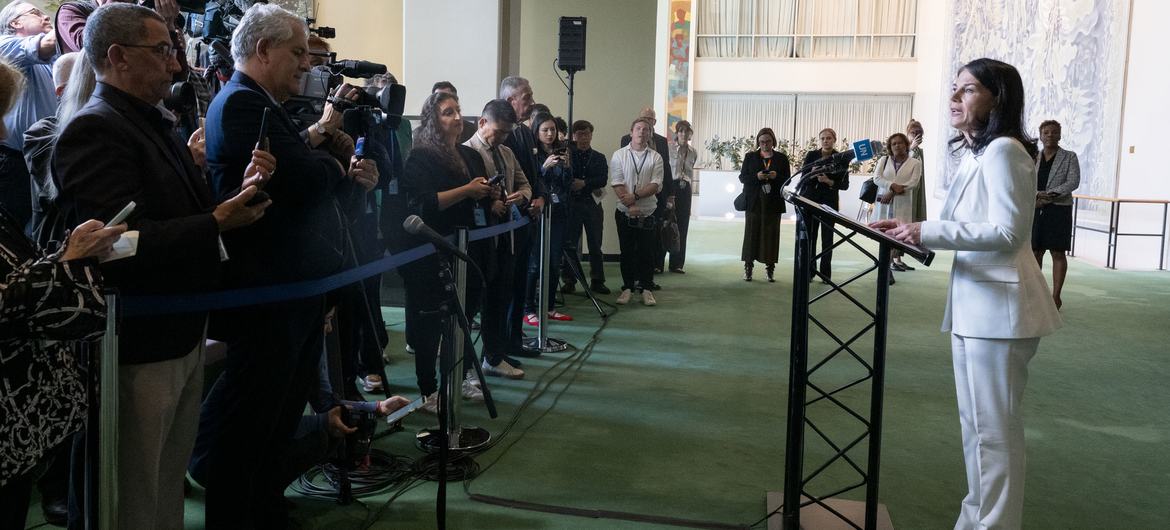
Annalena Baerbock, President-elect of the eightieth session of the UN General Assembly, speaks to the media following her election.
UN Photo/Eskinder Debebe
 
Annalena Baerbock, President-elect of the eightieth session of the UN General Assembly, speaks to the media following her election.

The world parliament

The General Assembly remains the UN’s most representative body, where each Member State has an equal voice – and an equal say in decisions.

While its resolutions are non-binding, the GA – as the acronym goes in New York – helps define global diplomatic norms, convenes dialogues on worldwide challenges and holds the Security Council to account.

The 80th session, starting 9 September, is expected to be pivotal – not only for sheer number and intensity of crises ongoing – but for advancing long-term reforms, including the UN80 initiative and the selection of the next Secretary-General before his term ends in 2026.


https://news.un.org/en/story/2025/06/1163936


https://creativecommons.org/licenses/by/4.0/legalcode

воскресенье, 18 мая 2025 г.

At Arab League Summit, Guterres reiterates call for Gaza ceasefire


17 May 2025
 Peace and Security

The UN Secretary-General renewed his call for a ceasefire in the Gaza Strip and upheld the need for a two-State solution between Israelis and Palestinians in a speech on Saturday to the League of Arab States Summit in Baghdad.

António Guterres told leaders meeting in the Iraqi capital that “the region and the world face trials and tests on all fronts,” starting with the situation in Gaza.

He reiterated that neither the atrocious 7 October 2023 terror attacks by Hamas nor the collective punishment of the Palestinian people can be justified.

Permanent ceasefire now
“We need a permanent ceasefire, now. The unconditional release of all hostages, now. And the free flow of humanitarian aid ending the blockade, now,” he said.

The Secretary-General expressed alarm over reports that Israel plans to expand ground operations in Gaza and stressed that the UN “will not participate in any so-called aid operation that does not adhere to international law and the humanitarian principles of humanity, impartiality, independence and neutrality.”

He again called for full support for UN Palestine refugee agency UNRWA, including funding.  

Two-State solution at risk
The UN chief rejected the repeated displacement of the Gaza population, as well as any suggestion of forced displacement outside Gaza, and urged leaders to remain focused on the terrible situation in the occupied West Bank.

“Let’s be clear,” he said. “Annexation is illegal. Settlements are illegal. Only a two-State solution can deliver sustainable peace.”

He said the high-level conference in June, co-chaired by France and Saudi Arabia, is an important opportunity.

“The world, the region – and, most of all, the people of Palestine and Israel – cannot afford to watch the two-State solution disappear before our eyes,” he said.

Respect Lebanese sovereignty
The Secretary-General addressed the situation in Lebanon. He emphasized that the country’s sovereignty and territorial integrity must be respected, and the Government must have full control over the entire territory.

He was encouraged by continued progress on reforms as well as efforts to deploy the Lebanese Armed Forces to the south, with support from the UN Mission in the country, UNIFIL.

Mr. Guterres touched on Syria, saying sovereignty, independence, unity and territorial integrity are critical. He urged strong support for an inclusive Syrian-led and Syrian-owned political process that safeguards the rights and participation of all the country’s people and ensures their protection.

Regarding Yemen, he noted that attacks by Houthi rebels in the Red Sea have caused significant damage to regional and local economies. He welcomed the cessation of hostilities between the Houthis and the United States, announced by Oman on 6 May.

The Secretary-General also called for the release of UN staff and other personnel in Yemen who have been arbitrarily arrested.

Engagement on Sudan
In Sudan, renewed and coordinated multilateral engagement is crucial to help stem appalling violence, famine, and mass displacement, he said, and thanked the Arab League and African Union (AU) for the excellent coordination meeting convened the previous day. He also commended the Arab League’s efforts to strengthen multilateral coordination.

The Secretary-General turned next to Somalia, saying unity and inclusive dialogue are imperative. Furthermore, assistance from Somalia’s partners will be essential in the fight against Al-Shabaab militants and to strengthen peace and security.

For this reason, Mr. Guterres said he has put forward a recommendation to the UN Security Council to enable predictable and sustainable financing for the AU Support and Stabilization Mission in the country.

Meanwhile in Libya, the UN is also actively engaging in efforts to end the confrontation between armed groups, to preserve the independence of key oversight institutions, to address obstacles preventing national elections, and set the course for long-term stability and prosperity in line with the people’s needs and aspirations.

Lessons from Baghdad
The Secretary-General concluded his remarks by commending the progress Iraq has made over since the restoration of sovereignty in 2004, such as strengthening institutions, resolving outstanding disputes through dialogue, and promoting sustainable development as well as human rights.

He said the UN Assistance Mission in Iraq (UNAMI) has accompanied the country on this path and is working to ensure the successful delivery of its residual mandate and an orderly drawdown by the end of the year.

“Despite the enormous challenges, let us draw lessons and hope from here in Baghdad. Working in unity and solidarity, we can help resolve conflicts and build a future of peace and prosperity," he said.

Gaza situation ‘beyond inhumane’
Speaking later to reporters, Mr. Guterres said the situation for Palestinians in Gaza “is beyond description, beyond atrocious and beyond inhumane.”

Since 2 March, Israel has banned the entry of cargo into the Strip, including aid and other life-saving supplies. UN agencies continue to warn that the entire population, 2.1 million people, is at risk of famine and one if five faces starvation.

“A policy of siege and starvation makes a mockery of international law,” he said, calling for the blockade to end immediatelyor Gaza ceasefire.

https://news.un.org/en/story/2025/05/1163381?_gl=1*na65*_ga*MjE0NDk0OTQ1NS4xNzQ3NTQ5MzQ1*_ga_TK9BQL5X7Z*czE3NDc1NDkzNDQkbzEkZzEkdDE3NDc1NDk0NDEkajAkbDAkaDA.*_ga_SCSJZ3XC0L*czE3NDc1NDkzNDQkbzEkZzEkdDE3NDc1NDk0NDEkajAkbDAkaDA.


https://creativecommons.org/licenses/by/4.0/legalcode

четверг, 15 мая 2025 г.

In Berlin, broad backing for UN peacekeeping as global threats mount


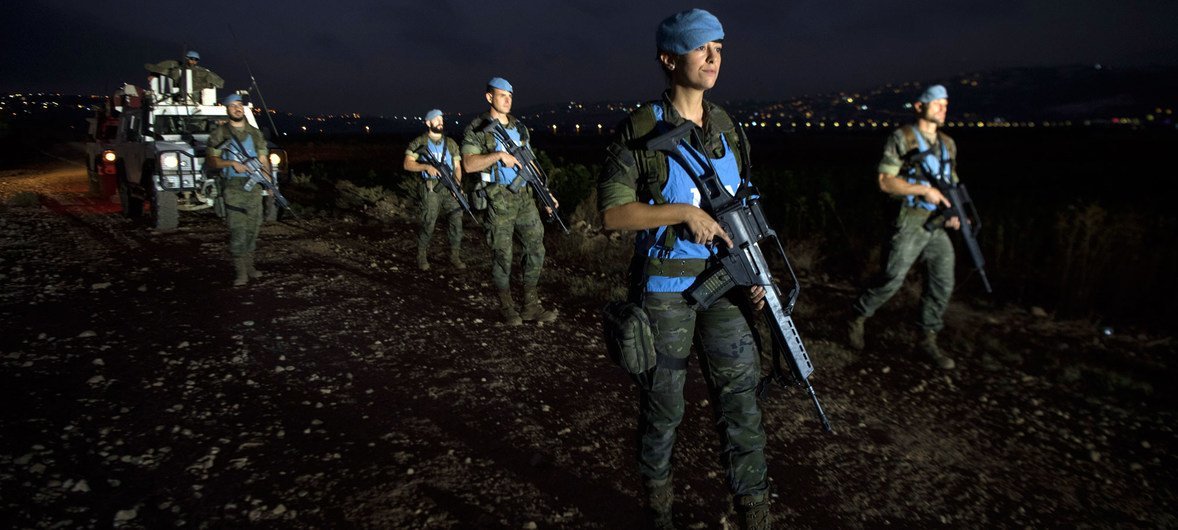
UN peacekeepers conduct a foot patrol along the Blue Line in southern Lebanon.
UNIFIL/Pasqual Gorriz
 
UN peacekeepers conduct a foot patrol along the Blue Line in southern Lebanon.


By Vibhu Mishra
14 May 2025 

Peace and Security

More than 130 countries and international partners threw their weight behind UN peacekeeping at a high-level ministerial summit in Berlin on Wednesday, pledging military, tech and political support.

UN Secretary-General António Guterres meanwhile warned that peace operations are under growing strain and must adapt to meet today’s rising threats.

The two-day conference on peacekeeping, hosted by the Government of Germany, brought together over 1,000 participants – including defence and foreign ministers – to reaffirm commitment to the UN’s flagship tool for maintaining peace and stability.

Tweet URL

It concluded on Wednesday with a wide array of pledges, including 88 military and police units, specialized training, and investments in emerging technologies and strategic communications.

Difference between life and death

“In trouble spots around the world, ‘blue helmets’ can mean the difference between life and death,” Mr. Guterres said in his opening remarks.

“Now more than ever, the world needs the United Nations. And the United Nations needs peacekeeping that is fully equipped for today’s realities and tomorrow’s challenges.”

Germany, which currently contributes troops to UN missions in South Sudan, Lebanon, and Western Sahara, announced €82 million (around $91.7 million) in funding, along with commitments in training, renewable energy solutions and drone technology.

“Germany continues to be a steadfast supporter of UN peacekeeping,” said Defense Minister Boris Pistorius.

Broad and diverse commitments

A total of 74 UN Member States made specific pledges, ranging from uniformed personnel to training and strategic support.

This includes pledges which will bolster military and police units, including airlift and rapid deployment capabilities (53 national contributions), specialized training (59), technological enhancements (18), advancing the Women, Peace and Security Agenda (38) and safety and protection (16).

Eleven countries also committed to improving accountability and conduct, including support to the trust fund for victims of sexual exploitation and abuse, and eight nations supporting the UN’s efforts to counter mis- and disinformation through strategic communications.

Deminers with the UN peacekeeping mission in Mali, MINUSMA, clearing an airstrip in Kidal region. (file photo)
UN Photo/Marco Dormino
 
Deminers with the UN peacekeeping mission in Mali, MINUSMA, clearing an airstrip in Kidal region. (file photo)

Mounting pressures

At a press conference following the meeting, Secretary-General Guterres acknowledged that peacekeepers operate in an increasingly complex and dangerous environment, citing a record number of global conflicts, the targeting of peacekeepers by drones and improvised explosive devices (IEDs) and the rising threat from disinformation campaigns.

“We need to ask some tough questions about the mandates guiding these operations, and what the outcomes and solutions should look like,” he said, speaking alongside German Foreign Minister Johann Wadephul and Defence Minister Pistorius.

“Every context is different, and missions must be adapted accordingly.”

The UN chief also stressed the importance of sustained financial backing, highlighting that many missions continue to struggle with cash flow shortages due to delayed payments from Member States.

“It is absolutely essential that all Member States respect their financial obligations, paying their contributions in full and on time,” he said.

Crucial reforms

The Berlin meeting feeds into the UN’s broader reform efforts, including an ongoing Review of Peace Operations announced in last year’s Pact for the Future, aimed at making peacekeeping and peace enforcement more flexible, cost-effective, and aligned with real-world needs.

This year’s Ministerial also coincides with the 80th anniversary of the United Nations and the 10-year anniversary of the 2015 New York Summit on Peacekeeping. It follows similar high-level meetings in Accra, Seoul, Vancouver and London.

Peacekeeping remains one of the UN’s most visible activities, with over 61,000 uniformed personnel from 119 countries currently deployed across 11 missions, supported by more than 7,000 civilian staff.


https://creativecommons.org/licenses/by/4.0/legalcode

https://news.un.org//en/story/2025/05/1163246

вторник, 13 мая 2025 г.

UN chief calls for major reforms to cut costs and improve efficiency


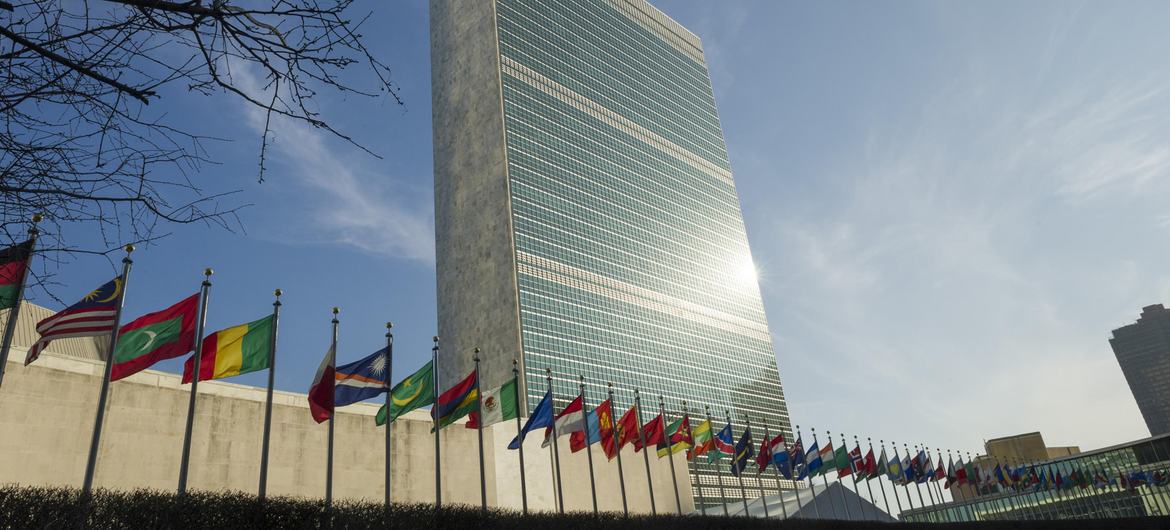
The Secretariat Building at United Nations Headquarters, in New York.
UN Photo/Rick Bajornas
 
The Secretariat Building at United Nations Headquarters, in New York.


By Vibhu Mishra
12 May 2025

 UN Affairs

Amid financial strain and growing global challenges, UN Secretary-General António Guterres is pushing for wide-ranging structural reforms to enhance the world body’s effectiveness.

Briefing Member States in New York on Monday Mr. Guterres outlined wide-ranging effort to revamp how the UN system operates – cutting costs, streamlining operations, and modernizing its approach to peace and security, development and human rights.

“These are times of peril,” he said, “but they are also times of profound opportunity and obligation. The mission of the United Nations is more urgent than ever.”

Three main objectives

Launched in March, the UN80 Initiative centres on three priorities: enhancing operational efficiency, assessing how mandates – or key tasks – from Member States are implemented, and exploring structural reforms across the UN system.

The conclusions will be reflected in revised estimates for the 2026 budget in September this year, with additional changes that require more detailed analysis presented in 2027.

‘Meaningful’ budget reductions

Mr. Guterres said the changes are expected to yield “meaningful reductions” in the overall budget. For example, the departments for political and peacekeeping affairs could see a 20 per cent reduction in staff by eliminating duplication.

This level of reduction, he said, could serve as a benchmark across the UN system – while also considering unique factors for each department.

Additional examples include consolidating all counter-terrorism work within the main Office of Counter-Terrorism (UNOCT), ending building leases and relocating posts away from expensive “duty stations” where cost of living is high.

“There might be immediate, one-off costs involved in relocating staff and providing potential termination packages,” he said, “but by moving posts from high-cost locations, we can reduce our commercial footprint in those cities and reduce our post and non-post costs.”

UN Secretary-General António Guterres briefs on the UN80 Initiative.

Efficiencies and upgrades

The first workstream focuses on efficiencies and improvements, developing a new model that improves consolidation, looks at centralising services, relocating to cheaper locations, and expanding the use of automation and digital platforms.

Mr. Guterres said departments the UN’s headquarters in New York and Geneva have been asked to review whether some teams can be relocated to lower-cost duty stations, reduced or abolished.

Reviewing mandates

The second workstream involves a review of how existing mandates are being carried out – not the mandates themselves, which are the purview of Member States only.

A preliminary review identified more than 3,600 unique mandates for the Secretariat alone. A full and more detailed analysis is now underway.

Mr. Guterres emphasised that the sheer number of mandates – and the bureaucracy needed to implement them – places a particular burden on smaller Member States with limited resources.

“Based on this work, Member States may wish to consider the opportunity to conduct themselves a review of the mandates,” he added.

Structural change

The third workstream – focused on structural reform – is already underway, Mr. Guterres said.

Nearly 50 initial submissions have already been received from senior UN officials, reflecting what Mr. Guterres described as “a high level of ambition and creativity.”

Key work areas have been identified for review. These include peace and security, development, human rights, humanitarian, training and research and specialised agencies.

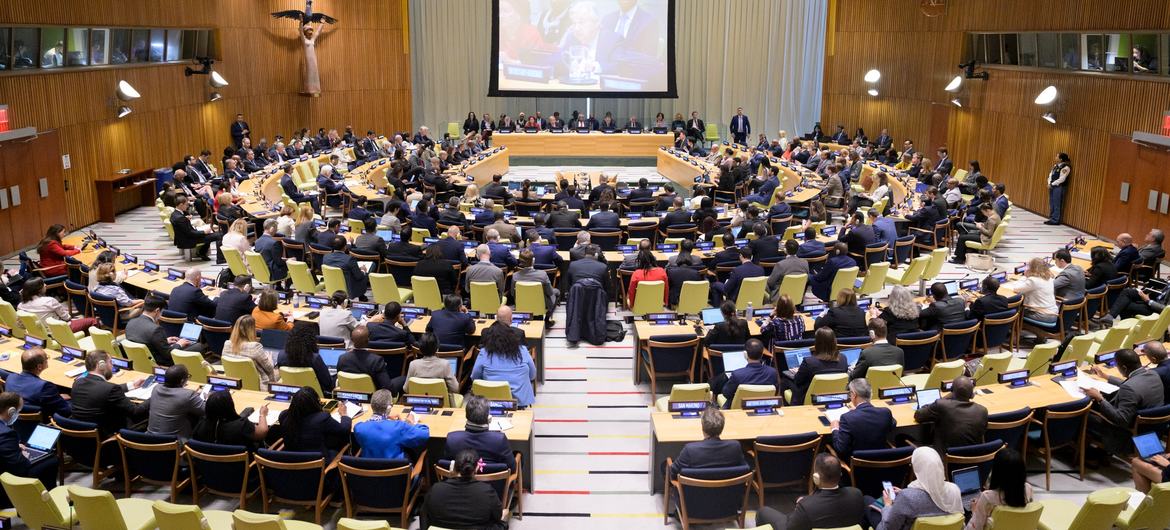
A wide view of the informal meeting of the General Assembly plenary that heard a briefing by the Secretary-General on the UN80 Initiative.
UN Photo/Manuel Elías
 
A wide view of the informal meeting of the General Assembly plenary that heard a briefing by the Secretary-General on the UN80 Initiative.

Not an answer to liquidity crisis

Mr. Guterres also touched on the UN dire cashflow situation, noting that the initiative “is not an answer” to the months-long liquidity crisis but by being more cost effective, it should help limit the impact.

“The liquidity crisis is caused by one simple fact – the arrears,” he said, adding that structural reform is not the answer to a fundamental failure by some Member States to pay what they owe on time to meet running costs.

Unpaid dues

According to information provided by the UN Controller to the General Assembly’s Fifth Committee (Administrative and Budgetary), only $1.8 billion has been received against the $3.5 billion regular budget assessments for 2025 – a shortfall of around 50 per cent.

As of 30 April, unpaid assessments stood at $2.4 billion, with the United States owing about $1.5 billion, China ($597 million),  Saudi Arabia ($42 million), Mexico ($38 million), and Venezuela ($38 million). An additional $137 million is yet to be paid by other Member States.

For the peacekeeping budget (which runs on a July-June cycle), including prior-period arrears, the unpaid amount totals $2.7 billion. For the International Tribunals, total contribution outstanding was $79 million as of 30 April.

Close consultation

The Secretary-General told Member States he would be consulting with them  closely and regularly on the cash crisis and needed reforms, seeking guidance  and presenting concrete proposals for countries to act on.

UN staff members and their representatives are being consulted and listened to, he added: “Our concern is to be humane and professional in dealing with any aspect of the required restructuring.”

In conclusion, he highlighted that the UN80 Initiative is a “significant opportunity” to strengthen the UN system and deliver for those who depend on it.

In response to the suggestion that the UN should focus on just the one key pillar of peace and security, he said it would be wrong to ditch development and human rights – all three are essential he underscored.

“Let us seize this momentum with urgency and determination, and work together to build the strongest and most effective United Nations for today and tomorrow.”


https://news.un.org/en/story/2025/05/1163151

https://creativecommons.org/licenses/by/4.0/legalcode

среда, 7 мая 2025 г.

UN Secretary-General urges military restraint from India, Pakistan


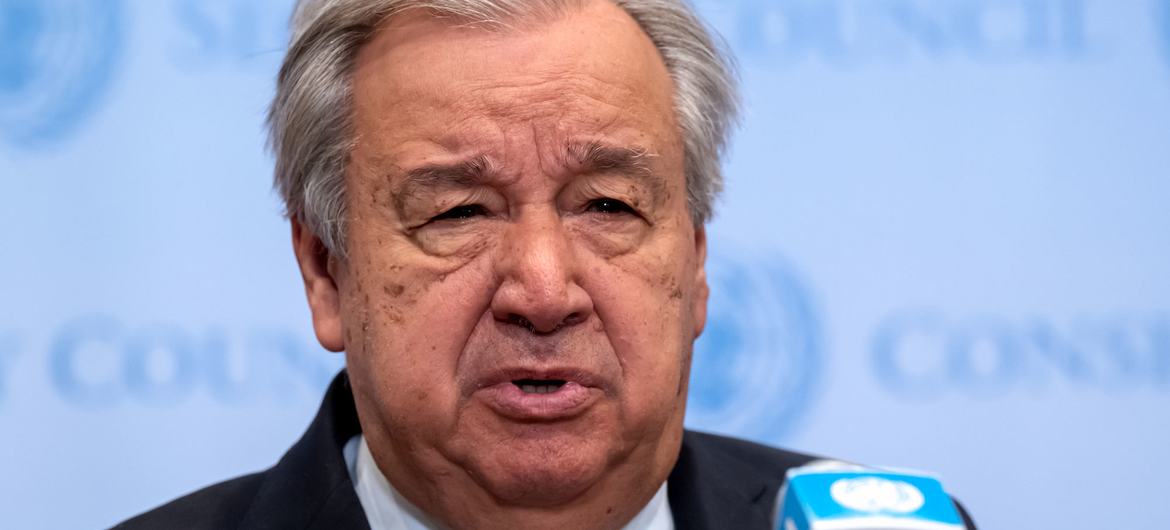
UN Secretary-General António Guterres. (file photo)
UN Photo/Mark Garten
 
UN Secretary-General António Guterres. (file photo)


6 May 2025
 Peace and Security

The UN chief has expressed deep concern over Indian military operations across the Line of Control and the international border with Pakistan.

In a note to correspondents issued by his spokesperson on Tuesday, Secretary-General António Guterres called for military restraint from both countries.

“The world cannot afford a military confrontation between India and Pakistan,” the note said.

On Monday, the Secretary-General had warned that the tensions between the two South Asian neighbours had reached “their highest in years.”

He offered his good offices to both governments to help defuse tensions and promote diplomacy, stressing that “a military solution is no solution.”

Speaking to the media on Monday, Mr. Guterres condemned the 22 April terror attack in the Pahalgam area of Jammu and Kashmir, which left at least 26 civilians dead and many more injured.

“Targeting civilians is unacceptable – and those responsible must be brought to justice through credible and lawful means,” he said.


https://news.un.org/en/story/2025/05/1162986


https://creativecommons.org/licenses/by/4.0/legalcode

понедельник, 5 мая 2025 г.

‘Step back from the brink’, Guterres urges India and Pakistan | UN News


5 May 2025

 Peace and Security

UN Secretary-General António Guterres on Monday called for “maximum restraint” from India and Pakistan, warning that escalating tensions over a recent deadly terror attack in Kashmir risk spiralling into outright military confrontation.

Addressing journalists outside the Security Council at UN Headquarters in New York, Mr. Guterres expressed deep concern over deteriorating relations between the two South Asian neighbours, saying they had reached “their highest in years.”

He reiterated his condemnation of the 22 April terror attack in the Pahalgam area of Jammu and Kashmir, which killed at least 26 civilians and injured many more.

“Targeting civilians is unacceptable – and those responsible must be brought to justice through credible and lawful means,” Mr. Guterres said.

“It is also essential – especially at this critical hour – to avoid a military confrontation that could easily spin out of control.”

India and Pakistan both administer parts of Kashmir but claim the territory in full.

The Security Council is due to meet behind closed doors later on Monday to discuss the rising tensions between the two nations.

UN ready to help de-escalate
He offered his good offices to both governments to help defuse tensions and promote diplomacy, stressing that “a military solution is no solution.”

“Now is the time for maximum restraint and stepping back from the brink,” he said.

Mr. Guterres also praised both countries for their long-standing contributions to UN peacekeeping operations and expressed hope that their shared history of cooperation could form the basis for renewed dialogue.

“The United Nations stands ready to support any initiative that promotes de-escalation, diplomacy, and a renewed commitment to peace,” he said.


https://news.un.org/en/story/2025/05/1162901


https://creativecommons.org/licenses/by/4.0/legalcode

пятница, 2 мая 2025 г.

Press Conference by Security Council President on Programme of Work for May


The Security Council will convene its signature event of the month on 20 May — an open high-level debate on maritime security, held under the overarching theme of maintaining international peace and security, the Council’s President for May announced today at a United Nations Headquarters press conference.

Evangelos C. Sekeris of Greece, whose country holds the rotating presidency of the 15-member organ this month, told reporters that the event — titled “Strengthening Maritime Security through International Cooperation for Global Security” — will be chaired by Greece Prime Minister Kyriakos Mitsotakis.  UN Secretary-General António Guterres will serve as the main briefer, and the President of the Board of Directors of the Union of Greek Shipowners will also address the Council.

Greece has “elevated” the representation to the highest political level to highlight the strong interest Athens places on this critical issue — as a UN Member State, a maritime nation and “home to one of the world’s largest merchant fleets”, Mr. Sekeris said.

He emphasized that many Member States recognize the critical importance of maritime security, particularly the need to protect freedom of navigation, secure global supply chains and raise awareness of the complexities and gravity of maritime threats.

Looking ahead, the Council will also hold its annual open debate on the protection of civilians in armed conflict on 22 May, which will be elevated to ministerial level and chaired by the Minster for Foreign Affairs of Greece, Giorgos Gerapetritis.  Several senior UN officials and a representative of civil society are expected to brief the organ.  He said Greece during its Council presidency will aim to highlight the vital role of this annual debate in safeguarding women, children and other vulnerable populations during armed conflict.

He noted various other highlights on the calendar.  On 6 May, the Council will convene its semi-annual debate on the situation in Bosnia and Herzegovina; on 14 May, it will hold its monthly briefing on the situation in Yemen, followed by a briefing on Libya on 16 May by Karim Khan, Prosecutor of the International Criminal Court.

On 21 May, under Greece’s presidency, the Council will conduct its monthly open briefing on the situation in Syria, he continued.  On 27 May, the organ will hold elections to appoint a new judge to the International Court of Justice.  Finally, on 28 May, the Council will hold its monthly briefing on the situation in the Middle East, with a focus on the Palestinian question.

When asked by reporter about whether the Council is considering meeting on the situation in South Asia, he said that the organ is seized of the matter.  “It is an issue that is ongoing and evolving,” he added, recalling that the Council had recently released a statement condemning the attack in Jammu and Kashmir. He expressed concern for the growing tensions between India and Pakistan.  If the situation does not de-escalate, the Council can certainly meet on the issue.

Asked whether it will add any meeting on non-proliferation “hotspots”, given that “there is a lot going on” with Iran, Ukraine and the Democratic People’s Republic of Korea, he said that, while there is no mandated meeting, “we can expect” for something to come up to fill up one of the empty slots.

.

Asked why Greece is not calling for an emergency meeting on Gaza, he said that there is the 28 May meeting, but “of course there will be meetings asked [for] before”.  “We have a position of principle and attach importance to addressing the humanitarian situation in Gaza,” he said, also calling for the release of all hostages. He also expressed hope for the upcoming international conference on the matter co-organized by Saudi Arabia and France.

When asked to comment about the Panama and Suez Canal in connection to Greece’s maritime security debate to be held, he said that the Suez is being affected by the situation in the Red Sea “where we have had many attacks” by the Houthis.  He said that in the Panama case there are no maritime security issues.

Asked about the cross-border terrorism in South Asia and growing tensions between India and Pakistan, he said it is a very pertinent issue and strongly condemned any act of terrorism.  The size and volume of the growing tensions is very concerning, he added, reiterating calls for de-escalation and dialogue.  He said that Greece as President of the Council will follow the issue closely.

Asked about the developments in Syria, he said that he “is monitoring the first moves” of the new Government.  “There is some optimism, but it has to go step by step and we have to see it,” he added. Asked about the challenges faced by the United Nations Interim Force in Lebanon (UNIFIL), he said that the Council remains seized of the matter and will continue to support UN efforts in Lebanon. “I think the situation is improving and we can be a little more optimistic,” he added.

When asked about whether Greece will introduce the issue of migration into any of its debates, he said there is no specific discussion on migration on the Security Council agenda for now but certainly the issue will be discussed in country-specific discussions and debates.

For the full programme of work, please see


https://press.un.org/en/2025/250501_sc.doc.htm


https://creativecommons.org/licenses/by/4.0/legalcode