Describing a worsening humanitarian and security situation in Syria, amid an uptick in violence in the north-west of the country and with 90 per cent of Syrians living below the poverty line, senior United Nations officials called for the Humanitarian Response Plan to be fully funded and the cross-border aid mechanism to be renewed for another 12 months, as they briefed the Security Council today.
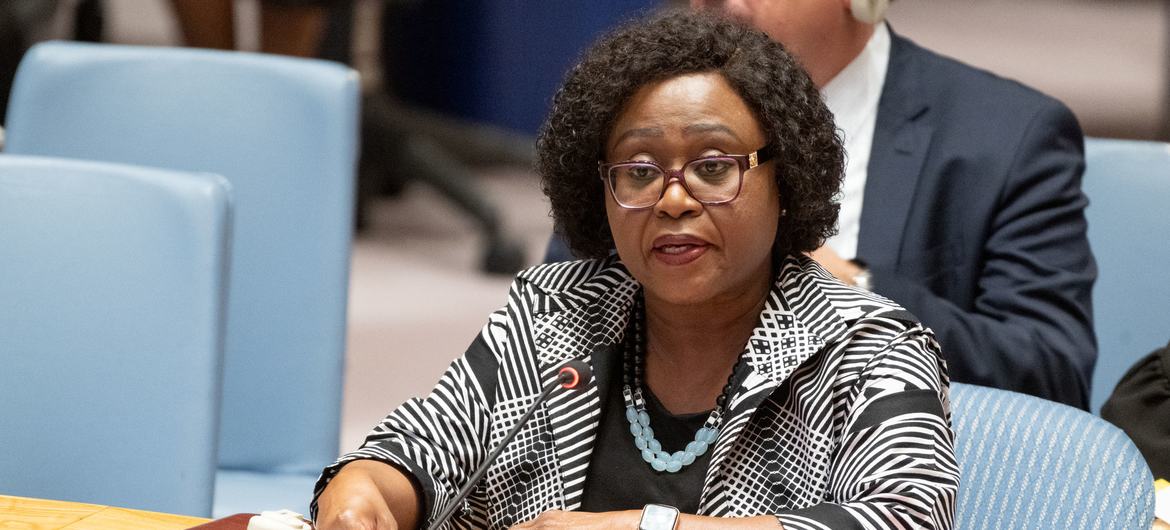
Najat Rochdi, Deputy Special Envoy of the Secretary-General for Syria, briefing the 15-nation organ, detailed the escalation in violence in the north-west and in the Idlib de-escalation zone, among other areas. Urging that humanitarian action be depoliticized, she also stressed the need for more resources and welcomed the pledges made at the Brussels Conference. Calling for access via all modalities, including cross-line and cross-border, she also spotlighted, ahead of the expiration of the Council’s cross-border resolution, the need for a 12-month extension.
Highlighting Special Envoy Geir O. Pedersen’s recent diplomatic efforts on numerous fronts, ranging from the Syrian Negotiations Commission in Geneva to his travels to Moscow to meet the Foreign Minister, as well as his attendance of high-level meetings in Astana with the Deputy Foreign Ministers of Iran, Russian Federation, Türkiye and the delegations of the Syrian Government and Syrian opposition, she said that these engagements made clear that “moving from intention to action requires genuine engagement, flexibility and commitments from more than just one group of actors”.
Martin Griffiths, Under-Secretary-General for Humanitarian Affairs and Emergency Relief Coordinator, briefing the Council on his trip to Damascus, said that, after 12 years of conflict and economic collapse, “the people of Syria are suffering more than we can truly appreciate”. Noting that 90 per cent of the population live below the poverty line, he pointed out that this year’s Humanitarian Response Plan, the largest in the world at $5.4 billion, is less than 12 per cent funded.
He, too, stressed the need to reauthorize the Council’s cross-border resolution, due to expire on 10 July, for an additional 12 months, adding that such an authorization reflects a pragmatic outlook on the current operation. The United Nations and its partners reach some 2.7 million of the most vulnerable men, women and children monthly with essential and life-saving assistance. The vast majority of this comes through the Security Council-authorized Bab al-Hawa border crossing, he said, adding that cross-line modalities cannot at present match the volume of desperately needed aid that comes cross-border.
In the ensuing discussion, Council members voiced concern about the recent escalation in violence and worsening humanitarian situation, with many calling for the cross-border aid mechanism, set forth in resolution 2672 (2023), to be renewed for 12 months, while others emphasized the urgent need for a ceasefire and for progress to be made on an inclusive political process to ensure lasting security and stability in the country.
Switzerland, speaking also for Brazil as co-penholders of the Syria humanitarian file, highlighted that 70 per cent of the population needs humanitarian aid and protection in every district of Syria. Voicing concern over the stark situation of children who are affected disproportionally by the crisis, she emphasized the need for a political solution, starting with a relaunching of the work of the Constitutional Committee.
The representative of the Russian Federation, addressing the upcoming cross-border mechanism authorization renewal, took issue with “hypocritical Western propaganda” that stresses that, without the renewal, millions of Syrians will starve and freeze, and there is no choice but to extend the scheme once again, thereby violating Syria’s sovereignty and territorial integrity. They know full well that there is an alternative: deliveries across the contact line provided for by resolution 2672 (2023), he said.
In a similar vein, China’s delegate said that the cross-border mechanism is an exceptional arrangement that should eventually be phased out in an orderly manner, with cross-line operations being the primary approach for humanitarian relief. Pointing out that some countries voiced concern over Syria’s humanitarian situation but continue to impose unilateral sanctions, worsening the country’s plight, he stressed: “Such self-contradictory and hypocritical behaviour is no different from pretending to be giving CPR to a patient without losing the chokehold on the patient’s throat.”
Meanwhile, the representative of the United States said that Moscow’s role in the recent upswing in violent attacks in Idlib is a grim reminder of its “long history of brutality against the Syrian people”. He also emphasized the urgent need for cross-border aid, adding that “the Assad regime” is making United Nations access unpredictable. The best option to provide certainty and flexibility for humanitarian operations is a 12-month extension of cross-border aid.
Nonetheless, Syria’s delegate, highlighting urgent measures taken by his country following the February earthquake, said it has provided approvals for and has facilitated United Nations efforts to address rising humanitarian needs. However, noting the lack of progress in providing such assistance to people who are difficult to reach across the border, he said that some hostile States, in coordination with their terrorist accomplices, have only allowed one convoy to pass.
He went on to excoriate the United States and European Union for the unilateral coercive measures imposed on his country, adding that the so-called exemptions they announced after the earthquake have not had any impact on the ground. Further, they also excluded Syria from the Brussels Conference, he said, calling on donors to uphold their commitments to the Humanitarian Response Plan and early recovery projects, and for the immediate and unconditional lifting of unilateral coercive.
The meeting began at 10:07 a.m. and ended at 12:21 p.m.
Briefings
NAJAT ROCHDI, Deputy Special Envoy of the Secretary-General for Syria, described recent air strikes in the north-west, including a strike on a market in that area that reportedly killed and wounded civilians, along with strikes by the Russian Federation in the Idlib de-escalation zone, and drone strikes from areas controlled by listed terrorist group Hayat Tahrir al-Sham, into Government-controlled areas. She also noted other concerning incidents, including reports of Turkish drone and artillery strikes on Syrian Democratic Forces and Syrian Government positions and civilian infrastructure; Syrian Democratic Forces shelling of Turkish positions; Israeli air strikes; and ongoing attacks by listed terrorist groups. In recent days, Geir O. Pedersen, Special Envoy of the Secretary-General for Syria called for restored and sustained calm with key actors in the Ceasefire Task Force.
As was stressed to the Humanitarian Task Force this week in Geneva, she said that the needs of Syrians must be prioritized and humanitarian action depoliticized, adding: “This means resources.” She welcomed the pledges made in the Brussels Conference and looked forward to swift disbursements. Calling for access via all modalities, including cross-line and cross-border, she spotlighted, ahead of the expiration of the Council’s cross-border resolution, the need for a 12-month extension. She underscored the need for sanctioning States to, in response to the earthquakes, step up efforts to counter overcompliance, noting that more children than in the past crossed combat lines to take exams over the past month, and adding that was “a welcome development which signals that all sides have it within themselves to depoliticize access to aid and services”.
Regarding the detained, disappeared and missing, she said that many look to today’s General Assembly vote with hope that a new entity dedicated to that issue could bring some measure of relief to families across Syria and outside of it. However, thousands of Syrians remained subject to arbitrary detention every day, she said, adding that these concerns had been aired by her colleagues in the latest meeting of the Astana Working Group. Millions of displaced Syrians, in the country and abroad, have seen no concrete shift in conditions for them to return voluntarily and in safety and in dignity. Recalling that many Syrians were among those drowned in the sinking of an overcrowded boat in the Mediterranean Sea, she said: This was “a tragic reminder to all of us of what hopelessness can bring”.
Giving an overview of Mr. Pedersen’s recent engagements with parties, including the Syrian Negotiations Commission in Geneva; senior American, British and European officials in Paris; and the foreign ministers of Jordan, Iraq, Lebanon and Egypt, to name a few, she highlighted his travels to Moscow to meet the Foreign Minister, as well as his attendance of high-level meetings in Astana, to meet with Deputy Foreign Ministers of Iran, Russian Federation, Türkiye and the delegations of the Syrian Government and Syrian opposition. Such engagements made clear that “moving from intention to action requires genuine engagement, flexibility and commitments from more than just one group of actors. Even modest steps to forge progress on the political track requires action from many different sides — each of whom has easy means to spoil if excluded. Syrians’ voices must be amplified in diplomatic efforts, including the Civil Society Support Room and the Women’s Advisory Board. While “diplomatic moves have yet to produce concrete results”, she emphasized that the opportunity is still there, and voiced hope that, in the coming weeks, the efforts of the Special Envoy can help build confidence towards the resumption of the intra-Syrian political process and implement Security Council resolution 2254 (2015).
MARTIN GRIFFITHS, Under-Secretary-General for Humanitarian Affairs and Emergency Relief Coordinator, reported that he had just returned yesterday from Damascus with a greater sense of the profound humanitarian challenges facing Syria. “The people of Syria are suffering more than we can truly appreciate,” he said. Twelve years of conflict, economic collapse and other factors have pushed 90 per cent of the population below the poverty line. This year’s Humanitarian Response Plan, the largest in the world at $5.4 billion, is less than 12 per cent funded. A deficit will force the World Food Programme (WFP) to slash its emergency food aid in Syria in July by 40 per cent. The United Nations Relief and Works Agency for Palestine Refugees in the Near East (UNRWA) only has funds for 18 per cent of its annual budget, the lowest since the crisis began in 2011. With donor support lagging behind soaring needs and operational costs, such pledges must swiftly turn into contributions to keep programmes running.
Any move towards a more sustainable response will require a fresh approach, one with longer timelines and fewer donor red lines, he continued. Young people can receive vocational training, but must also be mentored to turn these capacities into new incomes and livelihoods. Further, distinctions between a “rehabilitated school” and a “reconstructed school” can be relaxed to provide students with safe places to learn, he said, underscoring that stronger international consensus is needed on the importance of early recovery programmes. As well, irrigation systems can be constructed for communities of farmers without qualifying as development, he said, adding: “I look forward to returning in the coming weeks with ideas on how to forge such a consensus in partnership with the region.” Turning to violence in the country, he said there has been a marked increase in fighting in the north-west, particularly in Lattakia and Idlib. “It is with great sadness that we learn of the deaths of at least 11 people, including 9 individuals who lost their lives in a bombing near a market outside Jisr al-Shughour,” he said.
Warning that the Council’s cross-border resolution will expire in 11 days, on 10 July, he stressed the need to reauthorize the operation for an additional 12 months. “A 12-month authorization reflects a pragmatic outlook on the current operation,” he stressed. The United Nations and its partners reach, on a monthly basis, some 2.7 million of the most vulnerable men, women and children with essential and life-saving assistance. The vast majority of this assistance comes through the Security Council-authorized Bab al-Hawa border crossing, including a recent 10-truck convoy from Aleppo safely reaching Idlib, with assistance for some 22,000 people. This is an important result, but it is also a reminder that, at the moment, cross-line modalities cannot match the volume of desperately needed aid that comes cross border. More time, support and negotiations will be needed to enable cross-line assistance to comprise a larger portion of the total humanitarian response in north-west Syria. A 12-month authorization will ensure aid flows throughout the desperate winter season. It will also be a critical step in the demonstrable efforts to improve the humanitarian situation across Syria, he said.
Statements
VASSILY A. NEBENZIA (Russian Federation) underscored the Astana format’s leading role in promoting a long-term settlement to the Syrian crisis. Noting Syria's long-awaited return to the Arab League, he voiced hope that Arab States will assist in rebuilding Syria’s infrastructure. However, such efforts are complicated by the illegitimate unilateral sanctions imposed by Western States who are trying to bargain with Damascus for political concessions while continuing to espouse anti-Damascus attitudes. The lack of any proper response from United Nations leadership is cause for deep regret and condemnation. His country continues to work with the Syrian army to combat the terrorists entrenched in Idlib. The hypocritical Western propaganda — stressing that, without the cross-border mechanism, millions of Syrians will starve and freeze and there is no choice but to extend the scheme once again — violates Syria's sovereignty and territorial integrity. They know full well that there is an alternative: deliveries across the contact line provided for by resolution 2672 (2023), among others. It is just that those alternatives are not profitable for the internationally recognized terrorists in Idlib, he said, calling on the penholders of the Syrian humanitarian dossier to put the true interests of the long-suffering Syrian people living in territories under the control of the internationally recognized Government of Syria first.
JEFFREY DELAURENTIS (United States) highlighted that 90 per cent of the 4.5 million people in north-west Syria require humanitarian assistance to survive. Accordingly, cross-border aid remains essential, he said, noting that “the Assad regime” is making United Nations access unpredictable. He stressed the need to sustain the Syrian people, who have experienced more than a decade of insufficient food, inadequate shelter, attacks on health and education facilities, and diminished services as a direct result of Syrian President Bashar al-Assad’s war. However, “donations alone are not enough”, he stressed, noting that aid must reach those in need. The best option to provide certainty and flexibility for humanitarian operations is a 12-month extension of cross-border aid. “The regime and its Russian backers have also continued to strike hospitals and other civilian sites,” he added, noting that Moscow’s role in the recent upswing in violent attacks in Idlib is a grim reminder of its “long history of brutality against the Syrian people”.
PASCALE CHRISTINE BAERISWYL (Switzerland), also speaking for Brazil, said that the humanitarian situation in Syria is worse than ever in its 12-year history of conflict, with the February earthquakes compounding the already dire circumstances. Highlighting that 70 per cent of the population is in need of humanitarian aid and protection in every district of Syria, she voiced concern over the stark situation of children who are affected disproportionally by the drivers of the crisis. She emphasized that only a political solution — within the parameters defined by resolution 2254 (2015) — can put an end to the conflict. Calling for the work of the Constitutional Committee to be relaunched, she said that Switzerland remains ready to make Geneva available to host meetings of the Committee. However, efforts for peace and dialogue cannot bear fruit without a commitment from all parties to the establishment and observance of a nationwide ceasefire.
PEDRO COMISSÁRIO AFONSO (Mozambique), also speaking for Gabon and Ghana, said that factors including the earthquakes in February, were making the humanitarian and security situation worse than it was at the start of the conflict in 2011. In this “particularly difficult” context, he commended Special Envoy Pedersen’s efforts to usher in stability and lasting peace, calling on parties to respect the principles of distinction and proportionality, and to spare civilians, as well as infrastructure, in line with international humanitarian law. As well, he called on Syrian parties to commit to an inclusive political process, involving all stakeholders and without foreign interference. He also encouraged Syrian authorities to make progress on the issue of abducted and missing Syrians so that survivors and families can get answers. He underscored the need for existing humanitarian efforts to be expanded, urging the United Nations and partners to step up funding for early recovery programmes, and to increase cross-line assistance to supplement cross-border aid.
GENG SHUANG (China) said Syrian sovereignty and the Syrian Government’s ownership must be respected. The cross-border mechanism is an exceptional arrangement that should eventually be phased out in an orderly manner, and cross-line operations should be the primary approach for humanitarian relief in Syria. However, in the past six months, such operations were interrupted, he said, urging the Council to do more to ensure greater stability and predictability in relief work. He also expressed concern over huge gaps in humanitarian funding for Syria, urging donors to stay committed to their pledges and continue to fund aid operations. Some countries have voiced concern over Syria’s humanitarian situation but have continued wilfully imposing unilateral sanctions, which have caused Syria’s economic and humanitarian plight to worsen. “Such self-contradictory and hypocritical behaviour is no different from pretending to be giving CPR to a patient without losing the chokehold on the patient’s throat,” he said.
NICOLAS DE RIVIÈRE (France), spotlighting the recent shelling in the province of Idlib, condemned those attacks and stressed that Bashar al-Assad, who is behind unprecedented tragedies, cannot be unconditionally brought back into the fold as those responsible for crimes must be held accountable. France and the European Union have funded civil society actors and United Nations agencies with €30 billion in Syria and neighbouring countries. The seventh edition Brussels Conference was an opportunity to renew this support, he said, noting France’s pledge of €540 million for 2023. Only a political solution can put an end to the Syrians' suffering, he underscored, noting that the February earthquakes have only worsened an already dire humanitarian situation. As the Secretary-General has made clear, the cross-border mechanism remains essential, he added, noting that its renewal for a further 12 months would provide humanitarian actors with the necessary predictability.
BARBARA WOODWARD (United Kingdom), noting that “needs are at their highest levels ever in Syria”, stressed that predictable and sustained humanitarian access to 4.1 million people in the north-west region must be ensured. Recalling her recent visit to the Türkiye-Syria border, she said front-line humanitarians and local authorities need more access for longer of periods of time. Despite the progress of a cross-line convoy last week, nothing can replace the scope of the indispensable cross-border operation, she observed, adding: “Sixty trucks filled with life-saving supplies crossed the border on the day of my visit alone”. Citing the 12-month extension of the Council’s cross-border authorization as a “moral and humanitarian imperative”, she underlined that all three crossings — at Bab al-Hawa, Bab al-Salam, and Al Rai — are essential for an effective United Nations response. “Let’s be clear: this is not a ‘maximalist’ approach. This is a humanitarian approach,” she added.
NORBERTO MORETTI (Brazil), associating himself with the statement made by Switzerland in its capacity as co-penholder of the Syria humanitarian file, underscored the need to address outstanding issues incrementally and collectively. He welcomed positive political developments in the region since the earthquakes in February, highlighting Syria’s admittance to the League of Arab States, which opens avenues for dialogue. As well, he welcomed the commitment to implementing Council resolution 2254 (2015), along with the joint statement recently adopted in the twentieth round of Astana talks. Such a statement reiterates that there can be no military solution to the Syrian conflict, and calls for the resumption of the ninth round of the Syrian Constitutional Committee’s Drafting Commission without delay. In this context, he underlined the need for the Committee to resume its activities, for sustained and visible political will and for an urgent, comprehensive ceasefire.
HERNÁN PÉREZ LOOSE (Ecuador) expressed support to the Secretary-General’s proposal to renew access through the border-crossing for 12 further months to protect the predictability of humanitarian operations. The return of Syria to the League of Arab States must constitute a commitment to a definitive ceasefire and to the establishment of a transparent, transitional justice system. It is also critical to step up joint efforts to halt violent extremism in Syria. He noted that the precarious humanitarian situation and deterioration of public infrastructure point to just how truly grave the crisis in Syria is. Boys and girls disproportionately shoulder the impact of the conflict, he continued, recognizing efforts made to rehabilitate schools and shelters. Donors must continue to make the necessary contributions. The only possibility for Syria is to see the will of all actors on the ground unite to find a lasting and sustainable solution to that country’s conflict.
ISHIKANE KIMIHIRO (Japan) recalled that, at the Brussels Conference, State Minister for Foreign of Affairs Kenji Yamada reiterated Japan's determination to continue to provide assistance in line with the needs of Syrian citizens and neighbouring countries. Highlighting the visit by Under-Secretary-General Griffiths to Syria to discuss with Syrian leadership humanitarian assistance and early recovery, he also stressed that simply sending relief supplies and supporting early recovery efforts are not enough. Voicing regret at the lack of movement on the Syrian political track, he called for a renewal of dialogue among all Syrian parties at the Constitutional Committee. Noting that cross-border assistance is a lifeline to 4.1 million people in north-west Syria, he said the Council must renew the cross-border aid mechanism for at least 12 months. “Failure to reauthorize the cross-border aid mechanism would be a disaster,” he warned, urging Council members to strive to find common ground in a spirit of compromise.
ALBANA DAUTLLARI (Albania) said that Syria is one of the most demanding humanitarian crises in the world and the humanitarian needs of its people remain a priority. Accordingly, she called on all members to support the 12-month extension of the Council’s cross-border authorization to ensure that all three crossings — at Bab al-Hawa, Bab al-Salam, and Al Rai — remain open for as long as they are needed. There is no reason for reducing humanitarian access, she said, adding that the 12-month extension will support early recovery assistance. It is time to recommit and address the dire needs of Syrians as “there is no other alternative”, she said, noting that humanitarian aid must never be politicized. The political solution is the only way to end the suffering of the Syrian people. Without it, humanitarian needs will continue to rise further.
DARREN CAMILLERI (Malta) voiced regret that needs are higher than ever after 13 years of conflict, with continued fighting and political obstruction leading to the destruction of life-sustaining infrastructure and basic services across much of the country. With families facing hunger, violence, disease and a profoundly insecure future, the Council must overcome differences to ensure the continued delivery of critical protection, medical and humanitarian care, “which is the difference between life and death for too many in Syria”. While welcoming the increase in early recovery, livelihood and resilience efforts across all governorates, as well as last Friday’s successful crossline operation from Aleppo into north-west Syria, which was the first since the earthquake in February, he emphasized that the scale, scope and transparency of the United Nations’ cross-border mechanism at Bab al-Hawa cannot be matched. Echoing the Secretary-General’s call for its renewal for 12 months as a minimum, he stressed: “Anything less would amount to cynical politicization of humanitarian assistance.”
LANA ZAKI NUSSEIBEH (United Arab Emirates), Council President for June, spoke in her national capacity and welcomed the Syrian Government's recent decision to extend the opening of two additional crossings for another three months in response to the urgent needs resulting from the earthquake. Aid should not be used as a “bargaining chip” by any of the obstructive parties on the ground. More than 12 million people in Syria are food insecure, and more than 15 million people are in need for aid. As part of its efforts to support early recovery projects in earthquake affected areas, the United Arab Emirates has worked to build 1,000 temporary housing units and rehabilitate 40 schools. She noted the importance of supporting demining efforts in the Syrian territories. “These activities help facilitate a return to normal life, as well as avoid the catastrophic repercussions of these mines on civilians,” she noted. Further, she affirmed the need to extend the cross-border aid mechanism.
BASSAM SABBAGH (Syria) condemned the crimes and illegal acts of Israel and called on the Council to break its silence and hold perpetrators accountable. Recalling the twentieth meeting of the Astana process, he said that format has made numerous achievements to push back terrorism in his country. As well, his Government has taken urgent measures following the February earthquake and has provided approvals for and has facilitated United Nations efforts to address rising humanitarian needs. However, noting the lack of progress in providing such assistance to people who are difficult to reach across the border, he said terrorist groups have prevented such deliveries since the beginning of the year. Some hostile States, in coordination with their terrorist accomplices, have only allowed one convoy to pass. Further, given the limited increase in the number of early recovery projects and a very small increase in funding, the real impact of those projects remains unclear, he said. Moreover, lack of funding for the humanitarian response plan hampers the full implementation of resolution 2672 (2023).
Turning to the United States’ and European Union’s unilateral coercive measures, he said the so-called exemptions they announced after the earthquake have not had any impact on the ground. Moreover, they excluded Syria from the Brussels Conference, he pointed out, stressing that Syria is first and foremost concerned with the needs of its people. The United States is responsible for the worsening humanitarian situation in the camps in areas illegitimately controlled by their forces, he said, stressing that the only solution is to close those camps. Member States must uphold their responsibility and repatriate their citizens who are part of foreign terrorist combatants. As well, the return of refugees, which requires the rebuilding of infrastructure, must not be politicized. Donors must uphold their commitments to the humanitarian response plan and early recovery projects, he stressed, calling for the immediate and unconditional lifting of unilateral coercive measures as a moral and human duty that must be fulfilled by those countries.
AMIR SAEID IRAVANI (Iran) said that the Syrian Government's opening of the Bab al-Salam and Al Rai border crossings — and its three-month extension until 13 August — has significantly facilitated access to affected individuals. However, the ongoing unilateral sanctions have impeded humanitarian assistance, including a significant impact on procurement and payments, with banks’ compliance sections refusing or delaying the processing of financial transactions. He underlined the urgent need to repeal the alleged humanitarian exemptions, noting their ineffectiveness and illegality. Humanitarian assistance must be provided unconditionally, he said, adding that political considerations should not obstruct the delivery of assistance to those in need. Despite the clear emphasis placed on resolution 2672 (2023), there has been no significant improvement in cross-line delivery over the past month. The cross-border mechanism is a temporary arrangement that must be implemented in a non-discriminatory manner while fully respecting Syria's sovereignty and territorial integrity. Citing the illegal presence of foreign military forces — including United States forces — as the primary source of insecurity in Syria, he called for their immediate and complete withdrawal. He also condemned the continuous acts of aggression by the Israeli regime against Syria, particularly those that target civilian infrastructure, alongside the persistent occupation of the Syrian Golan.
SEDAT ÖNAL (Türkiye) highlighted his country’s participation in the twentieth high-level meeting in the Astana platform last week where they emphasized the need to fight effectively against terrorism and disrupt separatist agendas, while creating calm, and safe conditions for the voluntary return of refugees and facilitating humanitarian access. He also voiced support for the efforts of Special Envoy Pedersen to reconvene the Constitutional Committee amid the current political impasse. Turning to activities of the PKK-YPG [Kurdish Workers’ Party] in Syria, he cited 67 attacks this year by the group on Türkiye and opposition-controlled areas in Syria, stressing that his country is determined to eliminate the threat and safeguard its borders in line with international law. On the grim humanitarian situation, he underscored the need for predictability to be ensured to sustain crucial United Nations operations and for new modalities of assistance to be strengthened, including through early recovery efforts in line with resolution 2672 (2023). However, given the current conditions, he underlined the critical importance of renewing cross-border assistance for 12 months and for expanding the scope of the mandate through additional border crossings, calling on Council members to be guided by humanitarian considerations and “act accordingly”.
https://press.un.org/en/2023/sc15339.doc.htm