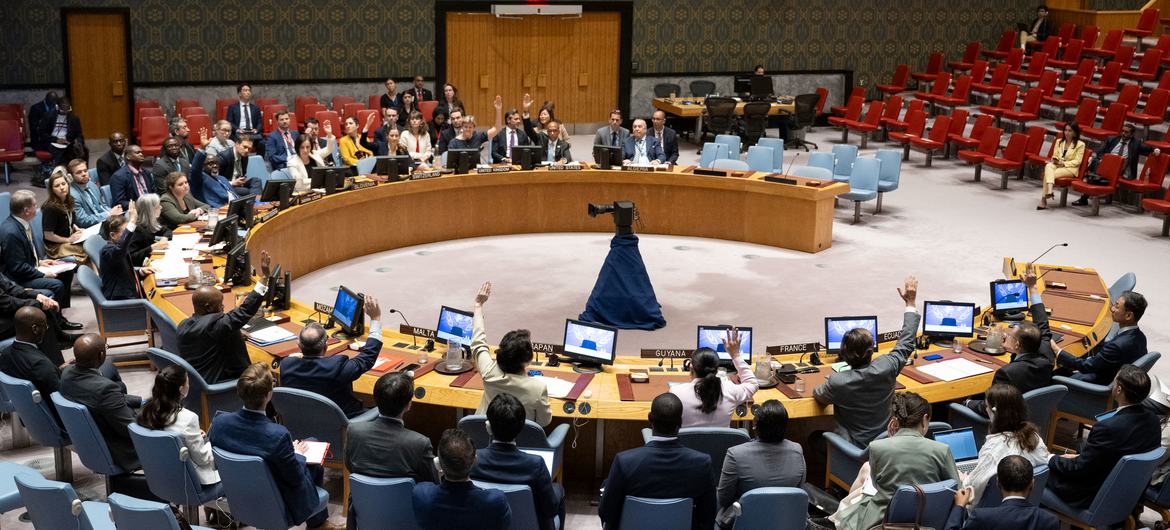
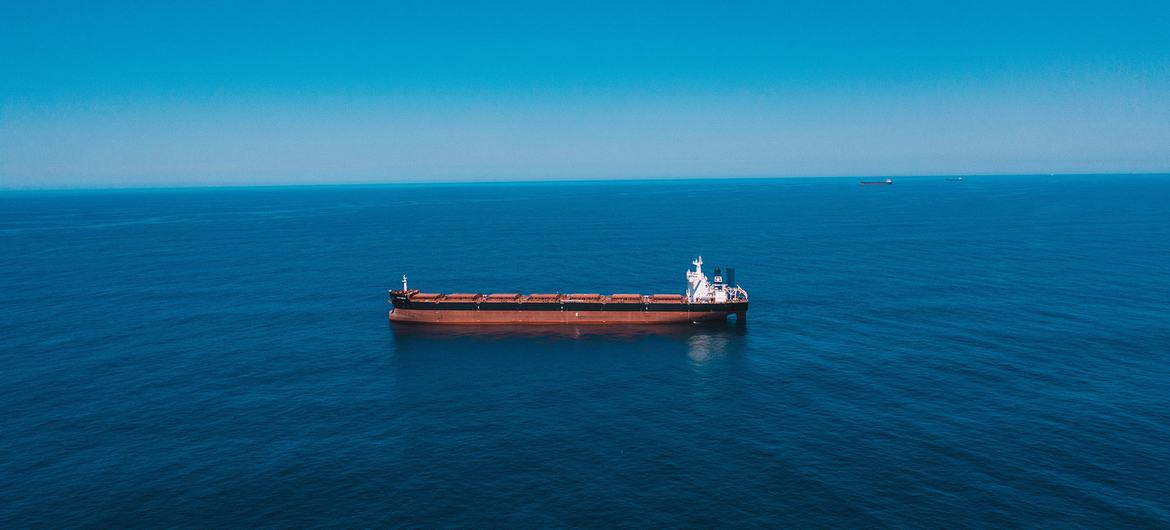
Following attacks on the MSC United and Maersk Hangzhou in late December 2023 — the latest in a series of incidents threatening maritime safety in the Red Sea — senior United Nations officials told the Security Council today of the imperative to safeguard global supply chains and avoid exacerbating regional tensions.
“There have been further alarming developments in the Red Sea,” observed Khaled Khiari, Assistant Secretary-General for Middle East, Asia and the Pacific in the Departments of Political and Peacebuilding Affairs and Peace Operations. Continued Houthi threats to maritime navigation — coupled with the risk of further military escalation — could potentially impact millions in Yemen, the region and the world. Recalling that shipping companies Maersk and Hapag-Lloyd have halted Red Sea operations, he detailed the effects on global supply chains — increased freight costs and lengthened delivery times.
Also calling for the immediate release of the Galaxy Leader and its crew — seized by the Houthis on 19 November 2023 — he reiterated that such incidents originating from Houthi-controlled areas of Yemen must stop. “No cause or grievance can justify continuation of these attacks against the freedom of navigation,” he underscored, calling on all parties to de-escalate tensions to return traffic through the Red Sea to normal and avoid dragging Yemen into regional conflagration.
Also calling for de-escalation was Arsenio Dominguez, Secretary-General of the International Maritime Organization (IMO), who underlined the importance of ensuring the safety of seafarers, the freedom of navigation and the stability of supply chains. The shipping lane through the Red Sea accounts for 15 per cent of global trade, and approximately 18 shipping companies have already decided to reroute their vessels around South Africa to reduce risks. He noted that this requires 10 additional days of travel, resulting in higher freight rates and a negative impact on trade.
As speakers took the floor, many condemned Houthi attacks on commercial vessels in the Red Sea and called for the immediate release of the Galaxy Leader and its crew. Others noted the negative effects that disruption of this vital shipping lane will have on supply chains and the delivery of humanitarian aid worldwide. Further, while many called for de-escalation to avert devastating regional effects, some underlined the need to contextualize these developments.
Algeria’s representative, urging such analysis, noted that the Middle East is currently navigating a challenging period of instability. Therefore, it is necessary to abstain from escalating tensions to prevent the emergence of regional conflict with “out of control consequences”, he stressed. Further, effective management of any situation necessitates an understanding of the relevant historical and geographic context, and efforts to fragment a crisis are bound to fail.
“What is happening in the Red Sea is a direct projection of the violence in Gaza,” stated the representative of the Russian Federation while citing Israel’s ongoing bloody operation there. Condemning the United States for covering up Israel’s actions and preventing the adoption of a resolution demanding an immediate ceasefire, he said this causes rage within the Arab world — which sometimes takes on dangerous forms, such as the actions of Ansar Allah in the Red Sea.
The representative of the United States, meanwhile, reported that his country and its allies have launched multinational naval operations to protect ships in the southern Red Sea and deter lawless non-State actors. Houthi attacks are clear violations of international law, pose grave implications for maritime security and undermine the fragile humanitarian situation in Yemen. He also stressed that the root of the problem is Iran’s long-standing funding of Houthi operations.
The Council must “address the radioactive Shiite elephant in the room”, urged Israel’s representative, stating that Iran seeks to dominate the Middle East and beyond under Shiite hegemony by standing in the shadows while pulling the strings of terror proxy puppets. “Iran is a global danger,” he stressed, calling on the Council to tackle the “real threat to the Middle East” by addressing Iran’s destructive role.
Slovenia’s representative, for his part, noted that the last months of 2023 proved an extremely turbulent and traumatic period in the Middle East. Spillover and escalation from the current devastation in Gaza, Israel and the broader region must be avoided. He observed: “It should be in no one’s interest to see a further destabilization and spiral of violence in the region — not the people of Gaza, not the people of Israel and not the people of Yemen.
MAINTENANCE OF INTERNATIONAL PEACE AND SECURITY
Briefings
KHALED KHIARI, Assistant Secretary-General for Middle East, Asia and the Pacific, Departments of Political and Peacebuilding Affairs and Peace Operations, told the Council that, since the last relevant briefing on 18 December 2023, “there have been further alarming developments in the Red Sea”. The United Nations continues to warn against the adverse political, security, economic and humanitarian repercussions of military escalation in the Red Sea, along with the risk of exacerbating regional tensions. Continued Houthi threats to maritime navigation — coupled with the risk of further military escalation — could potentially impact millions in Yemen, the region and the world. He noted that, since 18 December 2023, the Houthis have claimed responsibility for two attacks using naval missiles — on the MSC United on 26 December 2023, and on the Maersk Hangzhou on 31 December 2023. “There have been reports of other intercepted Houthi attacks, as well,” he added.
He went on to report that, on 31 December 2023, armed intervention by United States forces against the Houthis — conducted in response to two distress calls from the Maersk Hangzhou — resulted in 10 dead or missing, according to the Houthis. As a result, on 2 January, Maersk halted Red Sea shipping until further notice and, on the same day, Hapag-Lloyd said it will reroute vessels around the Cape of Good Hope until 9 January. “This is only one example of the risks of continued escalation of attacks against seagoing merchant vessels and the impact on global supply chains,” he said, spotlighting increased freight costs and lengthened delivery times. He also shared the concerns expressed by the Secretary-General of the International Maritime Organization (IMO) regarding the need to protect the freedom of maritime navigation as well as the potential impact of current disruptions to traffic in the Red Sea on international trade.
Calling for the immediate release of the Galaxy Leader and her crew — seized by the Houthis on 19 November 2023 — he reiterated that such incidents originating from Houthi-controlled areas of Yemen must stop. “No cause or grievance can justify continuation of these attacks against the freedom of navigation,” he underscored. All parties should de-escalate tensions to return traffic through the Red Sea to its normal state and avoid the risk of Yemen being dragged into regional conflagration. The Council’s continued active engagement with all concerned parties who may be able to push for restraint remains extremely valuable, he added, urging combined efforts to prevent further escalation in the Red Sea from exacerbating regional tensions or undermining regional security and international trade.
ARSENIO DOMINGUEZ, Secretary-General of the International Maritime Organization, condemned attacks against international shipping in the Red Sea and expressed IMO’s strong commitment to protect seafarers, ships and cargos, which bear the ultimate responsibility of ensuring the safety and security of global supply chains. Attacks against them are not acceptable. Ships must be allowed to travel worldwide unhindered in accordance with international law. Since November 2023, many attacks have been launched against international vessels “in this vital shipping lane”, which accounts for 15 per cent of global trade, he noted. An initial target was Israel, but that is not the case now. IMO will liaise with the shipping industry and navies to closely monitor the situation.
A significant number of shipping companies — approximately 18 — have already decided to reroute their vessels around South Africa to reduce risks, he said. This requires 10 additional days of travel, paying higher freight rates and dealing with negative impacts on trade. On 18 December 2023, members of the Djibouti Code of Conduct and its Jeda Amendments held an extraordinary meeting to discuss ways to deal with increasing threats to maritime security in the Red Sea. It was attended also by representatives of the shipping industry, navies and others. The meeting called for enhanced security measures and greater coordination among key stakeholders. It also called for continuous meetings to review and submit recommendations to IMO and the Security Council.
Citing the European Union-funded IMO capacity-building programme in the southern Red Sea and the Gulf of Eden, he pledged to work with partners, including the United Nations Office on Drugs and Crime (UNODC) and the International Criminal Police Organization (INTERPOL), to develop greater capacity and promote safety standards for maritime, port and land-based law enforcement authorities across Djibouti, Ethiopia, Somalia, Sudan and Yemen. He called for de-escalation, ensuring the safety of seafarers, freedom of navigation and stability of supply chains. As a practical measure, he encouraged ships to continue sending an initial report when entering the Voluntary Reporting Area to the United Kingdom Maritime Trade Operation Centre and other relevant centres in the region.
Statements
CHRISTOPHER P. LU (United States) warned that the Houthis continue to strike commercial vessels transiting through the Red Sea’s vital shipping lane amid growing consensus for freedom of navigation, regional peace and security, and global commerce. Since 19 November 2023, there have been over 20 attacks by the Houthis, he noted. The United States and its allies have launched multinational naval operations to protect ships in the southern part of the Red Sea and deter lawless non-State actors. He recalled an incident during which the United States navy personnel issued verbal warnings to the Houthi attackers, but rather than cease their attacks, they responded by opening fire. Three Houthi boats subsequently sank. Additionally, two anti-ship missiles were fired from Houthi-controlled areas at United States Navy vessels. Citing these attacks as clear violations of international law continue, he said that they pose grave implications for maritime security and undermine the fragile humanitarian situation in Yemen, thwarting the ability of the international community to deliver assistance to 21 million people in need. He also shed light on the root of the problem — Iran’s long-standing provision of financing to aid the Houthi operations.
JOSÉ JAVIER DE LA GASCA (Ecuador) condemned the Houthis’ terrorist attacks on commercial vessels in the Red Sea, which have intensified in recent weeks. Calling for the immediate release of the Galaxy Leader and its crew, he underlined the importance of full respect for international law governing maritime navigation and recalled that the 1982 United Nations Convention on the Law of the Sea regulates acts of piracy. Given the ramifications of conflict in the Middle East — “and the involvement of various actors” — he stressed that situations that increase risk must be avoided to avert devastating regional effects and destabilized international peace and security. He also noted that recent incidents have blocked maritime traffic through the Suez Canal — critical for global trade — and that the impossibility of navigation through the Red Sea has worsened the humanitarian situation in Yemen and impacted global supply chains. Inter-Yemeni dialogue is the only way to sustainable peace in that country, he said.
BOŠTJAN MALOVRH (Slovenia) called the Houthis’ interference with navigational rights and freedoms over the past weeks “simply unacceptable” as it poses a serious threat to international maritime security and to the movement of food, fuel and critical humanitarian assistance intended to reach those in need worldwide. The last months of 2023 have proved to be an extremely turbulent and traumatic period in the Middle East. Regional spillover and escalation from the current devastation in Gaza, Israel and the broader region must be avoided. Calling for the cessation of all attacks against commercial vessels operating in the region’s crucial waterways, he said: “It should be in no one’s interest to see a further destabilization and spiral of violence in the region — not the people of Gaza, not the people of Israel and not the people of Yemen”.
YAMAZAKI KAZUYUKI (Japan), voicing grave concerns about the increasingly volatile situation in the Red Sea, said that almost weekly — and as recently as yesterday — Houthi militants have been attacking commercial vessels with missiles and drones, and they have signalled that they will not stop these hostile activities. On the armed “seizure” and continued holding of the Japanese-operated Galaxy Leader and its 25-person multinational crew since 19 November 2023, he said that “it is unacceptable that the innocent crew has been detained for more than 40 days”, and strongly demanded the crew’s immediate and unconditional release. The Red Sea is a critical sea lane for global maritime transportation. The Houthis’ threats to maritime security and freedom of navigation in this important waterway have already disrupted international trade. Condemning the Houthis’ reckless conduct, he emphasized that the Council should take appropriate action to maintain international peace and security.
VANESSA FRAZIER (Malta) called on the Houthis to immediately cease attacks against commercial shipping and to abide by their obligations under international law. Spotlighting the illegal detention of the Galaxy Leader, she further called for the immediate and unconditional release of the vessel and its crew. Great strides have been made towards peace in Yemen over the past 18 months, and parties to the conflict must not allow regional tensions to threaten these efforts. Moreover, maritime security is critically important to the wellbeing of Yemeni civilians, who rely heavily on imports for essential needs. Houthi attacks against merchant shipping threaten the flow of aid to Yemen, which could have devastating consequences for the population and aggravate the already dire humanitarian situation in that country. Parties to the conflict — “notably the Houthis” — must remain focused on establishing a formal ceasefire leading to an inclusive Yemeni-led and -owned political process under UN auspices, she said.
JOONKOOK HWANG (Republic of Korea) noted that the parties in Yemen had committed to a set of measures to implement a nationwide ceasefire and to engage in preparations for the resumption of an inclusive political process under United Nations auspices. His country fully supports a Yemeni-led political transition process, the active role of the UN, including the Special Envoy for Yemen, and the meaningful participation of women. In this regard, the reckless provocations and dangerous escalation in the Red Sea must stop, as those activities do not help to ensure the aspirations of Yemen’s people to realize sustainable peace and development. As Chair of the Security Council Committee established pursuant to resolution 2140 (2014), his delegation will carefully watch the situation unfolding in and around the country, especially the implementation of sanctions, including the arms embargo.
JAMES KARIUKI (United Kingdom) condemned in the strongest terms the illegal and unjustified attacks on commercial shipping in the Red Sea by Houthi militants, joining 11 countries in a statement warning against further attacks. His country will continue to work with allies and partners to pursue all diplomatic routes to end this threat, and if necessary, “will not hesitate to take action to deter threats to freedom of navigation in the Red Sea”. Attacks using unmanned aerial vehicles, missiles and small boats are a direct threat to freedom of navigation, protected by international law. They pose a severe economic threat not only to Yemen — whereby driving up food prices they risk exacerbating the already dire humanitarian situation — but also to global food security and supply lines. Contrary to claims made by the Houthis, these attacks are totally indiscriminate and target shipping that has no connection to Israel, he asserted. Accordingly, he called for the immediate release of the MV Galaxy Leader and its crew and urged all parties in the region to exercise restraint and avoid escalation.
AMAR BENDJAMA (Algeria), noting the global importance of safe maritime navigation through the Red Sea, urged that recent developments there should be analysed within a broader regional context. The region is currently navigating a challenging period of instability, and therefore it is necessary to abstain from escalating tensions to prevent the emergence of regional conflict with “out of control consequences”, he stressed. He went on to state that the primary responsibility for maritime security rests with coastal States — best positioned to ensure the safety of crucial waterways — and underscored that any collective effort lacking the active involvement of such States is “likely to fall short of achieving the desired results”. Further, the effective management of any situation necessitates an understanding of the relevant historical and geographic context, and efforts to fragment a crisis are bound to fail. He added that the Red Sea is more than just a trade route — it is steeped in civilizations and communities with legitimate aspirations and hopes.
ADRIAN DOMINIK HAURI (Switzerland) expressed concern about maritime safety in the Red Sea due to the continuing attacks by the Houthis on cargo ships and the risk of an escalation of the situation. Welcoming UN efforts aimed at de-escalation, he stressed the importance of the rights and freedoms of navigation of all vessels in the Gulf of Aden and the Red Sea, in accordance with international law. The situation in the Red Sea already has an impact on global maritime traffic. It is essential to prevent regional escalation, which would have further negative consequences for international maritime traffic and could also be detrimental to the ongoing negotiations between the parties to the conflict in Yemen. In this regard, he cited the announcement by the UN Secretary-General's Special Envoy for Yemen, Hans Grundberg, that the parties have agreed on a set of measures to implement a nationwide ceasefire as “encouraging”.
DOMINGOS ESTÊVÃO FERNANDES (Mozambique) expressed grave concern over the escalating tensions in the Red Sea, warning that any decline in commercial shipping in the Red Sea will inevitably have adverse effects on both regional and worldwide trade. Maritime security is indispensable for effective trade flows, he said, also stressing that any progress achieved so far towards a comprehensive ceasefire agreement in Yemen should not be overshadowed by the escalating violence in the Red Sea. “As custodians of international peace and security, it is our collective responsibility to ensure that the ongoing peace efforts in Yemen are not jeopardized by these attacks,” he said, calling for an immediate cessation of the attacks on the vessels and their crews.
VASSILY A. NEBENZIA (Russian Federation) said that his country supported the Council’s 1 December 2023 press statement, calling on the Ansar Allah movement to cease any actions that threaten commercial vessels and their crews in the Red Sea and the Gulf of Aden. But, this problem is not transpiring in a vacuum. “What is happening in the Red Sea is a direct projection of the violence in Gaza,” he said, citing Israel’s ongoing bloody operation. Condemning the United States for covering up Israel's actions and preventing the adoption of a resolution demanding an immediate ceasefire, he pointed out that this causes rage in the Arab world, sometimes taking on such dangerous forms as the actions of Ansar Allah in the Red Sea. He noted two scenarios — the first being the Council’s greater efforts to resolve the long-standing conflict in Yemen and end the violence in Gaza. This will eliminate the root cause of the problem, and safe navigation in the region could resume. The second scenario is catastrophic — fanning the flames with oil, which Washington, D.C., and its allies are advocating. With this, the Yemeni settlement would be derailed and there will be a very real possibility of a new major regional conflict. Unfortunately, events are following the latter scenario, he warned.
CAROLYN RODRIGUES BIRKETT (Guyana) sounded alarm over the increased frequency of the attacks in the Red Sea, which endanger international navigation and the lives of crew members. Calling for their immediate end and for the preservation of navigational rights and freedoms of all vessels in the Gulf of Aden and Red Sea, she also demanded the immediate release of the Galaxy Leader and its crew. Voicing concern about the potential impact of these attacks on the ongoing conflict in the Middle East, she urged the perpetrators to avoid any further action that could spark an escalation in tensions and compound the already volatile situation in the Middle East. “A wider regional conflagration in the present circumstances must be avoided at all costs,” she asserted, noting that the Red Sea — with its connection to the Suez Canal — is one of the world's busiest shipping lanes.
MICHAEL IMRAN KANU (Sierra Leone) expressed concern that, despite the Council’s press statement issued on 1 December 2023, maritime attacks in the Red Sea have escalated — adversely affecting navigation and threatening the movement of essential commodities such as food and fuel. Noting the United States’ initiative to establish a multinational task force to deter and counter Houthi attacks in the Red Sea, he said: “In this significant endeavour, we urge for due compliance with international law.” Moreover, he expressed concern that increased maritime attacks in the Red Sea pose a serious risk to the peace talks between Saudi Arabia and the Houthis — a process that could lead to a comprehensive ceasefire agreement. He therefore called on all concerned to take appropriate steps to ensure that attacks on vessels in the Red Sea do not lead to a breakdown in the Yemeni peace process. Also expressing concern over possible regional escalation, he called on all regional actors to refrain from provocative acts.
GENG SHUANG (China) stressed that the Red Sea is an important waterway for goods and energy, calling for unimpeded access. Expressing grave concern about the recent attacks on commercial vessels in the Red Sea, he urged an end to such attacks and asked all parties to respect the freedom of navigation of all countries. Major countries with influence should play a key role in keeping shipping lanes safe in the Red Sea. Current tensions pose a new challenge to the Yemeni political process and add complexity to the already volatile Middle East situation, he said, urging restraint and maintaining the positive momentum towards a political settlement. Describing the current tension as a “spillover effect” of the conflict in Gaza, he said that the only way to avert further escalation in the Red Sea is to bring about a ceasefire in Gaza and provide humanitarian aid there. China will continue its unremitting efforts towards a long-lasting peace, he added.
NICOLAS DE RIVIÈRE (France), Council President for January, speaking in his national capacity, underscored that the attacks carried out by the Houthis in the Red Sea against commercial ships undermine fundamental principles of international law, namely the freedom of maritime navigation. Through these armed actions, the Houthis bear extremely heavy responsibility for the escalation of tensions in the region, he observed, adding that 15 per cent of global trade is directly threatened by the Houthis and those who train and support them. Further, he called for the immediate release of the Galaxy Leader and its crew, illegally detained by the Houthis. It is also the Council’s collective responsibility to ensure that the peace process in Yemen continues according to the Special Envoy’s road map. France will continue to shoulder its responsibilities in the Bab al-Mandeb Strait and contribute to the safety of commercial ships in conjunction with its partners, he said, calling on all international and regional actors to avoid any further escalation in the region.
GILAD MENASHE ERDAN (Israel) stressed that this is not an Israeli or Middle Eastern problem, but a global one. Houthi terrorists, armed and funded by a UN Member States, are flagrantly attacking ships flying any flag. These blatant attacks against diverse global targets are the epitome of an international terrorist threat. Noting that the Council has already acknowledged the Houthis as a terror group, he said that now is the time to enforce sanctions against them, as well as all who arm and fund them. On that, he underscored the need to “address the radioactive Shiite elephant in the room”, stating that the Ayatollah regime funds, arms, trains and directs the Houthis, Hamas, Hizbullah and other terrorist groups in Syria and Iraq. Iran seeks to dominate the Middle East and beyond under Shiite hegemony, and the Ayatollah’s strategy is to stand in the shadows while pulling the strings of terror proxy puppets. “Iran is a global danger,” he stressed, calling on the Council to tackle the “real threat to the Middle East” by addressing Iran’s destructive role.