Показаны сообщения с ярлыком ISIL. Показать все сообщения

вторник, 11 июня 2024 г.

Security Council Extends Mandate for Ombudsperson, Monitoring Team of Sanctions Regime against ISIL (Da’esh), Adopting Resolution 2374 (2024)


9649TH MEETING (PM)
SC/15722


Extending the mandates of the Ombudsperson and the Monitoring Team of the sanctions regime against Islamic State in Iraq and the Levant (ISIL), also known as Da’esh, and Al-Qaida, the Security Council today also updated the criteria for designating individuals, groups and entities on the regime’s list to include the committing of acts of sexual and gender-based violence. 

Council resolution 2734 (2024) (to be issued as document S/RES/2734(2024)) was adopted by a recorded vote of 14 in favour to none against, with one abstention (Russian Federation).

Acting under Chapter VII of the Charter of the United Nations, the 15-member organ extended the mandate of the Office of the Ombudsperson, established by resolution 1904 (2009), for a period of 36 months from its date of expiration in June 2024 and expressed its intention to review the mandate and take appropriate action regarding the further extension no later than 17 May 2027.

The text also affirms that the Ombudsperson shall continue to receive and review requests from individuals, groups, undertakings or entities seeking to be removed from the ISIL (Da’esh) and Al-Qaida Sanctions List in an independent and impartial manner and shall neither seek nor receive instructions from any Government.

Further, the Ombudsperson shall continue to present to the Security Council Committee pursuant to resolutions 1267 (1999), 1989 (2011) and 2253 (2015) concerning ISIL (Da’esh), Al-Qaida and associated individuals, groups, undertakings and entities, observations and recommendations regarding the delisting of those individuals, groups, undertakings or entities that have requested removal from the Sanctions List.

Also extended was the mandate of the current New York-based Monitoring Team and its members, established pursuant to paragraph 7 of resolution 1526 (2004), for a further period of 36 months from the expiration of its current mandate in June 2024.  The Council directed the Team to report on relevant thematic and regional topics and developing trends and to identify, gather information on and keep the Committee informed of instances and common patterns of non-compliance with the measures imposed in this resolution.

Under listing criteria, the Council decided to recognize that planning, directing, or committing acts involving sexual and gender-based violence including rape, enslavement of persons, and cases of abduction and trafficking in persons may be eligible for designation in the ISIL (Da’esh) and Al-Qaida Sanctions List, when such acts are being used by ISIL, Al-Qaida and associated individuals, groups and entities as a tactic of terrorism.

As in 2021, the resolution covers a wide range of measures, including asset freeze, travel ban and arms embargo.  The terms on asset freeze instruct States to freeze the funds and other financial assets or economic resources of listed individuals, groups, undertakings and entities, including funds derived from property owned or controlled directly or indirectly, by them or by persons acting on their behalf or at their direction.

The travel ban calls on States to prevent the entry into or transit through their territories of these individuals, while the arms embargo prevents the direct or indirect supply, sale or transfer to listed individuals, groups, undertakings and entities from their territories or by their nationals outside their territories, or using their flag vessels or aircraft, of arms and related materiel of all types including weapons and ammunition, military vehicles and equipment, paramilitary equipment, and spare parts for the aforementioned, and technical advice, assistance or training related to military activities.

The Council has tended towards unanimous adoptions on this topic and in statements after adoption, its members welcomed the extension of the mandates.  However, they also cautioned against politicizing those mandates, and notably, they expressed divergent views on the amendment of listing criteria to include sexual and gender-based violence.

The representative of the United States, who sponsored the text, said that provision reflects the Council’s recognition that “sexual and gender based violence is a tool terrorists utilize to further their aims.”  Noting the “devastating frequency of this horrific tactic”, from ISIL’s use of sexual slavery against the Yazidi community to Al-Shabaab’s use of abduction, rape and forced marriage, she said the text is a critical step in the global campaign to end sexual and gender-based violence.

China’s delegate pointed out that according to the resolution, when sexual violence is used as a terrorist tactic, such acts may be eligible for designation on the basis of current criteria.  This phrasing is more appropriate till the international community “reaches a clear consensus on the link between sexual and gender-based violence and terrorism”, he said.  It is necessary to “abandon ideological biases and double standards” and consider listing requests objectively, he said, stressing that the Monitoring Team and Ombudsperson must continue to perform their duties impartially.

The representative of the Russian Federation, who abstained from the vote, noted that the 1267 sanctions regime is one of the most effective and cautioned against dilution of its mandate.  If there is proof that terrorists associated with ISIL or Al-Qaida use sexual violence to achieve their goals, then the Committee must act accordingly; however, this must not result in watering down its counter-terrorism mandate and distracting it with secondary questions.  “It is unacceptable to automatically tie the question of SGBV [sexual and gender-based violence] to terrorism,” he said, adding that such cases should be considered only if there is reliable information.  Further, such violence should not be used as an independent criteria for listing, he underscored, expressing regret that the United States delegation “did not think it valuable to preserve the consensus spirit of the counter-terrorism agenda”.

Algeria’s delegate also expressed regret that the resolution was not adopted by consensus, because the 1267 sanctions regime derives its effectiveness from the unity of the Council. Some matters in the text deserve further consideration, he said, stressing the importance of the “Member-State driven nature” of the listing and de-listing process.  Politicizing the mandate of the sanctions regime will undermine it, he cautioned.


https://press.un.org/en/2024/sc15722.doc.htm


https://creativecommons.org/licenses/by/3.0/legalcode

среда, 15 ноября 2023 г.

Security Council ISIL (Da’esh) and Al-Qaida Sanctions Committee Amends Five Entries to Its Sanctions List


SC/15492

Security Council ISIL (Da’esh) and Al-Qaida Sanctions Committee Amends Five Entries to Its Sanctions List

On 14 November 2023, the Security Council Committee pursuant to resolutions 1267 (1999), 1989 (2011) and 2253 (2015) concerning ISIL (Da’esh), Al‑Qaida and associated individuals, groups, undertakings and entities enacted the amendments to list entries and narrative summaries specified below with underline and strikethrough, in connection with individuals and entities subject to the assets freeze, travel ban and arms embargo set out in paragraph 1 of Security Council resolution 2610 (2021), and adopted under Chapter VII of the Charter of the United Nations....


https://press.un.org/en/2023/sg15492.doc.htm


https://creativecommons.org/licenses/by/3.0/legalcode

пятница, 21 июля 2023 г.

Security Council ISIL (Da’esh) and Al-Qaida Sanctions Committee Amends Two Entries on Its Sanctions List

SC/15363

Security Council ISIL (Da’esh) and Al-Qaida Sanctions Committee Amends Two Entries on Its Sanctions List

On 21 July 2023, the Security Council Committee pursuant to resolutions 1267 (1999), 1989 (2011) and 2253 (2015) concerning ISIL (Da’esh), Al‑Qaida and associated individuals, groups, undertakings and entities enacted the amendments specified with strikethrough and underline in the entries below on its ISIL (Da’esh) and Al-Qaida Sanctions List of individuals and entities subject to the assets freeze, travel ban and arms embargo set out in paragraph 1 of Security Council resolution 2610 (2021), and adopted under Chapter VII of the Charter of the United Nations....


https://press.un.org/en/2023/sc15363.doc.htm

https://creativecommons.org/licenses/by/3.0/legalcode

пятница, 9 июня 2023 г.

UN investigative team outlines findings around ISIL chemical weapons use


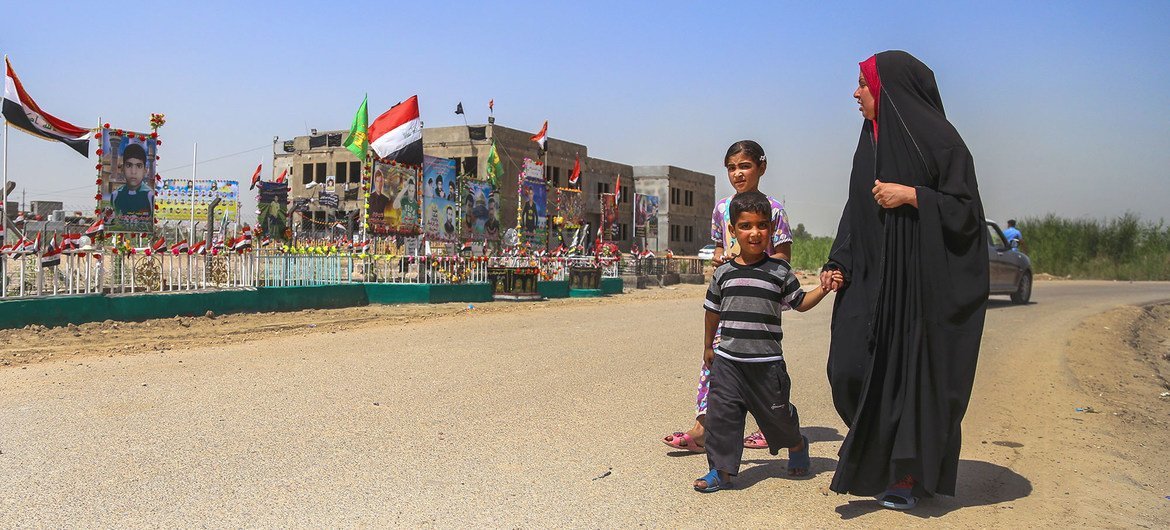
A family walks past a memorial set up at  the location of a suicide bombing, claimed by ISIL, at Al-Shuhadaa Staduim in Babil, Iraq.
© UNICEF/Wathiq Khuzaie
 
A family walks past a memorial set up at the location of a suicide bombing, claimed by ISIL, at Al-Shuhadaa Staduim in Babil, Iraq.
8 June 2023
Peace and Security

During their nearly four-year reign of terror in Iraq, ISIL extremists developed at least eight chemical agents, tested them on humans, and carried out at least 13 attacks, UN experts reported on Thursday. 

Senior officials with the UN Investigative Team promoting accountability for ISIL crimes, UNITAD, presented some of their findings to Member States meeting at UN Headquarters in New York. 

Tweet URL

For the past five years, UNITAD has been gathering evidence of crimes committed during ISIL’s self-proclaimed caliphate from June 2014 to December 2017, which could be used to prosecute the extremists in national or foreign courts. 

Prosecution is rare 

Christian Ritscher, Special Adviser and Head of UNITAD, recalled that chemical weapons use is outlawed internationally and could constitute a crime against humanity, war crime or even contribute to genocide, if a specific group is targeted. 

“To the best of my knowledge, the use of chemical weapons by non-State actors has rarely been adjudicated, if at all, in any court - whether national or international - around the world. As UNITAD, we would like to play our part and aim to change this,” he said. 

The investigations into ISIL’s development and use of chemical and biological weapons began two years ago, looking into the March 2016 attack on the town of Taza Khurmatu and whether other incidents had taken place elsewhere. 

‘Sophisticated’ programme 

Team Leader Paula Silfverstolpe said ISIL’s operations represent the culmination of nearly two decades of experimentation by Sunni jihadi groups, marking “the most sophisticated programme developed by non-State actors so far”. 

The overall manufacturing of weapons and ammunition fell under ISIL’s self-styled Department of Defence, specifically the Committee of Military Development and Manufacturing (CMDM), which had a monthly budget of over a $1 million as well as extrabudgetary funds to purchase raw materials. 

More than 1,000 combatants were involved in production, according to ISIL payroll records. 

Hundreds were deployed to the chemical weapons programme, and specific job advertisements were placed to recruit scientists and technical experts, including from abroad, drawing people from countries such as the United States, France, the United Kingdom and Belgium. 

A terrible ‘first’ 

Specialist research and development teams were located at the then extremist-run University of Mosul in northern Iraq, rural parts of Anbar province, and the city of Hawija, home to ISIL headquarters. 

Ms. Silfverstolpe said the militants developed at least eight chemical agents - aluminium phosphide, botulinum toxin, chlorine, cyanide ion, nicotine, ricin, thallium sulfate and sulfur mustard, which is also known as mustard gas. 

ISIL was also the first non-State group to develop a banned chemical warfare agent and combine it with a projectile delivery system. 

The toxins sulfur mustard, chlorine and aluminium phosphide are banned under the Biological Weapons Convention, and evidence demonstrates that ISIL weaponized their use in mortars, rockets and improvised explosive devices (IEDs). 

The terror group also explored the possibility of acquiring anthrax but there has been no evidence so far that combatants used it, or other biological agents, in any attacks, although investigations continue. 

Human testing and bonus payments 

UNITAD has also collected evidence which indicates that ISIL tested chemical agents on humans - including ricin, nicotine and thallium sulfate - as well as animals such as rabbits. 

ISIL records demonstrate that top leader Abu Bakr al-Baghdadi, who died in 2019, authorized the use of chemical weapons by troops and even approved bonus payments for those soldiers deploying them. “Martyrdom payments” were made if they died. 

Al-Baghdadi also personally ordered the attack against Taza Khurmatu “with the purpose of causing as many casualties as possible”. Of the 42 projectiles launched against the town, at least 27 contained sulfur mustard, which causes blisters and painful burns. Two children died and thousands of people, including first responders, were injured. 

‘Widespread and systematic’ attacks 

Judge Ali Noaman Jabbar of the Taza Investigation Court said the re-opening of the case and UNITAD’s interest has motivated numerous victims and their families to provide their testimonies. 

“The impact caused by the chemical attack includes various diseases such as cancer, skin diseases, miscarriages, deformities in embryos, chronic diseases, and psychological impact and trauma,” he said in a video message. 

The attack on on Taza Khurmatu “was definitely not an isolated case”, according to Ms. Silfverstolpe.  Information shows at least 12 other attacks were carried out in other locations, with unconfirmed reports of 35 more. 

“It was quite a widespread and systematic phenomenon, as far as the information that we have collected so far,” she said. 

Honour the victims 

UNITAD will continue to work with Iraq and other countries towards building cases in connection with 21 “persons of interest” suspected of involvement in the ISIL chemical weapons programme, who include foreign nationals.

While some are believed to be dead, others have been detained or are living in third countries.

Although the caliphate has been destroyed, Mr. Ritscher warned that the terrorism threat has not disappeared. 

“We need to advance criminal accountability in relation to the use of chemical weapons in the name of victims and survivors of ISIL to promote peace and reconciliation in Iraq, but also because it is a responsibility of the entire international community, given that such threats and crimes may present themselves in other countries,” he said. 


 https://news.un.org/en/story/2023/06/1137472

https://creativecommons.org/licenses/by/3.0/legalcode

среда, 7 июня 2023 г.

Admissible evidence, competent courts, critical to ensuring justice for ISIL victims in Iraq


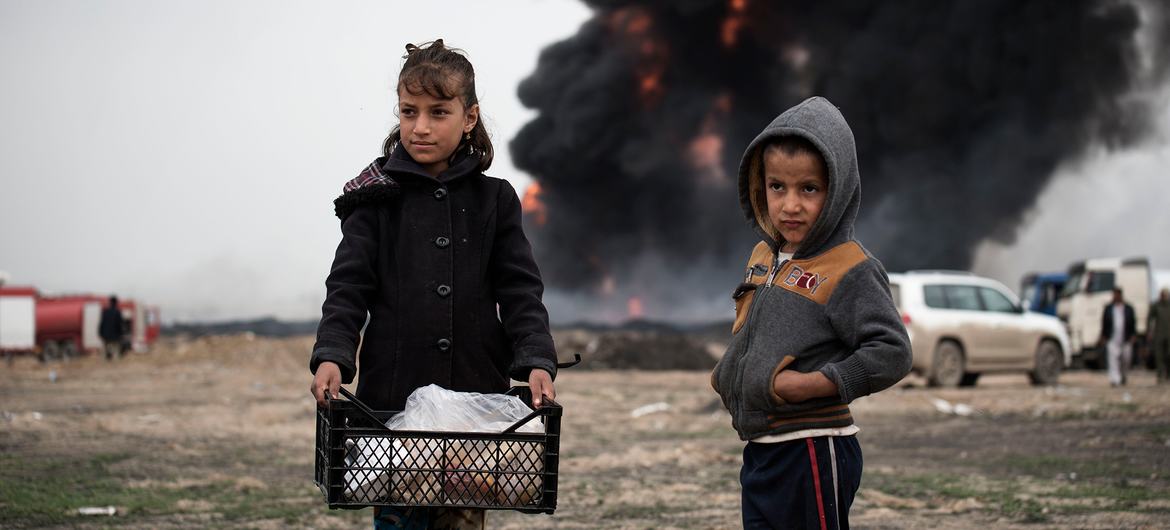
Oil wells in Qayyara, Iraq, set alight by ISIL members as they retreated (file).)
© UNICEF/Alessio Romenzi
 
Oil wells in Qayyara, Iraq, set alight by ISIL members as they retreated (file).)
7 June 2023
Peace and Security

Competent courts, admissible and reliable evidence, and an appropriate legal framework are needed to ensure that ISIL extremist militants can be prosecuted for the atrocities they committed during their reign of terror in Iraq, the UN Security Council heard on Wednesday. 

Ambassadors were briefed by Christian Ritscher, Special Adviser and Head of the UN Investigative Team to promote accountability for these crimes, UNITAD, established five years ago. 

Tweet URL

The Islamist group declared a self-styled caliphate across parts of Iraq and northern Syria in 2014, before being militarily defeated and driven from Iraq in December 2017. 

Commitment stronger than ever 

Presenting UNITAD's 10th report, he informed of progress to date, including supporting the digitization of millions of documents which are now in the possession of the Iraqi judiciary. 

Investigators have also produced a case-assessment on ISIL’s development and use of chemical weapons.  Further details will be outlined during an event at UN Headquarters in New York on Thursday, co-hosted alongside Iraq and India. 

“Today, the commitment of the Iraqi Government, in partnership with UNITAD, to advance the fight against impunity, seek justice in the name of victims and survivors - most of whom are Iraqis - and to address the remaining threat posed by ISIL, is stronger than ever,” he said. 

Mission not over 

However, the mission is far from over.  Mr. Ritscher stressed that “UNITAD’s work is to not simply establish a record for ISIL crimes, but to hold ISIL members who committed such heinous international crimes accountable, through evidence-based trials and before competent courts.” 

“International crimes” refers to the serious violations of war crimes, crimes against humanity and genocide.  The UN team is already working closely with competent Iraqi investigative judges who support their investigations, he said. 

“In turn, UNITAD is enhancing their capacities and ensuring that Iraqi courts are ready to hold ISIL perpetrators accountable for their international crimes, when the moment comes,” he added. 

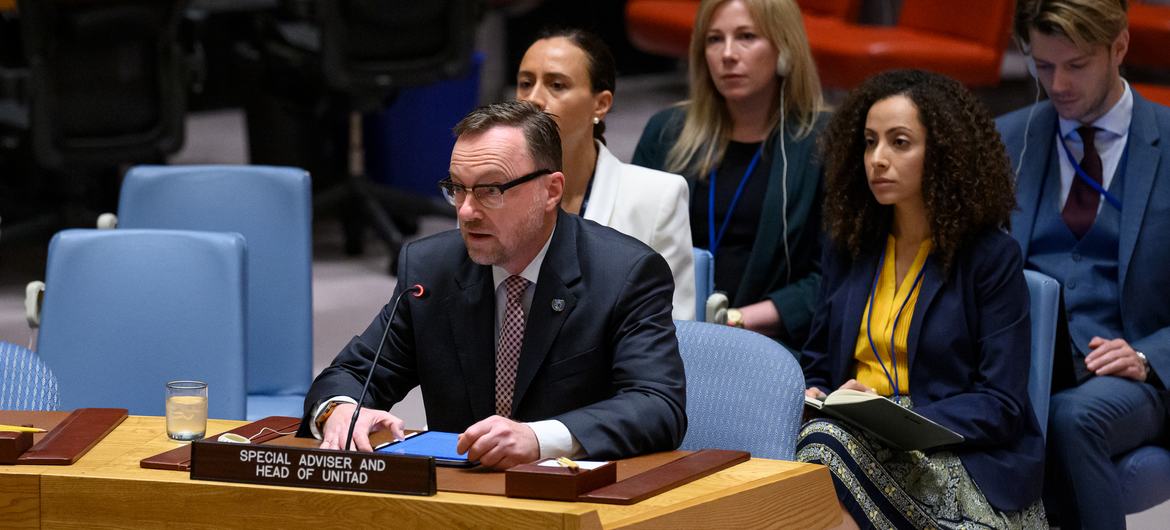
Christian Ritscher, Special Adviser and Head of the Investigative Team established pursuant to Security Council resolution 2379 (2017) (UNITAD), briefs the Security Council meeting on threats to international peace and security.
UN Photo/Loey Felipe
 
Christian Ritscher, Special Adviser and Head of the Investigative Team established pursuant to Security Council resolution 2379 (2017) (UNITAD), briefs the Security Council meeting on threats to international peace and security.

Mountains of evidence 

Mr. Ritscher assured the Council that there is no shortage of evidence of ISIL crimes, describing the terrorist group as “a large-scale bureaucracy that documented and maintained a State-like administrative system.”   

“What we aim to do is to ensure that this evidence is admissible before any competent court, whether in Iraq or in other States where prosecutions of ISIL members for international crimes are taking place,” he said. 

Archiving digitized documents 

In this regard, UNITAD has been leading a largescale project to digitize “considerable volumes” of ISIL records and battlefield evidence. So far, eight million pages from the holdings of the Iraqi and Kurdish authorities have been digitized.  

“Senior Iraqi Judges have informed me that their response times in relation to case files and requests for information have significantly improved, signalling lasting change because of these innovative efforts,” he said. 

As a next step, UNITAD is establishing a central archive that will be the unified repository of all digitized evidence against ISIL. The archive will be located at the Supreme Judicial Council of Iraq and launched in the coming days. 

“This central repository will play a key role to support prosecutions of ISIL perpetrators for their international crimes in Iraq. Moreover, it could be a milestone to founding a comprehensive e-justice system in Iraq, which can be upheld as a leading example, not only in the region, but also globally,” he said. 

Legal framework key 

Meanwhile, adopting an appropriate domestic legal framework remains the main challenge, Mr. Ritscher told the Council. 

He underlined UNITAD’s committed to supporting the Iraqi-led process towards a legal framework that enables national courts to prosecute ISIL criminal acts as international crimes.  

He pointed to the recent establishment of a joint working group bringing together Government, legal and judicial representatives, as well as key parliamentarians, as an important step forward. 

“Once an appropriate domestic legislation on international criminal law has been adopted, the way forward will be clearer. I remain hopeful that this will happen sooner rather than later,” he said. 

Preparing for future trials 

In parallel, UNITAD has already begun to contribute to the preparation of future trials. 

The Team has intensified cooperation with counterparts in the Iraqi judiciary, to jointly build cases against specific persons of interest and alleged perpetrators, prioritizing those living outside Iraq.  

Investigators are currently supporting some 17 countries, by conducting witness interviews, as well as providing expert testimonies and technical analysis in criminal proceedings against alleged ISIL members and supporters. 

 https://news.un.org/en/story/2023/06/1137432

https://creativecommons.org/licenses/by/3.0/legalcode