пятница, 29 декабря 2023 г.

Adopting Resolution 2721 (2023), Security Council Requests Secretary-General Appoint Special Envoy for Afghanistan

9521ST MEETING (AM)
SC/15548

Adopting Resolution 2721 (2023), Security Council Requests Secretary-General Appoint Special Envoy for Afghanistan

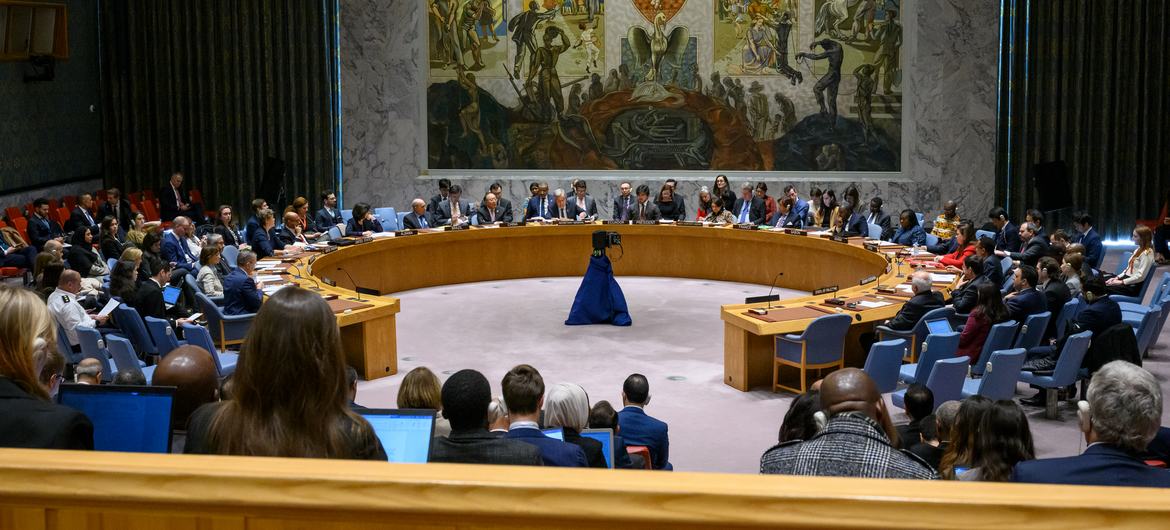
The Security Council today adopted a resolution requesting the Secretary-General to appoint a Special Envoy for Afghanistan, provided with robust expertise on human rights and gender, as it also stressed the critical importance of a continued presence of the United Nations Assistance Mission in Afghanistan (UNAMA).

Adopting resolution 2721 (2023) (to be issued as document S/RES/2721(2023)), the 15-nation Council by a vote of 13 in favour to none against, with two abstentions (China, Russian Federation), reiterated its full support to UNAMA and the Special Representative of the Secretary-General.  It also took positive note of the independent assessment on Afghanistan (document S/2023/856) and encouraged Member States and other relevant stakeholders to consider the implementation of its recommendations, especially in regards to increasing international engagement in a more coordinated manner.

By the text, the Council also affirmed that the objective of this process should be an Afghanistan at peace with itself and its neighbours, fully reintegrated into the international community and meeting international obligations.  Further, it recognized the need to ensure the full, equal, meaningful and safe participation of Afghan women in the process throughout.  As well, it welcomed the Secretary-General’s intention to convene the next meeting of the Special Envoys and Special Representatives on Afghanistan and requested that the UN chief brief the Council on the outcome of these consultations and discussions within 60 days.

Speaking before the vote, Yamazaki Kazuyuki (Japan), also on behalf of the United Arab Emirates, the co-penholder of the file, said that the Council deliberated multiple times on the issue of the situation in Afghanistan over the past year and that the draft resolution is the product of those extensive consultations.  The resolution expresses the Council’s strong determination to facilitate a new strategy that addresses a wide range of issues, including the need to engage more coherently and in a more structured manner with Afghanistan.  “By adopting this resolution, we will also demonstrate to the people of Afghanistan — including relevant authorities, women, girls and civil society — that the international community remains committed to a peaceful, stable, prosperous and inclusive Afghanistan,” he said, adding that the country continues to face enormous challenges.

Speaking after the vote, Lana Zaki Nusseibeh (United Arab Emirates) commended the collaborative nature of the work done on the text, and paid tribute to Afghan people — both in the country and in the diaspora — stating:  “I would like to salute their spirit.”  However, she expressed deep concern about the Taliban’s move to ban girls from attending school.  Afghanistan’s people, but most notably its women and girls, are increasingly isolated. Afghanis are also struggling to access basic goods and services like food, health care and education.  “Let today signal the beginning of the end for all of that,” she declared, adding that compromises are required and the resolution sets forth a practical approach.

Washington, D.C., stressed Lisa Browne (United States), is committed to promoting peace and stability in Afghanistan, but remains concerned over the Taliban’s policies against Afghan women and girls.  This has only moved the Taliban further away from being able to normalize relations with the international community.  She welcomed the resolution’s request to set up a Special Envoy for Afghanistan, emphasizing that such a post would help coordinate work to achieve progress in the country.

Adding to that, Barbara Woodward (United Kingdom) said Council members should seize the momentum of the independent assessment with the hope of shaping Afghanistan’s “current negative trajectory”.  She also noted that the Taliban has a responsibility to meet its international commitments, including by immediately reversing the policies restricting women’s rights and fundamental freedoms.  She encouraged all parties, including Afghan and international stakeholders, to take forward the independent assessment’s recommendations and to work towards an Afghanistan that is at peace with its people, its neighbours and the international community.

The vote showed the common resolve within the Security Council to address the situation in Afghanistan, observed Harold Adlai Agyeman (Ghana), also speaking for Gabon and Mozambique.  Reaffirming his commitment to the sovereignty, territorial integrity and national unity of Afghanistan, he emphasized that the resolution is not merely procedural.  In this regard, he called on the Taliban to reverse its discriminating policies against Afghan women and girls and urged frank and robust discussions and coherent efforts to ameliorate the political, security and human rights situation on the ground.  “The road ahead for Afghanistan is fraught with challenges.  But it is a road we must traverse with them,” he said, adding that “the rights, hopes and dreams of the Afghan people must not be ignored”.

However, Geng Shuang (China) stressed that the actions of the Council and the Secretary-General — including appointments of Special Envoys — should be based on thorough communication with the country concerned.  Therefore, the Council’s follow-up to the independent assessment should be done in full communication with the Afghan authorities.  Forcibly appointing a Special Envoy without regard for the country’s views may not only lead to a situation in which the Special Envoy would not be able to function but may also heighten confrontation between the international community and the Afghan authorities.  As Council members are divided on the follow-up implementation of the independent assessment’s report, and as the Afghan authorities still have reservations, it “seems hasty” to force the adoption of a resolution. Noting that his delegation abstained, he emphasized that Afghanistan’s history demonstrates that externally imposed solutions will end in failure.

Nevertheless, Anna M. Evstigneeva (Russian Federation), while noting that her country abstained, pointed to the many ideas that her delegation is in sync on.  Because it is imperative to maintain peace and stability in Afghanistan, the international community must therefore move towards pragmatic consultations with Afghanistan’s de facto authorities that would help restore many essential aspects of the country, including its recommitment to rebuilding and development.  She also commended efforts to ensure work is being done on countering terrorism and drug threats.  However, she warned against attempts to force Afghanistan to “dance under someone else’s tune”.  Doing so would not help the country progress.  She also called on Western donors to refrain from tying aid to certain political goals.

Underlining the usefulness of a unified strategy in Afghanistan, Nicolas De Rivière (France) said the independent assessment in front of the Council was helpful.  Recognizing the importance of further structuring the political and humanitarian coordination of the international community in Afghanistan, he said that France will contribute to a further road map to help reintegrate an Afghanistan that respects its international obligations.  Nonetheless, he condemned the systematic persecution of the Afghans by the Taliban, adding that his country will continue to follow the situation closely to ensure the five demands, in particular respect for women’s rights, continue to guide international actions


https://press.un.org/en/2023/sc15548.doc.htm


https://creativecommons.org/licenses/by/3.0/legalcode

UPDATING LIVE: UN Security Council meeting on the situation in the Middle East


Security Council meets on the situation in the Middle East
United Nations
 
Security Council meets on the situation in the Middle East
29 December 2023
Peace and Security

The UN Security Council meeting on the situation in the Middle East, amid rising tensions in the occupied West Bank and while the relentless fighting in the Gaza Strip continues to exact a terrible toll on civilians. A senior UN official warned of the risk of a spillover of the conflict with devastating consequences for the entire region.

Live video feed of the meeting.

Follow this page and @UN_News_Centre on X, formerly Twitter, for updates.

11:52 PM

Gilad Menashe Erdan, Ambassador and Permanent Representative of Israel to UN, questioned why an “urgent briefing” of the Security Council is not called when Israeli civilians and civilian sites are attacked.

“Do these attacks sound like a mere spillover, is this violence occurring magically on its own. Is it not clear genocidal terrorists are seeking to murder Israeli citizens every single day,” he said.

“This Council is quick to show solidarity with civilians across the Middle East so long as they are not Israelis,” he added, asking why the Security Council is silent when innocent Israeli civilians are targeted.

“Why have you not condemned the rocket fire from Lebanon, Syria and Yemen,” he said, warning that the situation in northern Israel is “reaching the point of no return.”

“Every day, innocent Israelis are under attack. If these attacks persist, Israel will ensure that these acts of terror stop,” Ambassador Erdan said, reiterating that if the attacks continue, “the situation will escalate will escalate and may lead to a full scale war.”

11:35 AM

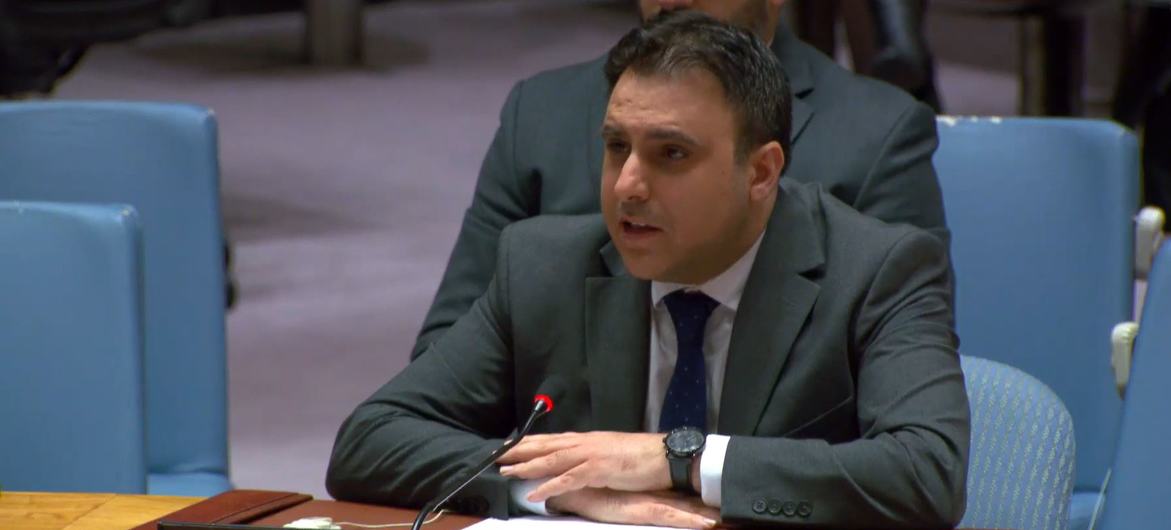
Majed Bamya, Deputy Permanent Observer of the Observer State of Palestine addressed the Security Council, stating that the killing of Palestinian civilians is “not a collateral effect” of war.

Majed Bamya, Deputy Permanent Observer of the Observer State of Palestine, addresses the Security Council.
United Nations
 
Majed Bamya, Deputy Permanent Observer of the Observer State of Palestine, addresses the Security Council.

“This Israeli assault relies, by design, on mass and indiscriminate killing of civilians. The humanitarian catastrophe is not the consequence of the war, it is a tool employed by Israel to pressure people and force them out,” he said.

He went on to note that the Council has called for the protection of civilians and for immediate, safe, unhindered and expanded humanitarian access to deliver assistance throughout the Gaza Strip, for respect for the laws of laws, and that it has rejected forced displacement.

“All of which require an immediate ceasefire that this Council has been prevented to call for, repeatedly,” he said, noting that Israeli has reacted with “disregard and disdain.”

“Why are they getting away with murder at this unprecedented scale,” he said, adding “because they were never held accountable.”

“That is why they confess to their crimes, that is why steal our lives, our land, our resources, our money, our past, our present and our future in broad daylight,” he said.

11:28 AM

All parties showing ‘reckless disregard’: Norwegian Refugee Council

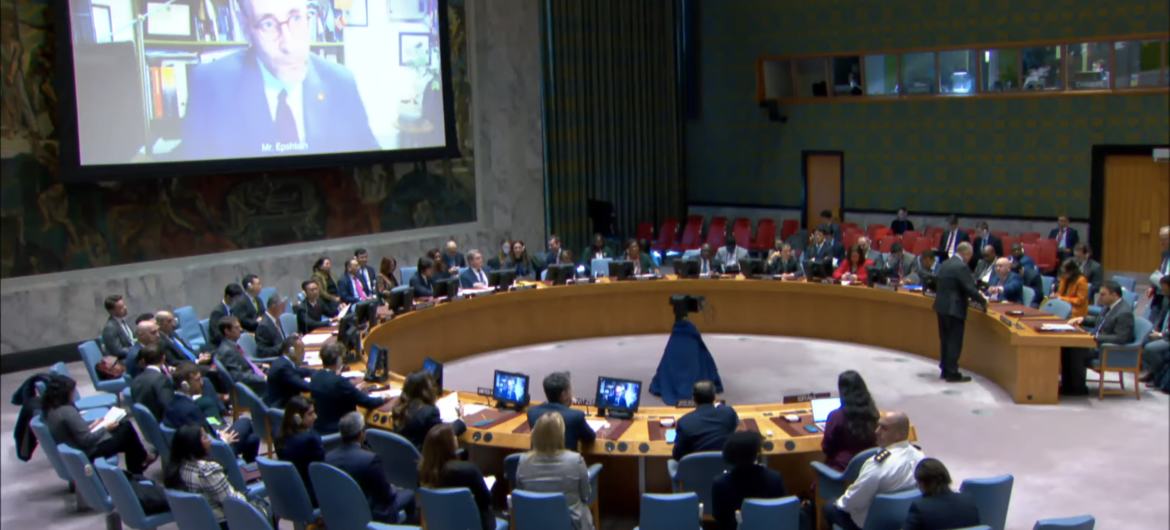
Itay Epshtain, Senior Advisor at the Norwegian Refugee Council (NRC), informed Council members of the legal observations that underpin the NRC’s response to the humanitarian crisis.

“Some capture serious violations that have been perpetrated and continue to occur, others relate to premeditated atrocities that should be prevented by this august Council,” he said, noting that all parties – Palestinians armed groups and Israel – have shown reckless disregard for the norms of international law, including the basic rules of international humanitarian law, “the very rules they must comply with in all circumstances, breached.”

He emphasized that the NRC has condemned the atrocious violence launched by Hamas against Israeli civilians and continues to call for the immediate release of all hostages. It also calls for humane treatment of Palestinians detainees, in keeping with international law.

“The same legal certainty must also mean a halt to the Israeli offensive from which ordinary Gazans have no refuge before it claims the lives of even more civilians, many of them women and children,” he said.

11:08 AM

Risk of spillover ‘remains high’: UN official

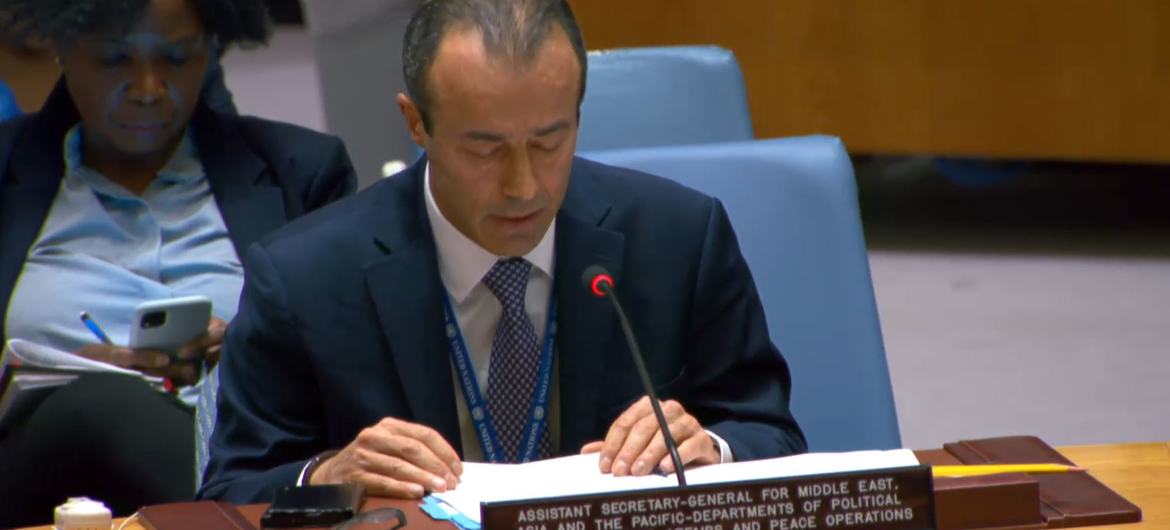
Khaled Khiari, Assistant Secretary-General for the Middle East at UN DPPA, informed Council members that the situation in the Middle East is alarming and continues to deteriorate, including “several interconnected theatres conflict”.

Khaled Khiari, Assistant Secretary-General, briefs the Security Council.
United Nations
 
Khaled Khiari, Assistant Secretary-General, briefs the Security Council.

He noted “intense” Israeli ground operations and fighting between Israeli forces and Hamas and other groups in most areas of Gaza, as Hamas and other Palestinian factions continue to fire rockets from Gaza into Israel.

“Civilians from both sides, particularly in Gaza strip currently, continue to bear the brunt of this conflict,” he said.

Reiterating the Secretary-General’s call for an immediate humanitarian ceasefire in Gaza, Mr. Khiari warned that the risk of regional spillover of this conflict with potential devastating consequences for the entire region “remains high” given also a multitude of actors involved.

He informed Council members of “continued daily exchanges” of fire across the Blue Line between Lebanon and Israel, posing a “grave risk” to regional stability.

“Increasingly, there have been strikes on civilian areas, with civilian casualties, on both sides of the Blue Line, in addition to a rising number of fatalities among combatants,” he added.

Mr. Khiari also noted attacks on US bases in Iraq and Syria, with the US conducting some airstrikes against groups suspected of these actions in Iraq and Syria. He also cited reports of Israeli air strikes inside Syria, as well as tensions in the Red Sea. 

11:05 AM

Meeting called to order

José Javier De La Gasca, Ambassador and Permanent Representative of Ecuador, which holds the Presidency of the Security Council for December, called the meeting to order.

Israel has been invited to the meeting, as has the been the Observer State of Palestine.

Khaled Khiari, Assistant Secretary-General for the Middle East, Asia and the Pacific, Department of Political and Peacebuilding Affairs; Marwan Muasher, Vice President for studies at Carnegie Endowment for International Peace and former Deputy Prime Minister of Jordan; and Itay Epshtain, Norwegian Refugee Council Special Advisor and Senior Humanitarian Law and Policy Consultant will brief the meeting.

10:35 AM

The United Arab Emirates (UAE), a non-permanent member called for the urgent meeting, and a senior UN official from the Department of Political and Peacebuilding Affairs (DPPA) is expected to brief ambassadors.

The meeting follows a resolution adopted last week by the Security Council calling for a scale-up in aid deliveries to civilians in the Gaza Strip. The resolution passed with 13 votes in favour, and the US and Russia abstaining.

Tensions in occupied West Bank

Earlier this month, Tor Wennesland, the UN Special Envoy for the Middle East Peace Process, voiced “deep concerns” over escalating tensions in the occupied West Bank, including East Jerusalem.

Briefing the Security Council on 19 December, he noted “intensified armed exchanges” between Palestinians and Israeli security forces, predominantly in the context of Israeli operations, which led to exceedingly high levels of fatalities and arrests.

Mr. Wennesland also expressed alarm at lethal attacks carried out by Israeli settlers against Palestinians and by Palestinians against Israelis in the occupied West Bank and Israel.

“All perpetrators of violence must be held accountable and swiftly brought to justice,” he stressed.

Humanitarian situation in Gaza

Meanwhile, the humanitarian situation in the enclave remains dire.

Earlier today, the UN Office for the Coordination of Humanitarian Affairs (OCHA) cited reports from Gazan health authorities that half of all the pregnant women seeking safety in shelters suffer from thirst, malnutrition and a lack of healthcare. There is a lack of vaccinations for newborns and one in every two displaced children faces dehydration, malnutrition and disease.

Some 1.9 million Gazans, or 85 per cent of the enclave’s population, have been internally displaced since the start of Israel’s retaliation following Hamas’ deadly terror attacks in southern Israel on 7 October

https://news.un.org/en/story/2023/12/1145182


https://creativecommons.org/licenses/by/3.0/legalcode

Rebuild trust and restore hope in 2024: UN chief’s call


Rebuild trust and restore hope in 2024: UN chief’s call

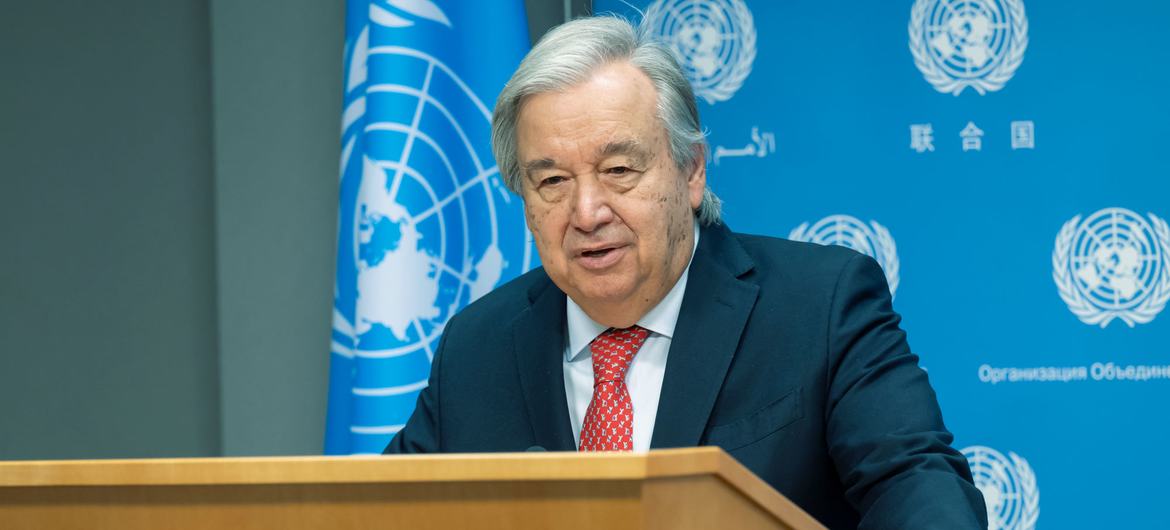
UN Secretary-General António Guterres.
UN Photo/Mark Garten
 
UN Secretary-General António Guterres.
28 December 2023
Peace and Security

United Nations Secretary-General António Guterres has called for global unity to make 2024 a year for “building trust and hope” following the immense suffering, violence, and climate chaos that characterized 2023.

“Humanity is strongest when we stand together. 2024 must be a year for rebuilding trust and restoring hope,” expressed Mr. Guterres in his New Year’s message.

“Let’s resolve to make 2024 a year of building trust and hope in all that we can accomplish together,” he urged, concluding with warm wishes for a happy and peaceful New Year

Secretary-General's New Year Message

Humanity in pain, planet in peril

In his message, the UN chief reflected on the pain and suffering afflicting humanity.  

Conflicts persist, claiming tens of thousands of civilian lives, many of them women and children. Millions have been driven from their homes, facing hunger and disease.

At the same time, “the planet is peril”, Mr. Guterres said, marked by record-breaking temperatures and worsening impacts of climate change.

“2023 has been a year of enormous suffering, violence, and climate chaos […] 2023 is the hottest year on record; people are getting crushed by growing poverty and hunger; wars are growing in number and ferocity,” noted the Secretary-General.

‘We must come together’

Mr. Guterres highlight the scarcity of trust and emphasized that “pointing fingers and pointing guns lead nowhere.”

“Humanity is strongest when we stand together […] We must come together across divides for shared solutions – for climate action, for economic opportunity and a fairer global financial system that delivers for all,” said Mr. Guterres.

Addressing discrimination and hatred poisoning relations between countries and communities, he stressed the importance of ensuring that new technologies, such as artificial intelligence, serve as forces for good.

“The United Nations will keep rallying the world for peace, sustainable development and human rights,” affirmed the UN chief.

“Let’s resolve to make 2024 a year of building trust and hope in all that we can accomplish together.”


https://news.un.org/en/story/2023/12/1145137


https://creativecommons.org/licenses/by/3.0/legalcode


пятница, 22 декабря 2023 г.

Security Council Requests UN Coordinator for Humanitarian Aid in Gaza, Adopting Resolution 2720 (2023) by Recorded Vote

9520TH MEETING (AM)
SC/15546

Security Council Requests UN Coordinator for Humanitarian Aid in Gaza, Adopting Resolution 2720 (2023) by Recorded Vote

Parties to Conflict Told to Allow Deliveries to Proceed ‘At Scale’

The Security Council today requested the Secretary-General to appoint a Senior Humanitarian and Reconstruction Coordinator for the Gaza Strip as it demanded the parties to the conflict to allow, facilitate and enable the immediate, safe and unhindered delivery of humanitarian assistance at scale directly to Palestinian civilians throughout that territory. 

Adopting resolution 2720 (2023) by a recorded vote of 13 in favour to none against, with 2 abstentions (United States, Russian Federation), the Council determined that the Coordinator will be responsible for facilitating, coordinating, monitoring and verifying, in Gaza, the humanitarian nature of all humanitarian relief consignments provided through States which are not parties to the conflict.

It further requested that the Coordinator establish a United Nations mechanism for speeding up the provision of humanitarian relief consignments to Gaza through States which are not party to the conflict, and in consultation with all relevant parties.  In that regard, it demanded that the parties to conflict cooperate with the Coordinator to fulfil their mandate without delay or obstruction.

Through its resolution, the Council demanded that the parties to the conflict allow and facilitate the use of all available routes to and throughout the entire Gaza Strip, including border crossings — and including full and prompt implementation of the announced Karem Abu Salem/Kerem Shalom border crossing — for the provision of humanitarian assistance.  This is to ensure that humanitarian personnel and assistance — including fuel, food and medical supplies and emergency shelter assistance — reaches the civilian population in need throughout the Gaza Strip without diversion and through the most direct routes, according to the terms of the resolution.

Through the text, the Council reiterated its demand — contained in resolution 2712 (2023), adopted on 15 November — that all parties to the conflict comply with their obligations under international law, including international humanitarian law.  It also demanded the immediate and unconditional release of all hostages as well as ensuring humanitarian access to address the hostages’ medical needs. It further demanded the provision of fuel to Gaza at levels that will meet humanitarian needs.  In addition, the Council requested that the Coordinator report to the Council on their work within 20 days, and then every 90 days thereafter through 30 September 2024.

Prior to adoption, the Council failed to adopt an amendment put forth by the Russian Federation owing to the United States casting a veto.  It would have had the Council call for an urgent suspension of hostilities to allow safe and unhindered humanitarian access, and for urgent steps towards a sustainable cessation of hostilities.  The vote was 10 in favour to 1 against (United States), with 4 abstentions (Albania, Japan, Switzerland, United Kingdom).

The United Arab Emirates’ representative, whose delegation presented the resolution, called it the product of extensive consultations between members of the Council and concerned parties.  “The purpose of this text is very simple:  It responds with action to the dire humanitarian situation on the ground for the Palestinian people bearing the brunt of this conflict while protecting those who are trying to deliver life-saving aid, and it demands the urgent release of the hostages and for humanitarian access to address their medical needs,” she said. 

“This was tough, but we got there,” the United States’ representative said.  Through the text, the Council can provide a glimmer of hope in a sea of unimaginable suffering.  She emphasized that international humanitarian law applies both to Israel and Hamas, which she described as a terror group that instigated the conflict and wages war from inside homes, hospitals and United Nations facilities.

The Permanent Observer of the State of Palestine said that so far, 20,000 Palestinians — almost half of them children — have been killed in Gaza, with another 2 million people forcibly displaced.  Israel’s objective is “no future for Palestinians in Palestine”, he asserted.  He called the Israeli military “a rogue army, unhinged and empowered by the impunity it enjoys, certain that it will not be held accountable.”  Only an immediate ceasefire can stop the war crimes, crimes against humanity and genocide under way in Gaza, he added.

Israel’s representative said that it has been 77 days since Hamas terrorists murdered, raped and mutilated 1,300 Israelis and took 250 hostages, yet the Council issued not one statement condemning that group and its atrocities.  He also noted that the remaining 150 hostages held by Hamas are not even allowed visits by the International Committee of the Red Cross (ICRC).  Israel already facilitates hundreds of truckloads of aid into Gaza every day and it could expand that.  However, UN monitoring of aid deliveries cannot be done at the expense of Israel’s security inspections, as Israel will not permit the regrouping and rearming of Hamas, he emphasized.

Egypt’s representative called today’s resolution is a step in the right direction to ensure that aid will be delivered and that humanitarian work will not remain hostage to the will of the occupying Power.  He emphasized that this first step should be followed by many others, including obliging Israel to unconditionally halt hostilities throughout Gaza. 

The Russian Federation’s representative called today a tragic moment for the Council, not one of triumph.  He stated that he would have vetoed the text had it not been supported by several Arab States.  He categorically disagreed with the content of operative paragraph 2, saying:  “We will not put our names to this.” 

France’s representative said the Council could have been more ambitious in its language regarding a ceasefire.  On the importance of observing international humanitarian law, she called on the Council to condemn terrorist attacks and sexual violence by groups such as Hamas.  “It is incomprehensible that this Council has still not been able to do so,” she said.

Statements

LANA ZAKI NUSSEIBEH (United Arab Emirates), in a statement prior to action, said that a recent visit to the Gaza Strip by Security Council members left an indelible impression of the desperate situation on the ground.  Unless the Council takes drastic action, there will be famine in Gaza, she warned, adding that there is a real risk of a regional spillover of the conflict. Efforts by Egypt to mitigate the situation are admirable, but there must be an international response.  The draft resolution before the Council is the product of extensive consultations and engagements between Council members and concerned parties, in particular Egypt and Palestine, she said.

“The purpose of this text is very simple:  It responds with action to the dire humanitarian situation on the ground for the Palestinian people bearing the brunt of this conflict while protecting those who are trying to deliver life-saving aid — and it demands the urgent release of the hostages and for humanitarian access to address their medical needs.”  The text, which builds on resolution 2712 (2023), is not perfect and only a ceasefire will end the suffering.  Today’s text responds to calls for a sustainable cessation of hostilities and a massive scaling-up of humanitarian aid.  “Often, in diplomacy, the challenge is meeting the moment in the world we live in, not in the world that we want — and we will never tire of pushing for full humanitarian ceasefire,” she said.

VASSILY A. NEBENZIA (Russian Federation) accused the United States of sabotaging the Council’s adoption of the draft resolution proposed by the United Arab Emirates.  It had given the Council an ultimatum:  either adopt a text convenient for Washington or face another veto.  He proposed an amendment to operative paragraph 2, replacing the phrase “and in this regard calls for urgent steps to immediately allow safe, unhindered and expanded humanitarian access and to create the conditions for a sustainable cessation of hostilities” with “and in this regard calls for an urgent suspension of hostilities to allow safe and unhindered humanitarian access, and for urgent steps towards a sustainable cessation of hostilities”.  Urging Council members to vote for this amendment — “the lowest common denominator” — he said it could be a moment of truth to show real support the people of Gaza and to end the violence there.

The Council then failed to adopt the proposed amendment by a vote of 10 in favour to 1 against (United States), with 4 abstentions (Albania, Japan, Switzerland, United Kingdom), owing to the negative vote of a permanent member.

LINDA THOMAS-GREENFIELD (United States), noting that she voted against the proposed amendment, said that the draft resolution calls for urgent steps to immediately allow unhindered and expanded humanitarian access into Gaza and to create the conditions for the cessation of hostilities.  “This is a strong step forward,” she said.

The Council then adopted draft resolution S/2023/1029 (to be issued as document S/RES/2720(2023)) by a recorded vote of 13 in favour to none against, with 2 abstentions (Russian Federation, United States).

Ms. THOMAS-GREENFIELD (United States) said:  “This was tough, but we got there.”  Since the start of the conflict, the United States has worked tirelessly to alleviate the humanitarian crisis, get life-saving assistance into Gaza and get hostages out, and push for protection of innocent civilians and humanitarian workers. “Today’s vote bolsters those efforts and lends support to our direct diplomacy.”  She thanked the United Arab Emirates and others for “working with us in good faith to craft a strong humanitarian-focused resolution”.  As a result, the Council can provide a glimmer of hope in a sea of unimaginable suffering.  She added that international humanitarian law applies not only to Israel, but also to Hamas, a terror group that instigated the conflict and wages war from inside homes, hospitals and United Nations sites.  Welcoming the call for the appointment of a senior UN official to expedite delivery of humanitarian aid, she said that she was appalled that the Council was once again unable to condemn Hamas’ horrific terrorist attack on 7 October. 

BARBARA WOODWARD (United Kingdom), welcoming the resolution’s adoption, noted that the United Kingdom has tripled its aid to the region. It was also the first country to call on Israel to open more crossings and to deploy experts to provide logistical support at Al-Arish in Egypt.  The text will streamline aid checks so as to massively scale-up the humanitarian response.  It will also, “for avoidance of doubt”, stipulate that such aid is without prejudice to the rights and obligations of parties under international humanitarian law.  Today’s adoption is an important signal of the Council’s commitment, and its actions — both today and in the future — must help ensure that the horror of 7 October never happens again.  Condemning Hamas’ acts of terror and supporting Israel’s right to self-defence, she added that the United Kingdom supports a two-State solution that guarantees true security and stability for both Israelis and Palestinians.

SÉRGIO FRANÇA DANESE (Brazil) said that the time for a humanitarian response in Gaza is now and not tomorrow or whenever the conflict ends.  After more than 70 days of hostilities, the situation is dire.  The remaining hostages must be released immediately and civilians and civilian facilities must be protected.  “This is not just a moral or ethical choice — it is an obligation under international humanitarian law as is humanitarian access.”  Humanitarian aid allowed into Gaza must be substantially increased and should contain all essential items, including fuel, he said, calling for full implementation of the resolution.

VANESSA FRAZIER (Malta) said that the resolution, as well as resolution 2712 (2023), must be fully implemented.  She emphasized the urgent need for an immediate ceasefire and called for compliance with international law, the protection of civilians and medical personnel, and accountability for violators.  Implementation of a monitoring mechanism should not hinder humanitarian assistance, she said, adding:  “On the contrary it should rapidly and efficiently facilitate it.”  She went on to emphasize the importance of political engagement for lasting peace and support the resolution’s commitment to a two-State solution.

DAI BING (China) said that for reasons known to all, the draft resolution contained several adjustments touching on important aspects which did not meet the expectations of Member States.  However, the Council’s action offers at least a glimmer of hope.  Whether this glimmer can be truly felt by the people of Gaza depends on whether the resolution can be effectively implemented. “We expect urgent action to be taken,” he said, expressing hope that the monitoring mechanism will be put in place. Only a ceasefire can prevent political settlement prospects from being completely destroyed, he said, adding that for this reason, China voted in favour of the Russian Federation’s proposed amendment.

YAMAZAKI KAZUYUKI (Japan) said that the catastrophic humanitarian situation in Gaza needs urgent attention and meaningful action by the Council.  Japan voted in favor of the resolution as the people in Gaza cannot wait any longer.  Calling for the immediate and unconditional release of all hostages, he said that he hoped that the resolution will be a first step towards real change on the ground.  He acknowledged serious diplomatic efforts by the United States to improve the situation on the ground and cited the entry of humanitarian convoys through the Kerem Shalom crossing.  However, gunfire and bombardments must stop immediately in order to allow meaningful humanitarian operations, he said.

PASCALE CHRISTINE BAERISWYL (Switzerland) said that images from the Rafah crossing illustrate that the civilian population is desperate and requires immediate support from the international community to survive.  Today’s resolution, along with the opening of the Kerem Shalom crossing, will help, she said, adding that the resolution provides for the appointment of a humanitarian and reconstruction coordinator and a UN mechanism to ensure that humanitarian aid reaches those in need as soon as possible.  The text also calls for conditions to be created for a lasting ceasefire that does not prejudice Israel’s right to defend its security. Further, it is complementary to international humanitarian law, according to which all parties to conflict must authorize and facilitate rescue operations to help populations in need, she said.

FERIT HOXHA (Albania) said the resolution marks an important step forward.  Albania would have liked a more robust text, but the resolution adopted today has notable merits.  He welcomed the establishment of a clear and straightforward mechanism to allow unhindered access for humanitarian assistance at scale for the people in Gaza.  “Countless families are in dire need.  They must be helped now, today and every day,” he said, adding that it is urgent for the United Nations to act.  He called for the resolution’s speedy and full implementation, adding that Albania’s vote in favour of the text should not be misused by Hamas as condoning the unacceptable and unjustifiable.

NATHALIE BROADHURST ESTIVAL (France) said that the Council could have been more ambitious in its language regarding a ceasefire.  France has consistently advocated for an immediate and durable humanitarian truce that leads to a lasting ceasefire.  Additionally, France mobilized the international community during the international humanitarian conference in November, which gathered more than €1 billion in pledges from Western nations.  Emphasizing the importance of observing international humanitarian law, she called on the Council to condemn terrorist attacks and sexual violence by groups such as Hamas.  “It is incomprehensible that this Council has still not been able to do so,” she said.

DOMINGOS ESTÊVÃO FERNANDES (Mozambique) said that his delegation’s vote in favour reflected Mozambique’s commitment to the principle of protection of civilians during any armed conflict.  While the resolution is not a perfect text, it is an effort to respond to the critical role of humanitarian personnel in providing aid to civilians affected by the conflict.  Having visited the Rafah hospital and the Rafah crossing border, his delegation “could see with our eyes and feel with our own hearts” the tragedy of the Palestinian people, he said.

HAROLD ADLAI AGYEMAN (Ghana) said that while it is time for hostilities to end, his delegation voted in favour of the resolution because with so many lives lost - mostly women and children — and many more on the verge of starvation, famine and pestilence, it is imperative to take every opportunity to save lives and facilitate humanitarian access.  All parties to the conflict have an obligation to comply with international law, in particular as it impacts civilians, and to protect UN personnel and premises.  He urged the easing of all rigid procedures to speed up delivery of humanitarian aid and reiterated the call for the immediate, unconditional release of all hostages.  Going forward, the Council cannot lose sight of its historical responsibility for the implementation of the two-State solution “even in this most darkest of moments”.

Mr. NEBENZIA (Russian Federation), recalling the vote on his delegation’s proposed amendment, said that the United States exposed its true face to the world by blocking an extremely weak call for a cessation of hostilities in Gaza.  Today is a tragic moment for the Council, not one of triumph.  Essentially, the Council was being asked not to get in the way while the United States “goes around twisting arms in the region”.  Noting that his delegation would have vetoed the text if it was not supported by several Arab States, he said the Arab world can take decisions and bear responsibility for them.  However, he categorically disagreed with the content of operative paragraph 2, stressing:  “We will not put our names to this.”  Implementing a Council resolution in Gaza is impossible absent a ceasefire, as the experience of resolution 2712 (2023) has shown, he said, stating that the Council will return to this issue and unambiguously demand a cessation of hostilities.

Ms. NUSSEIBEH (United Arab Emirates), welcoming the adoption of resolution 2720 (2023), said that she was grateful for the Council’s support. “The text compels the international community to finally share in the burden that Egypt has been shouldering and it commits all of us to breaking the cruel blockade strangling Gaza for the last 16 years.”  Every instance of progress serves a reminder of the scale of the tragedy.  However, “we are still unable to stop the war” and Palestinians are being asked to accept that diplomacy is the art of what is possible.  But what is possible is not predetermined; it is the product of active choices.  “The collective choices of this Council, influenced by its structure, has shaped this grim reality.  They can help shape a different future,” she said.

JOSÉ JAVIER DE LA GASCA (Ecuador), Council President for December, speaking in his national capacity, said that today’s adoption was the outcome of careful negotiations, good faith and the constructive spirit.  Recalling last week’s visit to the Rafah crossing by Council members, he said the humanitarian situation in Gaza is “disastrous and despairing”.  Today’s resolution aims to significantly increase the quantity of aid going into Gaza; it also calls for increased humanitarian access.  “This resolution in no way contravenes the previous resolution 2712 (2023) and should be seen as an additional step towards the urgent need for a ceasefire.”  Reiterating his condemnation for Hamas’s actions on 7 October, he said that today’s resolution should have explicitly mentioned that it is that group which is holding the hostages.

RIYAD H. MANSOUR, Permanent Observer of the State of Palestine, said that since the start of the war, 20,000 Palestinian people — almost half of them children — have been killed, plus 60,000 wounded and 2 million forcibly displaced.  Today’s resolution will allow the Palestine Red Crescent, Palestinian medical and civilian rescue teams and United Nations Relief and Works Agency for Palestine Refugees in the Near East (UNRWA) personnel to save human lives.  Referring to a statement by the Deputy Head of the Civil Administration of Israel on 4 November, he said that Israel’s goal and true objective is “no future for Palestinians in Palestine”.  Furthermore, Israel also targets storytellers and journalists, he said, adding:  “Israel’s target is not only the past and the present of our people, but indeed the future.”

He drew attention to the killing by Israeli troops of three Israeli hostages in Gaza as well as to the ongoing ill treatment and mass arrests of Palestinians.  “Those are the soldiers of a rogue army, unhinged and empowered by the impunity it enjoys, certain that it will not be held accountable.”  Death in all of its manifestations is everywhere in Gaza and the Council resolution just adopted seeks to address this inhumane situation. Noting that the Council took 75 days to “finally utter the words ‘cessation of hostilities’”, he added:  “There is no way to stop the war crimes, crimes against humanity and genocide under way but [for] an immediate ceasefire.”

BRETT JONATHAN MILLER (Israel) recalled that it once took the Council one day to condemn an act of terror in Iran and to express its sympathy for the victims and their families.  On the other hand, 77 days after Hamas intentionally murdered, raped and mutilated 1,300 Israelis and took 250 hostages, the Council has yet to issue a single statement condemning that group and its atrocities. While humanitarian aid is pouring into Gaza, the remaining 150 hostages held by Hamas are not even allowed visits by the International Committee of the Red Cross (ICRC) — “the most heinous war crime imaginable”. Israel is already facilitating hundreds of truckloads of aid into Gaza every day, and it is willing and able to exponentially increase its entry.  However, any enhancement of UN aid monitoring cannot be done at the expense of Israel’s security inspections, he said. 

Israel will not permit the regrouping and rearming of Hamas, as its 7 October atrocities cannot be repeated, he continued. Israel recently exposed another four-kilometre terror tunnel in Gaza, located 50 metres underground, he noted. For years and countless times, Israel met with officials to outline Hamas’s growing terror threat, “but our words fell on deaf ears.”  Just as the Council is committed to increasing aid, it should be committed to supporting Israel’s mission to return the hostages, block the smuggling of arms to terrorists and ensure that aid is not diverted to terrorists.  Any resolution should hold Hamas accountable, as it is a genocidal terror organization and a direct threat to Israel, Gazans and regional stability, he said.

OSAMA MAHMOUD ABDELKHALEK MAHMOUD (Egypt) said that today’s resolution is a step in the right direction to address the humanitarian impact of the war in Gaza.  It will ensure that aid will be delivered, unhindered, through a mechanism under UN supervision so that humanitarian work will not remain hostage to the will of the occupying Power.  Gaza is starving and houses, hospitals and medical facilities are being destroyed, accompanied by continued settler attacks in the West Bank and East Jerusalem that could lead to spreading violence.  Now that the Council has adopted a resolution, UN agencies and bodies must implement it without delay by drawing up a comprehensive plan to translate the text into a functioning, effective mechanism in full coordination with the international community, he said.

“This is a first step,” he continued, emphasizing that it should be followed by many others, including obliging Israel to unconditionally halt hostilities throughout Gaza.  All efforts aimed at alleviating the humanitarian crisis will only bear fruit if the Council implements a binding resolution concerning a comprehensive, lasting ceasefire.  He also pointed out that today’s resolution is not confined to humanitarian issues, as it also stresses that international law obligations should be respected, that civilians should not be forcibly transferred and that the unity of Palestinian territory in the Gaza Strip and the West Bank should be respected.  These are not less important than the humanitarian aspects, he said, reiterating the importance of realizing the legitimate aspirations of Palestinians


https://press.un.org/en/2023/sc15546.doc.htm


https://creativecommons.org/licenses/by/3.0/legalcode

Press Conference by Secretary-General António Guterres at United Nations Headquarters

SG/SM/22095

Press Conference by Secretary-General António Guterres at United Nations Headquarters

Following is the transcript of UN Secretary-General António Guterres’ press conference, in New York today:

Secretary-General:  Over the last weeks and days, there has been no significant change in the way the war has been unfolding in Gaza.  There is no effective protection of civilians.

Intense Israeli bombardment and ground operations continue. More than 20,000 Palestinians have reportedly been killed, the vast majority women and children.

Meanwhile, Hamas and other Palestinian factions continue to fire rockets from Gaza into Israel.  Some 1.9 million people — 85 per cent of Gaza’s population — have been forced from their homes.

The health system is on its knees.  Hospitals in the south are dealing with at least three times their capacity.  In the north, they are barely operational.  One colleague described the deathly silence of a hospital with no medication or treatment for its sick and injured patients.

According to the World Food Programme, widespread famine looms. More than half a million people — a quarter of the population — are facing what experts classify as catastrophic levels of hunger.  Four out of five of the hungriest people anywhere in the world are in Gaza.

And clean water is at a trickle.  UNICEF [United Nations Children’s Fund] found that displaced children in the south have access to just 10 per cent of the water they need. In these desperate conditions, it is little wonder that many people cannot wait for humanitarian distributions and are grabbing whatever they can from aid trucks.

As I warned, public order is at risk of breaking down. Humanitarian veterans who have served in war zones and disasters around the world — people who have seen everything — tell me they have seen nothing like what they see today in Gaza.

Israel began its military operation in response to the horrific terror attacks launched by Hamas on 7 October.  Nothing can possibly justify those attacks or the brutal abduction of some 250 hostages.  I repeat my call for all remaining hostages to be released immediately and unconditionally.

And nothing can justify the continued firing of rockets from Gaza at civilian targets in Israel or the use of civilians as human shields.

But at the same time, these violations of international humanitarian law can never justify the collective punishment of the Palestinian people, and they do not free Israel from its own legal obligations under international law.

Many people are measuring the effectiveness of the humanitarian operation in Gaza based on the number of trucks from the Egyptian Red Crescent, the UN and our partners that are allowed to unload aid across the border.

This is a mistake.  The real problem is that the way Israel is conducting this offensive is creating massive obstacles to the distribution of humanitarian aid inside Gaza.

An effective aid operation in Gaza requires security; staff who can work in safety; logistical capacity; and the resumption of commercial activity.  These four elements do not exist.

First, security.  We are providing aid in a war zone.  The intense Israeli bombardment and active combat in densely populated urban areas throughout Gaza threaten the lives of civilians and humanitarian aid workers alike. We waited 71 days for Israel finally to allow aid to enter Gaza via the Kerem Shalom crossing.  The crossing was then hit while aid trucks were in the area.

Second, the humanitarian operation requires staff who can live and work in safety.  One hundred thirty-six of our colleagues in Gaza have been killed in 75 days — something we have never seen in the history of the United Nations.  Nowhere is safe in Gaza.

I honour the women and men who have made the ultimate sacrifice, and I pay tribute to the thousands of humanitarian aid workers who are risking their health and lives in Gaza, even as I speak.

Most of our staff have been forced from their homes.  All of them spend hours each day simply struggling to survive and support their families.  It is a miracle that they have been able to continue working under these conditions.

And yet, those same colleagues are expanding humanitarian operations in southern Gaza to support people living there, while trying to assist the flood of displaced people who arrived from the north — with nothing.

They are currently providing aid in Rafah, western Khan Younis, Deir El Balah and Nuseirat in the south, and doing their best to reach the north despite huge challenges, namely security.  In these appalling conditions, they can only meet a fraction of the needs.

Third, logistics.  Every truck that arrives at Kerem Shalom and Rafah must be unloaded, and its cargo re-loaded for distribution across Gaza.  We ourselves have a limited and insufficient number of trucks available for this.  Many of our vehicles and trucks were destroyed or left behind following our forced, hurried evacuation from the north, but the Israeli authorities have not allowed any additional trucks to operate in Gaza. This is massively hampering the aid operation.

Delivering in the north is extremely dangerous due to active conflict, unexploded ordnance, and heavily damaged roads.  Everywhere, frequent communications blackouts make it virtually impossible to coordinate the distribution of aid, and to let people know how to access it.

Fourth and finally, the resumption of commercial activities is essential.  Shelves are empty; wallets are empty; stomachs are empty.  Just one bakery is operating in the whole of Gaza.  I urge the Israeli authorities to lift restrictions on commercial activity immediately.  We are ready to scale up our cash grant support to vulnerable families — the most effective form of humanitarian aid.  But in Gaza, there is very little to buy.

In the circumstances I have just described, a humanitarian ceasefire is the only way to begin to meet the desperate needs of people in Gaza and end their ongoing nightmare.  I hope that today’s Security Council resolution may help this finally to happen but much more is needed immediately.

Looking at the longer-term, I am extremely disappointed by comments from senior Israeli officials that put the two-State solution into question.  As difficult as it might appear today, the two-State solution, in line with UN resolutions, international law and previous agreements, is the only path to sustainable peace.

Any suggestion otherwise denies human rights, dignity and hope to the Palestinian people, fuelling rage that reverberates far beyond Gaza.  It also denies a safe future for Israel.

The spillover is already happening.  The occupied West Bank is at a boiling point.  Daily exchanges of fire across the Blue Line between Lebanon and Israel pose a grave risk to regional stability.

Attacks and threats to shipping on the Red Sea by the Houthis in Yemen are impacting shipping with the potential to affect global supply chains.  Beyond the immediate region, the conflict is polarizing communities, feeding hate speech and fuelling extremism.  All this poses a significant and growing threat to global peace and security.  As the conflict intensifies and the horror grows, we will continue to do our part.

We will not give up.  But at the same time, it is imperative that the international community speak with one voice:  for peace, for the protection of civilians, for an end to suffering, and for a commitment to the two-State solution — backed with action.  Thank you.

**Questions and Answers

Spokesman:  Thank you. Anade, Al Jazeera.

Question:  Thank you very much, Secretary-General, Anade Situma, Al Jazeera English.  On behalf of the UN Correspondence Association, thank you very much for this briefing.  My question to you, it’s been over two weeks since you invoked Article 99, and up until this point, until today, the Security Council has failed to act, and we haven’t seen a resolution until the resolution we just saw passed.  This resolution calls for increase to aid, but it does not join your call for a ceasefire.  When you invoked Article 99, were you hoping for more urgency on the part of the Security Council and perhaps even for them to join your call for a ceasefire?

Secretary-General:  Of course, I was hopeful.  That doesn’t mean that things happen according to our hopes.  But in any case, today, you can see, always, a glass as half full or half empty.  I hope that today’s resolution will make people understand that a humanitarian ceasefire is indeed something that is needed if we want humanitarian aid to be effectively delivered.

Spokesman:  Linda, then Joe.

Question:  Secretary-General, on behalf of NPR, I was just wondering, the resolution calls for both sides to allow unhindered safe delivery of aid.  We know the status, more or less, about Israel’s role.  I was wondering on the other side in terms of Hamas, how significant is Hamas’ control or not allowing access to aid to the people?

Secretary-General:  Well, we have condemned all violations of international humanitarian law.  Violations by Hamas in relation to civilian shields or in relation to the rockets sent to Israel.  And the violations done by Israel through these relentless bombardments and the fact that we are having a toll of civilians that is totally unprecedented in all conflicts I’ve seen until now.  So obviously, that is why a ceasefire is needed, to stop all obstacles coming from wherever they come — a humanitarian ceasefire.

Question:  But I’m sorry, again, but just how significant is Hamas’ denial of access to aid? I mean, is it minor?  Or is it, you know, a medium amount?

Secretary-General:  I think it is one of the contributions that needs to be taken into account.

Spokesman:  Joe and then…

Secretary-General:  But it’s obviously not the major factor when we look at the situation today in Gaza.

Correspondent:  Yeah, it’s Joseph Klein of Canada Free Press.  First, I want to wish you and your family a very happy holiday.

Secretary-General:  Happy holiday, too.

Question:  Thank you. My question also involves Hamas.  Do you realistically think that a viable, sustainable, two-State solution is possible as long as Hamas exists, with their threats to repeat October 7 over and over again?  And what is your comment on the fact that Israel has offered, I believe it is, at least a seven-day pause to allow the release of more hostages and more aid to come into Gaza?  But Hamas has flatly turned that down.  They’re demanding a complete permanent ceasefire.  Thank you.

Secretary-General:  First of all, I do believe that we need a humanitarian ceasefire, that has been what I believe it is needed.  But of course, we are favourable to any pause that can lead to improvement in humanitarian aid and to the exchange of prisoners.  And we know that negotiations are taking place.  I’ve been actively in contact with Qatar, with Egypt and with others. And I hope that these negotiations will be able to lead to new opportunities for the release of hostages, but our position in relation to the release of hostages is very clear.  We believe that there must be an immediate and unconditional release of hostages.

Your first question was…?

Question:  Yeah.  Well, my first question, they kind of relate to each other.  The first question was whether you believe…?

Secretary-General:  Ah, yes.

Question:  Realistically that there could be a two-State solution as long as Hamas exists.  And then responding to the second question, I specifically would be interested in knowing your comment on Hamas’ refusal to accept even a seven-day pause.  They want all or nothing.

Secretary-General:  I mean, both sides, apparently, want all or nothing.  And that is why we do not manage to have an agreement.  I think it’s important to have a spirit of compromise. But the first question is very important.  We believe that the legitimate representative of the Palestinian people is the Palestinian Authority.  And what we want to see is the creation of conditions that will allow the Palestinian Authority to assume responsibilities in Gaza and that is, in our opinion, the solution to allow for the two-State solution to become a reality.

Spokesman:  Denis, then Dezhi, then we’ll close it.

Question:  Denis Akishev, TASS News Agency.  Turning back from Gaza.  What is the current situation with the Grain Deal?  And do you plan to communicate with Russian officials or maybe with [the] Russian [Federation] President Vladimir Putin?

Secretary-General:  Sorry the…?

Spokesman:  The Grain Deal.

Secretary-General:  We have been in contact with both sides, trying to explore new forms that — I don’t think the repetition of the Grain Deal would make sense — but I’m a strong believer that it would be very interesting if we would be able to have conditions for freedom of navigation in the Black Sea.

Spokesman:  And last question.  Dezhi?

Question:  Sir?

Spokesman:  No, sorry. Dezhi, last question.

Question:  Secretary-General, Dezhi Xu with China Central Television.  Let me ask you a broader picture question.  It seems like in 2023, it seems very chaotic.  We have two conflicts going on.  We have SDGs [Sustainable Development Goals] even driving away further and the United Nations and you yourself has been put into a huge pressure.  Where’s the silver lining?  What kind of hope do you see for 2024?

Secretary-General:  Well, we have, in the UN, a very important process taking place, The Summit of the Future. And in The Summit of The Future, I hope it will be possible for us to agree on a new agenda for peace with a moralistic approach to prevention.  We had, yesterday, a very important victory in the Security Council.  After many years in which I’m fighting for the need to have peace-enforcing operations done by our African partners of the African Union, with mandates by the Security Council and assessed contributions, it was possible to have a resolution of the Security Council that creates the possibility of funding at 75 per cent.  It was one of the key elements of the Agenda for Peace, but there are many others.  On the other hand, we have already… we will be publishing, I believe today, the report of our high-level panel on artificial intelligence.  And I hope it will be possible to have some form of networked governance of artificial intelligence with flexibility, of course, taking into account different situations around the world, but that will create more opportunities for artificial intelligence to be a force for good and minimize the risks of artificial intelligence.  And I hope to see the UN in the centre of that effort.

We have, simultaneously, a number of other very important questions on the table, in which Member States will be able to take decisions in relation to participation of youth and future generations in decision-making, in relation to the reform of the international financial system, reform of the Security Council.  So, I see that, independently of the crises that are happening, I see that there is a dynamic effort within the UN to look seriously into the need to reform multilateralism and to make multilateralism stronger and more effective in a world that is becoming multipolar — but multipolarity will not guarantee peace, if there is not the stressing of multilateral governance institutions.  So, I’m very optimistic about the work that can be done within the UN, knowing that some of these crises that you mentioned will be very difficult to overcome.

Spokesman:  Thank you very much.

Secretary-General:  Thank you.

Correspondent:  Thank you.


https://press.un.org/en/2023/sgsm22095.doc.htm

https://creativecommons.org/licenses/by/3.0/legalcode

Security Council poised to vote on Gaza resolution calling for urgent, safe and unhindered flow of aid


Security Council poised to vote on Gaza resolution calling for urgent, safe and unhindered flow of aid

A view of the Security Council meeting on the situation in the Middle East on 8 December 2023.
UN Photo/Loey Felipe
 
A view of the Security Council meeting on the situation in the Middle East on 8 December 2023.
21 December 2023Peace and Security

After intense negotiations all week behind closed doors at the 15-member Security Council, ambassadors continued consultations into Thursday evening over the latest version of a draft resolution penned by the United Arab Emirates which reportedly calls for urgent steps to allow safe and unhindered delivery of aid to stricken civilians in the Gaza Strip. The United States said it would support the latest draft if the text remained the same, with a vote now anticipated on Friday. 

8:30 PM

The US ambassador Linda Thomas-Greenfield emerged from the closed door meeting telling reporters that after working hard over the past week, her country was ready to vote on a draft resolution, if compromises made remained in the latest draft.

7.15 PM

Ambassadors are still locked in consultations over the latest draft resolution and it is looking unlikely that they will head into the chamber tonight.

6:10 PM

Council members are in closed consultations on the draft resolution. 

5:55 PM

It's been a day of intense activity in and around the Security Council at UN Headquarters but it does now look as if ambassadors are going to go into consultations at the top of the hour, to try and bring the United States on board with a further amended draft which it is hoped will provide new impetus to boost the flow and speed of lifesaving aid to Gazans.

The last draft to go up for a vote was vetoed by the US on 8 December, which was quickly followed by action in the UN General Assembly four days later, when Member States voted by an overwhelming majority in favour of an immediate humanitarian ceasefire, through a non-binding resolution.

The Emergency Special Session of the Assembly resumed and then adjourned on Wednesday with dozens of countries making statements on the crisis.

Avoiding another veto

The Council has been negotiating throughout the week to find language which will avoid a further US veto, having first introduced a draft which called for a “cessation of hostilities”, which now calls for a “suspension” of fighting, to vastly increase access for lifesaving aid.

The US argued on Tuesday and in previous deadlocked sessions that any resolution must condemn the Hamas extremist group’s terror attacks of 7 October which sparked this deadly and unprecedented surge in the Palestine-Israel conflict, and which led to around 1,200 deaths in southern Israel and the capture of more than 200 hostages by extremists, dozens of whom remain captive in Gaza.

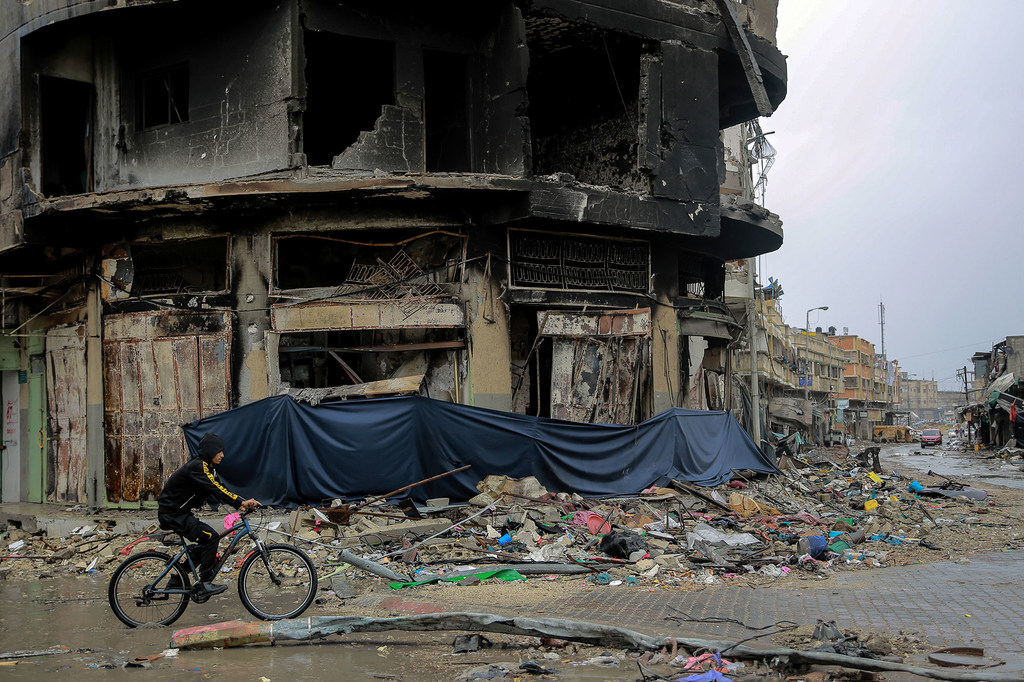
A boy cycles through the heavily bombarded Asqola neighbourhood of Gaza City.
© UNICEF/Omar Al-Qattaa
 
A boy cycles through the heavily bombarded Asqola neighbourhood of Gaza City.

Some countries critical of Israel’s offensive have argued in response that any resolution condemning Hamas, must also condemn the Israeli occupation and the thousands of civilian deaths resulting from Israel’s military action since 7 October.

According to media reports, a further sticking point for diplomats negotiating the draft resolution has been the setting up of a UN monitoring mechanism which would be responsible for assessing the effectiveness of aid delivery at scale, independent of either Israeli or Hamas authorities in Gaza.

Situation in Gaza

Latest casualty figures from authorities in Gaza report around 20,000 civilian deaths since the Israeli retaliatory bombardment and offensive began, most of them women and children.

As of Thursday there are no functioning hospitals left in the north of the enclave and injured parents stranded in facilities are "waiting to die" there, according to the UN health agency WHO.

Tuesday’s meeting

On Tuesday as the Council met to discuss the crisis in the Middle East in a scheduled debate, the UN Special Envoy for the peace process said the whole humanitarian system was “on the brink” of collapse, and also voiced deep concern at the deteriorating situation for Palestinians in the occupied West Bank.

“I reiterate that security forces must exercise maximum restraint and use lethal force only when it is strictly unavoidable to protect life,” Tor Wennesland stressed.


https://news.un.org/en/story/2023/12/1145022


https://creativecommons.org/licenses/by/3.0/legalcode

Security Council Opens Door to UN Funding for African-led Peace Missions, Unanimously Adopting Resolution 2719 (2023)

9518TH MEETING (PM)
SC/15544

Security Council Opens Door to UN Funding for African-led Peace Missions, Unanimously Adopting Resolution 2719 (2023)

The Security Council unanimously agreed today to consider, on a case-by-case basis, requests from the African Union Peace and Security Council seeking for authorization to access United Nations assessed contributions for African-led peace support operations.

Unanimously adopting resolution 2719 (2023) (to be issued as document S/2023/999), the Council, enhancing its partnership with the African Union, also acknowledged that such operations, including peace enforcement, can be deployed quickly with a mandate limited in time and exit strategy defined from the outset.

By the terms of the resolution, the support extended to African Union-led peace support operations will include costs and reimbursement of all categories of support as negotiated between the troop-police contributing country, the African Union and the United Nations.

Also through the text, the Council determined that support provided to African Union-led peace support operations will be delivered in accordance with the UN’s Human Rights Due Diligence Policy for non-United Nations security forces and within the regulatory and administrative framework established by the General Assembly.

At the outset of the meeting, the Council adopted — by a recorded vote of 9 in favour to none against, with 6 abstentions (Gabon, Ghana, China, France, Mozambique, Russian Federation) — an amendment, presented by the United States, whereby African-led peace operations will have access to funding from UN assessed contributions not exceeding 75 per cent of their respective annual budgets, with the remaining amount to be jointly mobilized as extra-budgetary resources.

Harold Adlai Agyeman (Ghana), speaking also on behalf of Gabon and Mozambique, said the idea of the United Nations helping to fund African-led peacekeeping operations dates back to 1981 when then-President Daniel arap Moi of Kenya, in his capacity as Chair of the Organization of African Unity, wrote to the Council for resources to deploy a pan-African peacekeeping force in Chad.

Driven by the ambition of the African Union to work closely with the United Nations, the draft resolution — put forward by the Council’s three African members — is an opportunity to address the question of adequate, predictable and sustainable financing that has been at the bane of African Union peace support operations, away from the ad hoc arrangements that have so far existed, he said.

It sets out in clear and simple terms the commitments of the African Union in complying with expected standards, the decision-making process, the financial arrangements and the oversight and reporting requirements, he continued.  “We believe that the United Nations support for enforcement operations led by the African Union brings enormous benefits to all of us and serves the interest of global peace and security,” he added, speaking prior to adoption.

Robert A. Wood (United States), speaking before the vote on the amendment, noted that the draft resolution, in its original form, lacked an explicit delineation of the financial burden-sharing.  The amendment would ensure that all stakeholders are on the same page about what the resolution means, he explained.

Nathalie Broadhurst Estival (France) emphasized the importance of reaching a unanimous agreement on the cost-sharing terms to avoid future sensitive discussions and concentrate on effective multilateral responses to restore peace.  She also said that France could not support the amendment as it was unclear how the 25 per cent not covered by assessed contributions would be funded.

Vanessa Frazier (Malta) called the resolution, as amended, a compromise to move forward.  Responsibility for funding missions should not rest on one country or one regional group, she added.

Dai Bing (China) said that the Council’s future deliberations on financing the African Union’s support operations should not be linked to human rights issues.  Furthermore, traditional donors should not reduce their contributions. He also expressed support for streamlining and optimization of some peacekeeping operations to avoid duplication and wasted resources.

Anna M. Evstigneeva (Russian Federation) supported the development of cooperation between the African Union, the UN and subregional organizations on the principle of “African solutions for African problems”.  Today’s resolution will increase the sustainability of resources for the maintenance of peace and security in Africa with the African Union playing a leading role, she said. 

Also speaking today were representatives of Albania, Brazil, Ecuador, Gabon, Japan, Mozambique, Switzerland and the United Arab Emirates


https://press.un.org/en/2023/sc15544.doc.htm


https://creativecommons.org/licenses/by/3.0/legalcode