Показаны сообщения с ярлыком UN Security Council. Показать все сообщения

пятница, 29 декабря 2023 г.

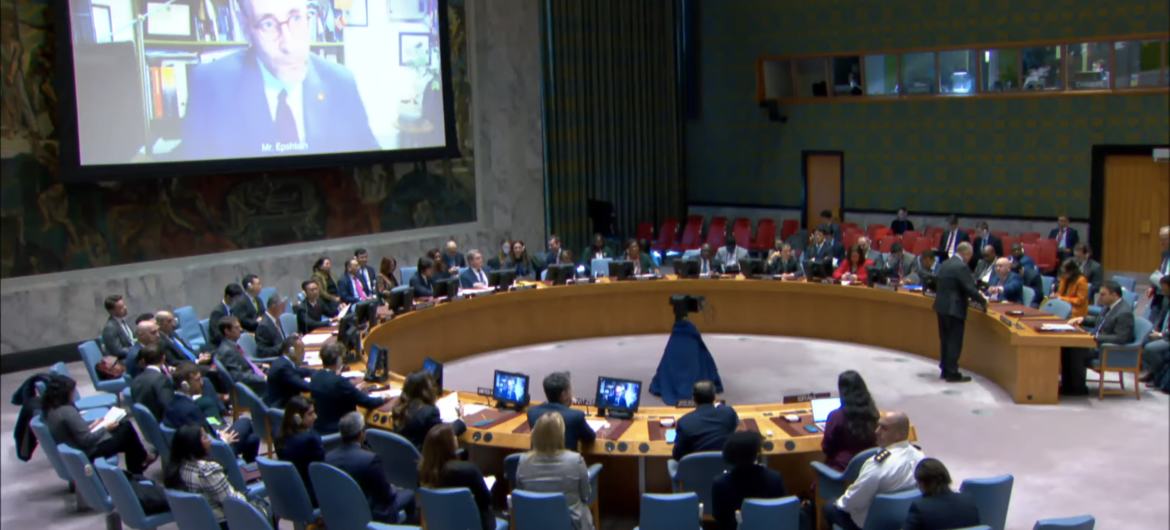
UPDATING LIVE: UN Security Council meeting on the situation in the Middle East


Security Council meets on the situation in the Middle East
United Nations
 
Security Council meets on the situation in the Middle East
29 December 2023
Peace and Security

The UN Security Council meeting on the situation in the Middle East, amid rising tensions in the occupied West Bank and while the relentless fighting in the Gaza Strip continues to exact a terrible toll on civilians. A senior UN official warned of the risk of a spillover of the conflict with “devastating consequences” for the entire region.

Live video feed of the meeting.

Follow this page and @UN_News_Centre on X, formerly Twitter, for updates.

11:52 PM

Gilad Menashe Erdan, Ambassador and Permanent Representative of Israel to UN, questioned why an “urgent briefing” of the Security Council is not called when Israeli civilians and civilian sites are attacked.

“Do these attacks sound like a mere spillover, is this violence occurring magically on its own. Is it not clear genocidal terrorists are seeking to murder Israeli citizens every single day,” he said.

“This Council is quick to show solidarity with civilians across the Middle East so long as they are not Israelis,” he added, asking why the Security Council is silent when innocent Israeli civilians are targeted.

“Why have you not condemned the rocket fire from Lebanon, Syria and Yemen,” he said, warning that the situation in northern Israel is “reaching the point of no return.”

“Every day, innocent Israelis are under attack. If these attacks persist, Israel will ensure that these acts of terror stop,” Ambassador Erdan said, reiterating that if the attacks continue, “the situation will escalate will escalate and may lead to a full scale war.”

11:35 AM

Majed Bamya, Deputy Permanent Observer of the Observer State of Palestine addressed the Security Council, stating that the killing of Palestinian civilians is “not a collateral effect” of war.
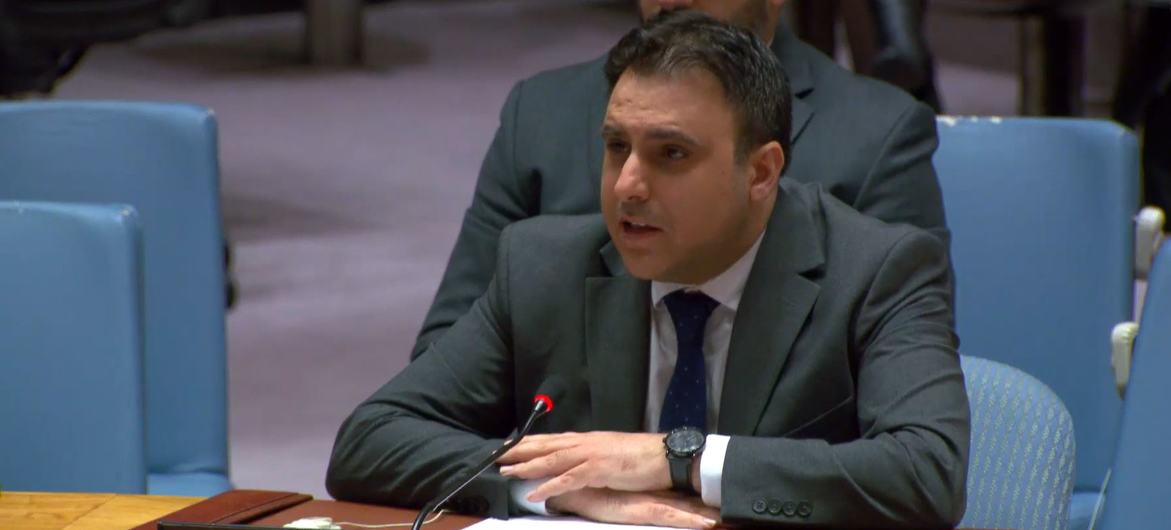
Majed Bamya, Deputy Permanent Observer of the Observer State of Palestine, addresses the Security Council.
United Nations
 
Majed Bamya, Deputy Permanent Observer of the Observer State of Palestine, addresses the Security Council.

“This Israeli assault relies, by design, on mass and indiscriminate killing of civilians. The humanitarian catastrophe is not the consequence of the war, it is a tool employed by Israel to pressure people and force them out,” he said.

He went on to note that the Council has called for the protection of civilians and for immediate, safe, unhindered and expanded humanitarian access to deliver assistance throughout the Gaza Strip, for respect for the laws of laws, and that it has rejected forced displacement.

“All of which require an immediate ceasefire that this Council has been prevented to call for, repeatedly,” he said, noting that Israeli has reacted with “disregard and disdain.”

“Why are they getting away with murder at this unprecedented scale,” he said, adding “because they were never held accountable.”

“That is why they confess to their crimes, that is why steal our lives, our land, our resources, our money, our past, our present and our future in broad daylight,” he said.

11:28 AM

All parties showing ‘reckless disregard’: Norwegian Refugee Council

Itay Epshtain, Senior Advisor at the Norwegian Refugee Council (NRC), informed Council members of the legal observations that underpin the NRC’s response to the humanitarian crisis.

“Some capture serious violations that have been perpetrated and continue to occur, others relate to premeditated atrocities that should be prevented by this august Council,” he said, noting that all parties – Palestinians armed groups and Israel – have shown reckless disregard for the norms of international law, including the basic rules of international humanitarian law, “the very rules they must comply with in all circumstances, breached.”

He emphasized that the NRC has condemned the atrocious violence launched by Hamas against Israeli civilians and continues to call for the immediate release of all hostages. It also calls for humane treatment of Palestinians detainees, in keeping with international law.

“The same legal certainty must also mean a halt to the Israeli offensive from which ordinary Gazans have no refuge before it claims the lives of even more civilians, many of them women and children,” he said.

11:08 AM

Risk of spillover ‘remains high’: UN official

Khaled Khiari, Assistant Secretary-General for the Middle East at UN DPPA, informed Council members that the situation in the Middle East is alarming and continues to deteriorate, including “several interconnected theatres conflict”.
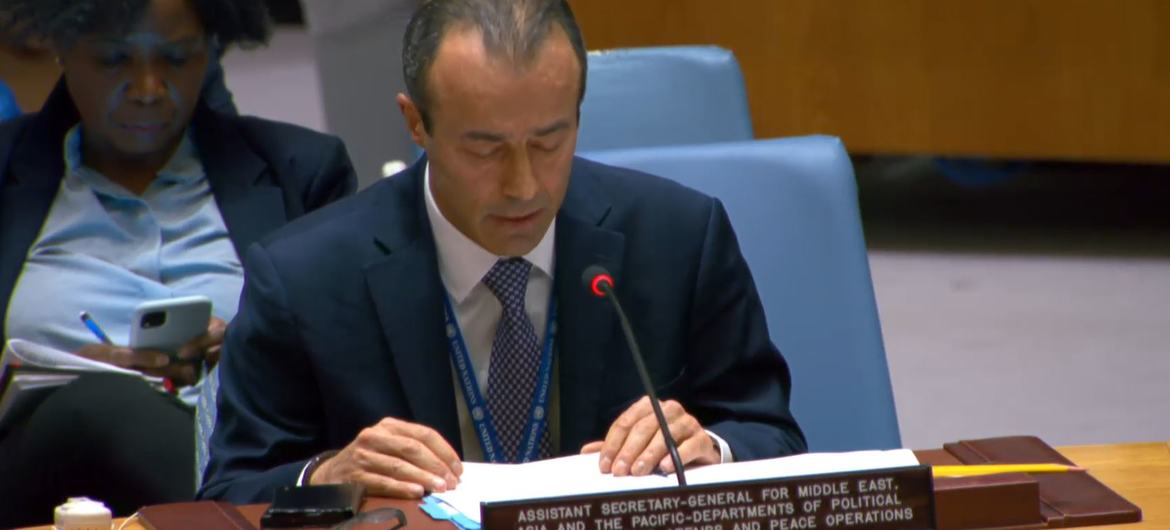
Khaled Khiari, Assistant Secretary-General, briefs the Security Council.
United Nations
 
Khaled Khiari, Assistant Secretary-General, briefs the Security Council.

He noted “intense” Israeli ground operations and fighting between Israeli forces and Hamas and other groups in most areas of Gaza, as Hamas and other Palestinian factions continue to fire rockets from Gaza into Israel.

“Civilians from both sides, particularly in Gaza strip currently, continue to bear the brunt of this conflict,” he said.

Reiterating the Secretary-General’s call for an immediate humanitarian ceasefire in Gaza, Mr. Khiari warned that the risk of regional spillover of this conflict with potential devastating consequences for the entire region “remains high” given also a multitude of actors involved.

He informed Council members of “continued daily exchanges” of fire across the Blue Line between Lebanon and Israel, posing a “grave risk” to regional stability.

“Increasingly, there have been strikes on civilian areas, with civilian casualties, on both sides of the Blue Line, in addition to a rising number of fatalities among combatants,” he added.

Mr. Khiari also noted attacks on US bases in Iraq and Syria, with the US conducting some airstrikes against groups suspected of these actions in Iraq and Syria. He also cited reports of Israeli air strikes inside Syria, as well as tensions in the Red Sea. 

11:05 AM

Meeting called to order

José Javier De La Gasca, Ambassador and Permanent Representative of Ecuador, which holds the Presidency of the Security Council for December, called the meeting to order.

Israel has been invited to the meeting, as has the been the Observer State of Palestine.

Khaled Khiari, Assistant Secretary-General for the Middle East, Asia and the Pacific, Department of Political and Peacebuilding Affairs; Marwan Muasher, Vice President for studies at Carnegie Endowment for International Peace and former Deputy Prime Minister of Jordan; and Itay Epshtain, Norwegian Refugee Council Special Advisor and Senior Humanitarian Law and Policy Consultant will brief the meeting.

10:35 AM

The United Arab Emirates (UAE), a non-permanent member called for the urgent meeting, and a senior UN official from the Department of Political and Peacebuilding Affairs (DPPA) is expected to brief ambassadors.

The meeting follows a resolution adopted last week by the Security Council calling for a scale-up in aid deliveries to civilians in the Gaza Strip. The resolution passed with 13 votes in favour, and the US and Russia abstaining.

Tensions in occupied West Bank

Earlier this month, Tor Wennesland, the UN Special Envoy for the Middle East Peace Process, voiced “deep concerns” over escalating tensions in the occupied West Bank, including East Jerusalem.

Briefing the Security Council on 19 December, he noted “intensified armed exchanges” between Palestinians and Israeli security forces, predominantly in the context of Israeli operations, which led to exceedingly high levels of fatalities and arrests.

Mr. Wennesland also expressed alarm at lethal attacks carried out by Israeli settlers against Palestinians and by Palestinians against Israelis in the occupied West Bank and Israel.

“All perpetrators of violence must be held accountable and swiftly brought to justice,” he stressed.

Humanitarian situation in Gaza

Meanwhile, the humanitarian situation in the enclave remains dire.

Earlier today, the UN Office for the Coordination of Humanitarian Affairs (OCHA) cited reports from Gazan health authorities that half of all the pregnant women seeking safety in shelters suffer from thirst, malnutrition and a lack of healthcare. There is a lack of vaccinations for newborns and one in every two displaced children faces dehydration, malnutrition and disease.

Some 1.9 million Gazans, or 85 per cent of the enclave’s population, have been internally displaced since the start of Israel’s retaliation following Hamas’ deadly terror attacks in southern Israel on 7 October

https://news.un.org/en/story/2023/12/1145182


https://creativecommons.org/licenses/by/3.0/legalcode

вторник, 6 июня 2023 г.

UN Security Council to welcome five new non-permanent members


A delegate casts his country's vote to elect five new non-permanent members to the UN Security Council.
UN Photo/Evan Schneider
 
A delegate casts his country's vote to elect five new non-permanent members to the UN Security Council.
6 June 2023
UN Affairs

Five countries have been elected as non-permanent members of the UN Security Council following a vote in the General Assembly on Tuesday. 

Algeria, Guyana, Republic of Korea, Sierra Leone and Slovenia will join the premier body for maintaining international peace and security, starting in January, serving for a two-year period. 

Tweet URL

They were among six countries vying for five non-permanent seats around the Council’s horseshoe-shaped table that will become vacant at the end of the year. 

Securing a seat 

The Security Council is composed of 15 countries, five of which - China, France, Russia, the United Kingdom and the United States – are permanent members, granting them the right to veto any resolution or decision. 

The 10 non-permanent members are elected by the General Assembly, which comprises all 193 UN Member States, and in line with geographical distribution by region.  

Voting is conducted by secret ballot and candidates must receive a two-thirds majority, or 128 votes, even if they run uncontested. 

Overall, 192 countries voted to fill three Council seats allocated to the Africa and Asia-Pacific Groups, and one each for Eastern Europe and Latin America and the Caribbean. 

Slovenia beat Belarus in the race for Eastern Europe, receiving 153 votes versus 38, while Algeria, Guyana, Sierra Leone and the Republic of Korea ran unopposed. 

Ready to serve 

The five newly elected countries will join Ecuador, Japan, Malta, Mozambique and Switzerland as non-permanent members of the Council. 

They will take up seats currently occupied by Albania, Brazil, Gabon, Ghana and the United Arab Emirates when their two-year terms end on 31 December. 


 https://news.un.org/en/story/2023/06/1137382


https://creativecommons.org/licenses/by/3.0/legalcode

вторник, 23 мая 2023 г.

Uphold promise to protect civilians caught in conflict: Guterres

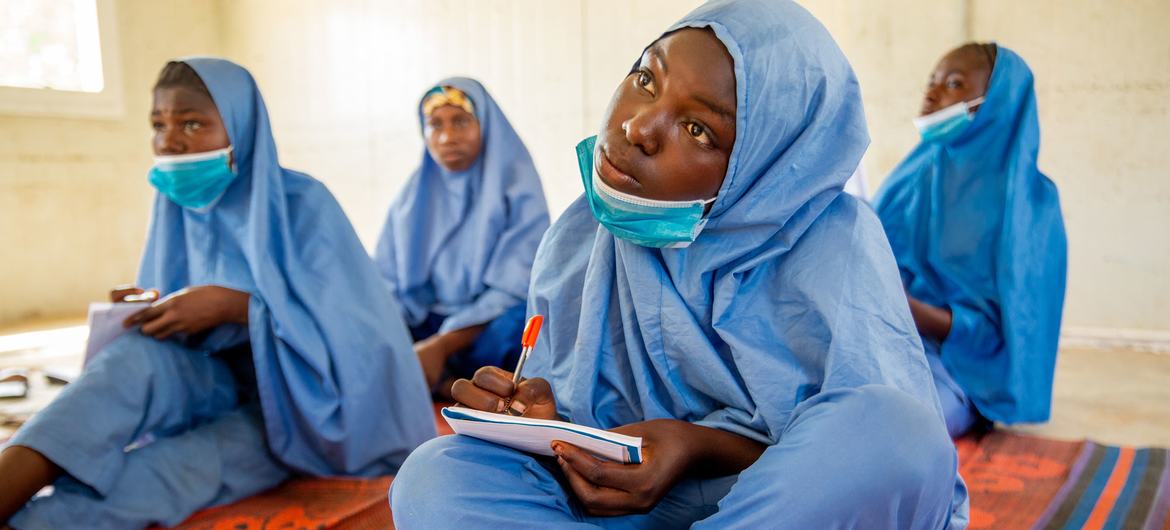
Medina, 16, attends class in a space set up by Save the Children at Dalori camp, Maiduguri, Save the Children set up spaces and services for vulnerable children in communities and camps for displaced people across Nigeria.

© UNOCHA/Damilola Onafuwa
 
Medina, 16, attends class in a space set up by Save the Children at Dalori camp, Maiduguri, Save the Children set up spaces and services for vulnerable children in communities and camps for displaced people across Nigeria.
23 May 2023
Peace and Security

The world is failing to live up to its commitment to protect civilians during wartime, Secretary-General António Guterres told the UN Security Council on Tuesday, urging greater respect for international humanitarian law. 

The UN chief was speaking during a debate on ensuring the security and dignity of people caught in the crossfire and addressing the related issue of access to food and essential services. 

Suffering and ‘outrage’ 

“Civilians have suffered the deadly effects of armed conflict for too long.  It is time we live up to our promise to protect them,” said Mr. Guterres, who also called for action “to break the deadly cycle of armed conflict and hunger.” 

Tweet URL

Last year, civilians accounted for 94 per cent of victims of explosive weapons deployed in populated areas, he said.  

More than 117 million people worldwide also faced acute hunger in 2022, primarily because of war and insecurity, which he described as “an outrage”. 

Easing the impact 

He pointed to recent action towards alleviating the impact of conflict on civilians. For example, some warring parties have taken steps to protect children and allow humanitarians to access people in need. 

Addressing food security, he mentioned measures such as the Black Sea Initiative to export grain from Ukraine amid the ongoing war, as well as a Memorandum of Understanding on bringing Russian food and fertilizer to global markets. 

Last November, States adopted a political declaration on restricting or refraining from the use of explosive weapons in populated areas, which he urged all countries to join.

The Council also adopted a resolution the following month which aims to prevent UN sanctions from harming civilians and obstructing humanitarian action. 

Call for action 

“These modest steps are welcome. But the terrible truth is that the world is failing to live up to its commitments to protect civilians; commitments enshrined in international humanitarian law,” said Mr. Guterres, referring to the Geneva Conventions. 

“We need action and accountability to ensure it is respected. That depends on political will,” he added. 

The Secretary-General urged the international community to intensify efforts to prevent conflict, protect civilians, preserve peace and find political solutions to war.  

Security Council’s ‘particular responsibility’

“Where war continues, all countries must comply with international humanitarian law and members of this Council have a particular responsibility,” he said. 

He urged Governments to incorporate international humanitarian law into their own laws, and military rules and training, adding that humanitarians also must be assured safe access and attacks against them must cease. 

The Council has a special role to play in urging States to respect the rules of war, he said.  Governments with influence over warring parties should engage in political dialogue, and train forces on better protecting civilians.  

Additionally, countries that export weapons should refuse to do business with any party that fails to comply with international humanitarian law. 

Furthermore, those who commit war crimes must be held to account.  “States must investigate alleged war crimes, prosecute perpetrators and enhance other States’ capacity to do so,” he said. 

Rise in conflict 

In his remarks, the Secretary-General paid tribute to the work of the International Committee of the Red Cross (ICRC), the “guardians” of the Geneva Conventions. 

ICRC President Mirjana Spoljaric, who also briefed the Council, reported that non-international armed conflicts have more than tripled over the past two decades - from less than 30 to over 90. 

She issued an urgent call to protect civilians and critical infrastructure in urban areas. 

“As fighting envelops towns and cities, such as in Sudan, Syria, Ukraine and Yemen, the ICRC is seeing large-scale and compounding patterns of harm.  We need to break the pattern of violations, and this can be done through strong political will and sustained action” she said. 

Ms. Spoljaric also spoke of the threat posed by misinformation and disinformation during conflict, which can fuel dangerous community divisions and undermine humanitarian action. 

She also underscored that civilian protection covers everyone, regardless of gender.  

In this regard, ICRC recommendations include ensuring that the clear prohibition of sexual violence under international humanitarian law is integrated into national laws, military doctrine and training. 

No women, no peace 

Civil society representative Aichatou Mounkaila from Niger delivered a message to the Council on behalf of women in the Lake Chad Basin region in Africa, where attacks by Boko Haram insurgents and other armed groups have displaced millions. 

Speaking in French, she said women are the first victims of any crisis but they also are the first to provide solutions. 

Ms. Mounkaila outlined five points that could inform the Council’s approach to ending conflict and hunger.  Action includes encouraging donors to allocate more funding to gender-sensitive livelihood reconstruction in areas such as sustainable agriculture, where women play a central role, so that they can rebuild their lives and communities.  

She also urged the Council to insist on the full, equal, and meaningful participation and leadership of women and girls at all levels of humanitarian response, community dialogues, peacebuilding and peace negotiations. 

“Without women, no sustainable peace is possible,” she insisted.   


https://news.un.org/en/story/2023/05/1136952
https://creativecommons.org/licenses/by/3.0/legalcode