Показаны сообщения с ярлыком SECRETARY-GENERAL. Показать все сообщения

пятница, 16 августа 2024 г.

Citing Legacy of Destruction, Secretary-General, in Observance Message, Says World Must Speak with One Voice to Finally End Nuclear Testing


SG/SM/22334


Following is UN Secretary-General António Guterres’ message for the International Day against Nuclear Tests, observed on 29 August:

Across nearly eight decades, more than 2,000 nuclear tests were conducted at more than 60 sites around the world.  These tests left a legacy of destruction, rendering lands uninhabitable and creating long-term health problems for people. 

Recent calls for the resumption of nuclear testing demonstrate that the terrible lessons of the past are being forgotten — or ignored. 

On the International Day Against Nuclear Tests, the world must speak with one voice to end this practice once and for all.

The Comprehensive Nuclear-Test-Ban Treaty is the only prohibition on all nuclear testing, and an essential, verifiable security tool.  But it is not yet in force.

In the name of the victims of nuclear tests and future generations, I call on all countries whose ratifications are needed for the Treaty to enter into force to do so — immediately and without conditions.  Let’s pass the test for humanity — and ban nuclear testing for good. 


https://press.un.org/en/2024/sgsm22334.doc.htm


https://creativecommons.org/licenses/by/4.0/legalcode

вторник, 13 августа 2024 г.

With Under-Representation in Voice, Over-Representation in Challenges, Africa Must Have Permanent Seat, Secretary-General Tells Security Council, Citing ‘Glaring Omission'

    SG/SM/22331


Following are UN Secretary-General António Guterres’ remarks to the Security Council debate on “Maintenance of Peace and Security:  Addressing the Historical Injustice and Enhancing Africa’s Effective Representation in the United Nations Security Council”, in New York today:

I thank Sierra Leone for convening this debate.  Since 1945, the United Nations Security Council has been a bedrock of global peace and security.  But, the cracks in its foundation are becoming too large to ignore. They are contributing to deadlock, stalemate and stagnation around today’s most pressing crises.  And they are feeding a broader crisis of credibility and legitimacy that is affecting multilateralism itself.

The Security Council was designed by the victors of the Second World War, and reflects the power structures at that time.  The world has changed since 1945.  But, the composition of the Council, despite a few changes, has not kept pace.

In 1945, most of today’s African countries were still under colonial rule and had no voice in international affairs.  This created a glaring omission that has remained unresolved until now:  there is no permanent member representing Africa in the Security Council, and the number of elected members from the continent is not in proportion to its importance.

We cannot accept that the world’s pre-eminent peace and security body lacks a permanent voice for a continent of well over a billion people — a young and rapidly growing population — making up 28 per cent of the membership of the United Nations.  Nor can we accept that Africa’s views are undervalued on questions of peace and security, both on the continent and around the world.

Africa is under-represented in global governance structures — from the Security Council to international financial institutions — but over-represented in the very challenges these structures are designed to address.  Conflicts, emergencies and geopolitical divisions have an outsized impact on African countries.

This Council’s agenda demonstrates this.  Nearly half of all country-specific or regional conflicts on your agenda concern Africa.  They are often exacerbated by greed for Africa’s resources — which are vital to the global economy — and further spread and aggravated by the interference of external actors.

The message is clear.  There can be no global security without African security.

Meanwhile, African countries are ground down by crushing debt burdens and a lack of financing thanks to the global financial architecture, in which they are underrepresented and denied the level of support they require. And they contend with ferocious flooding and droughts caused by a climate crisis they did nothing to create.

But, through it all, Africa has proven to be a willing and able partner for peace — particularly with the United Nations — both on the continent and beyond.  Through the Joint United Nations-African Union Framework for Enhanced Partnership in Peace and Security, we are addressing complex challenges on the continent — from the Central African Republic, to Somalia, the Sahel and the crisis in Sudan.

We are working with the African Union and regional and subregional organizations, such as the Economic Community of West African States (ECOWAS) to end the scourge of terrorism, which has killed tens of thousands on the African continent — including 11 of our personnel in the Abuja bombing of 2011.

Together, we are helping to ensure security, stability, and respect for human rights and the rule of law, while supporting democratic processes and institutions.

And this Council’s resolution 2719 (2023) has now established a framework for predictable financing of African Union-led peace support operations authorized by the Security Council through assessed contributions — an important vote of confidence in African capacities, and in our partnership.  We are now developing a joint road map to carry this forward.

Meanwhile, African countries host almost half of all UN peacekeeping operations, while contributing troops of their own to global hotspots over the years, including now in Lebanon.  Over 40 per cent of UN peacekeepers are African.

And let’s not forget the meaningful efforts made by African-led forces to restore peace — from Somalia to Lake Chad, from Mozambique to the Democratic Republic of the Congo.

In times of crisis and geopolitical division, African countries are often among the first to champion peace, multilateral solutions and adherence to international law and the UN Charter.  But, African efforts and contributions are not being matched by African representation.

Ensuring this Council’s full credibility and legitimacy means heeding the longstanding calls from the UN General Assembly, various geographic groups — from the Arab Group, to the Benelux, Nordic and Caribbean Community countries — and some permanent members of this Council itself, to correct this injustice.

For different parts of the world to contribute to its proceedings, reform of this Council’s membership must be accompanied by a democratization of its working methods.

A New Agenda for Peace puts forward a number of ideas — from more burden sharing among Council members to more systematic consultations with host States and regional organizations, as well as with countries contributing troops and police.  It also calls for improvements and innovation in other parts of the global architecture whose work has a bearing on peace and security.

It recommends that Member States elevate the work of the Peacebuilding Commission to realize its untapped potential and help mobilize support for national and regional prevention strategies.  This includes closer ties with the International Monetary Fund (IMF), the World Bank and regional development banks to secure sustainable financing for countries as they strengthen peace and security — with important implications for countries on the African continent.  The Peacebuilding Fund has been a critical catalyst to mobilize the contributions of international financial institutions.

The Agenda also calls for a revitalized role of the General Assembly in the area of peace and security.  A New Agenda for Peace has been informing negotiations on the Pact for the Future, to be adopted at next month’s Summit of the Future.

The Summit provides a critical opportunity to make progress on these issues, and help ensure that all countries can meaningfully participate in global governance structures as equals.  I urge all Member States to attend and contribute their views and ideas so that African voices are heard, African initiatives are supported and African needs are met.

African voices, African insights and African participation must be brought to bear across the Council’s deliberations and actions.  This is not just a question of ethics and justice.  It is also a strategic imperative that can increase global acceptance of the Council’s decisions — benefitting Africa and the world.

I call on all Member States to seize this opportunity to forge an ambitious Pact of the Future that paves the way for a global peace and security architecture that truly represents all countries, equally.


https://press.un.org/en/2024/sgsm22331.doc.htm


https://creativecommons.org/licenses/by/4.0/legalcode

воскресенье, 23 июня 2024 г.

Reversing Trend of Conflicts, Violence Will Require Individual and Collective Actions ‘to Forge Peace’, Says Secretary-General, in Message for Peacebuilding Day


SG/SM/22282

Following is UN Secretary-General António Guterres’ message for Peacebuilding Day, observed on 23 June:

There is no higher calling than the pursuit of peace.

But in far too many countries and communities around the world, peace is missing.  Conflicts and violence are spreading a plague of misery, suffering and death that affects millions of people each year.

Reversing this trend requires our individual and collective actions to forge peace.

It requires the timeless tools of dialogue, diplomacy and negotiation.

It requires a steadfast commitment to humanitarian aid to ease people’s suffering.

It requires effective support for sustainable development and the implementation of the Sustainable Development Goals.

It requires focusing on prevention, as called for in the New Agenda for Peace, to build trust, heal divisions, spur development, and stem the tide of violence in communities before it spins out of control.

It requires peacebuilding.

On this important day, the United Nations family salutes the tireless women and men around the world who are building strong foundations of peace for today and tomorrow.

We will never give up fighting for peace and are proud to stand with peacebuilders everywhere in this essential effort.


https://press.un.org/en/2024/sgsm22282.doc.htm


https://creativecommons.org/licenses/by/4.0/legalcode

вторник, 30 апреля 2024 г.

Secretary-General Calls for Peaceful, Inclusive, Transparent Process, ahead of Presidential Election in Chad


SG/SM/22208

Secretary-General Calls for Peaceful, Inclusive, Transparent Process, ahead of Presidential Election in Chad

The following statement was issued today by the Spokesman for UN Secretary-General António Guterres:

Ahead of the first round of the presidential election in Chad on 6 May, the Secretary-General calls on all Chadian stakeholders to ensure a peaceful, inclusive, transparent and credible electoral process.

The Secretary-General encourages all political leaders to refrain from any acts or discourse that could undermine a peaceful process, to overcome any disagreements through dialogue and to address complaints that may arise through established legal channels.

The Secretary-General reiterates the commitment of the United Nations to continue to support Chad in its effort to build a peaceful and prosperous future.


https://creativecommons.org/licenses/by/3.0/legalcode

Twenty Years on, Security Council Must Implement Resolution 1540, Secretary-General Urges, as Threat of Non-State Actors’ Using Mass Destruction Weapons Looms Large


SG/SM/22206

Twenty Years on, Security Council Must Implement Resolution 1540, Secretary-General Urges, as Threat of Non-State Actors’ Using Mass Destruction Weapons Looms Large

Following is UN Secretary-General António Guterres’ message to mark the twentieth anniversary Security Council resolution 1540 (2004):

The idea of terrorists and criminals wielding weapons of mass destruction is a nightmarish prospect.  Twenty years ago, countries came together to shield us from that threat. Security Council resolution 1540 (2004) requires Governments to take action to prevent non-State actors from getting their hands on nuclear, chemical and biological weapons.

Yet the threat still looms large.  In the two decades since the resolution was passed, dangers have grown.  Developments in science and technology are racing ahead — threatening to create a new generation of weapons of mass destruction that are easier to access and simpler to use.

As we mark the twentieth anniversary of Security Council resolution 1540 (2004), I urge countries to redouble their efforts to work together and to bolster national action in order to implement the resolution urgently and in full.  I also ask them to support our proposed New Agenda for Peace at the Summit of the Future later this year, which specifically recommends strengthening measures to prevent non-State actors acquiring weapons of mass destruction.

Together, let’s stop weapons of mass destruction falling into terrorist hands and build a safer world for us all.


https://press.un.org/en/2024/sgsm22206.doc.htm

https://creativecommons.org/licenses/by/3.0/legalcode

понедельник, 22 апреля 2024 г.

Secretary-General calls for UN 2.0 to tackle 21st century challenges


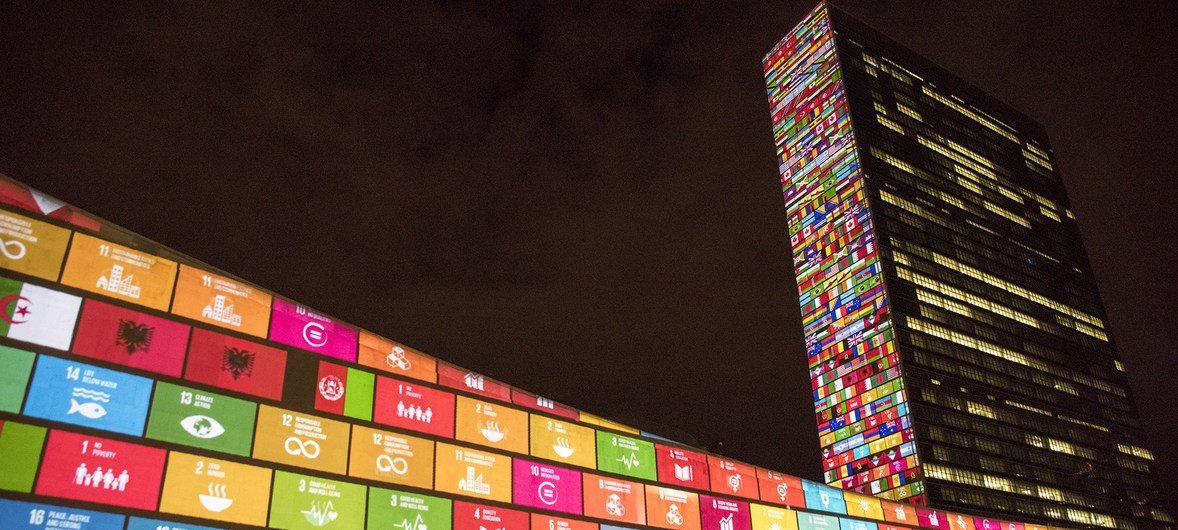
The Sustainable Development Goals projected onto UN Headquarters, in New York.
UN Photo/Cia Pak
 
The Sustainable Development Goals projected onto UN Headquarters, in New York.
22 April 2024

UN Affairs

Secretary-General António Guterres on Monday emphasized the need for a “strengthened and updated” United Nations to better reach and support people around the world.

Amid multifaceted crises ranging from conflicts to climate, and poverty and inequality, the world looks to the UN “to help deliver the better, safer and greener world we need,” Mr. Guterres said.

“But we cannot solve 21st century problems with 20th century tools – we need a UN 2.0,” he stressed, in a message opening the UN 2.0 week.

The transformation in skills and culture, encapsulated in the UN chief’s vision of a UN 2.0, is focused on fostering cutting-edge capabilities in data, digital solutions, innovation, foresight and behavioural science – to deliver stronger results and help countries accelerate efforts to achieve the Sustainable Development Goals (SDGs).

The Secretary-General’s vision is elaborated in a policy brief launched last September.

‘Forward-thinking culture’

In his message on Monday, Mr. Guterres also emphasized the need for a “forward-thinking culture” at the Organization, powered by rapid technological advances.

He added that this was particularly important given the fundamental changes proposed in Our Common Agenda, his vision for global cooperation and getting the SDGs back on track, as well as the Summit of the Future, which will be convened on 22-23 September in New York.

“We’re already seeing what is possible: From online resources for remote schools, to humanitarian aid based on real-time data, and technology that helps countries forecast and build resilience to disasters,” the UN chief said.

“Ultimately, UN 2.0 will make us better partners for countries as they achieve results for their people.”

UN 2.0 Week High-Level Opening

What is UN 2.0

Also speaking at the opening, Deputy Secretary-General Amina J. Mohammed explained that UN 2.0 is the Organization’s response to how “we will pivot and meet the world where it is at and where it needs to go”.

“Thinking about what that means for investing in our staff, but also attending to many of the ‘quintet of change’ issues,” she added, noting the five topics – data, digital solutions, innovation, foresight and behavioural science.

She expressed hope that the transformations will make the UN more fit for purpose.

“That we can actually get out there and raise the ambitions, and be more responsive for the needs,” she added.

UN 2.0 Week

Taking place from 22 to 26 April, UN 2.0 Week showcases a series of virtual events including panel discussions and best practice sharing dialogues. Over 40 speakers from across the UN system and partner organizations are slated to speak.

Click here to find out more about and sign up for the UN 2.0 Week events


https://news.un.org/en/story/2024/04/1148806


https://creativecommons.org/licenses/by/3.0/legalcode

четверг, 21 марта 2024 г.

‘Keep the Flame of Democracy Alive — for Present and Future Generations’, Says Secretary-General, in Video Message for Seoul Summit


SG/SM/22170

‘Keep the Flame of Democracy Alive — for Present and Future Generations’, Says Secretary-General, in Video Message for Seoul Summit

Following is the text of UN Secretary-General António Guterres’ video message for the Third Summit for Democracy, in Seoul today:

Excellencies, ladies and gentlemen, I congratulate the Republic of Korea for organizing this Summit, which arrives at a critical moment.

This year, more than 50 countries — representing half of the world’s population — are going to the polls.  But around the globe, democracy, human rights and the rule of law are under assault.

Civic space is shrinking.  Dissent is being silenced.  Human rights defenders and journalists are being persecuted.  Mis and dis-information — especially across social media — are driving wedges between people, while amplifying lies and racist and xenophobic hatred.

Mistrust is growing, fuelled by poverty, unemployment and rising prices.  And authoritarianism is on the march, running roughshod over the elements that make democracies work — free speech, peaceful opposition, accountable institutions, civil liberties, impartial and independent justice systems, and respect for the full spectrum of human rights.

Excellencies, growing up, my own country Portugal was ruled by dictatorship.  That dictatorship oppressed not only the people of Portugal — but people under its colonial rule.  But I’ve also lived to see democracy flourish — and to see how human rights and democratic values can lift people and societies alike.

The flame of democracy burns brightest when these principles are upheld.  That flame grows dimmer when they are denied, until countries find themselves in darkness.

Our responsibility today is to keep the flame of democracy alive.

By keeping civic and political space open so all people can make their voices heard in democratic processes — including minorities and the most vulnerable in every society.

By advancing sustainable development to fulfil social, cultural and economic rights by defeating poverty, inequality, hunger and unemployment, and repairing shredded social safety nets.

By investing in education.

By achieving full gender equality for women and girls.

By fighting against the poisons of racism and bigotry.

And by strengthening protections for journalists so they can help ensure transparency and hold leaders to account.

This Summit’s theme — “Democracy for Future Generations” — reminds us of an additional essential responsibility.  We must strengthen democratic systems and institutions for — and with — the world’s 1.8 billion young people and for the generations to follow.

September’s Summit of the Future in New York will be a place for partners to come together for solutions to build trust, strengthen cooperation, and safeguard the interests of future generations.

We must work together to combat corruption and strengthen accountability.

We must build guardrails for artificial intelligence and the digital world — including through the Global Digital Compact — to protect democracy against technology’s perils while realizing its promise.

And we must place human rights at the centre of democratic institutions and systems.

Excellencies, democracy is always a work in progress.  Let’s keep the flame of democracy alive — for present and future generations.

Thank you.


https://press.un.org/en/2024/sgsm22170.doc.htm


https://creativecommons.org/licenses/by/3.0/legalcode

четверг, 7 марта 2024 г.

Ramadan Cessation of Hostilities Can Help Stem Suffering, Usher Way to Sustainable Peace in Sudan, Secretary-General Tells Security Council

7 March 2024


Following are UN Secretary-General António Guterres’ remarks to the Security Council meeting on Sudan, in New York today:

Next month will mark one year since the outbreak of brutal fighting between the Sudanese Armed Forces and the Rapid Support Forces.

The conflict has taken a devastating toll on the people of Sudan, imperilling the unity of the country.

There is now a serious risk that the conflict could ignite regional instability of dramatic proportions, from the Sahel to the Horn of Africa and the Red Sea.

Meanwhile, the fighting rages on.  We are witnessing renewed offensives in Khartoum State, Al-Gazira State and elsewhere.

The bloodshed has recently forced us to suspend operations out of a critical humanitarian hub in Wad Madani — and there are growing fears of a further expansion of hostilities east.  At the same time, we are deeply alarmed by calls for arming civilians, and popular mobilization activities in various states.

Armed groups are entering the fray — in Darfur and South Kordofan.

All these dangerous developments are pouring fuel on the fire for an even more serious fragmentation of the country, a deepening of intra- and intercommunal tensions and more ethnic violence.

It is time to silence the guns and raise the volume for peace.

In just days, the holy month of Ramadan will commence.  So, from this Chamber today, I am making an appeal. I call on all parties in Sudan to honour the values of Ramadan by honouring a Ramadan cessation of hostilities.

This cessation of hostilities must lead to a definitive silencing of the guns across the country and set out a firm path towards lasting peace for the Sudanese people.  The values of Ramadan must prevail.

Now is the time to lay down the weapons.

The humanitarian crisis in Sudan is reaching colossal proportions. Fully half the population — some 25 million people — need life-saving assistance.  Over 14,000 people have been killed, although that number is likely far higher.

Sudan is now home to the world’s largest internal displacement crisis, with 6.3 million people seeking safety within the country since the beginning of the conflict.  Another 1.7 million people have fled to neighbouring countries.

The conflict has destroyed civilian infrastructure and brought basic services to a standstill.  More than 70 per cent of health facilities in conflict-affected areas are not functional.

Millions of children are out of school.  Water and sanitation systems are breaking down.  Diseases are multiplying.  Hunger is stalking Sudan.

Some 18 million people are acutely food insecure.  This is the highest number ever recorded during a harvest season, yet numbers are expected to surge even higher in the coming months.  We are already receiving reports of children dying from malnutrition.

The United Nations and our humanitarian partners are doing everything we can to stem this suffering.  But we are facing major challenges as we try to reach millions of people in need.

We welcome recent decisions by the Sudanese authorities to facilitate cross-line access from eastern Sudan and the use of three airports for humanitarian flights, as well as allowing the use of cross-border points into areas controlled by Sudanese authorities — including one border point from Chad, which we urge be sustained beyond the movement of preposition supplies.

It is also critical to address the chronic food insecurity crisis in parts of Darfur and other hard-to-reach areas.

Countless lives are at stake and time is of the essence.

In accordance with the Jeddah Declaration, authorities must allow full and immediate humanitarian access to all vulnerable populations regardless of where they are and who controls the area; all routes must be utilized — including both road and air corridors — to maximize the aid response and save lives; and all routes must remain open to allow a steady and sustainable flow of assistance and not be subject to burdensome and unreasonable restrictions or impediments.

We encourage the Sudanese authorities to ensure the swift implementation of these measures, and to continue efforts to facilitate humanitarian access, including across conflict lines.

Recent procedures to expedite visas for humanitarian staff are another step in the right direction.

I also urge the international community to provide financial support to the 2024 Sudan Humanitarian Response Plan, which remains significantly underfunded.

The human rights situation continues to spiral out of control throughout Sudan.

Protection concerns are growing by the hour.

Indiscriminate attacks by the Rapid Support Forces and the Sudanese Armed Forces have killed or injured a significant number of civilians. And we see continuing and widespread looting, arbitrary arrests, enforced disappearances, torture, recruitment and detention of children, alongside the shrinking of civic space.

We are also receiving troubling reports of systematic conflict-related sexual violence, including rape and gang rape, as well as abduction and trafficking for the purpose of sexual exploitation.

I call on the parties to uphold their obligations under international humanitarian law to protect civilians and to facilitate safe and unimpeded humanitarian access, as they have committed to do.

We welcome regional and international efforts to resolve the conflict — including through the efforts of the Intergovernmental Authority on Development (IGAD).

The Jeddah platform constitutes a critical and promising forum for dialogue — and African participation remains indispensable.

I recognize African Union Commission Chairperson Moussa Faki who has appointed a High-level Panel to lead African Union efforts to support the solution of the conflict in Sudan.

We must continue working to empower civilians — including women’s rights groups, youth and others mobilizing for peace — who are all critical to an inclusive political process enabling the resumption of Sudan’s democratic transition.

The United Nations stands ready to intensify the engagement with our multilateral partners — including the African Union, IGAD, the League of Arab States (LAS) and key Member States — to take urgent action towards a durable cessation of hostilities and an inclusive, coherent, complementary and effective international mediation.  These efforts must draw in regional States with tangible leverage on the warring parties to end the fighting.

My Personal Envoy, Ramtane Lamamra, has met with the leaders of the Rapid Support Forces and the Sudanese Armed Forces, criss-crossed the Horn of Africa and the Gulf, and visited numerous capitals for discussions on the way forward.  I count on him to continue leading United Nations political efforts and to promote the coordination of international mediation initiatives.

I call upon this Council to signal its strong and clear support for that critical effort.

Following the drawdown of UNITAMS last week, the technical liquidation period has commenced.

I am deeply grateful to the staff of the Mission — national and international — for their dedication and distinguished service under very trying circumstances.  I also thank all partners who contributed to the implementation of the UNITAMS mandate.

Although that Mission has drawn down, our collective work for peace must ramp up.

A Ramadan cessation of hostilities can help stem the suffering and usher the way to sustainable peace.

Let us spare no effort to support the people of Sudan in their legitimate aspirations for a peaceful and secure future.


https://press.un.org/en/2024/sgsm22146.doc.htm

https://creativecommons.org/licenses/by/3.0/legalcode

пятница, 9 февраля 2024 г.

Press Conference by Secretary-General António Guterres at United Nations Headquarters


Press Conference by Secretary-General António Guterres at United Nations Headquarters

Following is the transcript of UN Secretary-General António Guterres’ press conference in New York today:

Dear members of the media:

Yesterday, I addressed the General Assembly focusing on priorities for this year and beyond.  It is a long and detailed agenda — but the varied challenges are connected by a common thread.  Peace.

The need for peace in all its dimensions because peace is the tie that binds.  But, too often, we face instead a Gordian knot.  On issues of peace and security — we face rising conflict and geopolitical divisions.  On issues of peace within communities — we see rising polarization.  On issues of peace with justice — we have rising inequalities.  On issues of peace with nature, we have rising global emissions and global temperatures.

We are at a moment of truth — but we have a breakdown of trust. Trust in institutions.  Trust in leaders.  And also trust in governments and multilateral institutions.

The way to restore trust is by making a real and positive difference in people’s lives.  By solving people’s problems.

Yesterday, I presented a clear-eyed, sober assessment of the world.  This is no time for pulling punches.

We have a number of existential challenges:  The age-old nuclear threat.  The climate emergency and the dangers posed by unchecked artificial intelligence.  But we are not sufficiently united and organized to respond effectively to any of them.  On top of that, we face a multiplication of conflicts and geopolitical divides.

Much can be done across the board.  To end conflict, to effectively address threats posed by Artificial Intelligence, to take climate action, to achieve the Sustainable Development Goals.  But it will require a serious conversation between developed and developing countries; between rich and emerging economies; between north and south, east and west.

It will require reforming institutions that were built by a bygone world, for a bygone age.  Starting with reform of the Security Council and the Bretton Woods institutions.  We are no longer in a world of two super-Powers or in a unipolar world.  Multipolarity creates opportunities for justice and balance in global relations. But when multipolarity is not accompanied by effective, renewed and inclusive mechanisms of multilateral governance — the risks multiply.

So, this is a year for focusing on the future — and we have our Summit of the Future in September, and this is a year for focusing on people’s challenges also today.  We have institutions that need to be aligned with our times.  And we have principles to guide us, that we must preserve in all situations.  Respect for the United Nations Charter.  Respect for international law and international humanitarian law.  Peace with justice that addresses inequalities.

Following those principles will lead us to the pathways to solutions that I laid out yesterday.  The New Agenda for Peace.  The SDG Stimulus.  The Global Digital Compact.  The work of the Advisory Body on Artificial Intelligence.  The Climate Solidarity Pact.  And much more.

And on the peace and security front, I believe it is especially critical to find solutions to two burning conflicts that are having profound global consequences:  Ukraine and Gaza.

This month marks the two-year anniversary of Russia’s invasion of Ukraine.  It is essential that we work for a just and sustainable peace, but a peace in line with the UN Charter and international law.

And in Gaza, the situation just keeps getting worse.  In addition to the death and destruction from military operations — starvation and disease are bearing down on Palestinians in Gaza.  Despite some limited steps, our humanitarian operations continue to face denials of access, delays, impediments, and multiple dangers — including live fire.  One of our convoys was damaged by Israeli naval artillery earlier this week.  Just 10 out of 61 planned aid convoys to the north reached their destination in January.

Let’s be clear:  Denial of humanitarian access means denial of humanitarian relief for civilians.  Food and water are needed for a desperate population.  Medicine and fuel are needed for the desperation in hospitals.  And other life-saving supplies for a population in a terrible situation.  I am particularly worried by reports that the Israeli military intends to focus next on Rafah.

Half of Gaza’s population is now crammed into Rafah.  They have nowhere to go.  They have no homes — and they have no hope.  They are living in over-crowded make-shift shelters, in unsanitary conditions without running water, electricity and adequate food supplies. All of this underscores the need for full respect for international humanitarian law, including the protection of civilians and ensuring their essential needs are met.

We are clear in condemning the horrific attacks of Hamas.  We are also clear in condemning the violations of international humanitarian law in Gaza.  We need an immediate humanitarian ceasefire.  We need also the immediate and unconditional release of all hostages. And we need real, visible, concrete steps towards a two-State solution — based on UN resolutions, international law and previous agreements.  Repeated bloody hostilities, and decades of tensions and occupation, have failed to provide a State for the Palestinians, or security for Israelis.

In the Middle East and around the world, we need peace in every sense.  Our world cannot afford to wait.  And I thank you for your attention.

**Questions and Answers

Spokesman:  Great.  Thank you.  Before we go to questions, couple of ground rules, which I say every time.  Please limit yourself to one question.  Thank you.  We have our wonderful interpreters in the back for Spanish and French, in case the Secretary-General answers those questions in that language.  We’ll take a few questions.  Please just no Super Bowl-Taylor Swift questions; so Valeria, all yours.

Question:  Thank you, Secretary-General, on behalf of UNCA (United Nations Correspondents Association) for this press conference.  It’s always good to see you here.  So my question is on Gaza.  Yesterday, the Israeli Prime Minister rejected the Hamas proposed the ceasefire terms and said that the total victory in Gaza is possible within months.  So it looks that Israel does not have the willingness to consider or accept any negotiated deal.  Is there any hope to reverse this course?  Is there a plan B?  And the UN is playing any role in trying to reach a deal for a ceasefire?  Thank you.  Valeria Robecco from ANSA Newswire.  Sorry.

Secretary-General: I had a chance to be once again, at the end of last week, with the Prime Minister of Qatar that was kind enough to visit me after his visit to Washington, and he was hopeful that the negotiations will be able to go on and that those negotiations might lead to a breakthrough in relation both to different periods of cessation of hostilities and to the liberation of hostages.  For me, the question of the liberation of hostages is absolutely essential from the human point of view.  I had the possibility to receive several hostages, two hostages in Davos, families of hostages and people knowing them and I know what the suffering is, related to that.  So when we have a negotiation, in which the release of hostages is in one hand, and in which different aspects of pauses, ceasefires or restoring calm, several different kinds of language were used — when there is a negotiation of this nature, I think it’s in the interest of everybody and it’s in the particular interest of the Government in Israel to make sure that these negotiations are successful.

Spokesman:  Thank you.  Edie Lederer, Associated Press?

Question:  Thank you very much, Mr. Secretary-General.  I wanted to ask about another conflict that you mentioned yesterday.  The prosecutor of the International Criminal Court (ICC) says there are grounds to believe Sudan’s warring sides are committing crimes in Darfur, and there are reports that a genocide is taking place that is worse than the one in Darfur in 2003.  What can and should the United Nations and the international community be doing to halt these atrocities?

Secretary-General: First of all, we need to fully support the ICC, and I believe the role of the ICC and in particular the creation of conditions for prosecution of those involved in these atrocities is absolutely essential.  On the other hand, we are working with the IGAD (Intergovernmental Authority on Development) and with the African Union and the Arab League.  I hope I will have the occasion to meet with all of them again in the African Union Summit next week, to see how we can converge our efforts to bring these two generals to the table, to have a ceasefire and to finally create the conditions also for effective humanitarian aid to be distributed to a people that is in a desperate condition.  What is happening is horrible.  It needs to stop and we need to mobilize the whole of the international community, the neighbours, the countries that have influence on both parties to do everything possible to stop these horrible atrocities. There is no military solution for Sudan. They can go on fighting on and on and that, of course, will solve, will not bring any solution, so we must stop this as soon as possible.

Spokesman:  Sherwin, then Kristin.

Question:  Sherwin Bryce-Pease, South African Broadcasting.  SG, we have not heard you, in your own words, reflect on the International Court of Justice (ICJ) case brought by South Africa against Israel and the subsequent provisional orders that were handed down.  What do you make of the case?  What do you make of the court’s provisional decisions, and the lack of compliance we are all bearing witness to in Gaza today?  And in that regard, what is your message to Palestinian trapped in Gaza who have all but lost hope?

Secretary-General: First of all, we fully support the International Court of Justice.  We think the International Court of Justice is the right entity to pronounce itself on these issues.  We fully support the decisions of the International Court of Justice, and we clearly express that all those decisions must be implemented. And so, it is absolutely essential that all the decisions are implemented.  And obviously, I have full confidence in the International Court of Justice to be able to act if those decisions are not properly implemented.  You’re second?

Question:  Your message to people of Gaza?

Secretary-General: My message to the people of Gaza is a message of total solidarity and total commitment — solidarity with the horrible suffering; commitment to do everything, to mobilize the UN system, to provide the possible assistance we can provide and at the same time to go on with a very active global advocacy for an immediate humanitarian ceasefire to take place.

Spokesman:  Kristin Saloomey?

Question:  Thank you, Secretary-General, Kristin Saloomey from Al Jazeera English.  Following up on Sherwin’s question, in your remarks, you mentioned that one of the UN’s convoys was hit by Israeli artillery earlier this week.  I believe, only 10 out of 61 planned aid convoys to the North reached their destination in January.  Denial of humanitarian access means denial of humanitarian relief.  You said earlier today, Philippe Lazzarini noted that UNRWA hasn’t been able to deliver food north of Wadi Gaza since before 23 January.  All of this to say or to ask, is Israel in contravention of UN Security Council Resolution 2712,2720 and the ICJ ruling?

Secretary-General: I’ve said clearly that we are witnessing violations of international humanitarian law and those violations must stop.

Spokesman:  Ibtisam Azem?

Question:  Thank you.  Here.  Thank you. My name is Ibtisam…

Secretary-General: By the way, not only by Israel.

Question:  Thank you.  My name is Ibtisam Azem from Alaraby Aljadeed newspaper.  I have also a question on Gaza.  And the question is regarding the role that the US is playing.  Do you believe that, given the fact that the US has a very strong relationship with the Israeli Government, that they are using the leverage they should do?  Or the fact that they are giving or planning to give about 17 billion dollars for weapons makes them actually a party to the conflict and not separate, not an independent, what’s your position on that? And what’s your message to the American administration?  Thank you.

Secretary-General: Everybody knows that the United [States] is an ally of Israel.  That has been said time and time again by all leaders in the United States and in Israel.  So that is clear.  It’s a country that is an ally.  But it is also true, and I can testify to it myself, that there has been a lot of pressure by the United States in relation to Israel in different areas of humanitarian aid.  I remember several phone calls, President [Joseph] Biden to Prime Minister [Benjamin] Netanyahu to solve problems that we have on the ground and couldn’t solve by ourselves.  And I can also testify that there has been a clear pressure of the United States in order for full respect of international humanitarian law.  But that doesn’t change the fact that, indeed, United States is an ally of Israel.

Question:  Sorry.  Just a quick follow-up.  Do you believe that they are doing everything in their power to use that leverage?  Also given the fact that they cut money to UNRWA in the times where they are financing weapons?

Secretary-General: What I sincerely do not know, what is exactly is in their power.

Spokesman:  Javier, then Daniel.

Question:  Mr. Guterres I request to speak in Spanish, if you allow?

Secretary-General: Spanish, of course.

Question:  Usted ayer dijo que un gran número de personas está perdiendo cada vez más la confianza en las instituciones en términos del proceso político en general.  En América Latina estamos viendo un apoyo creciente y admiración por el modelo de Nayib Bukele en El Salvador donde principios básicos de la democracia se sacrifican en nombre de la prioridad número uno que es la seguridad.  ¿Qué opina de esa tendencia que se ve en todo el continente?

SG:  Yo creo que hay una tendencia generalizada no solamente en el continente americano pero un poco en el mundo del progreso del populismo y la polarización.  El progreso del populismo y el progreso de la polarización representan en mi opinión una amenaza a lo que es el normal y deseable funcionamiento de instituciones democráticas.

Spokesman:  Yeah, go ahead.

Question:  Hi, Daniel Edelson from Ynet from Israel.  I wanted to ask if you also have a message to the Israeli people, considering all the criticism that you’re facing from the public in Israel.  What is your message to the Israeli people, considering… your message to the Israeli people, considering how much criticism you’re facing in the country?

Secretary-General: Well, I am a politician that has a long history of relations with Israel.  I was elected Vice President of the Socialist International the same day, in the same Congress, that Yitzhak Rabin was elected and I remember that one of my first visits is when I was elected leader of the Socialist Party in Portugal was to visit [Yitzhak] Rabin and [Shimon] Peres — at that time, were Prime Minister and Deputy Prime Minister of Israel.  Later, when I was Prime Minister, I had the occasion, Shimon Peres and Yasser Arafat had not the chance to meet in New York, the time of the government of [Ariel] Sharon.  They met in my office in Lisbon for four hours with me and the former Prime Minister of Norway, Thorbjørn Jagland.  So I’ve always been very closely committed to support, although that in Israel, were defending the Israel interests, but also committed to peace in relation to the Middle East.

On the other hand, as Prime Minister of Portugal, I approved and made the parliament approve the decree that revoked the edict of expulsion that the Portuguese did in the early 16th century, in the most criminal and stupid act of the history of my country — when the Jewish community was expelled.  We revoked that edict, and I went myself to the Portuguese Synagogue of Amsterdam — by the way, an absolutely fantastic temple — unfortunately, almost deserted because of the Holocaust — to deposit that law. And today, as you are probably aware, tens of thousands of descendants of that community are gaining Portuguese nationality.  And there are even citizens of Israel that are moving from Israel to Portugal.  On the other hand, I was always a very strong supporter of all efforts in order to create the conditions for full security of the people of Israel under the state of Israel; and at the same time, for the creation of a Palestinian state, allowing for the two countries to live side by side in peace.  When Hamas attacked, with that absolutely intolerable terror attacks, I was very strong condemning it.  I was also very strong in asking since the beginning and repeatedly for the immediate and the unconditional release of hostages.  And when there were indications that I Hamas has infiltrated UNRWA, I acted immediately in order to guarantee that we do whatever is necessary for UNRWA to be able to avoid any kind of infiltration by Hamas.  But it is also true that I believe we need a two-state solution and I disagree with the policies of the Government of Israel, with the settlements and with a number of other initiatives that have undermined the two-state solution.  And I’ve also expressed my opinion that the way the military operations are being conducted in Gaza has been with an absolutely unacceptable excess of people being killed and of destruction.  So my message to the people of Israel is that I will always be a strong supporter of the right of Israel to live in peace and security.  I’ve always been a committed fighter against antisemitism, but I’m also totally committed to work for the Palestinians to be able to have their own state and to have their self-determination recognized and to the end of occupation.

Spokesman:  Benno and then Dezhi.

Question:  Thank you.  Benno Schwinghammer with the German Press Agency. Secretary-General, the allegations against the dozen UNRWA members were undoubtedly very shocking.  But to this point, they are still allegations, and it seems you didn’t even receive evidence in writing yet.  Still, you fired these workers already, without a thorough investigation first.  It seems that you or that the UN didn’t follow due process here.  Why is that?

Secretary-General: First of all, we received allegations in relation to 12 names and those allegations were credible.  Now, if the allegations are credible, you are dealing with a high risk.  And when you are dealing with a high risk, and you have rules and regulations that allow you to do so, you, I believe, should do what I did — which was to terminate immediately the contracts based on the so-called best interests of the organization, which is what the rules and regulations allow me to do.  At the same time, the investigation team was immediately on the ground.  And if I have made any mistake, it can be corrected in the future.  But we couldn’t run the risk not to act immediately as the accusations were related to criminal activities that are really dangerous.  And I must say, I’m a little bit surprised, when I now read in the press, that apparently, the military were not willing [for] the Ministry of Foreign Affairs of Israel to convey that information to us; and even worse, I read in the press that in the Ministry of Foreign Affairs, they didn’t expect me to act.  I mean, I can’t imagine that this was a trap.  One thing that you can be absolutely sure — any allegation that is presented to us by the Government of Israel in relation to any other infiltration of Hamas in the UN, at whatever level, we will act immediately upon it.

Spokesman:  Dezhi?

Question:  Xu Dezhi with China Central Television.  First, Happy New Year, but obviously, this is a difficult year for you, with so many Security Council resolutions not implemented, with the accusations of the US on UN institutions like UNRWA and governments asking to keep peacekeeping missions, there are more and more doubts on the effectiveness of the UN, especially on maintaining stability and security of the world.  What can you say to them?  What do you want to have in 2024?

Secretary-General: Well, first of all, let’s separate things.  One thing is the Security Council and in relation to the Security Council, I said yesterday that the Security Council has been largely paralyzed and that it has been divided and probably now more divided than ever.  I’m not finished.  Another thing, you mentioned UNRWA; I mean, of course, there were accusations in relation to the infiltration of Hamas in relation to UNRWA and to acts like what was mentioned.  But let’s not forget that we have more than 30,000 workers of UNRWA providing humanitarian aid, but also schooling, health, other forms of community support in Syria, in Lebanon, in Jordan, in West Bank and in Gaza.  And that in Gaza, we have from the operational point of view of the emergency, beyond the workers that were in schools and, you know, we have 3,000 people that are the backbone of humanitarian assistance in Gaza.  So independently of everything that has happened and acting in relation to that, with clear determination, I think it’s important to say that the humanitarian work that the UN does in the world is unique, irreplaceable and a source of pride for all of us, and it should not be confused with the difficulty of decisions Of the Security Council.

Question:  Yeah.  But, so the thing is I asked about the Security Council resolutions, they are not implemented.  They cannot, I mean, there are doubts whether the UN should be respected again?

Secretary-General: That is very simple, in my opinion.  When the world is divided, and the geopolitical divides today are enormous — when we see that we are no longer in a bipolar or unipolar world, as I said, we are in a kind of on the way to a multipolar world, but in a very chaotic situation.  Power relations became unclear.  And what we see today in the world is political actors doing whatever they want and with total impunity.  And in this situation of division, in which there is no respect, in which even the superpowers, nobody respects them, as we see every day, in what’s happening around the world, obviously, we are having an extreme difficulty in having Security Couuncil resolutions being implemented.  With a united Security Council, with the most important powers of the world able to work together, with more clarity in power relations, there will be more respect and there will be less capacity of people to go on doing what they do in total impunity and to the detriment of the suffering of millions of people around the world.

Spokesman:  Maggie, then Pam.

Question:  Secretary-General, Margaret Besheer, Voice of America.  Two years this month since Russia invaded Ukraine, do you worry that the fighting will continue while Moscow waits to see who wins the US election in November?

Secretary-General: Independently of the US elections, independently of everything else, I think it’s important to say that from our side, because we have no control of anything in the elections in the US or even in the battlefield — from our side, we will go on doing everything we can for peace and a peace based in the UN Charter and peace based in international law.

Spokesman:  Pam?

Question:  Thank you, sir.  Secretary-General, it’s good to have a briefing.  Thank you for being here.  It’s Pamela Falk from CBS News.  Big picture question based on a lot of what you said yesterday and questions. As you know, the UN’s credibility around the world is at an all-time low.  And that’s because of what you said, there’s more conflicts in the world than there have been since 1945.  You have a Summit of the Future, you’re looking for proposals, but generally speaking, do you believe that the UN can still in this day and age bring peace to the conflicts you’re looking at — Ukraine, Gaza, and Israel, and everything else, with Sudan and everything else we’re looking at?  Thank you.

Secretary-General: I’m the first to say that United Nations — namely, the Security Council, the Bretton Woods institutions and different other multilateral organizations created after the Second World War — are today outdated, they are dysfunctional, they are unfair, and they need to be reformed.  And I will do everything I can in the context of the Summit of the Future to push as much as possible for the reform of our own institutions and for asking for the reform of other institutions.  And so, it is clear that there is a dysfunctionality in relation to the reality of today’s world and the nature of the multilateral organizations like the UN.  Having said so, I’ve just seen a survey in relation to credibility in the world of different entities, and the UN is still clearly above, for instance, governments.  [laughter]

Spokesman:  Linda and then Yuna.

Question:  Thank you, Secretary-General. Linda Fasulo, NPR at the UN.  My question involves the suspension of aid by the various donors for UNRWA and my question is this:  Were you surprised at all at the quickness of these 16 donors, including the major donors, their withdrawal?  And since the report is not going to be due, I gather, until late April, which is two and a half months from now, have they indicated any sort of step or any goals that have to be reached where perhaps they would restore some aid sooner than waiting for the end of April?

Secretary-General: I was surprised.  But I think my duty now is to do everything possible to re-establish the situation and to re-establish the situation, of course, my appeal would be for everybody to establish it immediately, but I know all things are.  I’ve been in politics a long period of my life, and I know how politics play in governments, in parliament, in public opinions everywhere, and I understand the concerns that exist.  And so what we are doing is to do the right thing in order to give the guarantees that these countries would like to have, that we are doing everything possible to make sure that UNRWA is an organization that not only is effective, necessary, but it is also able to defend itself against infiltrations that can put into question its neutrality.  And we are doing everything in that direction.  And in my context, I’m hopeful that countries will recognize that effort and that progressively, this problem will be solved.

Spokesman:  Yuna and then Yvonne?

Question:  Oh, thank you.  Yuna Leibzon, Channel 12 News, Israel.  You have said also in recent days that the Israel military operation is a collective punishment with Palestinians in Gaza.  Because you acknowledge the brutal attack by Hamas, you’ve condemned it just now, I have to ask you as a former head of state: What is the expectation?  What can be done when a terrorist organization invades and murders another state?  And on that note, isn’t it time for the UN, as other countries, the US, European countries recognize Hamas as a terror organization?

Secretary-General: Well, the recognition of terrorist organizations is done by the Security Council in the United Nations.  So I said very clearly that what we had was terror attacks; so I think it’s an absolutely clear, my position about those attacks.  But now, let’s go to your question.  And your question is, for me, very simple.  Those attacks were horrible, but as different Israeli leaders have been telling repeatedly, they are not fighting the Palestinian people; they are fighting Hamas.  If that is the case, I cannot understand how this is conducted in such a way that has led in Gaza to reportedly around 28,000 people killed, to 75 percent of the population displaced, and to a level of destruction of entire neighbourhoods at the level that it has happened.  I think that there is something wrong in the way the military operations have been conducted.

Question:  But you know how Hamas is inside the civilian population.  We see it in schools.  We see it in hospitals.  It’s easier said than done.

Secretary-General: I have condemned the use of human shields.  I even said that they are a violation of international humanitarian law, but the same international humanitarian law is clear that even when there are human shields, there is an obligation to protect civilians.  So, in that regard, I think we are abiding by principles without double standards.  And I think it’s very important to be credible not to have double standards.

Spokesman:  Yvonne, RTE?

Question:  Secretary-General, Yvonne Murray, RTE News.  Thank you very much for this briefing.  When Russia invaded Ukraine, you said it was the saddest day of your tenure, nearly two years on.  Would you say the same thing today?

Secretary-General: I think they were both extremely sad.  I can’t compare the sadness of both situations.

Spokesman:  Yu, Kyodo News.

Question:  Thank you, Secretary-General. So my name is Yu from Kyodo Japanese news agency.  So my question is about North Korea, DPRK (Democratic People’s Republic of Kores). So as you know, North Korea launched missiles so many times and then the relationship with neighbour, like Japan and Korea, is getting worse.  So what do you think about the North Korea issue?

Secretary-General: I strongly condemn any violations of sanctions.  I strongly condemn any attempts of North Korea to launch missiles or to develop nuclear weapons.  I think it’s absolutely essential that North Korea abides by the same Security Council resolutions that unfortunately we have discussed in the previous questions, are sometimes difficult to implement.  But all those things that you mentioned are, from our perspective, totally unacceptable. As it is unacceptable, for instance, the maintenance of hostages for decades without proper information.  If they are alive, if they died, to their families, I’m talking about the Japanese that were rejected by North Korea.

Spokesman:  Thank you.  Ephrem, Celhia then Marta.

Question:  Thank you so much.  My name is Ephrem Kossaify from Arab News Daily.  A lot is being said about the role that the Secretary-General has to play in this conflict.  Some people expect you to say certain words, to act in a certain way.  A lot is being said about it and analyzed. According to you, how do you see your role in this?  And the fact that all your calls, all your pleas for ceasefire, for food to enter Gaza, for medicine, for everything you’ve been saying have fallen on deaf ears, and there’s no movement on the ground?  In the light of all of that, does that push you maybe to re-examine, reflect on the role of the Secretary-General in a crisis like this and in the world we’re living in today?  And if so, what is your vision about that?  And what are the forces that are stopping you from doing your job?  Thank you........


https://press.un.org/en/2024/sgsm22130.doc.htm


https://creativecommons.org/licenses/by/3.0/legalcode

четверг, 8 февраля 2024 г.

In Today’s Troubled World, Building Peace ‘Humanity’s Greatest Responsibility’, Secretary-General Stresses, Outlining Organization’s Priorities for 2024


SG/SM/22127

In Today’s Troubled World, Building Peace ‘Humanity’s Greatest Responsibility’, Secretary-General Stresses, Outlining Organization’s Priorities for 2024

Following is UN Secretary-General António Guterres’ briefing to the General Assembly meeting on the priorities of the Organization for 2024, in New York today: 

Let me begin by extending my very best wishes for 2024.  I wish health and happiness for you and your families — and peace for our world.

Our Organization was founded on the pursuit of peace.  Peace is our raison d’être.  Yet as I scan the landscape of today’s world, the one thing missing most dramatically is peace.  And by that, I mean peace in all its dimensions.

As conflicts rage and geopolitical divisions grow, peace in our world is threatened.  As polarization deepens and human rights are trampled, peace within communities is undermined.  As inequalities explode, peace with justice is shattered.  As we continue our addiction to fossil fuels, we make a mockery of any notion of peace with nature.

Around the globe, and across the range of issues, peace is the missing piece.  People want peace and security.  People want peace and dignity.  And, frankly, they want peace and quiet.

There is so much anger and hate and noise in our world today. Every day and at every turn, it seems — it’s war.  Terrible conflicts that are killing and maiming civilians in record numbers.  Wars of words.  Turf wars.  Culture wars.

So many peddling the perverse math that says you multiply support by dividing people.  This is especially troubling in a year when half of humanity will go to the polls.

Meanwhile, more and more families are falling behind.  More and more countries are drowning in debt. More and more people are losing trust in institutions and faith in the political process.

Peace is the way out of these interlinked crises.  Peace is more than a noble vision.  Peace is a rallying cry.  It is a call to action.  Our obligation is to act together for peace in all its dimensions.

Despite the turbulence of our times, there are reasons for hope. At the Sustainable Development Goals (SDG) Summit, world leaders endorsed an SDG Stimulus and the need for far-reaching reforms of the international financial architecture.

Countries also reached agreement last year on the High Seas Treaty to protect precious marine biodiversity from pollution and overfishing. We are making some headway on climate justice.  The loss and damage fund — provided that it is well-resourced — will help vulnerable countries recover from the impacts of extreme weather.

The Security Council agreed to our years-long call to back peace enforcement and counter-terrorism operations led by regional partners, notably the African Union, with mandates from the Council and supported by assessed contributions.  The new High Level Advisory Body on Artificial Intelligence launched a global conversation on how this all-pervading technology can benefit us all. Looking ahead, at the Summit of the Future in September, we have a chance to shape multilateralism for years to come.

And indeed our world badly needs:  Reform of the Security Council; reform of the international financial system; the meaningful engagement of youth in decision-making; a Global Digital Compact to maximize the benefits of new technologies and minimize the risks; [and] an emergency platform to improve the international response to complex global shocks.

I see a truly dynamic effort to build a more effective, inclusive and renewed multilateralism tuned to the twenty-first century and our increasingly multipolar world.  And you are at the heart of this essential effort.  And peace is at the heart of all we do.

For millions of people caught up in conflict around the world, life is a deadly, daily, hungry hell.  Record numbers are fleeing their homes in search of safety.  They are crying out for peace.  We must hear them, and act.

In the immediate term, we must continue to push for peace across the globe.

The situation in Gaza is a festering wound on our collective conscience that threatens the entire region.  Nothing justifies the horrific terror attacks launched by Hamas against Israel on 7 October.  Nor is there any justification for the collective punishment of the Palestinian people.

Yet, Israeli military operations have resulted in destruction and death in Gaza at a scale and speed without parallel since I became Secretary-General.  I am especially alarmed by reports that the Israeli military intends to focus next on Rafah — where hundreds of thousands of Palestinians have been squeezed in a desperate search for safety.  Such an action would exponentially increase what is already a humanitarian nightmare with untold regional consequences.

It is time for an immediate humanitarian ceasefire and the immediate and unconditional release of all hostages.  This must rapidly lead to irreversible actions towards a two-State solution, based on United Nations resolutions, international law and previous agreements.

In Ukraine, I repeat my call for a just and sustainable peace, in line with the UN Charter and international law — for Ukraine, for Russia and for the world.

In a swathe of countries across the Sahel, terrorism is spiking, and civilians are paying a terrible price.  We will not relent in supporting the people of the Sahel in these troubling times.

Collective action is essential in the Horn of Africa to consolidate the hard-won gains against Al-Shabaab and to preserve the fundamental principle of territorial integrity avoiding new crises.

The fighting must stop in Sudan before it destroys even more lives and spreads.

In Libya, while a ceasefire holds, the Libyan people deserve sustained peace and stability, starting with a commitment to free and fair elections.

In eastern Democratic Republic of the Congo, I call on all armed groups to lay down their weapons and I urge regional leaders to prioritize dialogue.

In Yemen, I appeal to all parties to focus on the path to peace and also to de-escalate tensions in the Red Sea based on the principle of freedom of navigation.

In Myanmar, we need sustained international and regional attention to help urgently forge a path towards a democratic transition and return to civilian rule.

In Haiti, lawlessness is surging and millions face acute food insecurity.  The Multinational Security Support mission must be deployed without delay and I hope all obstacles will be removed, and I also urge Member States to provide the necessary financial support.

And in the Western Balkans, some leaders continue to stoke tensions and ethno-nationalistic rhetoric.  I urge action for reconciliation, stability and economic prosperity across the region.

If countries fulfilled their obligations under the Charter, every person’s right to a life of peace and dignity would be guaranteed. But Governments are ignoring and undermining the very tenets of multilateralism — with zero accountability. 

The United Nations Security Council — the primary platform for questions of global peace — is deadlocked by geopolitical fissures.  This is not the first time the Council has been divided.  But it is the worst.

Today’s dysfunction is deeper and more dangerous. During the cold war, well-established mechanisms helped manage super-Power relations.  In today’s multipolar world, such mechanisms are missing.  And so our world is entering an age of chaos.

We are seeing the results:  a dangerous and unpredictable free-for-all with total impunity.

After decades of nuclear disarmament, States are competing to make their nuclear arsenals faster, stealthier and more accurate.  New potential domains of conflict, and weapons of war, are being developed without guardrails, creating new ways to kill each other — and for humanity to annihilate itself.

As conflicts proliferate, global humanitarian needs are at an all-time high, but funding is not keeping pace.

Humanitarian workers are saving lives and easing suffering around the world.  I pay tribute to their heroic efforts and to those aid workers who have paid the ultimate price, most recently and tragically in Gaza.

We need to strengthen and renew global peace and security frameworks to deal with the complexities of today’s multipolar world.

That is the rationale for our New Agenda for Peace.

First and foremost, the United Nations Security Council must be able to take decisions and implement them.  And it must become more representative.  It is totally unacceptable that the African continent is still waiting for a permanent seat.  The Council’s working methods must also be updated so that it can make progress — even when members are sharply divided.

The New Agenda for Peace addresses strategic risks through a recommitment to eliminating nuclear weapons and stepped-up efforts to prevent conflict.

It proposes measures to mitigate the impact of geopolitical competition on people and prevent the fragmentation of global trade rules, supply chains, currencies and the Internet.

It presents a view of prevention that addresses violence in all its forms and at all levels.

It recognizes the links between sustainable development, climate action, and peace; and it calls for the transformation of gendered power dynamics; the meaningful inclusion of women and young people in all peace processes; and respect for all human rights:  civil, political, economic, social and cultural.

It underscores the need for peacekeeping missions with realistic mandates and well-defined transition and exit strategies.

And it urges the development of norms and frameworks to regulate the use of new technologies, including artificial intelligence, in the military domain.

We also need peace within communities.

Around the world, we are seeing communities divided by rising hate speech, discrimination, extremism and human rights abuses.  Antisemitism, anti-Muslim bigotry, the persecution of minority Christian communities and white supremacist ideology are on the rise.

Authoritarianism is growing.  Civic space is shrinking.  The media is under attack.

Discrimination against women and girls, and gender-based violence, are the most widespread human rights abuses in our world.

I see two fundamental reasons for all of this.

First, the speed and reach of disinformation and hate has increased exponentially in the digital age.  The pursuit of profit has helped extremists to sow division.

Second, real and perceived inequalities, economic deprivation, and rapid social and economic change are feeding people’s fears.

Global standards of living may be higher than ever, but six out of seven people around the world report feeling anxious and fearful about their future.

The United Nations is supporting efforts to maximize investments in social cohesion and prioritize the security of every individual.  That is why we are calling for a renewed social contract, based on trust, justice and inclusion and anchored in human rights.

We are advancing my Call to Action for Human Rights.  We are promoting women’s full and equal participation and leadership in all sectors of society, as a matter of urgency. And we are pressing tech companies to assume their responsibility to stop amplifying and capitalizing on the spread of toxic disinformation and other harmful content.

Our forthcoming code of conduct for information integrity, to be published ahead of the Summit of the Future, will help guide decisionmakers to make the digital space inclusive and safer for all, while defending the right to freedom of expression.

Leaders across the board have a responsibility to ensure that people feel included and represented; that diversity is fully recognized as a strength; and that every community feels valued in itself and enjoys a full place in society as a whole.

Beyond tensions in the world and within communities, we need peace with justice.

Inequalities and injustice are fuel for a world at war with itself.  And conflicts are stoking further inequalities and injustice.

Take the tale of two canals.  Trade via the Suez Canal is down by 42 per cent since the start of Houthi attacks on shipping in the Red Sea more than three months ago.  Trade via the Panama Canal is down 36 per cent in the past month because of low water levels — a by-product of the climate crisis.

Whether the cause is conflict or climate, the result is the same:  disruption to global supply chains and increased costs for everybody.  Developing economies are particularly vulnerable to these disruptions.

Sustainable, inclusive development hinges on peace.  And delivering the Sustainable Development Goals is our most effective way of building peace and prosperity.

Yet we face a development emergency.

The seismic shock of the COVID-19 pandemic was followed by a sharp acceleration in global tensions — and global prices — when Russia invaded Ukraine.  Developing economies were sent reeling.  Many still are.

Today’s global economic outlook largely ignores the elephant in the room:  developing countries are experiencing their worst half-decade since the early 1990s. Many face unpayable debt service costs, which are now at record levels.

The world’s poorest countries will owe more in debt service this year than their public spending on health, education and infrastructure combined.  Meanwhile, Governments are being forced to cut back on investments and essential services.

All these issues will be on the agenda at the Fourth International Conference on Small Island Developing States in May and the Third International Conference on Landlocked Developing Countries in June.

To keep the promise of the SDGs, we need progress in two crucial areas.

First, finance.  We are pushing for an SDG Stimulus of $500 billion annually in affordable long-term finance for developing countries.

The SDG Stimulus calls for urgent action on debt, including breathing space for countries facing impossible repayment schedules.  I have invited a small number of Heads of State to work with me to make the Stimulus a reality.

With your support, we can significantly and immediately increase the capital and capacity of multilateral development banks and help get developing economies back on track.  Positive steps have been made by the leaders of the banks, but there is a long way to go.

Second, we must keep working to usher in a new Bretton Woods moment, with an international financial architecture that responds to the needs of all countries.

Today’s architecture is outdated, dysfunctional and unfair.  It favours the rich countries that designed it nearly 80 years ago.  It fails to offer countries the affordable finance required to meet our shared goals.  And it does not fulfil the basic foundation function of providing a financial safety net for all developing countries.

The Summit of the Future will consider the need for deep reforms to make financial institutions and frameworks truly universal and inclusive.

We must also harness the power of technology to advance the Sustainable Development Goals.

From health care to education, from climate action to food systems, generative artificial intelligence (AI) is the most important potential tool to build inclusive, green, sustainable economies and societies.  But AI is already creating risks around disinformation, privacy and bias.  It is concentrated in very few companies — and even fewer countries.

Technology must reduce inequalities, not reproduce them — or pit people against each other.  AI will affect all of humankind, so we need a universal approach to deal with it.

Our Advisory Body on Artificial Intelligence reflects the central convening role of the United Nations — bringing together Governments, private companies, academia and civil society.  The Body’s recommendations will feed into the Global Digital Compact proposed for adoption at the Summit of the Future.

We must move fast, be creative, and work together to ensure adequate guardrails and ethical standards, promote transparency, and build capacities in developing countries.

Artificial intelligence must not replace human agency.  It was created by humans and must always be under human control.

We must also make peace with the planet.  Humanity has waged a war we can only lose:  Our war with nature.  It is a crazy fight to pick.

We are detonating systems that sustain us:  Spewing out emissions causing our climate to implode; poisoning land, sea and air with pollution, and decimating biodiversity, causing ecosystems to collapse.

We have many important milestones, including: October’s UN Biodiversity Conference, November’s twenty-ninth UN Climate Change Conference, and December’s Conference on the UN Convention to Combat Desertification.

The climate crisis remains the defining challenge of our time. The coming years will largely determine whether we can limit global temperature rise to 1.5°C.

To stay within that limit, we must cut emissions 45 per cent by 2030 compared with 2010 levels.  And we need emissions to have peaked by 2025.  The good news is, we have never been better equipped to prevent climate breakdown.  And the benefits of renewables are clearer every year.

We must seize the momentum by taking action in three areas:  nationally determined contributions; phasing out fossil fuels; and finance.

By 2025, every country must commit to new national climate plans aligned with the 1.5°C limit.  I am mobilizing the entire UN system to assist countries to do so.

New national plans should cover all emissions and sectors.  They should map a just transition to clean energy.  And they must be backed-up by robust policies and regulations — from an effective carbon price, to ending fossil fuel subsidies.

For developing countries, this is a chance to create national climate plans that double as national transition plans and national investment plans:  To attract capital and investments; to chart a just transition to a net zero future; and to underpin sustainable development for generations to come.  For the G20, this is an opportunity to show true leadership on the global stage by accelerating a just, equitable fossil fuel phase-out.

The fossil fuel era is on its last legs.  The renewable energy revolution is unstoppable.

But we must act this year to ensure that the transition is just for people and planet — and that it will be fast enough to prevent full-on climate catastrophe,

That requires tripling global renewable energy capacity and doubling energy efficiency by 2030 — as agreed at the twenty-eighth UN Climate Change Conference.

It means working to ensure the production and trade of minerals critical to the energy transitions are just, sustainable and provide maximum added value in the countries supplying the raw materials in the first place.  Developing countries must not be only producers of raw materials; they must be much higher in the level of capacity to transform them.

The Panel on Critical Energy Transition Minerals will develop voluntary principles by the end of the year.  A just transition means urgent action to unlock the finance developing countries need to leapfrog fossil fuel dependence while bringing clean power to all.

Our Climate Solidarity Pact urges big emitters to make extra efforts to cut emissions and wealthier countries to support emerging economies to do so.  I urge countries to put it into effect.  And I welcome Brazil’s commitment to bring climate and finance discussions together as G20 President.

At a minimum, developed countries must clarify the delivery of the $100 billion, and explain how they will double adaptation funding, to at least $40 billion a year, by 2025.

At the twenty-ninth UN Climate Change Conference, all countries must agree on an ambitious new climate finance goal.  We should explore innovative sources of climate finance.

And the loss and damage fund must be up and running as quickly as possible — and with significant contributions.  Countries on the front line of climate chaos are entitled to far greater support.

This is a full agenda.  In one form or another, every element connects to the most essential of all human endeavours:  the pursuit of peace.  Peace can achieve wonders that wars never will.

Wars destroy.  Peace builds. But in today’s troubled world, building peace is a conscious, bold and even radical act.  It is humanity’s greatest responsibility.  And that responsibility belongs to us all — individually and collectively.

In this difficult and divided moment, let’s meet that obligation for today and future generations.  Starting here.  Starting now.

For my part, I can guarantee that I will never give up fighting for peace.


https://press.un.org/en/2024/sgsm22127.doc.htm


https://creativecommons.org/licenses/by/3.0/legalcode

пятница, 22 декабря 2023 г.

Press Conference by Secretary-General António Guterres at United Nations Headquarters

SG/SM/22095

Press Conference by Secretary-General António Guterres at United Nations Headquarters

Following is the transcript of UN Secretary-General António Guterres’ press conference, in New York today:

Secretary-General:  Over the last weeks and days, there has been no significant change in the way the war has been unfolding in Gaza.  There is no effective protection of civilians.

Intense Israeli bombardment and ground operations continue. More than 20,000 Palestinians have reportedly been killed, the vast majority women and children.

Meanwhile, Hamas and other Palestinian factions continue to fire rockets from Gaza into Israel.  Some 1.9 million people — 85 per cent of Gaza’s population — have been forced from their homes.

The health system is on its knees.  Hospitals in the south are dealing with at least three times their capacity.  In the north, they are barely operational.  One colleague described the deathly silence of a hospital with no medication or treatment for its sick and injured patients.

According to the World Food Programme, widespread famine looms. More than half a million people — a quarter of the population — are facing what experts classify as catastrophic levels of hunger.  Four out of five of the hungriest people anywhere in the world are in Gaza.

And clean water is at a trickle.  UNICEF [United Nations Children’s Fund] found that displaced children in the south have access to just 10 per cent of the water they need. In these desperate conditions, it is little wonder that many people cannot wait for humanitarian distributions and are grabbing whatever they can from aid trucks.

As I warned, public order is at risk of breaking down. Humanitarian veterans who have served in war zones and disasters around the world — people who have seen everything — tell me they have seen nothing like what they see today in Gaza.

Israel began its military operation in response to the horrific terror attacks launched by Hamas on 7 October.  Nothing can possibly justify those attacks or the brutal abduction of some 250 hostages.  I repeat my call for all remaining hostages to be released immediately and unconditionally.

And nothing can justify the continued firing of rockets from Gaza at civilian targets in Israel or the use of civilians as human shields.

But at the same time, these violations of international humanitarian law can never justify the collective punishment of the Palestinian people, and they do not free Israel from its own legal obligations under international law.

Many people are measuring the effectiveness of the humanitarian operation in Gaza based on the number of trucks from the Egyptian Red Crescent, the UN and our partners that are allowed to unload aid across the border.

This is a mistake.  The real problem is that the way Israel is conducting this offensive is creating massive obstacles to the distribution of humanitarian aid inside Gaza.

An effective aid operation in Gaza requires security; staff who can work in safety; logistical capacity; and the resumption of commercial activity.  These four elements do not exist.

First, security.  We are providing aid in a war zone.  The intense Israeli bombardment and active combat in densely populated urban areas throughout Gaza threaten the lives of civilians and humanitarian aid workers alike. We waited 71 days for Israel finally to allow aid to enter Gaza via the Kerem Shalom crossing.  The crossing was then hit while aid trucks were in the area.

Second, the humanitarian operation requires staff who can live and work in safety.  One hundred thirty-six of our colleagues in Gaza have been killed in 75 days — something we have never seen in the history of the United Nations.  Nowhere is safe in Gaza.

I honour the women and men who have made the ultimate sacrifice, and I pay tribute to the thousands of humanitarian aid workers who are risking their health and lives in Gaza, even as I speak.

Most of our staff have been forced from their homes.  All of them spend hours each day simply struggling to survive and support their families.  It is a miracle that they have been able to continue working under these conditions.

And yet, those same colleagues are expanding humanitarian operations in southern Gaza to support people living there, while trying to assist the flood of displaced people who arrived from the north — with nothing.

They are currently providing aid in Rafah, western Khan Younis, Deir El Balah and Nuseirat in the south, and doing their best to reach the north despite huge challenges, namely security.  In these appalling conditions, they can only meet a fraction of the needs.

Third, logistics.  Every truck that arrives at Kerem Shalom and Rafah must be unloaded, and its cargo re-loaded for distribution across Gaza.  We ourselves have a limited and insufficient number of trucks available for this.  Many of our vehicles and trucks were destroyed or left behind following our forced, hurried evacuation from the north, but the Israeli authorities have not allowed any additional trucks to operate in Gaza. This is massively hampering the aid operation.

Delivering in the north is extremely dangerous due to active conflict, unexploded ordnance, and heavily damaged roads.  Everywhere, frequent communications blackouts make it virtually impossible to coordinate the distribution of aid, and to let people know how to access it.

Fourth and finally, the resumption of commercial activities is essential.  Shelves are empty; wallets are empty; stomachs are empty.  Just one bakery is operating in the whole of Gaza.  I urge the Israeli authorities to lift restrictions on commercial activity immediately.  We are ready to scale up our cash grant support to vulnerable families — the most effective form of humanitarian aid.  But in Gaza, there is very little to buy.

In the circumstances I have just described, a humanitarian ceasefire is the only way to begin to meet the desperate needs of people in Gaza and end their ongoing nightmare.  I hope that today’s Security Council resolution may help this finally to happen but much more is needed immediately.

Looking at the longer-term, I am extremely disappointed by comments from senior Israeli officials that put the two-State solution into question.  As difficult as it might appear today, the two-State solution, in line with UN resolutions, international law and previous agreements, is the only path to sustainable peace.

Any suggestion otherwise denies human rights, dignity and hope to the Palestinian people, fuelling rage that reverberates far beyond Gaza.  It also denies a safe future for Israel.

The spillover is already happening.  The occupied West Bank is at a boiling point.  Daily exchanges of fire across the Blue Line between Lebanon and Israel pose a grave risk to regional stability.

Attacks and threats to shipping on the Red Sea by the Houthis in Yemen are impacting shipping with the potential to affect global supply chains.  Beyond the immediate region, the conflict is polarizing communities, feeding hate speech and fuelling extremism.  All this poses a significant and growing threat to global peace and security.  As the conflict intensifies and the horror grows, we will continue to do our part.

We will not give up.  But at the same time, it is imperative that the international community speak with one voice:  for peace, for the protection of civilians, for an end to suffering, and for a commitment to the two-State solution — backed with action.  Thank you.

**Questions and Answers

Spokesman:  Thank you. Anade, Al Jazeera.

Question:  Thank you very much, Secretary-General, Anade Situma, Al Jazeera English.  On behalf of the UN Correspondence Association, thank you very much for this briefing.  My question to you, it’s been over two weeks since you invoked Article 99, and up until this point, until today, the Security Council has failed to act, and we haven’t seen a resolution until the resolution we just saw passed.  This resolution calls for increase to aid, but it does not join your call for a ceasefire.  When you invoked Article 99, were you hoping for more urgency on the part of the Security Council and perhaps even for them to join your call for a ceasefire?

Secretary-General:  Of course, I was hopeful.  That doesn’t mean that things happen according to our hopes.  But in any case, today, you can see, always, a glass as half full or half empty.  I hope that today’s resolution will make people understand that a humanitarian ceasefire is indeed something that is needed if we want humanitarian aid to be effectively delivered.

Spokesman:  Linda, then Joe.

Question:  Secretary-General, on behalf of NPR, I was just wondering, the resolution calls for both sides to allow unhindered safe delivery of aid.  We know the status, more or less, about Israel’s role.  I was wondering on the other side in terms of Hamas, how significant is Hamas’ control or not allowing access to aid to the people?

Secretary-General:  Well, we have condemned all violations of international humanitarian law.  Violations by Hamas in relation to civilian shields or in relation to the rockets sent to Israel.  And the violations done by Israel through these relentless bombardments and the fact that we are having a toll of civilians that is totally unprecedented in all conflicts I’ve seen until now.  So obviously, that is why a ceasefire is needed, to stop all obstacles coming from wherever they come — a humanitarian ceasefire.

Question:  But I’m sorry, again, but just how significant is Hamas’ denial of access to aid? I mean, is it minor?  Or is it, you know, a medium amount?

Secretary-General:  I think it is one of the contributions that needs to be taken into account.

Spokesman:  Joe and then…

Secretary-General:  But it’s obviously not the major factor when we look at the situation today in Gaza.

Correspondent:  Yeah, it’s Joseph Klein of Canada Free Press.  First, I want to wish you and your family a very happy holiday.

Secretary-General:  Happy holiday, too.

Question:  Thank you. My question also involves Hamas.  Do you realistically think that a viable, sustainable, two-State solution is possible as long as Hamas exists, with their threats to repeat October 7 over and over again?  And what is your comment on the fact that Israel has offered, I believe it is, at least a seven-day pause to allow the release of more hostages and more aid to come into Gaza?  But Hamas has flatly turned that down.  They’re demanding a complete permanent ceasefire.  Thank you.

Secretary-General:  First of all, I do believe that we need a humanitarian ceasefire, that has been what I believe it is needed.  But of course, we are favourable to any pause that can lead to improvement in humanitarian aid and to the exchange of prisoners.  And we know that negotiations are taking place.  I’ve been actively in contact with Qatar, with Egypt and with others. And I hope that these negotiations will be able to lead to new opportunities for the release of hostages, but our position in relation to the release of hostages is very clear.  We believe that there must be an immediate and unconditional release of hostages.

Your first question was…?

Question:  Yeah.  Well, my first question, they kind of relate to each other.  The first question was whether you believe…?

Secretary-General:  Ah, yes.

Question:  Realistically that there could be a two-State solution as long as Hamas exists.  And then responding to the second question, I specifically would be interested in knowing your comment on Hamas’ refusal to accept even a seven-day pause.  They want all or nothing.

Secretary-General:  I mean, both sides, apparently, want all or nothing.  And that is why we do not manage to have an agreement.  I think it’s important to have a spirit of compromise. But the first question is very important.  We believe that the legitimate representative of the Palestinian people is the Palestinian Authority.  And what we want to see is the creation of conditions that will allow the Palestinian Authority to assume responsibilities in Gaza and that is, in our opinion, the solution to allow for the two-State solution to become a reality.

Spokesman:  Denis, then Dezhi, then we’ll close it.

Question:  Denis Akishev, TASS News Agency.  Turning back from Gaza.  What is the current situation with the Grain Deal?  And do you plan to communicate with Russian officials or maybe with [the] Russian [Federation] President Vladimir Putin?

Secretary-General:  Sorry the…?

Spokesman:  The Grain Deal.

Secretary-General:  We have been in contact with both sides, trying to explore new forms that — I don’t think the repetition of the Grain Deal would make sense — but I’m a strong believer that it would be very interesting if we would be able to have conditions for freedom of navigation in the Black Sea.

Spokesman:  And last question.  Dezhi?

Question:  Sir?

Spokesman:  No, sorry. Dezhi, last question.

Question:  Secretary-General, Dezhi Xu with China Central Television.  Let me ask you a broader picture question.  It seems like in 2023, it seems very chaotic.  We have two conflicts going on.  We have SDGs [Sustainable Development Goals] even driving away further and the United Nations and you yourself has been put into a huge pressure.  Where’s the silver lining?  What kind of hope do you see for 2024?

Secretary-General:  Well, we have, in the UN, a very important process taking place, The Summit of the Future. And in The Summit of The Future, I hope it will be possible for us to agree on a new agenda for peace with a moralistic approach to prevention.  We had, yesterday, a very important victory in the Security Council.  After many years in which I’m fighting for the need to have peace-enforcing operations done by our African partners of the African Union, with mandates by the Security Council and assessed contributions, it was possible to have a resolution of the Security Council that creates the possibility of funding at 75 per cent.  It was one of the key elements of the Agenda for Peace, but there are many others.  On the other hand, we have already… we will be publishing, I believe today, the report of our high-level panel on artificial intelligence.  And I hope it will be possible to have some form of networked governance of artificial intelligence with flexibility, of course, taking into account different situations around the world, but that will create more opportunities for artificial intelligence to be a force for good and minimize the risks of artificial intelligence.  And I hope to see the UN in the centre of that effort.

We have, simultaneously, a number of other very important questions on the table, in which Member States will be able to take decisions in relation to participation of youth and future generations in decision-making, in relation to the reform of the international financial system, reform of the Security Council.  So, I see that, independently of the crises that are happening, I see that there is a dynamic effort within the UN to look seriously into the need to reform multilateralism and to make multilateralism stronger and more effective in a world that is becoming multipolar — but multipolarity will not guarantee peace, if there is not the stressing of multilateral governance institutions.  So, I’m very optimistic about the work that can be done within the UN, knowing that some of these crises that you mentioned will be very difficult to overcome.

Spokesman:  Thank you very much.

Secretary-General:  Thank you.

Correspondent:  Thank you.


https://press.un.org/en/2023/sgsm22095.doc.htm

https://creativecommons.org/licenses/by/3.0/legalcode