Показаны сообщения с ярлыком veto. Показать все сообщения

среда, 26 июня 2024 г.

Delegates Urge More Transparent, Analytical Accounts beyond Meeting Records, as General Assembly Discusses Security Council’s Annual Report


SEVENTY-EIGHTH SESSION,
93RD & 94TH MEETINGS (AM & PM)
GA/12610

Delegates Urge More Transparent, Analytical Accounts beyond Meeting Records, as General Assembly Discusses Security Council’s Annual Report

Concerned Dysfunctional Council Is Unable to Discharge Its Mandate, Several Speakers Urge Reform, Better Representation for Developing Countries

Amid widespread concerns about a dysfunctional Council unable to discharge its responsibility to maintain peace, the General Assembly took up that body’s 2023 report today, and called for more transparent and analytical reports that go beyond meeting records.

That report (document A/78/2) was introduced by the representative of the Republic of Korea, President of the Security Council for June, who described today’s meeting as a demonstration of the Council’s accountability to the wider United Nations membership.  The Council held 290 formal meetings — 271 public and 19 private, 124 closed consultations and six informal interactive dialogues last year, he said, adding that it adopted 50 resolutions and six presidential statements.  Highlighting a 47 per cent increase in unscheduled meetings, he said the report includes information on six special reports submitted to the Assembly on use of the veto, which triggered Assembly plenary meetings.

Despite the “anodyne format” of the Security Council report, Dennis Francis (Trinidad and Tobago), President of the General Assembly, said, what emerges from its pages is “a vivid picture of a world fraught with tension and conflict”.  He reminded delegates that “the millions of people mired in conflict, poverty and crises do not care about distinctions between the various bodies of the United Nations” — what they see is a single united Organization. 

While 2023 was a deadly year for civilians from Gaza to Sudan, geopolitical tensions have stymied the Council’s ability to preserve peace, he noted, adding that five resolutions and one amendment were vetoed in 2023.  The Assembly is the most representative organ of the United Nations, he stressed, as he called on delegates to view today’s debate as an opportunity to exercise their right to assess “how the Council acts on behalf of you, the Member States”. 

Portugal’s representative, speaking for the Accountability, Coherence and Transparency Group, was the first of almost 30 speakers who called for a fuller and more analytical account of the Council’s work.  The report must discuss times when the Council has been unable to act, he said.  While the inclusion of the chapter on the veto is a significant achievement, it should also include explanations by permanent Council members who exercised the veto, and statistics on the number of times it has been exercised in the past, he added.

Yet again, the report falls short of expectations, the representative of Singapore said, noting that 180 of its 201 pages comprise a listing and description of resolutions, statements, meetings, and other correspondence — information already easily available online.  In particular, he highlighted the incomplete monthly assessments, noting that almost half the Council members, including two permanent ones, did not submit these.  Directing delegates to a footnote in his statement that details their names, he underscored:  “The monthly assessments are not an optional exercise.” 

The representative of the United Arab Emirates, a former non-permanent Council member, noted that monthly assessments, at times, require more time, in order to garner a consensus.  She also noted that most instances of the use of veto were linked to the unbearable situation in Gaza.  “We regret the fact that this issue was not raised in the introduction in the preface of the report,” she said.

However, Liechtenstein’s delegate pointed out that the monthly assessments of the Council presidencies do not require unanimity and are the most obvious way to have more analytical reflection of that body’s work. He also added that even “the most far-reaching, analytical and substantive report is no substitute for a functional Council.”  The vetoes are “symptomatic of a body unable to carry out its work”, he said.  

The call for Council reform was a persistent thread in today’s meeting, with Brazil’s delegate stressing that its “archaic structure is not representative of today’s political realities and needs”.  The serious under-representation, and even lack of representation of developing countries and entire regions, including Latin America, the Caribbean and Africa, is a matter of concern, he said, reiterating commitment to a speedy Council reform.

South Africa’s delegate, noting that her continent continues to occupy an important place in the Council’s work, called for closer cooperation with the African Union and the commencement of genuine text-based negotiations on Council reform. Recalling that the Council failed to implement the International Court of Justice’s orders to Israel to end its military assault on Rafah, she said that the report should have included “an analysis on how such inaction undermines the credibility of the Council.” 

The Council’s inability to intervene in Gaza was repeatedly invoked in today’s meeting.  Colombia’s delegate added that even though the question of Palestine shook the international community in 2023 and caused the Council to meet several times, it was unable to act decisively.  Five of the six vetoes of 2023 related to that issue, she said, cautioning that the Organization is perceived, especially by younger people, as being in “a state of structural paralysis”.  At the same time, she pointed out, the Council has been actively supporting the peacebuilding process in her country.

Other representatives of States on the Council’s agenda expressed varying notes of frustration, with Myanmar’s delegate voicing disappointment at the “minimum level of attention and action by the Council” regarding the situation in his country. The military junta has killed 5,300 people and is abusing the fundamental rights of its people.  Its atrocities amount to crimes against humanity, he said, urging the Council to act.

However, Syria’s delegate underscored the need to optimize time and resources by reducing the number of intensive and repetitive sessions.  Some States are exploiting this to pressure other countries and “tarnish their reputation”, he said.  Members of the Council must interact professionally with States being discussed on the agenda instead of marginalizing them, he said, calling for equitable geographical representation, including for Arab States.

At the beginning of the meeting, the President of the Assembly took note of a solemn appeal in connection with observance of the Olympic Truce (document A/78/917).  In other business, the Assembly took note of the “Notification by the Secretary-General under Article 12, paragraph 2, of the Charter of the United Nations”, that presents a list of matters relative to the maintenance of international peace and security considered by the Security Council (document A/78/300).

Opening Remarks

DENNIS FRANCIS (Trinidad and Tobago), President of the General Assembly, noted that the Council acts on behalf of the Member States, of which the Assembly is the most representative organ.  “I encourage you to view today’s debate as an exercise of that right — assessing how the Council acts on behalf of you, the Member States,” he said.  Noting that the Council’s report includes views expressed by Member States during the informal consultation he convened in January with the United Kingdom’s delegation — the first of its kind — he said that was a response to “repeated calls for a more collaborative and transparent approach” to drafting the report’s introduction.  Several of these views are longstanding and widely shared, including the need for a more analytical report that goes beyond merely listing the Council’s work, he said, expressing the hope that “this positive pattern of closer cooperation and collaboration between this Assembly and Council will continue in the future.” 

“Despite the technical presentation and anodyne format of the Security Council report”, he said, what emerges from its pages is “a vivid picture of a world fraught with tension and conflict”. From the Gaza Strip to Sudan, he pointed out, 2023 was a deadly year for civilians trapped in conflict, but the Council’s ability to act to restore peace has been under severe strain.  Geopolitical tensions are stymieing its work, he stressed, noting that five resolutions and one amendment were vetoed in 2023.  Also acknowledging that the Council has taken several important decisions, such as authorizing the Multinational Security Support Mission to Haiti, he added:  “The millions of people mired in conflict, poverty, and crises do not care about distinctions between the various bodies of the United Nations.”  They see a single, united Organization responsible for addressing their concerns, and the United Nations owes it to them to take decisive collective action, he underscored. 

Introduction of Report 

The representative of the Republic of Korea, President of the Security Council for June, introduced the 15-member organ’s 2023 report (document A/78/2) on behalf of all Council members.  The Council adopted the report on 16 May 2024.  “More than a routine, mandated reporting requirement,” today’s meeting is “an opportunity to further strengthen the relationship” between the Assembly and the Council and “a tool for transparency and demonstrates the accountability of the Council to the wider UN membership”, he said.  The UN Charter lays out the parameters of the relationship between the two bodies and their relationship has been built upon over the years.  The report includes information on the submission to the Assembly of six special reports on Council members’ use of the veto, which triggered Assembly plenary meetings.  

He said that as the main UN deliberative organ, the Assembly has the task of considering this annual Council report.  The Council held 290 formal meetings — 271 public and 19 private ones — and 124 closed consultations in 2023.  It also convened six informal interactive dialogues.  Last year also saw a 47 per cent increase in unscheduled meetings from 85 in 2022 to 118.  The Council adopted 50 resolutions and six presidential statements and issued 34 statements to the press.  The Council resumed conducting field missions, with a visit to the Democratic Republic of the Congo in March.  In October, the Council and the Peace and Security Council of the African Union held their seventeenth annual joint consultative meeting in Addis Ababa.  Thematic and cross-cutting issues remained high on the agenda, including:  women, peace and security; protection of civilians in armed conflict; peacebuilding; general issues relating to sanctions; and children and armed conflict, he added.

Statements

The representative of Portugal, speaking on behalf of the Accountability, Coherence and Transparency Group, welcomed the annual report’s timely adoption, the informal discussion of it in January in line with the Group’s prior recommendations, and the inclusion of statistics on the participation of women and on the number of vetoes cast.  Encouraging the Council to provide a fuller and more analytical account of its work, he highlighted the importance of discussing times when the Council has been unable to act and welcomed further details on failed draft resolutions, such as a brief description of the texts’ purposes and main provisions, and an indication of the grounds for rejection.  He acknowledged the reference to the submission of special reports in accordance with the Franco-Mexican veto initiative - Political Declaration on Suspension of Veto Powers in Cases of Mass Atrocity - and the information included on the resolution adoption in line with the Uniting for Peace resolution. 

It is the first time a chapter on the veto has been included in the annual report.  “This is a significant achievement, following successive calls in this regard,” he said, adding that the report should also include explanation by the permanent Council members who exercised the veto and statistics on the number of times it has been exercised in the past.  Information could also be included on the implementation of Council resolutions and decisions, with an indication of the constraints and reasons behind any lack of implementation. “At a time where the number of vetoes has increased significantly, the General Assembly must be ready to fill the gap left by the use of the veto,” he said.  “We need to strengthen the General Assembly’s own role in the maintenance of international peace and security, particularly when the Council cannot or does not act.”  Encouraging timelier monthly assessments by Council presidencies, he suggested the annual report should highlight information regarding the Council’s closed consultations and discussions held under “any other business” to help the UN membership understand the full range of issues and situations the Council is engaged with.

The representative of Chile, aligning himself with the Accountability, Coherence and Transparency Group, added that Note 507 — by the President of the Security Council dated 30 August 2017 (document S/2017/507) — is a living document and needs constant review.  Acknowledging that the Council achieved consensus on three topics related to its working methods, he noted that it also complied with the timeline for submitting the annual report.  However, a more comprehensive and substantive report is essential, he said, adding that it should incorporate the rationale behind Council decisions and elements of self-critique.  Calling for more women to be given the floor as civil society speakers, he noted that the use of veto by permanent members erodes the credibility of the multilateral system.  The Franco-Mexican initiative now has 106 State signatories and the Accountability, Coherence and Transparency Group’s code of conduct regarding Security Council action against genocide, crimes against humanity or war crimes has 130 signatories, he said, calling for more Member States to subscribe to both initiatives.

The representative of South Africa stressed that the Council acts on behalf of and is accountable to the broader UN membership. With this understanding, the General Assembly elects non-permanent members of the Council.  The current report serves merely as a record of the Council’s activities.  Her country joins others in requesting a more analytical report.  Recalling that the International Court of Justice has ordered Israel to end its military assault on Rafah, provide access to investigators and immediately increase humanitarian aid, she said that “the Council failed to give effect” to the Court’s orders.  “An analysis on how such inaction undermines the credibility of the Council would have been welcomed,” she said, calling for the commencement of genuine text-based negotiations on Council reform.  Africa continues to occupy an important place in the Council’s work.  Attention should continue to be paid to the crises on the continent, such as the dire situation in Sudan.  The Council therefore should continue reinforcing its close cooperation with the African Union, she said.

The representative of Poland noted the report’s importance as a record of the Council’s work, encouraging more analytical content to reflect the organ’s activities in a more substantive manner.  “The report should not only list actions and enumerate meetings but also highlight instances where the Council has been unable to act,” he said, welcoming the introduction of a chapter on the veto for the first time, a longstanding request from many Member States.  The increase in vetoes, which often become the subject of public frustration, cast a shadow over the entire UN.  “We must not fall into a trap of weakening our commitment to multilateralism with the UN at its core,” he said, arguing the Council must address topics beyond the traditional understanding of peace and security threats, such as cybersecurity; artificial intelligence; climate change; the women, peace, and security agenda; conflict-induced global food insecurity; and human rights.

The representative of Liechtenstein, aligning himself with the Accountability, Coherence and Transparency Group, pointed out that the monthly assessments of the Council presidencies do not require unanimity and are the most obvious way to have more analytical reflection of that body’s work.  Noting the chapter on use of the veto, he expressed the hope that this is a recognition of the Council’s accountability to the wider membership.  But even “the most “far-reaching, analytical and substantive report is no substitute for a functional Council,” he said, adding that while six vetoes were cast in all of 2023, six have already been cast this year.  “This is symptomatic of a body unable to carry out its work,” he said, adding that the increasing dysfunction in the Council has highlighted the need for the Assembly to take on a more dynamic role.  Underscoring the need to rebalance the division of labor, he noted that some peacekeeping missions are closing out before going through a realistic transition period, while others continue under threat of termination, and said the Council must work more closely with the Peacebuilding Commission and the Assembly to encourage more sustainable transitions. 

The representative of Singapore commended the Council for an early adoption of the report and the informal discussion with the larger UN membership, initiated by the United Kingdom, the penholder.  Expressing disappointment by the incomplete monthly assessments, he noted that for 2023 almost half the Council members did not submit their monthly assessments, including two permanent members.  One permanent member has not submitted any monthly assessments of its presidencies since 2017.  “The monthly assessments are not an optional exercise,” he said.  “I will not mention the names of members who have not submitted their monthly assessment reports.  But you can find that in a footnote in the formal text of my statement, which will be made available to all interested delegations.”  On substance, the report again falls short of expectations.  Despite the report being 201 pages long, 180 of these pages comprise a listing and description of resolutions, statements, meetings, and other correspondence — information already easily available online.  Member States are interested in the Council’s assessment of its performance, areas of divergence and convergence, and how to improve its performance.

The representative of Malaysia welcomed the new addition of the “special reports on the use of the veto” to the annual report.  “This is a positive step in response to the request by non-Council members for increased transparency in the work of the Council,” she said.  However, there should be a critical assessment and incisive analysis of how and why certain decisions were made or blocked.  Enhancing transparency regarding the Council’s deliberations and decision-making process would foster better understanding and enable accountability for permanent members who cast the veto.  She pointed out that only half of the Council presidencies in 2023 submitted their monthly assessments, calling on all rotating Presidents to make their monthly assessments available to the broader UN membership promptly.

The representative of Syria, noting the repeated calls for improving the quality of Council reports with more information and less narration, said it is important to adopt permanent rules of procedures as opposed to the current provisional rules.  The Council’s working methods must not be exploited in a selective way at the whims of some States, he said, calling for equitable geographical representation, in line with the needs of developing countries, including Arab States.  All members of the Council must interact professionally with States being discussed on the agenda instead of marginalizing them, he said, adding:  “They have to listen to their views and concerns and take them into account while drafting resolutions.”  Underscoring the need to optimize time and resources by reducing the number of intensive and repetitive sessions, he said some States are exploiting this to pressure other countries and “tarnish their reputation”.  He also called for periodical reviews of Council-imposed sanctions’ regimes.

The representative of Argentina noted that the year 2023 was marked by crises and conflict all over the world, requiring immediate action by the Council.  “We note with concern, that in the majority of these instances, the Council was blocked by the use of the veto and did not fulfil its mandate of maintaining international peace and security,” he said, stressing the importance of holding the Council to account and welcoming the timely submission of the report which enables greater transparency.  Encouraging greater analysis and details on resolutions that weren’t approved, reasons for their rejection and the use of the veto, he urged Council Members to provide information about deliberations during closed sessions.  “The report should assess the performance of the Council in discharging its mandate,” he said, noting the adoption of resolution A/RES/76/262 which gives a permanent mandate for an Assembly debate whenever a veto is cast in the Council.

The representative of Brazil said his country “shares the frustration of other delegations at the paralysis in the face of those and other conflicts in different regions of the world”.  The Council’s inability to reach a minimum consensus, especially among the permanent members, has made it impossible to fulfil its essential task assigned by the UN Charter.  Nevertheless, the Council advanced in important dossiers, including the approval of resolution 2719 (2023) on financing African Union peace support operation.  “The Council’s incapacity to act in certain situations is partially a consequence of an archaic structure that is not representative of today’s political realities and needs,” he said, citing “a serious under-representation, and even lack of representation” in the permanent category of developing countries and entire regions, including Latin America and the Caribbean and Africa.  Reiterating his country’s commitment to a speedy Council reform in both categories, he said the Summit of the Future in September will be an invaluable opportunity to make meaningful progress in this direction.

The representative of Colombia commended the Council’s continued and unanimous support for her country’s peacebuilding efforts, adding:  “we have responded with tireless commitment” to peace within and outside national borders.  The question of Palestine has shaken the international community in 2023, she said, adding that though the Council met on many occasions, it was unable to act decisively, despite the extremely high cost in lives lost and impact on vulnerable people.  Calling on that body to reconsider its procedures and working methods, she noted that use of the veto was implemented on six different occasions in 2023 — five of these related to the issue of the Middle East.  The indiscriminate use of the veto ultimately will lead to global public opinion — especially that of new generations — seeing the Organization as being in “a state of structural paralysis”, she cautioned. 

The representative of Indonesia said that annual report reaffirms the Council’s commitment to transparency and accountability.  “In 2023, the Security Council navigated a complex, geopolitical landscape where trust issues and double standards became increasingly apparent,” she said, adding that the rising use of vetoes exposed its deepening internal divisions, undermining international law and preventing urgent action to save lives.  “We witnessed how the Council was paralyzed in addressing the dire humanitarian situation in Gaza with resolutions being vetoed outnumbering by threefold those being adopted,” she said.  Welcoming the addition of a dedicated chapter on the use of veto, she regretted its lack of substance.  “The chapter merely lists the reports without providing the necessary insights,” she said, adding that a thorough review of the Council’s performance in effectively fulfilling its mandate is vital.  She urged the addition of an in-depth analysis of trends within the Council’s operations and an assessment of the challenges to its working methods. 

The representative of Austria expressed deep concern that six vetoes were cast in 2023 by permanent Council members with a special responsibility to maintain international peace and security.  In this regard, he called on all Member States to support the code of conduct set by the Accountability, Coherence and Transparency group.  “It is deplorable that the Security Council often cannot respond with the necessary clarity or not respond at all due to the politicization of debates and the misuse of the veto,” he said, reiterating a call for the full implementation of Article 27 (3) of the UN Charter.  He stressed the importance of close cooperation between the Council and the Assembly, asserting that monthly wrap-in and wrap-up sessions can strengthen their relationship and increase the transparency of the Council’s work.  As a candidate for the 2027-2028 Council term, his country is committed to accountability, coherence and transparency and direct and open engagement with all Member States, he said.

The representative of Germany, stressing the need for more transparency and accountability, noted that the Council remains deeply divided. The ongoing war on Ukraine has shown the limitations on the Council’s ability to act, he said, noting the use of the veto by the aggressor country.  The Council must find ways to address deadlocks and prevent the erosion of the international architecture for peace and security, he said, adding that future reports should provide more analytical insights into decisions and challenges.  Highlighting the importance of “integrating infographics and tables which make the report more accessible”, he said the Assembly must play a proactive role in contributing to the Council's work and ensuring that it considers the interests of all Member States.  

The representative of Norway, aligning himself with the Accountability, Coherence and Transparency Group, questioned whether the Council fulfilled its mandate in 2023, noting repeated failures to address major crises in Myanmar, Ukraine, Sudan, and Gaza with the repeated use of the veto challenging the Council’s effectiveness.  “The report before us today does not reflect this dire situation,” he said.  “We must again repeat our calls for the Council to submit a more complete, substantive, and analytical account of its work,” he said.  Encouraging Council members to produce monthly assessments in a timelier manner, he highlighted the overdue inclusion of a chapter on special reports resulting from the use of the veto, an important indicator of the Council’s functioning. Norway initiated the work on such a chapter to initiate a broader, more analytical review.  He also welcomed the inclusion of the Informal Working Group on Documentation and Other Procedural Questions in the annual report.

The representative of Cuba said that despite the many longstanding requests from the majority of Member States for more exhaustive and analytical work, the current report lacks assessments of the causes and implications of the Council’s decisions, citing an absence of analysis of resolution 2334 (2023) and other resolutions regarding Israel’s military offensive since October 2023.  The Council continues failing to stop the genocide being committed against the Palestinian people by the occupying Power, with the complicity of the United States. He expressed regret that the Council continued working in closed formats while the number of public meetings increased in recent years, including open debates.  “The informal meetings and closed meetings should be the exception, rather than the rule in the practice of the Council,” he said, demanding the transparency of these consultations.  The Council also should stop broadening the scope of the definition of international peace and security and “cease usurping the functions of other organs of the United Nations”, he said.

The representative of Myanmar, noting the ongoing conflict and wars across the globe, said this includes the illegal military coup in his country.  While expressing appreciation that the Council’s report briefly reflected that situation, he said “it is truly discouraging to recognize the level of inaction by the Security Council on Myanmar.”  Regretting the “minimum level of attention and action by the Council”, he said the cost of that is “huge for the people of Myanmar” in death, displacement and suffering.  Over 5,300 people have been brutally killed by the military junta while 3.1 million people have been displaced.  Pointing also to food insecurity, poverty and forced recruitment, he said the junta is abusing the fundamental rights of the Myanmar people, committing atrocities that are amounting to crimes against humanity.  Time is of the essence for the people of Myanmar who are bearing the brunt of the Council’s inaction, he said.

The representative of El Salvador said 2023 was marked by multiple crises and conflicts requiring immediate action by the Council which held 47 per cent more unscheduled sessions compared to the previous year.  Welcoming the timely submission of the report, she stressed its use as an overview of the Council’s work, noting that a great deal still needs to be done to transform it from a summary to a substantive, analytical and more relevant account.  Highlighting the inclusion of information on the six occasions when draft resolutions or amendments were not approved due to vetoes, she noted the concern and disappointment among Member States over the increasing use of the veto.  El Salvador believes it is extremely relevant to prepare substantive accounts of the open debates of the Council.  “The report should include these accounts and incorporate recommendations from Member States to the Security Council,” she said.

The representative of Mexico said the report should include information about the areas where there was disagreement.  It should also provide an analysis of trends in Council dynamics rather than merely report some statistics.  Future reports should include disaggregated data on the participation of women and civil society representatives at the Council’s sessions.  “In 2023, the prevailing geopolitical context put the Council to the test in terms of its ability to face and deal with international crises,” she said.  The Council adopted only 50 resolutions and six presidential statements.  “This is actually the lowest” since 1994, she observed.  The veto does not enhance unity and nor does it promote mutual understanding.  “It is an act of power that constitutes a clear example of misuse of a working method,” she warned.  The Council should also urgently hold robust debates on the future of UN peacekeeping before the swift withdrawal of some missions.

The representative of the United Arab Emirates, noting that her country participated in the drafting of the Council’s annual report during its tenure on that body, welcomed the informal consultations held with the Assembly President and Member States during the drafting of the preface to the report.  “We hope that this will be an ongoing practice,” she said.  Also welcoming the monthly assessments, she noted that this process, at times, requires more time, in order to garner a consensus.  The preface to the report can be enriched through overviews, she said, hoping that analysis of information about the use of the veto will be broadened in future.  Most instances of the use of veto were linked to the unbearable situation in Gaza, she noted, adding:  “We regret the fact that this issue was not raised in the introduction in the preface of the report.”  The preface should also include information about the implementation of Security Council resolutions, she said. 

The representative of Ukraine noted Member States’ concern over the Council’s failure to use its powers and fulfil its mandate.  “Recognition of the problem is a step in the right direction,” he said, recalling a root cause of these failures:  the presence among the Council’s permanent members of a country carrying out an armed aggression against a sovereign peace-loving country.  He highlighted the International Criminal Court’s arrest warrants for Sergei K. Shoigu, a former defence minister for the Russian Federation, and General Valery V. Gerasimov.  “The sooner the Russian aggression and war crimes are ended, and justice is served, the faster the Security Council can restore its efficacy in fulfilling its primary responsibility for the maintenance for international peace and security,” he said, adding the report’s term — “conflict in Ukraine” — is not appropriate since it obscures that one of the parties is the aggressor and instigator of the conflict, as recognized by Assembly resolutions.

The representative of Pakistan said the Council’s work on counter-terrorism needs urgent reform.  The listing and sanctions processes are cumbersome and politicized.  The Council has also ignored terrorism by extremist and fascist organizations, including the Hindutva groups terrorizing Muslims, and State terrorism brutalizing people under occupation, as in the case of Palestine and Kashmir.  The adoption of Council decisions should follow open discussions and allow inputs by the concerned States and parties.  The selection and appointment of expert panels and Special Representatives of the Secretary-General should be made transparently with balanced representation from the North and South and various regions.  The Council should set up a body to monitor and facilitate the implementation of its resolutions, including those in abeyance for considerable time, such as those on Palestine and Kashmir.  Expanding the number of non-permanent members is vital to enhancing its representativeness and reducing the dominance of its permanent members.  “Adding new permanent members will erode the principles of sovereign equality and equity and further paralyze the Council,” he insisted.

The representative of Angola commended the Council on its report’s new chapter on the use of the veto as well as statistics on the participation of women and relevant information on the number of vetoes cast, encouraging the organ to provide a more complete, substantive, and analytical account of its work to the Assembly.  Highlighting its institutional paralysis, he noted the Council’s slow response to conflicts in Gaza and Ukraine, the war in Sudan, and the persistent instability in the eastern Democratic Republic of Congo. “This situation underscores the need to reform the Security Council, a key organ of the United Nations, where unfortunately Africa is the only continent not represented in the Permanent Category of the membership,” he said.  Welcoming the adoption of resolution 2719 (2023), establishing a framework for predictable and sustainable financing for African Union peace support operations, he called on Council members to speed up its full implementation.

The representative of Costa Rica said that the report is a mere compilation of resolutions adopted by the Council, letters from the President of the Council, dates and signatures, and a list of agenda items, lacking the results of the votes, disagreements, or opinions.  “This is a problem,” he said, expressing hope that future editions will respond positively to the reflections and suggestions of the general membership.  He called for instituting regular consultations and feedback sessions with the membership during the drafting process.  The annual report continues to focus on conventional security challenges, which may make the work of the Security Council less relevant to current and future threats, and it still does not adequately address the importance of international cooperation and assistance in implementing Council resolutions.  Costa Rica recommends including a section dedicated to international cooperation and assistance, he said.

The representative of India said this annual debate has become a ritual without substance.  “Last year, only six monthly reports were compiled, reflecting lack of interest among the members,” he said.  The report is short on analysis of the peacekeeping operations, with little information on how peacekeeping operations are run, the problems they face, why certain mandates are set or changed, or when and why they are strengthened, scaled down or ended.  “As most peacekeepers are contributed by non-Council members, including by my country, who put the lives of our troops at risk to serve the cause of international peace, we strongly advocate for a better partnership to be developed between the Council and the troop-contributing countries,” he said.  The only remedy to the Council’s flaws is a comprehensive reform involving expansion in its permanent and non-permanent categories.

The representative of Oman called on the Council to take the necessary measures to stop the ongoing aggression against the Palestinian people and review its working methods, notably the use of the veto, which must be used in a manner that does not contravene the purposes and principles of the UN Charter.  He expressed regret that the Council failed to adopt a draft resolution on giving Palestine the chance to become a full UN member.  This runs counter to international consensus regarding the self-determination of the Palestinian people.  To that end, he called for a new approach to the Middle East and other relevant matters on the Council agenda.  Refusing Palestine’s membership in the United Nations does not serve the Organization and damages its credibility. 

The representative of Timor-Leste said that the report must highlight information on enhanced engagement with stakeholders, including civil society, post-conflict affected countries, and affected communities.  The report could be more explicit in addressing small developing and post-conflict States’ specific needs and priorities in its recommendations, such as sea-level rise and ocean conservation, economic development and trade, capacity-building and technical assistance, good governance, food security, peace and security, and issues that concern economic development.  This, he said, will encourage small developing and post-conflict or “fragile” States to engage more actively in incorporating the report’s recommendations into their development agendas and enhance their efforts to achieve the Sustainable Development Goals (SDGs).

The representative of Romania said it is becoming increasingly noticeable that the UN membership expects a more coordinated and collaborative relationship between the Council and the Assembly, most notably when it comes to peace and security.  “Maintaining the current mandates but using them more efficiently and achieving a strengthening cooperation between the two UN organs will also improve the UN’s public image and the efficiency of our collective efforts,” she said, adding that the increased number of meetings did not pave the way for a more consolidated approach to maintaining peace and security.  “Perhaps this is the moment when reform is more needed than ever,” she said, stressing the worrying trend of the increased use of veto.  Expressing concern over the growing fragmentation over the Council’s support for sanctions regimes, she said the Council fulfilled its mandate when it elected five new judges for the International Court of Justice. 

The representative of Mozambique noted that this year’s report was adopted under his country’s presidency and that its timely adoption and submission facilitated discussion in the Assembly, thus addressing wider membership demands.  The reporting period showed the search for balance between the Council’s unique responsibilities and the need to be responsive to the wider membership’s scrutiny, he said, noting that of the 290 meetings held by the Council during the reporting period, only 19 were private.  Commending the efforts of the 15 members to increase interaction with non-members, he welcomed the codification of the Assembly’s mandate to debate when a veto is used in the Council. 

“As an African country in the Council, Mozambique is proud of its contributions,” he said, stressing that under his country’s presidency, the Council resumed field missions after a pandemic-imposed hiatus.  He also thanked the Ad-hoc Working Group on Conflict Prevention and Resolution in Africa for its role in strengthening the relationship between the Council and the African Union Peace and Security Council.  “Despite a challenging environment with multiple hotspots, the Council members managed in 2023 to negotiate the renewal of mandates, sanctions regimes, and pursue its vital work,” he said. 

The representative of Bolivia said that the increasing use of the veto in the Council and eroding consensus in terms of the number of resolutions adopted are “symptomatic of growing polarization”.  Such division hinders the 15-member organ’s ability to make effective and timely decisions.  Those trends should be urgently addressed to prevent it from becoming a platform for confrontation.  It should rather be a space to guarantee international peace and security.  He also expressed regret that the Council’s action has been limited on fundamental issues, such as Gaza.  It has failed to ensure the implementation of “the only two resolutions” it adopted on the matter.  “Genocide in Gaza is a clear example of how the inaction and lack of consensus can lead to the significant worsening of security and well-being of populations,” he said, urging the Council to find ways to overcome these barriers.


https://press.un.org/en/2024/ga12610.doc.htm


https://creativecommons.org/licenses/by/4.0/legalcode

понедельник, 6 мая 2024 г.

General Assembly debates Russia’s veto of space arms race resolution


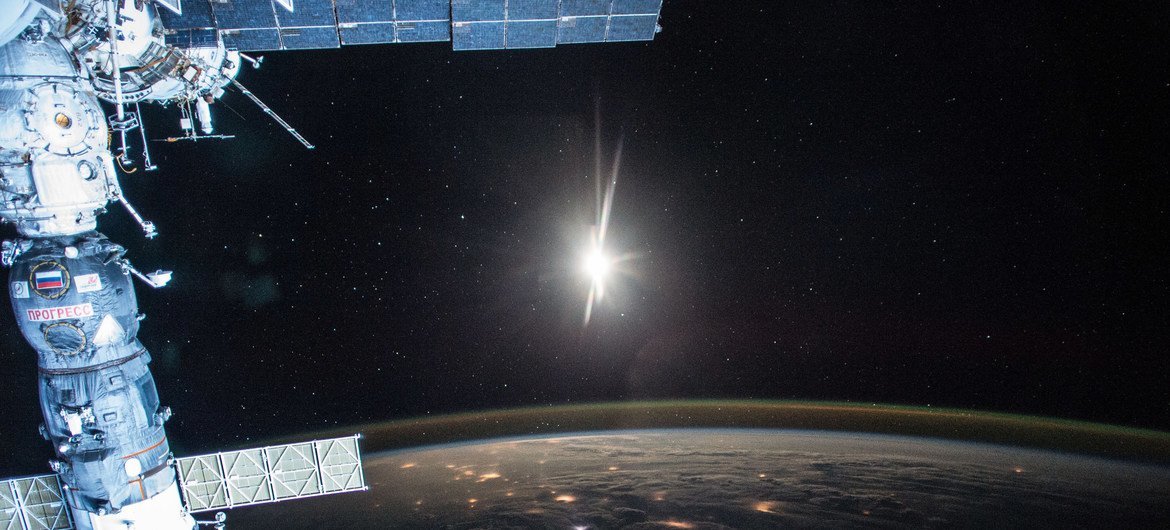
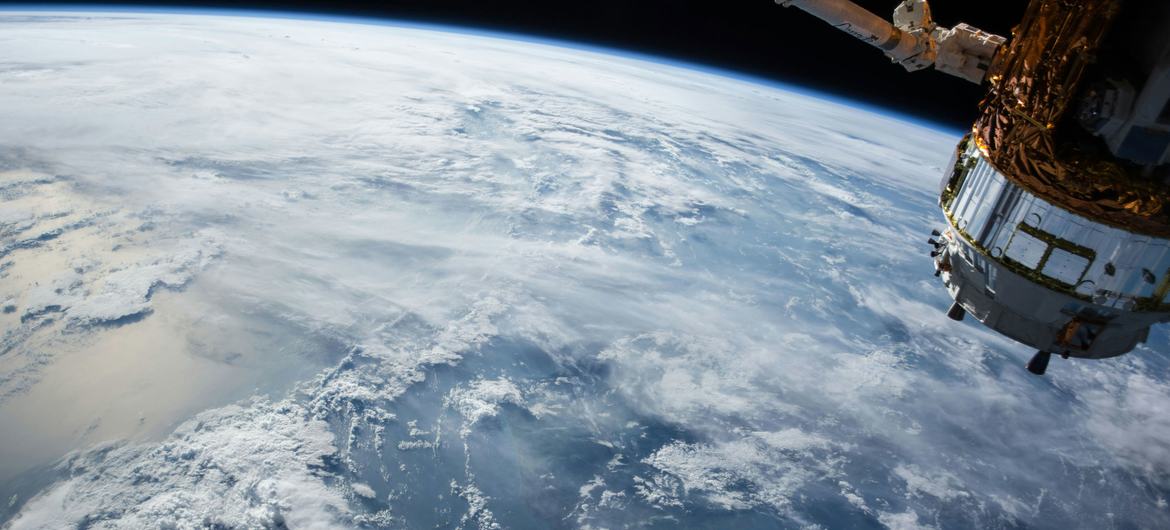
A view from the International Space Station, in orbit above the Earth.
Scott Kelly
 
A view from the International Space Station, in orbit above the Earth.


6 May 2024

Peace and Security

The UN General Assembly on Monday debated Russia’s veto in the Security Council which blocked a draft resolution aimed at preventing a new extraterrestrial arms race. 

Due to the negative Russian vote, the Security Council failed to adopt last month’s text, which received 13 votes in favour, with China abstaining. The draft resolution was introduced by United States and Japan, and co-sponsored by over 60 nations.

Assembly Vice-President Ahmad Faisal Muhamad opened the debate by reading a message from Dennis Francis, President of the General Assembly. 

Tweet URL
UN_News_Centre

Mr. Francis expressed concern that the Council could not reach consensus on addressing weapons of mass destruction in outer space.  

“Outer space does not belong to individual nations, its peaceful and sustainable use is not subject to national appropriation and must be a place of peace and cooperation for the benefit and in the interest of all countries,” he said.

“The militarization of outer space is a very concerning trend. Besides further deepening mistrust and divisions, this inevitably threatens life on Earth and could have catastrophic consequences.”

Clear prohibition

The Assembly President emphasized that the 1967 Outer Space Treaty “clearly prohibits” States parties from placing, installing or stationing in orbit around Earth  - or anywhere else in the cosmos - spacecraft carrying nuclear weapons or any other weapons of mass destruction.

Calling on all Member States to help safeguard the UN’s non-proliferation objectives both on Earth and in space, he urged nations to take all necessary steps to “keep the space weapons free.”

The debate was held as part of the General Assembly’s mandate under resolution 76/262 to discuss situations involving Security Council vetoes within 10 days of the veto.

The veto is a unique voting power held by the Security Council’s five permanent members – China, France, Russia, United Kingdom, and United States. A negative vote from any of these countries automatically causes a resolution or decision to fail.

Video feed of the General Assembly meeting.

Russia: Serious legal doubts

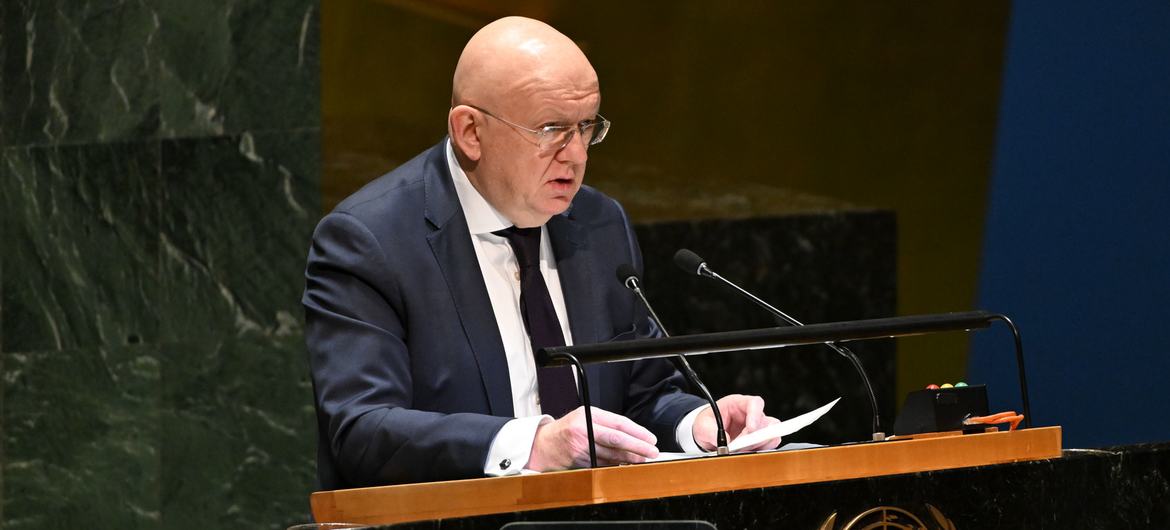
Vasily Nebenzya, Ambassador and Permanent Representative of Russia, explained why his delegation voted against the American draft resolution.

He stated that despite its “beautiful sounding title”, the text failed to address its declared goal because that objective was already covered by existing international agreements and voiced concern the resolution could have had “far-reaching consequences” for disarmament processes.

“During the negotiations on this draft, we attempted in vain to get an answer from the authors on why they were trying to use the Security Council to reaffirm already existing international obligations in the area of outer space exploration,” he said.

He referenced the 1967 Outer Space Treaty, which unequivocally prohibits placing weapons of mass destruction in outer space and suggested that discussions on this topic should take place in specialized forums that include all General Assembly members.

Ambassador Nebenzya criticized the draft for attempting to introduce new restrictions through the Security Council that were not previously established in any international instruments, including the 1967 Treaty, raising “serious doubts from a legal point of view” about these new restrictions.

“Imposing such obligations without preliminary, expert, legal and technical discussions is inadmissible,” he emphasized.

EU: Concern over hostile activities

Hedda Samson, Ambassador and Deputy Head of Delegation of the European Union (EU), responded to the Russian veto by emphasizing that it does not exempt Russia from its international legal obligations, including those outlined in the UN Charter, the 1967 Treaty, and international humanitarian law.

She emphasized the importance of enhancing space security, given that all nations increasingly depend on systems in orbit and beyond, for addressing climate change, disaster management, and sustainable development.

“Rising challenges and threats from outer space to our common security merit our full attention, including at the level of the Security Council,” she added.

In closing, Ambassador Samson also voiced EU’s concern over rising unfriendly and hostile activities in outer space.

“In this context, the European Union is actively engaged in promoting a safe, secure and sustainable space environment and the peaceful use of outer space on an equitable and mutually acceptable basis for all, for present and future generations,” she said.

Japan: Not an arena for a nuclear arms race

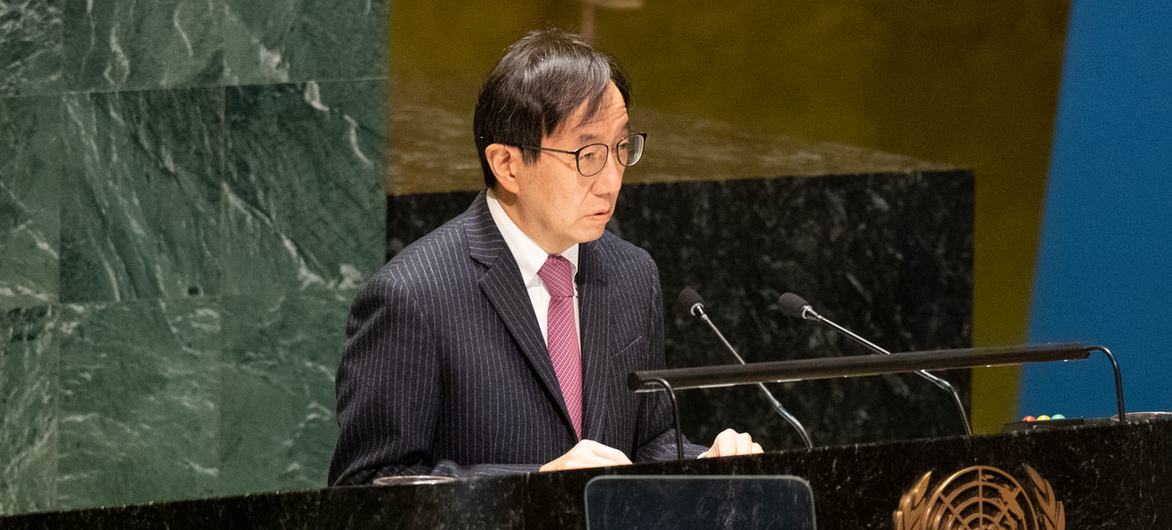
Kazuyuki Yamazaki, Ambassador and Permanent Representative of Japan, urged delegates to consider the catastrophic consequences if a nuclear weapon were detonated in outer space, resulting in the destruction of satellites and critical space infrastructure with irreversible impacts on people’s lives worldwide.

Ambassador Kazuyuki Yamazaki of Japan addresses the UN General Assembly plenary meeting on Russia's use of its veto to quash a draft resolution aimed at keeping weapons out of outer space.
UN Photo/Evan Schneider
 
Ambassador Kazuyuki Yamazaki of Japan addresses the UN General Assembly plenary meeting on Russia's use of its veto to quash a draft resolution aimed at keeping weapons out of outer space.

“The draft Security Council resolution on weapons of mass destruction in outer space, co-drafted by US and Japan, was intended to avoid such a nuclear catastrophe for humankind,” he added.

He highlighted the broad support for the draft, with 13 votes in favour and 65 co-sponsors.

“Regrettably, one permanent member decided to silence the critical message we wanted to send to the present and future people of the world: outer space must remain a domain free of weapons of mass destruction,” he lamented.

He said preventing nuclear weapons and other weapons of mass destruction in outer space “must remain our priority”.

“Outer space must never be an arena for a nuclear arms race,” he said.

China: Draft not comprehensive or balanced

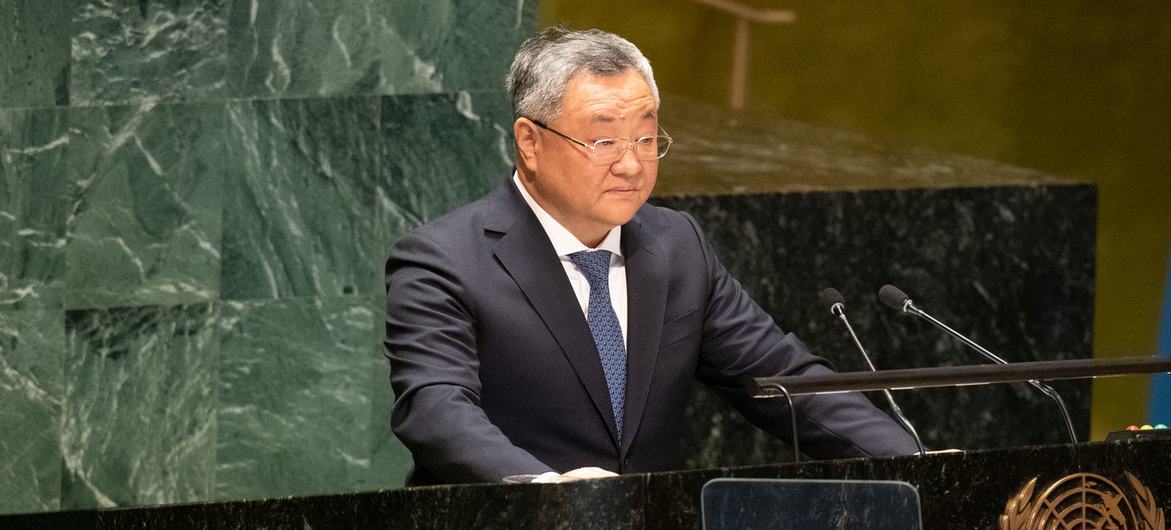
FU Cong, Ambassador and Permanent Representative of China, emphasized that outer space is the “global commons and embodies the shared aspirations of all humanity”.

Ambassador FU Cong of China addresses the UN General Assembly plenary meeting on Russia's use of its veto to quash a draft resolution aimed at keeping weapons out of outer space.
UN Photo/Evan Schneider
 
Ambassador FU Cong of China addresses the UN General Assembly plenary meeting on Russia's use of its veto to quash a draft resolution aimed at keeping weapons out of outer space.

“The world today is not at peace. The risk of outer space weaponization is on the rise and the right of developing countries to access space science and technology is being restricted,” he said.

He said the international community should take measures that benefit all countries.

These include preserving the peaceful character of outer space, urgently enhancing international space governance frameworks, and fostering increased cooperation and dialogue.

“The draft resolution on outer space security previously proposed by US and Japan is neither comprehensive nor balanced, which China is not in a position to support,” he said, adding that a new resolution proposed by Russia at the Security Council is more balanced and comprehensive.

“China support that [Russian] draft resolution and looks forward to its early agreement among Council members to jointly safeguard mutual trust and cooperation among all parties on the issue of outer space,” he added.

US: Transparent, inclusive negotiations

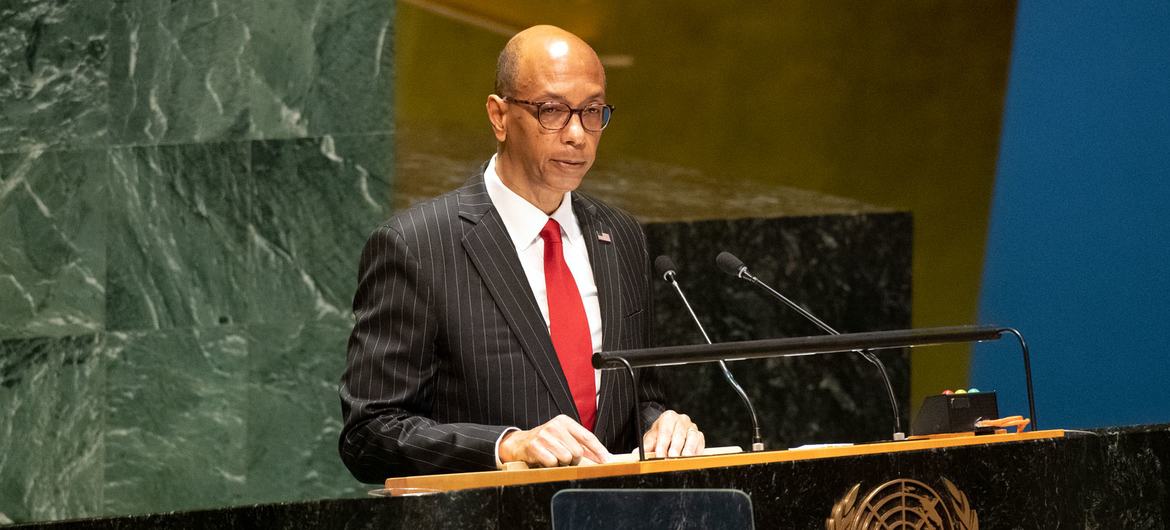
Robert Wood, US Ambassador and Deputy Permanent Representative, emphasized that the debate surrounding Russia's veto of the draft resolution presents a critical opportunity to promote accountability and transparency among all permanent members of the Council.

Deputy Permanent Representative Robert A. Wood of the United States, addresses the UN General Assembly plenary meeting on Russia's use of its veto to quash a draft resolution aimed at keeping weapons out of outer space.
UN Photo/Evan Schneider
 
Deputy Permanent Representative Robert A. Wood of the United States, addresses the UN General Assembly plenary meeting on Russia's use of its veto to quash a draft resolution aimed at keeping weapons out of outer space.

He highlighted that the draft resolution aimed to affirm the obligations of all States parties under the 1967 Outer Space Treaty, particularly over the prohibition of placing nuclear weapons or other weapons of mass destruction in outer space.

He explained that it also urged UN Member States not to develop nuclear weapons specifically designed for deployment in orbit, which would mitigate the risk of a nuclear incident in space and preserve vital satellites essential for communication, security, and sustainable development.

“It should not be at all controversial or difficult for the Security Council to affirm the clear obligations of parties under the Outer Space Treaty, nor should it be difficult to ask that States work together towards our shared interests,” he said.

Ambassador Wood noted that US and Japan, as the penholders, were deliberate, transparent, inclusive and flexible in their approach to the resolution, with the text evolving based on negotiations.

Regarding Russia’s new proposed draft resolution on the topic, he criticized it as a “diplomatic façade” concealing its “true intentions”.

The reality is that Russia currently possesses several conventional anti-satellite weapons in orbit, he said, citing a 2019 weapon test and ongoing threats against satellites.

“Russia’s actions cast significant doubt as to whether it will uphold its existing legal obligations under the Outer Space Treaty and raise concern about what this means for international peace and security,” he added.


https://news.un.org/en/story/2024/05/1149376


https://creativecommons.org/licenses/by/3.0/legalcode

среда, 24 апреля 2024 г.

Russia vetoes Security Council draft resolution on a weapon-free outer space


A view of the Earth and a satellite as seen from outer space.
© NASA
 
A view of the Earth and a satellite as seen from outer space.


24 April 2024

Peace and Security

Russia used its veto to quash a draft resolution aimed at keeping weapons out of outer space.

The Security Council rejected the draft resolution, introduced by Japan and the United States, by a vote of 13 in favour to one against, with one abstention (China), that would have had the 15-member organ call on “all States, in particular those with major space capabilities, to contribute actively to the objective of the peaceful use of outer space and of the prevention of an arms race in outer space.”

Also by the draft, the Council would have called on all nations “to refrain from actions contrary to that objective and to the relevant existing treaties in the interest of maintaining international peace and security and promoting international cooperation”.

Council rejects amendment tabled by China and Russia

Members also rejected an amendment tabled by China and Russia, by a vote of seven in favour to seven against, with one abstention, failing to reach the required nine votes for an adoption.

The amendment suggested an additional paragraph, which would have had the Council call on “all States, and above all those with major space capabilities, to take urgent measures to prevent for all time the placement of weapons in outer space and the threat or use of force in outer space, from space against Earth and from Earth against objects in outer space, and to seek through negotiations the early elaboration of appropriate reliably verifiable legally binding multilateral agreements.”

For a full summary of this and other meetings of major UN bodies, visit UN Meetings Coverage in English and French.


https://news.un.org/en/story/2024/04/1148951


https://creativecommons.org/licenses/by/3.0/legalcode

пятница, 12 апреля 2024 г.

General Assembly debates Russia’s veto of DPR Korea sanctions panel


Russia vetoed a draft resolution in March 2024 to renew the mandate of the Security Council's 1718 Committee panel of experts monitoring sanctions on the Democratic People’s Republic of Korea. (file)
UN Photo/Evan Schneider
 
Russia vetoed a draft resolution in March 2024 to renew the mandate of the Security Council's 1718 Committee panel of experts monitoring sanctions on the Democratic People’s Republic of Korea. (file)


11 April 2024

Sharp divisions emerged on Thursday as the General Assembly debated Russia’s veto on the Security Council which blocked renewal of the sanctions panel that monitors the Democratic People’s Republic of Korea (DPRK) nuclear weapon and missile programmes.

This is the third time this year that the world body has met to examine veto use among the Security Council’s permanent members – China, France, Russia, United Kingdom and United States – including on the situation in Gaza regarding a US veto.

Last week, Russia vetoed action to renew the panel of experts’ mandate to assist the Council’s DPRK sanctions committee. Current sanctions include an arms embargo and measures to prevent the proliferation of nuclear, ballistic missiles and other mass destruction-related programmes.

At the outset of Thursday’s meeting, Assembly President Dennis Francis told ambassadors that the recurring use of the veto undermines international peace and security.

“The spectre of nuclear conflict must compel us to move from rhetoric to tangible action,” he said, recalling his visit in October to the demilitarised zone between the Republic of Korea and DPRK – more commonly known as South and North Korea respectively - underlining that the current situation is tense.

Russia's Ambassador Vassily Nebenzia addresses the UN General Assembly.
UN Photo/Evan Schneider
 
Russia's Ambassador Vassily Nebenzia addresses the UN General Assembly.

New draft resolution

Russian Ambassador Vassily Nebenzia said his delegation had vetoed the draft resolution tabled by the United States for a number of reasons, among them that extending the panel of experts’ mandate would not contribute to normalising the situation on the Korean Peninsula.

“The basic mechanisms of the sanctions are failing,” he said, noting that all other restrictive measures against States are subject to review, but none of that applies to DPRK. “The indefinite maintenance of draconian measures is doomed to fail.”

The panel had been reduced to kowtowing to Western powers amid aggressive propaganda and sabre rattling, he said, while underlining that the sanctions have had severe humanitarian consequences.

As such, he said Russia plans to submit shortly a draft resolution to extend the panel’s mandate for one year, with a clear determination for the Security Council to update the parameters of the sanctions regime.

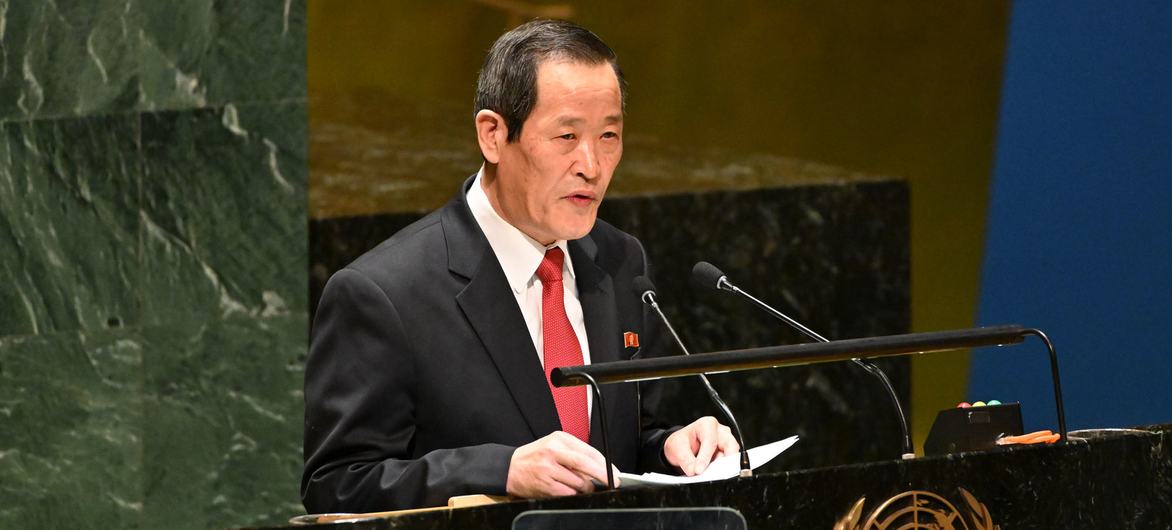
Ambassador Kim Song of the Democratic People's Republic of Korea addresses the UN General Assembly.
UN Photo/Evan Schneider
 
Ambassador Kim Song of the Democratic People's Republic of Korea addresses the UN General Assembly.

DPRK condemns double standards

Ambassador Kim Song of DPRK said nuclear weapons are stockpiled in many countries, including the US, yet Pyongyang is the only one facing sanctions.

Inhumane double standards exist in terms of States rights to defend themselves, he said, adding that Council sanctions are the product of the “heinous policies” of the US that hinder DPRK’s sovereignty, right to development and existence.

“This meeting today is not a simple gathering to hear and understand the exercise of the veto,” the ambassador said.

“Rather, it serves as an important occasion to determined whether we will leave Security Council to be a tool of the United States…or we make the Council to ensure justice and impartiality and perform its function as required by the international community.”

Geng Shuang, Ambassador and Deputy Permanent Representative of China, addresses the UN General Assembly.
UN Photo/Evan Schneider
 
Geng Shuang, Ambassador and Deputy Permanent Representative of China, addresses the UN General Assembly.

China: Sanctions must not be ‘carved in stone’

Deputy Permanent Representative Geng Shuang of China said the Korean War has long ended, “but the cold war mentality is still lingering”.

There will be no resolution of the current issues if the security concerns of all parties, including DPRK, remain unaddressed, he said, calling on relevant actors to work together to denuclearise the Korean Peninsula and adopt a path to peace.

The current tensions are stymying those efforts, he said, emphasising that dialogue and a political settlement of the matter is needed and the Council must play an active role.

“Sanctions should not be carved in stone,” he said, adding that “harsh sanctions” against DPRK have had a negative effect on the humanitarian situation in the country.

Regarding Russia’s new proposal, he expressed hope that Council members will work productively to extend the panel of experts’ mandate.

Ambassador Joonkook Hwang of the Republic of Korea addresses the UN General Assembly.
UN Photo/Evan Schneider
 
Ambassador Joonkook Hwang of the Republic of Korea addresses the UN General Assembly.

Republic of Korea: Veto will not silence ongoing efforts

The representative of the Republic of Korea said the veto sends “a dangerous message” and could have a cascading effect on other Council sanctions.

The panel will cease to exist in three weeks, but the sanctions remain in place, he said, encouraging all Member States to abide by these provisions.

In terms of the humanitarian situation, he said the international community has attempted to send aid, Pyongyang had declined.

“The veto will not silence the global non-proliferation regime,” he said, pledging his delegation’s efforts towards the proper functioning of the Security Council and its mechanism for the complete and verifiable denuclearisation of DPRK.

US: ‘We need to uphold our obligations’

Robert Wood, Deputy Permanent Representative of the United States, said that as the draft resolution’s penholder, his delegation had sought widespread engagement and that China and Russia have had ample opportunities to discuss sanctions reform in the Council.

Instead, Russia gave Council members an ultimatum that sought one of two outcomes: to prevent sanctions against DPRK or to silence the panel’s investigations, including into Moscow’s procurement of weapons from Pyongyang for its ongoing invasion of Ukraine.

Russia’s veto undermines the peace and security architecture and deprives action on one of the Council’s most pressing issues, that of peace on the Korean Peninsula, Mr. Wood said.

“Russia’s already threatening to terminate more UN sanctions mandates that help the Security Council monitor and take action to deter threats to international peace and security,” he said. “This is why it is critical for all of us to raise our voices today in support of the non-proliferation regime, and in opposition to attempts to silence information, we need to uphold our obligations.”


СЕМЬДЕСЯТ ВОСЬМАЯ СЕССИЯ,
68-Е И 69-Е ЗАСЕДАНИЯ (УТРО И ВЕЧЕР)
ГА/12592

Пленарное заседание Генеральной Ассамблеи: Использование права вето

(Примечание: окончательный отчет об этой встрече будет доступен позднее.)

Генеральная Ассамблея собралась сегодня, чтобы обсудить использование права вето в Совете Безопасности. Ожидалось также, что Ассамблея примет решение по проекту резолюции «Дальнейшие условия проведения четвертой Международной конференции по финансированию развития» (документ A/78/L.58 ).


https://press.un.org/en/2024/ga12592.doc.htm


https://creativecommons.org/licenses/by/3.0/legalcode

пятница, 17 ноября 2023 г.

Question of Veto Central to General Assembly’s Debate on Security Council Reform, with Speakers Urging Its Limited Use as ‘Weapon of Hatred and War

SEVENTY-EIGHTH SESSION,
 
36TH MEETING (PM)
GA/12563

Question of Veto Central to General Assembly’s Debate on Security Council Reform, with Speakers Urging Its Limited Use as ‘Weapon of Hatred and War’

The General Assembly today concluded its annual debate on Security Council reform, with several Member States stressing that the unfair and outdated rules and processes from the last century are not relevant in today’s world and paralyse the Council from taking meaningful action. 

The Assembly — having kicked off on Thursday its debate on the 15-member body tasked with maintaining international peace and security (Press Release GA/12562) — heard from the remainder of speakers today.  Many echoed the view regarding the need to limit veto use, saying legitimate reasons for doing so should include cases of genocide, crimes against humanity and war crimes.

Ukraine’s delegate, taking it a step further, said that it is extremely inappropriate that a country in a permanent seat has the privilege to exercise a veto right during consideration of situations in which that country is directly involved as a party to conflict and, moreover, is its instigator.  The veto “should not serve as a weapon of hatred and war”.  Restricting its use by a permanent member should indeed include cases of genocide but must also include conflicts in which that member is involved.

The growing use of the veto by some permanent members has paralysed the Council in recent years and undermined its credibility and that of the entire Organization, stressed El Salvador’s speaker.  As long as this outdated mechanism remains, El Salvador agrees it is vital to suspend it in cases of war crimes. 

As the only permanent Council member speaking during today’s debate, the representative of the Russian Federation said the veto has on more than one occasion saved the UN from being “drawn into dubious adventures”.  This was made clear recently when the United States and “its satellites” tried to push a Council resolution in support of Israeli actions in Gaza.  “Only the veto by Russia and China saved the world from the shameful scenario.”  If the veto were not provided for under the UN Charter, the Council would become just a body for “uncontrolled stamping of documents that are beneficial to a narrow group of countries” and the UN “would repeat the unenviable fate of the League of Nations”.  

Many speakers stressed the need for deep structural reforms, without which, they warned, the Security Council and its legitimacy will continue to suffer, dampening with it the reputation of the wider UN.  Rising geopolitical tensions, the war in Ukraine and the unfolding situation in the Middle East all call for a more transformed and transparent multilateral system, they said.  

The Council cannot continue excluding the voices of people from entire regions and continents from discussions and decisions that impact their future, said the representative of Guyana.  Outdated decision-making rules of years ago are no longer applicable today.  Such practices paralyse the Council, especially when naked self-interest is not isolated from its business. 

Kenya’s representative said that Africa remains unequal in the highest levels of global decision-making. Africa’s unique status — being the only region without representation in the permanent category and underrepresented in the non-permanent category — is an indictment of the multilateral system. The continent’s demand for two permanent and two additional non-permanent seats is not merely about justice, but about ensuring an equal footing in decision-making.  

There was broad support for expanding the membership, in both permanent and non-permanent categories, and for unrepresented or underrepresented regions and continents such as Africa and Asia to have a “meaningful seat” at the table. Others named countries that they thought should be welcome additions to the 15-member body.  Some speakers, whose country situations have been on the Council’s agenda for many years, said that the body was skewed in its approach to international politics as well as international peace and security. 

The representative of the Democratic People’s Republic of Korea said that the present Security Council structure is centred on the West and does not reflect today’s reality, thereby rendering it a political instrument of specific forces. Washington, D.C., actively protects the atrocities of its ally, causing a humanitarian catastrophe in the Middle East, while branding the just self-defensive measures of the Democratic People’s Republic of Korea as a “threat to international peace and security”. 

Syria’s delegate said that the people of the world now see international institutions as being complicit in destroying, looting and impoverishing the world’s inhabitants.  Violations of Council resolutions have been perpetuated under the pretext of maintaining international peace and security.  The occupier is now entitled to self-defence. The so-called rules-based international order championed by the West should rather be described as the rules-lacking international order. 

KIM SONG (Democratic People’s Republic of Korea) cited the United States’ veto on the draft resolution on a humanitarian pause in the Gaza Strip, on the unjust grounds that it did not mention Israel’s right to self-defence.  Washington actively protects the atrocities of its ally, causing a humanitarian catastrophe in the Middle East, while branding the just, self-defensive measures of the Democratic People’s Republic of Korea as a “threat to international peace and security”.  This is a double-dealing logic and practice. The present Security Council structure is centred on the West and does not reflect today’s reality, turning it into a political instrument of specific forces.  He re-emphasized that there is no place in the Council for Japan, an “A-class war criminal”, whose unprecedented crimes include forced abduction and the drafting of 8.4 million people, the massacre of 1 million people, and the sexual slavery of 200,000 Korean women for the Japanese Imperial Army. 

TITHIARUN MAO (Cambodia) noted that reform of the Security Council should be based on consensus, which is crucial for its success, considering that the five clusters of the intergovernmental negotiations framework are closely interconnected.  Thus, it is important for Member States to first reach a clear understanding of the principles and goals of reform — as any attempt to force a text-based negotiation without first obtaining consensus will hinder the process. His delegation’s fundamental position supports enlarging both the permanent and non-permanent seats, based on an equitable and geographical representation that reflects current realities. It should be more inclusive, representative and democratic.  If the reform only benefits a select few countries, it contradicts the fundamental principles of fairness and the goals driving it. 

MHD. RIYAD KHADDOUR (Syria), aligning himself with the Arab Group, said the peoples of the world now see international institutions as being complicit in destroying, looting and impoverishing the world’s inhabitants.  He said violations of Security Council resolutions have been perpetuated under the pretext of maintaining international peace and security.  He highlighted the entrenchment of new dangerous precedents that run counter to the spirit and text of the Charter of the United Nations.  The occupier is now entitled to self-defence while resistance has been deemed as terrorism, justified under the so-called rules-based international order championed by the West.  He said it should rather be described as the rules-lacking international order.  He underscored the need for reforming the Security Council and an equitable representation of its membership as this will ensure a well-functioning organ that can fulfil its mandate and command respect for the Charter of the United Nations.  The imbalance between the Global North and South should also be addressed.

YUSNIER ROMERO PUENTES (Cuba) said it is vital to address the issue of Security Council reform.  He took note of innovations in the previous session to advance transparent discussions.  Cuba believes the Council should become a more transparent and representative body. He pointed out that developing countries are underrepresented among the Council membership.  “It is not fair that entire regions such as Africa, Latin America and the Caribbean are not represented,” he said.  Regarding voting in the Council, Cuba has always been opposed to the veto.  But any new members should be afforded the power of the veto, he said, adding that new categories or subcategories of membership should be avoided since it would sow further division.  In the interest of achieving a better Council, inclusive and participatory reform to achieve tangible outcomes is needed, he said. 

SERHII DVORNYK (Ukraine) said that the Council has been taken hostage by the Russian Federation’s practice of using its platform to whitewash aggression and violations.  Not only have attempts to act on the “Ukrainian track” been blocked by the Russian Federation, but the Council’s toolbox also has been misused by Moscow to disseminate propaganda and to overburden war-related discussions by duplicating meetings.  It is inappropriate that the country in a permanent seat has the privilege to exercise a veto right during consideration of situations in which it is directly involved as a party to conflict and, moreover, its instigator.  The veto should not serve as a weapon of hatred and war. The legitimate reasons for restricting veto use by a permanent member should include cases of genocide, crimes against humanity and war crimes, as well as conflicts and situations in which a permanent member is involved.  He expressed support for expanding membership to various regions such as Africa and Asia, and States such as Germany. 

MARKOVA CONCEPCIÓN JARAMILLO (Panama) said the Security Council must move forward and adapt to new realities to enable the United Nations to respond decisively with greater accountability and transparency to twenty-first century challenges.  Panama supports increasing the number of Council members to between 21 and 27 States, but there must be a balance between membership categories and the format determining which countries occupy seats.  She said due account should be given to different regional groups.  An enlarged Council of non-permanent members allowed for longer periods, like 3 to 5 years, will ensure continuity in their work and help consolidate international peace and security.  Her delegation supports proposals for increasing Africa’s representation on the Council.  She said the indiscriminate use of the veto prevents the Council from fulfilling its mandate.  This should be limited.  Recalling that dialogue and negotiations on this matter have been taking place for 14 years and admonishing that perfection is the enemy of action, she urged the Assembly to move on to action.

ANDRÉS EFREN MONTALVO SOSA (Ecuador) said progress has been made on the format and logistics of Security Council meetings, allowing each delegation to better understand the viewpoints of other delegations. But there is no consensus on how far the reform process should go, he said.  “Perfecting United Nations organs is not our aim,” he said, adding that the greater goal is better peace and security, which requires a more modern and effective Council.  Reform is urgent, and a solid basis of realism is needed.  The Security Council has shown a failure to act.  However, with its election to the Council, Ecuador has been able to observe deliberations more closely.  The Council does produce results, he said, noting, “Why else do States want a seat?”  However, it must be able to act more swiftly, which will not be achieved with more permanent members but rather with fewer, he said.

CARLOS EFRAÍN SEGURA ARAGÓN (El Salvador) said that without structural reform, the Security Council and its legitimacy will continue to inevitably suffer, as will the relevance of the United Nations itself. To make the Security Council more representative, El Salvador supports the enlargement of the number of its elected members.  Recent events have made very clear the important contributions that elected Council members provide.  They give the Council the opportunity to reach balanced and significant decisions.  The growing use of the veto by some non-elected members has paralysed the Security Council, undermining its credibility and that of the entire Organization.  As long as this outdated mechanism remains, El Salvador believes it is vital to limit its use.  He supports suspending the veto in the cases of massive violations of international law, genocide, crimes against humanity and war crimes.  

FRANCISCO JOSÉ DA CRUZ (Angola), aligning himself with the African Group, said changes to the global geopolitical landscape make the question of reform increasingly complex.  “In the last few years, we have witnessed the inability of the Security Council to live up to its responsibility,” he said, adding that such failure demonstrates the need for reform.  Africa remains the only continent with no permanent seat in the Council, an unacceptable historical injustice that must be corrected.  The Common African Position, also known as the Ezulwini Consensus, calls for the allocation of two permanent member seats to Africa with the attendant prerogatives, including the right of veto, as long as it exists, as well as five non-permanent seats on the reformed Council so that the continent can enjoy representation commensurate with its current contribution to the maintenance of international peace and security.

CAROLYN RODRIGUES-BIRKETT (Guyana), aligning with the Caribbean Community (CARICOM) and the L.69 group of developing countries from Africa, Latin America and the Caribbean, Asia and the Pacific, noted widespread agreement that the unfair decision-making rules and anachronistic composition of 78 and 58 years ago are not applicable in today’s context.  This configuration helps paralyse the Council, especially when geopolitics and naked self-interest are not isolated from its overall business.  The Council cannot continue excluding the voices of people from entire regions and continents from deliberations that impact their future.  Her delegation advocates for expansion in both categories of membership and for a rotating seat on the Council for small island developing States, as they can contribute to the maintenance of international peace and security, especially in light of emerging and non-traditional threats.  She further voiced support for the Ezulwini Consensus for greater African representation on the Council. 

PHETVANXAY KHOUSAKOUN (Lao People’s Democratic Republic) said that the current international geopolitical and security landscape has underscored the urgency for advancing Security Council reform. Over the years, the intergovernmental negotiations framework has provided an essential platform for all Member States to discuss this reform, he noted, emphasizing that the Council should address ongoing global insecurities and armed conflicts as well as prevent another catastrophe for humankind.  Stressing that the member-driven process must be carried out in a comprehensive, transparent and inclusive manner, he observed that the reform process must ensure expansion in both permanent and non-permanent Council memberships, considering the interests of all nations and ensuring equitable geographical representation.

SHARIFA YOUSEF A. S. ALNESF (Qatar), aligning herself with the Arab Group, said Security Council reform is a major challenge and strategic objective for the international community, given its relationship with a principal pillar of the United Nations — maintenance of international peace and security.  The reform process is urgent, particularly considering the crises around the world, including the humanitarian situation in Gaza and crimes against humanity caused by the Israeli occupation against the Palestinian people.  This has great implications for regional and international peace, particularly in the face of the silence of the international community and the inability of the Council to fulfil its mandate and end the killings and destruction.  Promoting the Council’s effectiveness, transparency and representation “will allow us to enhance its legitimacy and contribute to international efforts to establish a global governance system which is more transparent”.  The equality of all States must be respected, with Council reform accompanied by an improvement in its working methods and decision-making process.

REIN TAMMSAAR (Estonia) expressed regret over the lack of meaningful substantive progress on reform of the Security Council, noting that the General Assembly should be able to collectively overcome the veto if the Council itself cannot uphold international law and the Charter of the United Nations.  He further voiced support for the France-Mexico initiative on veto restraint and the code of conduct by the Accountability, Coherence and Transparency Group on not voting against resolutions aimed at ending mass atrocities, including the crime of aggression.  Citing Article 27 of the Charter — stipulating that “a party to a dispute shall abstain from voting” in the Council — he called on that organ to strictly implement this clause as has been done in numerous cases since the inception of the United Nations.  He further advocated for “a fair distribution between continents and regions,” with small, medium and big States represented.

ANA JIMENEZ DE LA HOZ (Spain), aligning herself with Uniting for Consensus, said Spain believes that reforming the Security Council is an urgent matter as the organ must become more equitable, democratic, representative and transparent.  During these negotiations, it is important to be realistic, supportive and aspire to achieve reasonably satisfactory results for all.  A greater number of Member States should have the possibility of serving on the Council, she said, adding that Spain believes inevitable reforms must respond to today’s world and the global challenges facing the international community.  As a member of Uniting for Consensus, Spain will actively contribute to the upcoming intergovernmental negotiations to ensure Council reform advances.

DMITRY A. POLYANSKIY (Russian Federation) said that the use of the veto or the threat of its use, has more than once saved the United Nations from being drawn into dubious adventures.  This was made clear recently when the United States and “its satellites” tried to push a Security Council resolution in support of Israeli actions in Gaza, and “only the veto by Russia and China saved the world from the shameful scenario”.  In recent years, cases of vetoes in the Security Council have become more numerous.  However, such a situation is a consequence of the desire by Western members of the Council to put their opponents in an awkward situation using their own comfortable majority in the Security Council.  If the veto were not provided for under the Charter of the United Nations, the Council would become just a body for “uncontrolled stamping of documents that are beneficial to a narrow group of countries” and the United Nations “would repeat the unenviable fate of the League of Nations”.  The founding fathers of the Organization wanted to exclude such a scenario.

ABDULAZIZ M. ALWASIL (Saudi Arabia), aligning himself with the Arab Group, said the Security Council “should be more representative of today’s reality, more effective in keeping pace with current development and more efficient in addressing current challenges”. He welcomed the progress in identifying convergences and differences, which needs further discussion.  These efforts show that different groups and States agree on several commonalities and aspects of the five clusters.  The international community, therefore, should pursue positive discussions to bring views closer to a solution that garners the widest possible political acceptance.  He highlighted the Council’s recent delay in acting on Gaza, adding that the ultimate objective of its reform is to build a more transparent, credible, equitable and effective representative organ that can meet the people’s aspirations and address today’s challenges through multilateralism.  His delegation underscores the importance of the intergovernmental negotiations framework and the five reform clusters as well as further efforts towards a widely accepted solution.

DIEGO PARY RODRÍGUEZ (Bolivia) said that structural reform of the Security Council has never been as urgent as during this painful moment.  It is time to start a new phase of discussions to ensure the Council can fulfil its mandate, he said, noting his appreciation for efforts to increase transparency such as record-keeping and more informal meetings.  The complexity of Security Council reform necessitates more clarity on timelines, he said, expressing support for increased membership in the organ, which will achieve a greater plurality of views and better geographical representation.  Another issue that cannot wait is reform of voting in the Council, he said, adding that it is urgent to restrict or eliminate the veto.  Additionally, the methods and working procedures must become more transparent and democratic.  He concluded by saying one aim of reform is to establish a Council that faithfully reflects the world as it is.

ADAMU IBRAHIM LAMUWA (Nigeria), associating with the African Group and the L.69 group, said that it is obvious that the Security Council is “incapacitated” and has become ineffective in upholding its mandates in the prevention of conflicts and in stopping wars.  Current geopolitical tensions, the tragic war in Ukraine and the unfolding situation in the Middle East all call for a more transformed and transparent multilateral system.  Council reform is inspired by the principles of the UN Charter.  The objective of this process is based on the sovereign equality of all Member States.  He spotlighted Africa's demands for Council reform that will ensure its legitimate right to fair and equitable representation.  He also noted Africa’s position in support of abolishing use of the veto. 

SIARHEI MAKAREVICH (Belarus) said reform of the Council is a question that directly concerns the national interests of all Member States.  Previous discussions have shown the fragile process of finding compromise towards a comprehensive resolution of all disagreements on reform.  “Reform is of great importance and affects the security on the planet,” he said, adding that all parties must create a clear and precise process that achieves a consensus that can meet the needs of the contemporary world.  His delegation supports efforts aimed at a broad dialogue that welcomes the consideration of all thematic clusters covering contemporary problems. Intergovernmental negotiations should be maintained, and any attempt to disrupt these negotiations could destroy the vulnerable process of reform.  There are serious differences among Member States, especially concerning the right of the veto.  More representation is needed for developing countries, and his delegation welcomed the Council’s enlargement, including seats for Member States from Eastern Europe.

MICHAEL KAPKIAI KIBOINO (Kenya) said that current conflicts and crises demonstrate that the Security Council is unable to effectively discharge its mandate.  Although he recognized progress in holding open meetings through webcasting as well as record-keeping, progress was slow on the substantive issues of the intergovernmental negotiations process.  Highlighting that Africa remains unequal in the highest levels of global decision-making, he stressed that its unique status — being the only region without representation in the permanent category and underrepresented in the non-permanent category in the Council — is an indictment of the multilateral system.  The continent’s demand for two permanent and two additional non-permanent seats is not merely about justice, but about ensuring an equal footing in decision-making on international peace and security matters, particularly concerning Africa.  “We should seize every available opportunity that would accelerate the Security Council reform,” he added.

YOSEPH KASSAYE (Ethiopia), associating himself with the African Group, said that the Council needs to reflect global reality to effectively respond to contemporary challenges of maintaining international peace and security. Highlighting that Africa remains the only major continent without representation in the permanent category, he said it is also underrepresented in the non-permanent category.  “This historic injustice must be urgently redressed,” he stressed, noting that the continent will decide the modality with which it determines its representation.  He observed that the veto is not democratic nor effective, stating that if retained, Africa’s demand for two permanent seats, with all the rights and prerogatives of current members, should also include this right. “In improving the working methods of the Security Council, we wish to see an accessible, accountable, democratic, representative and more effective Council,” he added.

Right of Reply

Exercising the right of reply, the representative of Japan said his country has consistently contributed to the United Nations and the international community in a positive way and will continue to do so.

The representative of the Democratic People’s Republic of Korea, speaking in exercise of the right of reply, said that a war criminal State like Japan should not be allowed to be a permanent member of the Security Council.  There is no doubt, Japan is a war criminal State that inflicted immeasurable pain and suffering by invading many Asian countries in the past century.  Moreover, Japan is the only country that still denies its past crimes against humanity, including the genocide of 1 million innocent Koreans.  Instead of apologizing, Japan further accelerates a scheme to become a military power.  In defiance of strong protests and criticism, Japan discharges nuclear contaminated water into the ocean.  It is another crime against humanity.  He reiterated that the Security Council should be composed of peace-loving States. He also totally rejected the statement made by the Republic of Korea on 16 November and strongly urged Seoul to stop deceiving the international community.

In a second right of reply, the representative of Japan regretted that the delegation of the Democratic People’s Republic of Korea referred to a matter irrelevant to the debate on the Security Council concerning the Fukushima Daiichi Nuclear Power Plant.  Japan never discharged “ALPS-treated water” into the sea in a manner that endangers human health and the marine environment.  The comprehensive report of the International Atomic Energy Agency (IAEA) attests to this, stating that the discharge conforms to relevant international safety standards with negligible radiological impact on humans and the environment.  His country remains committed to transparency and providing information based on scientific evidence.


https://press.un.org/en/2023/ga12563.doc.htm

https://creativecommons.org/licenses/by/3.0/legalcode