Показаны сообщения с ярлыком Elections. Показать все сообщения

четверг, 15 августа 2024 г.

No date yet for long-awaited South Sudan elections


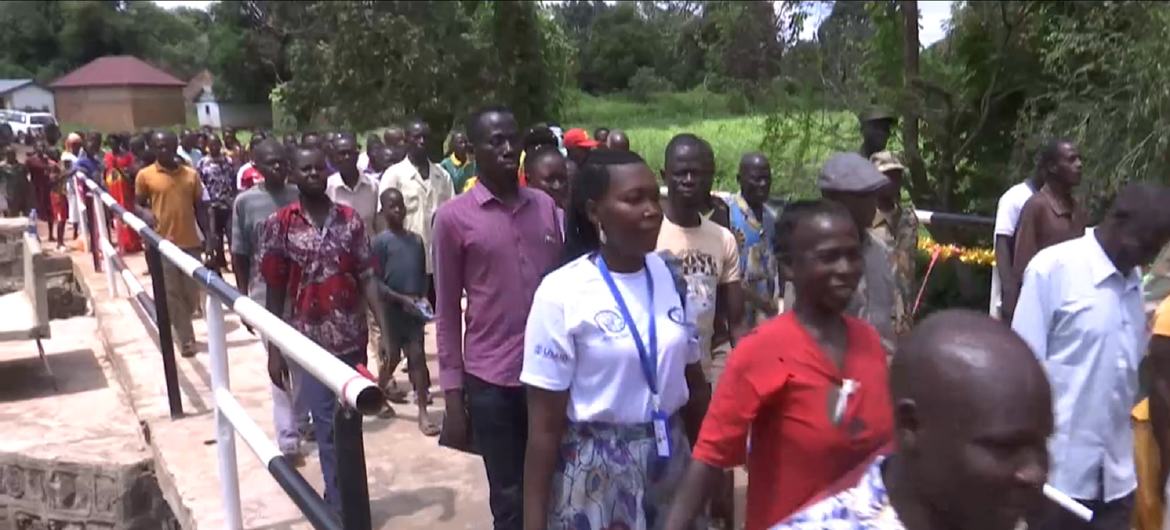
People crossing over a newly constructed bridge in Tambura, South Sudan, funded by the UN Mission in the country, UNMISS.
UNMISS
 
People crossing over a newly constructed bridge in Tambura, South Sudan, funded by the UN Mission in the country, UNMISS.


14 August 2024 

Peace and Security

The UN continues to support an enabling environment for general elections in South Sudan, but the date remains elusive, the Secretary-General’s Special Representative for the country told the Security Council on Wednesday. 

Nicholas Haysom, who also heads the UN Mission in South Sudan (UNMISS), briefed ambassadors on political, security and humanitarian developments in the world’s youngest nation, which was scheduled to hold its first post-independence elections in December.

Election date proposal expected

The latest UNMISS report covers the period from mid-February to mid-July, as political parties continued discussions on key steps necessary for the vote and to resolve outstanding issues under a transition roadmap, stemming from a 2018 peace agreement.

Tweet URL

Mr. Haysom said the High-Level Standing Committee that oversees implementation of the peace deal has completed its report and a preliminary version was released on Tuesday night.

“On the critical issues of the date of the elections, we understand, however, that no date has been agreed as yet, and that the president has designated the electoral institutions to produce a feasible proposal on when these elections may be held,” he said.

Talks in Nairobi

Meanwhile, a second dialogue process was launched in May in Nairobi between the transitional government of national unity and non-signatories to the peace deal. 

The talks, known as the Tumaini Initiative, seek to ensure that non-signatory parties, civil society, faith-based groups and traditional leaders join the peace process.

The Tumaini Initiative has proposed new monitoring, oversight and implementation mechanisms and a National Leadership Council structure. 

However, the Sudan People’s Liberation Movement in Opposition (SPLM/IO), led by Vice President resident Riek Machar, announced last month that it was withdrawing from the talks, “citing concerns that the Tumaini Initiative dealt with matters that were already agreed in the Revitalized Peace Agreement and accordingly it had gone beyond its remit,” Mr. Haysom said.

“There is currently a lack of clarity as to whether the SPLM/IO has reversed that decision but as part of the report of last evening, there is indication that this is under review,” he added.

UN upholds dialogue

Mr. Haysom said UNMISS has used its good office’s role to engage the parties involved in these ongoing processes.  

He stressed that the Mission “is not championing either process as an exclusive modality but is promoting the constructive confluence of the two”, adding that both must “advance with deliberate speed to deliver on the aspirations of South Sudanese citizens.”

Regarding the overall implementation of the peace agreement and roadmap, he noted that action has been taken, including the provision of funding to the National Constitutional Review Commission and the appointment of State High Elections Committees, while the National Elections Commission (NEC) has begun assessing the infrastructure and facilities necessary for the polls.

Protective environment for elections

So far, 29 political parties have registered for the elections, which the NEC had announced last month would take place on 22 December.

“I note, however, that there is still ongoing consultations between the political stakeholders as to whether elections can or should be held this year. This makes it difficult to treat 22 December as a definitive trigger in isolation from other critical factors,” he said.

Mr. Haysom added that should the elections be held in December, UNMISS would provide a report on the security situation at intervals of 90, 60 and 30 days out.

In the meantime, the Mission continues to support establishing an enabling environment for the elections, with focus on dialogue and engagement, physical protection and creating “a broader protective environment”.

‘A perfect storm’ approaches

Turning to the humanitarian situation, he warned that “a perfect storm is gathering in South Sudan”.

The impeding crisis is due to chronic food insecurity, spillover from the war in neighbouring Sudan, political uncertainty, a rapidly deteriorating economy worsened by the rupture in critical oil infrastructure and revenue, and the potential for once-in-a-lifetime flooding in September.

“Any one of these elements on its own presents a significant challenge. When taken together, it could push the country to a tipping point – and all during a time when the people of South Sudan are embarking on a delicate phase of nation-building,” he said.

Millions need humanitarian aid

Edem Wosurnu of the UN humanitarian affairs office, OCHA, expanded on the envoy’s remarks.

She said more than nine million people in South Sudan, 76 per cent of the population, require humanitarian protection and assistance. The majority, 54 per cent, are children and 24 per cent are women. 

In total, just over seven million South Sudanese are acutely food insecure, an increase of around 1.5 million since last year.  Additionally, 2.5 million children and women are at risk of acute malnutrition, which is projected to climb to 2.7 million by December due to the impact of the crisis in Sudan. 

‘Pockets of famine’ predicted

“Mid-year projections by our food security experts suggest that flooding combined with conflict could result in pockets of famine between June 2024 and January 2025,” she said.

The impact from flooding is already being felt in some communities. Since May, heavy rains and the calculated release of water from Lake Victoria have caused the Nile River to rise, affecting up to 300,000 people.

“At the peak of the flood season, anticipated between September and October, flooding could impact up to 3.3 million people.,” Ms. Wosurnu said.

“This includes communities yet to recover from the devastating floods which occurred between 2019 and 2022, and which displaced more than one million people each year.”

Sudan war’s impact

Meanwhile, South Sudan has been the country worst hit by the displacement crisis caused by the war in Sudan, which began in April 2023.

Nearly 780,000 people fleeing the fighting have crossed over the border, including 580,000 South Sudan returnees. 

“Many are arriving in areas already deprioritized for assistance. They are often malnourished, in poor physical condition, and require immediate life-saving assistance,” she said.

Once again, the arrivals are mostly women and children, with many requiring specialized support for trauma and gender-based violence.

Humanitarians under fire

Ms. Wosurnu said that despite the challenges, humanitarians continue to deliver in South Sudan, reaching more than 2.6 million out of the six million people targeted for support this year, but she also highlighted the dangers they face.

“As we prepare to mark World Humanitarian Day next week, it is worth reminding the Council that South Sudan remains one of the most dangerous places for humanitarians to operate,” she said.

During the first half of 2024, 237 “humanitarian access incidents” were reported and 46 per cent involved violence against personnel and assets. Four humanitarian workers have been killed in the line of duty since 2023, she added, while aid convoys have been subjected to illegal taxation and looting.

Humanitarian response also continues to be underfunded, she added.  A $1.8 billion plan to fund operations this year has received only $561 million to date.


https://news.un.org/en/story/2024/08/1153186


https://creativecommons.org/licenses/by/4.0/legalcode

вторник, 13 августа 2024 г.

UN chief calls for inclusive elections in Bangladesh


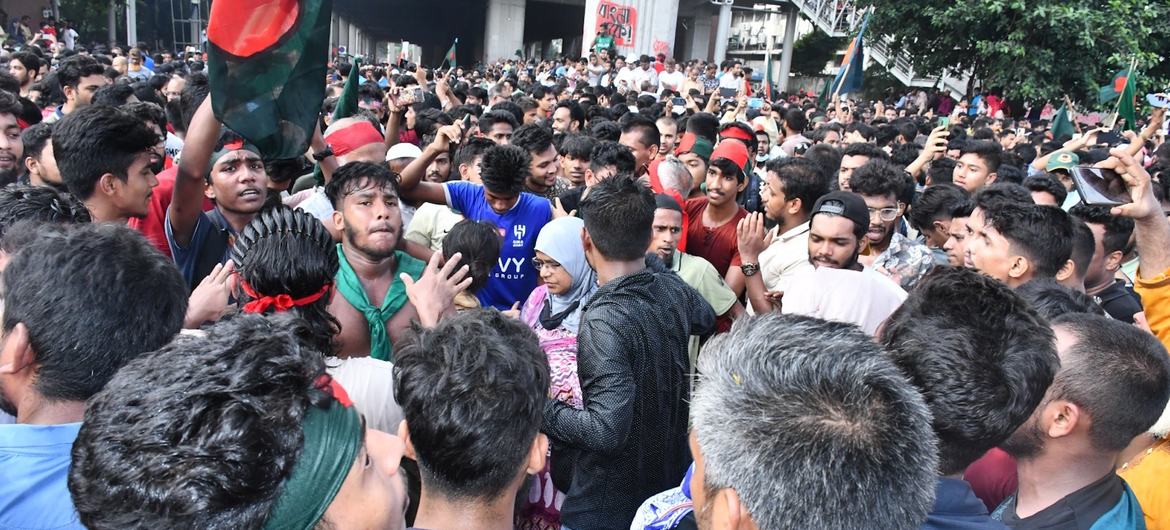
Bangladesh faces political turmoil after the Prime Minister resigned and fled the country following weeks of widespread protests.
UN Bangladesh/Mithu
 
Bangladesh faces political turmoil after the Prime Minister resigned and fled the country following weeks of widespread protests.


13 August 2024 

Peace and Security

The UN Secretary-General has welcomed efforts to restore calm and hold fresh parliamentary elections in Bangladesh, urging the interim Government to be inclusive as the country moves towards restoring democratic rule.

In a statement issued by his Deputy Spokesperson late on Monday (New York time), the UN chief also called for full respect of the human rights across the country.

“The Secretary-General welcomes efforts to restore calm and organize parliamentary elections in Bangladesh, with the support of an interim government,” UN Deputy Spokesperson Farhan Haq said.

He also called on the interim administration being led by Nobel Peace laureate Muhammad Yunis “to continue to make every effort” to be inclusive, taking into account the voices of women and youth as well as those of minority and indigenous communities, as the country moves towards new elections.

Tweet URL

Mr. Yunus and the Grameen Bank, which he founded, were the recipient of the Nobel Peace Prize in 2006 for their work based around grassroots economic and social development.

He was sworn in last Thursday as the chief adviser to the interim government (a position equivalent to the Prime Minister), after Bangladeshi Prime Minister Sheikh Hasina resigned and fled the country following weeks of protests.

The statement further noted that the Secretary-General stood in “full solidarity” with the people of Bangladesh and called for the full respect of their human rights.  

“He continues to underscore the need for a full, independent, impartial, and transparent investigation into all acts of violence,” the statement added.

Dramatic fall of the Government

More than 300 people, including many children, are said to have been killed since student-led protests erupted in July, while more than 20,000 were injured. The bloodshed was among the worst ever witnessed in Bangladesh.

The unrest began in July with protests by students against civil service job quotas. Though the scheme was withdrawn, protests erupted again in early August, with the key demand for PM Hasina to quit and for those responsible for the violent suppression of demonstrations to be held accountable.

Ms. Hasina had been in power since January 2009, having earlier led the country from 1996 to 2001.


https://news.un.org/en/story/2024/08/1153126


https://creativecommons.org/licenses/by/4.0/legalcode

среда, 20 марта 2024 г.

Senegal: UN experts urge respect of fundamental freedoms ahead of elections

19 March 2024

The experts previously raised concerns with the Government about the prosecution and detention of opposition leaders and their supporters. They also welcomed the release of over 500 detainees amongst whom opposition leaders Ousmane Sonko and Bassirou Diomaye Diakhar Faye last week, even if it is only days before presidential elections scheduled to be held on 24 March 2024.

“We urge authorities to uphold the fundamental freedoms necessary for an inclusive and meaningful democratic process, and end restrictions on public freedoms that the country has witnessed in recent years,” the experts said.

They noted that Senegal had witnessed unprecedented mass protests across the country, since March 2021, in response to the arrest and trial of opposition leaders. “Since then, several opposition leaders and supporters, journalists and human rights defenders have reportedly been arrested, killed or injured as result of excessive use of force by law enforcement,” the experts said.

“Senegalese authorities appear to have resorted to frequent restrictions on public freedoms, bans on protests and temporary internet shutdowns,” the experts said, pointing to the negative impact on the exercise of the right to freedom of expression and peaceful demonstrations by members of the political opposition and civil society.

“Arrests and bans on demonstrations are dangerously restricting the civic and political space that is an essential part of any democratic society,” the experts said.

They stressed that the rights to freedom of peaceful assembly and association are essential components of any democracy, allowing citizens of all ages to express their political opinions and creating the conditions for dialogue between the opposition and the majority that is essential to preserve the country’s democratic gains.

"We urge Senegalese authorities to create conditions conducive to the exercise of public freedoms, and in particular the rights of peaceful assembly, association and expression during the electoral period," the experts said.

*The experts: Mr. Clément Nyaletsossi Voule, Special Rapporteur on the rights to freedom of peaceful assembly and of association; Ms. Priya Gopalan (Chair-Rapporteur); Mr. Matthew Gillett (Vice-Chair on Communications); Ms. Miriam Estrada-Castillo, and Mr. Mumba Malila - Working Group on arbitrary detention.

Special Rapporteurs and Working Groups are part of what is known as the Special Procedures of the Human Rights Council. Special Procedures, the largest body of independent experts in the UN human rights system, is the general name of the Council’s independent fact-finding and monitoring mechanisms. Special Procedures mandate-holders are independent human rights experts appointed by the Human Rights Council to address either specific country situations or thematic issues in all parts of the world. They are not UN staff and are independent from any government or organisation. They serve in their individual capacity and do not receive a salary for their work.

For additional information and media requests please contact: Vanessa Asensio (vanessa.asensioperez@un.org)

For media enquiries regarding other UN independent experts, please contact Maya Derouaz (maya.derouaz@un.org) and Dharisha Indraguptha (dharisha.indraguptha@un.org).

Follow news related to the UN's independent human rights experts on X: @UN_SPExperts


PRESS RELEASES SPECIAL PROCEDURES


https://creativecommons.org/licenses/by/3.0/legalcode

вторник, 24 октября 2023 г.

Switzerland’s Right-Wing Party Surges on Immigration Concerns


  • Anti-immigrant SVP fortifies position as country’s top party
  • Parliament elections see Green parties erase 2019 gains
An electoral poster of candidates of Swiss People's Party (SVP UDC) in Aarberg, canton of Bern.

Photographer: Fabrice Coffrini/AFP/Getty Images


Switzerland’s right-wing People’s Party scored one of its best results ever in national elections, reaping the rewards of a campaign that leveraged concerns over immigration.

The SVP — as the party is known by its German acronym — won 28.6% of votes, up from 25.6% four years ago. That’s an even stronger win than anticipated in opinion polls and close to its 2015 record of 29.4%.

Swiss People’s Party Soars in National Vote

Source: Swiss Federal Statistical Office

Note: Final results for lower-house elections.

The party has been Switzerland’s most popular for two decades, thanks to a focus largely on domestic issues such as immigration and the economy. The SVP wants to limit the country’s population to 10 million people, citing overstretched infrastructure and lack of housing.

“The worry about an explosion of the population is big,” Thomas Matter, an SVP lawmaker from Zurich, told SRF. “I do hope that the conservative parties now work together on immigration matters, so the SVP doesn’t have to tackle this alone.”

The party also seeks to enshrine the country’s traditional neutrality — despite calls to respond more forcefully to Russia’s invasion of Ukraine — and to cap the costs of the switch to sustainable energy.

Right-wing groups have been rising across Europe recently, with Germany’s AfD receiving a boost from voters in regional ballots and Italy’s Prime Minister Giorgia Meloni still riding high in polls after a year in office. In neighboring Austria, the anti-immigrant Freedom Party is the front-runner for 2024 elections.

In Switzerland too, a rising sense of insecurity has shaped the vote. In March, the collapse of Credit Suisse and its subsequent takeover by UBS Group AG cast a shadow over the solidity of the Swiss banking system.

People's Party Strongest Force for 20 Years

Number of seats in lower house of parliament

Source: Swiss Federal Statistical Office

Note: Final results. Center Alliance: Before 2023 combined seats for CVP and BDP.

Nationally, the Social Democrats came a distant second to the SVP, with the Center Alliance edging out the the pro-business Free Democrats for third place. Switzerland’s two Green parties reversed most of the gains they made in 2019, according to official results.

Irrespective of the results, a shift in Switzerland’s executive is unlikely as the 7-seat government isn’t formed by a coalition or outright majority but is a compact between the largest parties. Ministers will be elected by lawmakers on Dec. 13 and the centrists already announced that they won’t challenge sitting members.

Read More: Swiss Centrists Won’t Claim FDP’s Second Government Seat

The SVP’s win translates into nine additional seats in the 200-member lower house, bringing its total to 62.

The right-wing shift was underscored by the success of the MCG alliance in Geneva, where the local populist group campaigned for preferential treatment of Swiss workers over French ones, while promoting left-wing social policies.

Fanning Polarization

The SVP’s win will energize those who want the party to focus on radical positions instead of trying to forge compromises — something that has been at the core of Swiss politics for decades.

“If the outlier parties score with a campaign like this, then there’s no incentive to collaborate,” said Georg Lutz, a professor of political science at Lausanne university.

Still, the outcome of the parliamentary election is much less of a determinant for future policy in Switzerland compared to other countries, as initiatives and referendums, held several times a year, give voters a say on everything from corporate tax to immigration.

The Social Democrats “will probably have to make greater use of plebiscites to correct” the shift to the right, Priska Seiler Graf, a lawmaker from Zurich, said in an interview with SRF.

Swiss Voter Turnout Has Been Below 50% for Decades

Source: Swiss Federal Statistical Office, SRF

With ballots happening so often, turnout in national elections is traditionally low. The 46.6% recorded on Sunday was higher than in 2019, but still one of the lowest in Europe


 https://www.bloomberg.com/news/articles/2023-10-22/switzerland-election-results-right-wing-party-set-for-best-result-ever


https://creativecommons.org/licenses/by/3.0/legalcode