понедельник, 29 сентября 2025 г.

Глава МИД Азербайджана призвал поддержать кандидатуру Баку для проведения «ЭКСПО – 2025»


Фото ООН


Министр иностранных дел Азербайджана Эльмар Мамедъяров выступил в Генассамблеи ООН


28 сентября 2018

ООН


Азербайджан поддерживает инициативы главы ООН по предупреждению войн и поддержанию мира, привержен выполнению Целей устойчивого развития и продвигает идеи мультикультурализма. Об этом заявил министр иностранных дел Азербайджана Эльмар Мамедъяров, выступая в ходе общих прений 73-й сессии Генассамблеи. При этом он напомнил об «оккупации Арменией» одной пятой территории Азербайджана и призвал международное сообщество «усилить давление на Ереван, чтобы добиться выполнения соответствующих резолюций Совета Безопасности».

Министр иностранных дел Азербайджана рассказал с трибуны Генассамблеи об успехах его страны в развитии экономики и ее участии в многочисленных региональных проектах – строительстве транспортных коридоров, объектов инфраструктуры и создании высокотехнологичных коммуникационных магистралей.

По его словам, устойчивый экономический рост позволяет Азербайджану оказывать помощь развивающимся странам, а также государствам, которые справляются с последствиями стихийных бедствий. Азербайджан, по его словам, борется с коррупцией и активно сотрудничает с правозащитными механизмами ООН.

Глава МИД Азербайджана сообщил, что Баку претендует на проведение международной выставки «ЭКСПО – 2025» и призвал страны, которым в ноябре предстоит определить победителя, поддержать кандидатуру Азербайджана. «Страны Восточной Европы, Кавказа и бассейна Каспия никогда не принимали у себя ЭКСПО», - сообщил Мамедъяров, подчеркнув, что избрание Баку позволит расширить географию проведения выставки.

По словам министра, Азербайджан как «один из признанных центров мультикультурализма» провел многочисленные международные мероприятия, направленные на укрепление межкультурного диалога. «Представители всех этнических и религиозных групп проживают в Азербайджане в мире и гармонии», - подчеркнул он.

Вместе с тем, глава МИД Азербайджана напомнил, что пятая часть территории его страны находится «под оккупацией со стороны Армении», а «один из девяти жителей страны является беженцем или внутренним переселенцем». Он призвал международное сообщество оказать давление на власти Армении, чтобы добиться немедленного выполнения соответствующих резолюций Совета Безопасности ООН.

«Новое руководство Армении должно понимать, что его обещания армянскому народу о превращении Армении в экономически развитое и процветающее государство невозможно выполнить, не установив мир и добрые взаимоотношения с соседями, не уважая их суверенитет и территориальную целостность», - подчеркнул Эльмар Мамедъяров.

Как заявил министр, в Азербайджане считают, что не существует «альтернативы миру, стабильности и взаимовыгодному региональному сотрудничеству».


https://news.un.org/ru/story/2018/09/1339582
http://creativecommons.org/licenses/by/3.0/legalcode


суббота, 27 сентября 2025 г.

AI must not decide humanity’s fate, UN chief warns Security Council


AI can help prevent crises and drive progress – but without guardrails, it risks fueling conflict, disinformation and instability.
Unsplash/Chris Yang
 
AI can help prevent crises and drive progress – but without guardrails, it risks fueling conflict, disinformation and instability.


By Vibhu Mishra
24 September 2025 Peace and Security

Artificial intelligence holds vast potential but poses grave risks if left unregulated, UN Secretary-General António Guterres told the Security Council on Wednesday.

“AI is no longer a distant horizon – it is here, transforming daily life, the information space, and the global economy at breathtaking speed,” Mr. Guterres said at the Council’s high-level debate on the technology’s security implications for transforming warfare.

“The question is not whether AI will influence international peace and security, but how we will shape that influence.”

Used responsibly, the UN chief said, AI can help anticipate food insecurity, support de-mining operations, and identify outbreaks of violence before it spills out of control.

“But without guardrails, it can also be weaponised,” he cautioned, pointing to AI-enabled targeting in recent conflicts, cyberattacks on critical infrastructure, and deepfakes capable of fuelling polarisation or derailing diplomacy.

The ability to fabricate and manipulate audio and video threatens information integrity, fuels polarisation and can trigger diplomatic crises…humanity’s fate cannot be left to an algorithm,” he stressed.

Tweet URL

Decisions must rest with us

Mr. Guterres set out four priorities for governments: maintaining human control over the use of force, building coherent global regulatory frameworks, protecting information integrity, and closing what he called the “AI capacity gap” between rich and poor nations.

I reiterate my call for a ban on lethal autonomous weapons systems operating without human control, with a view to concluding a legally binding instrument by next year,” he said.  

He also insisted that decisions on nuclear weapons “must rest with humans – not machines.”

The Secretary-General highlighted steps already underway, including the creation of an independent scientific panel on AI and a new global dialogue on AI governance – due to take place in New York on Thursday.

Together, these initiatives aim to connect science, policy and practice; provide every country a seat at the table; and reduce fragmentation,” he said.

A call to broaden access

Yejin Choi, Senior Fellow at Stanford University’s Institute for Human-Centered Artificial Intelligence, told the Security Council that current progress in AI is too concentrated among a handful of companies and countries.

“When only a few have the resources to build and benefit from AI, we leave the rest of the world waiting at the door,” she said.

Let us expand what intelligence can be – and let everyone everywhere have a role in building it.”

AI must reinforce inclusion

Ms. Choi urged governments and international institutions to invest in alternative approaches beyond scaling ever-larger models, arguing that smaller, more adaptive systems could lower barriers to entry.

Let us expand what intelligence can be, and let everyone have a role in building it
– Professor Choi

She also pressed for stronger representation of linguistic and cultural diversity, noting that today’s leading AI models “underperform for many non-English languages and reflect narrow cultural assumptions.”

Act without delay

Secretary-General Guterres closed by warning the window for effective regulation is closing fast.

“From nuclear arms control to aviation safety, the international community has risen to the challenge of technologies that could destabilise our societies – by agreeing to rules, building institutions, and insisting on human dignity,” he said.

The window is closing to shape AI – for peace, for justice, for humanity. We must act without delay.

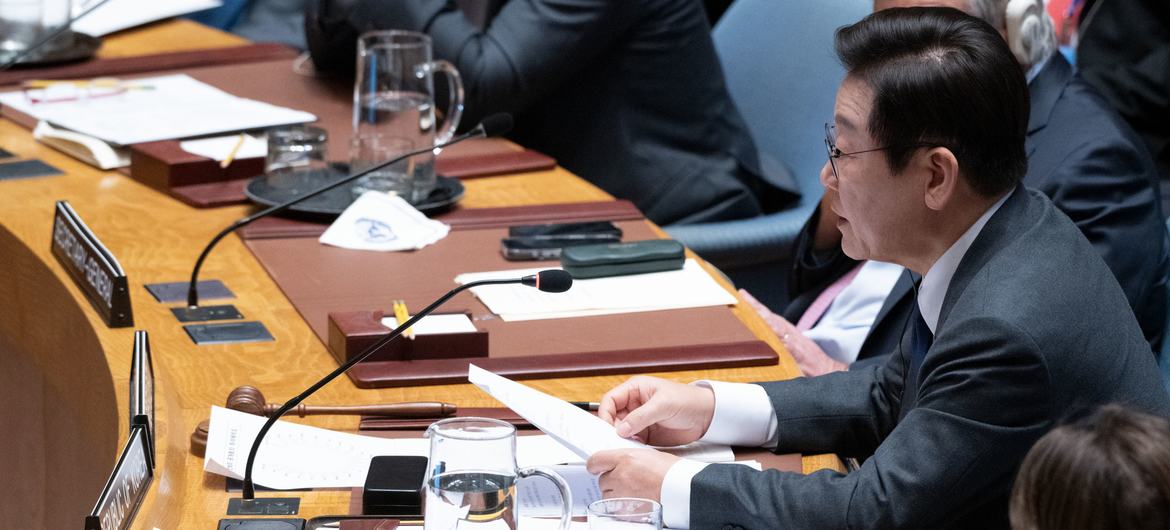
Lee Jae Myung, the President of the Republic of Korea, chairing the Security Council meeting.
UN Photo/Evan Schneider
 
Lee Jae Myung, the President of the Republic of Korea, chairing the Security Council meeting.

The Security Council session was held on the margins of the ongoing high-level week of the General Assembly’s 80th session.

The meeting was convened by Republic of Korea (Council President for September) and attended by heads of states and governments, including Lee Jae Myung, the President of the Republic of Korea, who chaired the meeting


https://news.un.org/en/story/2025/09/1165942


https://creativecommons.org/licenses/by/4.0/legalcode

воскресенье, 21 сентября 2025 г.

Iran’s uranium stockpile grows following three years of denied access


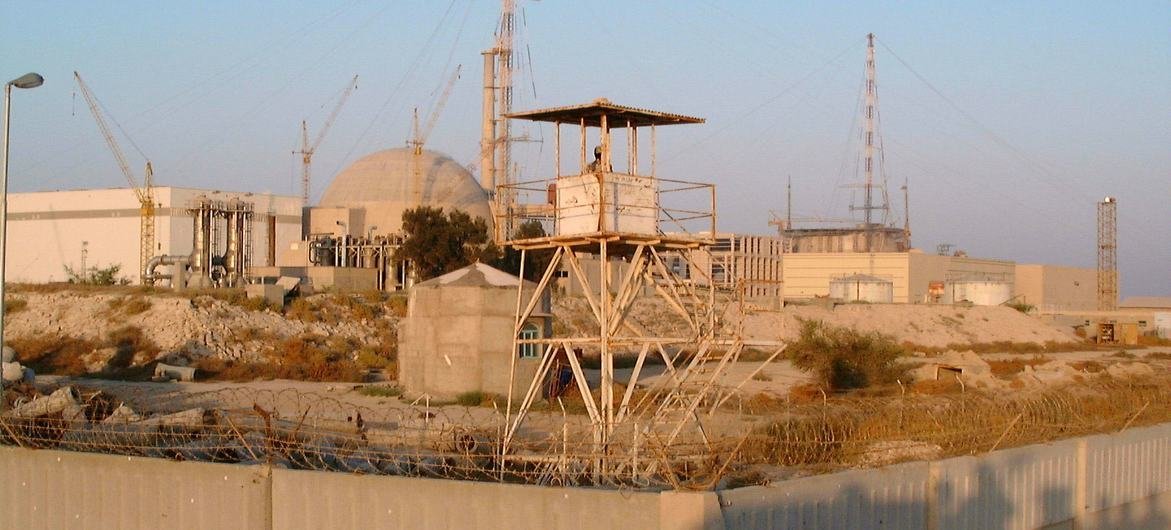
The Busher nuclear power plant in Iran. (file photo)
IAEA/Paolo Contri
 
The Busher nuclear power plant in Iran. (file photo)

3 June 2024
Peace and Security

Iran’s stockpile of enriched uranium continues to increase, the head of the UN atomic watchdog agency said on Monday, adding that it has been three years since the agency was able to access the country.

Addressing the Board of Governors of the International Atomic Energy Agency (IAEA), Director General Rafael Grossi indicated no progress had been made in resolving outstanding issues.

He mentioned that Iran is still not implementing provisions of the nuclear safeguards agreement, and that withdrawal of designations for several IAEA inspectors are yet to be reversed.

“These outstanding safeguards issues…need to be resolved for [IAEA] to be in a position to provide assurance that Iran’s nuclear programme is exclusively peaceful,” Mr. Grossi emphasized.

He also voiced concerns about public statements made in Iran regarding its technical capabilities to produce nuclear weapons and potential changes to its nuclear doctrine, which only deepen apprehensions about the “correctness and completeness” of the country’s safeguards declarations.

Ukraine’s power plants

Nuclear Safety, Security and Safeguards in Ukraine.
© IAEA
 
Nuclear Safety, Security and Safeguards in Ukraine.

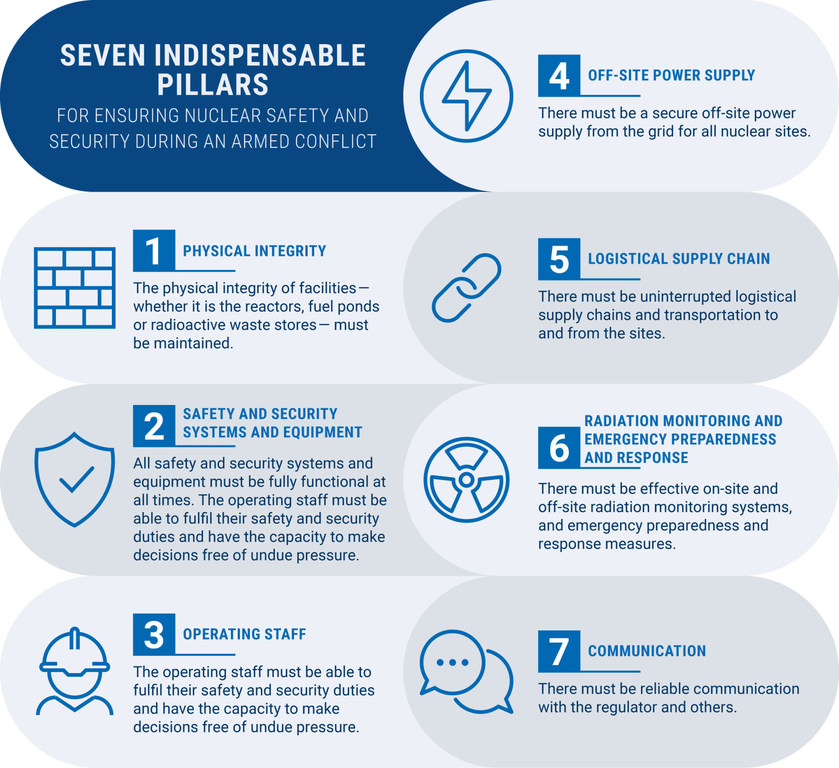
Turning to Ukraine, the IAEA chief warned the situation at the Zaporizhzhia Nuclear Power Plant “remains precarious” and that all seven Pillars of Nuclear Safety and Security have been “fully or partially compromised”.

These include physical integrity; functional safety and security systems and equipment; radiation monitoring and emergency response; secure and reliable off-site power supply; trained staff; an uninterrupted logistic supply chain; and open communication.

The attacks and the frequent disconnection of the off-site power lines due to military activity are creating a grave situation,” Mr. Grossi said.

All six reactor units at the plant have been in cold shutdown since April, a safety measure long recommended by the IAEA. Despite this, the agency’s ability to ensure the plant’s safety and security remains compromised due to restricted access, he added.

He further reported that Ukraine’s other four nuclear power plants continue to face compromised supply chains for spare parts and high levels of stress among staff.

DPR Korea’s nuclear programme

Mr. Grossi also voiced concern over the continued and further development of the Democratic People’s Republic of Korea’s (DPRK) nuclear programme.

The IAEA has observed intermittent cooling water discharge, consistent with the operation of the Light Water Reactor (LWR) at Yongbyon, along with ongoing activities at the reported centrifuge enrichment facility.

The Nuclear Test Site at Punggye-ri remains occupied and prepared to support a new test.

“The continuation and further development of the DPRK’s nuclear programme is a clear violation of relevant UN Security Council resolutions and is deeply regrettable,” Mr. Grossi said, urging the country to comply fully with its obligations and to cooperate promptly with IAEA.

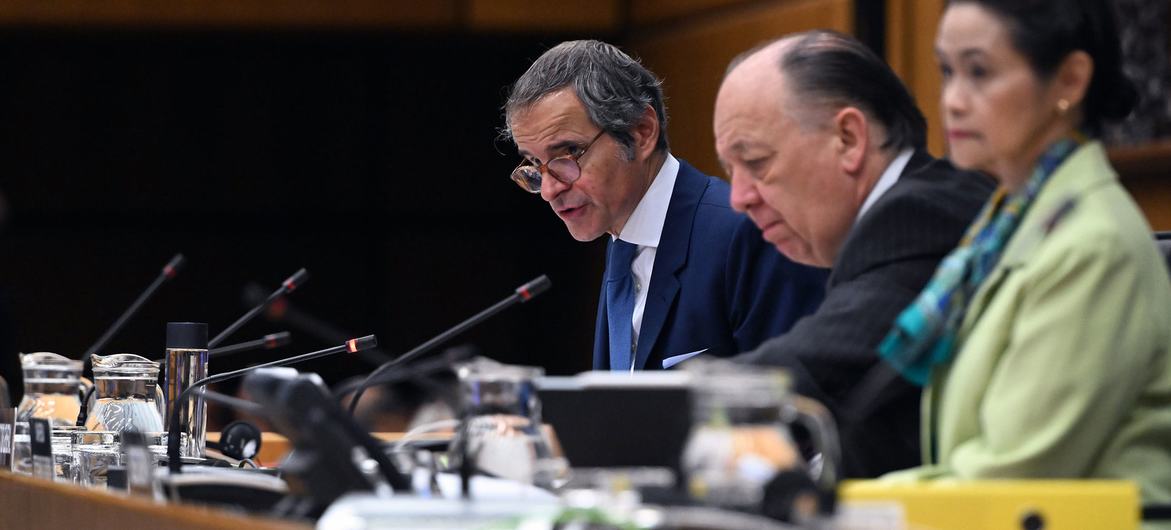
Rafael Mariano Grossi (right), IAEA Director General, delivers his opening statement at the 1717th Board of Governors meeting held at the IAEA Headquarters, in Vienna.
© IAEA/Dean Calma
 
Rafael Mariano Grossi (right), IAEA Director General, delivers his opening statement at the 1717th Board of Governors meeting held at the IAEA Headquarters, in Vienna.

Japan’s Fukushima Daiichi plant

In Japan, IAEA continues to monitor the discharge of Advanced Liquid Processing System)-treated water from the Fukushima Daiichi Nuclear Power Station, which suffered a meltdown 13 years ago, he reported.

Mr. Grossi confirmed that the discharge is progressing in accordance with the safety plan approved by Japan’s Nuclear Regulation Authority.

“Expert independent analysis of the six batches released so far have confirmed the tritium concentration in each batch of ALPS-treated water released to date is far below Japan’s operational limit.”

Nuclear technology for sustainable development

In his concluding remarks, the head of IAEA underscored the agency’s key role in promoting sustainable development.

“The IAEA is a crucially important vehicle for advancing sustainable development and international peace and security,” he said, urging member states to continue their support for the agency’s indispensable work.


https://news.un.org/en/story/2024/06/1150576


https://creativecommons.org/licenses/by/3.0/legalcode
пятница, 19 сентября 2025 г.

UN80 Initiative: New report charts proposals for change across UN structures and programmes

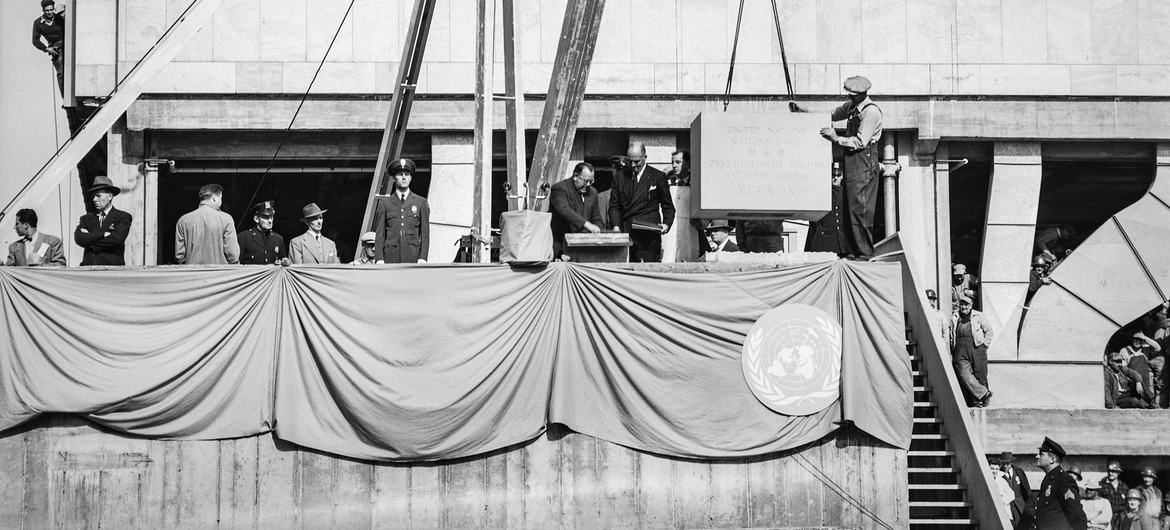
The corner-stone of the UN headquarters building was laid on UN Day at a special open-air General Assembly meeting held on 24 October 1949.
UN Photo
 
The corner-stone of the UN headquarters building was laid on UN Day at a special open-air General Assembly meeting held on 24 October 1949.


18 September 2025 UN Affairs

The Secretary-General shared a progress report on Thursday on structural reforms and programme realignments under the UN80 Initiative, setting out proposals to make the United Nations more coherent, effective and better equipped to respond to global challenges.

The report, Shifting Paradigms: United to Deliver, outlines possible adjustments in how the UN is structured, how its entities collaborate, and how it operates. It is the third major output of the Initiative, following earlier reports on efficiency measures and on mandate implementation review. Issued just before the General Assembly’s High-Level Week, the document is intended to inform Member States' deliberations.

“This is a work in progress,” Mr Guterres says in the preface. “We look forward to working with Member States – as owners of the process – to realize our common ambition: a United Nations system that is more coherent, more effective, and better equipped to serve ‘We the Peoples’.”

Main areas of focus

The proposals address all three pillars of UN work – peace and security, sustainable development and human rights – as well as humanitarian action, ways to strengthen cross-pillar collaboration and system-wide enablers. It calls for fewer silos, less duplication and more effective collaboration, noting that the UN system, built up over 80 years, must adapt to today’s far more complex challenges.

  • In peace and security, the report proposes consolidating offices and leadership layers, establishing centres of excellence for peacebuilding and for Women, Peace and Security, and preparing leaner, more integrated peace operations.
     
  • New Humanitarian Compact is proposed to streamline planning, integrate global supply chains, expand common back-office services and strengthen humanitarian diplomacy, with the goal of serving over 100 million people more quickly and effectively.
     
  • On sustainable development, the Secretary-General recommends assessing potential mergers of agencies, pooling expertise through new joint knowledge hubs, and reconfiguring regional and country-level operations for greater impact.
     
  • In human rights, the report proposes creating a UN Human Rights Group, led by the High Commissioner, to coordinate system-wide action and reduce duplication.
     
  • Among the system enablers, the report highlights the creation of a UN System Data Commons, a Technology Accelerator Platform, unified back-office services, streamlined training and research, and reforms to strengthen pooled and core funding.

Next steps

Several proposals in the report lie within the Secretary-General’s authority and can be advanced without delay. Most, however, rest with Member States. Mr. Guterres has been invited by the President of the General Assembly to brief on the report on 15 October 2025.


https://news.un.org/en/story/2025/09/1165883


https://creativecommons.org/licenses/by/4.0/legalcode