‘No System Can Long Endure if It Cannot Adapt to Changing Environment,’ Says Nobel Prize Laureate; Veto Must No Longer Be ‘Last Word’, Urges Prime Minister
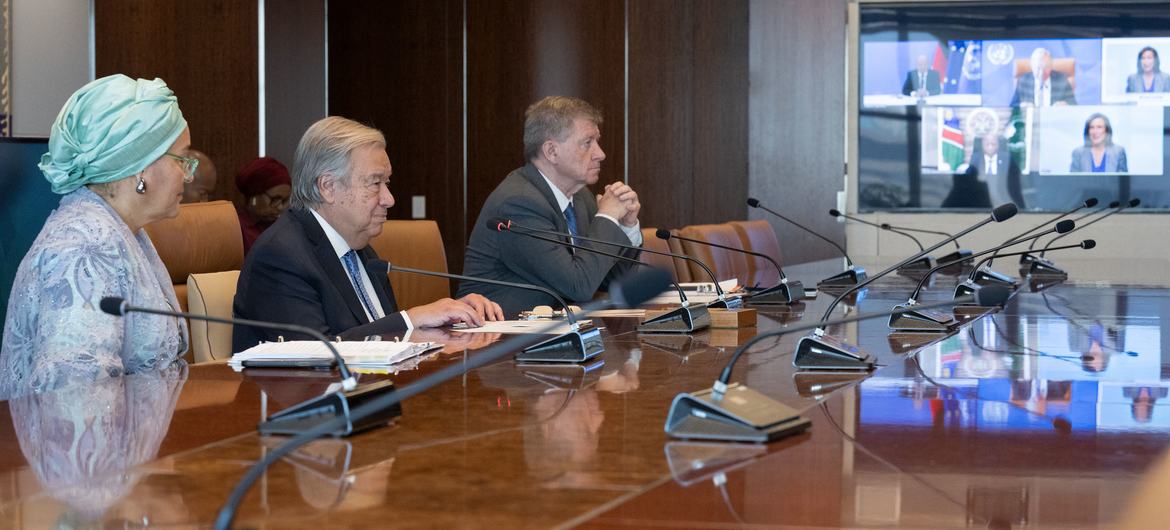
Reform of international institutions, particularly the Security Council, rebuilding of trust and enhanced regional partnerships are critical to making multilateralism work for the peace and security of future generations, speakers underlined during an interactive dialogue at the Summit of the Future today.
The session, titled “Enhancing multilateralism for international peace and security”, heard Julius Maada Bio, Sierra Leone’s President, saying in introductory remarks that threats including terrorism, climate change and pandemics require “collective action, shared responsibility, and most importantly, the revitalization of multilateralism”. He noted that his country knows the “transformative power of peacebuilding, reconciliation and cooperation”, and called for boldness and innovation in reforming the global institutions.
Also in introductory remarks, Simon Harris, Taoiseach of Ireland, said that the United Nations is struggling to respond to the challenges of violent conflict. A principled and consistent approach by all Member States is a “minimum requirement to restore belief in what we can achieve”. He called for terminating the “outdated use of the veto” in the Security Council. “We have a huge responsibility to our citizens and to future generations,” he underscored.
International peace and security — the theme of today’s dialogue - is one of the five main pillars of the Pact for the Future, an intergovernmentally negotiated, action-oriented outcome adopted at the Summit of the Future today. The global security landscape is undergoing profound transformation. In 2022, conflict-related deaths reached a 28-year high, while global military expenditures hit a record $2.24 trillion.
- Need for equal representation and inclusivity
- Coalition-building and partnership to generate the political will for change
- Past successes point the way
“No one is truly safe where others are still entrapped by wars, famine, health outbreaks, rising sea levels, as well as political, economic and social exclusions,” said Ellen Johnson Sirleaf, the former President of Liberia, one of three speakers making scene-setting remarks. Today’s unprecedented crises lay bare the limitations of our current international systems, she added. “No system however good can long endure if it cannot adapt to its changing environment and circumstances.” She called for more representative and accountable international institutions.
Speaking about the need for inclusivity in peace and security, the former President of Colombia, Juan Manuel Santos, said the peace process in his country has been widely recognized for its participation of women, youth and indigenous communities. He underlined that the “world has not lived up” to the commitment of including women in conflict resolution. “I am a witness of the role of women in peacemaking.” Expressing concern about the implications of integrating artificial intelligence (AI) in nuclear systems, he called for more dialogue between nuclear States to better understand potential risks.
The President and CEO of the International Crisis Group, Comfort Ero, said the Pact of the Future has excluded a section on how climate change is reshaping conflict risks, meaning it “does not address a major emerging challenge”. “For now, these are words on paper, but they are also openings to revitalize the UN.” Preventing and resolving conflict is about reviewing policies, reforming international institutions and “generating the shared political will to address the crises we face — together” via coalition-building and regional partnerships.
Some speakers underscored their nations’ positive impact on peace and security. Noting his own country’s contribution to UN peacekeeping operations since 1978 in affected areas globally, Ratu Wiliame Maivalili Katonivere, the President of Fiji, said his region “is the ocean of peace”. Guatemala’s President, César Bernardo Arévalo de León, remarked that his country is a successful example of how the implementation of the UN principles can promote peace and development amid complex conflicts. He recalled that the UN played a key role in negotiating its 1996 Peace Agreement, but also noted that “deep-seated reform is needed”.
Taking the need for reform further, the Prime Minister of Liechtenstein, Daniel Risch, said Member States are looking at the Security Council to “step out of its paralysis”. He underlined that, by presenting the Veto Initiative, his country has ensured that a veto in the Council is no longer the “last word”.
The Prime Minister of Iceland, Bjarni Benediktsson, said: “The problem we have today is lack of trust.” Agreements must be honoured to rebuild it, yet Member States are intentionally targeting civilians and infrastructure. It is required that “all countries, including large and powerful countries, honour their commitments,” he said.
Mihai Popsoi, Deputy Prime Minister of Moldova, noting the conflict on his country’s borders in Ukraine said returning “to the principles and purposes of the UN Charter, respect for the sovereignty, independence and territorial integrity of Member States”, alongside respect for international law and non-proliferation, is crucial. Reform of the Security Council to be more representative is critical to deal with conflicts. The Minister for Foreign Affairs of Kyrgyzstan said that his country is a candidate for a non-permanent membership at the Security Council for 2027-2028, adding that — like 60 other States — it has never been elected to this body. “It is the right time to redress this historic injustice,” he added.
Sayyid Badr bin Hamad bin Hamood Albusaidi, the Minister for Foreign Affairs of Oman, said the war in Gaza challenges the principles of multilateralism. “We are facing a chronic failure to learn from the past or to understand the present,” particularly regarding Palestine. It is necessary to transform thinking that the world can be organized into friends and enemies to “a more open-minded and pragmatic mentality suitable for today’s multipolar world”.
South Sudan’s Minister for Foreign Affairs said his country which saw a decades-long conflict ended through a negotiated peace process stands as a “testament to enduring powers of multilateralism”. The Deputy Foreign Minister of Türkiye said “diplomacy, when used effectively, can deliver desired outcomes even in the face of ongoing conflicts”, as shown by the Black Sea Grain Initiative.
The diplomat representing the former Government of Afghanistan overthrown by the current Taliban regime said his country serves as a stark reminder of the necessity of women's full participation in peace processes.
The Republic of Korea’s representative recalled that, with the help of UN forces, it defended freedom and peace in the 1950s. He said his country proposed an inter-Korean dialogue through the Unification Doctrine, calling on the Democratic People’s Republic of Korea to return to the table with sincerity.
The representative of the African Union stressed that the African perspective must be considered. “The African philosophy of Ubuntu is what we bring to the table along with rich human and material endowment. The future we want will start now,” he added.
https://press.un.org/en/2024/ga12629.doc.htm