воскресенье, 20 июля 2025 г.

World News in Brief: Violence in Haiti, rising insecurity in DR Congo, expert panel on nuclear war


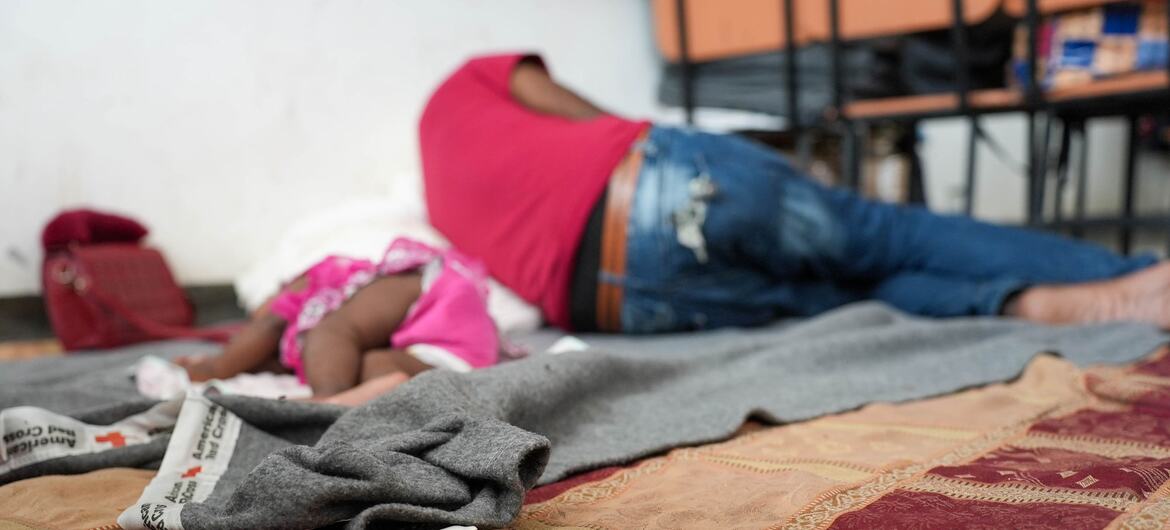
An adult and child rest at centre for displaced people in Haiti.
© WFP/Pedro Rodrigues
 
An adult and child rest at centre for displaced people in Haiti.


18 July 2025
 Humanitarian Aid

The UN humanitarian affairs office OCHA is stressing the need to scale up support for displaced families in Haiti amid ongoing insecurity and violence. 

Displaced Haitians are dispersed among the 250 active displacement sites across the country, most of which are informal. Just over a fifth of these sites are managed by humanitarian organizations, meaning that many are living in precarious conditions.  

In June alone, more than 200 alerts were reported across displacement sites, over 80 per cent of which were related to essential needs such as lack of water, food, shelter or healthcare.

OCHA noted that nearly 1.3 million people are now internally displaced in Haiti, the highest number ever recorded in the country due to violence.

Constrained UN response

The UN and partners have supported more than 113,000 displaced Haitians this year, providing essential services such as water, shelter, sanitation and healthcare.

The humanitarian response is severely constrained by limited funding and persistent insecurity, hampering humanitarian access to the most affected areas and delaying the delivery of aid. 

Despite the challenges, the agency continues to work closely with Haitian authorities and humanitarian partners to coordinate relief efforts and mobilise additional resources to support displaced communities. 

DR Congo: Ongoing violence in the east drives displacement, impedes aid delivery

Ongoing violence in North and South Kivu provinces in the eastern Democratic Republic of the Congo (DRC) continues to claim the lives of civilians and to trigger new displacement. 

In North Kivu, UN partners on the ground in Rutshuru and Lubero territories reported that fighting between M23 and other armed groups was ongoing until Tuesday, resulting in eight civilian deaths and 42,500 displaced people as of earlier this week. 

Since early July, heavy clashes between M23 and other armed groups in South Kivu have also persisted, as local partners said the fighting has displaced at least 37,000 people from their homes. 

Aid access restrictions 

The surge in violence is making it harder for humanitarians to deliver assistance to vulnerable communities. 

While partners and teams on the ground are doing their best to maintain services for those affected, access restrictions and severe funding shortages pose significant obstacles. 

A humanitarian convoy coordinated by OCHA along the road between the provincial capital Bukavu and the city of Uvira, primarily planned for this Friday, has been postponed due to a lack of security guarantees on that route. 

Many UN partners on the ground are forced to scale back their operations, disrupting essential services for those in need. 

OCHA called on the international community to take urgent action to address these severe funding gaps and avert a humanitarian tragedy. 

New panel to examine the effects of a nuclear war

The UN Secretary-General has appointed an independent scientific panel of 21 experts to examine the physical and societal consequences of a nuclear war on a local, regional and planetary scale in the days, weeks and decades following such an event.

The creation of the panel, mandated by a General Assembly resolution, comes at a time when nuclear guardrails are being eroded and “the risk of nuclear war is higher than at any point since the depths of the Cold War,” UN deputy spokesperson Farhan Haq said on Friday during the daily media briefing from Headquarters in New York. 

The panelists will seek input from a wide range of stakeholders – including international and regional organizations, the International Committee of the Red Cross (ICRC), civil society and affected communities. 

Members will hold their first meeting in September and will submit a final report to the General Assembly in 2027. 


https://news.un.org/en/story/2025/07/1165439

https://creativecommons.org/licenses/by/4.0/legalcode

пятница, 4 июля 2025 г.

Press Conference by Security Council President on Programme of Work for July


The Security Council will convene its signature event on 22 July — a high-level open debate on promoting international peace and security through multilateralism and the peaceful settlement of disputes — the Council’s President for the month said at a United Nations Headquarters press conference today.

Asim Iftikhar Ahmad (Pakistan), who holds the 15-member organ’s rotating presidency for this month, said the open debate — held under the overarching theme of maintaining international peace and security — will be chaired by his country’s Deputy Prime Minister and Minister for Foreign Affairs, Mohammad Ishaq Dar. The Secretary-General is expected to brief the Council.  “The debate stems from the fact that today’s crises often emerge from unresolved disputes, erosion of international obligations and underutilization of peaceful means enshrined in the Charter,” he said.  The discussion will examine the effectiveness of existing dispute settlement mechanisms, identify barriers to implementing Council resolutions and explore ways to strengthen preventive diplomacy, mediation and technical support.  It will also reaffirm the commitments made in the Pact for the Future towards preventive diplomacy and the peaceful resolution of disputes.

The Council will further hold a signature event on “Cooperation between the UN and regional and subregional organizations”, chaired also by Pakistan’s Deputy Prime Minister and Minister for Foreign Affairs.  It will spotlight UN’s engagement with the Organisation of Islamic Cooperation (OIC), which represents 57 member States across four continents and has played an increasingly important role in conflict prevention and mediation, humanitarian response and post-conflict recovery.  This meeting will explore ways to institutionalize and deepen this cooperation, particularly in relation to peace processes in various contexts.

On 23 July, the Council will hold its quarterly open debate on the Middle East, including the Palestinian question, which will be elevated to the ministerial level.  The meeting will reaffirm the Council’s responsibility to protect civilians, uphold international humanitarian law and push for an immediate ceasefire, along with just and lasting solutions based on UN resolutions concerning the Palestinian question.

Throughout July, the Council will consider several country-specific and thematic issues, primarily through mandated briefings and situational updates.  These will include discussions on Colombia, Haiti, Cyprus, Sudan, Syria, Yemen and the International Criminal Court, as well as consultations on Lebanon within the framework of resolution 1701 (2006).  The President of the Security Council reaffirmed his readiness to convene additional meetings should developments on the ground — particularly in Africa, the Middle East or Asia — warrant timely engagement.  On 29 July, the Council will also hold a briefing on UN Peace Operations, in the context of the Secretary-General’s ongoing review.

“We are committed to an open and consultative Presidency,” he stated, outlining the Council’s working methods, which are grounded in transparency, inclusivity and close coordination among all 15 members.  He noted that the Council remains alert and responsive to global developments, with a particular focus on conflict zones such as in the Middle East, Africa, Sudan and the Democratic Republic of the Congo.

He also responded to several questions posed by media correspondents, many of which concerned the situation in Gaza.  In his national capacity, he said the objective of the draft resolution — jointly proposed by China, the Russian Federation and his own country — is to achieve a ceasefire to the conflict. 

In response to a question about the future role of Hamas in Gaza, he emphasized that this is an intra-Palestinian matter that “should be left to the Palestinians [themselves]”.

Addressing a query about the Special Representative of the Secretary-General of the United Nations for Children and Armed Conflict’s recent report on children in Gaza, which the reporter described as “unfair”, he stressed that mandates such as children and armed conflict must be upheld universally and without selectivity. “[By] failing to do that, […] we are undermining these important mandates,” he warned.

On the conflict between Israel and Iran, he spoke in his national capacity to reaffirm Pakistan’s principled position, grounded in international law and the Charter of the United Nations.  He noted that some discussions have deviated from Iran’s legitimate rights, highlighting that Tehran remains a party to the Treaty on the Non-Proliferation of Nuclear Weapons.  “The best way to address the Iranian nuclear issue in all its complexity is through dialogue and diplomacy,” he said.  However, he added, this path was seriously disrupted by the recent attacks, while expressing hope that “a window of opportunity” still exists to resume dialogue and reach a conclusive resolution in accordance with international law.

Regarding the UN’s cooperation with regional and subregional organizations, he pointed to OIC’s growing role in areas such as counter-terrorism, counter-extremism and humanitarian affairs.  He emphasized the importance of deepening engagement between OIC and the Security Council.

When asked about how the issue of Kashmir could be addressed in the Council, he responded in his national capacity that the dispute remains unresolved and continues to be a source of tension between India and Pakistan, hindering broader regional relations.  He emphasized that it is the Council’s responsibility — especially that of its permanent members — to take meaningful steps towards implementing their own resolutions.


https://press.un.org/en/2025/250701_sc.doc.htm


https://creativecommons.org/licenses/by/4.0/legalcode