пятница, 29 марта 2019 г.

Контактная группа по Венесуэле исключила силовой вариант решения кризиса


29 марта 2019, 00:59


© Стоп-кадр видео


Международная контактная группа по Венесуэле провела вторую встречу на уровне министров. На встрече участники группы исключили вариант применения силы для решения политического кризиса в Венесуэле.


Как передает РИА Новости, такое заявление сделала глава европейской дипломатии Федерика Могерини после переговоров в Эквадоре.


о мнению участников, решением кризиса должны заниматься сами венесуэльцы, используя «политические, демократические, мирные способы». Кроме того, контактная группа снова призвала к проведению новых выборов президента в Венесуэле и подтвердила намерение собирать для страны гуманитарную помощь «без политических вмешательств».


Напомним, цель контактной группы — обеспечить условия для мирного политического процесса в Венесуэле. Первое заседание на министерском уровне прошло в Монтевидео 7 февраля.


http://www.rosbalt.ru/world/2019/03/29/1772420.html
http://creativecommons.org/licenses/by/3.0/legalcode

Central Mali: Top UN genocide prevention official sounds alarm over recent ethnically-targeted killings


UNICEF/Maiga


Local population in Ogossagou, a village in the Mopti region of Mali, which was attacked on 23 March, leaving over 160 people dead, 70 injured, hundreds displaced, and numerous huts and granaries burnt.


28 March 2019


Human Rights


The United Nations Special Adviser on the Prevention of Genocide, Adama Dieng, expressed on Thursday his deepest concern and strongly condemned recent attacks against villages in Mali, including mass-killings last weekend in the Mopti region, which left 160 dead, including some 50 children, according to the UN human rights office (OHCHR).


The assault on the villages of Ogossagou and Welingara, populated with people from the Peulh – or Fulani – ethnic group took place on Saturday 23 March. In addition to the killings, at least 70 were injured, allegedly by members of the Dogon ethnic group. It was the fourth major attack since the start of the year against villages populated by Peulhs/Fulanis. On 1 January, in Kolougon, at least 37 women, children and men were killed during the day.


The UN independent human rights expert mandated with monitoring the situation in Mali, Alioune Tine, said in a statement that he also received reports that, on 26 March, suspected Fulani armed elements two Dogon hamlets, Ouadou and Kere Kere, killing at least six people, abducting about 20 people, and burning several homes.


Mr. Tine noted that since January 2019 there had been reports of at least 22 incidents of human rights violations by community-based self-defense groups, which had resulted in the deaths of at least 230 people.


The UN prevention of genocide office confirmed “a serious upsurge in inter-communal violence as well as negative impact of counter-terrorism operations conducted by community-based armed groups on the civilian populations in the region”.


The office further noted that “there is growing ethnicization of the conflict in central Mali, in which entire communities are being stigmatized as terrorists or as affiliates of armed groups”.


The community-based armed groups and other armed actors have been carrying out targeted attacks against civilians in the context of the fight against terrorism, committing “serious violations and abuses of human rights including killings, destruction of property, arbitrary detention and de facto embargos on villages, restricting movement of civilian populations,” the UN genocide prevention office stated.


The statement deplored that these developments and dynamics are “not sufficiently recognized neither by national authorities nor by the international community, who are focusing mostly on the peace process in the North and on the threat posed by jihadist movements”.


“Over the recent months, violence has reached unprecedented level amid retaliatory attacks and serious violations of human rights in central Mali impacting on all communities,” Special Advisor Dieng said. “Unless these concerns are immediately addressed, there is a high risk of further escalation of the situation in which atrocity crimes could be committed,” he warned.


To prevent further escalation of violence, Mr. Dieng urged the Malian Government – with the support of the international community, and the UN peacekeeping mission in the country, MINUSMA – to immediately address the current grave upsurge of violence in central Mali and to provide, with no further delay, protection as well as assistance to vulnerable population.


“I call on the Malian government to urgently investigate and prosecute the perpetrators of the recent attacks as well as those responsible for serious violations and abuses of human rights.” he said, adding that the authorities and all Malians should “prevent and refrain from stigmatizing entire communities”.


The UN office on the prevention of genocide said it stands ready to provide support to local reconciliation and inter-communal dialogue processes, with the aim of promoting inclusivity, strengthening resilience and social cohesion.


Human rights expert Alioune Tine also called for “a thorough, prompt and impartial investigation and the perpetrators must be brought to justice. The protection of lives and the well-being of civilians is at stake.”


“It is crucial that these inter-communal tensions, and this cycle of violence, are addressed urgently if the risk of crimes against humanity is to be averted,” he insisted.


https://news.un.org/en/story/2019/03/1035661
http://creativecommons.org/licenses/by/3.0/legalcode

Landmark terror finance resolution adopted by Security Council


UN Photo/Eskinder Debebe


The United Nations Security Council debates the threats to international peace and security caused by terrorist acts at UN Headquarters in New York on 28 March 2019.


28 March 2019

Law and Crime Prevention

The UN is hailing a new Security Council resolution adopted on Thursday as a landmark step in suppressing the funding of terror groups worldwide.


Speaking via video-link from Rome, where he has been meeting specialist Italian law enforcement officials to discuss building closer ties to tackle the problem; The UN’s counter-terrorism chief, Vladimir Voronkov, said that the adoption comes at a “critical time,” with recent attacks demonstrating that terror groups continue to have access to both legal and illegal sources of funding.


Underscoring the necessity for strong collaboration and targeted efforts, in order to achieve “concrete results” in the fight against terrorism and terrorist financing, Mr. Voronkov said that Resolution 2462 on Countering the Financing of Terrorism, pulls together previous resolutions to create a consolidated document that also covers several key emerging issues.


The resolution calls for the UN Office of Counter-Terrorism (UNOCT) – set up in 2017 to strengthen the Organization’s ability to implement s global counter-terrorism strategy – to play a leading role in identifying ways to suppress terrorist financing.


Only through strong collaboration and targeted efforts, can we achieve concrete results in our fight against terrorism and terrorist financing Vladimir Ivanovich Voronkov, Under-Secretary-General, UN Office of Counter-Terrorism


Mr. Voronkov identified three priorities. The first concerns expanding the focus of the UNOCT to cover intelligence sharing, risk assessments and public-private partnerships; the second points to system-wide awareness-raising and the development of a comprehensive approach to the problem.


The UNOCT’s third priority is to work closely with the Financial Action Task Force, an inter-governmental body which sets standards for combating money laundering, terrorist financing and other related threats to the integrity of the international finance system; and regional regulators.


Marshall Billingslea, President of the Financial Action Task Force, and Mercy Buku, an expert in the countering of terrorist financing, also briefed the Security Council on the subject. Mr. Billingslea welcomed the fact that the new resolution calls on States to do more to prevent ransom payments to terrorists, which, he said, incentivizes them to continue using kidnapping as an important revenue stream.


He also noted that, currently, two-thirds of States are not effectively prosecuting terrorist financing, which extends well beyond the banking and financing sectors, to include construction, drug trafficking and even the used car trade.


Ms. Buku, speaking via video-link from Nairobi, where, she said, the consequences of recent terror attacks are fresh in the minds of citizens, hailed the adoption of the resolution as “timely” in promoting the fight against terrorism, terrorist financing and money-laundering, but pointed out that the fight must not adversely affect financial inclusion initiatives, that enable access to banking services, and seek to reduce poverty and inequality.


https://news.un.org/en/story/2019/03/1035671
http://creativecommons.org/licenses/by/3.0/legalcode

Khashoggi murder trials must public and meet international standards, UN expert urges


UN Photo/Mark Garten


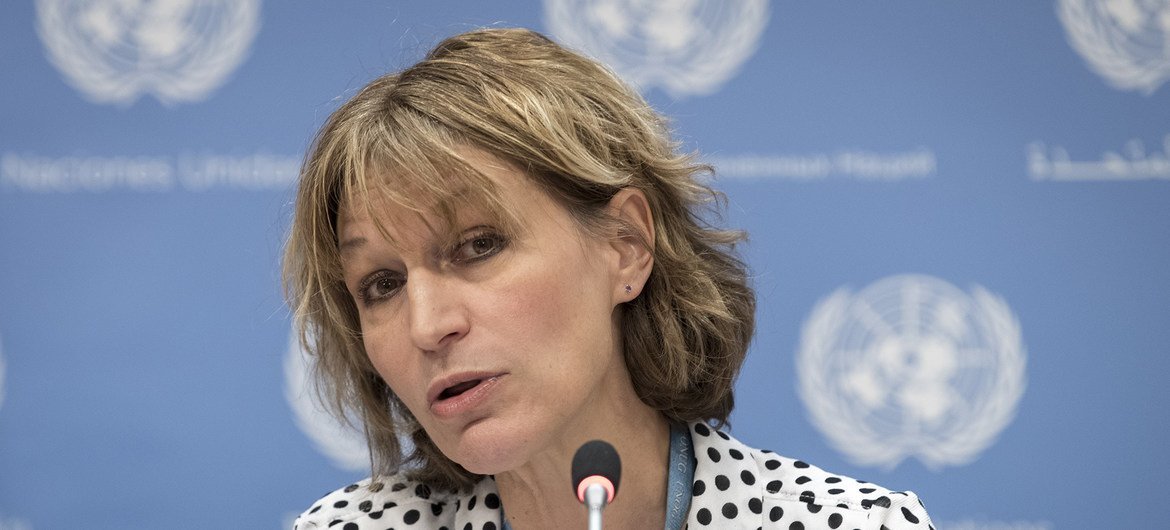
Press Briefing by Ms. Agnes Callamard, Special Rapporteur on extrajudicial, summary or arbitrary executions

28 March 2019

Human Rights

A United Nations human rights expert said on Thursday that Saudi Arabia’s closed-door trials of those it accuses of assassinating the dissident journalist Jamal Khashoggi in Istanbul, have fallen short of international standards, calling instead for public trials of the alleged killers.


Agnes Callamard, who is leading an independent human rights inquiry into the killing at the Saudi consulate last October, denounced the lack of transparency of Saudi Arabia’s investigation and legal proceedings so far.


Calling the murder “an extrajudicial killing committed in a consulate office on foreign territory,” the Special Rapporteur on extrajudicial, summary or arbitrary executions spelled out that “these are not internal, domestic matters”.


The Saudi Government is “grievously mistaken”, she stated, if it believes that the current proceedings will satisfy the international community “either in terms of procedural fairness under international standards or in terms of the validity of their conclusions”.


Initially, Saudi Arabia detained 21 people during its investigation into Mr. Khashoggi’s killing, 11 of whom are currently being tried, with five facing the death penalty if convicted.


“The investigation and subsequent prosecution should comply with international legal standards, and that demands the highest levels of transparency and impartiality”, she maintained, adding that while the rights of the victim and his family are at stake, “so too are the rights of other States under international treaties and law”.


Noting that the Saudi Government has invited representatives of Permanent Members of the Security Council to attend some of the hearings, Ms. Callamard expressed her misgivings that “they risk being participants in a potential miscarriage of justice” and “possibly complicit” should the trials be marred by violations of human rights law.


“They should review their cooperation and insist that the proceedings be made fully open to the public and expert international observers”, stressed the Special Rapporteur.


She explained that a credible investigation before a court of law, requires adjudication of the disappearance and murder, based on international human rights law, the Vienna Convention on Consular Relations and customary law on the sanctity of sovereign territory.


“Thus far”, Ms. Callamard observed, “the Saudi authorities have not even disclosed publicly the identities of the accused; their roles in relation to the government or the details of the charges they face, and have held the court proceedings behind closed doors”.


The Special Rapporteur said that the Government would “demonstrate its good faith if it opens its efforts to international review.”


She concluded by renewing her request for permission to visit that country as part of her “inquiry into the fate and whereabouts of Mr. Khashoggi, to which I would welcome a positive response.”

The UN Special Rapporteur calls on the Saudi Government to:

Make public the names of those being prosecuted and the charges they face.
Make public all trial proceedings and evidence against the accused.
Invite international, independent, experts to monitor trial proceedings.
Make public the details and results in establishing the whereabouts of Mr. Khashoggi’s remains.
Make public the fates of all those arrested in connection with Mr. Khashoggi’s murder.


https://news.un.org/en/story/2019/03/1035691
http://creativecommons.org/licenses/by/3.0/legalcode

New UN Global Climate report ‘another strong wake-up call’ over global warming: Guterres


28 March 2019
The increasing number of natural disasters and dangers linked to climate change, highlighted in a major UN report released on Thursday, represents “another strong wake-up call” to the world, which must be countered by finding sustainable solutions quickly, UN Secretary-General António Guterres has said.


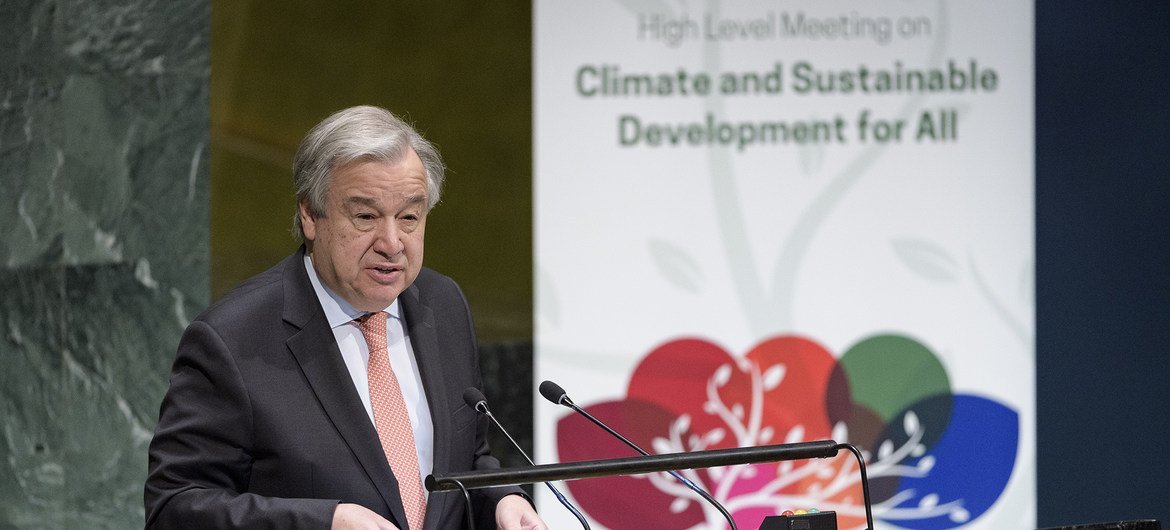
Speaking at the launch of the State of the Global Climate report by the World Meteorological Organization (WMO), Mr. Guterres reiterated his call for action, underlining that the alarming conclusion that climate change is accelerating, “proves what we have been saying: climate change is moving faster than our efforts to address it.”

This was why he had convened the Climate Action Summit due to take place on 23 September, he said, sitting alongside the President of the General Assembly and the head of WMO, briefing correspondents in New York.

UN Photo/Manuel Elias

High-level meeting on Climate and Sustainable Development for All
‘Don’t come with a speech, come with a plan’

Mr. Guterres called on Heads of State to attend his climate action summit in New York on 23 September, and achieve positive change. “Don’t come with a speech, come with a plan,” he said, adding: “This is what science says is needed. It is what young people around the globe are rightfully demanding.”


I want the summit to demonstrate the benefits of climate action and how everyone can benefit”, he said. “A growing number of governments, cities and businesses…already understand that climate solutions can strengthen our economies, improve air quality and public health and protect our environment.”

This will involve a commitment to enhancing national pledges contained in the Paris Agreement by 2020, Mr. Guterres explained, and countries “showing how we can reduce greenhouse gas emissions by 45 per cent over the next decade and get to net zero emissions globally by 2050”.

Assessing the potential benefits of sustainably-driven climate solutions that leave no-one behind, the UN Secretary-General welcomed the “growing number of governments, cities and businesses” that had embraced Agenda 2030-inspired climate solutions as a way to “strengthen our economies, improve air quality and public health and protect our environment”.

Initiatives could come from a range of areas, “such as energy, sustainable agriculture, forests and oceans and resilience to climate impacts”, Mr. Guterres said, maintaining that renewable technologies “are already delivering energy at a lower cost than the fossil-fuel driven economy”.

Despite this progress, much more radical steps must be taken, he insisted, explaining that “this means ending subsidies for fossil fuels and high-emitting, unsustainable agriculture, and shifting towards renewable energy, electric vehicles and climate-smart practices”.

In addition, “it means carbon pricing that reflects the true cost of emissions, from climate risk to the health hazards of air pollution”, the UN chief explained, “and it means accelerating the closure of coal plants, halting plans for new ones, and replacing those jobs with healthier alternatives, so the transformation is just, inclusive and profitable.”

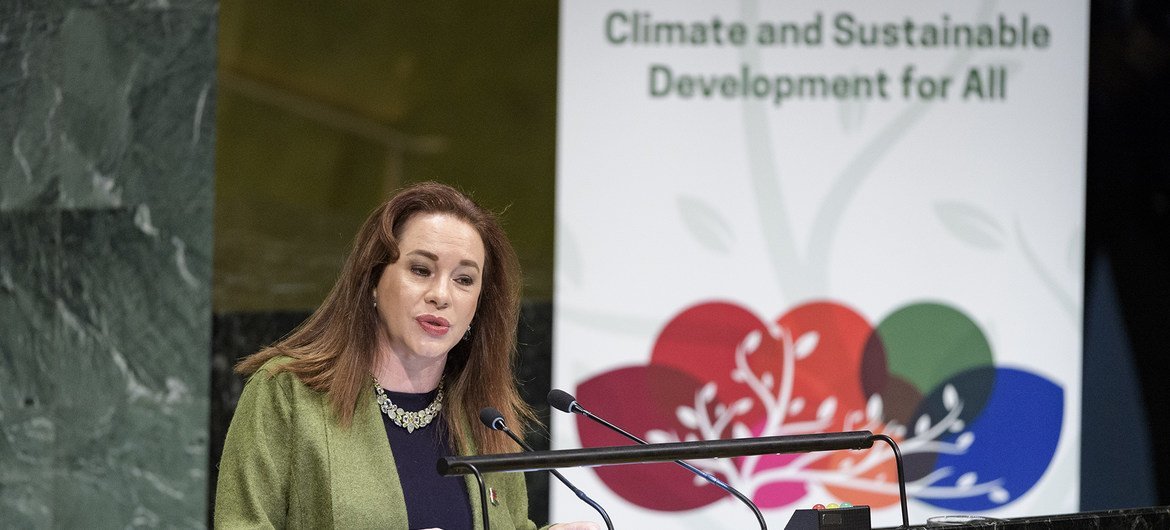
UN Photo/Manuel Elias

High-level meeting on Climate and Sustainable Development for All

President of the General Assembly, Maria Fernanda Espinosa, said she had pledged throughout her time in office there was a need for “a holistic understanding of the socio-economic consequences of increasingly intense extreme weather on countries around the world”, adding that the report “makes an important contribution to our combined international action to focus attention on this very critical problem.”

It was “really not good news” she told journalists, that CO2 emissions had jumped from 1.6 per cent in 2017, to passing the 2.7 per cent emissions growth, during 2018.

“We need to act, and to act now. The numbers and data are extremely worrisome…We are capable, we have the science, we have the knowledge, we have the tools in hand” to push back on global warming, she added.

WMO said that the temperature rise last year, came despite the agreement by the international community in December 2015 in Paris, to curb carbon dioxide and other greenhouse gas emissions, and to limit global temperature rise to well below 2C.
Paris Agreement increasingly under threat – WMO chief

“The time remaining to achieve commitments under the Paris Agreement is quickly running out,” said WMO Secretary-General, Petteri Taalas.

Outlining the report’s key findings, Professor Taalas warned of record greenhouse gas concentrations last year, that drove global temperatures towards increasingly dangerous levels.

According to WMO, carbon dioxide levels were at 357 parts per million (ppm) in 1994, rising to 405.5 ppm in 2017.

Professor Taalas also described “striking” evidence of record warming from 2015 to 2018, increasing sea-level rise and the loss of sea ice in both northern and southern polar regions.
Idai victims ‘personify why we need to limit climate change’

Noting that extreme weather events have continued into 2019 - most recently with Tropical Cyclone Idai, which caused devastating floods and loss of life in Mozambique, Zimbabwe and Malawi – Professor Taalas said that its victims “personify why we need the global agenda on sustainable development, climate change adaptation and disaster risk reduction”.

“We are seeing record rises in land and ocean temperatures, sea levels and greenhouse gas concentrations,” Mr. Guterres told journalists. “Second, we are seeing, more and more, the dramatic impact of extreme weather conditions. Last year saw 14 weather events where the devastation cost more than $1 billion…The average number of people exposed to heatwaves has increased by some 125 million since the beginning of the century, with deadly consequences.”


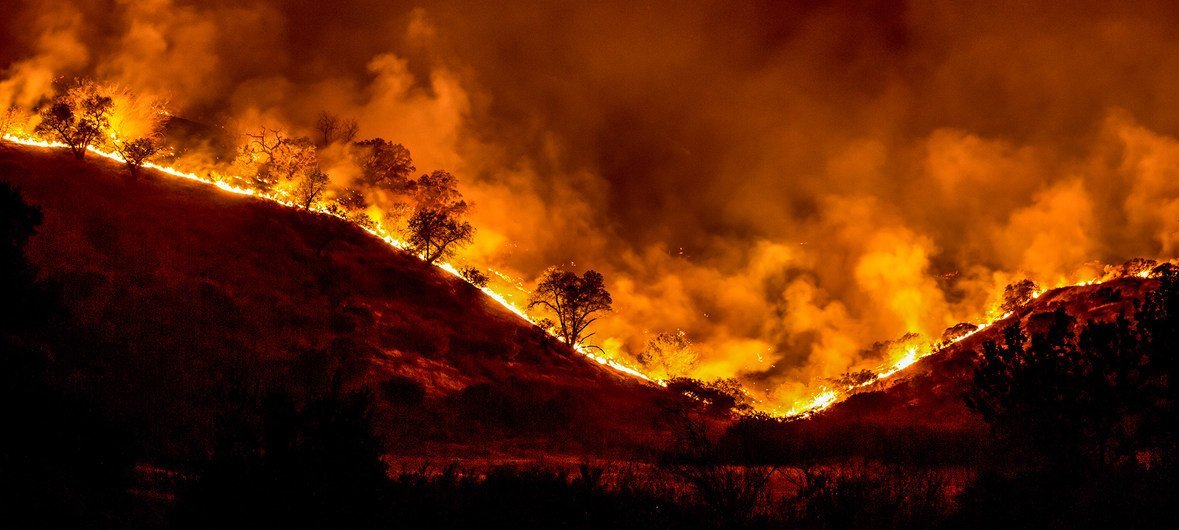
Peter Buschmann for Forest Service, USDA

2018 Woolsey Fire burns a hillside in California.

2019 so far: record warmth in Europe, unusual cold in North America

According to WMO, the start of this year has also seen warm record daily winter temperatures in Europe, unusual cold in North America and searing heatwaves in Australia. The extent of ice in the Arctic and Antarctica is yet again well below average, it said.

From now until May, WMO also forecasts above-average sea surface temperatures, which are expected to lead to above-normal land temperature, particularly in tropical latitudes.

General Assembly meets on climate change and sustainable development

Earlier on Thursday, the General Assembly held a High-Level meeting on climate change and sustainable development, including panel discussions on synergies between the two, and how the two agendas can be brought together in terms of concrete action.

"We all can reduce our carbon footprint everyday: in terms of the food we consume, the clothes we use, the transport we choose and the garbage we generate”, said Ms. Espinosa.

“Clearly we need to modify our consumption patterns. This is not just a world of shortages, but also of over-consumption. A great paradox is that 1,300 million tons of food are wasted every year, while almost 2000 million people suffer from hunger or malnutrition”, she told delegates at UN Headquarters.


http://creativecommons.org/licenses/by/3.0/legalcode

Правительство Мэй проиграло еще раз: парламент Британии запретил разводиться с ЕС без договора


Юри ВендикБи-би-си


2 часа назад


Правообладатель иллюстрацииAFPImage caption


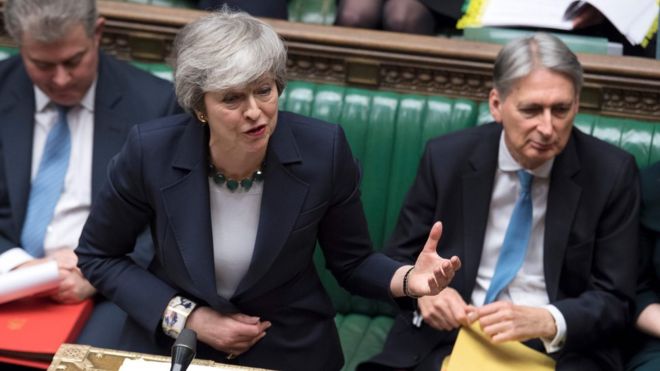
Премьер-министр Тереза Мэй сама обещала проголосовать за запрет на выход из ЕС без соглашения. Но депутаты сделали запрет более жестким, чем предлагала премьер.


Британская Палата общин большинством голосов запретила правительству выводить страну из Евросоюза без какого-либо соглашения. Теперь Британия готовится отложить выход из Евросоюза, который должен был состояться 29 марта.


При этом депутаты нанесли правительство Терезы Мэй еще одно поражение: кабинет предлагал исключить возможность выхода без соглашения только конкретно 29 марта, но Палата общин проголосовала за поправку, запрещающую выход без соглашения вообще когда-либо.


Эта важная поправка была принята большинством всего в четыре голоса: 312 против 308. Она не имеет силы приказа для правительства, но очень важна политически, как индикатор воли парламента.


"Юридически, по умолчанию, вероятность выхода без соглашения сохраняется [...] если только не будет достигнута какая-либо иная договоренность", - сказала Тереза Мэй после голосования.


Премьер-министр сказала, что теперь перед парламентом стоит выбор: все-таки одобрить дважды отвергнутый вариант соглашения о выходе, довести дело до второго референдума - который, по мнению Мэй, подорвет доверие народа к демократическим институтам - или же добиваться соглашения с ЕС на новых условиях.


За отредактированное таким решительным образом постановление в итоге проголосовал 321 депутат, против - 278.


В тексте постановления, внесенного правительством, говорилось, что парламент отвергает возможность выхода 29 марта без соглашения, но при этом констатирует, что "возможность выхода без соглашения по умолчанию остается в силе, если Палата общин и ЕС не ратифицируют какое-либо соглашение".


Итоги голосования в среду были вполне ожидаемы: большинство депутатов Палаты общин, в том числе членов правительства, считают, что "обвальный" выход из ЕС несет слишком большие риски для экономики страны.


Теневой министр по делам "брексита", лейборист Мэтью Пенникук в завершение дебатов в среду сказал, что возможный ущерб от выхода из ЕС трудно переоценить.


"Это будет равноценно национальной катастрофе", - заявил Пенникук.


Наиболее решительные сторонники разрыва с ЕС, впрочем, доказывают, что никакой катастрофы не будет - будут лишь кратковременные трудности, но затем британская экономика, освобожденная от общеевропейских тарифов нормативов, расцветет.

Дальше - просьба об отсрочке


Накануне парламент во второй раз отверг проект соглашения о выходе, составленный правительством Терезы Мэй и Евросоюзом.


В четверг в Палате общин планируется провести голосование по вопросу об отсрочке "брексита", а именно, одобрить поручение правительству просить Евросоюз о переносе дня выхода Британии с 29 марта на более поздний срок.


ЕС может дать ответ на эту просьбу уже 21-22 марта - в эти дни пройдет очередной саммит Евросоюза.


Многие высокопоставленные политики Евросоюза неоднократно заявляли, что готовы дать Британии отсрочку, но хотели бы понять, зачем именно она ей нужна - то есть, с какими новыми предложениями Лондон приедет на новые переговоры.


До сих пор исходная позиция Лондона, как ее сформулировала Тереза Мэй - это выход Британии из единого рынка ЕС (чтобы иметь возможность ограничить иммиграцию из Евросоюза), из таможенного союза и выход из-под юрисдикции люксембургского Европейского суда.


Для того, чтобы попытаться сформулировать новую позицию, некоторые британские депутаты предлагают позже, после получения отсрочки, вынести на поочередное голосование в Палате общин несколько вариантов будущих отношений с Евросоюзом.


Источники в Консервативной партии не исключают, что правительство Мэй, попросив ЕС об отсрочке, просто снова вынесет на голосование все тот же, дважды отвергнутый проект соглашения о выходе.


Не исключено, что в конце концов нужное число депутатов Палаты общин поддастся - и проект пройдет.


В этом случае все будет относительно просто: Британия формально выйдет из ЕС, но фактически почти все останется по-прежнему, потому что по соглашению тут же начнется переходный период до конца 2020 года.


В течение этого периода Британия лишается представительства и права голоса в органах власти ЕС, но полностью сохраняет все остальные права и обязанности члена Евросоюза.


https://www.bbc.com/russian/news-47548218
http://creativecommons.org/licenses/by/3.0/legalcode

четверг, 28 марта 2019 г.

ОБСЕ призвала продолжить обмен заключенными между Киевом и Донбассом


Вчера, 20:22


© РИА Новости


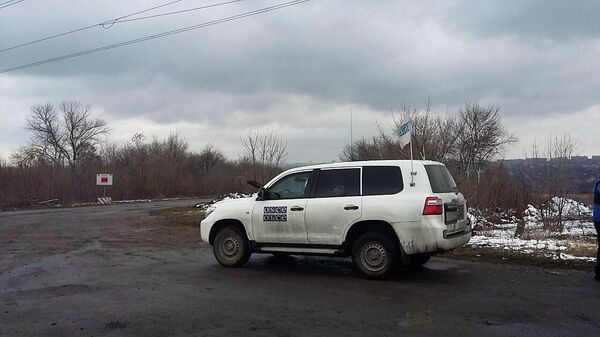
МИНСК, 27 мар - РИА Новости. Сторонам конфликта в Донбассе следует продолжить процесс обмена заключенными, заявил в среду в Минске спецпредставитель ОБСЕ Мартин Сайдик.


Ранее власти самопровозглашенной Луганской народной республики передали Киеву 60 заключенных, осужденных до 2014 года.


"Как известно, 20 марта из ОРЛО (отдельные районы Луганской области - ред.) было передано 60 заключенных, не связанных с конфликтом, на территорию, подконтрольную правительству Украины. Приветствуя этот факт, хочу подчеркнуть необходимость дальнейшей передачи заключенных", - сказал Сайдик журналистам по итогам заседаний контактной группы по урегулированию ситуации в Донбассе.


По его словам, осужденным нужно обеспечить возможность "отбывать наказание ближе к родным и близким".


https://ria.ru/20190327/1552171158.html
http://creativecommons.org/licenses/by/3.0/legalcode