среда, 27 июня 2018 г.

UN official sees ‘unprecedented opportunities’ to make progress on peace in Afghanistan


UNAMA/Fardin Waezi

Tadamichi Yamamoto (third from right), Head of the United Nations Assistance Mission in Afghanistan (UNAMA), and UNAMA Human Rights Chief Danielle Bell host women’s rights activists to discuss women’s access to justice in the country, 30 May 2018.

26 June 2018

Peace and Security

The coming months will present critical opportunities for the international community to review assistance to Afghanistan, as the country works towards a lasting peace, stable democracy and self-reliance, the top United Nations official there told the Security Council in New York on Tuesday.

Tadamichi Yamamoto, head of the UN Assistance Mission in Afghanistan (UNAMA), briefed ambassadors on what he called the current “politically dynamic period” that has seen ceasefires by the Government and the Taliban extremist group and preparations for elections in October.

“The key political events of peace and elections are far from assured but we are seeing unprecedented opportunities to make progress to seek peace and to consolidate the political foundation for the future,” he said.

The unilateral ceasefires were held earlier this month during the celebrations marking the end of Ramadan.

It was the first time in nearly 20 years that both sides have honoured a call to lay down arms.

Mr. Yamamoto reported that during the three days, social media channels were flooded with photos of representatives from the two sides embracing each other. Local authorities also allowed Taliban fighters to return to their hometowns, while some Afghan soldiers visited areas controlled by the extremists.

Afghans, including Taliban fighters, clearly want peace – Tadamichi Yamamoto, head of UNAMA

Despite the developments, a government proposal to extend the ceasefire was not reciprocated.

Mr. Yamamoto explained that because the Taliban’s goal is to end the presence of foreign fighters in Afghanistan, it has shunned direct talks with the Government.

But, as he told the Council, ending the long-standing conflict will require talks among all parties, which of course means the Taliban and the authorities will have to meet over the negotiating table.

“What we have learned is that both the Afghan Government and the Taliban have command and control over their troops. Afghans, including Taliban fighters, clearly want peace. It is also clear that President Ghani is taking courageous steps to seek peace through talks,” he said.

Meanwhile, preparations continue for parliamentary elections in October and presidential elections in early 2019.

So far, more than 7 million people have registered to vote in what Mr. Yamamoto described as “a fully Afghan-led and Afghan-owned process”.

The UN has provided 23 international experts to work alongside the Independent Election Committee, with additional technical advisers currently being recruited.

Civil society representatives have also committed to monitor proceedings at all polling stations.

The UN Mission chief highlighted concerns, however, such as uneven registration in some provinces, including due to logistical or security reasons.

Mahmoud Saikal, Afghanistan’s Ambassador to the UN, said “comprehensive” security arrangements have been put in place to ensure citizens can vote in safety.

“Our hope and expectation is to ensure that these elections will be transparent, credible and inclusive, in accordance with our people’s demands,” he added.

The security concerns come as deadly violence continues across Afghanistan, with a suicide bombing in the capital, Kabul, on 11 June being the most recent tragedy.


Our hope and expectation is to ensure that these elections will be transparent, credible and inclusive, in accordance with our people’s demands – Mahmoud Saikal, Ambassador of Afghanistan

UNAMA reported more than 5,600 security incidents between mid-February and mid-May this year, while 311 people have been killed by improvised explosive devices (IEDs) — a preferred weapon of terrorist groups.

Vladimir Voronkov, head of the UN Office of Counter-Terrorism, told the Council he hoped a global meeting this week at UN Headquarters in New York will boost international cooperation to tackle such threats.

“Afghanistan genuinely needs and continues to request legal technical assistance and capacity-building projects to strengthen its national criminal justice framework to combat terrorism,” he said.

Linked to this is Afghanistan’s long-standing position as a source for opium, the drug used to make heroin.

The Security Council meeting coincided with the launch of the annual flagship report by the UN Office on Drugs and Crime (UNODC). It showed that global opium production reached a record high in 2017, largely driven by Afghanistan.

Mr. Yamamoto also pointed to another threat: drought, particularly in the north and west of the country.

Wheat harvests last year were nearly 60 per cent below the five-year average, and the 2018 crop is expected to be even lower.

The UN has accordingly revised a plan to address the problem, with humanitarians now seeking $547 million to support affected populations.


https://news.un.org/en/story/2018/06/1013152
http://creativecommons.org/licenses/by/3.0/legalcode

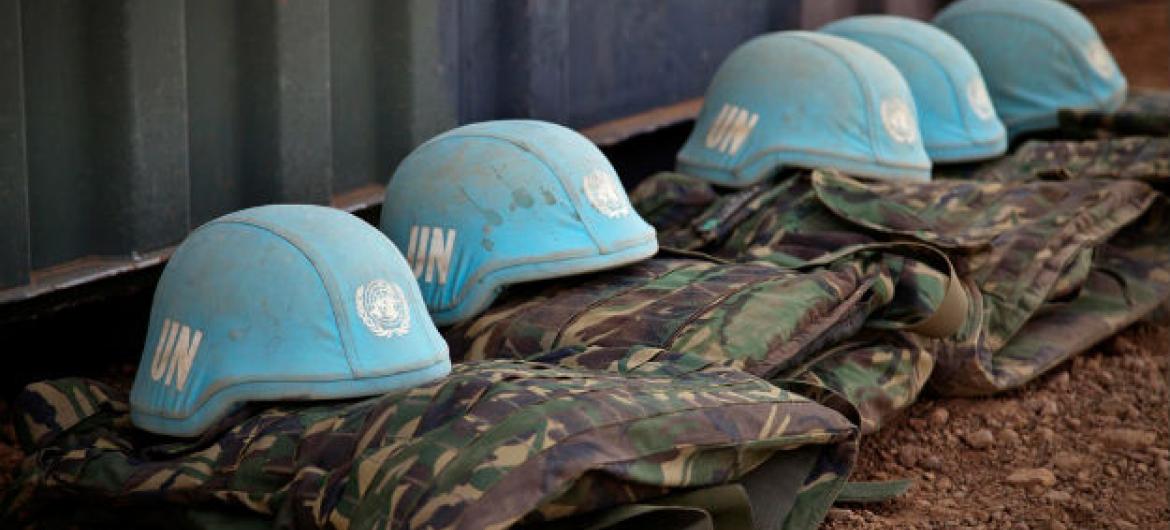
Guterres condemns killing of Bangladeshi peacekeeper in South Sudan, during armed attack on UN convoy


UN Photo/Marco Dormino

Blue helmets and uniforms of UN Peacekeepers.

26 June 2018

Peace and Security

The UN chief on Tuesday condemned the killing of a peacekeeper from Bangladesh, who was supporting the delivery of humanitarian aid to vulnerable civilians in South Sudan.


In a statement released by his Spokesman, Secretary-General António Guterres offered his deepest condolences to the bereaved family, and to the Government of Bangladesh.

“The Secretary-General recalls that attacks against United Nations peacekeepers may constitute a war crime,” stressed the statement, adding that the UN chief reaffirmed his “unwavering support to the brave men and women serving in the United Nations Mission in South Sudan (UNMISS) in their efforts to protect civilians and stabilize South Sudan.”

UNMISS named the fallen “blue helmet” as Military Liaison Officer, Lieutenant Commander Ashraf Siddiqui, who was part of a convoy being led by Nepalese peacekeepers, providing protection to humanitarians who were travelling from Yei to Lasu.

Several shots were fired at their vehicles by unknown gunmen, said the statement, and the peacekeeper “was hit and died from his injuries shortly afterwards”, said the UNMISS Spokesperson.

“It is a tragedy that he lost his life in such an appalling act of violence, while working to help those in need and to protect the lives of others”, said the UN Special Representative and head of UNMISS, David Shearer.

“Peacekeepers and aid workers should be able to carry out their work freely and safely and not be subjected to the kind of senseless attack we have witnessed today,” he added.


https://news.un.org/en/story/2018/06/1013192
http://creativecommons.org/licenses/by/3.0/legalcode

вторник, 26 июня 2018 г.

Resettlement needs set to rise to 1.4 million people in 2019, UN refugee agency reports


UNHCR/Gordon Welters
In Germany, a UN resettlement programme gives families hope. Here, an immigration officer stamps the passports of a Syrian family that has just landed at Hanover airport on a charter flight from Egypt.
25 June 2018

Close to 1.4 million people will need resettlement in countries free from war and persecution in 2019, the UN refugee agency, said on Monday, citing growing forced displacement across the globe.


Resettlement – the transfer of refugees from the country where they have claimed asylum to a safe “third country” – is the responsibility of international agencies, including Office of the UN High Commissioner for Refugees (UNHCR).

Noting a 17 per cent projected overall increase in needs next year, the UN agency’s Projected Global Resettlement Needs 2019 report warns that access to this “key, durable solution” for those in need of international protection is extremely limited.

Refugees from 36 nationalities are in need of resettlement out of a total of 65 international operations, the UNHCR report states.

For the third year in a row, refugees from Syria are set to have the highest resettlement requirements, at more than 600,000 people.

This represents a 26 per cent increase on current needs.

Regionally, Africa is likely to remain the region with the highest projected resettlement needs next year, led by the Democratic Republic of the Congo (DRC).

According to the UNHCR report, 163,000 people from DRC will be in need of international resettlement in 2019 – a 10 per cent increase on 2018.

In South Sudan, meanwhile, continued instability and violence are behind a 71 per cent increase in needs, with 158,000 individuals out of more than 2.4 million refugees expected to require shelter in a third country next year
.

Elsewhere on the African continent, protracted instability will continue to affect “Congolese, Somalis, Sudanese and Eritreans”.

In Asia, meanwhile, resettlement needs stand at 102,146 – a one per cent increase from 2018.

The picture is very different in Europe, where those in need of shelter in a third country is set to increase by almost 40 per cent next year, from more than 300,000 this year, to some 420,750 in 2019.

Over 95 per cent of this requirement is represented by Syrian refugees in Turkey.

In the Middle East and North Africa region, resettlement needs are projected at 271,297 people in 2019 - a slight decrease from this year.

Reflecting the inclusion of “high-risk protection cases” from El Salvador, Honduras and Guatemala, projected resettlement needs in the Americas region in 2019 are forecast to rise 123 per cent in 2019, to just over 4,000 people.

The need to expand resettlement was acknowledged by all UN Member States in the September 2016 New York Declaration for Refugees and Migrants.

Despite this, the UNHCR report notes recent “fluctuations” in State resettlement quotas which have seen quotas grow from 2012 to 2016, only to see a “steep reversal” in 2017, when only 75,200 refugees were offered resettlement globally.

Because of this development, the UN refugee agency is preparing to focus on three major crises in 2019: countries hosting large numbers of refugees; central Mediterranean migration: and resettlement out of Turkey, Lebanon, Jordan, Iraq and Egypt linked to the Syria conflict.


https://news.un.org/en/story/2018/06/1012972
http://creativecommons.org/licenses/by/3.0/legalcode

Easing funding woes for UN agency assisting Palestine refugees a ‘wise investment for today and the future’


UNRWA
Beneficiaries queue for food assistance at the UNRWA distribution centre in Sahnaya, Damascus in Syria.


25 June 2018
Humanitarian Aid
A pledging conference on Monday for the United Nations Relief and Works Agency for Palestine Refugees in the Near East (UNRWA) aimed to address the body’s chronic funding shortfall and also examine long-term priorities.
“The outstanding work of UNRWA has an immediate effect by meeting the urgent humanitarian needs of millions of Palestine refugees in the West Bank, Gaza, Jordan, Lebanon and Syria,” Secretary-General António Guterres said in his opening remarks at the Conference.
“At the same time, this work provides a foundation of hope and dignity – serving as a critical conflict prevention mechanism in a turbulent region and moving our world closer to the promise of the 2030 Agenda for Sustainable Development to leave no one behind,” he added.
For decades, UNRWA’s high quality education has been standard setting in the region, gender parity has been the school norm for generations and UNRWA health care has attained near universal immunization, the UN chief explained. 
He also lauded the UN agency’s microfinance programmes and its work providing food assistance to 1.7 million refugees, while acknowledging: “All these efforts have taken place in an environment of chronic economic hardship and conflict.”
Mr. Guterres expressed deep gratitude to all who have contributed the funding that which has allowed UNRWA to maintain its vital services, noting the agency’s own extraordinary measures to reduce its expenditures by an additional $92 million. 
“But these innovative efforts will not be sufficient to fully close the funding shortfall this year,” he said, urging UN Member States to make up the difference. 
UNRWA’s vital efforts must be allowed to falter, he said, stressing that failure comes with a price, namely more hardship for communities; more desperation for the region; and more instability for the world. 
“We must do everything possible to ensure that food continues to arrive, that schools remain open and that people do not lose hope,” he said, and noted that closing UNRWA’s funding gap “is a wise investment for today and for the future.”

Miroslav Lajčák, the President of the UN General Assembly, pointed out that UNRWA had not been set up to last for 70 years.
“We have turned a temporary solution into the status quo,” he told those assembled, encouraging everyone to change that “through direct and meaningful talks.”
“And, ultimately,” he continued “a two-state solution, which allows Israelis and Palestinians to live side-by-side, in peace.”
He urged all to work together to come up with an immediate solution for the Agency’s shortfall, but added: “Let us not forget the bigger picture. And the urgent need for a political solution.”

For his part, UNRWA Commissioner General Pierre Krähenbühl presented a special report on the Agency’s current financial crisis, in which he outlined the dramatic dimensions of the funding shortfall.
He also highlighted resource mobilization efforts under way to address it, including the Dignity Is Priceless campaign, which aims to raise funds from individuals. 
This year’s meeting was a milestone for judging the prospects to bridge UNRWA’s budget gap as well as a platform to outline consequences, should a significant shortfall remain.
The General Assembly established UNRWA in 1949 to provide assistance and protection to 5.3 million registered Palestine refugees in Gaza, the West Bank, Syria, Lebanon and Jordan.

https://news.un.org/en/story/2018/06/1013022
http://creativecommons.org/licenses/by/3.0/legalcode

Security Council urged to act with ‘one strong voice’ on raft of ills plaguing Middle East and North Africa


UNHCR/Phil Moore
A Chadian man waits at the Egyptian border at Sallum, having fled the conflict in Libya, where ongoing instability has been affecting neighboring countries since the fall of Muammar Gadaffi in 2011. (file)


25 June 2018
Peace and Security


Ambassadors in the Security Council have been urged by the United Nations Secretary-General to find ‘much-needed consensus’ to resolve the myriad challenges in the Middle East and North Africa.


António Guterres issued the call during a debate in the chamber on Monday, focusing on the various fault-lines in the region.

Decades-old conflicts, together with new ones, as well as deep-rooted social grievances, a shrinking of democratic space and the emergence of terrorism and new forms of violent extremism, are undermining peace, sustainable development and human rights,” he said.

“The territorial integrity of countries like Syria, Yemen and Libya is under threat. Millions of people have been forcibly displaced from their homes. And the impacts of this instability have spread to neighbors and beyond.”

Mr. Guterres reminded the Council of the numerous crises across the region, starting with the Israeli-Palestinian conflict – the central issue at the heart of what he called ‘the Middle Eastern quagmire.’

He reiterated the UN’s support for a two-state solution that would allow both communities to live side-by-side in peace: something that also is essential for security and stability in the entire region.

Meanwhile, the ongoing war in Syria has subjected civilians to “a litany of atrocities”, including sieges, starvation, widespread displacement and the use of chemical weapons.

The UN chief further stated that the conflict has become ‘a battleground for proxy wars’, with regional and international actors taking part.


“More than ever, our aim is to see a united and democratic Syria, to avoid irreparable sectarianism, and to ensure full respect for Syria’s sovereignty and territorial integrity, and to enable the Syrian people to freely decide on the country’s future,” Mr. Guterres told the 15 ambassadors.

Moving on to Yemen, the UN chief highlighted recent efforts by his Special Envoy, Martin Griffiths, to avoid an escalation in violence. He also spoke of UN engagement in Libya, including support for a national dialogue process that has revealed citizens’ deep longing for peace and to exit the period of transitional governance.

Mr. Guterres also praised Iraq’s ‘resilience’ in recent years, citing victory over the extremist group, the Islamic State of Iraq and the Levant (ISIL or Da’esh), as an example of how the nation has overcome the risk of fragmentation.

“Iraq’s endurance as a stable, federal state is a testament to the enormous sacrifices of the Iraqi people, from all communities,” he said. “And I strongly hope that the Iraqi institutions will be able to ensure an adequate conclusion of the electoral process able in a way that fully respects the will of the Iraqi people.

Lebanon also was praised for its respect for diversity. The Secretary-General said he looked forward to the formation of a new Government there, following peaceful parliamentary elections last month — the first in nearly a decade.

On the region as a whole, Mr. Guterres recalled that Cold War rivals still found ways to talk to each other and cooperate, indicating that countries in the Middle East and North Africa could pursue a similar path.

He also urged Council members to find “much-needed consensus and to act with one strong voice”, adding that regional organizations can also contribute to efforts towards preventive diplomacy, mediation and confidence-building.

“The region needs to ensure the integrity of the State, its governance systems and the equal application of the rule of law that protects all individuals,” he said.

“Majorities should not feel the existential threat of fragmentation, and minorities should not feel the threat of oppression and exile. And everyone, everywhere, should enjoy their right to live in dignity, freedom and peace.”


https://news.un.org/en/story/2018/06/1012992
http://creativecommons.org/licenses/by/3.0/legalcode

International Day in Support of Victims of Torture 26 June


Singers wearing hats advocating "No Torture" line up before performing at a Human Rights Day event outside of Mogadishu Central Prison in Somalia. UN Photo/Tobin Jones


Torture seeks to annihilate the victim’s personality and denies the inherent dignity of the human being. Despite the absolute prohibition of torture under international law, torture persist in all regions of the world. Concerns about protecting national security and borders are increasingly used to allow torture and other forms of cruel, degrading and inhuman treatment. Its pervasive consequences often go beyond the isolated act on an individual; and can be transmitted through generations and lead to cycles of violence.

The United Nations has condemned torture from the outset as one of the vilest acts perpetrated by human beings on their fellow human beings.

Torture is a crime under international law. According to all relevant instruments, it is absolutely prohibited and cannot be justified under any circumstances. This prohibition forms part of customary international law, which means that it is binding on every member of the international community, regardless of whether a State has ratified international treaties in which torture is expressly prohibited. The systematic or widespread practice of torture constitutes a crime against humanity.

On 12 December 1997, by resolution 52/149, the UN General Assembly proclaimed 26 June the United Nations International Day in Support of Victims of Torture, with a view to the total eradication of torture and the effective functioning of the Convention against Torture and Other Cruel, Inhuman or Degrading Treatment or Punishment.

26 June is an opportunity to call on all stakeholders including UN Member States, civil society and individuals everywhere to unite in support of the hundreds of thousands of people around the world who have been victims of torture and those who are still tortured today.

Recovering from torture requires prompt and specialized programmes. The work of rehabilitation centres and organisations around the world has demonstrated that victims can make the transition from horror to healing. The UN Voluntary Fund for Victims of Torture, administered by the UN Human Rights Office in Geneva is a unique victim-focused mechanism that channels funding for the assistance to victims of torture and their families. The UN Voluntary Fund for Victims of Torture accepts donations.

For more information, visit the website of the UN High Commissioner for Human Rights.


http://www.un.org/en/events/torturevictimsday/
http://creativecommons.org/licenses/by/3.0/legalcode

International Day Against Drug Abuse and Illicit Trafficking, 26 June


UNODC conducts illicit crop monitoring of opium poppy fields in Myanmar. Photo: UNODC


By resolution 42/112 of 7 December 1987, the General Assembly decided to observe 26 June as the International Day against Drug Abuse and Illicit Trafficking as an expression of its determination to strengthen action and cooperation to achieve the goal of an international society free of drug abuse.

Supported each year by individuals, communities and various organizations all over the world, this global observance aims to raise awareness of the major problem that illicit drugs represent to society.
Listen First

Building on the success of last year, the theme for 2018 is: "Listen First - Listening to children and youth is the first step to help them grow healthy and safe." It is an initiative to increase support for prevention of drug use that is based on science and is thus an effective investment in the well-being of children and youth, their families and their communities.

The UN General Assembly held a Special Session (UNGASS) on drugs in April 2016. This Special Session marked an important milestone in achieving the goals set in the policy document of 2009 "Political Declaration and Plan of Action on International Cooperation towards an Integrated and Balanced Strategy to Counter the World Drug Problem", which defined action to be taken by Member States as well as goals to be achieved by 2019.

The outcome document recommends measures to address demand and supply reduction, and to improve access to controlled medicines while preventing diversion. The recommendations also cover the areas of human rights, youth, children, women and communities; emerging challenges, including new psychoactive substances; strengthening international cooperation; and alternative development. The text puts new emphasis on proportionate national sentencing policies and practices for drug-related offences, and features a strong focus on prevention and treatment.


#ListenFirst Public Service Announcement 2018


http://www.un.org/en/events/drugabuseday/
http://creativecommons.org/licenses/by/3.0/legalcode