среда, 3 апреля 2019 г.

Strengthen inclusion, participation of people with autism to ‘achieve their full potential’ says UN chief


2 April 2019


Human Rights


On World Autism Awareness Day, United Nations Secretary-General António Guterres underscored in his message on Tuesday, the importance of technology which helps people living with autism “achieve their full potential”.


“Celebrate the diversity of our global community and strengthen our commitment to the full inclusion and participation of people with autism”, he said, as “a vital part of our efforts to uphold the core promise of the 2030 Agenda for Sustainable Development: to leave no one behind”.


In recent years, societies across the world have become increasingly aware of autism, the neurological condition that impacts communication and social behavior. Last year, Mr. Guterres launched a Strategy on New Technologies to help align these tools with UN values, international law and human rights conventions, including the Convention on the Rights of Persons with Disabilities.


This year’s observance underscores the importance of “affordable assistive technologies” to help people with autism live independently and “exercise their basic human rights”, he said.


However, the UN chief pointed out that there are still “major barriers to accessing such technologies”, including high costs, unavailability and a lack of awareness of their potential.


“On World Autism Awareness Day, let us reaffirm our commitment to these values – which include equality, equity and inclusion – and to promoting the full participation of all people with autism, by ensuring that they have the necessary tools to exercise their rights and fundamental freedoms,” he said. 

Freedom is ‘Room to breathe’


UN Headquarters in New York observed the Day with a special event that focused on leveraging technology to remove barriers for people with autism so they can fully participate in society; and to promote equality, equity and inclusion.


“These technologies are much more than tools that are useful or nice to have”, said Alison Smale, the UN Global Communications chief who chaired the commemoration: “Reliable access to affordable assistive technologies is a fundamental human rights issue”.


David Savarese speaking at the event “Assistive Technologies, Active Participation” at UN Headquarters, on World Autism Awareness Day., by UN Photo/Manuel Elias


Discussions with self-advocates and autism experts covered topics from leveling the playing field through the internet and digital communities, to political participation and advocacy that gives voice to people with autism.


“Freedom is the room to breathe and grow”, said keynote speaker David Saverese using his own assistive technology. The Emmy award-nominated documentary filmmaker is himself a person living with autism.


“People spend too much time listening to fear” said the top graduate of Oberlin College. “Hope not fear, is what drives self-efficacy…hope lives on messy, imperfect”.


Unable to verbalize, he uses assistive technology to underscore how it helps people living with autism to “feel safer in our own skin”.

“It’s not easy to be assisted by others”, he said, but when our work in smart technology “assists others to read and write…or follow their dreams”, it can help provide “better lives for our people”.
‘Safe’ to live independently


During a panel discussion, Julia Ejiogu, Clinical Director of The Zeebah Foundation in Abuja, Nigeria, said that although most parents in Africa are not aware of the capabilities that technology can provide for their children, “we can capitalize on this nugget” of a “vibrant global network” to educate and provide more awareness “to close the gap”.


Through a communication device, self-advocate Neal Katz teaches media to UCLA students with autism, saying: “I feel most human when I am in control”.


I feel most human when I am in control –self-advocate Neal Katz


“Thanks to assisted technology, I am safe from living a life where other people tell me what to do and where to go”, he explained, adding that when he makes up his mind about what he wants, “I take out my iPhone and select the corresponding icon on my app and am on my way”.


For his part, through assistive technology, Noor Pervez, Community Engagement Coordinator of the Autistic Self Advocacy Network, spoke about how to empower autistic people.


“Every country should prioritize getting non-speaking individuals to participate in conversations that involve us”, he maintained, adding that people with autism must “boost our voices”.


https://news.un.org/en/story/2019/04/1035931
http://creativecommons.org/licenses/by/3.0/legalcode

Prospect of a nuclear war ‘higher than it has been in generations’, warns UN


UN Photo/Rick Bajornas


A view of the sculpture “Good Defeats Evil” on the UN Headquarters grounds, presented to the UN by the Soviet Union on the occasion of the Organization’s 45th anniversary. Created by Zurab Tsereteli, a native of Georgia, the sculpture depicts St. George slaying the dragon.

2 April 2019

Peace and Security

In a world defined by “competition over cooperation, and the acquisition of arms, prioritized over the pursuit of diplomacy”, the threat of a nuclear weapon being used is “higher than it has been in generations,” the Security Council heard on Tuesday.


The warning came from Izumi Nakamitsu, the UN High Representative for Disarmament Affairs, in a meeting convened in support of the Non-Proliferation Treaty (NPT), ahead of the next conference to review the historic accord, scheduled for 2020.


The possible use of nuclear weapons is one of the greatest threats to international peace and security Izumi Nakamitsu, UN High Representative for Disarmament Affairs


The NPT, which entered into force in 1970, represents the only multilateral, binding commitment to the goal of disarmament by the States which officially stockpile nuclear weapons.


Its objective is to prevent the spread of nuclear weapons and weapons technology, to promote cooperation in the peaceful uses of nuclear energy and to further the goal of achieving nuclear disarmament and disarmament overall.


UN Photo/Eskinder Debebe


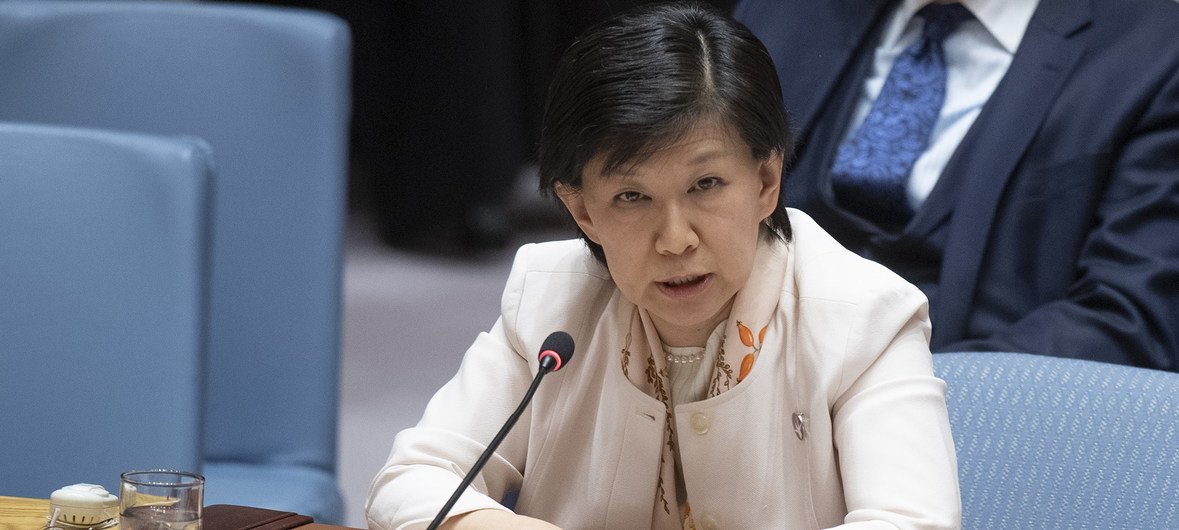
High Representative for Disarmament Affairs, Izumi Nakamitsu, speaking at the Security Council meeting on strengthening the Treaty on the Non-Proliferation of Nuclear Weapons.


Ms. Nakamitsu said that the use of nuclear weapons, “either intentionally, by accident, or through miscalculation”, is one of the greatest threats to international peace and security, and that “the potential consequences of a nuclear war would be global and affect all Member States.”


The Treaty, she said, is widely acknowledged as “the cornerstone of the international non-proliferation regime and the essential foundation of nuclear disarmament. Its role as a pillar of our collective security is likewise an accepted fact.”

From disarmament success to “dangerous rhetoric”


The disarmament chief described the two pillars of the NPT – disarmament and non-proliferation ­– as “two sides of the same coin”, adding that “backward movement on one will result in backward movement on the other.”


Unfortunately, Ms. Nakamitsu was able to cite several examples, including the use of “dangerous rhetoric” about nuclear weapons’ use; an increased reliance on nuclear weapons in security doctrines; and modernization programmes to make nuclear weapons faster, stealthier and more accurate.


The durability of the NPT, which has lasted for almost half a century, cannot be taken for granted, she insisted, adding that there is currently nothing to replace the disarmament and arms control framework which is foundational to the post-Cold War era.


With the Treaty coming under increasing stress, the upcoming Review Conference in 2020 will, she said, be a “defining moment.” It could either highlight divisions between States and raise questions about their willingness to seek collective security for all, or present “a golden opportunity to make the practical gains that will ensure the Treaty’s continued viability.”


UN Photo/Evan Schneider


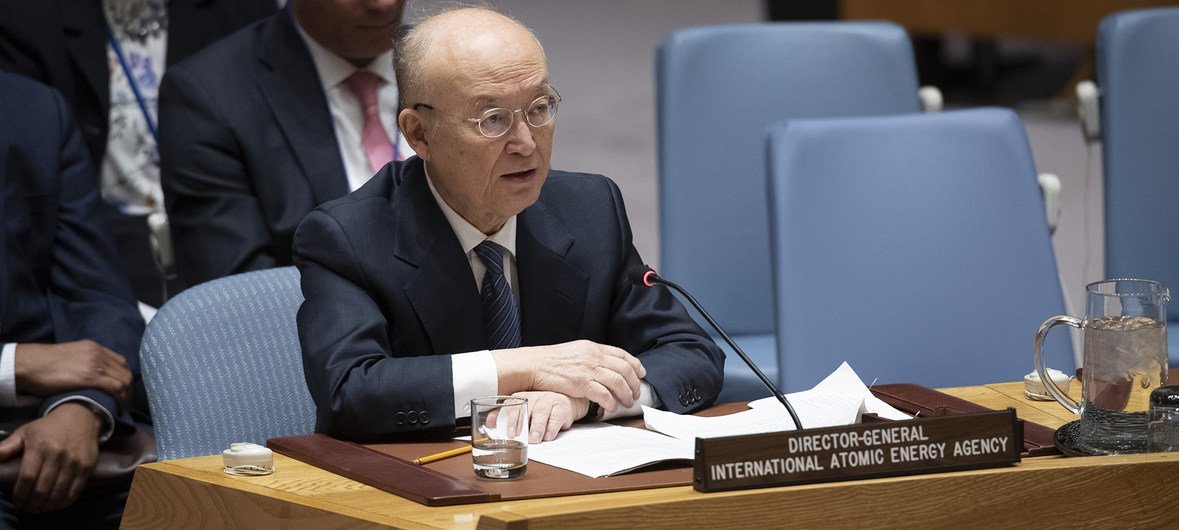
Director General of the International Atomic Energy Agency, Yukiya Amano, speaking at the UN Security Council.

Iran, North Korea nuclear programmes ‘top of the agenda’


Director General of the International Atomic Energy Agency (IAEA), Yukiya Amano, also briefed the Council, reminding members of the role that the Agency plays in the implementation of the NPT; in the creation of an environment “conducive to nuclear cooperation”; and in assisting developing countries to use nuclear energy for peaceful means.


However, Mr. Amano said the IAEA was facing several challenges, including the steady increase in the amount of nuclear material in circulation, the number of nuclear facilities under IAEA safeguards (the system of inspection and verification of the peaceful uses of nuclear materials), and continuing pressure on the Agency’s budget.


He told the Council that monitoring the nuclear programmes of Iran and North Korea, officially known as the Democratic People’s Republic of Korea (DPRK), are among the top items on the IAEA’s agenda.


Mr. Amano said that Iran was implementing its commitments under the UN-backed Joint Comprehensive Plan of Action, whose future has been put in doubt by the decision of the US administration to withdraw from the agreement. After 2009, he said, there have been “no credible indications of activities in Iran relevant to the development of a nuclear explosive device.”


As for the DPRK, Mr. Amano said that the country’s nuclear programme has significantly expanded over the past decade, carrying out nuclear tests on five separate occasions since 2009, despite the recent lull. With no inspectors inside the country, the IAEA monitors the situation using tools such as open-source information and satellite imagery.

Security Council reaffirms support for nuclear treaty


In a statement released following the meeting, the Security Council announced a reaffirmation of its members’ support for the Non-Proliferation Treaty, and a commitment to “advance the goals of the NPT as the cornerstone of the nuclear non-proliferation regime and the foundation for the pursuit of nuclear disarmament and the peaceful uses of nuclear energy.”


Describing the NPT commitments taken under the treaty as viable and mutually reinforcing, the statement underscored the need for its full implementation, and the importance of achieving universal adherence to the Treaty.


The Council members agreed that the 2020 NPT Review Conference will provide an opportunity for an unambiguous reaffirmation of commitment to the Treaty, a commemoration of its historic achievements, and the strengthening of the nuclear-disarmament and non-proliferation regime.


https://news.un.org/en/story/2019/04/1035941
http://creativecommons.org/licenses/by/3.0/legalcode
Help prevent children ‘from becoming victims in the first place’, implores Guterres at campaign launch


UNICEF/Ashley Gilbertson

Three former child soldiers at Elevage camp in Bambari, Central African Republic.

2 April 2019


Peace and Security


From killing and maiming, to recruitment, sexual abuse and abduction, “violence against children in armed conflict can take many forms”, said Secretary-General António Guterres, in a special message delivered at the launch of a new UN advocacy campaign on Tuesday - Act to Protect Children Affected by Conflict.


“Should a child survive and be fortunate enough to be released to a reintegration programme, they still have only a slim chance of recovery”, he said in remarks read out at a launch event in UN Headquarters, by staff member Sharon Riggle.


The UN chief pointed out that a lack of resources and a failure to provide long-term assistance to victims and their communities “have made many children open to a second victimization, either through the stigmas they carry or through inadequate education and growth opportunities, leaving them trapped in a cycle of violence and despair”.


The new global campaign aims to “raise worldwide awareness, assist children in need and prevent them from becoming victims in the first place”, according to Mr. Guterres.


“Crucially, this initiative will offer children an opportunity to raise their voices”, he stressed, inviting everyone to ensure it “reaches all corners of the world so no child ever fears being left behind again”.
Protecting ‘used and abused’ children


Chairing the launch event, Virginia Gamba, the UN Special Representative for Children and Armed Conflict, said that the campaign would better protect children “who have been used and abused by - in and for - armed conflict around the globe”.


She maintained that there was an “urgent need” to raise awareness about what she terms the six grave violations, namely the killing and maiming of children; recruitment or use of children as soldiers; sexual violence against children; abduction of children; and attacks against schools or hospitals.


“We need it to highlight the impact of conflict on children” she stressed, along with putting “a strong emphasis on tangible actions to end and prevent them”.


While noting the “important progress” achieved so far, Ms. Gamba argued that “our work is far from over”.


“Consensus, tools will not bring the change we need if they are not followed by tangible actions for the children who need it the most”, said the Special Representative.


She highlighted some of the actions that the campaign would push for, including the Paris Principles, the Safe Schools Declaration and the more recent Vancouver Principles.


“We can join forces to advocate for these endorsements”, she said, “because norms matter” and the agreements “bring us one step closer” to implementation where “they can have a real impact in children’s lives”.


Ms. Gamba recalled that the international community “painstakingly developed” the Action Plan through the Security Council and urged all signatories to fully implement it “with a clear focus on ending violations and preventing their reoccurrence”.


“We cannot expect that children who have faced the worst of humanity will be able to recover on their own”, she asserted, flagging the Global Coalition for Reintegration, which aims to “improve the availability and quality of these essential services”.


In conclusion, she announced upcoming campaign events, in Brussels, Sudan, Central African Republic, Democratic Republic of the Congo and Mali, among others, encouraging everyone to “join forces and ACT to Better Protect Children Affected by Armed Conflict”. 

Children exposed


For her part, Bintou Keita, the Assistant Secretary-General for Africa in the Department of Political and Peacebuilding Affairs, said that she had seen children, “the lifeblood and our future”, exposed to “too many repulsive acts of violence for too long”.


Ms. Keita cited children killed in conflict-prone areas of Afghanistan, Darfur, Iraq, Myanmar, the Philippines, Somalia, Syria and Yemen, “to name a few”, saying that they also “comprise 69 per cent of civilian casualties from landmines and explosive remnants of war”.


“Providing protection to children affected by armed conflict is not only a legal responsibility but also a moral obligation” she declared.


Calling the ACT campaign of “vital importance to keep the eyes of the world focused” on children’s suffering, UN peacekeeping chief Jean-Pierre Lacroix lamented that “armed groups are proliferating and grave child rights violations are increasing”.


He said that the UN peacekeeping missions in Mali, the Democratic Republic of the Congo, Central African Republic, Sudan and South Sudan, all have “child-specific mandates”, assuring the UN’s “commitment to this cause”.


https://news.un.org/en/story/2019/04/1035961
http://creativecommons.org/licenses/by/3.0/legalcode
Acute food insecurity ‘far too high’ UN agency warns, as 113 million go hungry


UNICEF/Campeanu


Twins Elizabeth and Madelina, who suffer from malnutrition, are being held by a relative in the street, where they live, in Juba, South Sudan. (2018).

2 April 2019

Humanitarian Aid


Approximately 113 million people in 53 countries experienced high levels of food insecurity last year, according to a new joint UN and European Union (EU) report released on Tuesday, which warns that these crises are primarily driven by conflict and climate-related disasters.


The Food and Agriculture Organization (FAO), World Food Programme (WFP) and EU “Global Report on Food Crises 2019”, shows that the number going chronically-hungry has remained well over 100 million over the past three years, with the number of countries affected, rising.


According to the report, nearly two-thirds of those facing acute hunger come from just eight countries: Afghanistan, the Democratic Republic of the Congo, Ethiopia, Nigeria, South Sudan, Sudan, Syria and Yemen. And although there were 11 million fewer people believed to be in food crisis in 2018 compared with 2017, in 17 countries, acute hunger either remained the same or increased, the report indicates.


Moreover, an additional 143 million people in another 42 countries are just one step away from acute hunger. Climate and natural disasters pushed another 29 million people into acute food insecurity in 2018, says the report, and that number excludes 13 countries - including North Korea and Venezuela - because of data gaps.


"It is clear from the Global Report that despite a slight drop in 2018 in the number of people experiencing acute food insecurity - the most extreme form of hunger - the figure is still far too high”, said FAO Director-General, José Graziano da Silva, speaking at a two-day conference to discuss the findings, in Brussels.


“We must act at scale across the humanitarian-development-peace nexus to build the resilience of affected and vulnerable populations. To save lives, we also have to save livelihoods”, he added.


While critical to saving lives and alleviating human suffering, humanitarian assistance does not address the root causes of food crises, WFP Executive Director, David Beasley noted in Brussels, highlighted the importance of “attacking the root causes of hunger: conflict, instability, the impact of climate shocks”.


“Boys and girls need to be well-nourished and educated, women need to be truly empowered, rural infrastructure must be strengthened in order to meet that Zero Hunger goal.


Programmes that make a community resilient and more stable will also reduce the number of hungry people. And one thing we need world leaders to do as well: step up to the plate and help solve these conflicts, right now”, Mr. Beasley added.


From 2014 to 2020, the EU will have provided nearly €9 billion for initiatives on food and nutrition security and sustainable agriculture in over 60 countries.


"Food crises continue to be a global challenge, which requires our joint efforts. The EU continues to step up its humanitarian efforts. Over the last three years, the EU allocated the biggest humanitarian food and nutrition assistance budget ever, with nearly €2 billion overall. Food crises are becoming more acute and complex and we need innovative ways to tackle and prevent them from happening”, said Christos Stylianides, EU Commissioner for Humanitarian Aid and Crisis Management.


https://news.un.org/en/story/2019/04/1035921
http://creativecommons.org/licenses/by/3.0/legalcode
‘Counter and reject’ leaders who seek to ‘exploit differences’ between us, urges Guterres at historic mosque in Cairo


UN Photo/Mahmoud Abd ELLatiff


Secretary-General António Guterres speaks at the al-Azhar Mosque in Cairo, expressing his solidarity and underscoring the need to fight the scourge of Islamophobia, as well as all forms of hatred and bigotry. 2 April, 2019.


2 April 2019


Human Rights


Speaking in Cairo’s historic al-Azhar mosque on Tuesday, UN chief António Guterresissued a call for societies, faiths and cultures everywhere to “focus on what unites us”, urging everyone to work together towards realizing the 2030 Agenda “for the collective benefit of all”.


Reflecting on what he called “ever-rising anti-Muslim hatred, anti-Semitism, racism and xenophobia”, the Secretary-General said it was vital now to “counter and reject religious and political figures who exploit differences” for their own gain. He said we must also ask “why so many people feel excluded, and why they are tempted by extreme messages of intolerance against each other.”


Mr. Guterres arrived at the more than 1,000-year-old mosque and centre of Islamic scholarship in the Egyptian capital, as “a man of faith”, he said, to show his solidarity with the faithful, in the wake of last month’s massacre at two mosques in New Zealand by a self-avowed white supremacist.


“As the holy Quran says in Surah Fussilat, verse 34, ‘Good and evil deeds are not equal. Repel evil with what is better, and then you will see that one who was once your enemy, has become your dearest friend.’” said the UN chief.


He noted the similar attack by a lone gunman on Jewish worshippers at a Synagogue in the Pennsylvanian city of Pittsburgh last October, where as in the Christchurch aftermath, concerned citizens of other faiths, rallied to support and protect survivors.


“This is the spirit that I know is deeply embedded in Islam – a faith of love, compassion, forgiveness, mercy and grace”, said the UN chief.


With hate speech “entering the mainstream” and “spreading like wildfire” through social and traditional media, he noted that it was infecting both liberal democracies and authoritarian States. “These dark forces menace democratic values, social stability and peace. They stigmatize women, minorities migrants and refugees,” he said.


Faith leaders “have a very important role” Mr. Guterres said, noting that his host, the Grand Imam of al-Azhar, Sheikh Ahmed al-Tayeb, had joined hands with Pope Francis in Abu Dhabi in February.


“I have here, given by the Grand Imam, the text, the common text, approved by him and the Pope”, said the Secretary General, “which is a fantastic testimony of mutual respect, tolerance, compassion and peace, given by the two great religious leaders to the world.”

Muslims have paid 'heavy price' for terrorist acts of 'a handful of criminals'


“As the Grand Imam stated, Muslims have paid a heavy price due to the actions of ‘a handful of criminals.’ He also stressed that ‘all religions agree that God forbids killing,’” added Mr. Guterres.


He noted that the Grand Imam had also called for Muslims in the Middle East to protect Christian communities, who have been subjected to terror at the hands of fundamentalist groups such as ISIL, or Da’esh.


“I also commend the initiatives taken by al-Azhar to promote the true face of Islam and counter violent extremist philosophies and terrorist propaganda,” said the UN chief: “Nothing justifies terrorism and it becomes particularly hideous when religion in involved.”


Later in the day in Cairo as part of his extended visit to the Middle East region this week, Mr. Guterres toured the Grand Egyptian Museum describing it on Twitter as “an impressive reminder of how the Arab world opened the door to epic discoveries and possibilities”.


https://news.un.org/en/story/2019/04/1035881
http://creativecommons.org/licenses/by/3.0/legalcode

вторник, 2 апреля 2019 г.

Более 4 млн долларов выделены ООН на помощь беженцам в лагере «аль-Холь»


Фото ВОЗ
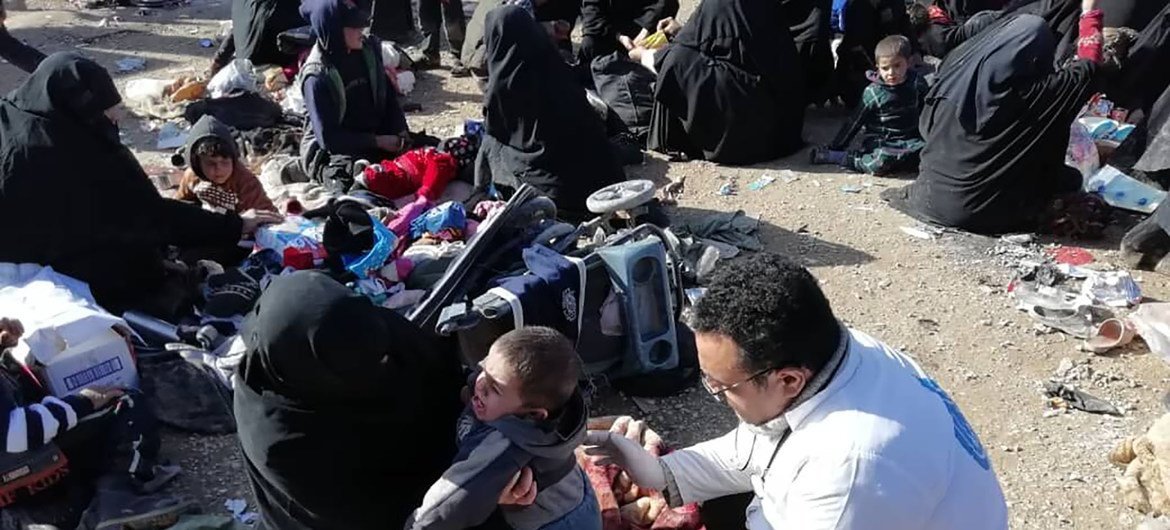
Беженцы в лагере «аль-Холь», расположенном на северо-востоке провинции Хасеке


1 апреля 2019
Беженцы и мигранты


Сегодня 4,3 млн долларов были выделены из гуманитарного фонда ООН в Сирии для помощи беженцам в лагере «аль-Холь», расположенном на северо-востоке провинции Хасеке. В этом лагере нашли приют люди, спасшиеся из анклава Багуз, находящегося во власти ИГИЛ.


Гуманитарная ситуация в лагере крайне тяжелая. Многие его обитатели истощены. Из-за активных боевых действий в провинции Дейр-эз-Зор в последнее время население лагеря резко увеличилось: с 35 тыс. до 73 тыс. человек. Сейчас 19 тысяч сирийцев проживают в огромных палатках, пользуясь общим душем и туалетом.

Многие из недавно прибывших беженцев находятся в очень тяжелом состоянии - с признаками изнеможения и депрессии. Они страдают от хронического недоедания и просто не выживут без немедленной помощи.

«Благодаря этим средствам [из гуманитарного фонда ООН] мы немедленно окажем помощь десяткам тысяч беженцев, в частности, женщин и детей, которые составляют 90 процентов обитателей лагеря», - заявила гуманитарный координатор ООН в Сирии Коринн Флейшер.

Выделенные средства пойдут на закупку дополнительных палаток, одеял, продовольствия, питьевой воды, средств личной гигиены, а также лекарств. В настоящий момент ООН мобилизует дополнительные средства объемом до 12 млн долларов для беженцев этого лагеря.

«Похоже, что вооруженные столкновения в Багузе прекратились, однако кризис еще далек от разрешения. На сегодняшний день мы не знаем, сколько еще людей прибудет в лагерь в ближайшие дни», - добавила Коринн Флейшер. Сейчас в этом лагере работают представители 42 организаций.


https://news.un.org/ru/story/2019/04/1352201
http://creativecommons.org/licenses/by/3.0/legalcode

Brunei’s new penal code would enshrine ‘cruel and inhuman punishments’ UN rights chief warns


UN Photo/Manuel Elias

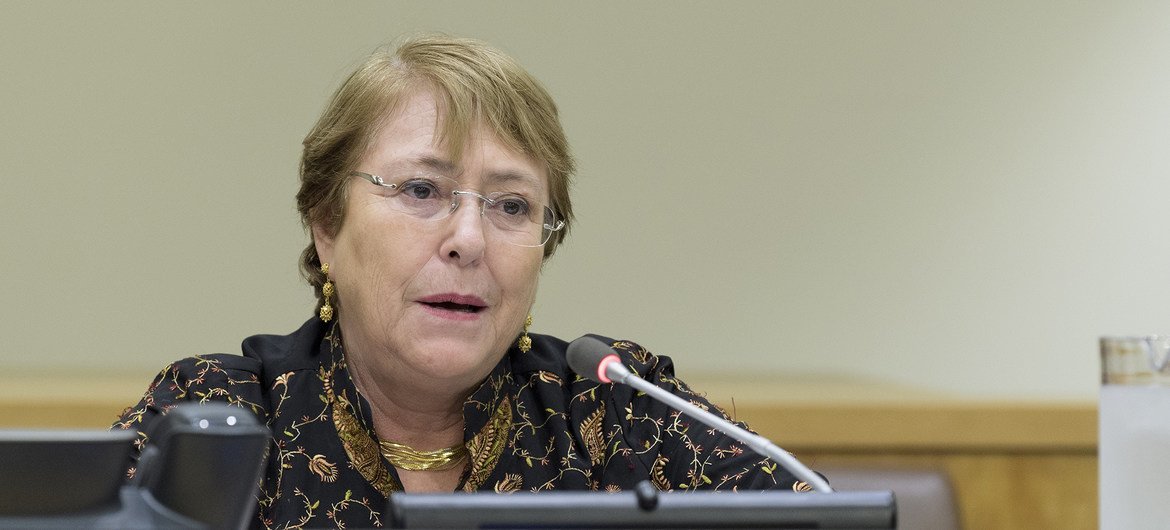
Michelle Bachelet, United Nations High Commissioner for Human Rights, at UN Headquarters in New York on 27 September 2018.


1 April 2019

Human Rights


Proposed changes to Brunei’s penal code to incorporate punishments under a strict interpretation of Islamic law - including death by stoning - should be halted, the UN’s top human rights official, Michelle Bachelet, said on Monday.


In an appeal to the Bruneian Government to stop what she described as “draconian” revisions, due to come into force on Wednesday, High Commissioner Bachelet maintained that they “would enshrine in legislation cruel and inhuman punishments that seriously breach international human rights law”.

According to a statement from Ms. Bachelet issue by her office, OHCHR, the death penalty would in theory be applicable for offences such as rape, adultery, sodomy; extramarital sexual relations for Muslim citizens; robbery, and insult or defamation of the Prophet Mohammad.


Public flogging as a punishment for abortion would also apply, as well as amputation for theft, once the proposed revisions become law. Other changes include making it a criminal offence to expose Muslim children “to the beliefs and practices of any religion other than Islam”, Ms. Bachelet said, before describing them as potentially marking “a serious setback” for human rights protections in the south-east Asian State. The oil-rich country has been ruled by Sultan Hassanal Bolkiah Mu’izzaddin Waddaulah, for more than 50 years.

Although the death penalty is already on the statute books in Brunei, the last execution there was carried out in 1957. Nonetheless, Ms. Bachelet stressed that under international law, capital punishment may only be applied for murder or intentional killing, after a trial held according to due process.

“I urge Brunei to maintain its de facto moratorium on the use of capital punishment,” she said, underlining that “human rights and faith are not opposing forces”.

She added: “No judiciary in the world can claim to be mistake-free and evidence shows that the death penalty is disproportionately applied against people who are already vulnerable, with a high risk of miscarriages of justice.”

Echoing concerns about the country’s penal code by UN human rights panels in the past, Ms. Bachelet highlighted the possible encouragement of violence and discrimination against women, including on the basis of their sexual orientation, and against religious minorities in Brunei.

“Any religion-based legislation must not violate human rights, including the rights of those belonging to the majority religion, as well as of religious minorities and non-believers,” Ms. Bachelet said.

“It is vital that the Government, religious authorities and a wide range of civil society actors work jointly to uphold human dignity and equality for all,” the High Commissioner added. “My Office stands ready to assist the Government of Brunei, using the constructive approach laid out by the faith-based framework of the Beirut Declaration on ‘Faith for Rights’.


https://news.un.org/en/story/2019/04/1035831
http://creativecommons.org/licenses/by/3.0/legalcode