воскресенье, 7 октября 2018 г.

Nigeria: Top UN officials say more support needed to ease humanitarian crisis and rebuild lives in conflict-ravaged north-east


OCHA/Eve Sabbagh
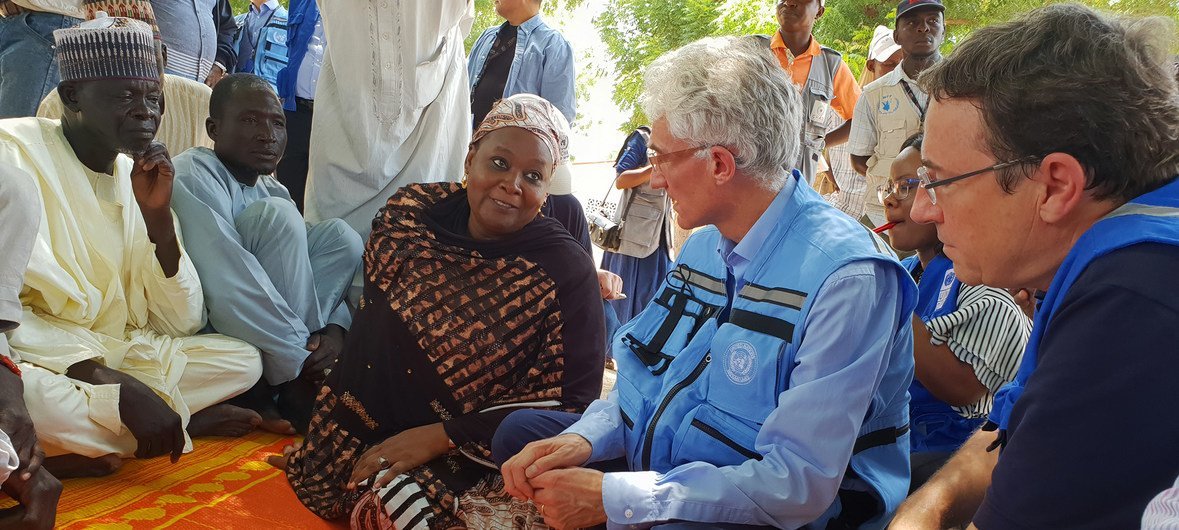
UN Emergency Relief Coordinator Mark Lowcock (2nd r) and UNDP Administrator Achim Steiner (r) with the head of the Nigeria State Emergency Management Agency (middle), speaking with a group of farmers from the border town of Banki in Borno state, Nigeria on 6 October 2018.


6 October 2018
Humanitarian Aid


The top United Nations relief and development officials on Saturday called for national and international partners to step up support for humanitarian efforts in north-eastern Nigeria and help millions of people rebuild their lives in the region that has been ravaged by Boko Haram’s near decade-long insurgency.


UN Development Programme (UNDP) Administrator Achim Steiner and UN Emergency Relief Coordinator Mark Lowcock made this call as they wrapped up a two-day official visit to Nigeria to rally support for the Government-led efforts on the ground, especially in the conflict-torn northeastern Nigerian states of Borno, Adamawa and Yobe.

“We are committed to Nigeria and to the people of Nigeria,” said Mr. Lowcock, who heads up the UN Office for Coordination of Humanitarian Affairs (OCHA).

Humanitarian aid can only be a temporary solution, he said and was pleased to visit the region alongside the UNDP Administrator to help join up humanitarian and development efforts “to save lives, help stabilize the situation, rebuild lives and communities for the future.”

“We must do everything we can to prevent this crisis from continuing for years,” Mr. Lowcock told reporters in Maiduguri, at the end of the visit, which also included meetings with Minister of Finance Zeinab Ahmad, government ministers and high-level officials.


“Helping ppl affected by crisis requires us to work together – humanitarian & dev. orgs alike to tackle immediate humanitarian needs & root causes of #LakeChadCrisis,” @ASteiner while visiting affected communities in NE Nigeria w/ @UNOCHA‘s @UNReliefChief. https://t.co/xPjICu1JBe— UN Development (@UNDP) October 6, 2018

They visited projects in Bama town and Ngwom community in Borno, the state most affected by the 10-year conflict, where humanitarian and development workers are providing life-saving assistance and implementing development programmes. The two officials heard first-hand testimonies from people affected by the Lake Chad Basin crisis who are trying to rebuild their lives.

“We have a unique opportunity to make a real difference to communities across the north-east of Nigeria,” said Mr. Steiner. “Helping people affected by the crisis requires us to work together – humanitarian and development organizations alike – to tackle immediate humanitarian needs and the root causes of the crisis.”

The Government of Nigeria has launched recovery initiatives and efforts in north-east Nigeria aimed at rapid stabilization. Early recovery and livelihood activities implemented by UN agencies and international and local NGOs seek to address the underlying causes of the conflict, lay the foundations for sustainable development and prevent aid dependency.

The humanitarian crisis in Nigeria’s north-east has spilled over into the Lake Chad region. It remains one of the most severe in the world today with 7.7 million people in need of humanitarian assistance in the worst-affected states of Borno, Adamawa and Yobe alone.

According to OCHA, food security and the nutrition situation remains extremely fragile across the north-east, particularly given the high levels of aid dependency, compounded by the lack of access to land or other livelihood opportunities. Up to three million people are estimated to suffer from critical food insecurity. Almost a million children aged from six months to five years are acutely malnourished, with 440,000 facing Severe Acute Malnutrition (SAM).

The visit follows an international donor conference held in Berlin in early September during which some $2.5 billion was pledged for humanitarian, stabilization and recovery projects in the Lake Chad region.

https://news.un.org/en/story/2018/10/1022442
http://creativecommons.org/licenses/by/3.0/legalcode

In DR Congo, UN Security Council says December polls are ‘historic opportunity’ for country


MONUSCO/Michael Ali
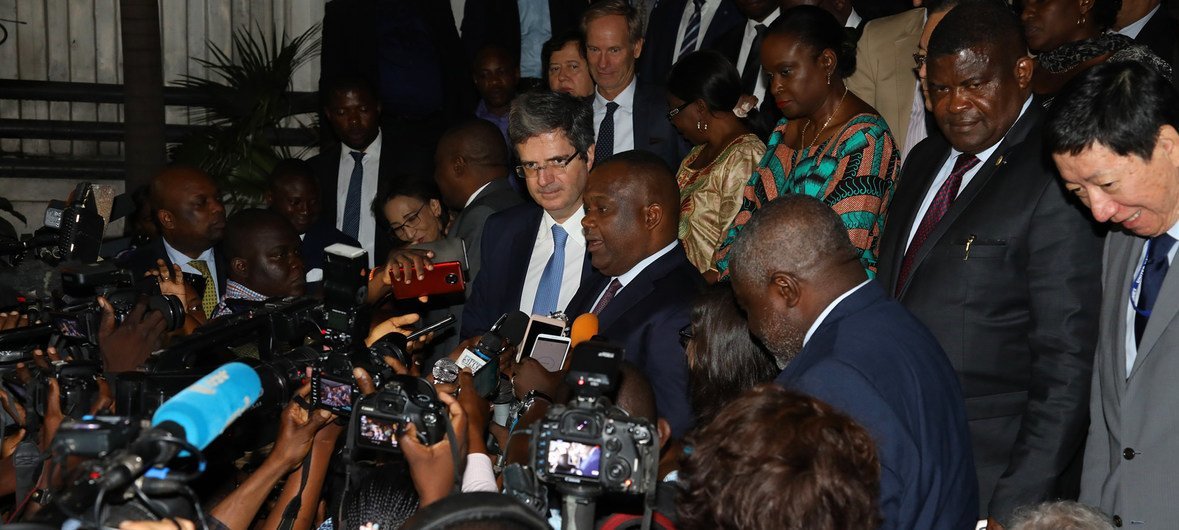
Members of the UN Security Council speak to the media after arriving in the Democratic Republic of the Congo on 5 October 2018.


6 October 2018
Peace and Security


The United Nations Security Council wrapped up on Saturday a two-day mission to the Democratic Republic of the Congo (DRC), where the body’s 15 members pledged to support the process in the run-up to long-delayed elections, set for late December, and called for the polls to be credible and peaceful.


“The Security Council must put all its weight [behind] our priority objective: elections by 23 December, which are credible, transparent, and held in a calm climate,” François Delattre, the Permanent Representative of France to the UN and leader of the Council mission, said on Friday evening during a press briefing in Kinshasa, the Congolese capital.

The DRC is scheduled to hold long-delayed elections on December 23, 2018. President Joseph Kabila has declared he will not stand for the polls, in line with the country’s Constitution.

On Saturday, the Security Council delegation had a “significant and in-depth” meeting with President Kabila, which Ambassador Delattre described as the “high point of the Council’s mission in Kinshasa.”

“We have signaled the Council's willingness to accompany the DRC on the road to peace, stability and prosperity,” Mr. Delatter stated, adding: “The 23 December election mark a historic opportunity on this path. They are paving the way for the country's first democratic and peaceful transition.”


#VIDEO: The Security Council members have discussed with the #CENI president about the elections process in the #DRChttps://t.co/KXz9FqzB6I@franceonu@SRSG_MONUSCO@UN— MONUSCO (@MONUSCO) October 6, 2018

Arriving in Kinshasa Friday afternoon, the Security Council delegation held a two-hour “working session” discussing the progress and challenges of the electoral process with the office of the Independent National Electoral Commission (CENI).

The President of the CENI, Corneille Nangaa, thanked the Council for the considerable support of the UN to the elections process. “Today we have more than 130 international MONUSCO experts who are our advisers,” Nangaa told reporters, referring to acronym for the UN stabilization mission in the country.

He also made clear that the DRC Government had decided “not to solicit other financial and logistical support from partners”.

Mr. Nangaa went on to stress the need to reconcile a critical double imperative: the credibility of polls and their holding on 23 December.

The Security Council also met on Saturday with the National Episcopal Conference of the Congo (CENCO), which facilitated the signing by the Government and the opposition of the so-called ‘New Year’s Eve agreement’ on December 31, 2016, by which elections were to be held before the end of 2017. After a postponement, marked by violent protests, the polls were finally announced for late December 2018.

For CENCO, the meeting with the Council delegation was an opportunity to express “the fears, difficulties and worries” related to the electoral process, but also to emphasize that “the process is moving forward”.

“CENCO has been inviting political and social actors to seek consensus around the problems that divide them,” Fr André Masinganda, the First Deputy Secretary-General of CENCO, told Radio Okapi, citing, among others, problems related to the electoral register and the voting machine.


https://news.un.org/en/story/2018/10/1022452
http://creativecommons.org/licenses/by/3.0/legalcode

суббота, 6 октября 2018 г.

Execution of juvenile offender in Iran ‘deeply distressing’ – UN rights chief


ILO/M. Creuset
UN High Commissioner for Human Rights Michelle Bachelet (file photo)


5 October 2018
Human Rights


Denouncing the execution of a juvenile offender in Iran, whose trial was also reportedly marred by irregularities, the top United Nations human rights official has called on the country to end the use of the death penalty for those under-18, in line with its obligations under international law.


Zeinab Sekaanvand Lokran was convicted of murdering her husband in 2012, when she was 17-years-old. She was executed this week, despite a number of appeals from UN Special Rapporteurs.

“The sheer injustice in the case of Zeinab Sekaanvand Lokran is deeply distressing,” Michelle Bachelet, the UN High Commissioner for Human Rights, said in a news release on Friday.

“The serious question marks over her conviction appear not to have been adequately addressed before she was executed. The bottom line is that she was a juvenile at the time the offence was committed, and international law clearly prohibits the execution of juvenile offenders.”

According to the High Commissioner’s office (OHCHR), Ms. Sekaanvand’s detention and trial were also marred by reports that she was beaten by police officers following her arrest, forced to make a false confession, and denied access to a lawyer until her final trial session, where she recanted her confession.

In addition, claims that Ms. Sekaanvand had been a victim of domestic violence were reportedly not adequately examined during the judicial process. She was executed on 2 October, and her family was given just one day’s notice, for a final visit.

The news release also noted that dozens of other convicted juvenile offenders reportedly remain on death row in Iran, which has already executed at least five juvenile offenders so far this year. Executions are often carried out with little warning, and without proper scrutiny and transparency.

“As a State party to both the Convention on the Rights of the Child and the International Covenant on Civil and Political Rights, Iran has an obligation to abide by their provisions and to end the use of the death penalty against juvenile offenders,” expressed Ms. Bachelet.

The UN rights chief also called for an end to the death penalty in all circumstances, as no judiciary in any part of the world can fully avoid miscarriages of justice.

Article 6.5 of the International Covenant on Civil and Political Rights states that death sentence “shall not be imposed for crimes committed by persons below eighteen years of age and shall not be carried out on pregnant women.”

In addition, the Convention on the Rights of the Child, requires all States Parties to ensure that no child shall be subjected to torture or other cruel, inhuman or degrading treatment or punishment and “neither capital punishment nor life imprisonment without possibility of release shall be imposed for offences committed by persons below 18 years of age.”


https://news.un.org/en/story/2018/10/1022372
http://creativecommons.org/licenses/by/3.0/legalcode
Concern rising over fate of Rohingya refugees sent home by India: UNHCR


UNICEF/Brown

Over 720,000 members of Myanmar's Rohingya community have sought refuge in Bangladesh after widespread ethnic violence erupted in the country's Rakhine province.


5 October 2018
Migrants and Refugees


The United Nations refugee agency (UNHCR) has voiced ‘great concern’ for the safety and security of seven Rohingya men who have been sent home by Indian authorities, after reportedly being denied access to lawyers, or full consideration of their asylum applications.


“[We] continue to seek clarification from the authorities on the circumstances under which these individuals were returned to Myanmar,” Andrej Mahecic, a spokesperson for UNHCR told journalists at the UN Office at Geneva on Friday.

Prior to their return, the men were moved from Silchar prison in Assam province, near the border with Bangladesh - where they had been in detention since 2012 - to the province of Manipur, bordering Myanmar.

“On learning of their detention and the planned return, and based on credible reports that the seven men are Rohingya, UNHCR requested the Indian authorities to grant access to this group, to assess their need for international refugee protection,” said Mr. Mahecic.

According to the UNHCR spokesperson, the UN agency did not receive a response to its request and was unable to secure access for a lawyer from a state legal service.

Beginning in August last year, widespread ethnic violence in Myanmar’s Rakhine province forced some 720,000 members of the country’s minority Muslim Rohingya community to flee their homes and seek refuge across the border in Bangladesh – joining several thousands more who fled Myanmar in years prior – sparking one of the largest and most complex refugee crises in the world.

Former UN human rights chief, Zeid Ra’ad Al Hussein, described the violence against the Myanmar as “textbook example of ethnic cleansing”.

An independent international fact-finding mission, established by the UN Human Rights Council to look into the violence, found patterns of gross violations of international human rights and humanitarian law, committed by Myanmar’s military, the Tatmadaw.

It also documented mass killings, the scorching of Rohingya settlements and large-scale gang rape and other sexual violence by Myanmar soldiers.
About 18,000 registered Rohingya refugees and asylum-seekers in India – UNHCR

In addition, there are some 18,000 Rohingya refugees and asylum-seekers, living in different locations, who have registered with the UNHCR office in India, said Mr. Mahecic.

UNHCR issues identity cards to the registered refugees and documents to asylum-seekers, helping prevent arbitrary arrests, detention and deportation. It works with the state legal services, authorities and a network of partners to provide legal support to persons of concern in detention in India.


https://news.un.org/en/story/2018/10/1022402
http://creativecommons.org/licenses/by/3.0/legalcode

Nobel Peace Prize goes to UN Goodwill Ambassador and Congolese doctor, highlighting sexual violence


5 October 2018


Women

Nadia Murad, a Yazidi rights activist and the first Goodwill Ambassador for the Dignity of Survivors of Human Trafficking of the United Nations Office on Drugs and Crime (UNODC), and Denis Mukwege, a gynecologist who helps victims of sexual violence in the Democratic Republic of Congo (DRC), were awarded the 2018 Nobel Peace Prize on Friday.

The decision to jointly-award the prestigious prize, has the potential to help end the use of sexual violence as a weapon of war, the UN said - a cause which is central to the Organization's work.

UN Secretary-General António Guterres, speaking at UN Headquarters in New York, said that "in defending the victims of sexual violence in conflict, they have defended our shared values."

He praised Dr. Mukwege's "fearless" championing of women raped and abused in conflict, repairing "shattered bodies" as a skilled surgeon but also restoring "dignity and hope".


By honouring these defenders of human dignity, this prize also recognizes countless victims around the world who have too often been stigmatized, hidden and forgotten - UN chief António Guterres

Ms. Murad, he said, had given voice to "unspeakable abuse" in northern Iraq, when Dae'sh terrorists brutally targetted the Yazidi ethnic minority in 2014. "She has pursued support for victims of human trafficking and sexual slavery, and justice for perpetrators."

The UN chief said the award was part of a "growing movement to recognize the violence and injustice" faced by women and girls, the world over.

"Ten years ago, the Security Council unanimously condemned sexual violence as a weapon of war. Today the Nobel Committee recognized the efforts of Nadia Murad and Denis Mukwege as vital tools for peace," said Mr. Guterres.

"By honouring these defenders of human dignity, this prize also recognizes countless victims around the world who have too often been stigmatized, hidden and forgotten. This is their award, too... Let us honour these new Nobel laureates by standing up for victims of sexual violence everywhere."

Welcoming the announcement by the academy in Oslo, Norway, on behalf of the UN in Geneva earlier in the day, spokesperson Alessandra Vellucci explained that eradicating sexual violence in conflict remains a priority.


Congratulations to @DenisMukwege and #UNODC Goodwill Ambassador @NadiaMuradBasee, who won the #NobelPeacePrize for their tireless fight against sexual violence as a weapon of war and armed conflict @NobelPrize▶️ https://t.co/5H92XCOgjGpic.twitter.com/t1dRoQt0e0— UN Office on Drugs and Crime (@UNODC) October 5, 2018


“I will recall that this is a cause that is very close to the United Nations and as you know we have a Special Representative [on Sexual Violence in Conflict, Pramila Patten, who is also working in towards this,” Ms. Vellucci said. “I’m sure that this Nobel Peace Prize will help advance the cause of ending sexual violence as a weapon of conflict. Congratulations to the winners.”

Ms. Patten said that "today’s recognition of two champions in the fight to end wartime rape is an inspiration for all of us working in this field,” adding that it shone "a spotlight on a crime that has long been hidden in the shadows of history and sends a strong message that all the women, girls, men and boys who have suffered sexual violence, deserve justice and redress."

The joint prize was also welcomed by the UN Office on Drugs and Crime (UNODC), which appointed Ms. Murad Goodwill Ambassador for the Dignity of Survivors of Human Trafficking in 2016.

UNODC Executive Director Yury Fedotov hailed Ms. Murad's courage and resilience saying that it “reminds us that we must always listen to the people who have been most affected and harmed by the crimes we seek to stop”.

The testimonies of survivors like Ms. Murad “must inform and strengthen our efforts to achieve justice”, Mr. Fedotov added.

Her advocacy has helped to establish what Mr. Guterres described as "a vitally important" UN investigation, "of the harrowing crimes that she and so many others endured."
'The man who mends women'

Dubbed by the press “the man who mends women,” Dr. Mukwege gained international recognition for his work and had earned much recognition, including the UN Prize in the Field of Human Rights in 2008, and the Sakharov prize in 2014.

Dr. Mukwege, who has treated thousands of rape victims at his hospital in the Democratic Republic of Congo, has been shortlisted for the Nobel Prize several times.


UN Photo/Eskinder Debebe


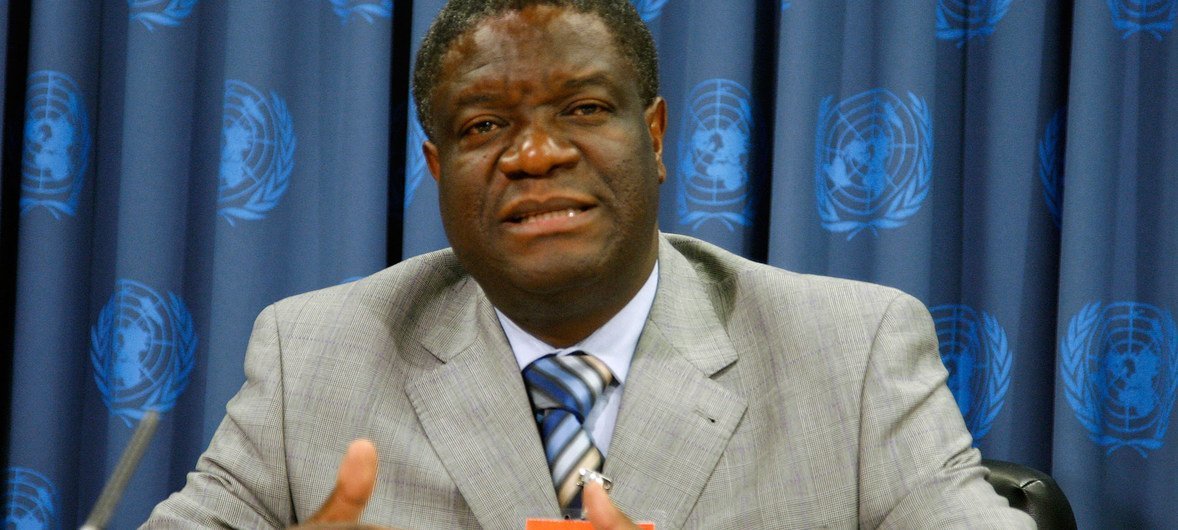
Denis Mukwege, Director and Founder of Panzi General Referral Hospital in the Democratic Republic of the Congo.

The Nobel academy’s decision to honour Dr. Mukwege is in recognition of his years of work as one of DRC’s most prominent rights defenders.

As a surgeon, he is known for helping survivors of rape in eastern DRC and he was the focus of a film, The Man Who Mends Women.

He experienced conflict at first hand in the region, when patients and staff at the hospital he ran were reportedly killed by soldiers.


This is richly deserved recognition of these two extraordinarily brave, persistent and effective campaigners against the scourge of sexual violence - UN human rights chief, Michelle Bachelet

After founding a hospital offering free medical care to victims of terrible sexual abuse and violence, Dr. Mukwege turned to advocacy, after reportedly realizing that some rape survivors were the daughters of women who had been raped years earlier.

The UN High Commissioner for Human Rights, Michelle Bachelet, said shortly after the announcement that it was "hard to imagine two more worthy winners."

"This is richly deserved recognition of these two extraordinarily brave, persistent and effective campaigners against the scourge of sexual violence, and the use of rape as a weapon of war," she added.

"Nadia and Denis, I’m sure I speak for all human rights defenders, when I say we salute you, we admire you beyond words. You have fought for the pain women have suffered through sexual abuse to be recognized and confronted, and for their dignity to be restored. We need more people to stand up the way you have stood up for the rights of women, for justice, for the rights of minorities, for the rights of everyone."

The Executive Director of UN Women, Phumzile Mlambo-Ngcuka, said she was celebrating "these gender quality leaders, along with their care and trust of women."

"There can be no peace while women and girls are raped with impunity as a tactic of war. The 2018 Peace Laureates are doing vital work to bring visibility and voice to this violation of women's rights and to bring justice to women and girls brutally harmed by sexual violence in conflict.

Within the UN, the issue of eradicating sexual violence in conflict has long been a top priority.

This work is carried out in collaboration with Member States by Special Representative on Sexual Violence, Pramila Patten of Mauritius, who also holds the rank of UN Under‑Secretary-General. Her Office was established in 2009 by UN Security Council resolution 1888; its first representative was Margot Wallström of Sweden.


The UN Security Council resolution was one in a series which recognized the harmful impact that sexual violence has on communities, while also undermining peace and security once conflict has ended.


https://news.un.org/en/story/2018/10/1022322
http://creativecommons.org/licenses/by/3.0/legalcode


пятница, 5 октября 2018 г.

ЕС объявил о финальной стадии переговоров по Brexit

4 октября 2018, 20:16


© СС0 Public Domain


Главный переговорщик Евросоюза по вопросам Brexit Мишель Барнье заявил, что переговоры о выходе Британии из ЕС находятся на завершающей стадии.

По его словам, нерешенным остается наиболее острый вопрос по границе между Ирландией и Северной Ирландией.

Барнье отметил, что недавно провел переговоры с ирландским премьером Лео Варадкаром, который принимает активное участие в решении проблемы.

«Рад вновь встретиться с премьер-министром Ирландии Лео Варадкаром. Мы находимся на финальной стадии переговоров по Brexit и работаем рука об руку с ирландским правительством», — говорится в Twitter Барнье.

Представитель ЕС вновь напомнил, что заключение соглашения с Лондоном невозможно без решения ирландского вопроса, и крайний срок истекает в ноябре.


http://www.rosbalt.ru/world/2018/10/04/1736840.html
http://creativecommons.org/licenses/by/3.0/legalcode

Tunisia ‘at a turning point’ stresses UN rights expert


SUBSCRIBE


UNDP/Noeman Al-Sayyad


Voting in Tunisia Constituent Assembly Elections in October 2011.


4 October 2018


Human Rights


An independent UN human rights expert welcomed on Thursday the progress made towards democratic reform in Tunisia, since the 2011 revolution, and emphasized the importance of protecting freedom of peaceful assembly and association.


“Tunisia is at a turning point in its post-revolution history,” said the UN Special Rapporteur on the rights to freedom of peaceful assembly and association, Clément Nyaletsossi Voule. His statement followed a 10-day visit during which new legislation on the issue was being discussed.

“My meetings with various interlocutors allowed me to understand the stakes of the democratic transition,” he noted, welcoming the progress the country has achieved in terms of human rights protection over the past seven years, and the political will shown by the authorities to adopt new laws and establish institutions in line with international human rights standards.

However, he expressed deep concern over the current law establishing a National Registry for Enterprises, aimed at combating money laundering and terrorism.

Given that the bill creates requirements that would limit the capacity of associations to operate freely, and the important role played by them in the democratic transition, he called for Parliament to exempt associations from the new law. The call was ignored as the bill was adopted last Tuesday, reportedly without further debate.

In his statement, Mr. Voule urged the authorities to reconsider the approval of a law he considers “regressive” for Tunisian civil society.

He also expressed concerns about reports of arbitrary arrests and disproportionate use of forceduring the January 2018 protests against the finance law and austerity measures.

In addition, the expert cited delays in putting in place some of the institutions established by the 2014 constitution, such as the constitutional court, the new court of auditors and an institution to safeguard human rights. “Without these institutions, the democratic transition, of which the rights to freedom of peaceful assembly and of association are essential pillars, cannot be ensured and might be undermined,” he said.

“I truly hope that the democratic transition will be irreversible and lead to a fair and democratic society, in line with the slogan of the revolution,” he added, “employment, freedom, dignity.”

The conclusions and recommendations of the Special Rapporteur will be presented during the 41st session of the United Nations Human Rights Council in June of next year. Preliminary conclusions are available here.


https://news.un.org/en/story/2018/10/1022222
http://creativecommons.org/licenses/by/3.0/legalcode