пятница, 5 октября 2018 г.

Nigeria inundated by floods; UN steps up disease prevention efforts


WHO/Chima Onuekwe
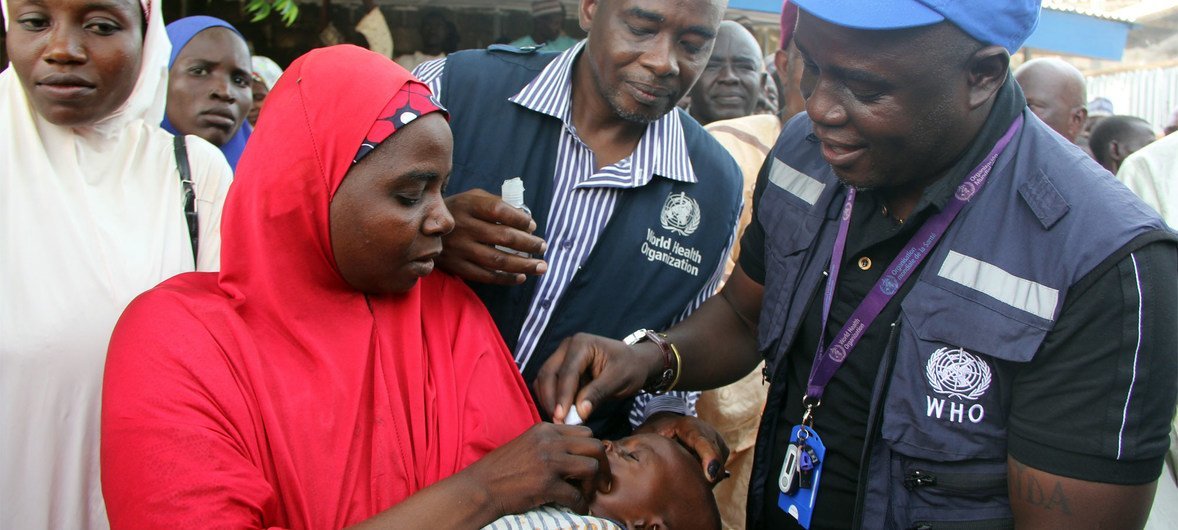
A WHO official vaccinates a child against cholera during an OCV campaign in Borno state, northeastern Nigeria.


4 October 2018
Humanitarian Aid


With over 826,000 people affected by heavy flooding affecting most of Nigeria, humanitarian agencies continue to step up efforts to provide life-saving assistance, especially basic medical care, which is essential to prevent disastrous epidemics.


Nigeria’s two main rivers, the Niger and the Benue, burst their banks after heavy rain began falling in August, and the country has been experiencing large-scale floods.

The disaster is now affecting 12 out of 36 states according to the National Emergency Management Agency, with 176,300 people displaced, more than 150,000 hectares of farmland inundated, 17,800 houses washed away, and 321 roads and bridges destroyed.

As of Monday, the floods had claimed about 200 lives. A state of national disaster has been declared in the four most-affected states: Kogi, Niger, Anambra and Delta.

The United Nations and its partners are carrying out rapid assessments and scaling up support to the Government’s emergency response. In particular, the World Health Organization (WHO) has deployed experts to strengthen surveillance and early warning systems and is working to ensure that essential drugs are available in newly-created camps for displaced families.

“In addition to the immediate destructions and loss of lives, floods can severely affect the health of the affected population, even after the water levels have receded,” said the head of WHO in Nigeria, Dr. Wondimagegnehu Alemu, in a statement released on Thursday.

Floods and their consequences – including a lack of drinkable water, shelter, and overflowing sanitation systems – can easily lead to the spread of communicable and water-borne diseases, such as cholera and malaria. In addition, access to healthcare and essential drugs can be difficult if health facilities are damaged.

“We can efficiently mitigate these risks if they are properly assessed and if disaster response measures are in place,” Dr. Alemu explained.

To facilitate the mobilization of resources for the response to the flooding, the International Federation of Red Cross and Red Crescent Societies (IFRC) launched an emergency appeal, seeking close to US$5.5 million. The funds are to support 300,000 of the most vulnerable flood-affected people for the next nine months, with shelter and basic household items; protection and livelihoods assistance, including through cash transfers; health care provision; water and sanitation supplies.

The country’s north-east is in the grip of one of the world’s worst humanitarian crises due to conflict, and already suffering various cholera outbreaks in the states of Borno, Adamawa and Yobe, making it crucial for humanitarian partners to effectively monitor and control the effects of the flooding in the rest of the country.

In the coming days, the UN humanitarian chief, Mark Lowcock, and the head of the UN Development Programme, Achim Steiner, will visit the region, spending Friday and Saturday in Nigeria, and then moving on to neighbouring Chad.


https://news.un.org/en/story/2018/10/1022272
http://creativecommons.org/licenses/by/3.0/legalcode

'Endless volley of assaults’ aimed at refugees: protection chief calls for ‘humane dialogue’


UNHCR/Eugene Sibomana

Volker Türk, Assistant High Commissioner for Protection visits Mahama refugee camp, in Rwanda.

4 October 2018

Migrants and Refugees


“Noise, chatter, shrillness, lack of civility, and harsh language,” surround the public debate over refugees, who face a “seemingly endless volley of assaults,” said the UN refugee agency’s (UNHCR) Assistant High Commissioner for Protection on Thursday.


Volker Türk, made the comments in a key address on Thursday at the UNHCR’s annual Executive Committee Session held in Geneva, where he called for a “more empathic and humane dialogue” focusing on human dignity, to counter fraught debates about refugees.

The world is “facing a watershed moment where two sets of values have emerged,” he said. On the one hand, the Global Compact on Refugees has been developed, with 193 UN Member States joining in a constructive multilateral approach to the issue. Mr Türk said it showed what “can be achieved when we choose to rise above short-term interests to find a common way forward.”


We need to confront the xenophobia, racism, nativism, and bigotry, often driven by fear, anger, and anxieties within communities - Volker Türk, UNHCR protection chief

In contrast, he said, some states are succumbing to populist pressures and shirking their responsibilities, at a time when war and persecution have uprooted a record 68.5 millionchildren, women and men worldwide.

“We need to confront the xenophobia, racism, nativism, and bigotry, often driven by fear, anger, and anxieties within communities. These are often used to deflect responsibility as a pretext for demolishing institutions of liberal democracy. This ultimately has a corrosive effect on everyone.”

Respect for dignity must be the antidote to dehumanization, said Mr Türk, underlining how hatred and violence had their origins in reducing individuals and groups to one or two characteristics, which “denigrates, and dehumanizes, challenging the inherent dignity of all.”

On the subject of statelessness and nationality, Mr Türk said that stateless people have told him how they feel invisible, as if they have “fallen through the cracks and do not matter,” and that “individuals are not objects to be governed by the powerful, but are subjects of law, endowed with dignity and entitled to a legal identity.”

Factors fueling conflict and violence must be addressed as a matter of priority, he said, “including the arms trade, extraction industries, the acquisition of land for mining and other purposes, inequality, authoritarianism and environmental change and degradation.”

Mr Türk expressed his surprise that some of the countries that have benefited most from international cooperation and trade are amongst the least willing to be part of international or regional frameworks on population movements, including refugees.

His comments echoed those made on Monday by Filippo Grandi, United Nations High Commissioner for Refugees, in his opening statement to the Executive Committee Session.

Mr. Grandi contrasted the decision of countries near regions of conflict or other crises, to those further afield, often rich countries, which are closing borders and “pushing people away,” adding “Today, when I engage with the leaders of countries neighbouring those in crisis, how am I to tell them to take more people, when some in richer countries are discussing how to close their doors?”

The UNHCR’s annual Executive Commission session ends on Friday.


https://news.un.org/en/story/2018/10/1022242
http://creativecommons.org/licenses/by/3.0/legalcode
UN chief urges peaceful, free and fair elections in Cameroon


UN Photo/Mark Garten

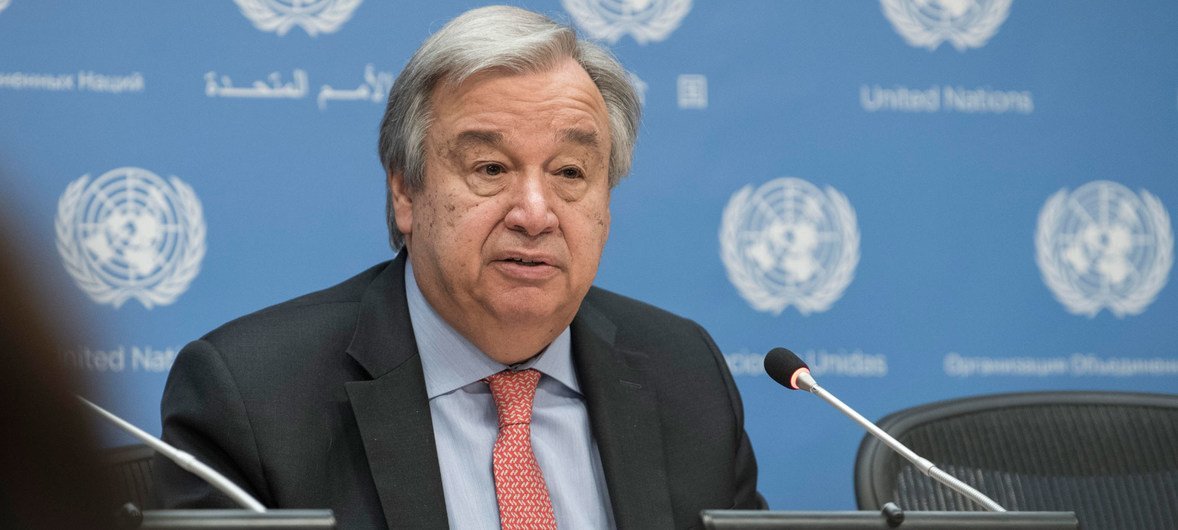
UN Secretary-General António Guterres.


4 October 2018
Peace and Security


United Nations Secretary-General António Guterres has called for a peaceful, credible and inclusive elections in Cameroon, as the country prepares to hold presidential elections this coming Sunday.


In a statement from his spokesperson, the UN chief also called on all stakeholders to “exercise restraint before, during and after the election.”

He also urged all Cameroonians to exercise their democratic rights, urging all candidates “to address any complaints related to the electoral process through established legal and constitutional channels.”

Nine candidates are contesting the elections to the country’s highest body, according to media reports.

Further in the statement, the Secretary-General condemned all threats of violence or acts of intimidation by any group and reiterated that all grievances should be addressed through inclusive dialogue.

“The United Nations stands ready to provide support in this regard,” added the statement.

Insecurity is a concern in Cameroon in the country’s north, as a result of activities of the Boko Haram terrorist group, and according to the UN Office for the Coordination of Humanitarian Affairs(OCHA), there are some 160,000 persons displaced across the country – a majority of them in the south-west.

https://news.un.org/en/story/2018/10/1022312
http://creativecommons.org/licenses/by/3.0/legalcode

Syria: UN Humanitarian Coordinator calls for unimpeded access from within the country


© UNICEF/Aaref Watad

Around 400 families have taken shelter in a makeshift camp north of Idlib, Syria, after fleeing violence to the south of the city in early September 2018.


4 October 2018

Humanitarian Aid


Highlighting the “complexities of the situation in Syria” with close to 13 million people in need of life-saving assistance, the United Nations Humanitarian Coordinator in the country called on warring parties to allow access to all areas from within the country, so aid can reach those in need “fast and efficiently”.


Ali Al Za’atari, who is also Resident Coordinator in Syria, said that was especially necessary in the north-west cities of Idlib and Afrin.

“Syria is still undergoing a serious humanitarian crisis and this humanitarian crisis affects about 13 million Syrian citizens and refugees as well,” he told the UN News Arabic service.

During a briefing to the press at UN Headquarters in New York, he noted that given the scale of the needs remaining across all sectors – food, health care, education, economic recovery and reconstruction – and the continued movements of population, the crisis is likely to continue for years.

"There are no longer armed clashes and shells falling on the roofs and on people in many cities and Syrian territories, but in other areas this threat still exists and people are still scared and insecure,” he stressed.

Noting that donors have been “generous”, he warned that the 2018 Humanitarian Response Plan was in need of nearly $3.4 billion in total – but only 46 per cent funded so far. “This puts limits on our work in Syria,” he said, adding that he is confident more funding will be received by the end of the year.

Although 14 UN agencies are based in the country, humanitarian access for assessments and aid delivery remains challenging, especially in the cities of Idlib and Afrin as “the region is out of government control” and “it could be a very long and complicated process to get access.”

On the sidelines of the UN General Assembly in New York last week, Mr. Al Za’atari said that a plan had been agreed between UN humanitarians and the Syrian government delegation “that would allow for greater and faster access, as well as various assessments of the situation of those in need”.

“If things continue well, as agreed, we expect to have an agreed response plan by March 2019," he told UN News.


https://news.un.org/en/story/2018/10/1022302
http://creativecommons.org/licenses/by/3.0/legalcode

четверг, 4 октября 2018 г.

США объявили о выходе из нескольких международных соглашений


04 Октябрь, 2018 02:55

Русская служба «Голоса Америки»
Артем Гуревич


Советник президента США по национальной безопасности Джон Болтон


Советник Трампа по нацбезопасности заявил, что Международный суд ООН «политизирован и неэффективен»


Администрация Дональда Трампа 3 октября объявила о выходе из двух международных соглашений. Это произошло после того, как Иран и Палестинская автономия подали в Международный суд ООН жалобу на политику, которую проводят Соединенные Штаты.

Советник президента по вопросам национальной безопасности Джон Болтон назвал верховный трибунал ООН «политизированной и неэффективной» организацией. Он сказал, что США пересмотрит все международные соглашения, которые могут быть затронуты решениями Международного суда.

Днем 3 октября Международный суд ООН в Гааге удовлетворил иск Тегерана, приказав США проконтролировать процесс применения санкций к Ирану, которые Вашингтон готовится ужесточить в следующем месяце. В решении суда говорится, что санкции не должны касаться гуманитарной помощи и вопросов безопасности гражданской авиации.

Тегеран заявил, что санкции США, введенные в мае администрацией Трампа, нарушают условия договора о дружбе с Ираном, который был заключен в 1955 году. Вашингтон, в ответ, в одностороннем порядке вышел из договора, который был подписан до Исламской революции 1979 года, в результате которой две страны превратились в противников.

Глава МИДа Ирана Джавад Зариф раскритиковал выход США из соглашений, назвав администрацию Трампа «режимом вне закона».

Джон Болтон добавил, что США также выходят из «дополнительного протокола» Венской конвенции о дипломатических отношениях 1961 года. Он предупредил, что Соединенные Штаты «не будут сидеть сложа руки, в то время как против нас выдвигают необоснованные политические претензии».

Решение о выходе из протокола было принято после того, как в сентябре власти Палестинской автономии подали в Международный суд еще одну жалобу против США, обвинив Вашингтон в неправомерности решения о переносе посольства из Тель-Авива в Иерусалим. Палестинские власти заявили, что перенос посольства в Иерусалим является нарушением международного соглашения и потребовали отмены этого решения.

При этом Болтон подчеркнул, что «США остаются участником Венской конвенциии», и что Вашингтон ожидает от других участников конвенции выполнения всех международных обязательств.


https://www.golos-ameriki.ru/a/us-do-not-agree-with-the-un-international-court/4598741.html
http://creativecommons.org/licenses/by/3.0/legalcode

In Iraq, UN welcomes new President, and Prime Minister-designate, calls for ‘truly representative’ new cabinet


UNAMI
Voters at polling stations in Erbil, Kurdistan Region, Iraq, on Election Day, 12 May 2018.


3 October 2018
Peace and Security


The United Nations Special Representative for Iraq, Ján Kubiš, on Wednesday, welcomed the designation of a new Prime Minister, Adel Abdel-Mahdi, and urged political leaders to promote women’s meaningful representation in politics.


“As the United Nations Assistance Mission for Iraq (UNAMI) and the United Nations family in Iraq congratulate Mr. Abdel-Mahdi on his appointment, we recognise the enormous challenges he faces,” said Mr. Kubiš, adding that “we stand side by side with him, as he leads the country in its steady march towards a future of stability, economic growth and prosperity.”

In a statement issued later, UN Secretary-GeneralAntónio Guterres, also congratulated Iraq's new President, Barham Salih, after his swearing-in on Tuesday, saying that he was looking forward to "working closely" with him, "on all issues of mutual concern, in accordance with the mandate of the United Nations in Iraq."

Since the Iraqi government of Saddam Hussein was toppled following the 2003 invasion, the country’s three largest ethnic-sectarian groups have shared the country’s highest positions, with the Prime Minister position held by a Shia politician, the Speaker of Parliament post by a Sunni, and the Presidency by a Kurd.

Ending months of deadlock following inconclusive national elections in May, the new Prime Minister – a former Vice- President, Oil Minister and Finance Minister – has one month to form a cabinet that will be presented to parliament for approval.

In this regard, Mr. Kubiš urged political leaders to live up to their pledges on women’s meaningful representation in politics.

“Iraq needs a stable, national government that brings Iraqis together and restores hope in their country as they move forward in the post-Da’esh period,” said Mr. Kubiš. “This government should be formed well within the constitutional timeline, should be professional, competent, truly representative and inclusive of women in cabinet posts”.


https://news.un.org/en/story/2018/10/1022132
http://creativecommons.org/licenses/by/3.0/legalcode

Top UN judicial body orders US to ease Iran sanctions


Photo/ICJ/Jeroen Bouman

A view of the Peace Palace, seat of the International Court of Justice (ICJ) in The Hague, Netherlands, 2005


3 October 2018

Peace and Security


In a ruling issued on Wednesday, the International Court of Justice (ICJ), the principal judicial organ of the United Nations, ordered the United States to lift some of the economic sanctions it has imposed on Iran, which effect the importation of humanitarian goods and products, as well as the safety of civilian aircraft.


Following President Donald Trump’s announcement in May that the US was withdrawing from the 2015 agreement on Iran’s nuclear programme, known as the JCPOA – reached by Iran, the five permanent members of the Security Council, Germany and the European Union – the US President ordered sanctions “lifted or waived” in connection with the agreement, to be re-imposed. The sanctions affect anyone doing business with Iran in areas such as finance, oil and shipping.

Iran claimed that the sanctions violated a 1955 bilateral treaty regulating trade and commerce between the two countries and, in August, brought the case to the ICJ, seeking an emergency suspension.

In its ruling, the ICJ found Iran’s case to be credible and urgent, ruling that restrictions on importing “foodstuffs and medicines, including life-saving medicines, treatment for chronic disease or preventive care, and medical equipment, may have a serious detrimental impact on the health and lives of individuals on the territory of Iran.”

The Court ordered the US to “remove, by means of its choosing, any impediments arising from the measures announced on 8 May”, allowing medicines and medical devices, foodstuff and agricultural goods into Iran, together with “spare parts, equipment and associated services (including warranty, maintenance, repair services and inspections) necessary for the safety of civil aviation.”

The decision is reportedly the first time that international judges have ruled on a case of “economic warfare.”

Following the ICJ ruling, US Secretary of State Mike Pompeo, announced at a press conference and on Twitter, that the US was “terminating” the 1955 Treaty of Amity with Iran.


https://news.un.org/en/story/2018/10/1022142
http://creativecommons.org/licenses/by/3.0/legalcode