среда, 3 октября 2018 г.

UNAMA UNITED NATIONS ASSISTANCE MISSION IN AFGHANISTAN


2 Oct2018


UN CONCERN AROUND LEVEL OF VIOLENCE IN ELECTION CAMPAIGN PERIOD


KABUL - The UN Assistance Mission in Afghanistan (UNAMA) expresses its concern around the level of violence early in the campaigning period for the 20 October parliamentary elections, including intimidation and attacks against candidates, their agents and supporters. The Mission condemns today’s most serious incident that killed at least 14 civilians and wounded a further 42 when a suicide attacker struck at a campaign rally in Nangarhar.

Since campaigning formally commenced on 28 September, there have been several attacks resulting in the killing of a candidate and three security guards of another candidate, as well as the shooting of a further candidate’s agent and son.

UNAMA urges all actors to halt all violence and intimidation against candidates and voters.

“I am outraged by attacks deliberately targeting civilians seeking to exercise their basic right to participate in elections,” said Tadamichi Yamamoto, the UN Secretary-General’s Special Representative for Afghanistan. “This violence, including today’s reprehensible attack in Nangarhar, is an assault on the constitutional rights of the people of Afghanistan.”

Today’s suicide attack appears to have deliberately targeted a crowd gathered at an electoral campaign event.

Afghan civilians have borne the brunt of election-related violence in 2018, documented in an earlier UNAMA report that identified a disturbing pattern of attacks at election-related facilities following the commencement of the voter registration process in Spring. The greatest loss of civilian life in a single incident took place on 22 April when a suicide attacker targeted a crowd gathered outside a national identity card distribution centre in Kabul, resulting in 198 civilian casualties.

The United Nations extends deep condolences to families who lost loved ones in today’s attack in Nangarhar and other acts of election-related violence and wishes a full and speedy recovery to those injured


https://unama.unmissions.org/un-concern-around-level-violence-election-campaign-period
http://creativecommons.org/licenses/by/3.0/legalcode

Afghanistan: UN ‘outraged’ by new elections-related suicide attack


UNAMA

Electoral Staff from Independent Election Commission (IEC) opening ballot boxes for counting in Herat, Afghanistan, on 18 September 2010.


2 October 2018
Peace and Security


Denouncing attacks and intimidation in the week since formal campaigning began for Afghanistan’s parliamentary elections next month, the United Nations voiced outrage on Tuesday at the death of 14 civilians, killed by a suicide bomber at a campaign rally. A further 42 were wounded.


“I am outraged by attacks deliberately targeting civilians seeking to exercise their basic right to participate in elections,” said Tadamichi Yamamoto, the UN Special Representative for Afghanistan, in a statement that called for an immediate end to election-related violence.

“This violence, including today’s reprehensible attack in Nangarhar, is an assault on the constitutional rights of the people of Afghanistan.”


The UN Assistance Mission in Afghanistan (UNAMA) expressed concern around the level of violence early in the campaigning period for the 20 October elections, including intimidation and attacks against candidates, their agents and supporters.

Since campaigning formally commenced on 28 September, there have been several attacks resulting in the killing of a candidate and three security guards of another candidate, as well as the shooting of a further candidate’s agent and son. “UNAMA urges all actors to halt all violence and intimidation against candidates and voters”, said the statement from the Mission.

Tuesday’s suicide attack appears to have deliberately targeted a crowd gathered for a campaign event, the agency said, stressing that Afghan civilians have borne the brunt of election-related violence in 2018.

It recalled the “disturbing pattern of attacks” at election-related facilities following the start of voter registration earlier this year, with the greatest loss of civilian life in a single incident, occurring on 22 April when a suicide attacker targeted a crowd gathered outside a national identity card distribution centre, in the capital Kabul, resulting in 198 civilian casualties.


https://news.un.org/en/story/2018/10/1022072
http://creativecommons.org/licenses/by/3.0/legalcode

вторник, 2 октября 2018 г.

МИД РФ осудил вторжение косовского спецназа в населенные сербами районы края


1 октября 2018, 21:06


© СС0 Public Domain


Демонстративное вторжение 29 сентября косовского полицейского спецназа в сербонаселенные районы на севере края вопреки существующим на сей счет договоренностям между Белградом и Приштиной — провокация, нацеленная на запугивание косовских сербов и оказание давления на Сербию. Об этом говорится в комментарии МИД РФ, размещенном на сайте ведомства.

Безответственное поведение косовских властей могло повлечь за собой новое кровопролитие и дестабилизацию в Балканском регионе в целом, подчеркнули в МИД. Продолжение силовых попыток установления Приштиной контроля над сербонаселенными районами края ведет к разжиганию межэтнической напряженности и лишает смысла многолетние усилия международного сообщества по мирному урегулированию.

МИД РФ осудил пассивное поведение международных сил для Косово, которые не предприняли никаких действий, хотя в соответствии с имеющимся у них мандатом СБ ООН обязаны обеспечивать мир и безопасность в крае.

Напомним, в субботу около 60-ти бойцов спецподразделения МВД ROSU вошли в центр экологии и спорта в населенном пункте Зубин Поток вблизи плотины на севере автономного края. Косовские спецназовцы задержали нескольких сербов, которые не совершали никаких правонарушений. Президент Сербии Александр Вучич привел армию страны в полную боевую готовность. Министр полиции Небойша Стефанович заявил, что в полную боеготовность приведены также все специальные и особые подразделения МВД.


http://www.rosbalt.ru/world/2018/10/01/1735888.html
http://creativecommons.org/licenses/by/3.0/legalcode

В парламенте Ирака не хватило депутатов для утверждения кандидатуры президента


2 октября 2018, 00:20


© Иллюстрация ИА «Росбалт»
Иракские парламентарии не смогли проголосовать по кандидатуре на пост президента страны из-за недостаточного числа депутатов на заседании, передает «Интерфакс» со ссылкой на курдский телеканал «Рудау».

По данным канала, изначально парламентское голосование было назначено на 3 октября. Затем его перенесли на два дня раньше — на 1 октября, чтобы у депутатов осталось время до 3 октября в случае, если они не смогут утвердить кандидатуру на пост президента за одно заседание.

На эту должность претендуют представитель Демократической партии Курдистана Фуад Хусейн и Бархам Салих из Патриотического союза Курдистана.

Согласно договоренности между двумя партиями, кандидат от Патриотического союза Курдистана должен получить пост президента Ирака, в то время как кандидат от Демократической партии Курдистана станет президентом Иракского Курдистана. Однако теперь в Демократической партии Курдистана решили, что партия имеет право выдвинуть кандидата на пост президента Ирака, учитывая наличие большинства ее представителей как в парламенте Ирака, так и в парламенте Иракского Курдистана.

В связи с этой ситуацией со стороны Багдада неоднократно звучали призывы в адрес курдских партий с просьбой определиться с общим кандидатом. Представители самих партий также считают, что кандидат должен быть один. Тем не менее, ни одна из партий пока не готова на уступки, отмечает телеканал.

Если депутаты не смогут принять решение сами, то им предоставят возможность проголосовать за одного из двух представителей партий, после чего кандидатура победителя будет вынесена на общее голосование в парламент Ирака. Согласно действующим правилам, президентом Ирака выбирают курдского представителя, спикер парламента, как правило, является представителем суннитов, в то время как премьер-министр страны выбирается из шиитского большинства.


http://www.rosbalt.ru/world/2018/10/02/1735903.html
http://creativecommons.org/licenses/by/3.0/legalcode

В ОБСЕ назвали даты встреч по Донбассу в Минске

19:11 19.09.2018


© Фото : OSCE/Mikhail Evstafiev


МИНСК, 19 сен — РИА Новости. Следующие заседания контактной группы по урегулированию ситуации на востоке Украины пройдут в Минске 2 и 16 октября, сообщил в среду спецпредставитель ОБСЕ Мартин Сайдик.

"Наша следующая встреча состоится во вторник, 2 октября. И потом следующая будет опять во вторник, 16 октября", — сказал Сайдик журналистам.


https://ria.ru/world/20180919/1528935562.html
http://creativecommons.org/licenses/by/3.0/legalcode

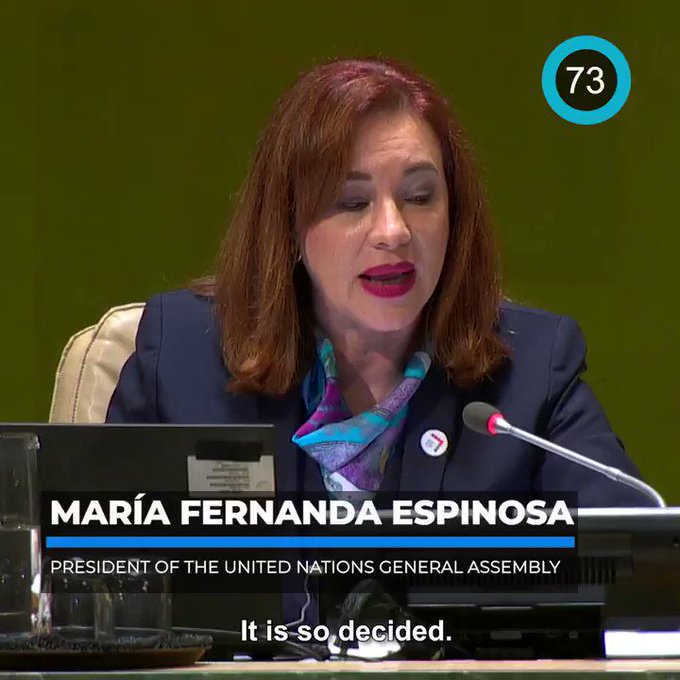
UN Assembly wraps up annual general debate, its global multilateral role reaffirmed; now comes the task of reform


UN Photo/Cia Pak

María Fernanda Espinosa Garcés, President of the seventy-third session of the General Assembly, gavels to a close the General Assembly’s annual general debate.


1 October 2018


UN Affairs


In the end, after all was said and done in the marathon of speeches from Heads of State and Government at the General Assembly’s seventy-third annual general debate, it all came down to one thing – the centrality of a strengthened United Nations as the only global forum that can address the multiple challenges facing the world, from conflict resolution to climate change mitigation and sustainable development.


Held under the theme of ‘Making the United Nations relevant to all people: global leadership and shared responsibilities for peaceful, equitable and sustainable societies,’ leaders from the world’s largest nations and economies to the world’s smallest swore fealty to the UN and its Charter, and the need to reform the Organization in the face of a daunting future.

Secretary-General António Guterres and Assembly President María Fernanda Espinosa Garcés set the tone with their opening speeches on day one of the six-day high-level segment devoted to addresses from the UN’s 193 Member States, many of them led by Heads of State and Government.

UN Photo/Loey Felipe
Secretary-General Guterres address the General Assembly on the opening day of its annual debate.

“As guardians of the common good, we also have a duty to promote and support a reformed, reinvigorated and strengthened multilateral system,” Mr. Guterres said, a theme Ms. Espinosa emphasized.

“Multilateralism is the only possible answer to the global problems we face. Weakening or putting it in question only generates instability and bewilderment, distrust and polarization,” she said.

In all, 77 Heads of State, five Vice-Presidents, 44 Heads of Government, four Deputy Prime Ministers, 54 Ministers, one Vice-Minister, and eight Chairs of Delegation mounted the podium during the six days.

National leaders, while often devoting much attention to their particular interests and specific details, did not fail to mention the world body’s significance.


Weakening [multilateralism] only generates instability and bewilderment, distrust and polarization – Assembly President Espinosa 🎥

Nearly all countries called for massive action to mitigate the potentially catastrophic impact of climate change and rising oceans, and stressed the need for international cooperation to achieve the Sustainable Development Goals (SDGs), which seek to eliminate a whole host of social ills, from extreme poverty and hunger to access for all to health care and education, all by 2030.

For many countries, especially from Africa, a special priority is reform of the 15-member Security Council, the only UN body whose resolutions have legal enforcement status. They want new permanent members outside of the current five, the Second World War allies of China, France, Russia, the United Kingdom and the United States, all of which have veto power, and are known by the shorthand, ‘P-5’.

They point out that the world has vastly changed since the UN was set up in 1945 with 51 Member States and an 11-member Council, with six rotating non-permanent members serving two-year terms.

The Council was last enlarged in 1965 with the addition of four non-permanent members. UN Member States now number 193 yet the Council remains stuck at 15, which they called a negation of fair representation and true democracy. For the sake of democracy, they also called for more powers to be devolved to the General Assembly which encompasses all 193 Member States.

One of the major complaints about the Council membership is the permanent members’ veto powers, long seen as a hurdle to urgent collective action when any of the five prioritizes its own national interests over global needs.

Aware of this problem, a representative of one of the P-5, French President Emmanuel Macron, called for Council enlargement in both permanent and non-permanent categories and suspension of the right of veto in the event of mass atrocities “so that its composition reflects contemporary balances and it is strengthened as a place of consultation and not obstruction.”


UN Photo/Cia Pak

Prime Minister Theresa May of the United Kingdom of Great Britain and Northern Ireland addresses the seventy-third session of the United Nations General Assembly.

None of the others made such an offer. British Prime Minister Theresa May said the Security Council “must find the political will to act in our collective interest.”

Foreign Minister Sergey Lavrov of Russia made no mention of Council reform, but instead lamented that diplomacy has been “increasingly replaced by dictate and unilateral extraterritorial restrictions put in effect without the consent of the UN Security Council.” The Council-authorized international military presence In Kosovo is being transformed into a US military base, he added.

Chinese Foreign Minister Wang Yi also made no mention of reform, but warned that if the nuclear accord limiting Iran’s atomic activities in return for a lifting of sanctions, from which the US has withdrawn, fails to be implemented, the Council’s authority and role will be challenged, and peace and stability in both the region and the wider world jeopardized.

US President Donald Trump himself sounded a more unilateral theme, rejecting the “ideology of globalism,” and made no mention of Council reform, but he did reiterate US commitment to making the UN more effective and accountable. “I have said many times that the United Nations has unlimited potential,” he declared.

With the need to promote and guarantee a multilateral, rules-based global order on the minds of the bulk of the speakers in the past week, bolstering support for the landmark Paris Agreement on climate change and the 2030 Agenda for Sustainable Development was also a key focus, as was the need to ensure gender equality and women’s empowerment.

“This United Nations must show leadership in recognizing the talents and contributions of women to human civilization and progress,” Mia Amor Mottley, the first woman Prime Minister of Barbados told the Assembly on Friday before rushing back to her country, which was being drenched by Tropical Strom Erik.


There are no minorities here ... there are no small nations here. There are only nations in the United Nations — President Arthur Peter Mutharika of Malawi

She said that UN must explain that women have value and give much, “whether they labour over smoking wood fires; whether [they] are trapped in poverty because of a lack of opportunity, equality and respect; whether they lead countries; whether they stay at home to care for families; or whether they come to the UN.”

Summing up the six-day session, Assembly President Espinosa on Monday underscored the importance given to multilateralism as the only way to address the problems facing humankind.

She said that “if we added together all of the discussions and speeches that took place, we would have a ‘global snapshot’ of the state of the world today – of the successes and the most pressing challenges facing our nations, and of the role that falls to this Organization and to multilateralism.”

“The representatives of more than 7.6 million inhabitants of the planet agreed almost unanimously on the irreplaceable role of this Organization,” she said. “To hear so many times the calls to strengthen multilateralism fills us with satisfaction, and at the same time presents an enormous challenge to ensure that each day this Organization becomes ever more relevant to our peoples.”

Perhaps the best distillation of the founding spirit of the UN came from Malawi’s President Arthur Peter Mutharika. “Every nation is important and we all have something to offer,” he said. “There are no minorities here. There are no small nations here. There are only nations in the United Nations.”

GENERAL DEBATE 73


https://twitter.com/i/status/1046900450170159104


https://news.un.org/en/story/2018/10/1022002
http://creativecommons.org/licenses/by/3.0/legalcode

Work together, act on promises made collectively, Sweden urges at UN Assembly


UN Photo/Cia Pak

Olof Skoog, Chair of Delegation and Permanent Representative of Sweden to the UN, addresses the seventy-third session of the United Nations General Assembly.

1 October 2018

UN Affairs


Addressing the United Nations General Assembly, the Swedish head of delegation underscored the importance of international cooperation and called on world leaders to work together to deliver on the promise of peace and prosperity for everyone everywhere.


“As [former Secretary-General] Kofi Annan once said, ‘We don’t need any more promises. We need to start keeping the promises we have already made’,” Olof Skoog, the chair of Sweden’s delegation, said as the UN Assembly wrapped up its annual general debate on Monday.

In his address, Mr. Skoog highlighted the priorities of his country’s presence at the Security Council, including its insistence on diplomacy and political solutions to address entrenched conflicts.

In addition, Sweden introduced an “all-inclusive” approach to peace, he continued, including by analysing evolving risks, such as climate change and the risk of famine, and that it will continue to demand women’s participation in peace processes and negotiations.

He also applauded “courageous and selfless” humanitarians, who are working to protect civilians and provide them with assistance in complex ongoing conflicts worldwide.

Further in his address, the Swedish official noted the hope offered by the 2030 Agenda for Sustainable Development – the global development framework agreed by all 193 UN Member States in 2015, noting that the Agenda “puts an enormous responsibility upon us all.”

Highlighting the need for UN assistance to implement the 2030 Agenda, he welcomed efforts reforms initiated by the Secretary-General, to make the Organization more “fit for purpose”.

Mr. Skoog also recalled the commitments made under the Paris Agreement on Climate Change and drew attention to the “alarmingly large” gap between commitments and the required emissions reductions.

Concluding his address, the chair of the Swedish delegation called on the international community to show the added value of international cooperation to overcome these challenges and deliver on the promise of peace, defending human rights and driving economic and social progress for women and men everywhere.

“International cooperation, and a well-functioning multilateralism at its core, is the best tool we have. So, let us be the generation that acted on our promises – not just as independent States, but as United Nations,” he said.

https://news.un.org/en/story/2018/10/1022012
http://creativecommons.org/licenses/by/3.0/legalcode